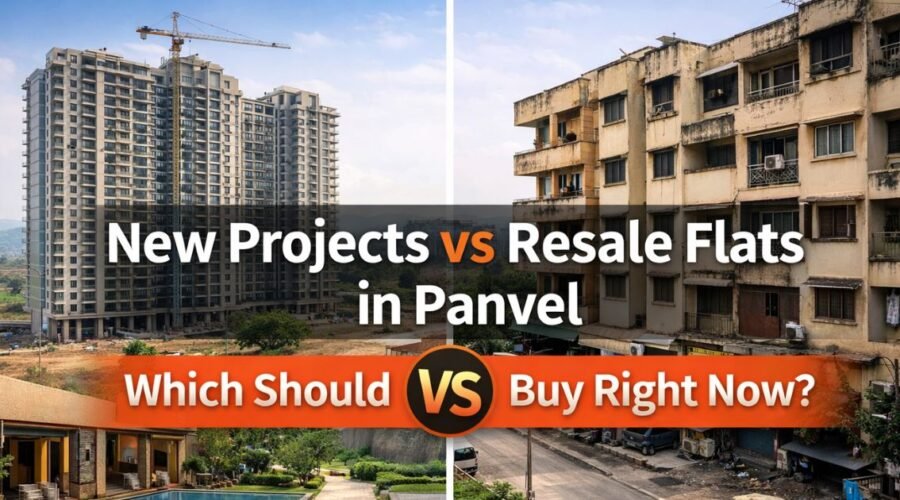
New Projects vs Resale Flats in Panvel: Which Should You Buy Right Now?
If you are comparing a new project and a resale flat in Panvel, the practical answer is this: resale usually makes more sense for buyers who want immediate possession, real area visibility, and lower execution risk, while new projects suit buyers who want newer amenities, phased payments, or long-term upside and can handle delays. In 2026, the bigger mistake is not choosing the wrong flat type. It is comparing only brochure prices and ignoring GST, CIDCO fees, municipal risks, and Panvel’s very different micro-markets.
Panvel is no longer a simple “future growth” story. The Navi Mumbai International Airport is already operational, the Mumbai Trans Harbour Link has already changed regional perception, and a lot of the easy speculative excitement has already been priced in. So the question today is not “Will Panvel grow?” The better question is: which kind of property still makes sense for your purpose, budget, and timing?
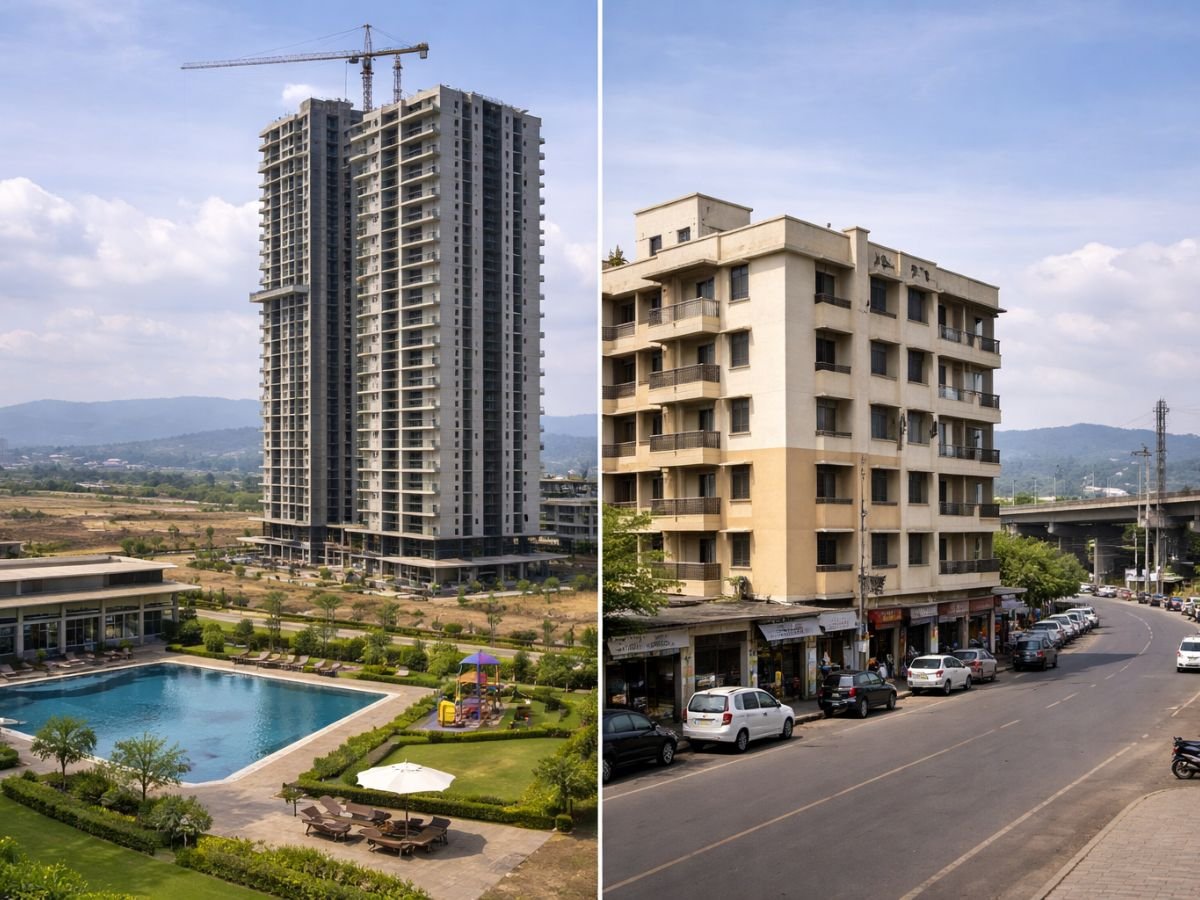
New project or resale flat in Panvel: what usually makes more sense right now?
| Factor | New Project in Panvel | Resale Flat in Panvel |
|---|---|---|
| Upfront tax | Usually 5% GST on under-construction units, 1% only in some affordable cases | 0% GST if the flat has a valid Occupancy Certificate |
| Possession | Future possession, delay risk remains | Immediate or near-immediate possession |
| Site reality | Amenities may be promised, surrounding area may still be developing | Building, roads, station access, and daily life can be checked directly |
| Payment style | Construction-linked or staggered payments can help cash flow | Larger immediate payment pressure |
| Main hidden cost | GST, clubhouse charges, advance maintenance, infra charges | CIDCO transfer fee, repair burden, possible PMC tax arrears |
| Best suited for | Patient buyers, investors, amenity-led buyers | Families, commuters, first-time end-users, cautious buyers |
| Bigger risk | Delivery and OC delay | Title, transfer fee, old building issues, local tax baggage |
In most real-life situations, resale is the safer and more practical buy for end-users, while new projects still work for selective buyers and investors who can tolerate delay, extra charges, and infrastructure dependence.
The decision becomes much clearer when you compare the actual buying experience, not just the marketing pitch.
That is why Panvel resale flat vs new project is not really a lifestyle comparison. It is a risk-and-cash-flow decision.
Who should choose a new project in Panvel, and who should avoid one?
A new project in Panvel can still be the right call, but only for the right buyer profile. Many buyers enter new launches thinking they are automatically getting the better asset. That is not always true in this market.
Buyers who benefit from phased payments and newer amenities
New projects work best for buyers who want time-based payment flexibility. If you are not under pressure to move in immediately and you want a newer tower, modern layout, larger amenity package, or township-style environment, new supply can make sense.
This is especially relevant in pockets like Panvel West, Palaspe side, Karanjade, and some NAINA-influenced corridors, where large-scale new supply is more common than in the older station-linked parts of Panvel. These projects may offer things resale buildings often do not: better parking, newer lifts, cleaner lobbies, more standardised fire systems, children’s play areas, internal landscaped zones, and bigger clubhouse-driven communities.
For some investors too, new projects remain viable because they are buying time as much as property. They are not paying only for today’s livability. They are paying for a future catchment, future absorption, and future social infrastructure.
Buyers who may underestimate delay, delivery, or location risk
This is where many people go wrong.
A MahaRERA registration is important, but it does not guarantee that the project will become smoothly livable on the exact date you imagine. In Panvel-side growth corridors, especially where development depends on broader civic rollout, a tower can be physically ready while final usability still lags because of pending NOCs, OC delays, weak last-mile access, incomplete drainage, or municipal service issues.
That makes under-construction property a weak fit for:
- buyers currently living on rent who cannot manage both rent and EMI for long
- families who need immediate water supply, school access, and daily convenience
- commuters who depend on fast station reach
- cautious buyers who do not want to build their life around projected infrastructure
So yes, new projects in Panvel are not wrong. But they are wrong for people who need certainty more than aspiration.
Who should choose a resale flat in Panvel, and when is it the safer buy?
In 2026, resale is no longer the “second-best” option in Panvel. In many situations, it is the more intelligent option.
A resale flat becomes the safer buy when your priority is possession certainty, neighborhood maturity, and practical daily life. You can see the exact flat, the building condition, the crowd, the road width, the market distance, the station access, and even the real sunlight and ventilation. That kind of certainty matters more than many buyers realise.
Buyers who need immediate possession and visible ground reality
Resale makes the most sense for:
- families shifting soon
- buyers with children or elders
- commuters who want predictable railway or highway access
- buyers who want to avoid GST on under-construction units
- first-time buyers who want less uncertainty
In Old Panvel, and in established parts of New Panvel, resale is often the only product that matches practical end-use demand properly. These are markets where land scarcity, built-up density, and transit relevance make ready stock more useful than future stock.
A good resale flat with valid OC, clean documents, and practical location often beats a more glamorous new project that is far more dependent on future execution.
Cases where resale stock can still become a weak choice
That said, not every resale flat is a bargain and not every ready-to-move flat is low-risk.
A resale flat can still become a bad buy if:
- the building is physically tired and repair-heavy
- the society has unresolved maintenance or structural issues
- the flat sits on leasehold land and CIDCO transfer fees are high
- municipal property tax exposure has not been properly checked
- the area is too old for your lifestyle expectations
- parking, lift condition, water pressure, or redevelopment uncertainty becomes a long-term headache
So the phrase should I buy a resale flat in Panvel should always lead to another question: is it freehold or leasehold, is the OC valid, and are all municipal and title checks clean?
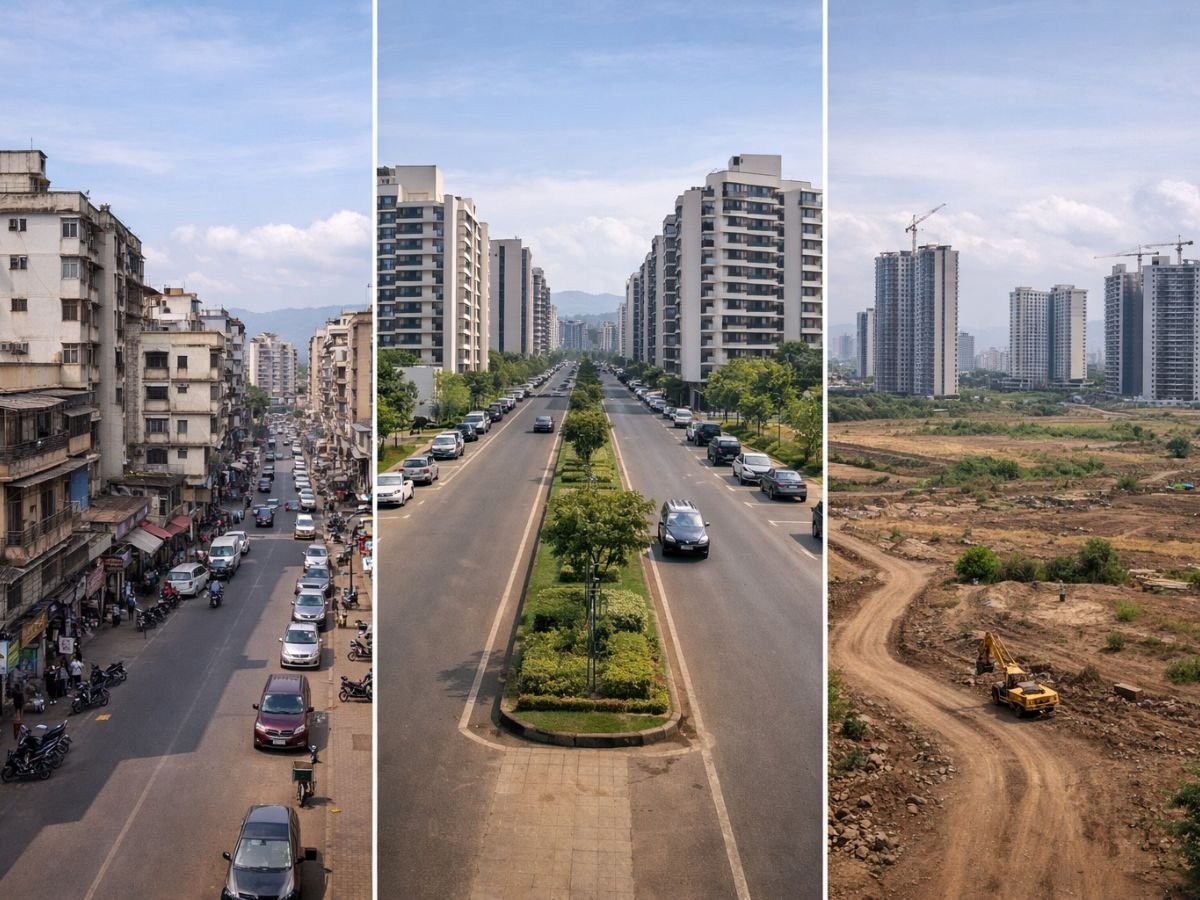
In Panvel, the better choice often depends on where you are buying, not just what you are buying
| Panvel pocket | Approx. rate band | What usually works better | Why |
|---|---|---|---|
| Old Panvel (station side) | ₹10,500 to ₹14,000/sq ft | Mostly resale | Land scarcity, established market, railway access, immediate daily convenience |
| New Panvel East | ₹7,000 to ₹9,800/sq ft | Mixed, depends on building and location | Blend of maturing societies and selective newer supply |
| New Panvel West | ₹6,500 to ₹8,500/sq ft | Selective new projects plus good resale | More modern communities, larger layouts, better amenity density in some pockets |
| Karanjade / Palaspe Phata | ₹5,000 to ₹8,200/sq ft | More new-project-heavy | Lower entry point, growth-driven logic, but stronger dependence on future infrastructure |
This is where most generic articles fail. Panvel is not one uniform market. Product choice changes with micro-location.
Old Panvel behaves very differently from New Panvel East, New Panvel West, or Karanjade / Palaspe Phata.
This leads to one simple local rule: do not search for a township-style new project if your life depends on quick Panvel Station access, and do not search for an old resale society if your top priority is a large modern gated community with fresh amenities.
In Panvel, the area often decides the product. Not the other way around.
What are the real market signals that tell you whether this is the right time to buy in Navi Mumbai?
The market signal today is not “buy blindly before prices explode.” That phase has largely passed.
Panvel reportedly saw around 53% price appreciation from late 2022 to the end of 2025, driven mainly by airport and connectivity momentum. That is a big move. It means buyers entering now should be more disciplined. The easiest speculative gains have likely already been captured by earlier entrants.
At the same time, the larger MMR market still carries roughly 3.11 lakh unsold units, which matters. It means supply pressure has not vanished. Buyers, especially in new projects, may still get negotiation room, payment flexibility, or selective inventory deals.
A few practical market signals matter more than headlines:
- If a project is using airport hype more than actual site progress, be careful.
- If inventory is high in a corridor, urgency is usually lower.
- If the project is in a peripheral growth belt, infrastructure execution matters as much as tower construction.
- If your EMI is stable and affordable, today can still be a good time for end-use buying.
- If you are expecting another immediate 2022–2025 style price sprint, that assumption is too aggressive.
The repo rate was stable at 5.25% as of February 2026, which helps end-users because EMI predictability matters. But stable financing alone does not make every property a good buy.
So, the best time to buy property in Navi Mumbai is not a universal window. In Panvel, it depends on whether you are buying present usability or future build-out.
When buying now makes sense, and when waiting may actually be smarter
Buying now makes sense when the product is already right for your life, not because the market feels exciting.
Buy now scenarios
Buy now is usually sensible if:
- you are an end-user buying in an established Panvel pocket
- the resale flat has clean papers, valid OC, and manageable society condition
- you need immediate possession
- you have stable loan eligibility and enough cash buffer
- the location solves your actual commute or family need today
This logic is especially strong for buyers looking at station-linked or practical end-use areas where supply is limited and waiting does not necessarily improve the quality of what comes to market.
Wait-and-watch scenarios
Waiting may be smarter if:
- you are targeting a new project in an area with heavy unsold inventory
- the project depends too much on future civic readiness
- the total price feels stretched after GST and ancillary charges
- your budget becomes tight once EMI, rent, and fit-out costs are combined
- you are buying mainly because of “future airport appreciation” rather than present suitability
For some buyers in peripheral belts, patience may actually improve bargaining power. In high-supply project clusters, waiting can sometimes lead to better commercial terms, better unit choice, or more realistic builder negotiation.
Cost is not just price: how new projects and resale flats differ in total buying burden
This is the most important math in the article.
A buyer comparing only the base rate is making the most common Panvel property mistake.
A new project may look clean on paper, but for under-construction property, 5% GST immediately changes the total cost. On top of that, townships often add advance maintenance, clubhouse fees, development charges, parking charges, or other bundled costs that make the final cheque much larger than the brochure impression.
A resale flat removes the GST burden, which is a major advantage. But resale has its own traps. The biggest one in Panvel is the CIDCO transfer fee for leasehold properties. If the flat or society has not gone through the newer leasehold-to-freehold conversion, the buyer may face a significant transfer-related outgo that can distort the expected savings.
A simple example explains this better:
- A buyer sees an ₹80 lakh under-construction flat.
- GST alone may add about ₹4 lakh.
- Add other project charges, and the gap becomes even wider.
Now compare that with a resale flat:
- Same ₹80 lakh headline price
- No GST if valid OC exists
- But the buyer may still face CIDCO transfer-related cost and must also confirm there are no hidden municipal dues or near-term repair shocks
That is why under-construction vs ready possession in Panvel is not just about timing. It is about full acquisition burden.
Risk check: what can go wrong in a Panvel new project and what can go wrong in a resale flat
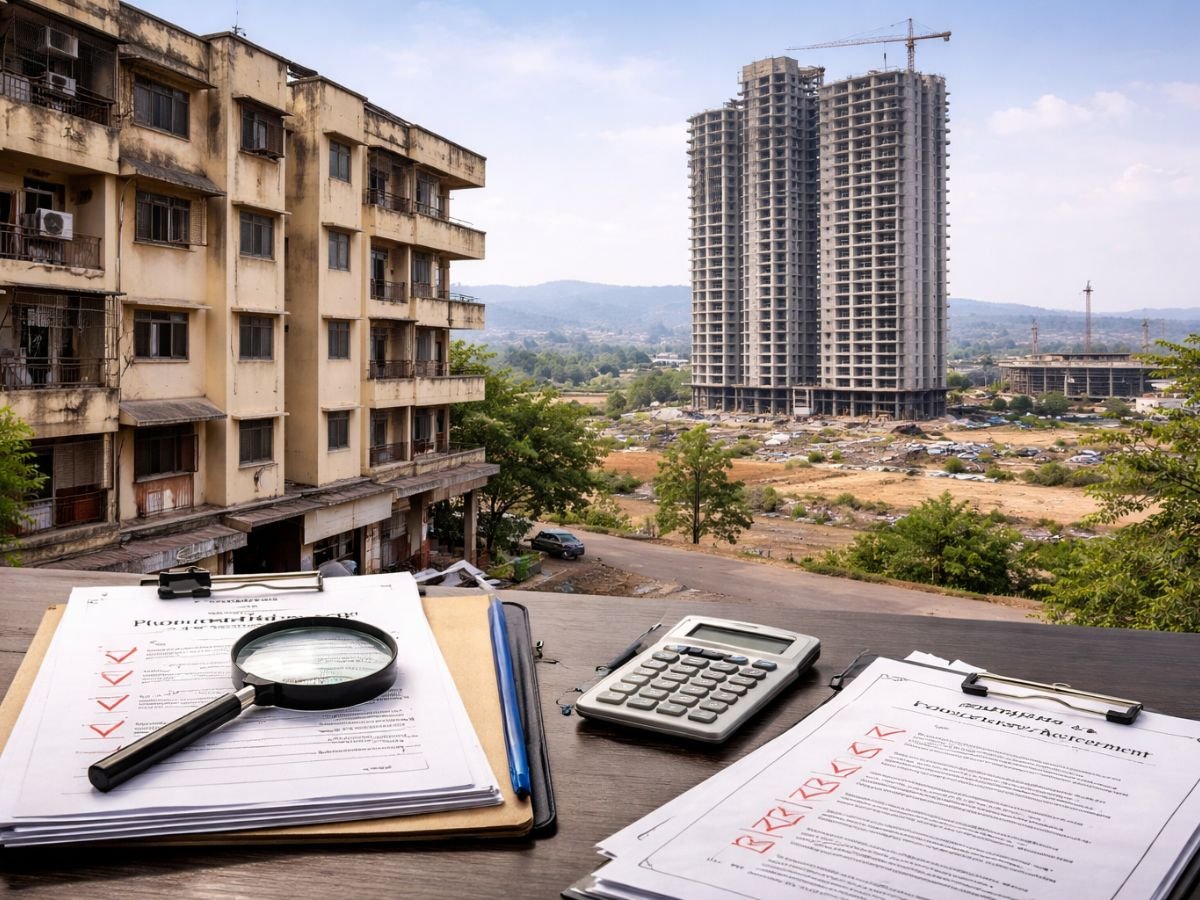
Panvel buyers need two different due diligence mindsets, depending on the product.
New project risk checks
For new projects, the main risks are delivery and livability:
- project may be MahaRERA-registered, but final usability may still lag
- OC may get delayed due to CIDCO-municipal friction or pending NOCs
- surrounding roads, water lines, or drainage may still be weak
- brochure-led expectations may not match final execution
- future area development may take longer than expected
Resale flat risk checks
For resale, the risks move from construction to documentation and inherited liability:
- check whether the flat is on leasehold or freehold land
- confirm whether CIDCO freehold conversion has already happened
- verify Occupancy Certificate
- do not confuse society dues with municipal tax clearance
- check if there are any unresolved PMC property tax arrears
- inspect building aging, leakage, lift condition, parking practicality, and major repair exposure
One very important local point: PMC property tax litigation and enforcement activity in early 2026 made resale verification much more serious than before. A society receipt is not enough. A buyer must verify actual municipal clearance properly.
If you are a family, commuter, or investor, the answer is not the same
The same Panvel property can be smart for one buyer and wrong for another.
Family buyer
For a family, resale in established Panvel pockets often wins. Schools, markets, water reliability, known neighbourhood patterns, and easier shifting matter more than brochure amenities. A family usually benefits from visible reality.
Daily commuter
For a commuter, railway and road practicality matter more than future story. If daily life depends on Panvel Station or fast highway access, a well-located resale or near-completion asset usually makes more sense than an ambitious peripheral township.
Investor
An investor can think differently. If the holding period is long and the buyer is comfortable with under-construction risk, selective new projects in growth-led corridors may still work. But the expectation should be measured. Panvel has already seen a strong run-up. The logic now is not blind flipping. It is selective entry with risk discipline.
First-time budget buyer
This buyer has to be the most careful. Lower entry price in outer belts can look attractive, but monthly cash flow pain can become real if possession delays stretch and rent continues. In many cases, a slightly older but usable resale flat is financially safer than a shiny under-construction promise.
A simple decision framework before you book anything in Panvel
Use this quick filter before finalising any property:
Panvel property decision checklist
- Can you handle EMI plus rent for more than 12 months if needed?
- Is your priority immediate use or future upside?
- Does the location solve your real commute, not just your brochure fantasy?
- Have you compared total cost, not just base price?
- For a new project, have you checked MahaRERA details and actual on-ground progress?
- For resale, have you checked OC, title clarity, PMC tax status, and leasehold/freehold status?
- Is the building practical for daily life, not just visually acceptable?
- Are you buying in a station-linked pocket, a maturing area, or a future-driven growth belt, and do you understand the difference?
If these answers are not clear, do not rush into booking.
Conclusion
If the goal is safe end-use, immediate living, practical commute, and lower execution risk, a resale flat in Panvel usually makes more sense right now, especially in established parts of Old Panvel and New Panvel. If the goal is newer amenities, staged payment structure, or long-term positioning in growth corridors, a new project can still work, but only if you have patience, buffer capital, and a clear understanding of area-level delays and cost additions.
The real decision is not “new is better” or “resale is cheaper.” The real decision is whether you are buying certainty or possibility. In Panvel in 2026, certainty is often found in clean, well-located resale stock. Possibility is found in selective new supply. The smarter buyer knows which one they actually need.
FAQs
Frequently Asked Questions