
Office Space vs Shop Investment in Navi Mumbai: Which Makes More Sense?
For most first-time commercial buyers in Navi Mumbai, office space is usually the safer starting point if it is in a genuine office ecosystem like Airoli, Mahape, or CBD Belapur. Shops can outperform, but only in proven retail pockets with real daily demand, strong frontage, and practical parking. This is not a simple office-vs-shop question. In Navi Mumbai, the right answer depends on asset type, node, micro-location, tenant fit, and local authority realities.
Commercial property can look exciting on paper because rental yields are often better than residential. But that does not mean every commercial unit is a smart buy. A wrong office in a weak business pocket can remain vacant for months. A wrong shop in a flashy but poorly functioning building can quietly burn money through maintenance, tax, and dead inventory.
That is why this guide focuses on one practical question: if you are putting real money into Navi Mumbai commercial property, should you choose an office or a shop?
Office space vs shop investment in Navi Mumbai: which is the better buy for most people?
The practical answer is this: office space is the safer default, shop is the sharper but riskier bet.
Office spaces generally work better for buyers who want steadier leasing demand, longer tenant stay, and lower regret. Shops can create stronger upside in the right pocket, but they are much less forgiving when the location is wrong. In commercial real estate, a bad shop usually hurts faster than a bad office.
Quick summary
Which Commercial Asset Suits Which Buyer? (2026 Guide)
|
|---|
Who should buy office space, and who should buy a shop?
This decision becomes much easier when you stop thinking like a property buyer and start thinking like the future tenant.
First-time commercial investor
For a first-time investor, office space usually makes more sense. The reason is simple. Office demand is more structured in the right node. The tenant pool is often more stable, lease periods are usually longer, and the decision is less dependent on street-level visibility.
A 400 to 800 sq. ft. office in a well-used commercial belt of Belapur or Airoli is usually easier to understand than a shop whose entire success depends on whether customers actually stop there.
Self-use business owner
If you are buying for your own business, the answer depends on how your business gets customers.
A CA firm, logistics liaison office, immigration consultant, training centre, or backend service company usually fits better in an office environment. A clinic, salon, pharmacy, diagnostics point, café, bakery, or walk-in retail brand usually needs a shop or visible ground-floor commercial unit.
Yield-focused investor
A yield-focused investor should usually lean toward office space, especially if the goal is lower management stress. Corporate or professional tenants often stay longer because moving offices is operationally painful and interior investment is high.
Appreciation-focused buyer
If your goal is sharper capital upside and you understand local retail behaviour well, a shop can win. But that only applies in pockets with proven demand, real frontage, and repeat catchment. A shop is not an appreciation machine just because it is on the ground floor.
Why the answer changes sharply from one Navi Mumbai node to another
This is where many buyers go wrong. Navi Mumbai is not one uniform commercial market.
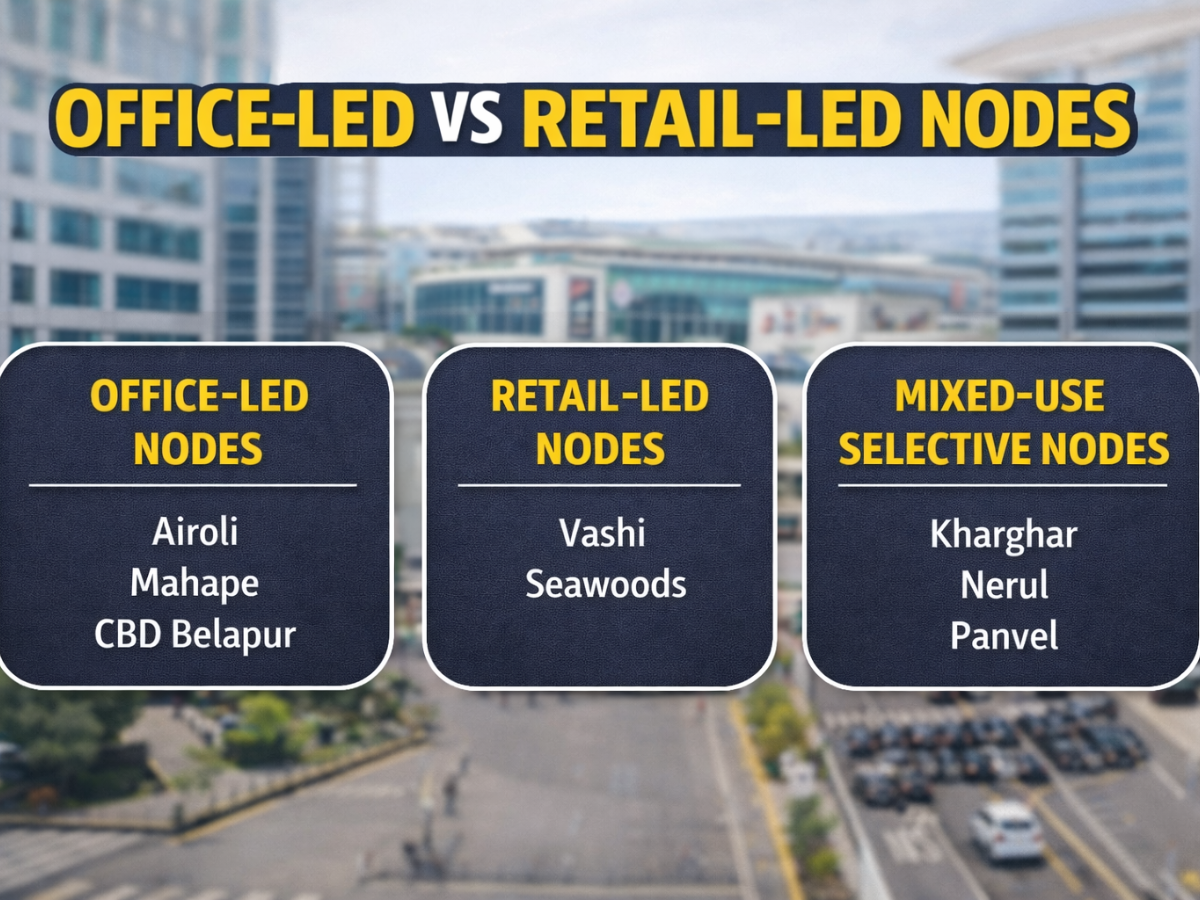
It is a planned city with very different nodes performing very different jobs. Some belts are office-led. Some are retail-led. Some are mixed-use but only in selected pockets. So asking “office or shop?” without asking “where exactly?” is incomplete.
Office-led ecosystems
Airoli and Mahape are the clearest examples. These belts work because of IT, business parks, corporate offices, service vendors, support teams, and weekday business movement. Retail exists there, but it is mostly support retail, not broad consumer retail.
CBD Belapur is also a proven office node, especially for professional services, government-linked work, logistics documentation, consultants, and smaller formal businesses.
Retail-led ecosystems
Vashi is still one of the strongest everyday retail and mixed commercial markets in Navi Mumbai. Seawoods, especially around the station and mall-influenced belt, also has strong premium retail logic. These locations work because people actually come there to spend, meet, eat, and shop.
Mixed-use but selective pockets
Kharghar, Nerul, Panvel, and some Seawoods and Belapur belts can support both formats, but not equally in every sector. One road works, the next internal lane does not. One building works, the next one struggles. That is why micro-location matters more than the node name alone.
In which Navi Mumbai nodes does office space usually make more sense?

Office investment works best where formal business demand already exists and where the building format matches occupier needs.
Airoli and Mahape for office-led demand
If you want a true office-led ecosystem, Airoli and Mahape are among the strongest choices. These belts benefit from IT and corporate demand, office parks, and business movement that is not dependent on residential walk-ins.
This is where an office makes sense because the surrounding market already understands office use. Staff commute, weekday activity, and tenant search behaviour are aligned with the product.
CBD Belapur for formal office use and institutional comfort
CBD Belapur remains a practical choice for smaller offices. It has the kind of administrative and professional ecosystem that supports lawyers, consultants, CA firms, logistics-linked offices, documentation work, and government-facing businesses.
For many first-time buyers, Belapur is easier to understand than newer speculative commercial belts. It is not the cheapest market, but it often offers better clarity of use.
Select Nerul, Seawoods, and Kharghar belts where office works only selectively
Office demand does exist in parts of Nerul, Seawoods, and Kharghar, but not across the whole node in a uniform way. In these places, building quality, station access, parking, and occupier profile matter a lot more.
A cheap office in a poor-format building with weak lift quality, awkward floor plate, or low business visibility may remain vacant even if the broader node sounds promising.
In which Navi Mumbai nodes does a shop usually make more sense?
Retail works best where people are already spending time and money, not where buyers are only hoping future footfall will come.
Vashi and Sanpada for stronger everyday commercial behaviour
If someone asks where shop investment in Navi Mumbai usually feels most natural, Vashi is near the top of the list. It has old but strong commercial habits, established spending behaviour, and a wider retail customer base.
Sanpada also benefits in selected pockets due to connectivity and spillover demand, but retail still needs road logic, frontage, and visibility.
Seawoods station and mall-influenced belts for premium selective retail
Seawoods has a premium retail advantage, but it is selective, not universal. Shop investment here works best when the unit benefits from station movement, destination traffic, affluent residential catchment, or a premium mixed-use environment.
Not every Seawoods retail unit enjoys this advantage. Some benefit from the halo of the area without actually having the right access pattern.
Kharghar, Panvel, and local consumption pockets where shop success depends on catchment, not hype
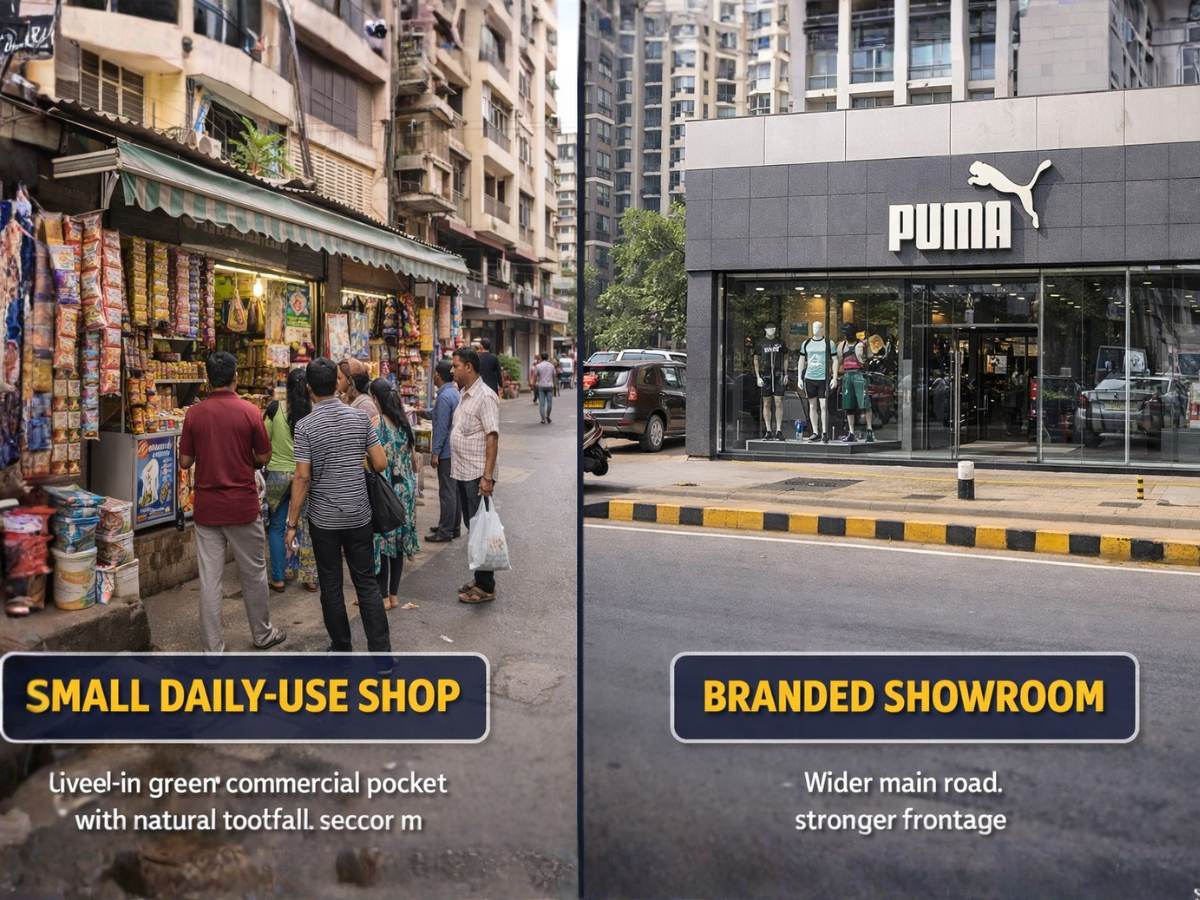
Kharghar and Panvel can support shops very well, especially for daily-needs retail, food, healthcare, coaching, and neighbourhood services. But here the real question is not “is the node growing?” The real question is “does this exact pocket have usable residential consumption?”
A road-facing shop near dense residential clusters can work. A tucked-away box in an over-marketed project may not.
What actually makes an office space investable in Navi Mumbai?
An office becomes investable when it is practical for the tenant, not just affordable for the buyer.
A usable office should have decent floor efficiency, proper access, reliable lift service, clean common areas, acceptable washroom quality, and workable parking. In Navi Mumbai, that matters more than many first-time investors realise because office tenants compare function, not just rent.
Fit-out is also a major issue. In Mumbai-region commercial markets, decent office fit-outs can cost well above ₹5,000 per sq. ft., and medium to premium ranges can go higher. That means a tenant does not want to spend heavily on interiors inside a badly planned or inconvenient building.
Office investment checklist
- Is the building in a real office ecosystem, not only a mixed commercial promise?
- Is the office floor plate usable without too many dead corners?
- Are lifts, lobbies, washrooms, and common areas good enough for staff and clients?
- Is there enough parking or at least practical drop-off access?
- Is station or metro connectivity realistically useful?
- Would a professional tenant feel comfortable operating here?
- Is the building already showing working occupancy, not just empty possession?
What actually makes a shop investable in Navi Mumbai?
A shop becomes investable when it can convert attention into sales. That is the heart of retail.
The biggest retail mistake in Navi Mumbai is confusing footfall with conversion. A place can have thousands of commuters passing by and still fail as a retail location for certain businesses. People in motion are not automatically customers. They may be rushing to a train, bus, office, or home.
Frontage matters. Display width matters. Signage matters. Parking or at least stopping convenience matters. Surrounding tenant mix matters. A shop with poor frontage in a bad layout can struggle even inside a known node.
A serious caution on weak retail formats
One of the most dangerous traps for first-time buyers is the small, upper-floor, strata-sold retail unit in an aging or badly managed commercial complex. Navi Mumbai has already seen enough examples of weak mall and strata-retail formats failing over time.
That is why a “cheap” 150 or 200 sq. ft. shop on the third floor of a tired building is not automatically a bargain. It can become an asset that earns nothing, keeps charging maintenance, and becomes difficult to resell.
Which is easier to rent, hold, and resell in Navi Mumbai?
In most cases, office space is easier to hold, while shops can create stronger upside if the location is already proven.
Office tenants are often stickier. They spend money on interiors, registrations, branding, operations, and staff movement. That creates inertia. Retail tenants can also stay long, but small retailers are more vulnerable to business failure, changing sales patterns, or shifting customer movement.
A vacant commercial asset is expensive to hold. CAM charges in commercial buildings can fall in the range of ₹10 to ₹25 per sq. ft. per month, depending on building services. That means a 1,000 sq. ft. asset can quietly drain ₹10,000 to ₹25,000 per month even before municipal tax and other costs.
Office vs shop lifecycle comparison
| Factor | Office Space | Shop |
|---|---|---|
| Vacancy risk | Usually lower in real office nodes | Higher if retail pocket is weak |
| Tenant stickiness | Usually stronger | Varies heavily by business type |
| Fit-out burden | High, but can improve stickiness | Lower to medium depending on use |
| Sensitivity to bad micro-location | Medium | Very high |
| Resale depth | Better if leased and usable | Strong only if location is proven |
| Income predictability | Usually better | More binary (hit or miss) |
| Mistake cost | Slower burn | Often faster and sharper |
Which hidden costs and operating realities can flip the investment math?
This is the section many buyers ignore until it is too late.
The quoted rate per sq. ft. is only the entry point. After that come fit-out expectations, CAM, property tax, parking issues, signage restrictions, documentation friction, and sometimes authority-related transfer costs that can materially change your returns.
In NMMC areas, commercial property tax can be a serious holding burden. In PMC-side areas like Panvel and Kharghar, taxation logic also works differently and commercial usage carries a higher burden than residential. So ROI should never be calculated using rent alone.
CIDCO-linked transfer realities are especially important in Navi Mumbai because this is fundamentally a leasehold city. After the April 1, 2025 revision, transfer costs for some CIDCO-linked commercial properties became much more serious, and commercial shops were among the categories affected by hikes. That changes exit math. It also means short-term flipping becomes much riskier unless the property structure and transfer position are clearly understood.
Which legal and authority checks matter before buying either asset in Navi Mumbai?
Commercial buying in Navi Mumbai is not just about title, area, and stamp duty. It is also about understanding the local authorities behind the property.
If the property is under construction or recently launched, check the MahaRERA registration, promoter name, project status, and whether timelines and project disclosures look credible. MahaRERA is not just a formality. It is a working due-diligence tool.
Use IGR Maharashtra eASR carefully. It is useful as a ready reckoner and stamp-duty anchor, but it is not the same thing as live transaction value. Premium retail in Vashi or certain selective commercial pockets can trade at realities that differ sharply from administrative baseline values.
For CIDCO-linked assets, do not skip leasehold and transfer history. Check whether transfer-related liabilities, premiums, or estate-side issues are pending. Also understand whether freehold conversion is possible or desirable, because that can affect future liquidity.
On the municipal side, tax history and property record visibility matter. In NMMC and PMC regions, the tax burden can materially affect holding costs, especially during vacancy.
Three practical scenarios: when office wins, when shop wins, and when neither should be bought
Scenario 1: ₹80 lakh to ₹1.5 crore first-time investor
If safety matters more than excitement, a smaller office in Airoli, Mahape, or CBD Belapur is usually the better starting point. The tenant pool is more understandable, and the building type is easier to evaluate.
Scenario 2: Business owner buying for self-use
If you run a professional service business, office usually wins. If your business depends on walk-ins, visibility, and repeated neighbourhood demand, shop wins. Buying the wrong format here can damage both the business and the property investment.
Scenario 3: Discounted “value” retail unit in a weak building
This is where the answer is neither. If the deal is a small upper-floor retail box in a weak mall or aging project, the correct decision may simply be to walk away. Cheap commercial property can be more dangerous than expensive commercial property if the building format itself is broken.
Final checklist: how to decide between an office and a shop before paying token
Before you pay token, ask these questions clearly:
- Does this asset match the node’s real economic driver?
- Would a real tenant actually want this exact unit, not just the broader area?
- Is this office usable enough for a professional occupier?
- Is this shop visible enough to convert real customers?
- Who pays CAM and carrying cost during vacancy?
- Have you factored in fit-out expectations and activation cost?
- Have you checked CIDCO leasehold and transfer realities properly?
- Have you treated portal price as asking price, not truth?
- Is the building already functioning well, or only being marketed well?
- If this stays vacant for six months, can you still comfortably hold it?
Conclusion
If you want the cleanest practical answer, it is this: buy office space in Navi Mumbai if you want a safer first commercial investment and you are entering a genuine office ecosystem like Airoli, Mahape, or CBD Belapur. Buy a shop only when the retail pocket is already proven by frontage, access, and real catchment demand.
A shop can absolutely beat an office. But in Navi Mumbai, that usually happens only when the asset, node, micro-location, and customer behaviour are perfectly aligned. Without that alignment, office is the more forgiving asset. And in commercial property, the more forgiving asset is often the smarter first move.
FAQs
Frequently Asked Questions