
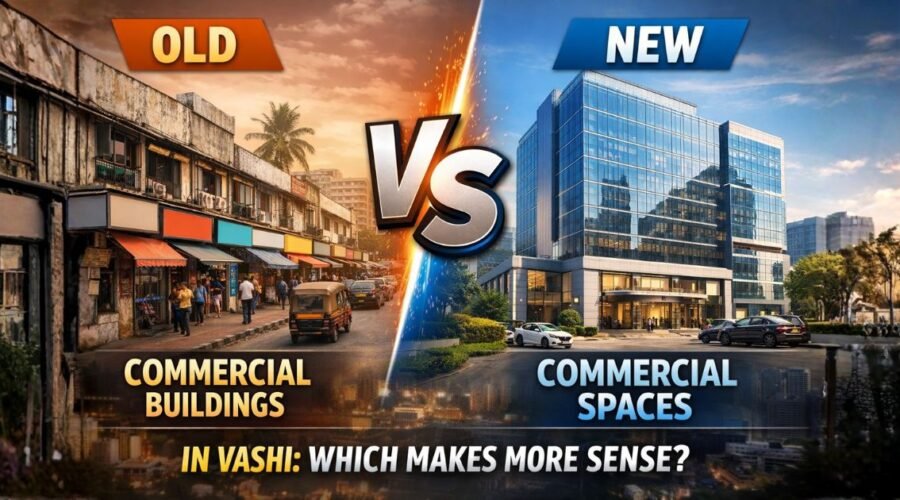
Old Commercial Buildings vs New Commercial Spaces in Vashi: Which is the best option for investment?
In Vashi, old commercial buildings usually make more sense when location, footfall, and established business movement matter more than looks. New commercial spaces usually make more sense when the buyer wants cleaner compliance, better parking, stronger office comfort, lower immediate capex risk, and easier tenant presentation. There is no universal winner here. In Vashi, the right buy depends on your business model, the exact sector, building condition, and how much operational friction you can handle.
That is the real point many generic articles miss. They compare old and new like a brochure comparison. Vashi does not work like that. A tired-looking older retail unit in the right part of Sector 17 can outperform a much cleaner commercial unit in a newer building if the business depends on street visibility. On the other hand, a polished office in Sector 30A can make far more sense than a legacy office in an ageing building if the buyer needs parking, smoother operations, and a better corporate environment.
So the question is not “old or new?” The better question is: what kind of business or investment are you trying to support in Vashi?
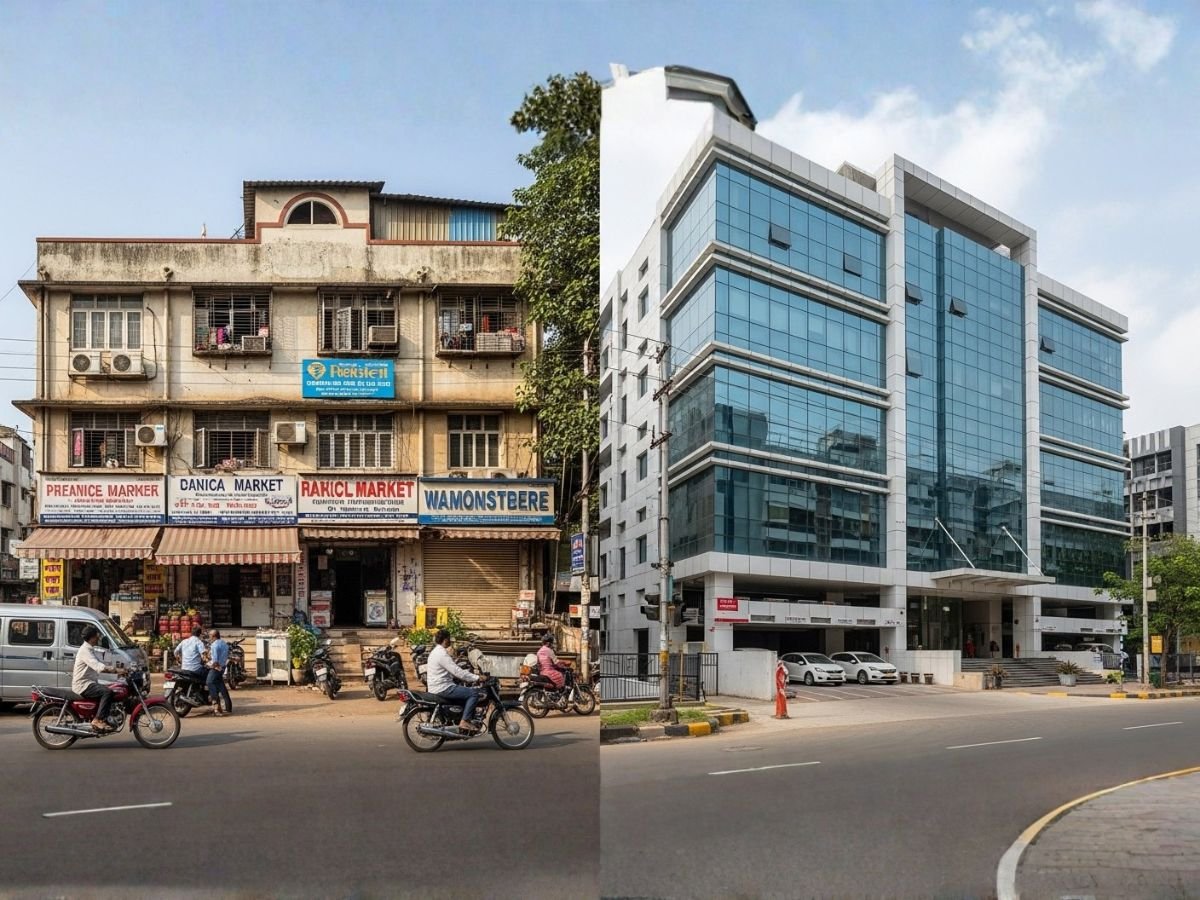
Old commercial buildings or new commercial spaces in Vashi: which is usually the better buy?
Usually, old stock wins on location strength and new stock wins on operational comfort and predictability. That is the simplest answer.
Old commercial buildings in Vashi, especially in legacy belts, often sit in places that newer projects cannot replicate. They benefit from long-established customer habits, denser mixed-use surroundings, and real on-ground commercial memory. But that advantage comes with stress: repairs, structural ageing, poor parking, lift issues, and surprise capital expenditure.
New commercial spaces, especially in office-oriented pockets, solve many of those problems. They offer better infrastructure, more formal layouts, stronger compliance comfort, and easier presentation to tenants or clients. But they are not automatically better buys. If the micro-location is weaker for your business, or if the premium is too high, the “new” advantage can become expensive without adding real utility.
Here is the quick comparison first:
| Decision Factor | Old Commercial Buildings in Vashi | New Commercial Spaces in Vashi |
|---|---|---|
| Best strength | Location, visibility, established catchment | Comfort, presentation, compliance, parking |
| Best suited for | Retail, self-use service offices, location-driven businesses | Corporate offices, formal service firms, pre-leased or presentation-sensitive buyers |
| Main risk | Capex shock, repair levies, structural fatigue, parking stress | Higher entry cost, higher CAM, weaker walk-in potential in the wrong micro-market |
| Best local fit | Legacy belts like Sector 17 | Sector 30 / 30A style office corridors |
| Better for | Buyers who can absorb friction | Buyers who want predictability |
When does an old commercial building in Vashi make more sense than a new one?
An old commercial building in Vashi makes more sense when the location does more work than the building itself. This is especially true in retail-led or highly localized service businesses.
When location and established business movement matter more than appearance
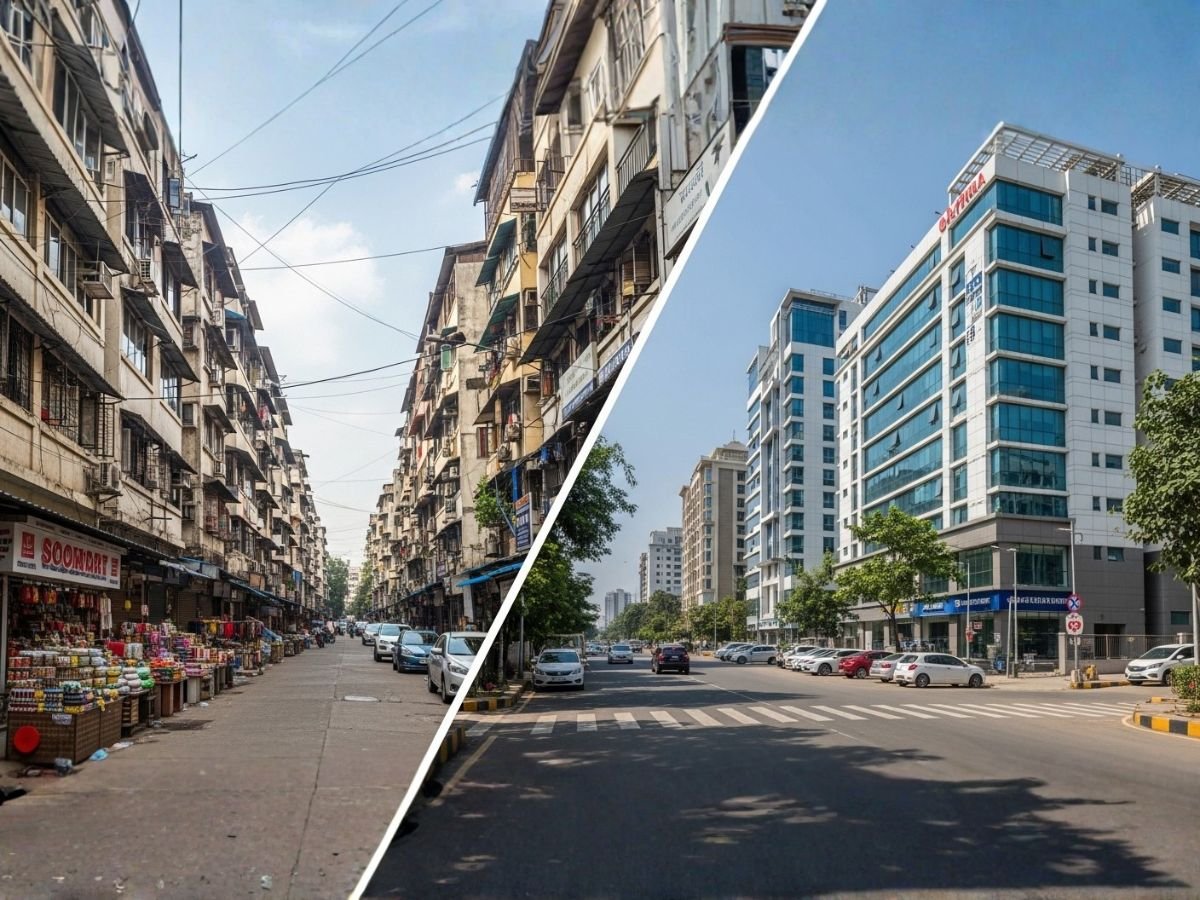
This is where older Vashi stock still has real power. In legacy parts of Vashi, especially the older commercial fabric around Sector 17, the value often comes from what happens outside the unit, not inside it. The catchment is already there. The traffic is already there. The market memory is already there.
That is why older retail frontage in strong Vashi belts can still command very high rates and rentals. Based on current market patterns in the dossier, older legacy retail stock in Sector 17 can trade around ₹28,000 to ₹31,000+ per sq. ft., while high-street retail rentals can move in a broad ₹200 to ₹400 per sq. ft. range depending on frontage, exact stretch, and use case.
If your business depends on visibility, impulse visits, and a known market pocket, old stock may still beat new stock comfortably.
When self-use buyers can handle repair and fit-out friction
Old stock can also work for self-use buyers who are realistic about what they are buying. A lawyer, consultant, coaching brand, jewellery trader, or service business may choose an older unit because the location is simply too valuable to ignore.
But the deal only works if the buyer has enough financial buffer. In Vashi, the apparent “discount” on older stock can disappear fast after electrical upgrades, plumbing corrections, façade work, HVAC setup, waterproofing, and general modernization. The dossier indicates that immediate capex in older buildings can often range from roughly ₹8 lakh to ₹25 lakh, depending on condition and scope.
So yes, old stock can make sense. But only when the buyer is buying a location advantage, not just a lower-looking entry price.
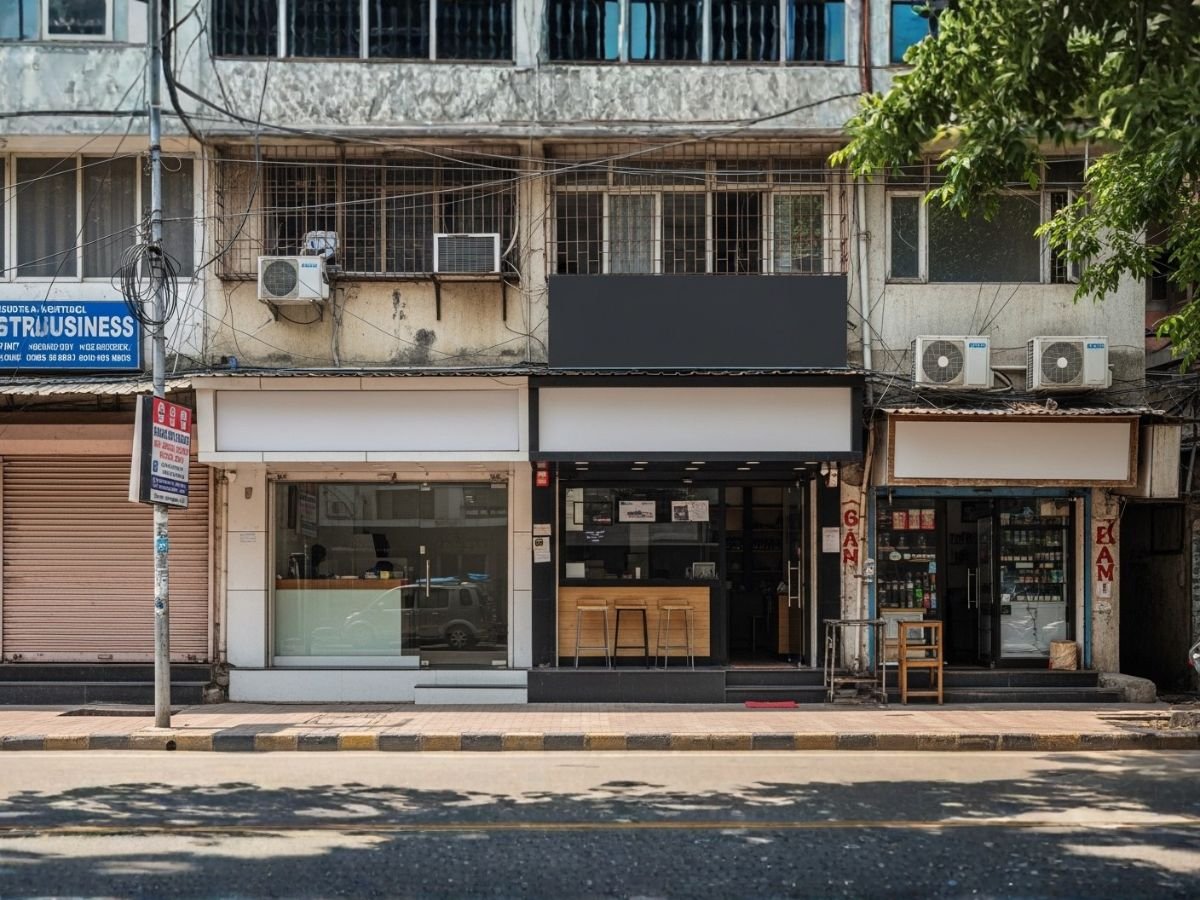
When old retail frontage still beats newer but weaker locations
This is one of the biggest truths in Vashi commercial property. For retail, an older ground-floor unit in the right legacy stretch can still outperform a cleaner new space if the new space does not get real street-level engagement.
A moderately aged showroom in a dense, proven market belt will often out-trade a prettier commercial unit placed inside a more formal but less organic office environment. That is why shop buyers should never compare old and new only by façade quality.
When is a new commercial space in Vashi worth paying more for?
A new commercial space in Vashi is worth paying more for when the business depends on comfort, compliance, presentation, employee convenience, and lower immediate friction.
When parking, comfort, and cleaner presentation affect office performance
This is where new office stock earns its premium. In modern office-oriented belts, the building itself contributes to the business outcome. High-speed lifts, centralized systems, better common areas, planned parking, stronger fire-safety comfort, and cleaner entry experience matter for certain users.
For a wealth management office, tech team, BPO-style office, branch office, or professional services firm with higher client expectations, these things are not cosmetic. They affect how the business operates daily.
In old Vashi belts, parking is not a small inconvenience. It can be a serious business issue. Clients who struggle to stop, park, or access the building comfortably may simply avoid repeated visits.
When tenanting ease and corporate suitability matter
Newer commercial spaces usually present better to formal tenants. A company looking for office space often prefers cleaner layouts, better compliance, and a more structured environment. That makes newer stock easier to pitch for tenanting, especially in office-led use cases.
The dossier’s current ranges suggest newer office-oriented stock in Sector 30A can sit around ₹16,000 to ₹23,000+ per sq. ft. in many cases, which is lower than certain premium legacy retail belts. That is the Vashi paradox: newer does not always mean more expensive per square foot if you are comparing different micro-markets and asset behaviors.
When the buyer wants lower immediate capex risk
A new building does not remove all risk, but it usually reduces one major headache: near-term repair shock. You are less likely to face sudden lift replacement calls, severe waterproofing surprises, or major façade correction immediately after purchase.
That does not mean new stock is cheap to hold. The burden often shifts from unpredictable repair calls to predictable but high monthly maintenance. In many newer buildings, Common Area Maintenance can range roughly from ₹10 to ₹25 per sq. ft. per month. So the buyer is buying smoother operations, but also taking on a regular carrying cost.
Why does this answer change between Sector 17 and Sector 30 or 30A?
Because Vashi is not one single commercial market. The old-vs-new answer changes sharply depending on where in Vashi you are buying.
Why old stock can still work in Sector 17
Sector 17 follows older mixed-use market logic. It is dense, active, familiar, and still commercially relevant because people already know how to use it. That makes it especially strong for high-street retail, local clinics, educational use, and service businesses that depend on repeated local movement.
But this comes with visible friction. Parking is tight. Street-level congestion is real. Older buildings may face structural audit pressure. Common areas can feel tired. Maintenance is often not as predictable as buyers assume.
Why newer office stock usually reads better in Sector 30 or 30A
Sector 30 and 30A operate differently. They are more aligned with transit-oriented, office-focused commercial use. This is where newer stock makes more operational sense, especially after the connectivity impact of the Mumbai Trans Harbour Link. Better access from Mumbai-side business movement has helped strengthen the appeal of cleaner office inventory here.
This part of Vashi suits formal offices better than street-led retail logic. It is about workforce movement, office presentation, and operational ease, not old-market density.
Here is the most useful comparison:
| Feature | Sector 17 (Legacy / Mixed-Use) | Sector 30 / 30A (Modern / Office-Led) |
|---|---|---|
| Typical strength | Footfall, market memory, local catchment | Formal office stock, transit access, parking comfort |
| Asset character | Older retail and legacy offices | Grade-A style offices, newer towers, business parks |
| Current pricing pattern | Can command high location premium, around ₹28,000–₹31,000+ per sq. ft. in stronger stock | Often around ₹16,000–₹23,000+ per sq. ft., depending on project and building quality |
| Parking reality | Congested, stressed, limited | Planned parking usually better |
| Best fit | Retail, clinics, walk-in service businesses | Corporate offices, formal service firms, branch teams |
| Main risk | Structural fatigue, repair levies, street friction | Higher CAM, vacancy carrying cost if underused |
Is old stock in Vashi actually cheaper, or just cheaper at the time of purchase?
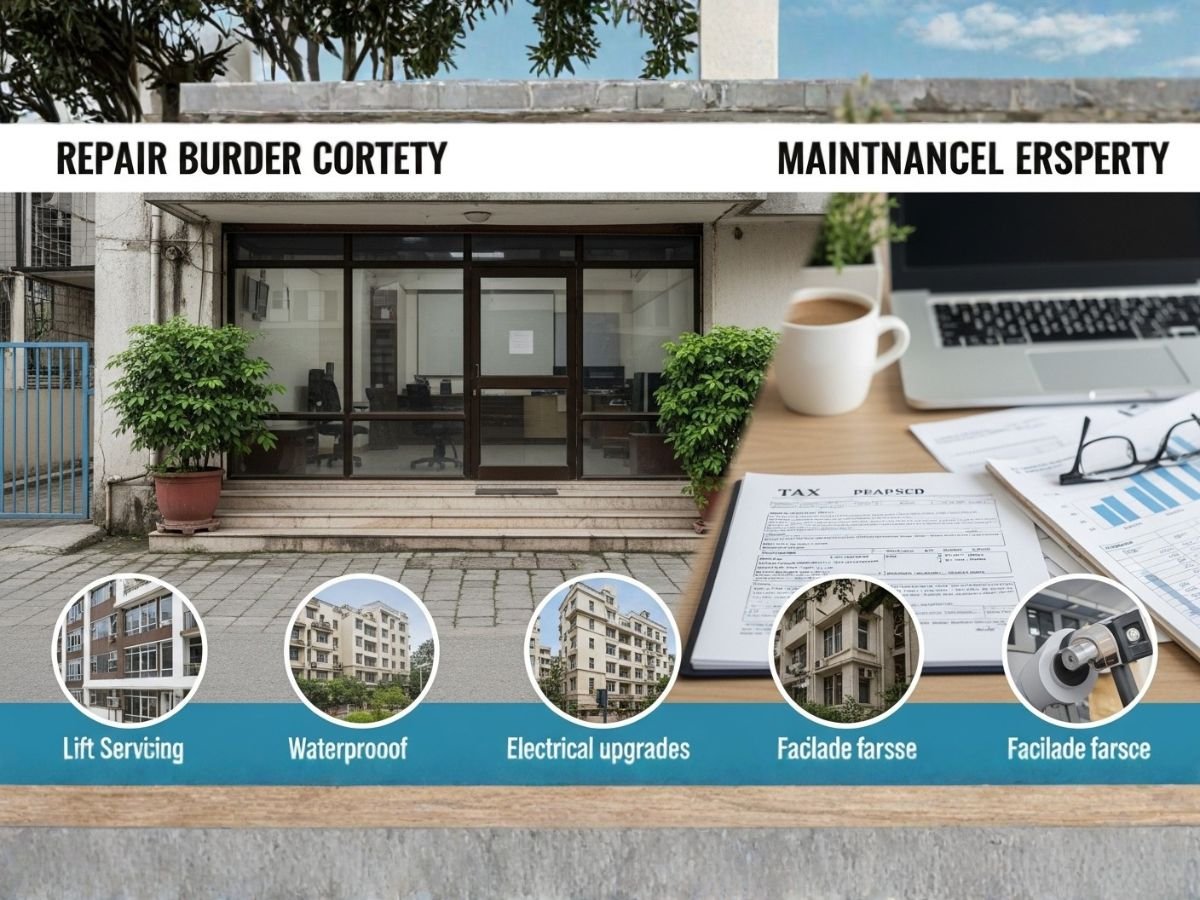
Usually, old stock is often cheaper only at the moment of purchase, not always over the full holding period.
Repair calls, façade work, lifts, waterproofing, and common-area fatigue
Older Vashi buildings can carry a low monthly fee and still become expensive later. That is because the real risk is not just routine maintenance. It is sudden repair levies. Lift replacement, external plastering, waterproofing, structural reinforcement, and corrosion-related fixes can change the economics of the purchase very quickly.
NMMC’s structural audit regime also matters here. Buildings over 30 years old fall under mandatory structural audit requirements under Section 398A, and non-compliance can invite penalties. That makes building condition a financial issue, not just a visual one.
Interior and HVAC correction costs in older offices
An older office that looks “cheap” may need a full reset before it becomes usable for a modern business or tenant. By the time the buyer spends on interiors, electricals, HVAC, lighting, false ceiling, toilets, data lines, and basic presentation upgrades, the entry discount may look much smaller.
Vacancy and presentation risk for investors
This part is often ignored. An investor buying old stock may model a strong gross yield, but actual outcome depends on tenant quality, time to lease, presentation, and how much the tenant needs to spend or negotiate because the building feels dated.
The same applies to holding cost. NMMC’s commercial property tax is high, at 68.33% of rateable value as noted in the dossier. So holding an empty commercial unit during repairs or vacancy is not a light matter.
Capex shock warning
A legacy Vashi commercial asset can hurt the buyer in four layers at once:
- Higher-than-expected fit-out or repair cost
- CIDCO transfer charge impact after the 2025 hike
- High NMMC commercial property tax burden
- Vacancy time while the unit is being repaired or repositioned
This is why old stock should never be called “cheap” without full-cycle math.
Does new stock in Vashi really solve the old-building problems?
Yes, but only partly.
What new stock genuinely improves
New stock usually improves:
- building systems
- parking quality
- common-area presentation
- fire-safety and infrastructure comfort
- office usability
- corporate tenant appeal
It also reduces the risk of immediate structural stress, which is a very real issue in older Vashi buildings.
What new stock still does not fix if the micro-location is weak
A new building cannot create the right business ecosystem if the business model itself needs organic footfall. A beautiful office park or corporate tower does not automatically work for a retail business, coaching setup, hardware-led outlet, or walk-in-heavy service format.
That is the mistake some buyers make. They think new stock solves everything. It does not. It only solves the problems that building quality can solve. It cannot fix the wrong product-market fit.
Which is better for self-use buyers, and which is better for investors?
For self-use retail, older stock often remains stronger. For self-use office, newer stock often becomes the better answer. For investors, the answer depends on whether they want predictability or speculative upside.
Self-use office buyers
If the business is office-led, presentation-sensitive, and depends on smoother daily function, newer commercial space usually makes more sense. That includes professional firms, tech teams, branch offices, finance firms, and formal service businesses.
Retail self-use buyers
If the business depends on visible frontage and known local movement, old stock in the right part of Vashi can be the better commercial buy even if the building is imperfect.
Pre-leased and rental-focused investors
For passive or relatively hands-off investing, newer or better-managed office stock is usually safer. It is easier to position for formal tenants and easier to hold without repeated repair stress.
Older stock may still work for highly capitalized local investors, but that becomes a different game. That buyer is usually not chasing easy passive rent. They are betting on deep location value, repositioning, or long-term redevelopment possibility.
Which buyer profiles should avoid old Vashi stock, and which should avoid new premium stock?
This section matters because the wrong buyer gets punished in Vashi.
Avoid old Vashi stock if you are:
- under-capitalized
- expecting passive ownership with no repair stress
- an NRI wanting hands-off income
- highly dependent on polished tenant presentation
- unable to absorb surprise repair or transfer-related outflow
Avoid new premium stock if you are:
- a purely walk-in retail business needing dense street movement
- a low-margin operator who cannot carry high CAM
- buying only because the tower looks impressive
- assuming new stock guarantees faster appreciation
- forcing an office-led product into a use case that actually needs market chaos and visibility
What should you verify before choosing old or new commercial space in Vashi?
This is where real buying discipline starts. Do not treat due diligence as a closing formality.
Old-stock checks
- Ask for the latest structural audit report if the building is over 30 years old
- Check AGM or society records for repair discussions, redevelopment disputes, lift replacement, façade work, or major levy history
- Verify NMMC tax dues are cleared
- Understand actual condition, not seller language
- Calculate interior correction cost honestly
- Verify CIDCO transfer implications clearly before signing
New-stock checks
- If under construction or recently completed, verify MahaRERA where relevant
- Check actual CAM structure in writing
- Understand tenant restrictions if the building sits in a specific commercial or IT park format
- Verify parking allocation, not just brochure marketing
- Test whether the location suits your actual business use, not just office optics
Common checks for both
- Check exact use suitability
- Check title and transfer history
- Verify holding cost math
- Check access, parking, and user experience physically
- Separate gross yield from actual net yield
One more local financial point matters a lot here. The dossier notes that CIDCO transfer charges were sharply increased from April 1, 2025, including a flat 50% hike for flats and shops in registered societies and much steeper cost exposure for certain commercial built-up areas. That means transfer-cost planning is not optional anymore. It directly affects negotiation and actual acquisition cost.
Real Vashi buyer examples: who should choose old stock and who should choose new stock?
Scenario 1: The expanding jeweller
This buyer should usually prefer old stock in a strong legacy commercial stretch. The business needs visibility, local trust, complementary footfall, and a market people already use. New office-style stock will not replace that value.
Scenario 2: The mid-sized tech startup
This buyer should usually choose newer office stock, especially in a more formal office-oriented Vashi pocket. Reliable systems, cleaner space, parking, and business presentation matter more than old-market visibility.
Scenario 3: The NRI passive investor
This buyer is usually better off with newer pre-leased office stock. Old stock from a distance can become operationally exhausting because every repair, tax issue, society conflict, and vacancy period becomes harder to manage.
Scenario 4: The strategic local speculator
This buyer may still choose older distressed stock in a strong location, but only if they fully understand the risk. This is not a beginner move. Redevelopment is never guaranteed, and timelines can stretch badly.
So, what actually makes more sense in Vashi: old commercial buildings or new commercial spaces?
Old commercial buildings make more sense in Vashi when the business needs geographic advantage more than building comfort. That usually means legacy retail, high-visibility service businesses, and some self-use buyers who can absorb fit-out and repair friction.
New commercial spaces make more sense when the buyer needs predictability, cleaner operations, corporate usability, better parking, and lower near-term physical risk. That usually means office-led businesses, formal tenants, and investors who prefer easier holding.
So the sharper answer is this: old wins where market behavior is stronger than the building, and new wins where the building itself is part of the business advantage.
Conclusion
In Vashi, old commercial buildings are not outdated by default, and new commercial spaces are not superior by default. Old stock usually wins when the location itself creates business. New stock usually wins when daily function, compliance comfort, parking, and professional presentation drive the outcome.
So do not compare these assets like two versions of the same product. They are not. In Vashi, you are choosing between location power with friction and operational comfort with premium cost. The right decision is the one that matches your business, your capital strength, and your tolerance for the real-world problems that come with each side.
FAQs
Frequently Asked Questions
