
How NAINA, NMIA and Rail-Highway Junctions Affect Panvel Industrial Growth
Panvel industrial growth is becoming stronger, but only in places where three things actually come together on the ground: usable NAINA planning, real NMIA-linked logistics relevance, and strong rail-highway freight movement. That is the real answer. These drivers do not lift every industrial plot equally. The biggest gains usually go to logistics parks, ready warehouses, transport-linked yards, and selected industrial land near working corridors, not to every land parcel being sold with an airport story.
A lot of people hear the same pitch again and again: airport aa raha hai, NAINA hai, connectivity hai, so industrial growth is guaranteed. But Panvel does not work that simply. In practical terms, NAINA decides whether land can become part of a more formal planned industrial geography, NMIA changes which occupiers start looking at the belt, and the rail-highway network decides whether trucks, containers, workers, and cargo can actually move efficiently.
That difference matters. Because in industrial real estate, maps and announcements help, but occupiers still choose locations based on movement, compliance, utility access, and operational speed. A planned plot without approach roads is weak. A plot near the airport with no relevant cargo use is weak. A belt with excellent road and freight logic can outperform a more heavily marketed area.
The short answer: these three drivers do support Panvel industrial growth, but not in the same way
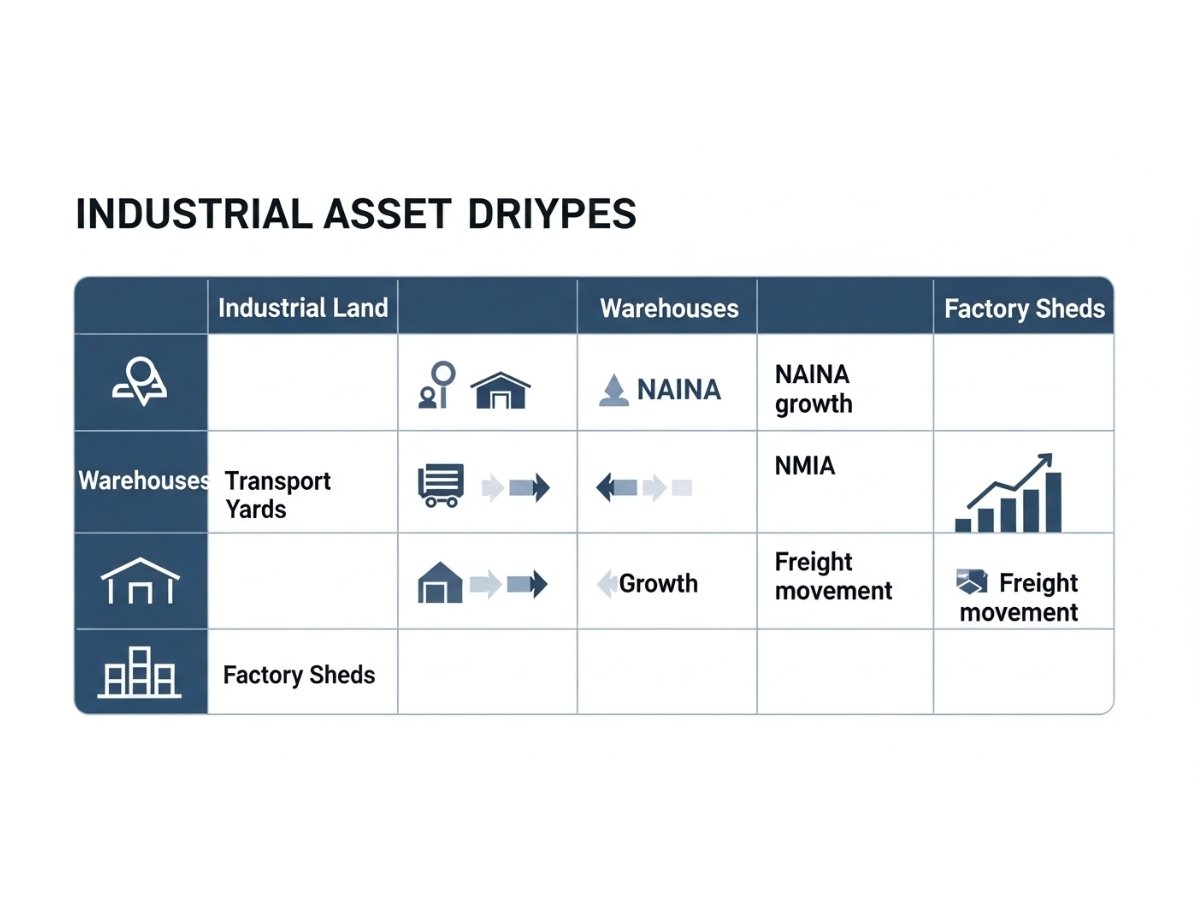
| Growth driver | What it really changes | Asset types that benefit most | Practical timing |
|---|---|---|---|
| NAINA planning | Land use structure, zoning logic, legal framework, future urban form | Raw industrial land, planned logistics parks, future mixed-use and industrial growth pockets | Mostly long-term |
| NMIA | Occupier type, air-cargo relevance, high-value and time-sensitive logistics demand | Grade A warehouses, cold chain, transit sheds, pharma and express logistics support spaces | Short to medium-term |
| Rail-highway junctions | Freight speed, truck movement, bulk transport efficiency, route flexibility | Warehouses, container yards, transport yards, manufacturing sheds with strong movement needs | Immediate to short-term once routes function |
Why NAINA matters to industrial growth only when planning turns into usable industrial geography
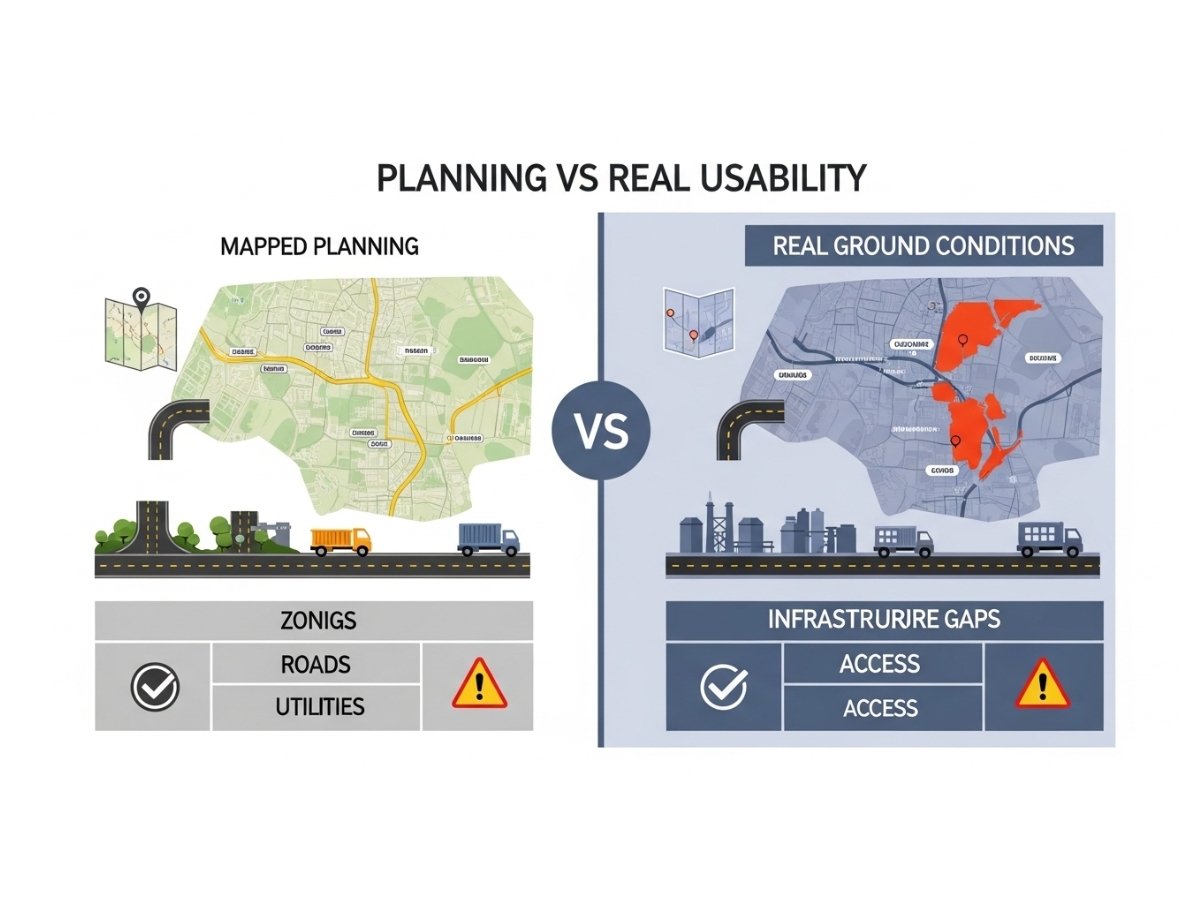
NAINA is one of the biggest planning stories in the wider Navi Mumbai-Panvel region. But readers should be careful here. Planning is important, yes. Planning alone is not industrial growth.
What NAINA changes on paper
NAINA was designed to prevent unplanned development around the new airport region and put CIDCO in the role of Special Planning Authority. On paper, this matters a lot. It introduces a structured land-pooling model, Town Planning Schemes, and a clearer urban framework than random fragmented growth.
The core planning logic is the well-known 60:40 model. Landowners surrender 40 percent of land for roads, public infrastructure, amenities, and growth center development, and retain 60 percent as a reconstituted plot. That retained land can receive a higher FSI, going up to around 1.7 under the NAINA framework described in the dossier. From a market point of view, this is supposed to convert confusing agricultural fragments into clearer, legal, more developable land.
For industrial growth, that sounds attractive. A large developer or logistics player naturally prefers legally cleaner land inside a broader planned system rather than messy fragments with uncertain future surroundings.
What industrial users still need beyond planning maps
Still, industrial users do not operate on theory. They operate on access and uptime.
A warehouse operator, 3PL company, transport fleet, or industrial occupier needs a physically usable site. That means proper approach roads, turning movement for trailers, power supply, drainage, water, and basic utility readiness. A plot may look strong on a development map, but if the 30-meter DP road is not actually built or acquired on the ground, that plot cannot function properly for heavy logistics.
This is where many people get misled. They see zoning and assume immediate industrial usability. But in real Panvel-side industrial decisions, usability comes first. A location becomes truly valuable only when a truck can reach it without daily friction, a building can be approved and serviced, and an occupier can start operations without spending years solving basic access problems.
Why NAINA-led expectation and actual industrial absorption are not the same
This is the biggest gap between brochure logic and ground logic.
In many infrastructure-led regions, land prices start moving before industrial absorption becomes real. The same thing can happen in NAINA-influenced belts. Once a planning narrative starts, speculative pricing enters early. But industrial absorption only comes later, when legal clarity, roads, and utilities begin to support actual use.
The dossier also points to local resistance in villages such as Devad, where objections around the 60:40 formula and demands for different regulatory treatment have slowed or complicated execution. That matters because industrial growth is not just about what a regulation allows. It is also about whether that framework can be executed smoothly enough to create usable plots and roads.
Caution: NAINA is not a shortcut to instant industrial value
A NAINA-tagged land parcel is not automatically a strong industrial buy.
Be careful when:
- the village-level implementation is still disputed
- the Town Planning Scheme is not fully clear
- the approach road exists only on paper
- utility infrastructure is still missing
- the land is being sold mainly on “future growth” language with little present usability
For long-horizon institutional investors, this may still be acceptable. For a normal investor or a business wanting near-term use, this can become a trap.
How NMIA changes the industrial story around Panvel
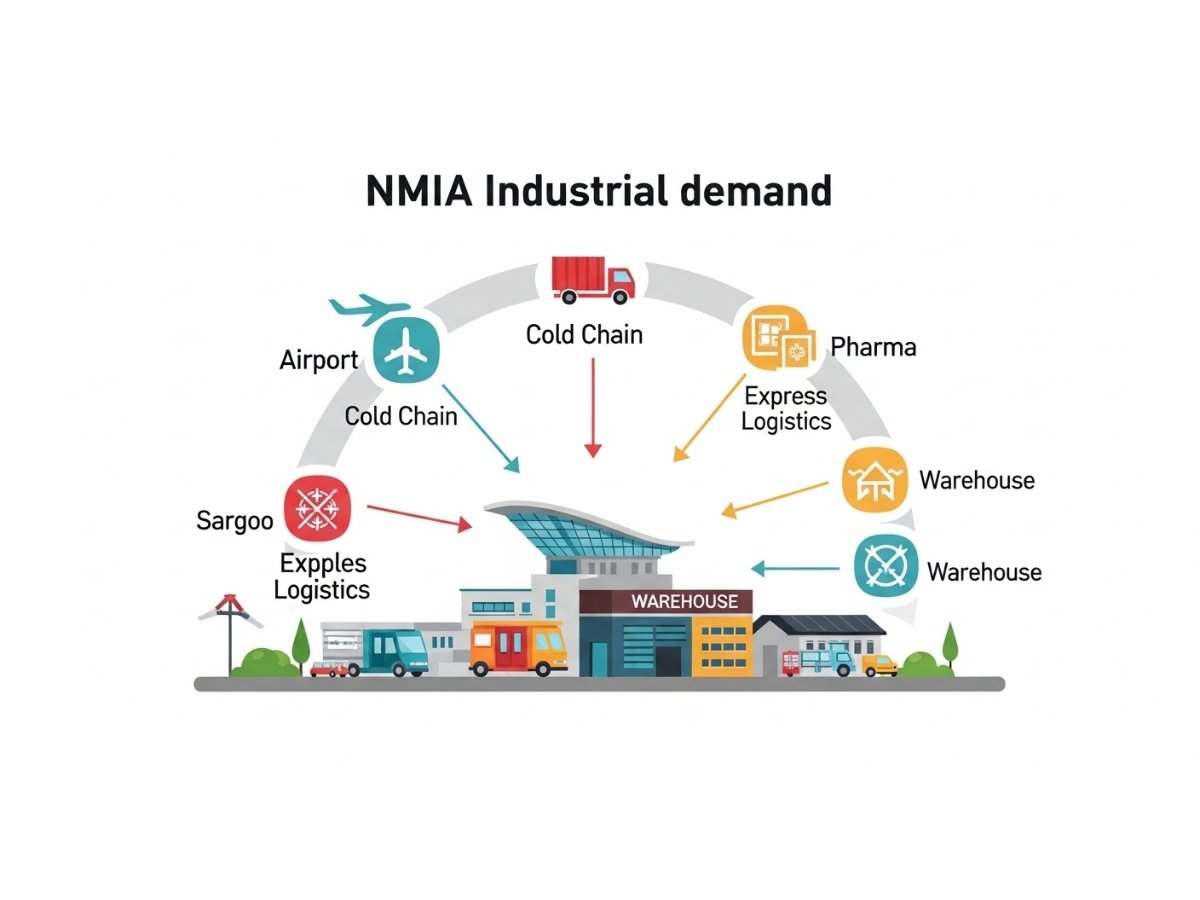
NMIA does matter. But not in the broad, lazy way it is often sold.
Why an airport does not benefit every industrial asset equally
An airport does not create uniform industrial demand. It helps specific types of cargo and specific types of businesses.
If you are dealing with heavy steel, bulk chemicals, standard fabrication, or large low-margin weight-heavy goods, airport proximity is not a major operating advantage. Those businesses depend far more on highways, port access, rail freight, power, and compliance ecosystems. So a standard factory user in an established zone like Taloja may benefit far more from road and freight upgrades than from being near NMIA itself.
This is the first thing buyers need to understand. Airport-led industrial growth is selective, not universal.
Which users gain more from airport-linked proximity
NMIA becomes much more relevant for occupiers whose business depends on speed, value density, or cargo sensitivity.
That includes:
- pharma exporters
- cold chain and perishable cargo players
- electronics and advanced component movement
- express logistics
- sorting and redistribution hubs
- air cargo support uses
- bonded and high-security transit infrastructure
The dossier notes that NMIA has been designed with cargo capability, including specialized handling such as pharma infrastructure and sensitive cargo support. It also mentions a major FedEx investment into a large automated air cargo hub. That is the kind of signal industrial markets watch carefully. Not because one project alone changes everything, but because it shows serious occupiers are beginning to build around the node.
Why logistics and time-sensitive movement matter more than simple distance
This is where many buyers again make a mistake. They think closer distance to the airport automatically means higher value.
But in industrial logistics, movement time matters more than simple map distance. A plot that is slightly farther but sits on a fast corridor between the port, highway, and airport can be more valuable than a closer plot that is trapped in local traffic or weak access.
The Panvel-side story becomes especially strong when NMIA is read together with JNPA and the wider freight corridors. The dossier describes the sea-air transshipment logic very clearly. Goods can move through JNPA, shift quickly through the regional logistics network, and then use NMIA for time-sensitive onward movement. That kind of system supports specific asset demand: sorting facilities, transit sheds, cold storage, bonded warehousing, and specialized logistics space.
So the industrial land or warehousing that benefits most is not merely land “near airport.” It is land that supports fast, reliable, multimodal movement.
Why Panvel’s rail-highway junction position is a real industrial advantage
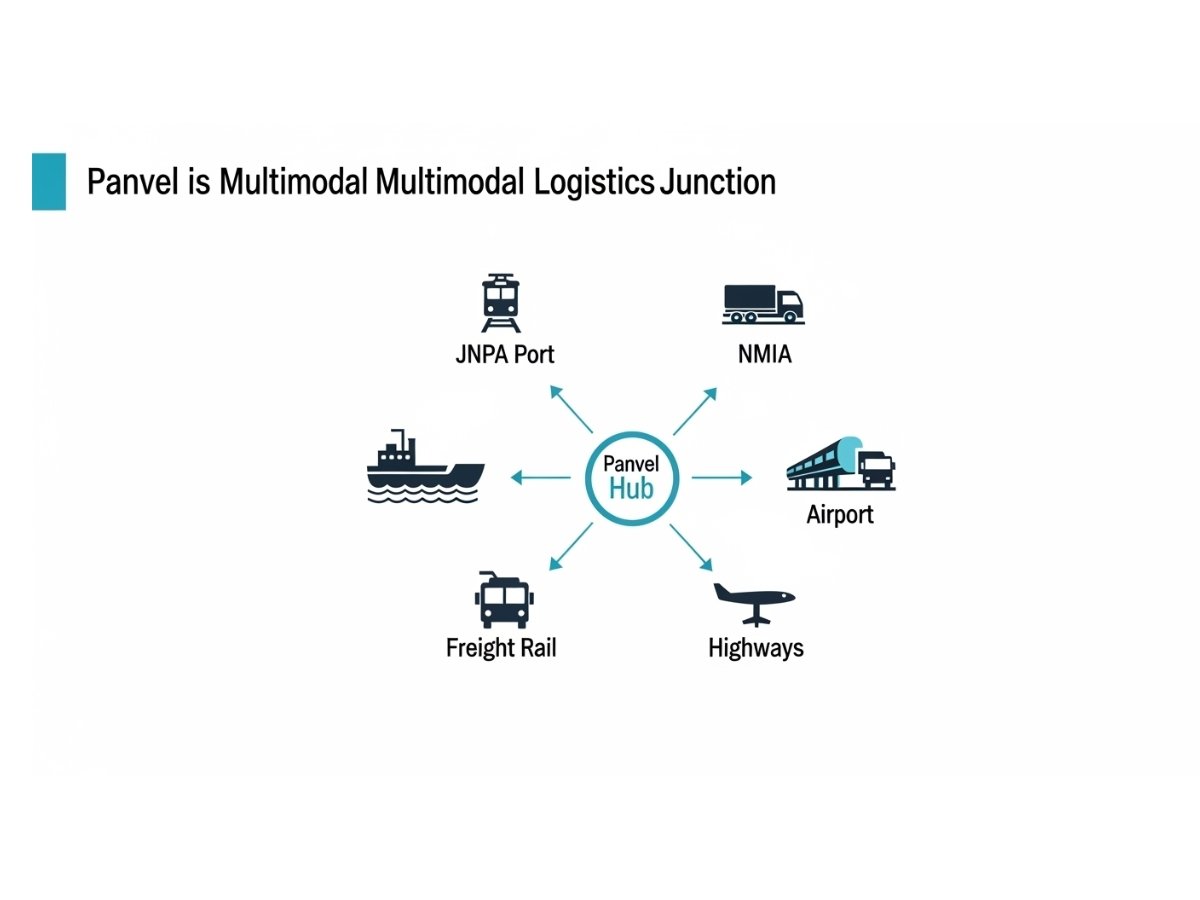
If NMIA is the selective gateway driver, the road and rail network is the operating backbone.
This is the part of the story that often matters the most for actual industrial growth.
Road-led freight movement and highway-linked warehousing
For a long time, Panvel-side industrial movement suffered because trucks exiting JNPA and heading toward major highway routes had to fight serious congestion around Palaspe Phata, Kalamboli, D-Point, and linked junctions. That meant wasted hours, unpredictable turnaround time, and weaker supply chain efficiency.
The approved JNPA-to-Chowk greenfield highway changes the logic because it aims to create a faster, direct freight route that bypasses major bottlenecks. Even before full market effects mature, the importance is obvious. If a corridor can cut freight delay sharply, warehousing and distribution demand improves around the right interchanges and access points.
This is why highway-linked warehousing near strong evacuation routes often gains faster than interior land sold on general infrastructure optimism.
Rail connectivity, freight logic, and why junction value matters
The Western Dedicated Freight Corridor is another major shift in how Panvel should be read industrially.
The dossier notes that the critical JNPT-side balance section saw trial runs completed by March 31, 2026, which is an important milestone. For industrial users, this matters because freight-dedicated rail changes bulk movement economics. It reduces dependence on mixed passenger rail schedules, supports container movement at scale, and improves the larger logistics value of the region.
For Panvel, the real strength is not just that freight rail exists somewhere in the state. The strength is that the region increasingly sits at a powerful junction between port movement, freight rail evacuation, and highway distribution. That is a real industrial advantage. A logistics market becomes stronger when cargo can shift efficiently from sea to rail, rail to road, and road to end user.
Why multimodal movement improves some industrial uses more than others
Not every occupier benefits equally from multimodal infrastructure. Large logistics aggregators, e-commerce fulfillment systems, export-linked manufacturers, container handlers, and transport-heavy operators gain the most. Their entire operating model improves when routes are faster, freight handling is more reliable, and cargo movement becomes less dependent on urban choke points.
Smaller local units, by contrast, may not need premium corridor positioning. A modest local manufacturer or storage operator may not be able to justify the higher land or rent cost near a major junction if their cargo volumes are limited.
The Panvel-Karjat suburban rail link also matters in a different way. Industrial growth is not only about cargo. It is also about labour movement. If staff and blue-collar workers can access industrial nodes more efficiently, that improves the viability of large logistics parks and manufacturing clusters over time.
Which industrial asset types benefit the most from this three-part growth story
| Asset type | Main growth driver | Who it suits | Market reading |
|---|---|---|---|
| Raw industrial land | NAINA planning, future highway corridors | Land aggregators, long-horizon investors, large developers | High upside, but high execution risk |
| Grade A warehouses and ready sheds | NMIA-linked logistics demand, road freight efficiency, port-airport linkage | 3PL, e-commerce, pharma, express logistics | Strongest near working corridors and usable micro-markets |
| Container yards, CFS-type support uses, transport yards | Port throughput, highway access, freight rail and truck movement | Logistics fleets, yard operators, support ecosystems | Strong operational relevance, especially near movement-heavy belts |
| Traditional factory sheds | Road and freight advantages, but heavy utility and compliance needs | Engineering, chemicals, ancillaries, industrial operators | Stronger in established ecosystems like Taloja MIDC than speculative greenfield plots |
Industrial land
Raw industrial land is where the biggest story is often sold. It is also where the biggest mistakes happen.
Yes, land can appreciate strongly when planning improves, corridors are announced, and industrial demand starts moving toward a belt. But raw land buyers take the maximum risk. They must deal with title clarity, zoning, NAINA implementation issues, access road status, utility creation, and long holding timelines.
So industrial land works best for well-capitalized players with patience and legal stamina. It is a weak fit for casual retail speculation.
Ready sheds and warehouses
These are the clearest near-term beneficiaries when logistics demand becomes real.
Why? Because occupiers do not want only future stories. They want immediate utility. A compliant warehouse with strong approach roads, height, loading, flooring, and freight access becomes much more attractive in an environment shaped by NMIA cargo growth, JNPA movement, and highway-freight improvement.
That is why ready Grade A space near the right Panvel-side belts can command stronger rentals and faster occupier attention than speculative land.
Transport yards, logistics parks, and support uses
These often get less glamour, but they are crucial in a freight-driven ecosystem.
Container yards, empty parks, fleet yards, maintenance-oriented support spaces, and logistics park land banks benefit directly from throughput. If road and rail connectivity improve and port evacuation gets smoother, these uses gain practical daily relevance.
In many industrial markets, support uses quietly become some of the most functional assets because they are tied to real movement, not only narrative.
Traditional factory use and where caution remains
Factory users need more than connectivity. They need power, environmental compliance, water, drainage, and sometimes effluent systems.
That is why established industrial ecosystems still matter. Taloja MIDC remains important because it already provides a more suitable regulatory and infrastructure environment for many manufacturing users. So while Panvel industrial growth is real, not every emerging location is equally suitable for factory-led use. For many standard manufacturing businesses, the smarter move is still an established industrial node rather than a newly marketed corridor plot.
Which Panvel-side locations are likely to benefit first, and which may lag
Panvel should not be read as one single industrial geography. The benefits are highly uneven.
The first beneficiaries are usually the belts closest to real freight movement advantage. The Palaspe Phata-Chowk side becomes important because the greenfield JNPA-Chowk route changes the logic of evacuation and warehousing. These are the kinds of locations where large-format logistics and distribution uses can strengthen first.
Taloja MIDC and its nearby influence zones also remain important because they already have a working industrial base. That makes them more dependable for factory-oriented users and for occupiers who need infrastructure now, not later.
Existing warehousing and freight-support villages in broader Panvel-side and MMR-region logistics belts, such as Adivali, Dhansar, and Koynavale, can also gain because established storage and freight activity often gets upgraded before completely new geographies become functional. Institutional money usually prefers upgrading proven belts rather than betting blindly on raw interiors.
By contrast, deeper NAINA villages without strong present connectivity, especially where land-pooling disputes or road execution issues remain, are more likely to lag. They may still become relevant later. But near-term industrial growth is usually corridor-led, not interior-map-led.
What changes first in an infrastructure-led industrial market: land pricing, occupier demand, or warehouse absorption
This sequence matters a lot for readers who are trying to judge whether a market is truly maturing or simply being marketed.
The early stage signal
The first signal is usually land pricing. Announcements come, maps circulate, corridor talk begins, and speculative buying pushes up expectations. This stage looks exciting, but it is also the least reliable for real industrial strength.
The stronger confirmation signal
The stronger signal is institutional commitment.
When major occupiers, logistics platforms, or large developers commit serious capital, the market story becomes more credible. The dossier’s FedEx example is important in this sense. Serious players do not usually move only on hype. They check cargo logic, connectivity, title, and future usability before placing large bets.
The late-stage signal
The strongest signal is warehouse absorption and stable leasing.
When built industrial space starts leasing consistently at workable rents, and occupiers renew because the location actually works, the micro-market has moved beyond future narrative. That is when a corridor starts becoming truly industrially relevant.
Where buyers and investors misread the Panvel industrial growth story
This topic creates a lot of excitement. It also creates a lot of confusion.
Buying only on airport hype
This is the most common mistake. Airport mention sounds powerful, so buyers assume all nearby industrial land becomes valuable.
But airport benefit is highly selective. If the eventual user has no cargo-speed dependence, no air freight relevance, and no supply chain reason to be near NMIA, then airport proximity alone is weak logic.
Confusing future corridor value with present industrial usability
A proposed or partly progressing corridor can improve long-term potential. That does not mean immediate usability.
The Virar-Alibaug Multimodal Corridor is a good example from the dossier. It is strategically important, but adjacency to a future expressway is not the same as actual access, and access-controlled roads do not behave like ordinary roads. Buyers who ignore that difference can lock money into land that remains functionally weak for years.
Ignoring compliance, approach roads, and plot functionality
This is where industrial due diligence becomes very different from residential-style land buying.
An industrial plot can look excellent on paper and still fail on the ground because:
- approvals do not support the intended use
- the access road is incomplete or blocked
- the plot shape is poor for loading or circulation
- truck movement is impractical
- utilities are not usable
- local authority permissions are incomplete or mismatched
In industrial real estate, one weak access road can destroy the value of a supposedly strong location.
Who should actually act on this trend, and who should stay selective
The Panvel industrial story is not for everyone.
Good fit
This trend is strongest for:
- large 3PL and logistics operators
- e-commerce fulfillment systems
- pharma and time-sensitive export-linked users
- institutional warehouse developers
- cargo support infrastructure players
- transport-linked yard and logistics park operators
These users can actually use the region’s multimodal advantage.
Selective fit
SMEs and standard light manufacturing operators should be more careful.
If the real need is simply stable industrial utility, reasonable rent, and practical operations, then paying a big infrastructure premium in a heavily marketed corridor may not make sense. Many such users may still find better value in established industrial ecosystems.
Poor fit
This is a poor fit for:
- short-term land flippers
- undercapitalized speculative buyers
- casual investors buying only on airport marketing
- buyers who cannot hold through long execution delays
- people unwilling to do serious land and access due diligence
What to check before buying industrial land, a shed, or a warehouse in this belt
Before buying in the Panvel industrial belt, check these points properly:
- Confirm the exact land use and whether the parcel is genuinely fit for industrial or warehousing use.
- Check whether CIDCO, NAINA-related planning control, PMC, MMRDA, MIDC, or another authority is the relevant layer for that site.
- Verify whether the required NOC or planning permissions are actually in place.
- Check whether the approach road exists physically, not only on map.
- Inspect truck turning, trailer movement, entry-exit practicality, and road width.
- Confirm power, water, drainage, and industrial utility readiness.
- For NAINA-influenced land, check whether village-level land pooling or TPS-related issues remain unresolved.
- Do not assume MahaRERA protection for industrial projects. The dossier clearly notes that industrial units and estates do not get that protection in the same way.
- If buying built stock, rely on strong private documentation, civil contractual safeguards, and deeper due diligence.
- Check whether the plot’s operational usefulness matches your actual use case. Not every “connected” plot is a useful industrial plot.
Final verdict: Panvel industrial growth is strongest where planning, gateway access, and freight movement meet
Panvel industrial growth is real, but it is concentrated, not uniform. NAINA helps by creating a more formal planning framework. NMIA helps by attracting selective cargo-driven and time-sensitive occupier demand. Rail-highway junction infrastructure helps by making freight movement faster, cheaper, and more reliable. The strongest industrial outcomes come where all three align in a usable way.
That is why the best opportunities are usually not the loudest-marketed ones. They are the locations with legal clarity, corridor relevance, real truck access, and genuine logistics utility. For warehouses, logistics parks, transport-linked support assets, and selected land plays, Panvel can become one of the most important industrial growth stories in this belt. But for deep speculative land, weak access plots, or factory users who still need established industrial utilities, caution remains necessary.
Does NAINA automatically make industrial land in Panvel more valuable?
No. NAINA improves planning potential, but industrial value rises properly only when land becomes usable through access roads, legal clarity, and utility support. A NAINA-linked plot can still remain weak if execution on ground is delayed.
Will NMIA benefit every industrial business in Panvel?
No. NMIA mainly benefits businesses connected to time-sensitive or high-value cargo, such as pharma, perishables, express logistics, and advanced supply chain operations. Heavy or bulk manufacturing usually gains much more from freight and highway improvements than from airport proximity itself.
Why are rail-highway junctions so important for Panvel warehouse growth?
Because warehousing works on movement efficiency. If trucks can exit faster, if freight can move through dedicated rail systems, and if port-linked cargo can connect to major distribution routes without long choke-point delays, warehouse demand becomes much stronger.
Which Panvel-side areas are likely to benefit first?
Belts with real corridor strength, such as the Palaspe-Chowk side, established logistics-support zones, and stronger industrial ecosystems like Taloja-side areas, are more likely to benefit first than deep interior speculative villages with weak present access.
Is industrial land near a future corridor a safe buy today?
Not automatically. Future corridor value and present industrial usability are different things. Access-controlled highways, land acquisition delays, and missing approach roads can leave a plot functionally weak for years even if the long-term map story looks strong.
Does MahaRERA protect buyers of under-construction industrial sheds or warehouses here?
The dossier indicates that industrial units and estates do not get the same MahaRERA protection. That means buyers should be extra careful with builder documentation, contractual structure, delivery risk, and legal due diligence.
Conclusion
If you want one practical line to remember, keep this: Panvel industrial growth is not being driven by hype alone, but by the selective convergence of planning, cargo relevance, and freight movement. NAINA without execution is incomplete. NMIA without the right occupier is overrated. Connectivity without usable access is not enough. The real winners will be the belts and asset types that convert these big infrastructure stories into everyday operational utility.
FAQs
Frequently Asked Questions