
Rent vs Buy in Seawoods: Which Option is best for the Buyers?
If you are confused between renting and buying in Seawoods, the practical answer is this: renting usually makes more sense if you are stretching financially, unsure about your timeline, or mainly paying for the Seawoods lifestyle. Buying makes more sense if you want long-term self-use, can comfortably absorb premium pricing and ownership costs, and are choosing the right building at the right deal. That is because Seawoods in 2026 is not a cheap future story. It is already a mature premium node with high capital values and comparatively modest rental yields.
Seawoods behaves very differently from places like Ulwe, Pushpak Nagar, or even some parts of Panvel. In those areas, buyers often enter because prices are lower and future growth is the main attraction. In Seawoods, the premium is for what already exists today: Palm Beach Road access, Seawoods-Darave station connectivity, the Nexus Seawoods Grand Central ecosystem, and a more polished end-user environment.
Quick Summary
Here is the simplest way to think about rent vs buy in Seawoods.
| Situation | Renting usually makes more sense | Buying usually makes more sense |
|---|---|---|
| Timeline | You may move in 3 to 7 years | You plan to stay 10+ years |
| Cash flow | EMI and upfront costs will squeeze you | EMI is comfortable and reserves remain strong |
| Purpose | Lifestyle access, flexibility, testing the area | Stable self-use, long-term family base |
| Building choice | You want premium amenities without capital lock-in | You found a strong building and fair deal |
| Risk tolerance | You do not want repair, transfer, or resale friction | You accept ownership complexity for control |
The main reason is the gap between monthly rent and the true cost of buying. Current listing data shows that a 2 BHK in Seawoods can rent roughly from the high ₹30,000s to around ₹90,000-plus depending on sector, furnishing, and amenities, while sale prices for 2 BHK flats commonly stretch from around ₹1.4 crore in older stock to well above ₹3 crore in premium towers.
So yes, renting wins on cash-flow efficiency, while buying wins on stability and long-term ownership control.
Why Seawoods gives a different rent-vs-buy answer than many other Navi Mumbai areas
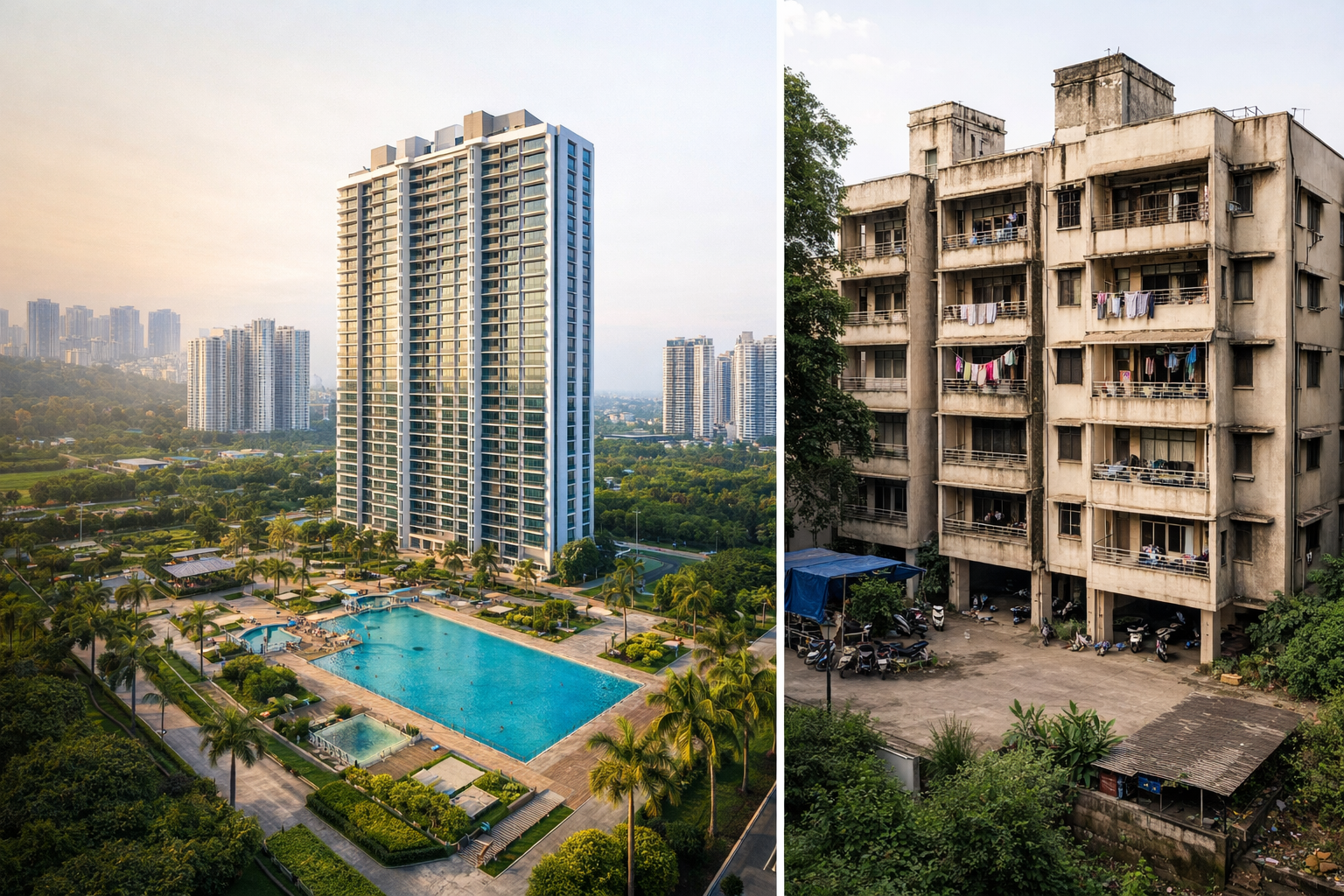
Seawoods is not a low-base market anymore. That changes everything.
Housing and 99acres both show Seawoods as a premium locality with average rates far above ordinary Navi Mumbai mid-market levels, and Seawoods West in particular sits at a much higher price band than the broader node average. That means you are often paying not for future possibility, but for present-day convenience and status.
This is where many buyers get confused. They apply the same logic used in airport-driven growth corridors: “buy now before prices run away.” But Seawoods has already priced in much of its location premium. It is closer to a defensive premium end-user market than an early-stage appreciation play.
In simple words, Seawoods is a place people often choose because they want:
- station access without chaos
- Palm Beach Road connectivity
- a more premium residential environment
- mall-office-transit convenience in one zone
- a long-term upgrade within Navi Mumbai
That is why the answer here is not emotional. It is structural.
When renting in Seawoods usually makes more sense
Your timeline is short or uncertain
If you think you may shift jobs, move schools, relocate to Mumbai, or upgrade again in a few years, renting is usually the safer decision. Premium property is expensive to enter and often slow to exit. A ₹2.5 crore to ₹3 crore flat is not something you can always liquidate quickly at the price you want.
You want the Seawoods lifestyle without locking in premium capital

This is one of the strongest cases for renting. Seawoods is one of the few places in Navi Mumbai where renting can actually be a smart way to “consume lifestyle” without taking on multi-crore ownership stress.
A tenant can access a premium 2 BHK in a strong society for roughly ₹60,000 to ₹80,000 in many active listings, while buying a comparable unit may require a huge down payment plus stamp duty, registration, brokerage, interiors, and society-related costs.
The EMI-to-rent gap feels too wide
This is the biggest practical signal.
A buyer looking at a premium 2 BHK around ₹2.5 crore may need:
- around ₹50 lakh or more as down payment
- stamp duty and registration on top
- brokerage
- parking or fit-out costs
- monthly EMI that can easily sit far above the rent of a similar unit
So if your rent is ₹65,000 but your true ownership outgo feels closer to ₹1.8 lakh to ₹2.1 lakh per month after all costs are considered, renting is not “wasted money.” It may be the more disciplined financial choice.
You are still testing commute, school, or family fit
This matters more in Seawoods than people admit. Some families love the station-mall convenience. Others later realise they prefer quieter sectors, less density near the commercial belt, or a different school pattern. Renting gives you time to test real life, not brochure life.
Quick checklist: You should lean toward renting in Seawoods if…
- You may move within 3 to 7 years
- The down payment will deplete your emergency buffer
- You want premium amenities but not premium liabilities
- You are unsure whether Seawoods East or West suits you better
- You are comparing Seawoods living with buying in a lower-cost node elsewhere
When buying in Seawoods usually makes more sense

You are buying for long-term self-use
If this is a 10-year-plus decision, the answer changes. Seawoods is one of those Navi Mumbai locations where buying can still make strong sense for self-use, especially for families and established professionals who want permanence.
Premium micro-markets often do not crash the way speculative markets can. They may slow down, plateau, or negotiate, but truly good stock in high-demand pockets remains hard to replace.
Your finances can absorb premium pricing and ownership costs
This part is non-negotiable. Buying in Seawoods makes sense only when:
- the EMI is comfortable
- you still have liquidity after down payment
- you can handle maintenance without stress
- you are not buying just to escape the feeling of “paying rent”
Maharashtra registration fee tables continue to show the ad valorem registration structure with a cap of ₹30,000 for high-value transactions, and the IGR Maharashtra fee structure remains the primary official reference point for such charges.
You found the right pocket, building, and deal quality
In Seawoods, buying the wrong flat just because it is “ownership” can be a costly mistake. A well-located, well-run, legally cleaner building in the right pocket is often more important than simply buying within the node.
You value stability more than flexibility
Some people want full control over interiors, long-term family settlement, address stability, and emotional certainty. In those cases, renting may remain mathematically superior, but buying can still be the correct decision.
EMI vs rent in Seawoods is not the only comparison that matters
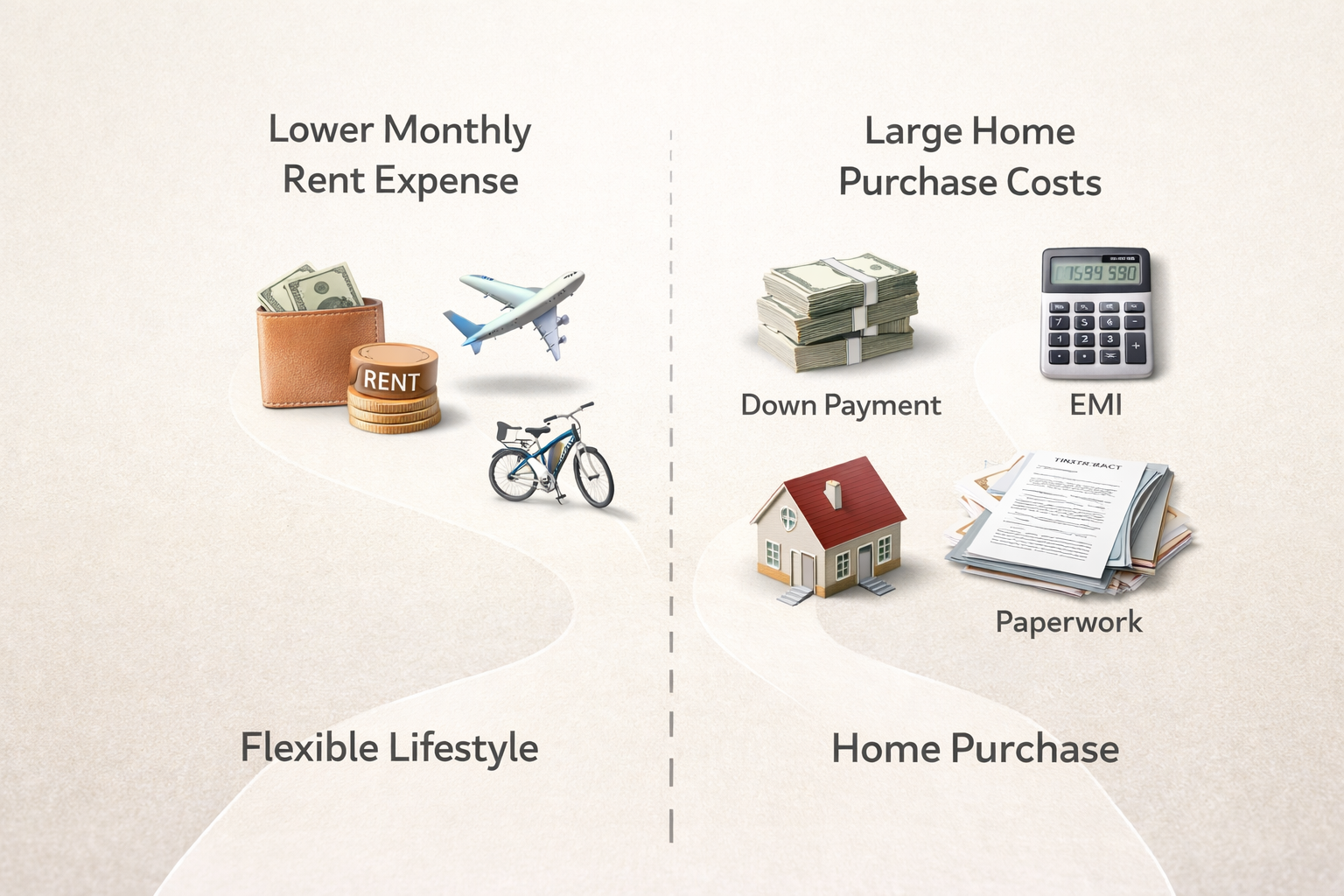
This is where most generic articles fail. They compare only EMI versus rent and stop there. In Seawoods, that is incomplete.
A practical 2 BHK scenario
Let us take a premium 2 BHK purchase at around ₹2.5 crore and compare it with renting a similar apartment at around ₹65,000 to ₹75,000.
| Cost layer | Buying a premium 2 BHK in Seawoods | Renting a similar 2 BHK in Seawoods |
|---|---|---|
| Upfront capital | Huge down payment, often ₹50 lakh+ | Deposit usually far lower |
| Stamp duty / registration | Significant extra cost on top of price | No stamp duty or registration |
| Brokerage | Usually payable | Usually payable |
| CIDCO / transfer / document friction | Can apply in resale depending on title structure and society status | Not your burden as tenant |
| Interiors / renovation | Can be very high, especially older stock | Usually limited to minor setup |
| Monthly outgo | EMI + maintenance + repairs risk | Rent, often simpler and more predictable |
| Exit flexibility | Low | High |
Now add the local reality. Premium towers can carry monthly maintenance that is meaningfully higher than older societies, while older societies may look cheaper but can hit you later through repairs, water-proofing, plumbing, lift replacement, and renovation. That is why a “cheap” resale flat in Seawoods can stop looking cheap very quickly.
Maintenance in premium towers vs older societies
This is a silent budget killer. Premium towers often come with better security, landscaping, gym, pool, clubhouse, and smoother management, but those amenities are not free. Older buildings may have lower monthly maintenance, but sometimes much higher uncertainty.
So the real question is not only Seawoods rent vs EMI. It is:
Can you afford Seawoods ownership after all the hidden costs, not just the base property price?
Which kinds of people should rent in Seawoods, and which should buy
| Reader type | Better fit | Why |
|---|---|---|
| Corporate commuter | Rent | Wants station and Palm Beach access without long lock-in |
| Family settling for 10+ years | Buy | Stability matters more than flexibility |
| Premium lifestyle renter | Rent | Can enjoy Seawoods without blocking massive capital |
| Yield-focused investor | Usually avoid or be cautious | Premium-node rental yield is usually modest |
| Existing Navi Mumbai upgrader | Buy | Seawoods can be a long-term upgrade destination |
| NRI or uncertain returnee | Rent first | Better to test the area and building before purchase |
This section matters because many readers are not asking a pure finance question. They are asking, “What should someone like me do?”
A commuter working toward CBD Belapur, Vashi, or even with South Mumbai rail dependence may find Seawoods ideal to rent. A family already committed to Navi Mumbai, with children’s schooling and strong liquidity, may be better off buying.
In Seawoods, the pocket and building matter almost as much as the buy-vs-rent decision
Seawoods is not one single uniform market. Local people know this clearly.
There is a big difference between:
- premium West-side, Palm Beach-oriented, tower-led living
- older inner sectors
- more utilitarian East-side stock
- high-convenience station-linked locations
- older cooperative inventory that may need heavy work
Current portal data itself shows the spread. Seawoods West rates and premium projects sit much higher than broader averages, while some sectors and resale stock remain notably lower.
That is why one important truth must be said plainly:
Renting a premium apartment in Seawoods West can sometimes be smarter than buying an older, compromise-heavy flat elsewhere in the node just to say you own in Seawoods.
That may sound uncomfortable, but it is often true.
A strategy many buyers ignore: rent in Seawoods, buy elsewhere
What can go wrong if you buy in Seawoods without checking the deal properly
This is where buyers lose money.
Overpaying for branding, furnishing, or view premium
Some listings are expensive because of actual location and building quality. Others are expensive because of staging, urgency, or seller expectations. In Seawoods, that difference matters a lot.
Ignoring society age, repair burden, or maintenance load
An older flat may look like a bargain, especially against new tower pricing. But then come:
- bathroom and plumbing rework
- waterproofing
- electrical upgrade
- carpentry and flooring
- society repair contributions
That can change the whole equation.
This is where local authority matters. Depending on the property, the buyer may need to verify:
- whether the society or plot structure has leasehold-related implications
- whether any CIDCO transfer or conversion issue affects cost or paperwork
- whether under-construction inventory is properly reflected on MahaRERA
- whether past property tax dues are clear
NMMC announced an Abhay Yojana for property tax defaulters on 10 March 2026, which is a reminder that municipal dues are not a minor side issue in resale transactions. Buyers should verify tax history before closing any deal.
On the CIDCO side, widely reported 2025 updates indicated higher transfer charges in Navi Mumbai, while 2025 reporting on CIDCO’s freehold-conversion move suggested that freehold status can reduce future transfer friction. These details can materially affect resale math and should be checked case by case before agreement. :contentReference[oaicite:8]{index=8}
So, should you rent or buy in Seawoods? Use this final decision framework
Use this final filter honestly.
| Ask yourself this | Rent if… | Buy if… |
|---|---|---|
| How long will I stay? | Less than 7 years is likely | 10+ years is likely |
| Can I handle the upfront hit? | Down payment and charges will strain reserves | You still remain financially comfortable |
| Why am I choosing Seawoods? | Mainly for lifestyle, convenience, prestige | For long-term living and stable anchoring |
| What kind of flat am I choosing? | The buy option has too many compromises | The chosen flat is strong on location, quality, and paperwork |
| What matters more right now? | Flexibility and capital preservation | Stability and control |
Final quick checklist
Choose rent if:
- you want Seawoods without locking in multi-crore capital
- the EMI will distort your lifestyle
- your work or family timeline is fluid
- you are still learning the node
Choose buy if:
- you are settling for the long term
- finances are genuinely comfortable
- the building and paperwork check out
- you are buying for self-use, not just fear of missing out
Conclusion
For many professionals, commuters, and short-to-medium-term residents, yes. The rent-to-ownership cost gap is large enough that renting can be financially smarter even when the rent itself looks high.
FAQs
Frequently Asked Questions