
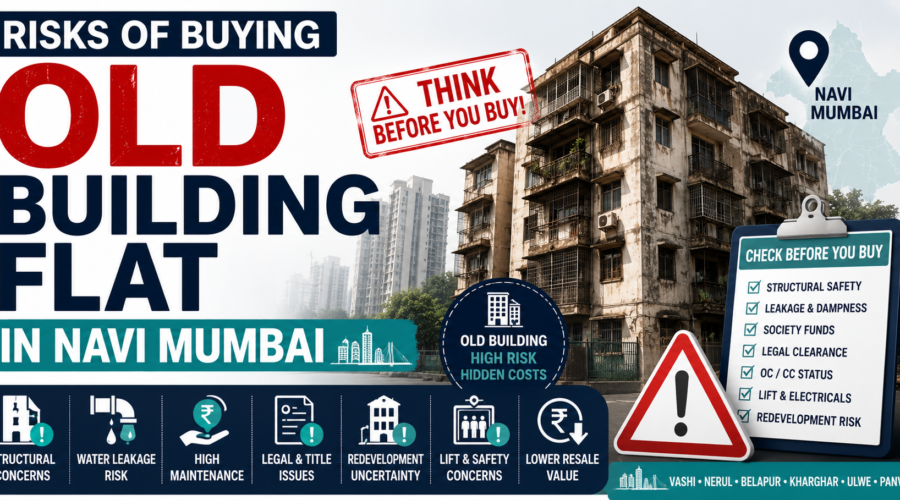
Risks of Buying Old Building Flat in Navi Mumbai: Buyer Checklist
The main risks of buying old building flat in Navi Mumbai are weak structure, missing OC or CC, unclear title, unpaid society dues, hidden mortgage, illegal alterations, no conveyance, and false redevelopment promises. Before paying token money, check the structural audit, society records, title chain, IGR records, MahaRERA status if applicable, CIDCO/NAINA permissions, and CRZ or land-use restrictions where relevant.
Is Buying an Old Building Flat Risky?
Buying an old building flat is not automatically bad.
Many old buildings in Vashi, Nerul, Kopar Khairane, Airoli, Ghansoli, Belapur, Kharghar or Panvel have good locations, bigger usable space and active societies.
But the risk is higher than buying a newer flat.
Why?
Because old flats usually carry more history.
There may be multiple past owners, old agreements, missing original documents, repair issues, society disputes, unpaid dues, weak structure or redevelopment rumours.
So the right question is not “Is old flat good or bad?”
The right question is:
Can this old flat pass legal, structural, society and authority verification before I pay token money?
If the answer is no, pause the deal.
This is an educational guide. Verify the latest position with the relevant authority or a property lawyer before making a transaction.
Main Risks of Buying Old Building Flat
1. Weak Structure or Dangerous-Building Risk
This is the biggest old-building risk.
A flat may look renovated from inside, but the building may have:
- leakage,
- cracks,
- exposed steel,
- weak columns,
- terrace seepage,
- lift problems,
- poor drainage,
- unsafe staircases.
In Navi Mumbai, structural safety is a serious issue for old buildings. Buyers should ask whether the society has completed a recent structural audit through a qualified structural engineer.
Do not trust only fresh paint, new tiles or a renovated kitchen.
A renovated flat inside a weak building is still a risky purchase.
Ask for:
| Check | Why it matters |
|---|---|
| Structural audit report | Shows building condition |
| Repair recommendations | Shows pending safety work |
| Dangerous-building notice | Shows municipal risk |
| Engineer certificate after repair | Shows whether repair was completed |
| Society repair fund status | Shows whether society can handle major repairs |
2. Missing OC, CC or Approved Plan
OC means Occupancy Certificate.
CC means Commencement Certificate.
The approved building plan shows what was legally permitted.
For an old flat, these documents help you check whether the building and flat were built with proper approval.
If OC, CC or approved plans are missing, it can affect resale, home loan, redevelopment, repair permission and future buyer confidence.
Ask for:
- OC,
- CC,
- approved building plan,
- completion certificate, if available,
- municipal or planning authority records.
The correct authority depends on the location. It may be NMMC, Panvel Municipal Corporation, CIDCO, NAINA or another planning authority.
3. Unclear Title Chain
Old flats may have many past transactions.
The seller may have purchased it, inherited it, received it through gift deed, or got it after family settlement.
So check the title chain properly.
Ask for:
- current sale deed,
- previous sale agreements,
- Index II,
- share certificate,
- title deed,
- gift deed, release deed or heirship documents, if applicable,
- death certificate and legal heir documents in inheritance cases,
- Power of Attorney, if the seller is not personally signing.
A document supports verification. It should not be treated as automatic ownership proof without lawyer review.
If seller name, society record and registered document do not match, do not pay token money. —
4. Society Share Certificate and Membership Issues
In a cooperative housing society, the share certificate is important.
It should show the seller as the society member.
Also check:
- society NOC,
- no-dues certificate,
- transfer forms,
- maintenance payment record,
- repair fund dues,
- pending disputes,
- redevelopment meeting records, if any.
If the seller says “society will give documents later,” pause.
For old flats, society records often reveal hidden problems faster than the broker does.
5. No Conveyance or Deemed Conveyance
Many old societies still have weak land/title documentation.
Conveyance means the land and building rights are transferred to the society.
Deemed conveyance is a legal route where society applies to get conveyance when the builder has not completed it.
This becomes very important during redevelopment.
If the seller or broker says “redevelopment is coming soon,” ask:
- Does the society have conveyance or deemed conveyance?
- Has the society passed redevelopment resolutions?
- Is a developer selected?
- Is there a development agreement?
- Are rent, corpus, extra area and timelines written?
- Is the project registered with MahaRERA where applicable?
Do not pay a higher price only because someone says redevelopment will happen.
A redevelopment promise is not the same as redevelopment approval.
6. Hidden Loan, Mortgage or Litigation
An old flat may have a pending loan, bank charge, family dispute or court matter.
Check:
- bank NOC,
- loan closure letter,
- CERSAI search,
- IGR search,
- litigation search by lawyer,
- society dispute records,
- whether all co-owners are signing.
IGR Maharashtra eSearch can support document-history checking, but online eSearch information should not be treated as an ownership certificate.
Use it as a verification tool, not as final legal proof.
7. Unpaid Society Dues and Repair Liabilities
Old buildings may have high repair costs.
Before purchase, check whether the seller has cleared:
- monthly maintenance,
- sinking fund,
- repair fund,
- property tax,
- water dues,
- electricity dues,
- parking charges,
- penalty charges,
- redevelopment contribution, if any.
Ask for written no-dues confirmation from the society.
Do not rely only on the seller’s statement.
8. Illegal Alterations Inside the Flat
Many old flats have internal changes.
Common examples:
- enclosed balcony,
- shifted kitchen,
- changed bathroom position,
- broken internal walls,
- loft or mezzanine,
- duct modification,
- merged rooms,
- parking conversion.
Some changes may be minor. Some may affect structure, drainage, fire safety or approval compliance.
If the flat has major changes, ask for society permission and relevant approval where needed.
For structural changes, verify with an architect or structural engineer.
9. CIDCO, NAINA, Gaothan, NA or CRZ Risk
This applies more in areas such as Panvel, Ulwe, Taloja, Dronagiri, Uran, Raigad belt, gaothan pockets, village-side properties and NAINA-influence areas.
For such properties, flat-level documents may not be enough.
You may also need to check:
| Area / issue | What to verify |
|---|---|
| CIDCO-origin property | allotment, lease deed, transfer permission, dues, OC |
| NAINA area | zoning, Zone Confirmation Statement, development permission |
| Gaothan property | property card, village limits, mutation entries |
| NA / land conversion | land-use permission or planning approval position |
| CRZ / creek-side property | CZMP, CRZ category, mangrove or buffer restrictions |
Maharashtra land-use and NA permission rules have changed in recent years. Do not assume NA permission is always required or never required.
For NAINA, gaothan, CRZ, green zone or land-use questions, verify before transaction with a property lawyer, revenue office or planning authority.
What to Check Before Paying Token Money
Before paying token money for an old building flat, ask for these minimum documents.
| Category | Documents to check |
|---|---|
| Seller ownership | sale deed, previous agreements, Index II, title chain |
| Society records | share certificate, society NOC, no-dues certificate |
| Building approval | OC, CC, approved plan, completion records |
| Structural safety | structural audit, repair report, dangerous-building notice |
| Financial risk | bank NOC, loan closure letter, CERSAI, tax receipts |
| Land records | property card, 7/12, 8A, mutation entries where applicable |
| Authority checks | NMMC, PMC, CIDCO, NAINA, MCZMA, MahaRERA where relevant |
| Redevelopment | conveyance, resolutions, developer selection, agreement, RERA status if applicable |
Rule: no document review, no token money.
If the seller refuses basic documents, that itself is a red flag.
For deeper checks, read Navi Mumbai property fraud checklist, property title fraud checks, and paying token amount before document verification.
How to Verify an Old Building Flat in Navi Mumbai
Step 1: Inspect the building first
Do not inspect only the flat.
Check the staircase, terrace, lift, parking, columns, exterior walls, water seepage and common areas.
Speak to society members if possible.
Step 2: Match seller records
The seller’s name should match the sale deed, society record, share certificate and identity documents.
If there are co-owners, all must sign.
If there is a Power of Attorney, get it checked by a lawyer.
Step 3: Check IGR records
Use IGR Maharashtra for registered document history and Index II search.
But remember: IGR search supports verification. It is not a final ownership certificate.
Step 4: Check Mahabhulekh / Mahabhumi records
For land-linked checks, use Mahabhulekh or Mahabhumi for 7/12, 8A and property card where applicable.
7/12 shows land details in revenue records.
8A generally relates to account/holding details.
Property card is commonly used in urban land-record verification.
Use digitally signed records where legal use is required.
Step 5: Check MahaRERA where relevant
If the old building is under redevelopment, builder sale or new project registration, check MahaRERA.
Look for:
- project registration,
- promoter name,
- project status,
- complaints,
- orders,
- lapsed or revoked status,
- abeyance status.
MahaRERA registration is useful, but it does not remove the need for independent legal and document verification.
Step 6: Check CIDCO / NAINA / CRZ where relevant
For Navi Mumbai and surrounding growth areas, local authority verification can decide the deal.
Check CIDCO or NAINA records where the property falls under their jurisdiction.
For coastal, creek-side or mangrove-sensitive areas, check CRZ/CZMP status through the relevant authority.
Red Flags
Pause or walk away if you see these signs:
- Seller says, “Pay token first, documents later.”
- OC or CC is missing.
- Society refuses to give NOC or no-dues certificate.
- Share certificate is not in seller’s name.
- Structural audit is missing for an old building.
- Building has dangerous-building notice.
- Seller cannot explain title chain.
- Flat has loan but no bank NOC.
- Co-owner or legal heir is not signing.
- Broker says redevelopment is guaranteed but has no records.
- CIDCO transfer or NAINA zoning is unclear.
- CRZ, gaothan or NA status is unclear.
- Original documents are missing.
- Area in agreement, society record and physical flat does not match.
A cheap old flat becomes expensive when the risk is hidden.
Common Mistakes Buyers Make
Mistake 1: Buying only because the price is low
Low price may mean poor condition, weak documents, major repairs or dispute risk.
Mistake 2: Trusting redevelopment rumours
Redevelopment should be checked through society records, conveyance status, developer documents and legal review.
Mistake 3: Assuming bank loan approval means the property is safe
Bank checks are useful, but they are not a full title, structural, society and zoning verification.
Mistake 4: Checking the flat but ignoring the building
The flat may look good. The building may still be unsafe.
Mistake 5: Ignoring land and authority checks
This is risky in CIDCO, NAINA, gaothan, CRZ, green zone and village-side areas.
For related checks, read CIDCO allotment and transfer fraud checks, NAINA zoning and plot fraud checks, and fake CIDCO plot documents.
conclusion
Before buying an old building flat in Navi Mumbai, verify the documents before paying token money.
Check the title chain, society records, structural audit, OC/CC, dues, redevelopment status and authority permissions.
If the flat is linked to CIDCO, NAINA, gaothan, CRZ, green zone or old land records, get professional verification first.
For the next step, use verify old flat documents before token.
FAQs
Frequently Asked Questions