
Risks of Buying Property Without Society in Navi Mumbai: Buyer Checklist
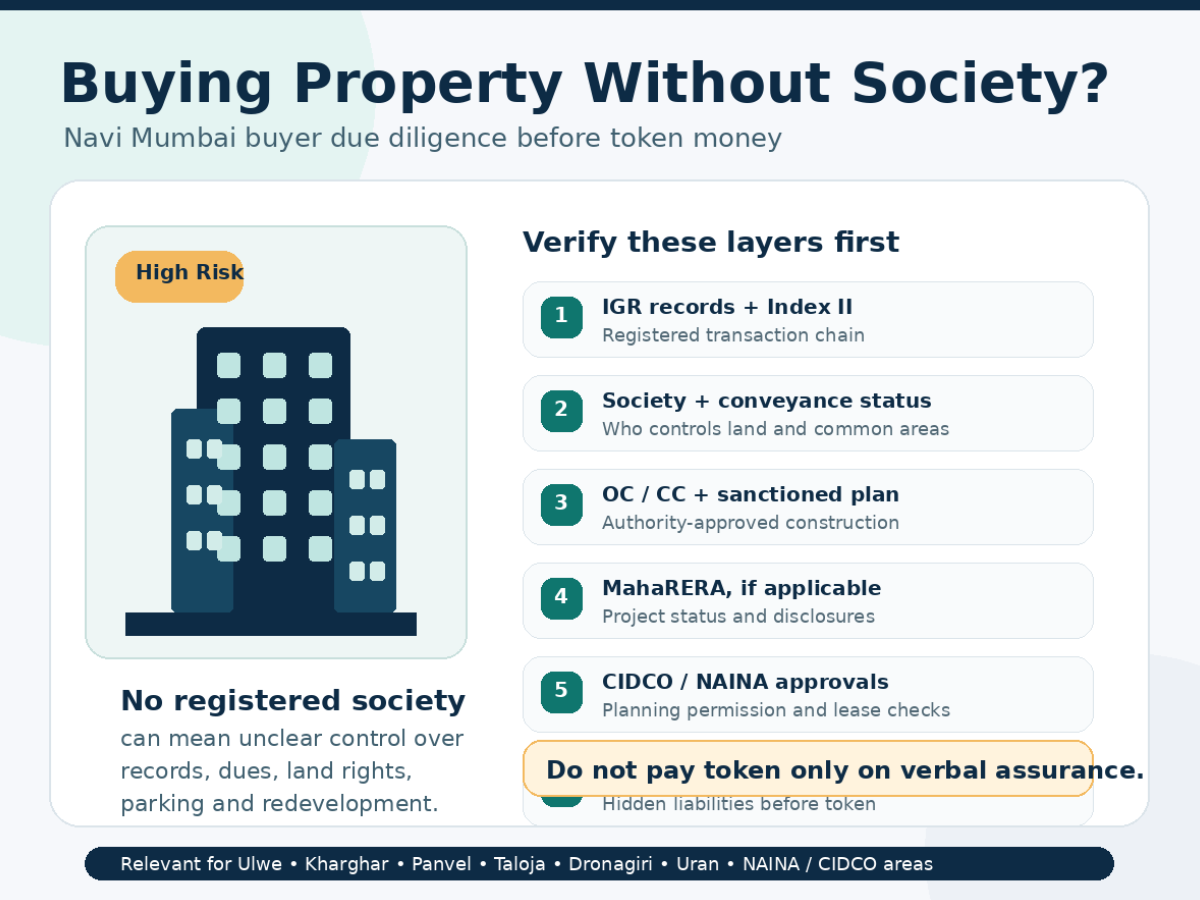
Buying property without a registered society is not automatically illegal, but it is a high-risk deal unless the title, conveyance, approvals, dues, encumbrances and seller authority are verified. Before paying token money in Navi Mumbai, Panvel, Ulwe, Kharghar, Taloja, Dronagiri, Uran, NAINA or CIDCO areas, check IGR records, land records, OC/CC, MahaRERA status and conveyance documents.
Should You Buy Property Without Society?
You can consider it only after proper verification.
But do not treat it as a small paperwork issue.
A “property without society” can mean different things. The society may not be registered. The society may be registered but conveyance may not be completed. Or the builder may still control important documents, land rights, parking, common areas or future redevelopment value.
Do not pay token money only because the broker says, “Society will be formed later.”
In Navi Mumbai and nearby markets, this becomes more important because properties may fall under CIDCO, NAINA, gaothan, village land, leasehold, redevelopment, coastal, CRZ or mixed land-record situations.
What “Without Society” Actually Means
1. No registered cooperative housing society yet
The building may be occupied, but the legal society may not be registered. Residents may have an informal committee, but that is not the same as a registered cooperative housing society.
A registered society helps maintain member records, dues records, transfer process, share certificates, maintenance decisions and future redevelopment decisions.
2. Society formed, but conveyance not done
This is a major issue.
Conveyance means the land and building rights are transferred from the builder or landowner to the society. Deemed conveyance is a legal route used when the builder does not execute conveyance.
If the society exists but conveyance is pending, the building may still face future title, redevelopment or common-area control issues.
3. Builder still controls key rights
In some cases, the builder may delay society formation because control over land, FSI, parking, terrace, open spaces or future development rights is still commercially useful.
This does not automatically prove fraud. But it is a clear signal to verify documents before paying.
4. CIDCO, NAINA or gaothan-related property
In CIDCO or NAINA areas, society status is only one part of due diligence.
A buyer should also check lease conditions, transfer permissions, commencement certificate, occupancy certificate, approved plan, development permission, property card, 7/12 extract and mutation entries.
For gaothan or village-side property, society may not be the central issue. The bigger risk may be unclear title, old family ownership, access road, sanad, land conversion, CRZ, green zone or no-development zone.
Main Risks of Buying Property Without Society
| Risk | Why it matters |
|---|---|
| Unclear land or building control | Buyer may not know who legally controls land, common areas or future rights |
| No reliable dues record | Maintenance, water, electricity, property tax or builder dues may be hidden |
| Weak resale trail | Future buyer or bank may question missing society records |
| Pending conveyance | Society may not have full control over land/building rights |
| Builder dependency | Buyer may depend on builder for NOC, transfer, records and clarifications |
| Loan confusion | Bank loan approval does not mean title is fully safe |
| Future redevelopment risk | Society may struggle during redevelopment if title/conveyance is unclear |
| Fraud risk | Token money may be collected before documents are properly verified |
Documents to Check Before Paying Token Money
Use this checklist before paying even a small token amount.
| Document / Record | What it helps verify |
|---|---|
| Registered agreement or sale deed chain | Whether past transfers are properly registered |
| Index II | Summary of registered transaction details |
| Society registration certificate | Whether a legal society exists |
| Share certificate | Whether seller is recorded as a society member |
| Conveyance deed or deemed conveyance order | Whether land/building rights moved to the society |
| 7/12 extract | Land record for survey-number-based land |
| 8A extract | Revenue record connected with landholding details |
| Property card | Urban property record, often used for city survey/CTS properties |
| Mutation entry | Change in land record after sale, inheritance or transfer |
| OC | Whether occupancy was permitted by authority |
| CC | Whether construction commencement was approved |
| Sanctioned plan | Whether construction matches approved plan |
| MahaRERA project page | Project status, approvals, encumbrance, title report, if applicable |
| CIDCO / NAINA approval | Planning permission, CC/OC and development-plan relevance |
| Dues statement | Maintenance, utility, society/builder dues |
| Bank NOC / loan closure proof | Existing mortgage or loan clearance |
| Lawyer title-search report | Independent legal review before token |
Important: A document supports verification. Do not assume one document alone “proves ownership.”
How to Verify the Property
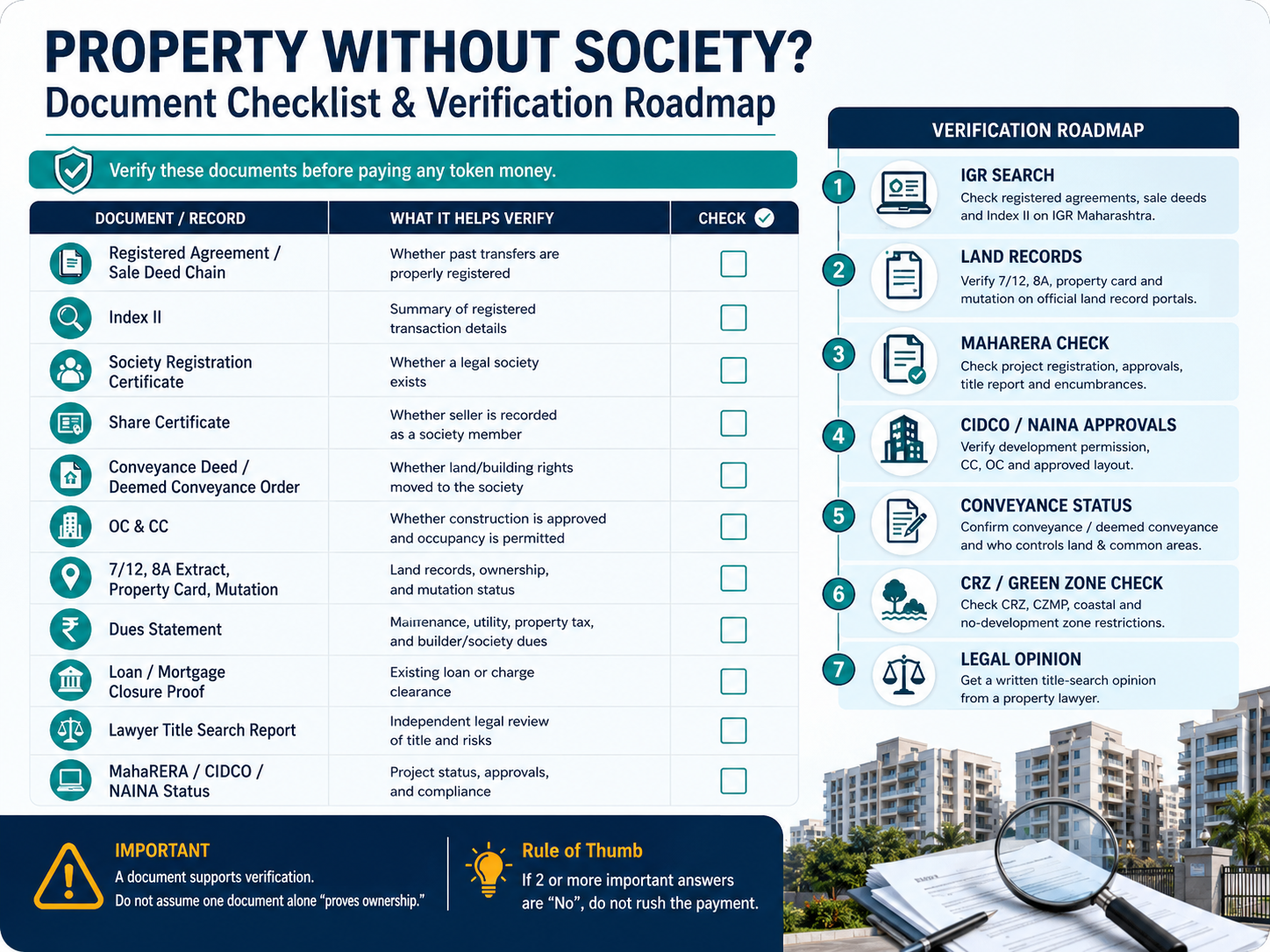
Step 1: Search IGR Maharashtra records
Check registered agreements, sale deeds and Index II through IGR Maharashtra eSearch.
This helps verify whether the transaction chain is registered and whether party names, flat details, survey numbers, CTS numbers or consideration details are consistent.
Step 2: Check land records
For land-linked properties, check 7/12 extract, 8A, property card and mutation entries through official Maharashtra land-record portals.
Plain meaning:
- 7/12 extract: land record showing survey number, area, occupant/holder and land details.
- 8A extract: revenue-related landholding record.
- Property card: urban land/property record, commonly linked to city survey or CTS properties.
- Mutation entry / फेरफार: record of change after sale, inheritance, transfer or other event.
These records support due diligence. They are not a replacement for legal title search.
Step 3: Check MahaRERA, if applicable
For applicable registered projects, check the project on MahaRERA.
Look for:
- Project registration status
- Promoter name
- Legal title report
- Encumbrance details
- Approved plans
- Commencement certificate details
- Completion timeline
- Complaints, if visible
- Lapsed, revoked or abeyance status
Do not assume a RERA number means the property is fully safe. It is one verification layer.
Step 4: Check CIDCO or NAINA approvals
For Panvel, Ulwe, Dronagiri, Uran, Taloja, Pushpak Nagar and NAINA-side properties, check CIDCO/NAINA permission records where relevant.
Ask for:
- Development permission
- Commencement certificate
- Occupancy certificate
- Approved layout
- Building permission
- NAINA zoning or development-plan relevance
If the property is in a NAINA or village-edge area, verify with the planning authority before relying on broker claims.
Step 5: Check conveyance status
Ask whether conveyance has been executed in favour of the society.
If not, ask:
- Why is conveyance pending?
- Has the society applied for deemed conveyance?
- Whose name appears on the property card or land record?
- Does the builder still control land/common areas?
- Has a lawyer reviewed the title chain?
If answers are unclear, pause the deal.
Step 6: Check CRZ, green zone or no-development-zone risk
For coastal, creek-side, mangrove-adjacent or village land near Uran, Dronagiri, Panvel, Raigad or Thane belts, check CRZ/CZMP and planning restrictions.
A low price is not useful if development, transfer, construction or future resale becomes difficult.
Step 7: Get a written legal opinion
For property without society, no conveyance, missing OC, gaothan property, NAINA plot, CIDCO leasehold property, POA sale, family dispute or mutation mismatch, get a written title-search opinion from a property lawyer.
Verify before transaction.
Navi Mumbai Example
Suppose a buyer is considering a resale flat in Ulwe.
The building is occupied. The broker says the residents manage maintenance. The seller says the society is “in process.” The bank says a loan can be processed.
This is not an automatic rejection.
But the buyer should not pay token until these are checked:
- Registered agreement chain
- Index II
- Seller identity and authority
- OC and CC
- Society registration status
- Conveyance status
- Property card or land record
- MahaRERA status, if applicable
- CIDCO/NAINA approval, if relevant
- Dues and loan closure proof
- Lawyer’s written title note
If society and conveyance are both missing, the risk increases. The buyer should pause and verify who controls the land, building and common areas.
Red Flags
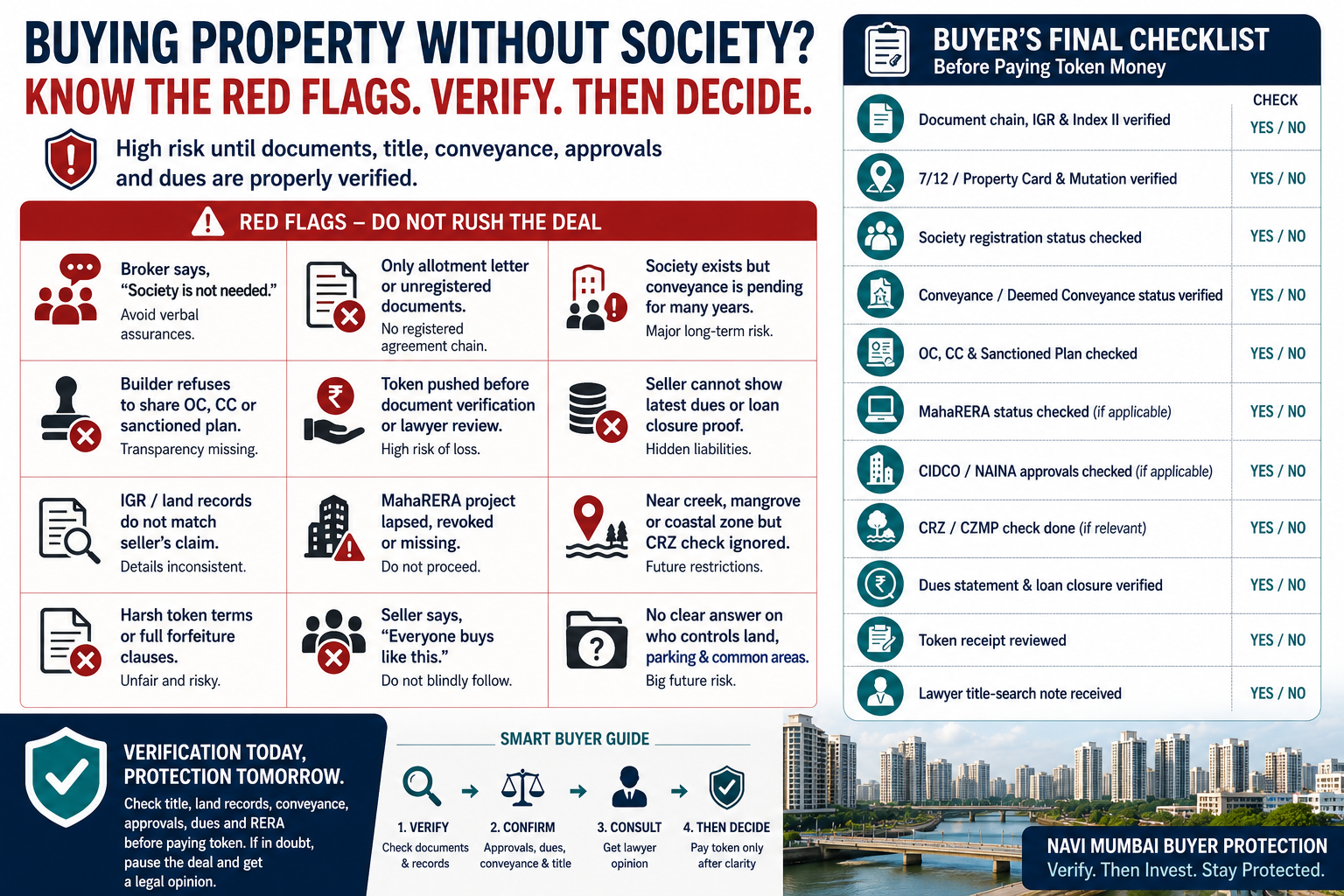
Avoid rushing if you see these signs:
- Broker says, “Society is not needed.”
- Seller cannot show registered agreement chain.
- Only allotment letter is available.
- Society exists, but conveyance is pending for many years.
- Builder refuses OC, CC or sanctioned plan.
- Seller cannot show latest dues status.
- IGR records do not match the sale documents.
- 7/12, property card or mutation entries do not match the seller’s claim.
- MahaRERA project is lapsed, revoked, missing or inconsistent.
- CIDCO/NAINA approval proof is not available.
- Property is near creek, mangrove or coastal zone but CRZ check is ignored.
- Broker pushes for token before lawyer review.
- Token receipt has harsh forfeiture terms.
- Seller says, “Everyone buys like this.”
Common Mistakes Buyers Make
- Paying token before document review.
- Treating bank loan approval as full legal clearance.
- Confusing informal committee with registered society.
- Ignoring conveyance because people already live in the building.
- Accepting old land-record copies.
- Not checking IGR records close to the transaction date.
- Not checking OC/CC in CIDCO or NAINA areas.
- Assuming RERA registration removes all title risk.
- Buying gaothan or village property without revenue-record review.
- Not asking who controls future redevelopment rights.
What to Check Before Paying Token Money
Use this final decision checklist.
| Check | Status |
|---|---|
| Seller name matches registered document chain | Yes / No |
| IGR eSearch checked | Yes / No |
| Index II checked | Yes / No |
| 7/12 or property card checked | Yes / No |
| Mutation entries checked | Yes / No |
| Society registration checked | Yes / No |
| Conveyance or deemed conveyance status checked | Yes / No |
| OC and CC checked | Yes / No |
| MahaRERA checked, if applicable | Yes / No |
| CIDCO / NAINA approval checked, if applicable | Yes / No |
| CRZ / CZMP checked, if relevant | Yes / No |
| Dues statement checked | Yes / No |
| Loan or mortgage closure checked | Yes / No |
| Token receipt reviewed | Yes / No |
| Lawyer title-search note received | Yes / No |
If two or more important answers are “No,” do not rush the payment.
Conclusion
Before paying token for a flat, plot or resale property without society in Navi Mumbai, get the documents checked properly. Start with property due diligence in Navi Mumbai, then move to title, land records, society, conveyance, RERA, CIDCO/NAINA and dues verification.
This is an educational guide. Verify the latest position with the relevant authority or a property lawyer before making a transaction.
FAQs
Frequently Asked Questions