

Seawoods vs Vashi for Retail Investment: Which Node Works Better in Navi Mumbai?
For most retail investors, Vashi is the safer default. It has broader everyday demand, older but stronger commercial habits, and a deeper tenant pool across many retail categories. Seawoods can still beat Vashi, but mostly in selected premium, station-linked, and mall-influenced pockets. In other words, this is not just a Seawoods vs Vashi decision. It is a micro-location decision inside those two nodes.
Seawoods or Vashi for retail investment: what is the practical answer?
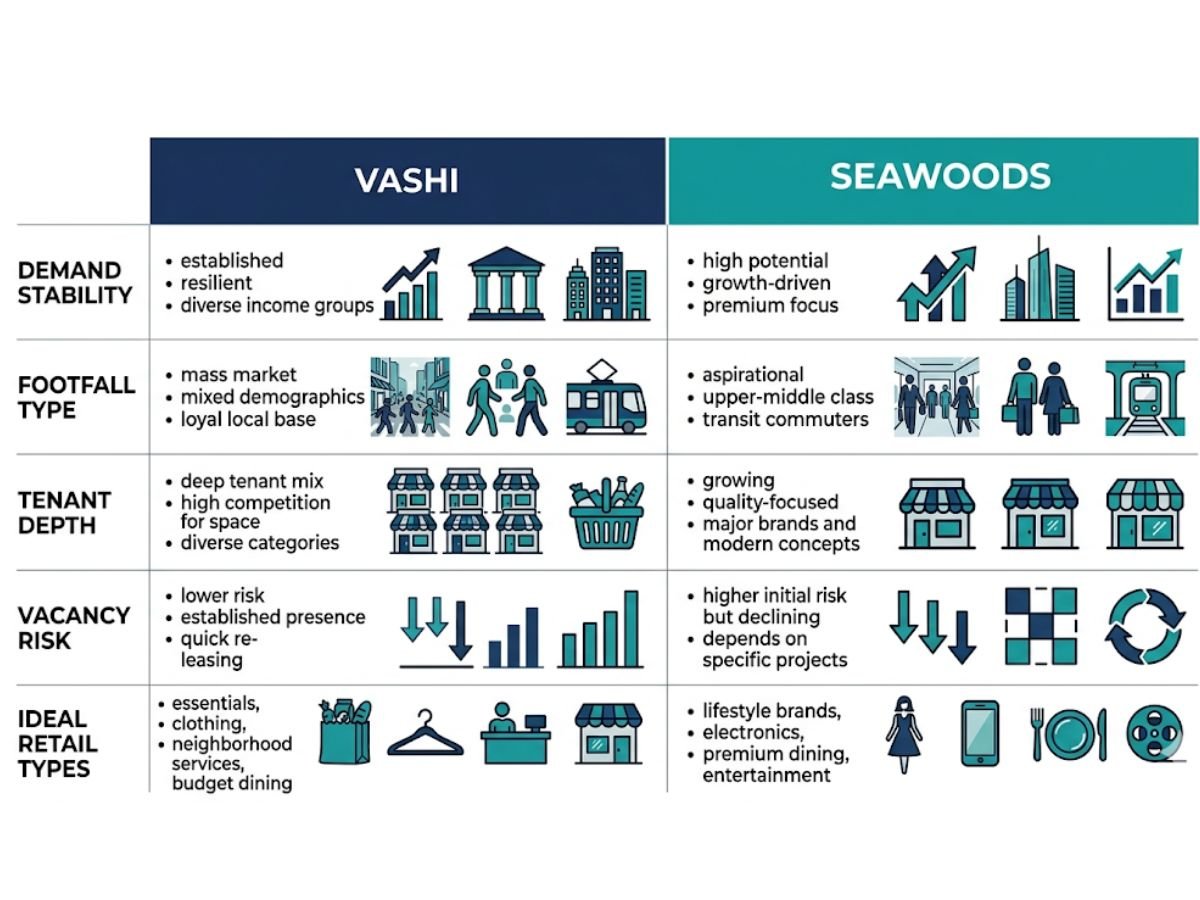
The practical answer is simple.
If you want safer retail demand, easier tenant replacement, and wider category fit, Vashi usually works better.
If you want a premium environment, modern presentation, cleaner customer experience, and selective lifestyle retail upside, Seawoods can work very well, but only in the right pocket and with the right tenant type.
Before comparing both nodes directly, Seawoods Commercial Property Guide is worth reading for the local context.
Quick summary
| Factor | Vashi | Seawoods |
|---|---|---|
| Retail investment safety | Usually stronger | Selective |
| Footfall type | Utility, business, destination shopping | Transit, leisure, lifestyle |
| Tenant depth | Broader | Narrower but premium in selected pockets |
| Vacancy risk | Lower in proven pockets | Low near station/TOD, higher in internal sectors |
| Best for | Everyday retail, service retail, financial, medical, electronics, food | Premium salon, boutique café, curated F&B, lifestyle-led retail |
| Main risk | Older stock, parking stress, hidden capex | Mall halo trap, overpaying for prestige, weaker internal retail |
| Better default for most investors | Yes | No |
| Can outperform in the right micro-location | Yes | Yes, but more selectively |
Why Vashi usually feels safer for retail investors
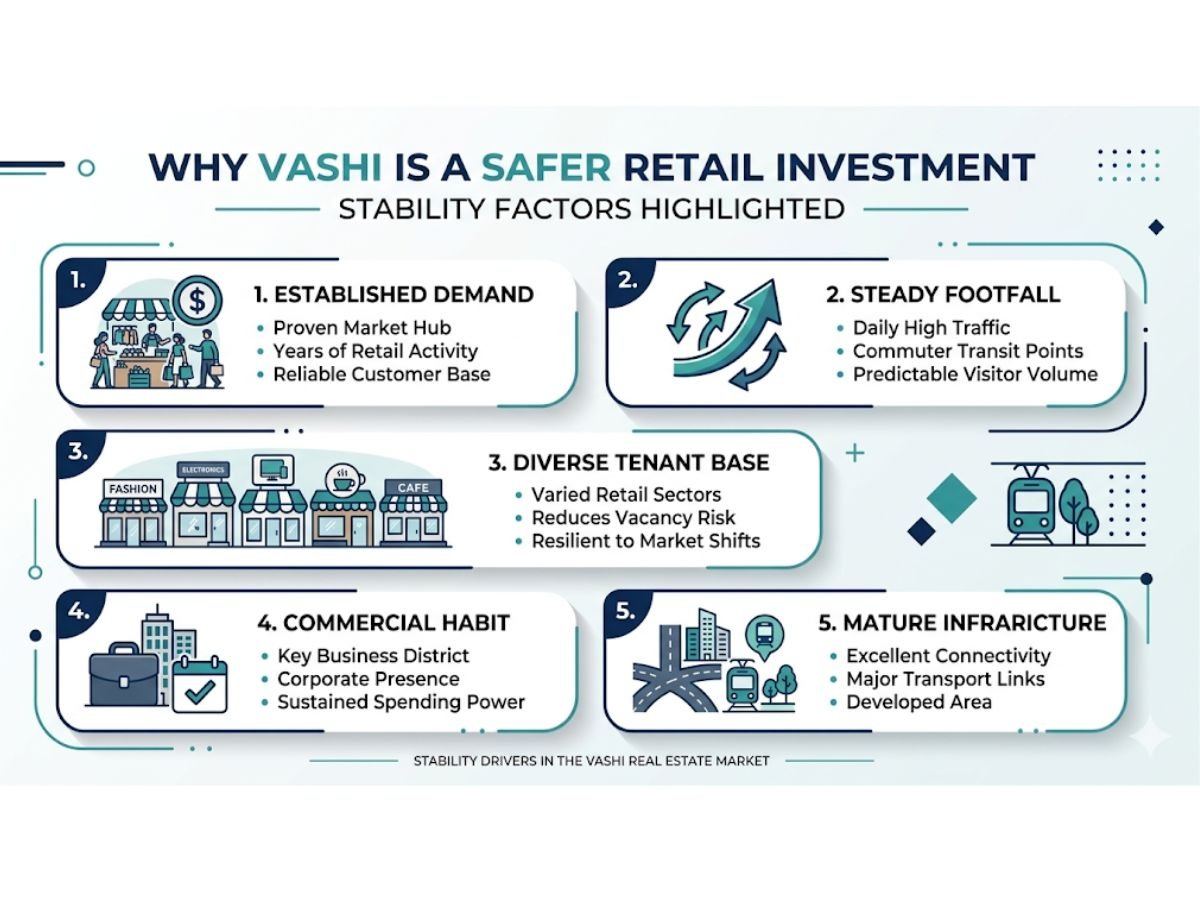
Vashi feels safer because it has been a working commercial market for decades. Not just a premium-looking node. A working one.
The difference matters. In Vashi, people already come for specific purposes: shopping, banking, diagnostics, coaching, office work, wholesale buying, electronics, food, and daily services. That creates a more forgiving retail ecosystem.
Why Vashi’s established commercial habit matters more than image
A lot of investors underestimate this point. They see an older building in Vashi and assume it is weaker than a cleaner-looking modern unit elsewhere. But in retail, habit beats appearance very often.
A dated shop in a proven Vashi pocket can still outperform a prettier unit in a quieter premium area because shoppers already know the area, visit it regularly, and transact there with intent.
That is why Vashi still holds its ground so strongly. The demand does not depend on one single catalyst. It comes from layered activity across offices, markets, transport links, financial institutions, and service businesses.
Which types of shops usually fit Vashi better
Vashi usually suits:
- daily utility retail
- electronics and related trade
- medical diagnostics and support retail
- banking and finance-linked retail
- food formats with regular business catchment
- services that need repeat local plus regional footfall
This is especially true in proven pockets where people are already moving for work or purchase reasons, not just strolling.
Where Vashi’s advantage becomes weaker
Vashi is not automatically perfect.
Its weaker side shows up when a buyer ignores:
- old building condition
- parking stress
- traffic friction
- frontage depth
- loading and unloading difficulty
- hidden repair or society costs
So yes, Vashi is safer. But only if you buy in a working pocket, not because the property brochure says “Vashi address.”
Where Seawoods can beat Vashi and where it usually cannot
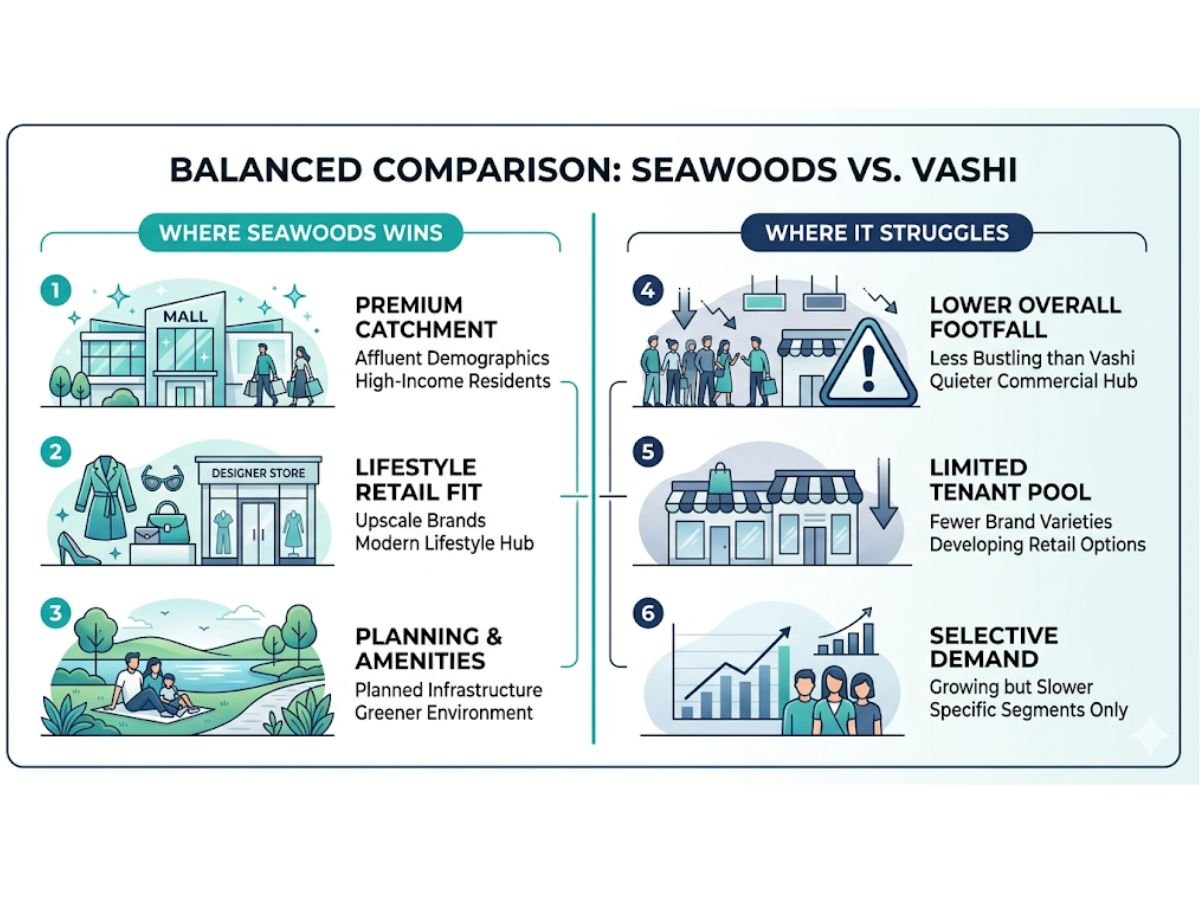
Seawoods can beat Vashi when the retail format matches the premium transit-oriented environment around Seawoods Grand Central and the station ecosystem.
This is where many people get confused. They think Seawoods is better because it looks better. That is not the real logic. Seawoods works best when premium customer profile, convenience, and format alignment come together.
The station-mall-premium catchment advantage
Seawoods has a different kind of retail strength.
Its strongest edge comes from the station-integrated, mall-driven, lifestyle-oriented ecosystem. That creates a polished environment for categories like:
- premium salons
- boutique fitness
- café and dessert formats
- curated gifting
- lifestyle-led services
- premium convenience retail
This is not the same as saying all Seawoods retail is strong. It means the right Seawoods retail can be very strong.
Why premium surroundings do not guarantee retail success
This is where investors make expensive mistakes.
A premium residential or mall-adjacent node creates a strong impression. But impression is not the same as everyday walk-in conversion. A shop deep inside a calm residential sector may look excellent on paper and still struggle because people do not naturally stop there.
This is the mall halo trap. Buyers assume mall visitors will spill into nearby external retail. In reality, a well-designed transit-oriented development often keeps spending inside its own ecosystem. External shops survive only when they meet a need that the internal mall environment does not fully serve.
Which retail formats fit Seawoods better
Seawoods usually works better for:
- premium salon and wellness
- café, bakery, dessert-led retail
- boutique food and beverage
- polished service brands
- aspirational retail formats
- self-use brands that need a cleaner premium setting
It is less forgiving for random general retail purchased only because the address sounds premium.
Which node gives better footfall quality, not just footfall quantity?
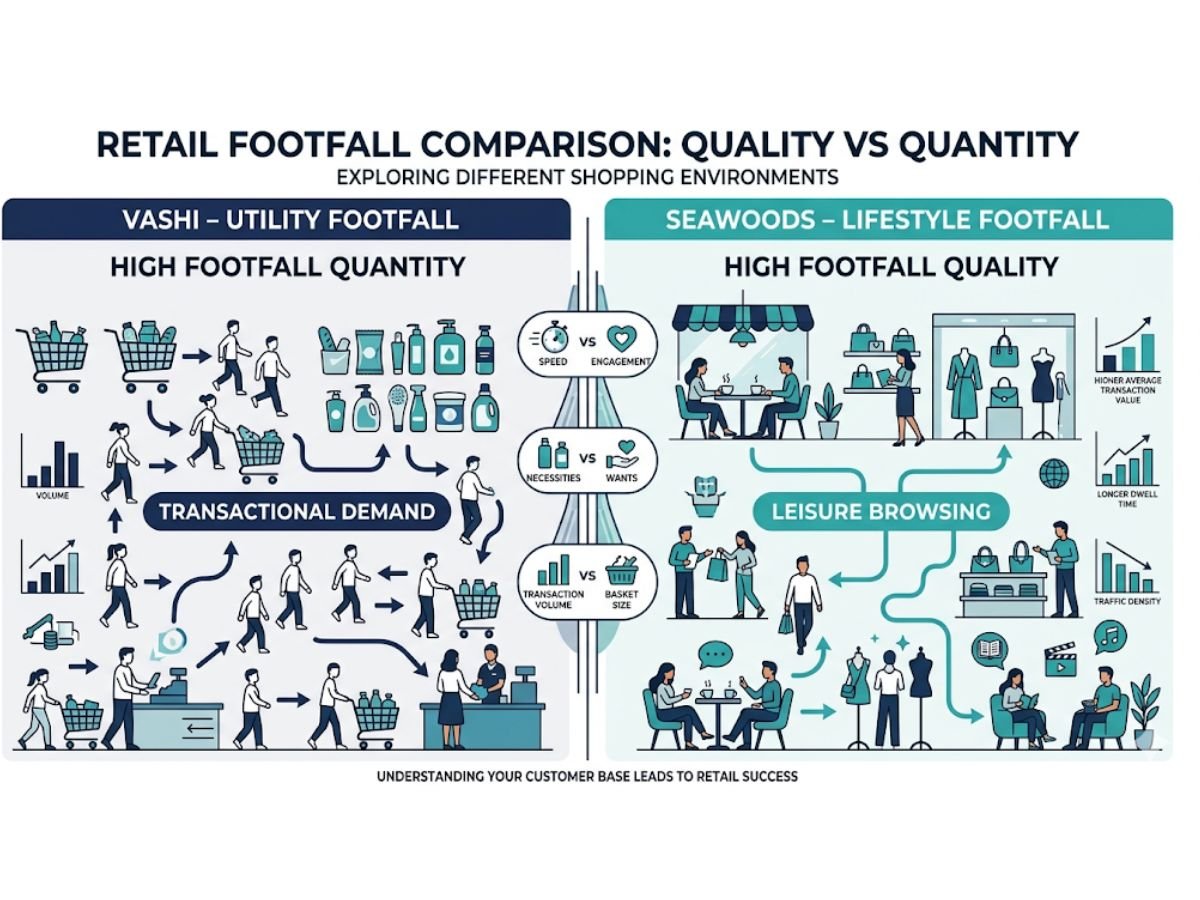
This is one of the most important questions in the whole comparison.
High footfall sounds impressive. But retail survives on usable footfall, not just visible crowd movement.
Vashi usually gets stronger utility and transaction-led footfall. People come there because they need to buy, visit, compare, collect, consult, or finish work.
Seawoods, especially near the TOD ecosystem, gets more transit, leisure, and lifestyle footfall. That can be excellent for the right category, but weaker for the wrong one.
So which is better? It depends on what your shop needs.
If your retail format depends on direct necessity, Vashi is usually stronger.
If your format depends on polished impulse buying, lifestyle browsing, or premium service consumption, Seawoods can be stronger in the right zone.
Which micro-locations matter more than the node name itself?
This is where smart investors separate themselves from emotional investors.
Buying “in Vashi” means almost nothing by itself. Buying “in Seawoods” also means almost nothing by itself. Retail strength changes sharply from one stretch to the next.
Vashi station-facing, market-facing, and internal sector retail
Vashi’s stronger retail zones are usually the ones tied to:
- station movement
- established market circulation
- office and service clusters
- known commercial sectors
- proven frontage
A main-road-facing or market-facing unit with strong walkability can perform very differently from an internal lane shop in the same node.
Seawoods station-linked, mall-influenced, and internal sector retail
Seawoods is even more sensitive to micro-location.
A station-linked or mall-influenced unit has very different retail logic compared to a quiet interior-sector shop that mainly serves nearby residents. The former may support premium retail; the latter may only suit convenience services.
Main-road visibility vs stoppability vs parking convenience
A lot of investors overpay for visibility.
But billboard visibility is not walk-in value.
This matters on stretches influenced by fast-moving corridors and prestige roads. If customers cannot safely stop, park, approach, and enter, the shop may underperform even with strong visibility. That is why internal walkable commercial pockets can beat flashy roadside frontage.
Which node usually gives better rentability and tenant replacement?
For most investors, Vashi usually wins this test.
Not because every Vashi shop is better, but because prime Vashi pockets have a broader tenant universe. A vacant unit can be relevant to more kinds of occupiers.
A Vashi shop can often attract replacement demand from finance, food, diagnostics, retail services, convenience formats, electronics, logistics support, and other business users. That lowers vacancy risk.
Seawoods can also give strong rents, but replacement is more selective. A premium unit often needs a tenant who matches the environment and can justify the rent and fit-out. That can lengthen vacancy cycles between leases.
So if your biggest concern is this question if the unit falls vacant tomorrow, how quickly can it be re-let? Vashi usually gives more comfort.
Which retail categories are stronger in Vashi and which are stronger in Seawoods?
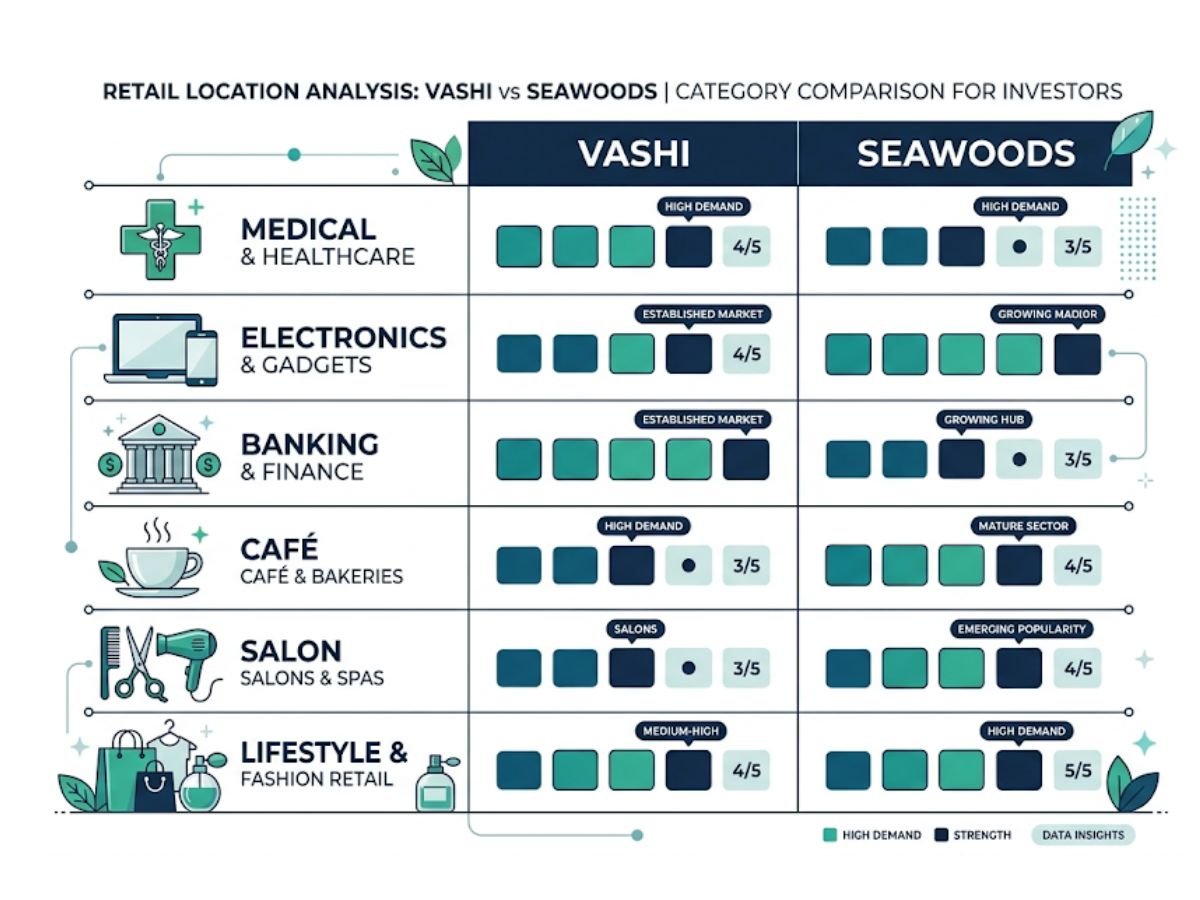
| Retail Category | Vashi | Seawoods | Practical Reading |
|---|---|---|---|
| Medical and diagnostics support | Stronger | Moderate | Vashi’s older and denser utility ecosystem helps |
| Electronics / trading-linked retail | Stronger | Weaker | Vashi’s commercial habit supports this much better |
| Banking / finance support retail | Stronger | Moderate | Vashi remains more universally business-facing |
| Daily-needs and utility retail | Stronger | Selective | Broader catchment in Vashi |
| Premium salon / wellness | Good | Stronger | Seawoods suits aspirational service retail better |
| Boutique café / curated F&B | Good in right pocket | Stronger in right pocket | Seawoods fits polished lifestyle formats |
| Convenience retail near transit | Good | Strong | Both can work, but pocket matters |
| Premium gifting / lifestyle-led formats | Selective | Stronger | Seawoods environment helps presentation-based retail |
This is exactly why retail investment should never be bought using only average rate per square foot.
What are the biggest mistakes buyers make in Seawoods and Vashi retail deals?
The most common mistake is buying node prestige instead of retail function.
In Seawoods, buyers often assume a premium address will automatically create retail success. In Vashi, buyers often assume older stock automatically means bargain strength. Both assumptions can go wrong.
Red-flag checklist before you buy
- buying because the node name sounds strong
- paying a big premium for a unit with weak stoppability
- assuming mall traffic will spill over automatically
- ignoring internal-sector isolation
- ignoring parking stress in old Vashi pockets
- calculating yield on brochure price but not all-in cost
- underestimating fit-out dependence
- overlooking society issues or deferred repair burden in older stock
- treating Palm Beach visibility as guaranteed retail conversion
- assuming exit will be easy without checking leasehold transfer costs
One bad assumption can destroy the entire investment case.
What local legal and cost checks matter before buying a retail unit here?
This section matters more than many buyers realise.
A retail deal in Navi Mumbai is not just about price, rent, and location. It is also about authority friction, closing cost, holding cost, and exit cost.
MahaRERA if the retail unit is under construction
If you are buying under-construction commercial inventory, check the project on MahaRERA. Use it to verify project registration, layout details, promoter details, and possession timeline.
But be clear about one thing: MahaRERA is not a guarantee that the shop will become a successful retail investment. It is mainly a legal transparency and timeline tool.
CIDCO leasehold and transfer reality
A lot of Navi Mumbai land is under CIDCO leasehold structure. That means resale is not as frictionless as many buyers expect.
In practical terms, investors should check:
- whether the property is on CIDCO leasehold land
- what NOC or transfer conditions apply
- whether transfer premiums may materially affect entry or exit
- whether the cost calculation already includes these liabilities
This matters in both Vashi and Seawoods. If ignored, it can badly affect net yield and exit planning.
NMMC tax and local operating-cost awareness
Commercial holding cost is also important. Buyers should understand local municipal tax treatment and recurring operating burden before finalising numbers.
Do not calculate returns only on rent and EMI. Include maintenance, tax burden, transfer costs, fit-out requirement, and vacancy buffer.
IGR Maharashtra ready reckoner as reference, not truth
Ready Reckoner value is a reference tool. It is useful for guidance and transaction structuring, but it is not the same as live negotiated market value.
Use it carefully. Do not confuse it with actual retail performance or real transacted market strength.
Who should choose Vashi, who should choose Seawoods, and who should avoid both for now?
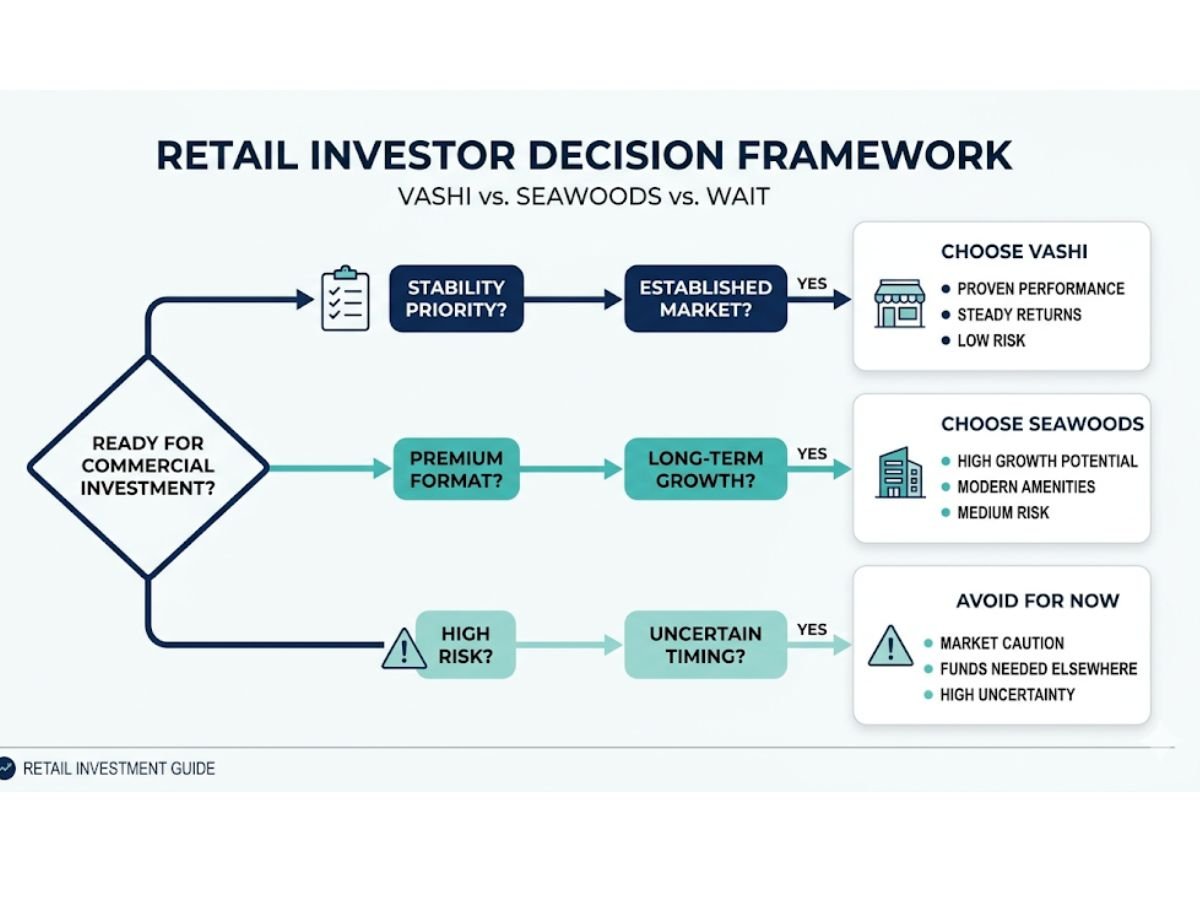
This is where the final decision becomes easier.
Choose Vashi if you are…
- a retail investor who wants broader tenant demand
- a buyer focused on rentability and faster replacement
- a self-use owner needing strong everyday business movement
- a practical investor who values liquidity over polish
- a buyer okay handling older stock if the location is proven
Choose Seawoods if you are…
- a selective investor targeting premium retail formats
- a self-use brand owner who needs a modern, polished setting
- a buyer comfortable paying for presentation and environment
- an investor who understands that category fit matters more than node prestige
- someone buying near the right station-linked or mall-influenced pocket, not just anywhere in Seawoods
Avoid both for now if you are…
- undercapitalised for premium-node retail
- chasing fast speculative gains
- buying only because of address image
- uncomfortable with holding-cost pressure
- unable to absorb vacancy, capex, or transfer-cost shocks
In such cases, other growth corridors may offer a better risk-reward equation. But that is a separate discussion.
You may also want to read Vashi Commercial Property Guide if you want the Vashi side of the comparison as well.
conclusion
If the goal is safer retail investment with stronger tenant depth and more proven everyday commercial resilience, Vashi remains the better default.
If the goal is a selective premium retail play in a modern, transit-oriented, lifestyle-driven environment, Seawoods can outperform, but only when the micro-location and retail category are exactly right.
That is the real answer.
Vashi is the broader retail safety play. Seawoods is the sharper premium bet.
And in both cases, the winning decision is not made at node level. It is made at the level of street, frontage, parking, access, and tenant fit.
FAQs
Frequently Asked Questions