
Ulwe Real Estate Investment: Prices, Growth Potential, Risks, and Best Areas to Buy
Ulwe Real Estate Investment Guide: Is It Still a Good Place to Buy Property in Navi Mumbai?
Yes, Ulwe can still make sense as a property investment in Navi Mumbai, but mostly for buyers who understand it as a medium-to-long-term infrastructure-led market, not a magic short-term profit zone. The right buy in Ulwe depends on sector choice, project quality, possession stage, and entry price discipline. It is not a market where every building, every pocket, and every buyer profile will get the same result.
That is the first thing many people miss.
Ulwe is often discussed in one-line sales language: airport area, future hotspot, next big node. Real life is more layered than that. Some buyers may do well here over time. Some may end up holding a flat in a project that looks good on paper but does not perform the way they expected. That difference usually comes down to understanding what truly drives Ulwe and what is only marketing noise.
Quick Summary: Ulwe Investment Verdict
| Question | Practical Answer |
|---|---|
| Is Ulwe still good for investment? | Yes, for selected buyers with a medium-to-long-term view. |
| Is it ideal for quick gains? | Usually no. Ulwe is stronger as a patience market than a fast-flip market. |
| Is Ulwe better for appreciation or rental income? | Usually appreciation-first, with rental potential improving gradually. |
| Are all sectors equally attractive? | No. Micro-location matters a lot in Ulwe. |
| Does the airport automatically guarantee high returns? | No. It improves the broader story, but project quality and entry price still decide outcomes. |
| Should first-time buyers consider it? | Yes, if budget is limited and expectations are realistic. |
| What should buyers check first? | MahaRERA status, possession stage, builder credibility, approvals, sector practicality, and pricing discipline. |
Is Ulwe still a good place to invest in property in Navi Mumbai?
Yes, but only under the right conditions.
Ulwe remains one of the more important airport-linked residential nodes in Navi Mumbai because it sits inside a larger infrastructure story that has become more real over the last two years. The Mumbai Trans Harbour Link has already changed regional access patterns, and Navi Mumbai International Airport is now operational in Ulwe, which gives the node much stronger long-term relevance than it had when it was only an “upcoming” promise.
But that does not mean Ulwe is automatically the best buy for everyone.
For an investor who wants mature rental demand today, fully developed daily convenience, and less project-selection risk, there are stronger alternatives in more established parts of Navi Mumbai. For a buyer who wants a planned node, relatively more accessible entry bands, and a long-hold thesis linked to airport-led demand, Ulwe still deserves serious consideration. CIDCO’s official nodal plan listings also reinforce that Ulwe is not some random spillover belt; it sits within Navi Mumbai’s formal planning framework.
So the better answer is this: Ulwe is still investable, but it rewards patience, selection discipline, and realistic expectations more than emotional buying.
What actually drives Ulwe’s property story today, and what is just marketing noise?
Ulwe’s investment case is real, but it gets oversold very easily. That is why buyers should separate structural drivers from sales-pitch exaggeration.
NMIA matters, but not in the simplistic way many ads suggest
Navi Mumbai International Airport is not just a future promise anymore. The official airport site is live, and recent reporting places commercial operations from late December 2025, with the airport located in Ulwe itself.
That matters because operational infrastructure changes long-term demand psychology. It improves Ulwe’s relevance for future employment spillover, service demand, airport-linked business movement, and regional visibility.
But it does not mean every apartment in Ulwe becomes premium overnight. Airport influence supports the node-level story. It does not remove project-level risk.
Atal Setu and broader access have improved the market story

The Mumbai Trans Harbour Link has already been open to traffic since January 13, 2024, and it materially improved Mumbai–Navi Mumbai regional mobility. Your own recent buyer guide correctly frames airport-linked areas such as Ulwe as long-term appreciation zones rather than instant rental miracles.
This is important. In real estate, access upgrades often matter more over time than on day one. Better regional connectivity increases confidence, discoverability, and buyer willingness to consider a node. But the effect is still uneven. A project with poor execution, bad internal layout, weak surroundings, or unrealistic pricing can underperform even in a strong macro corridor.
CIDCO planning gives Ulwe more structure than many speculative belts
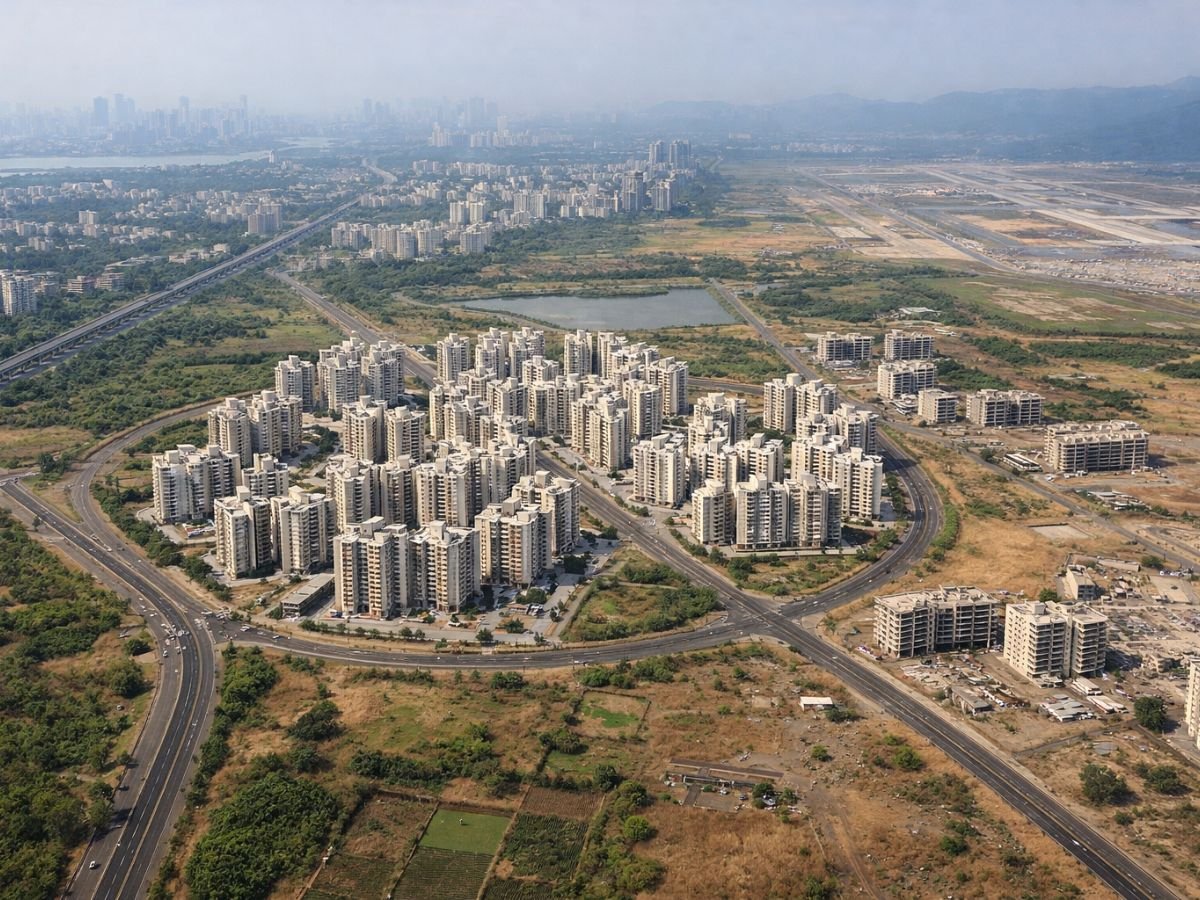
Ulwe benefits from being part of CIDCO’s planned Navi Mumbai framework. That may sound like a technical point, but for buyers it has practical meaning: road layout, sector planning, and broader urban structure usually feel more organized than in many unplanned growth zones. CIDCO officially lists Ulwe among its nodal plans.
That said, planning structure alone is not the same as full maturity. A planned node can still feel patchy on ground if social infrastructure, occupancy, retail depth, and surrounding convenience are developing at different speeds.
Which type of investor should seriously consider Ulwe, and who should avoid it?
Ulwe is not a universal recommendation. It suits certain buyer types much better than others.
Buyers for whom Ulwe can make sense
Ulwe works best for long-hold investors, budget-conscious buyers, and people who want exposure to the airport-side growth narrative without paying the entry levels of more established premium nodes. It also suits first-time buyers who are okay with a market that is still evolving and who understand that the real payoff may come through gradual appreciation rather than immediate cash flow.
A buyer looking at a 5-to-10-year horizon may find Ulwe more sensible than someone chasing immediate return-on-capital within 12 to 24 months.
Buyers who should be more careful
Ulwe is a weaker fit for people expecting premium rental yield from day one, families who want fully mature urban comfort immediately, or investors who do not want to spend time filtering sectors and projects carefully.
It is also not the best place for buyers who get emotionally pulled by the phrase “airport area” and then overpay for an average project. In Ulwe, entry discipline matters a lot. A decent project bought at a sensible rate can work. A weak project bought at a hype-driven rate can disappoint for years.
Is Ulwe better for capital appreciation, rental income, or end-use-led buying?
For most buyers, Ulwe is still stronger as an appreciation-led market than as a pure rental-yield play.
Rental demand in Navi Mumbai is shaped by jobs, colleges, business districts, and commuting convenience. Your recent internal rental-yield content rightly notes that growth areas like Ulwe have evolving rental potential but are still more appreciation-led than income-led in many cases.
That is the practical position.
If someone asks, “Will Ulwe give me the best rental yield in Navi Mumbai today?” the honest answer is usually no. Areas with deeper established tenant ecosystems may perform better on immediate rental consistency.
But if the question is, “Can Ulwe offer long-term appreciation with gradually improving rental relevance as the airport and related activity deepen?” then the answer becomes much more favourable.
For end users, Ulwe can also make sense in a hybrid way. Some buyers may live there later even if they buy now mainly for future upside. That kind of flexibility gives Ulwe an edge over purely speculative outer-belt locations.
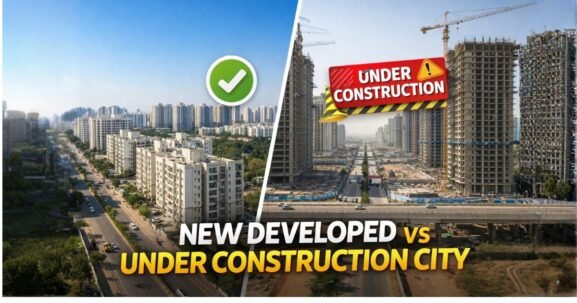
Ready possession, under-construction, or resale in Ulwe: which gives the better investment entry?
This depends on risk appetite more than on trend headlines.
Ready possession is usually better for buyers who want clarity, immediate usability, and lower execution risk. You can see the actual building, actual surroundings, occupancy pattern, maintenance condition, and practical neighborhood reality.
Under-construction projects may offer lower entry in some cases, but the buyer takes more risk on delivery, execution, and timing. In a market like Ulwe, where long-term story and on-ground pace may not always move in perfect sync, this difference matters.
Resale can be underrated. In some sectors, resale units offer better realism because the market has already tested the building. You can compare asking rate, actual quality, occupancy, and accessibility more easily than in a brochure-led launch.
For a normal buyer, this is often the simplest rule:
- choose ready possession if certainty matters most
- choose resale if you want price negotiation plus visible reality
- choose under-construction only when the project, builder, approvals, and pricing give you a clear enough edge to justify the wait
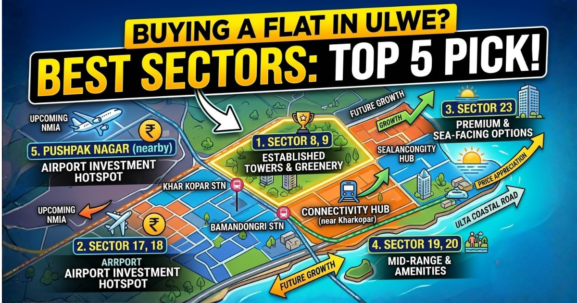
Not all of Ulwe performs the same: how to think about sectors and micro-locations
This is where many generic articles fail badly.
Ulwe should not be treated as one flat market. The better question is not “Should I buy in Ulwe?” but “Which kind of Ulwe am I buying into?”
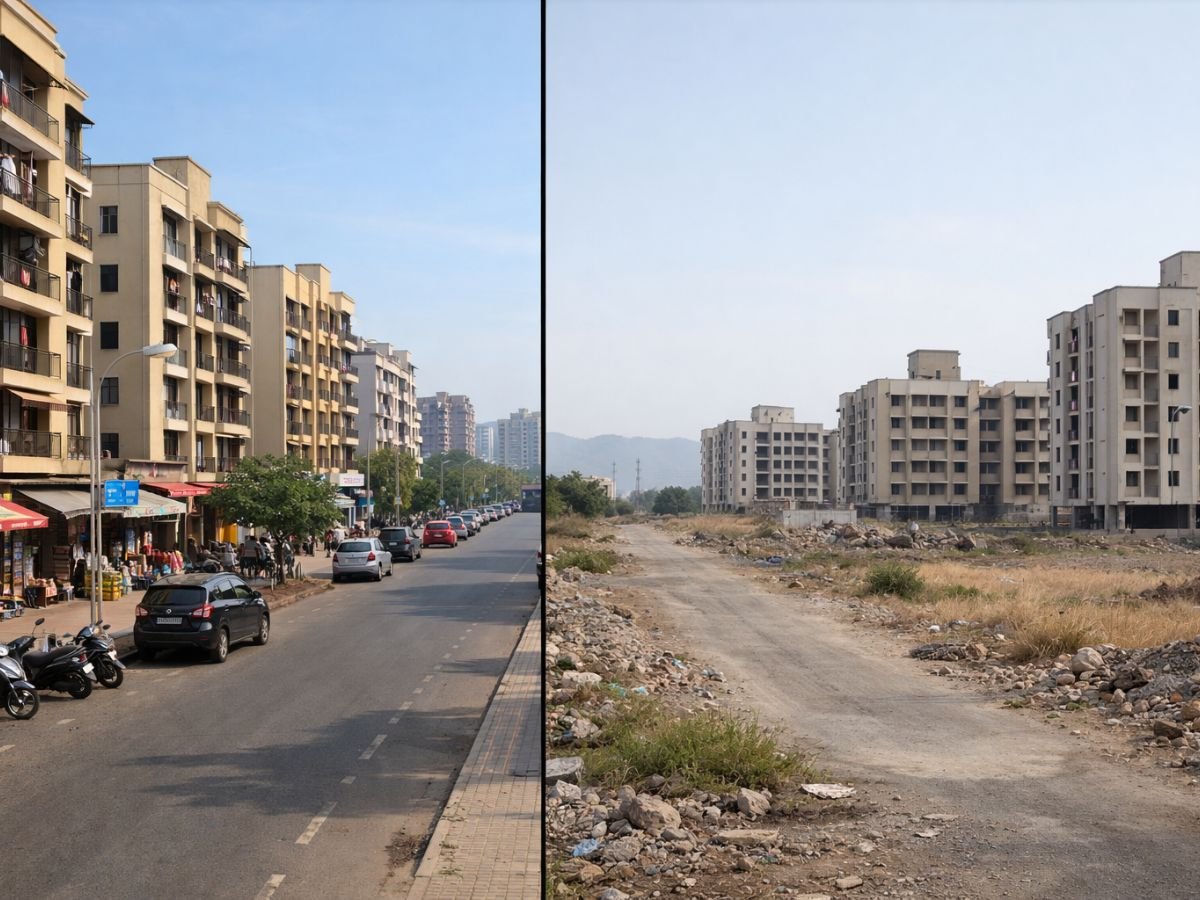
Some pockets feel more practical because they combine better internal roads, more visible occupancy, station-side convenience, grocery and daily-use comfort, and a more believable end-user environment. Other pockets may still feel more patience-dependent. They may look good on a map, but the surrounding livability, tenant pull, or daily convenience may still lag.
A buyer should think about four ground-level filters:
1. Station and commute practicality A location that looks close on paper but feels awkward in daily movement can reduce both tenant appeal and end-user comfort.
2. Main-road approach and surrounding activity Wide roads are good, but what matters more is actual usability, convenience, and neighborhood traction.
3. Occupancy and lived-in feel A building in a sector with visible habitation often performs differently from a project that still feels isolated.
4. Project quality versus surrounding promise In Ulwe, a good micro-location can still be spoiled by a weak project, and a decent project can underperform if its surrounding catchment stays slow.
Your own recent airport-linked pricing content places Ulwe roughly in the ₹9,500 to ₹14,000 per sq. ft. range depending on sector and station proximity. That is useful not as a universal market price, but as an indicative band showing how much micro-location can change valuation inside the same node.
What people get wrong about Ulwe investment
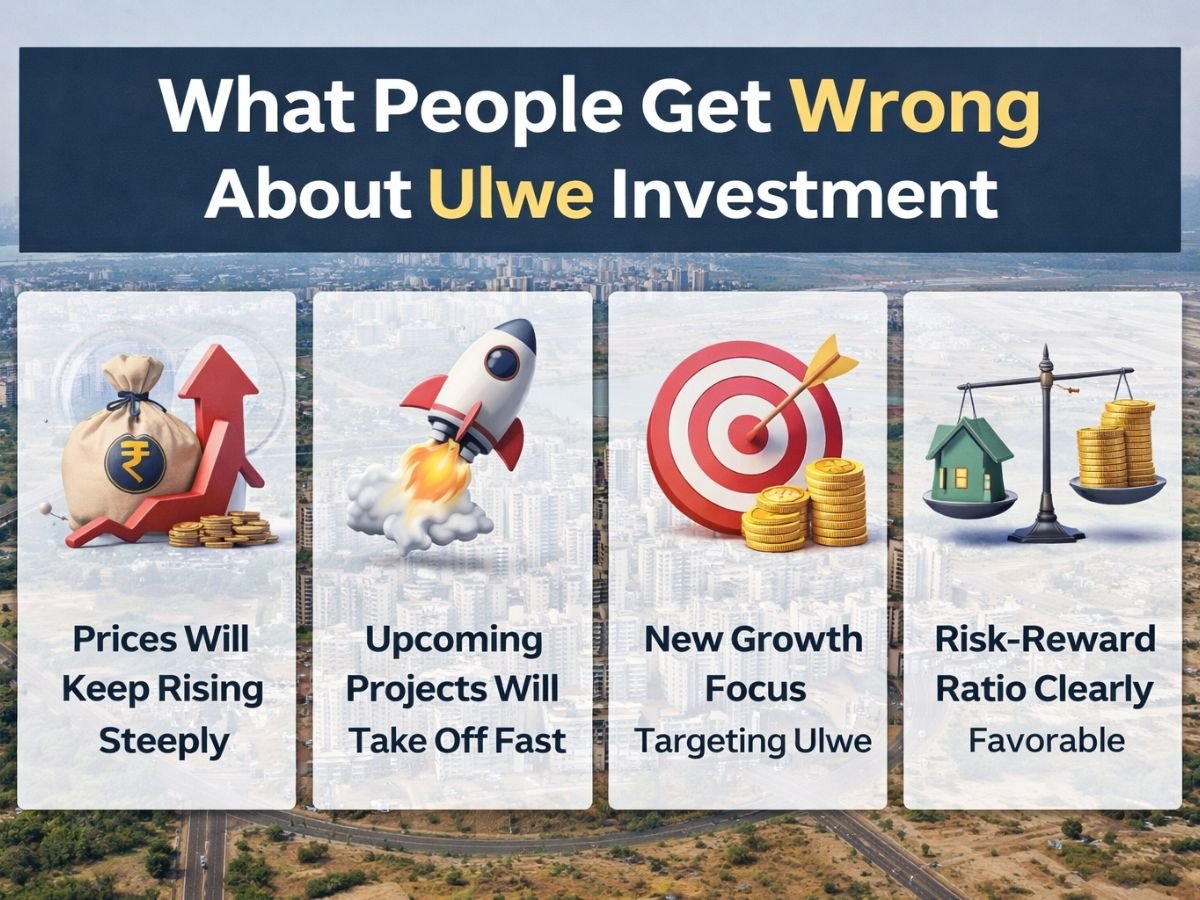
This is where buyers lose clarity.
The biggest mistake is assuming that airport proximity alone guarantees fast appreciation and strong rentals. It does not. Airport-linked growth improves the broader demand narrative, but returns still depend on what you buy, where you buy, and how much you pay.
The second mistake is confusing affordability with value. A lower ticket size can be attractive, but low price alone does not make a property a good investment. Sometimes it only reflects weaker project quality, slower absorption, or less practical location.
The third mistake is treating wide roads and planned sectors as proof of maturity. They are good signs, yes, but real estate performance also depends on daily urban life: residents, services, convenience, tenant base, and actual demand depth.
The fourth mistake is ignoring exit logic. Before buying in Ulwe, an investor should ask one simple question: “Who will buy this from me later, and why?” If the answer depends only on general future hype, the purchase is not yet well thought through.
Ulwe vs Pushpak Nagar, Panvel, Kharghar, and Taloja: where does Ulwe actually win?
Ulwe becomes easier to understand when compared with nearby options.
| Area | Where it usually wins | Where it may lose |
|---|---|---|
| Ulwe | Airport-linked story, CIDCO planning, medium-to-long-term appreciation case, relative affordability in many pockets | Uneven micro-locations, rental story still evolving, not equally mature everywhere |
| Pushpak Nagar | Strong airport adjacency narrative, earlier-stage upside for some buyers | Higher patience requirement, more future-dependent in feel |
| Panvel | Bigger city logic, stronger transport identity, broader long-term demand base | Market can be too broad and uneven; not every Panvel location works equally well |
| Kharghar | Better maturity, stronger end-user comfort, deeper social infrastructure | Higher entry cost in many pockets, lower affordability for budget buyers |
| Taloja | Lower entry and large budget-buyer appeal | Image, industrial perception in some minds, and livability filtering matter a lot |
Your own recent comparison article between Kharghar, Ulwe, and Panvel is useful here: it frames the decision around buyer fit, not empty ranking language. That is exactly how Ulwe should be judged.
In plain terms, Ulwe usually wins when the buyer wants a planned airport-side node with appreciation potential and can tolerate some unevenness. It loses when the buyer wants the strongest present-day urban maturity or top-tier rental certainty.
What should you check before investing in an Ulwe project?
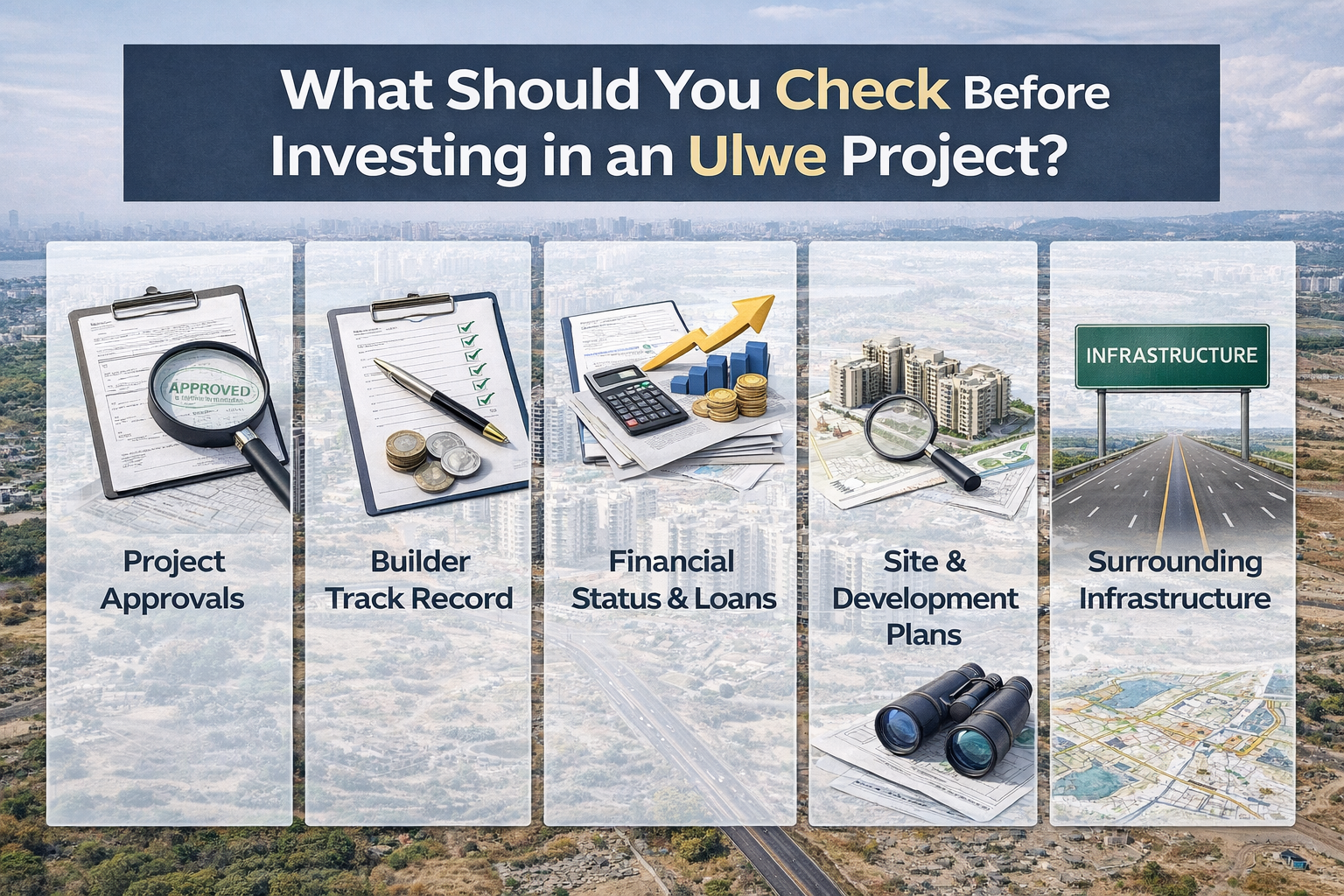
Before booking anything in Ulwe, do not stop at location excitement. Check the project properly.
1) Check MahaRERA status and builder trail
MahaRERA’s official portal lets buyers search projects, promoters, and complaint-related information. That is one of the most important first filters for any under-construction or recently launched purchase in Maharashtra.
2) Check possession realism, not just brochure promises
In Ulwe, timing matters. If a project claims a huge upside because of surrounding infrastructure, ask what the building itself is delivering, by when, and with what approvals.
3) Check whether the asking rate makes sense for that exact micro-location
Do not compare a station-favoured project with a weaker interior pocket as if both deserve the same rate. Use local comparisons and, where useful, the Maharashtra IGR ready reckoner tools as a reference point for official valuation context, while remembering that market value and transaction value are not always identical.
4) Check exit practicality
Would this flat be easy to resell or lease if needed? Projects with poor access, weak livability, unclear project quality, or overhyped pricing can become sticky during resale.
5) Check whether you are buying the node story or the actual asset
The node story may be good. The asset may still be average. Never confuse the two.
Buyer Checklist Before Investing in Ulwe
- Verify MahaRERA registration and project details
- Check builder track record, not just marketing material
- Compare ready possession, resale, and under-construction options
- Visit the sector at different times of day
- Check station access and daily convenience, not just highway logic
- Ask what kind of tenant or future buyer this project realistically attracts
- Compare rate with nearby projects in similar micro-locations
- Do not pay a premium only because the word “airport” is being used repeatedly
Conclusion: Should you invest in Ulwe or not?
Ulwe is still one of the more important real estate bets in Navi Mumbai for buyers who want an airport-linked, CIDCO-planned, medium-to-long-term growth market without jumping straight into the pricing levels of more mature premium nodes.
But that does not mean you should buy blindly.
Ulwe is a good market for disciplined buyers, not lazy buyers. It rewards people who compare sectors, question project quality, check approvals, and stay realistic about rentals and timelines. If your goal is steady long-term positioning in a growth corridor, Ulwe still deserves a place on your shortlist. If your goal is instant premium rental income, instant maturity, or guaranteed fast returns, you should be much more selective or look at stronger alternatives.
The cleanest one-line conclusion is this: Ulwe is still worth considering, but only when you buy the right project in the right pocket at the right expectation level.
FAQs
Frequently Asked Questions