Vashi, Navi Mumbai | Demographics, Economy, etc.
Vashi is one of Navi Mumbai’s earliest planned nodes and remains one of its most mixed-use areas. It combines established residential sectors with a major railway station, offices, Sector 17’s commercial streets, the APMC wholesale market belt, shopping, healthcare and education.
For people considering Vashi for daily living, the main strengths are its mature infrastructure and regional connectivity. The tradeoffs are equally important: some housing stock is old, parking can be difficult in busy pockets, commercial activity affects traffic, and the experience changes considerably from one sector to another.
This guide focuses on how Vashi works today, what differs by zone, and which transport projects are already operational versus still planned.
Vashi at a Glance
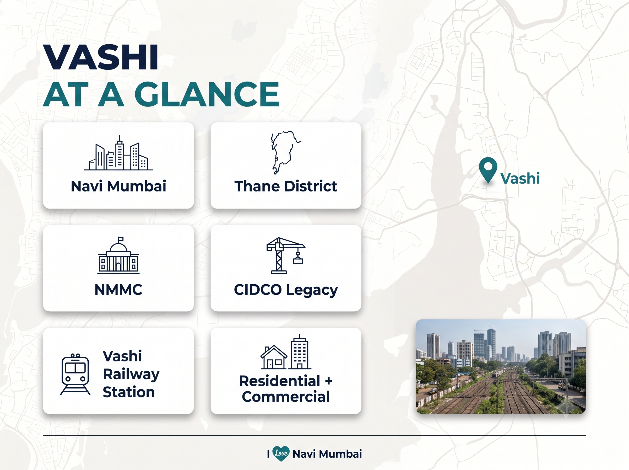
Vashi is a residential and commercial node of Navi Mumbai in Thane district. Municipal functions fall under the Navi Mumbai Municipal Corporation (NMMC), while CIDCO remains central to the area’s planning and development history.
| Detail | Vashi |
|---|---|
| City | Navi Mumbai |
| District | Thane |
| Municipal body | NMMC |
| Development legacy | CIDCO |
| Main suburban station | Vashi |
| Character | Residential + commercial + wholesale trade |
| Common PIN | 400703; verify the exact address |
| Nearby nodes | Sanpada, Kopar Khairane, Turbhe |
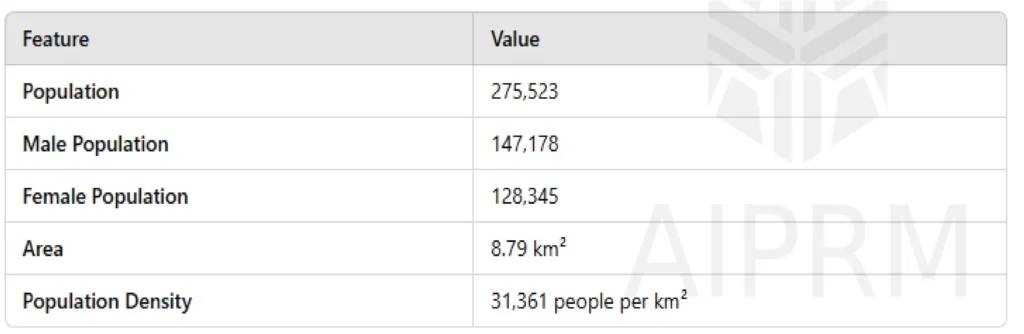
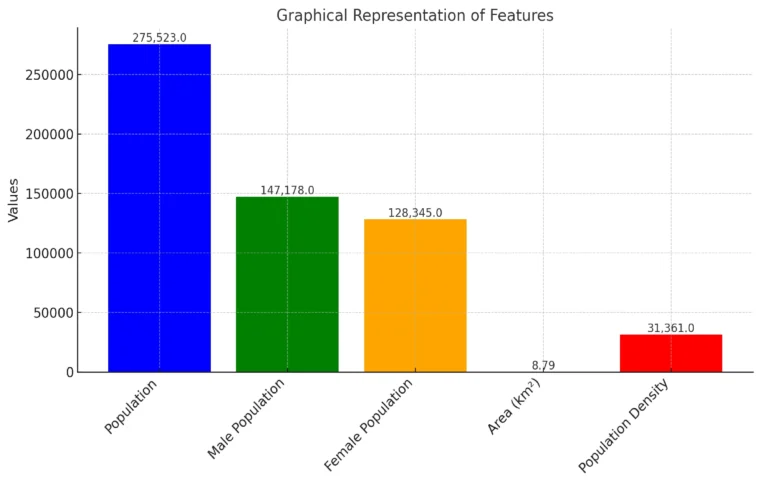
NMMC’s development-plan material records a 2011 Vashi node population of 209,781. That is an official historical baseline, not a current 2026 population estimate, so it should not be presented as Vashi’s present population.
The quickest way to understand Vashi is not through one property rate or one sector. The station area, Sector 17, established residential sectors, Palm Beach-side pockets and the APMC belt all function differently.
Geography
Vashi is a zoned node of Navi Mumbai which is situated in western densities of Thane Creek. This makes it a very important bridge between navigating Mumbai and Navi Mumbai whereby the two cities can be easily reached. The Thane Creek lies on the eastern side, Turbhe on the south, Kopar Khairane on the western side and Ghansoli on the north of the city.
The geographical location of Vashi is on a fairly flat coastal plain though in some sections there has been some elevation. The closeness of the city to Thane creek gives her a waterfront which greatly contributes on her landscape as well as recreation.
The strategic location of Vashi and proper master planning of the infrastructure makes it an attractive place to settle down in terms of residential, commercial, and even entertainment zone in the Navi Mumbai area.
History
Preceding the 1990s, Vashi was just a small fishing hamlet with Koli community occupying the place. People in the villages depended primarily on fishing and agriculture. The area used to be a sight of salt pans that boosted the economy of the place.
CIDCO (City and Industrial Development Corporation) began with the construction of Navi Mumbai as a planned city to ease the congestion that was faced in Mumbai in the 1970s. One of the nodes that were selected in this project is Vashi. CIDCO took land away of the villagers, providing them with other housing and remuneration.
During the 1980s the development of the infrastructure was very fast in Vashi and new well-planned roads, residential complexes and commercial centres were established. Vashi Mini-Sea Shore had also been developed offering scenic water front and recreation space. Gradually Vashi changed into a modern city with a high quality life and active life.
Demographics
Why Vashi Matters in Navi Mumbai
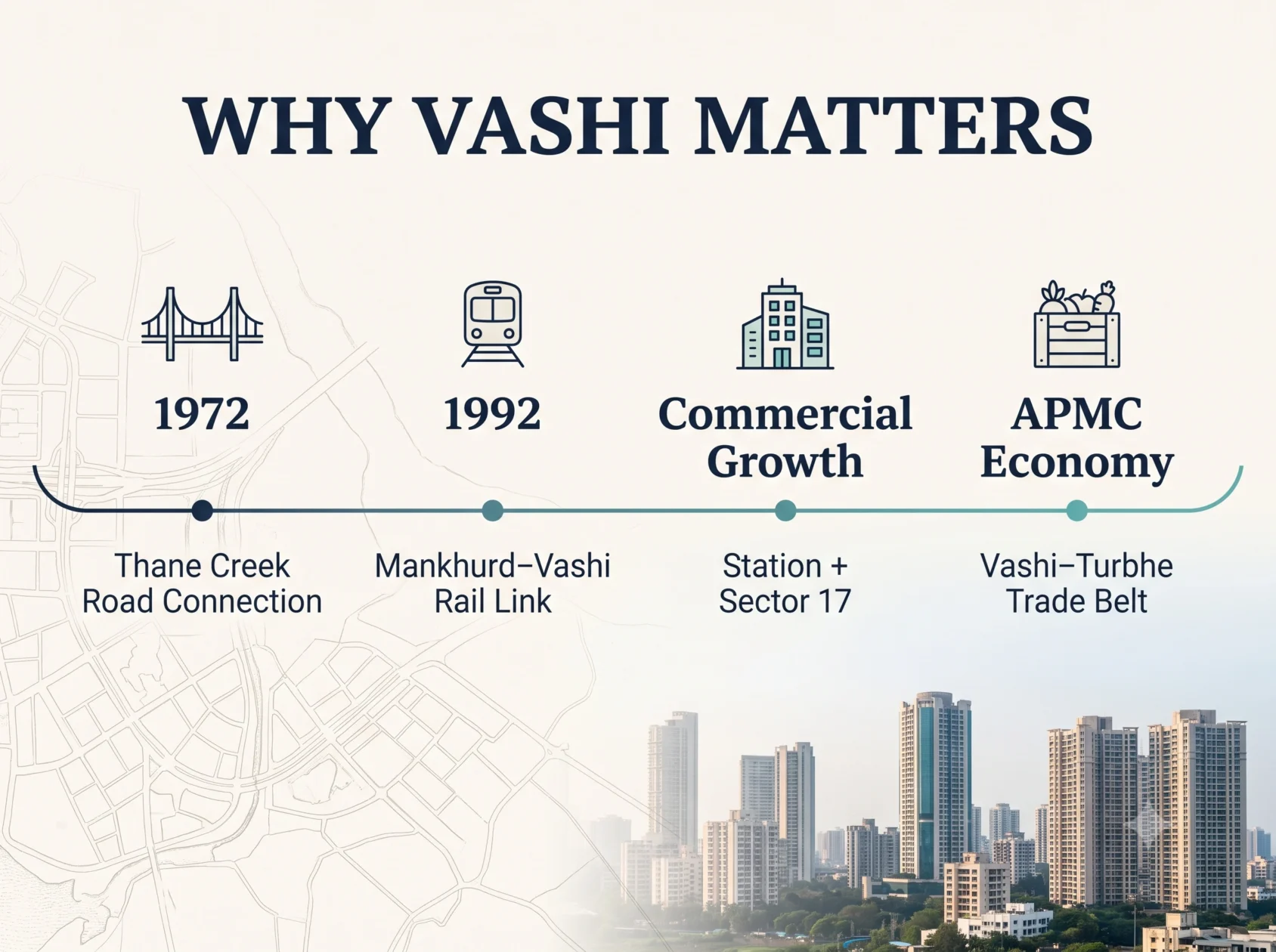
Vashi has a different history from newer nodes such as Ulwe or parts of Panvel-side Navi Mumbai. It was part of the early phase through which planned Navi Mumbai began taking physical shape.
Vashi and the Beginning of Planned Navi Mumbai
CIDCO’s historical records place Vashi close to the beginning of Navi Mumbai’s planned development story. The road connection across Thane Creek opened in 1972, strengthening the physical link between Mumbai and the emerging city on the eastern side of the creek.
That matters because Vashi developed with a head start over many later Navi Mumbai nodes. Housing, markets, public institutions and commercial activity had more time to mature.
This history also explains one of Vashi’s present-day tradeoffs: parts of the housing stock and civic fabric are significantly older than those in newer nodes.
The 1992 Railway Link Changed Vashi's Role
The Mankhurd-Vashi railway connection opened in 1992, giving the node a much stronger public-transport relationship with Mumbai.
The railway did more than reduce dependence on roads. It helped make Vashi practical for commuters, increased commercial activity around the station and strengthened its role as one of Navi Mumbai’s early employment and retail centres.
Today, proximity to Vashi station still influences office use, rental demand and daily convenience, although station access alone should not determine a housing decision.
Railway Station + International Infotech Park
CIDCO also developed commercial infrastructure around Vashi railway station, including the International Infotech Park concept associated with the station complex.
This creates an unusual urban pattern. The station area is not simply a transport interchange. Offices, retail, commuter activity and commercial buildings are concentrated around it.
For someone working close to the station, this can reduce last-mile dependence. For someone looking for a quieter residential environment, it may make sense to compare sectors further away from the commercial core.
APMC, Sector 17 and the Commercial Identity of Vashi
Vashi’s economy is not defined by one central business district.
Sector 17 developed as a major local commercial area, while the Mumbai Agricultural Produce Market Committee’s wholesale-market complex gives the Vashi-Turbhe side of the node a very different economic role.
Official APMC information describes a market estate covering about 72.5 hectares and comprising eight markets. Parts of this activity are associated with Vashi sectors 18 and 19, while the wider market geography extends towards Turbhe.
This wholesale activity is one reason Vashi cannot be understood as only a residential locality.
Understand Vashi by Zone, Not Just by Pin Code
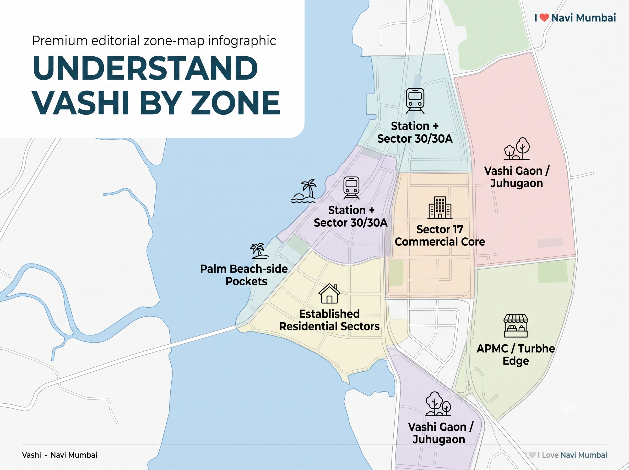
Two homes labelled simply as “Vashi” can offer noticeably different daily experiences. Station dependence, parking, commercial activity, building age and road access all change by micro-location.
Vashi Station and Sector 30/30A
The station-side zone is built around movement.
Rail access, offices, commercial buildings, retail and large numbers of daily commuters make it useful for people who value public transport and workplace access.
The same concentration can also mean more footfall and traffic. A renter choosing this area should check the actual walking route between the building and station rather than relying only on straight-line distance.
Sector 17 Commercial Core
Sector 17 remains one of Vashi’s recognised commercial areas, with banks, shops, offices, restaurants and professional services concentrated within a relatively compact zone.
For residents, that means many daily requirements are nearby. The tradeoff is street pressure. Parking availability, pedestrian movement and traffic can vary sharply by road and time of day.
Anyone choosing a home or office here should inspect the exact lane rather than judging the whole sector from its central market.
Established Residential Sectors
Vashi contains several long-established residential pockets with schools, shops, clinics and mature neighbourhood infrastructure already around them.
Age becomes important here. Two societies in the same sector may differ significantly in lift condition, parking, maintenance, redevelopment position and internal amenities.
For buyers, building-level due diligence can therefore matter as much as sector reputation.
Sectors 28–29 and Palm Beach-Side Residential Pockets
The residential pockets towards the Palm Beach Road side offer a different setting from the station and Sector 17 commercial areas.
Road orientation, housing type and access patterns can differ even between nearby societies. Buyers should avoid assuming that every Palm Beach-side address offers the same views, road access or building quality.
The best residential sectors in Vashi should therefore be compared against individual priorities such as station dependence, school access, building age and budget.
APMC and the Sector 18–19 / Turbhe Edge
The APMC side is shaped by wholesale trade, loading activity and commercial movement in a way that purely residential parts of Vashi are not.
People working in wholesale trade may value this proximity. A household considering a nearby residential pocket should instead look closely at truck movement, road activity, noise and peak-hour conditions.
The Vashi-Turbhe boundary also shows why property-portal locality labels should not be treated as exact administrative boundaries.
Vashi Gaon / Juhugaon and Micro-Location Due Diligence
Vashi Gaon and Juhugaon have a different development pattern from the planned CIDCO sector layout.
This does not automatically make property there good or bad. It means a buyer needs to check the specific property’s title, tenure, approvals, building records and applicable authority requirements rather than assuming that every address follows the same documentation pattern as a planned-sector cooperative society.
For any purchase, use a proper property verification in Navi Mumbai checklist before paying token money.
Vashi Police Station
Vashi Police Station undertakes the duty of law and order in Vashi area. Its location is 76, Groma Marg Sector 19D Vashi Navi Mumbai Maharashtra 400703.
Inorbit Mall Vashi
A major shopping place in Vashi is Inorbit Mall that was opened in the year 2008. It contains numerous national and international brands, restaurants, and entertainment setups along with a gross leasable space of 550,000 square feet. The mall is well accessible because it is in close proximity to Vashi Railway Station.
Vashi Connectivity: What Works Today
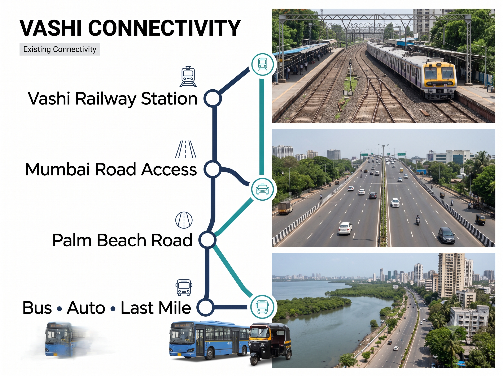
Vashi’s biggest transport advantage is that its basic connectivity is already established. Railway and road access are functioning today; they are not dependent on future metro proposals.
Vashi Railway Station
Vashi Railway Station forms one of the most important destinations of the Harbour Line under the Mumbai Suburban Railway service. It is a strategically positioned bridge that links Vashi with diverse places within Mumbai and Navi Mumbai as thousands of commuters use it daily to travel.
Mumbai Road Connectivity
Road access towards Mumbai uses the Thane Creek corridor and the Sion-Panvel route.
A major current-status correction is important here: Thane Creek Bridge 3 is operational, not an upcoming project. Its final arm opened in June 2025.
That gives the Mumbai-Navi Mumbai road corridor additional capacity, but it should not be translated into a fixed Vashi-to-Mumbai travel time. Congestion elsewhere on the route can still change the journey considerably.
Palm Beach Road and Intra-Navi Mumbai Access
Palm Beach Road is important mainly for movement within Navi Mumbai, connecting the Vashi side towards Sanpada, Nerul, CBD Belapur and other southern nodes.
For households whose work, school or regular travel is within Navi Mumbai rather than Mumbai, this intra-city connectivity can be as important as the Thane Creek crossing.
A property’s exact access to the road matters more than simply advertising “Palm Beach Road connectivity.”
Bus, Auto and Last-Mile Reality
Railway access solves only part of a commute.
Autos, buses, walking routes and private vehicles handle the last mile between the station and many residential or commercial pockets. The practical quality of that connection changes by sector and time.
For this reason, someone shortlisting a flat should test the route during the same hours they expect to commute.
Peak-Hour Commute: What ILNM Should Measure
A reliable Vashi commute guide should avoid statements such as “30 minutes to Mumbai” unless the route, day and traffic conditions are defined.
Useful commute reporting would instead record:
- starting sector
- destination
- weekday and departure time
- railway or road route used
- station-to-home last mile
- actual journey range across multiple tests
Until such testing is available, route relationships are more reliable than exact travel-time promises.
What Is Operational and What Is Still Proposed in 2026?
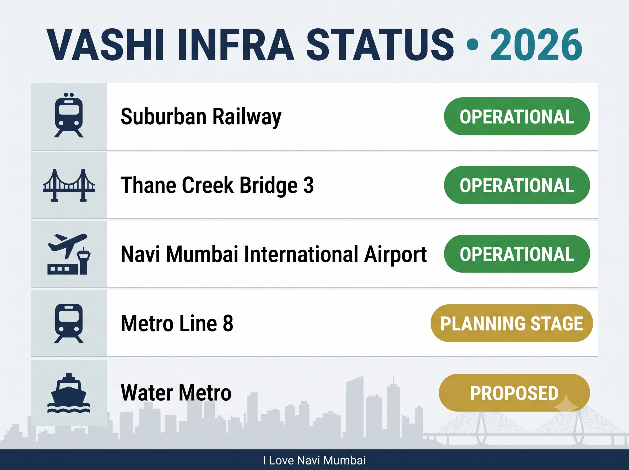
Transport pages about Navi Mumbai become outdated quickly because planned and operating projects are often mixed together.
As of August 2026, the distinction for Vashi is straightforward:
| Infrastructure | Status | What it means for Vashi |
|---|---|---|
| Suburban railway | Operational | Existing daily public transport |
| Thane Creek Bridge 3 | Operational | Existing Mumbai road connection |
| Navi Mumbai International Airport | Operational | Existing regional airport infrastructure |
| Metro Line 8 | Planning / clearance stage | Not an operating Vashi Metro service |
| Water Metro | Proposed | Do not treat as an existing ferry service |
Thane Creek Bridge 3: Operational
TCB-3 should now be described as existing infrastructure.
The bridge became fully available to traffic in June 2025. Any older Vashi article that still describes it as “upcoming” needs correction.
Its practical benefit is additional road capacity across Thane Creek. It does not guarantee congestion-free travel throughout the wider Mumbai route.
Navi Mumbai International Airport: Operational
Navi Mumbai International Airport should also no longer be presented as a future airport.
By 2026, the airport is operational. For Vashi, its relevance is regional access rather than a reason to make automatic property-appreciation predictions.
Road travel to the airport will depend on the origin within Vashi, chosen route and traffic conditions.
Metro Line 8: Planning Stage
Vashi does not have an operational Metro station as of August 2026.
The proposed Metro Line 8 airport-to-airport corridor includes Vashi in planning material, but current 2026 work remains in the planning and statutory-clearance process.
Until construction and station details are formally established, the correct description is planned/proposed connectivity, not “Metro coming soon.”
Water Metro: Proposal, Not Existing Vashi Ferry Service
A Vashi station has also appeared in Mumbai Water Metro planning discussions.
That does not mean Vashi currently has a commuter Water Metro or ferry service.
Readers should treat this as a proposal under development, not part of today’s transport options.
Daily Life in Vashi
Vashi’s daily-life advantage is the maturity of its urban infrastructure. Residents are not dependent on one new township mall or one isolated commercial centre for everyday needs.
Shopping: Inorbit, Sector 17 and Local Retail
Vashi combines organised retail with traditional commercial streets.
Inorbit Vashi remains an active shopping anchor, while Sector 17 supports banks, shops, professional services, restaurants and everyday retail.
That combination gives residents different options for routine purchases and leisure rather than concentrating everything in one destination.
APMC and the Wholesale Economy
The APMC complex is an economic institution, not simply another local market.
Its eight-market structure supports large-scale wholesale trade. That creates employment and business activity, but it also changes road conditions in nearby pockets through commercial traffic and loading movement.
Anyone choosing a property close to this belt should inspect the immediate road environment during active market hours.
Sagar Vihar, Mini Seashore and Open Spaces
Sagar Vihar and Mini Seashore are among Vashi’s better-known recreation and waterfront-oriented spaces.
They provide a different side of Vashi from the station and commercial belts, but current maintenance, access, crowding and monsoon conditions are best judged through a recent visit rather than an old online review.
For ILNM, these locations are particularly suitable for original photography because they help explain Vashi visually rather than through stock images.
Eating Out and Evening Activity
Eating options are spread across Sector 17, station-side commercial areas, malls and other local pockets.
A node pillar does not need a long restaurant ranking. Restaurant openings and closures change too frequently.
A separate Vashi food guide can handle individual recommendations, while this page should establish only that the node has a mature evening and dining ecosystem.
Schools, Colleges and Healthcare
Families evaluating Vashi usually need more than a list of institution names. They need to know whether school and hospital access works from the exact sector they are considering.
Education
Vashi is home to several renowned educational institutions, catering to students of all ages. Some prominent institutions include:
1. Careernova Technologies:
• Focus: This is an educational technology startup that offers offline courses in trending technologies like 3D printing, artificial intelligence, drones, and robotics.
• Aim: To bridge the gap between career aspirations and the traditional curriculum.
• Website: Careernova Technologies
2. Fr. Conceicao Rodrigues Institute of Technology (FCRIT):
• Type: A private engineering college affiliated with the University of Mumbai.
• Courses: Offers undergraduate and postgraduate programs in various engineering disciplines.
• Known for: Quality education, modern infrastructure, and good placement assistance.
• Website: FCRIT
3. Fr. Agnel Polytechnic:
• Type: A polytechnic college offering diploma courses in engineering fields like civil, mechanical, automobile, and electronics.
• Focus: Practical, hands-on training and skill development.
• Website: Fr. Agnel Polytechnic
4. Bakliwal Foundation - College of Arts, Commerce & Science (BFCACS):
• Type: A college offering undergraduate courses in arts, commerce, and science.
• Focus: Specialized studies and career-oriented programs.
• Website: Bakliwal Foundation
5. Sacred Heart High School & Junior College:
• Type: An English-medium school affiliated with the Maharashtra State Board of Secondary and Higher Secondary Education.
• Focus: Holistic education with a focus on academics, extracurricular activities, and moral values.
• Website: Sacred Heart High School & Junior College
What Families Should Check Before Choosing a Sector
A family comparing Vashi sectors should check:
- school route during actual morning traffic
- availability of school transport
- distance to an appropriate hospital
- safe pedestrian access
- nearby parks or open spaces
- building age and maintenance
- parking availability
These checks often reveal more than a generic “family-friendly” score.
Is Vashi a Good Place to Live?
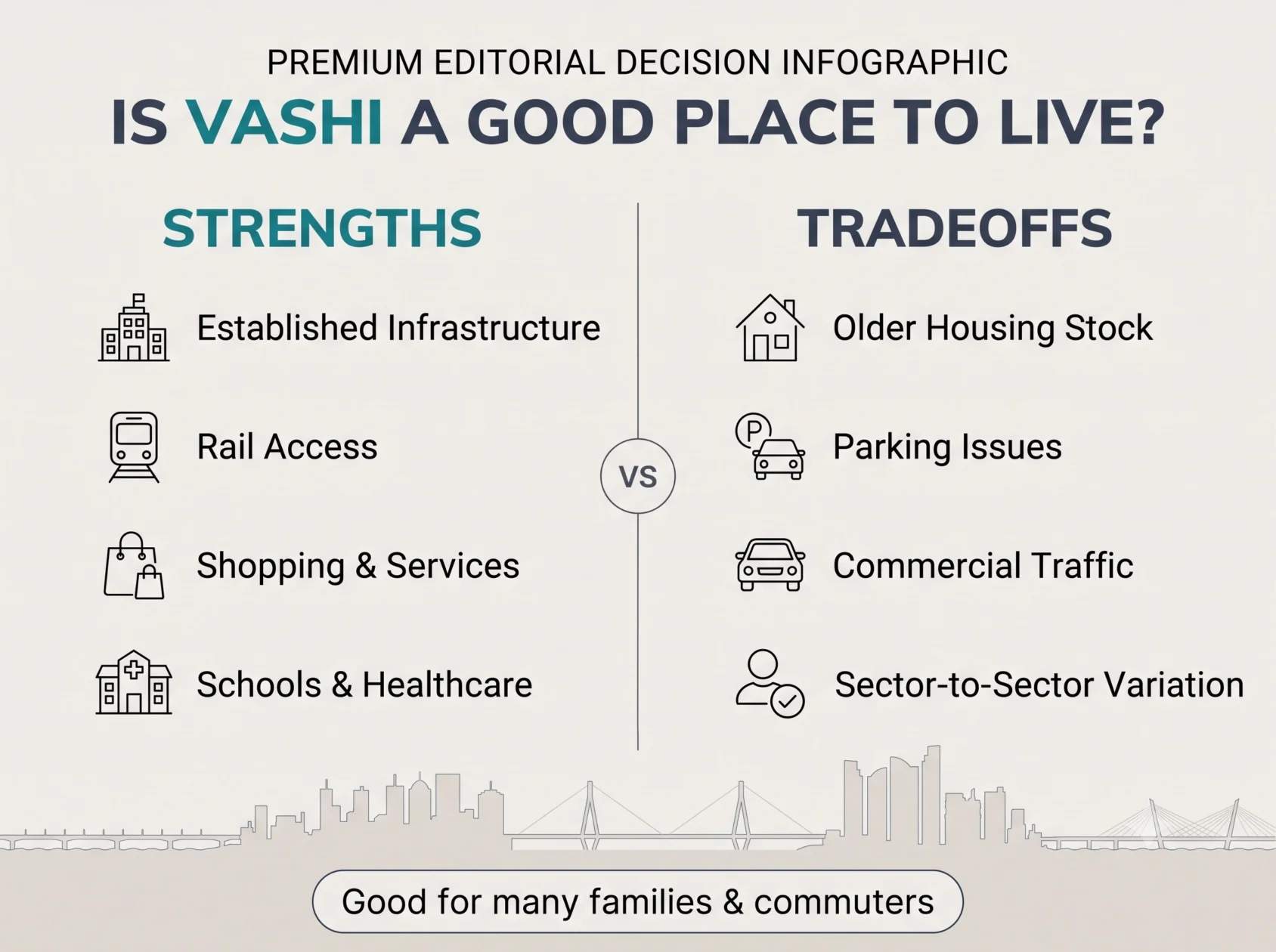
For many families and commuters, yes, but not without tradeoffs. Vashi works particularly well for people who value established railway access, retail, education, healthcare and daily services. Buyers or renters looking for newer large-scale housing complexes, lower prices or quieter streets may prefer to compare other Navi Mumbai nodes.
Where Vashi Performs Well
The strongest case for Vashi is that much of its essential urban infrastructure already exists.
Residents have access to suburban rail, established shopping areas, local markets, schools, hospitals and multiple road connections.
It also works for households whose members commute in different directions because Vashi connects not only towards Mumbai but also to Thane and other Navi Mumbai nodes.
Where Vashi Has Tradeoffs
The age of the locality is also one of its limitations.
Some housing societies are older. Parking standards vary. Redevelopment may matter in one building but not the next. Busy commercial pockets can experience traffic and street pressure.
Vashi should therefore be evaluated society by society, not only sector by sector.
Who Vashi Suits
Vashi is particularly worth considering for:
- Mumbai-bound suburban rail commuters
- Thane and Navi Mumbai commuters
- families wanting established schools and healthcare nearby
- professionals who prefer a mature locality over a newer township
- households wanting shopping and daily services close by
Who Should Compare Other Nodes
It may be useful to compare alternatives if your priority is:
- a newer gated township
- a lower housing budget
- quieter streets away from commercial activity
- larger modern amenity packages
- proximity to a workplace elsewhere in Navi Mumbai
There is no single “best” Navi Mumbai node independent of commute, budget and housing preference.
Civic and Livability Issues to Check Before Moving
Education
Vashi’s civic reality varies street by street. Broad claims such as “Vashi has no problems” or “Vashi floods” are both too simplistic.
Parking and Street Pressure
Parking is one of the issues that should be checked physically, especially around older societies and busy commercial streets.
Many parts of Vashi were planned before today’s levels of private-car ownership. A building that appears well located on a map may still have limited resident or visitor parking.
Ask the society exactly what parking is available rather than assuming it is included.
Older Buildings and Redevelopment
Some Vashi housing stock dates back several decades, including CIDCO-era buildings.
That makes structural condition, repair history and redevelopment status relevant to buyers. A redevelopment proposal should never be treated as guaranteed future value.
Before purchasing in an older building, verify the society’s documentation, structural position, redevelopment stage if any, existing approvals and legal status.
Monsoon Waterlogging: Check the Exact Corridor
Waterlogging has been reported on specific Vashi-area road corridors during intense monsoon spells, including parts of the APMC and Sion-Panvel-side road network.
That evidence should not be converted into the claim that the entire node is flood-prone.
For a renter or buyer, the better question is whether the exact building approach road, basement and parking area have a known monsoon problem.
Water and Power
Occasional water or power interruptions reported across Navi Mumbai should not automatically be described as permanent Vashi problems.
Supply can differ by society, maintenance system and temporary civic conditions.
Ask the building about municipal water timing, storage capacity, backup arrangements and recent interruption history before moving.
Safety
A single “Vashi safety score” would be misleading.
A practical safety assessment should consider:
- the exact street
- station-to-home route
- night-time activity
- lighting
- building security
- pedestrian crossings
- police/public data where available
Resident experiences can add context, but they should be labelled as personal sentiment rather than official fact.
Property and Rent in Vashi: What the Master Page Should Tell You
Vashi has enough variation that one “average rate” can create a false impression.
Detailed price analysis belongs in the Vashi property guide, while this master page should explain what changes the value of one property versus another.
Why One Vashi Rate Is Misleading
Housing values and rents can differ because of:
- sector
- station access
- building age
- redevelopment status
- parking
- floor and configuration
- society condition
- amenities
- road frontage
- residential versus commercial use
An older apartment and a newer redevelopment product in nearby sectors should not automatically be compared through one locality average.
Asking Price Is Not the Same as Registered Price
Property portals generally display advertised or asking prices.
An asking price is what a seller or broker is quoting. It is not automatically the amount at which a property was actually registered.
Where registered transaction data is available, it should be identified separately rather than mixed with portal listing averages.
Where to Go for Detailed Property Research
Readers evaluating a purchase should continue to:
- the Vashi Property Guide
- Best Residential Sectors in Vashi
- the Vashi commercial property guide
- current Vashi commercial rates and rents
- property verification in Navi Mumbai
The master locality page should explain Vashi. It should not duplicate every property-market article.
Vashi Compared with Nearby Nodes
Nearby nodes can suit different daily routines even when they appear close on a map.
| Comparison | Practical reason to compare |
|---|---|
| Vashi vs Sanpada | Similar broad corridor, different micro-location and residential choices |
| Vashi vs Nerul | Alternative established node further south in Navi Mumbai |
| Vashi vs Airoli | Useful for Thane/northbound and employment-corridor commuters |
| Vashi vs Kopar Khairane | Useful for TTC/MIDC and Trans-Harbour-side work patterns |
Vashi vs Sanpada
Sanpada is the most natural nearby comparison for many people because it shares strong railway and road relationships with Vashi.
Choose between them only after comparing the actual building, station route, budget and daily destination. The locality name alone does not establish which is quieter or better value.
Vashi vs Nerul
Nerul is another mature Navi Mumbai residential node, but its geography and regular travel patterns differ from Vashi.
Someone frequently travelling towards CBD Belapur, Seawoods or southern Navi Mumbai may find Nerul worth comparing, while Vashi may remain more practical for certain Mumbai- and Thane-side movements.
Vashi vs Airoli / Kopar Khairane
Airoli and Kopar Khairane become particularly relevant for people whose jobs are connected to the Thane-Belapur Road, TTC MIDC or northern Navi Mumbai employment belt.
Vashi generally offers a different mix, with stronger legacy retail, APMC-related business activity and an established central commercial identity.
The right choice should follow the workplace, not a generic locality ranking.
Conclusion
Vashi’s strongest advantage in 2026 is maturity. Railway connectivity, commercial activity, healthcare, education, shopping and everyday infrastructure are already part of the node rather than promises tied to future development.
Its main weakness is also connected to that maturity. Parts of Vashi have older housing, limited parking and busy commercial roads, and the difference between two sectors or societies can be substantial.
Choose Vashi if established infrastructure and regional connectivity fit your routine. Think more carefully if your priority is a newer township, a lower budget or a quieter residential environment.
FAQ's
Frequently Asked Questions