Which Businesses Work Best in Kharghar? Real Local Demand, Sectors and Business Fit
The businesses that usually work best in Kharghar are daily-need retail, family-led services, student-linked businesses, healthcare formats, coaching and appointment-based professional services. That is the direct answer. Kharghar is not the right market for every idea just because it looks premium. Some pockets support quick-turn retail, some support steady neighbourhood demand, and some are better for clinics, coaching, offices, or practical service businesses than for flashy walk-in concepts.
Kharghar rewards utility far more than hype. It has a strong residential base, a large student ecosystem, educated households, and selective office demand. That combination makes it a very usable market, but only if the business matches the pocket.
Quick Summary: Which Business Types Usually Fit Kharghar Best?
| Business type | What drives demand in Kharghar | Best-fit pocket type | Main caution |
|---|---|---|---|
| Grocery, pharmacy, bakery, convenience retail | Daily repeat household demand | Mature residential sectors, chowk-facing clusters | Weak frontage or poor parking can reduce conversion |
| Salons, grooming, repairs, utility services | Routine local usage and repeat trust | Internal family-heavy sectors, mixed-use local markets | Overpaying for premium frontage can hurt margins |
| Coaching, tuition, test prep, stationery | Large student base and family education spend | Sectors around education-heavy belts like 12, 15, 16, 17 | Needs practical access more than expensive branding |
| Clinics, diagnostics, dental, physiotherapy | Repeat visits and appointment-led demand | Upper floors or accessible mixed-use pockets in mature sectors | Parking and building utility matter more than visibility |
| CA, legal, insurance, consultancy, IT backend | Educated residential base and appointment/referral demand | Upper-floor offices, commercial towers, Sector 10/33-type office pockets | Ground-floor rent is usually unnecessary |
| Budget food, cloud kitchens, fast-casual formats | Students, commuters, quick meals, delivery demand | Station/connector belts and student-heavy sectors | Full-scale dine-in models face higher risk |
| Premium wellness, boutique fitness, specialized care | Higher-income family catchment | Lifestyle-facing belts like 20 and 21 | Only selective formats work; copy-paste premium does not |
Which businesses usually work best in Kharghar in real local terms?
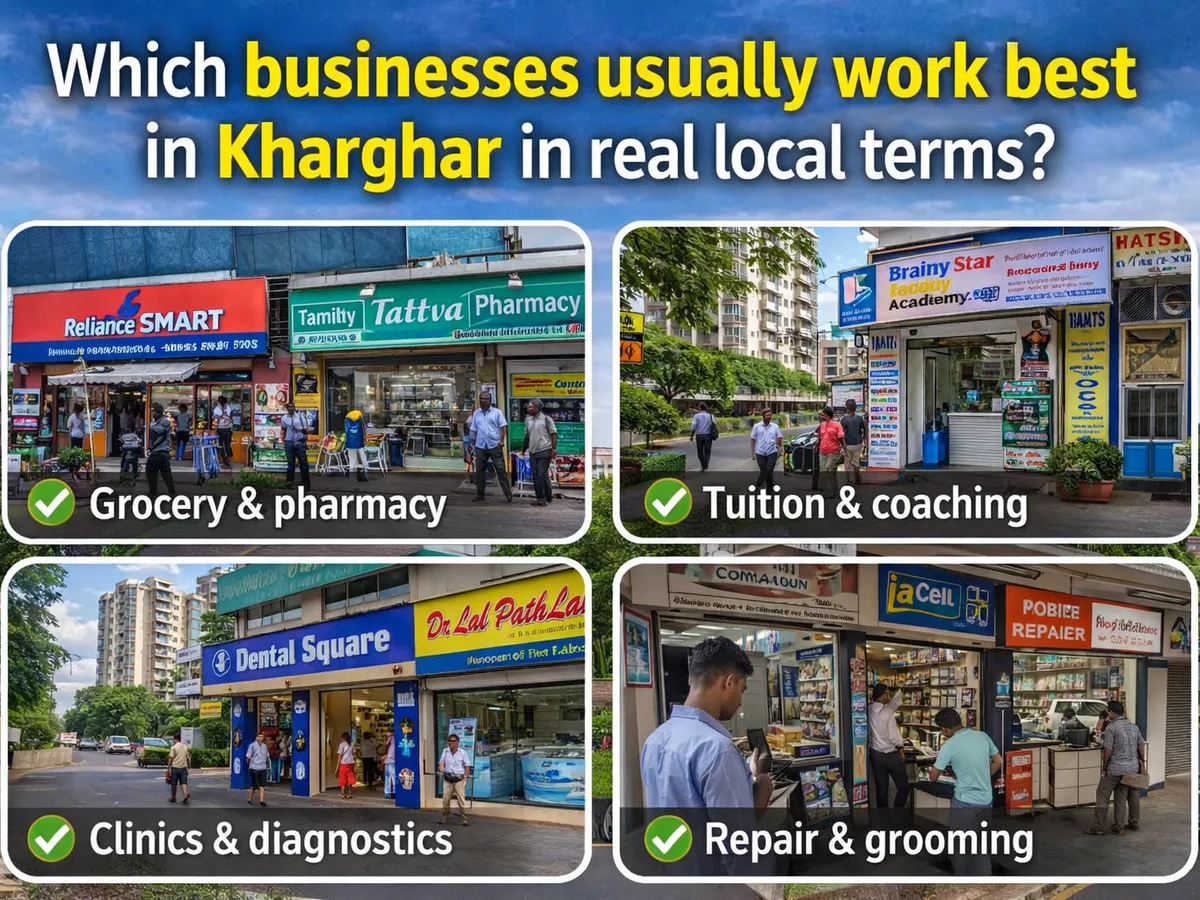
In real local terms, the best business in Kharghar is usually one that solves a routine need. The node supports businesses people need every week, every month, or on repeat appointments. That is why grocery, pharmacy, diagnostics, tuition, salons, clinics, dental, physiotherapy, cloud kitchen, daycare, coaching, and professional services usually show better local resilience than trend-led premium retail.
Businesses driven by daily residential demand
This is Kharghar’s most reliable commercial layer. A large residential population, estimated in the 2.5 to 3 lakh range in recent years, creates continuous demand for essential spending. People may cut back on impulse purchases, but they still need groceries, medicines, repair services, milk-and-bread convenience, grooming, laundry, and practical food options.
That is why supermarkets, pharmacies, bakeries, neighbourhood salons, mobile repair, tailoring, and daily-use convenience retail often work better than more glamorous formats. They are built on habit, not excitement.
Businesses driven by family and student demand
Kharghar is one of the strongest education-linked nodes in Navi Mumbai. With institutions such as NIFT, ITM, NMIMS and others in the larger belt, plus a broad school ecosystem, the local economy naturally supports coaching, stationery, test-prep centres, printing, student food formats, PG support services, and budget tech repair.
Family demand strengthens the same ecosystem further. Parents spend steadily on tuition, kids’ activities, preschool support, child healthcare, dental, and practical enrichment. So if someone asks what business to start in Kharghar, the answer is often not “something trendy.” It is often “something families or students need again and again.”
Businesses driven by healthcare and repeat visits
Healthcare is one of the strongest business categories in Kharghar because the demand is local, recurring, and trust-based. This is especially true for dental clinics, pathology, physiotherapy, child specialists, wellness clinics, and diagnostic-linked practices.
A clinic does not need a flashy highway-facing shop to survive. It needs accessibility, parking practicality, patient comfort, and a catchment that will return. In Kharghar, that makes healthcare one of the more durable business categories as well as one of the more realistic tenant types for commercial investors.
Businesses that work more like office or appointment-led uses
This is where many people make a costly mistake. Not every business needs a ground-floor shop.
A CA office, architect, lawyer, insurance advisor, visa consultant, specialized coaching centre, digital service office, or IT backend unit can work perfectly well from an upper-floor office or a commercial tower. In Kharghar, upper-floor office rentals are usually much lower than street-level shop rentals. That changes the economics completely.
For many service businesses, first-floor or second-floor space is not a compromise. It is the smarter model.
Why Kharghar supports some business categories better than others
Kharghar supports some business opportunities better than others because it is not an organically messy market. It is a CIDCO-planned node with sector-based development, wide roads, separated pockets, educational clusters, family-heavy residential belts, and selective transit-oriented commercial zones.
That means businesses do not survive here just because they exist in a growing city. They survive because they match the immediate catchment.
A station-side quick-service food format and a pediatric clinic are not chasing the same customer behaviour. A pharmacy near a dense residential cluster and a premium boutique inside a weak retail stretch are also not playing the same game. Kharghar commercial demand is highly local, pocket-specific, and practical.
There is also a lifestyle layer to the node. Central Park, the hills, open spaces, and a relatively planned residential environment support wellness, family recreation, sports-linked spending, and certain premium services. But even here, the demand is selective. It does not automatically mean every premium concept will work.
Which kinds of retail businesses are strongest in Kharghar?
The strongest retail businesses in Kharghar are usually the ones with steady repeat demand, fast turnover, and clear local utility. Ground-floor retail is expensive here. Approximate estimates based on 2024-2025 market trends place shop capital values around ₹25,000 to ₹35,000 per sq. ft., while good ground-floor rents can range roughly from ₹75 to ₹130+ per sq. ft. depending on frontage and location.
That means weak retail ideas get punished very quickly.
| Retail category | Local strength in Kharghar | Frontage dependency | Risk level |
|---|---|---|---|
| Grocery, pharmacy, convenience retail | Very strong | Medium to high | Lower than discretionary retail |
| Bakery, snacks, quick service food | Strong in the right pocket | High | Moderate |
| Salon, grooming, repair, utility services | Strong | Medium | Moderate |
| Kids and education-support retail | Strong in family/student belts | Medium | Moderate |
| Premium fashion/lifestyle boutique | Selective only | High | High |
| Large sit-down dining | Selective and difficult | Very high | High |
| Aesthetic café without clear catchment | Often overrated | Very high | High |
Grocery, pharmacy, bakery, daily convenience
This is the safest retail layer in Kharghar. These businesses are driven by routine behaviour, not mood or novelty. A pharmacy near dense housing, a convenience store serving late-evening demand, or a bakery in a family-heavy sector can survive on repeat needs.
That is why utility retail often performs better than more exciting concepts. It fits how Kharghar actually lives.
Salons, grooming, repair, tailoring, mobile and utility services
These businesses work because they are hyperlocal and repeat-led. Residents do not always want to travel across sectors for a haircut, mobile repair, laundry drop, tailoring fix, or basic service need. They usually prefer convenience.
So a well-placed salon or repair business inside a settled residential-commercial belt can be stronger than a larger but poorly matched retail format in a high-rent stretch.
Kids, family and education-support retail
School-linked and coaching-linked business demand is very real in Kharghar. Stationery, printing, books, hobby classes, uniforms, kids’ products, educational supplies, and small academic support formats can work well in the right catchment.
This is one of those business categories that looks ordinary but is often more sustainable than a concept-heavy lifestyle shop.
Food formats that work better than full-scale destination dining
Food works in Kharghar, but not all food works equally.
Budget dining, delivery-first formats, student-facing food, snacks, quick meals, and cloud kitchen models generally make more sense than large, high-rent, highly aesthetic cafés that depend on destination footfall. Kharghar has a big student base and commuter-driven demand, but that does not automatically convert into support for every premium F&B idea.
Useful food formats usually beat beautiful food formats.
Which service and office-type businesses fit Kharghar better than pure retail?
Service and office-type businesses are often a better fit in Kharghar than pure retail because they do not need costly street-level visibility to attract the right customer. They need access, functionality, trust, and in many cases, referrals or digital discovery.
Approximate estimates based on 2024-2025 market trends place upper-floor office rents around ₹43 to ₹73 per sq. ft., with capital values roughly in the ₹18,000 to ₹28,000 per sq. ft. range. That is a major difference from shop-level economics.
Clinics, diagnostics, dental, physiotherapy, wellness
These are some of the strongest categories in Kharghar because the local population can support repeat appointments. A family-heavy residential base, educated households, and a practical health-seeking population create stable demand.
The important point is this: a dental clinic or physiotherapy centre does not need to pay double just to sit on the ground floor. If patients can reach the clinic easily and park reasonably, the business can operate just as effectively from an upper floor.
Coaching, tuition, training, skill centres
Kharghar clinic and coaching demand are both backed by local reality, not by theory. The student ecosystem is large, and the family mindset is education-oriented. This makes focused training centres, test-prep units, spoken English classes, design coaching, and academic support services naturally viable.
These businesses also fit well in upper-floor units or internal commercial buildings because they are destination-led, not impulse-led.
CA, legal, insurance, consultancy, real estate advisory
These businesses are ideal examples of formats that do not need expensive retail frontage. They benefit more from professional presentation, good accessibility, parking, and a credible office environment.
In Kharghar, an appointment-led office in a practical commercial building can outperform a street shop simply because the cost structure is healthier.
Coworking, small professional offices, back-end service units
This category becomes more interesting as Kharghar develops further, especially with the longer-term pull of the International Corporate Park in Sector 33. That future B2B gravity is important, but even today, small offices, backend support units, and flexible professional workspaces are more realistic than many people assume.
This is one area where the market may strengthen further over time, especially in southern and emerging belts.
Which businesses work best near Kharghar station, and which work better inside residential sectors?
The short answer is simple. Station-facing areas suit fast, convenience-led, quick-decision businesses. Internal residential sectors suit trust-led, routine, and appointment-based businesses.
Station and connector-facing business fit
Businesses near Kharghar station or high-movement corridors usually work best when they can capture quick decisions. Think QSRs, snacks, grab-and-go formats, mobile accessories, ATM-facing convenience, courier-style services, and small transactional retail.
These pockets have visibility and movement, but they also come with traffic friction, parking pressure, and hurried customer behaviour. So they are not ideal for businesses that need long dwell time.
Internal residential sector business fit
Internal residential sectors usually work better for pediatricians, dentists, path labs, preschools, coaching, gyms, daily groceries, salons, and services that depend on repeat neighbourhood trust.
This matters because Kharghar is not one long high street. People often prefer nearby convenience inside their residential side of the node. That gives internal sectors a different kind of commercial value.
Why some businesses need walk-in visibility and others do not
This is one of the biggest business mistakes in Kharghar. People assume more visibility always means more success. It does not.
A café that depends on browsing and impulsive visits may need visibility. A dentist does not. A coaching centre needs reach and access, not a highway-facing signboard. A CA office needs credibility and convenience, not a corner shop.
High visibility without the right customer behaviour is just higher rent.
Which sectors or pocket types in Kharghar suit different business categories?
It is better to think in pocket types than in rigid “best sector” rankings. Different parts of Kharghar support different business models.
| Kharghar pocket type | Businesses that usually fit better | Why it works | Main caution |
|---|---|---|---|
| Transit-linked belts near station and connectors | QSR, convenience retail, mobile, fast services, budget food | High movement and quick transactions | Parking and long-stay formats struggle |
| Legacy family belts like 10, 12, 13 | Clinics, coaching, supermarkets, salons, family dining | Mature catchment and repeat local trust | Needs right micro-location within the sector |
| Student belt like 15, 16, 17 | Budget cafés, stationery, cloud kitchen, PG support, tech repair | Large education-driven demand | Premium pricing is harder to sustain |
| Premium lifestyle belts like 20, 21 | Boutique wellness, specialized care, premium salons, selective branded retail | Stronger lifestyle catchment | Only selective premium concepts work |
| Emerging belts like 34, 35, 36 | Early-mover essentials, pharmacy, hardware, neighbourhood services | Lower entry cost and future growth | Catchment may still be maturing |
| Sector 33 future corporate side | Coworking, B2B support, offices, corporate services | Long-term ICP-linked potential | More future-facing than immediately proven |
Transit-linked and connector-led pockets
These pockets support speed, convenience, and footfall capture. Businesses that can convert quickly do better here. Slow-experience formats often do not.
Central residential sectors with steady everyday demand
This is usually where sustainable local business gets built. If the catchment is settled, the spending pattern is repeat-driven and predictable.
Institutional and family-heavy belts
This is where Kharghar becomes especially interesting. The student economy and family economy overlap in useful ways. That creates real support for coaching, stationery, clinics, budget dining, and service formats.
Premium-looking pockets where only selective formats work
Some pockets look premium, and they are. But premium-looking is not the same as premium-ready for every category. A specialized wellness clinic may work. A random high-ticket lifestyle store may not.
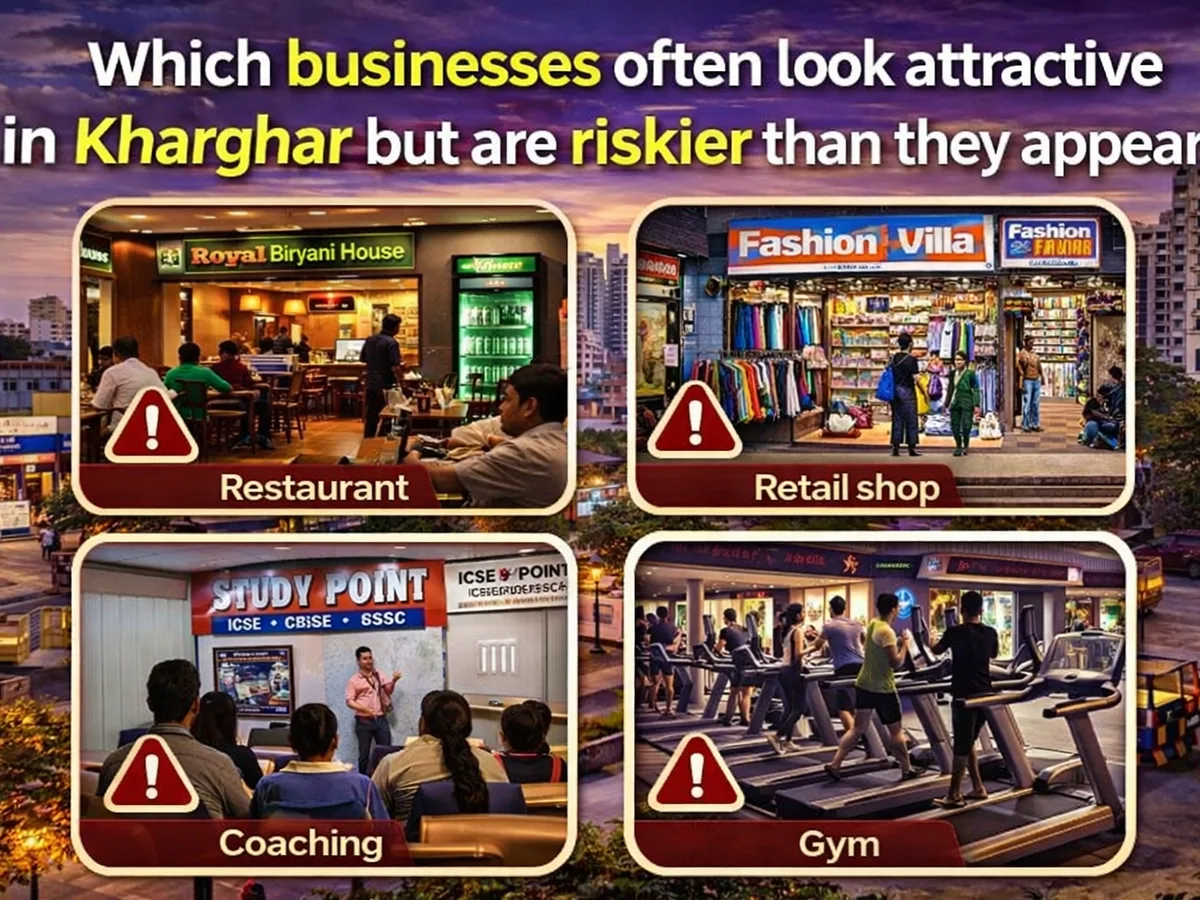
Which businesses often look attractive in Kharghar but are riskier than they appear?
This is where many first-time operators lose money. Some business ideas sound perfect for Kharghar from a distance, but the ground reality is less friendly.
> Caution Box > > In Kharghar, three risks are repeatedly underestimated: > > 1. Me-too premium cafés and aesthetic food concepts can struggle because rent is high and local demand is more practical than Instagram-led. > 2. Large-format retail without parking looks impressive but often fails because customers cannot stop comfortably. > 3. Liquor-dependent pub or restro-bar models are a major strategic risk. While State Excise laws may technically permit licensing under strict conditions, Kharghar operates as a de facto dry node due to aggressive community opposition and PMC-side resistance. Any business model dependent on alcohol should be treated as highly unsafe here.
Me-too cafés and aesthetic food concepts
These often fail because they are copied from other markets without understanding Kharghar’s actual behaviour. Students want affordability. Families want practicality. Rent eats margin very fast.
High-rent fashion or premium lifestyle retail without deep catchment
A premium audience exists in parts of Kharghar, but it is not broad enough to rescue every concept. If the format needs very high average billing and low conversion kills the math, the risk is high.
Large-format businesses that depend on unrealistic footfall assumptions
Big shops are not automatically better shops. If the business needs a lot of space, a lot of staff, and constant visibility-led traffic, it becomes fragile very quickly.
Businesses that need destination pull more than Kharghar actually gives
Some concepts need people to travel for them. Kharghar can support that in a selective way, but not for everything. Many businesses survive better when they serve their immediate catchment instead of trying to become a destination too early.
If you are taking a commercial shop or office in Kharghar, how should you match the space to the business?
This decision should never be based only on carpet area or broker pitch. In Kharghar, the right space-business match can decide whether the business feels naturally viable or permanently stressed.
Frontage, signage, and visibility check
If the business depends on impulse traffic, the frontage matters. But if it is appointment-led, do not overpay for signage.
Also remember a very practical compliance issue here. Kharghar falls under Panvel Municipal Corporation, not NMMC, and Marathi signboards in Devanagari script are mandatory, with the Marathi text size required to be equal to or larger than other languages. This is actively enforced.
Parking, pick-up-drop, and daily convenience check
This is critical. A physiotherapy centre, family clinic, coaching class, salon, or sit-down food business can all suffer if parking is poor. Many older or tighter commercial stretches in Kharghar face real parking constraints.
Surrounding tenant mix and repeat-footfall check
A shop beside a pharmacy, clinic, school-facing lane, or grocery cluster behaves differently from a shop in a dead-looking row. The tenant mix around the unit matters more than many buyers admit.
Carpet size, utility layout, and business-format match
A dental clinic needs a different layout from a cloud kitchen. A coaching class needs usable seating flow, not just area on paper. A retail shop needs frontage-to-depth balance. So built-up area alone is a weak decision tool.
Rent or purchase cost vs realistic revenue logic
This is where many ideas collapse. If the rent assumes perfect conversion every day, the business is already under pressure before opening. Kharghar commercial property can be expensive. The business must justify the cost structure honestly.
Which business types are better for owner-users, and which suit commercial investors looking for tenants?
This is an important distinction.
For owner-users, Kharghar can work well for clinics, coaching centres, professional offices, small service formats, salons, pharmacies, and practical food businesses if the operator understands the catchment.
For investors, the question is not “What sounds exciting?” It is “What tenant is likely to stay?” Tenant durability matters more than trend value.
A pathology lab, dental clinic, pharmacy chain, bank-facing utility tenant, or established professional office is often a stronger long-term tenant than a boutique fashion brand or experimental café. Retail can give stronger upside, but it can also create more tenant replacement pain.
Who should start a business in Kharghar, and who should be more careful?
Kharghar is a good fit for some operators and a weak fit for others.
A specialist doctor, dentist, physiotherapist, educator, coaching operator, cloud kitchen founder, daycare operator, or practical local service entrepreneur can do well here if the location is chosen carefully.
A first-time entrepreneur taking a large, expensive, premium-facing shop for an untested concept should be much more careful. Kharghar is not hostile to new business. It is hostile to badly matched business.
A franchise buyer should also be careful not to assume the brand will solve the local catchment problem. It will not.
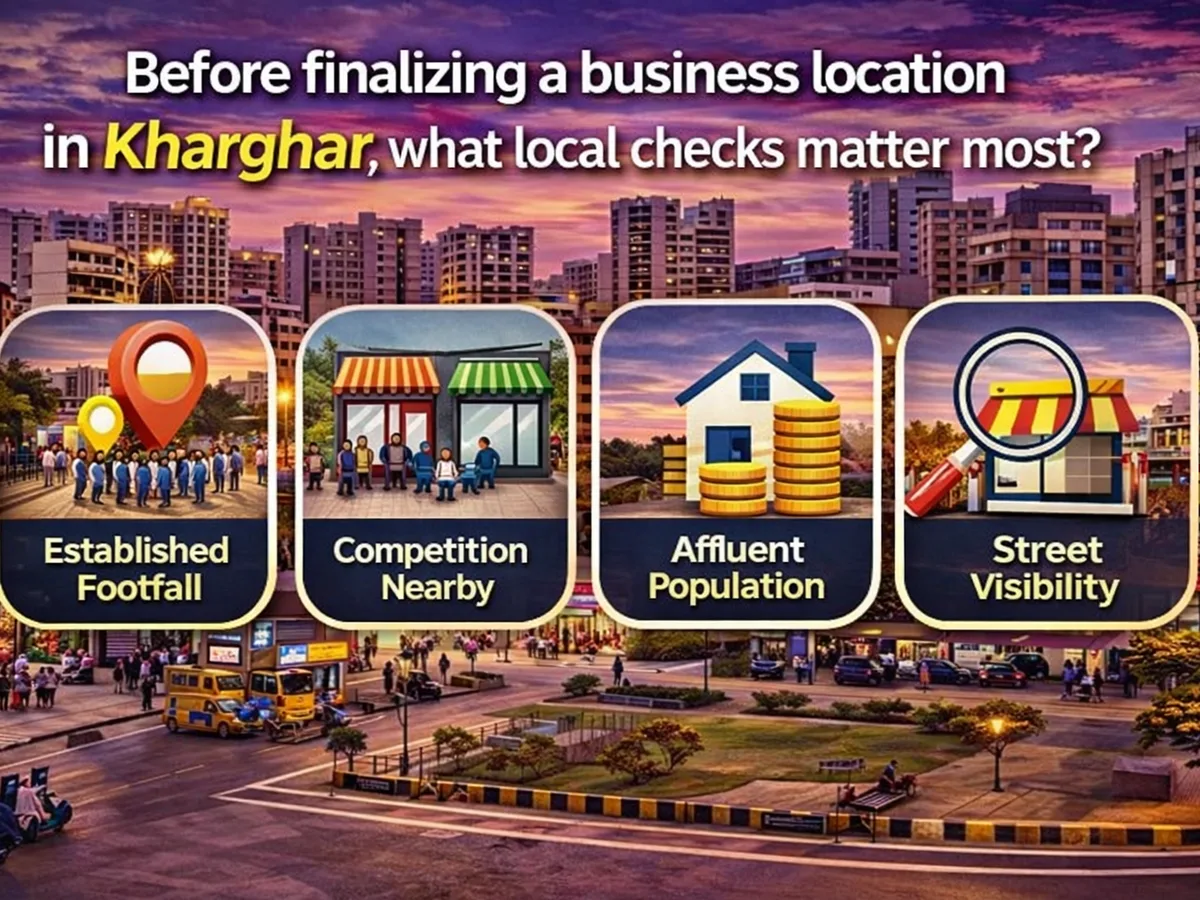
Before finalizing a business location in Kharghar, what local checks matter most?
Before signing anything, do these checks properly:
- Confirm whether the business activity is actually permitted in the building or society
- Confirm PMC licensing requirements, not NMMC
- Check whether Marathi signboard compliance is required in the proposed format and plan for it from day one
- Check parking reality physically during peak hours, not just during a broker visit
- Verify whether the space utility matches your business model, not only the area
- For food, clinic, or special-use formats, verify whether building-level permissions, NOCs, plumbing, exhaust, fire-related requirements, or service infrastructure can realistically support the business
- If the property is on CIDCO-origin land, understand that CIDCO and the society/building side may still matter for occupation rights or structural-use issues, while PMC governs day-to-day business operation
- Do not assume a busy road means a viable business
That last point matters more than it sounds.
Conclusion
Kharghar is one of those places where business success depends less on excitement and more on fit. The businesses that work best here are usually the ones tied to everyday living, family needs, education demand, healthcare, local services, and appointment-led professional activity. That is the practical reality.
If the business needs repeat trust, routine spending, or targeted appointments, Kharghar can be a very strong market. If the business depends on hype, oversized rent, unrealistic footfall assumptions, or liquor-led nightlife logic, the risk rises sharply. In simple terms, Kharghar rewards useful businesses, not just visible ones.
FAQs
Frequently Asked Questions