

CBD Belapur Metro Station Guide: Timings, Fare, Route Map & Property Rates Impact
CBD Belapur Metro Station is considered a major turning point in Navi Mumbai’s transport system. After years of delays, contractor changes, funding complications, and political approvals, Navi Mumbai Metro Line 1 finally became operational in 2023. By 2026, this metro corridor has gradually developed into a stable and reliable commuter network.
Belapur is already known as the administrative and commercial center of Navi Mumbai. With the CIDCO headquarters, government offices, court complex, corporate buildings, and strong Palm Beach Road connectivity, the area had an established identity. However, after the metro became operational, the locality received structured rapid transit support. This has noticeably changed daily commute patterns, rental demand, and property market dynamics.
This blog provides a complete 2026 guide to CBD Belapur Metro Station — covering timings, fare structure, route map, station facilities, connectivity challenges, and most importantly, a detailed analysis of property rates and investment impact.
CBD Belapur Metro Overview – Basic Information 2026
CBD Belapur Metro Station is the southern terminal of Navi Mumbai Metro Line 1. The total corridor length is approximately 11.1 kilometers, and the line consists of 11 elevated stations. The station is located in Sector 11 and is strategically positioned near CBD Belapur Railway Station.
As of 2026, the first train typically starts around 6:00 AM, while the last metro operates around 10:00 PM. During peak hours, train frequency is approximately every 10 minutes, and during non-peak hours, trains run every 12 to 15 minutes. The fare starts at ₹10 and goes up to ₹40 for the full stretch.
Belapur was already known as an administrative hub, but with the metro, it is now evolving into a transit-oriented zone. For office commuters, students, and MIDC workers, this station has become an important interchange point.
Timings & Daily Commuter Experience
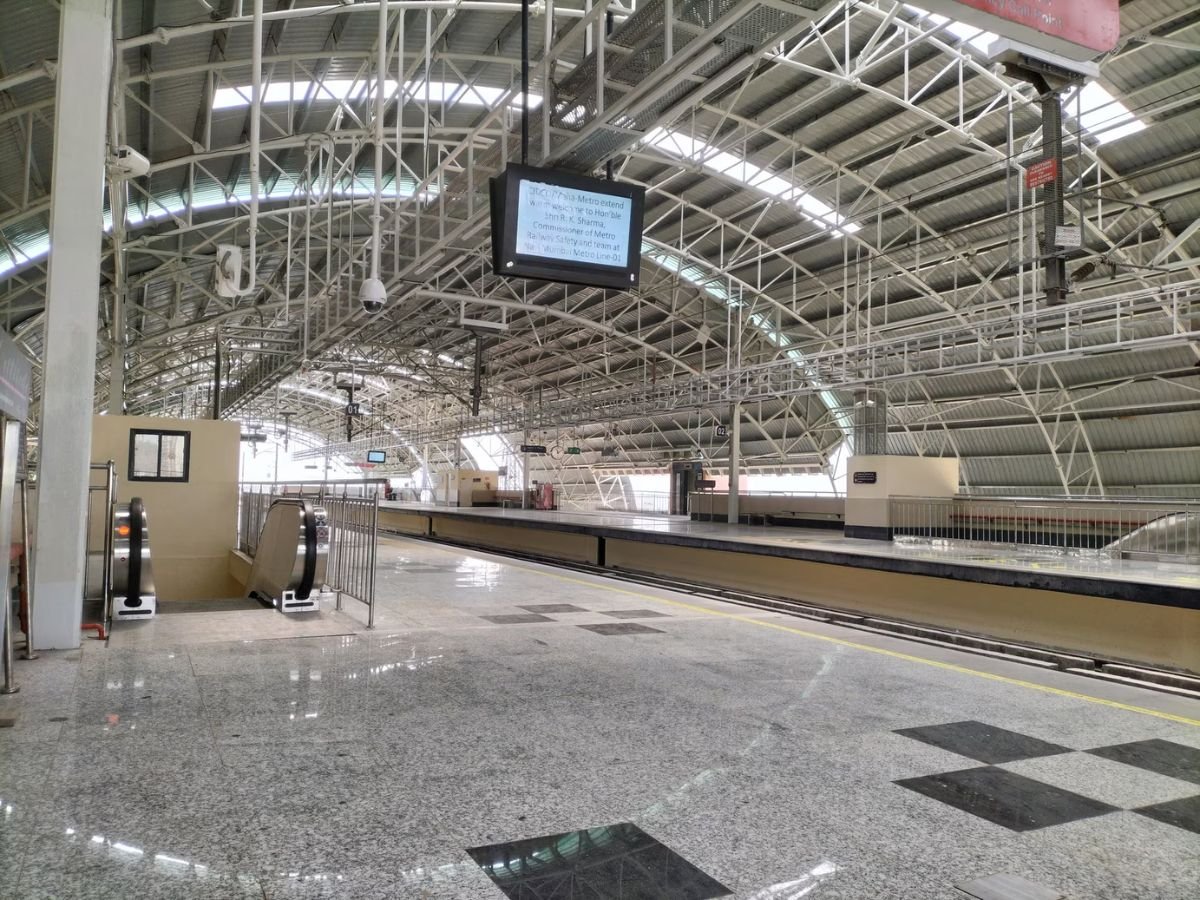
Metro timings are designed to be commuter-friendly, although there is still scope for improvement. The 6:00 AM first service is highly beneficial for government employees, industrial workers, and early-shift professionals. The last train around 10:00 PM covers the majority of office commuters, but late-night workers still depend on alternative transport options.
Peak hours are generally between 7:30 AM to 10:00 AM and 5:30 PM to 8:00 PM. During these hours, trains operate at a 10-minute frequency. In non-peak hours, the 12–15 minute interval can slightly increase waiting time.
The complete journey from CBD Belapur to Pendhar takes approximately 25 to 30 minutes. Compared to road travel, especially considering traffic at Sion-Panvel Highway and Kharghar junction, which can take 45 to 60 minutes, the metro provides predictable and reliable travel time — one of its biggest advantages for daily commuters.
Connectivity from Belapur Railway Station to Metro (By Car)
Belapur Railway Station to Belapur Metro (By Car)
| Step | Direction Instructions | Distance |
|---|---|---|
| 1 | Head northeast. | 90 m |
| 2 | Turn left at the medical store toward Sakal Bhavan Road. | 48 m |
| 3 | Slight left toward Sakal Bhavan Road. | 51 m |
| 4 | Turn left onto Sakal Bhavan Road (Pass by Raigad Bhawan / Belapur Bhavan on the left). | 200 m |
| 5 | Turn left onto Kokan Bhavan Road (Pass by Harshad Thombare on the left). Destination will be on the left. | 170 m |
| Total | Drive Time: Approximately 2 minutes | 550 m |
Bus Routes from Sector 6 Kharghar to Navi Mumbai International Airport (NMIA)
| Route Option | Bus Numbers | Transfer / Connection Point | Estimated Time |
|---|---|---|---|
| Primary Shuttle | 22AC / 52 / 125AC → A-3 | Take local bus to Belapur Railway Station, then transfer to the A-3 Airport Shuttle. | 1 hr 10 min |
| Nerul Connection | Local Bus → A-4 | Take local bus to Nerul Station (E), then transfer to the A-4 Airport Shuttle. | 1 hr 15 min |
| Reti Bandar Link | 22AC / 125AC → A-2 | Board at Shilp Chowk (Sector 6 area), get down at Reti Bandar, and transfer to A-2 Shuttle. | 1 hr 12 min |
| Premium Direct (BOM) | Chalo Bus S-105 | Direct AC Premium Bus from Jalvayu Vihar Kharghar to Mumbai Airport (CSMIA). | 1 hr 32 min |
| Ulwe Link | 17AC → A-2 | Transfer at Reti Bandar to reach NMIAL Terminal 1 via Ulwe. | 1 hr 20 min |
Bus Routes from Sector 6 Kharghar to Navi Mumbai International Airport
Several bus route options are available for commuters traveling from Sector 6 Kharghar to Navi Mumbai International Airport.
One option is to take bus numbers 22AC, 52, or 125AC to Belapur Railway Station and then transfer to the A-3 Airport Shuttle, taking approximately 1 hour and 10 minutes.
Another option is to travel to Nerul Station (E) and transfer to the A-4 Airport Shuttle, with an estimated travel time of around 1 hour and 15 minutes.
Passengers can also board at Shilp Chowk and transfer at Reti Bandar to the A-2 Shuttle, which takes approximately 1 hour and 12 minutes.
A premium direct option includes the Chalo Bus S-105 AC service from Jalvayu Vihar, Kharghar to Mumbai Airport (CSMIA), taking around 1 hour and 32 minutes.
Fare Structure & Ticketing System (2026 Updated)
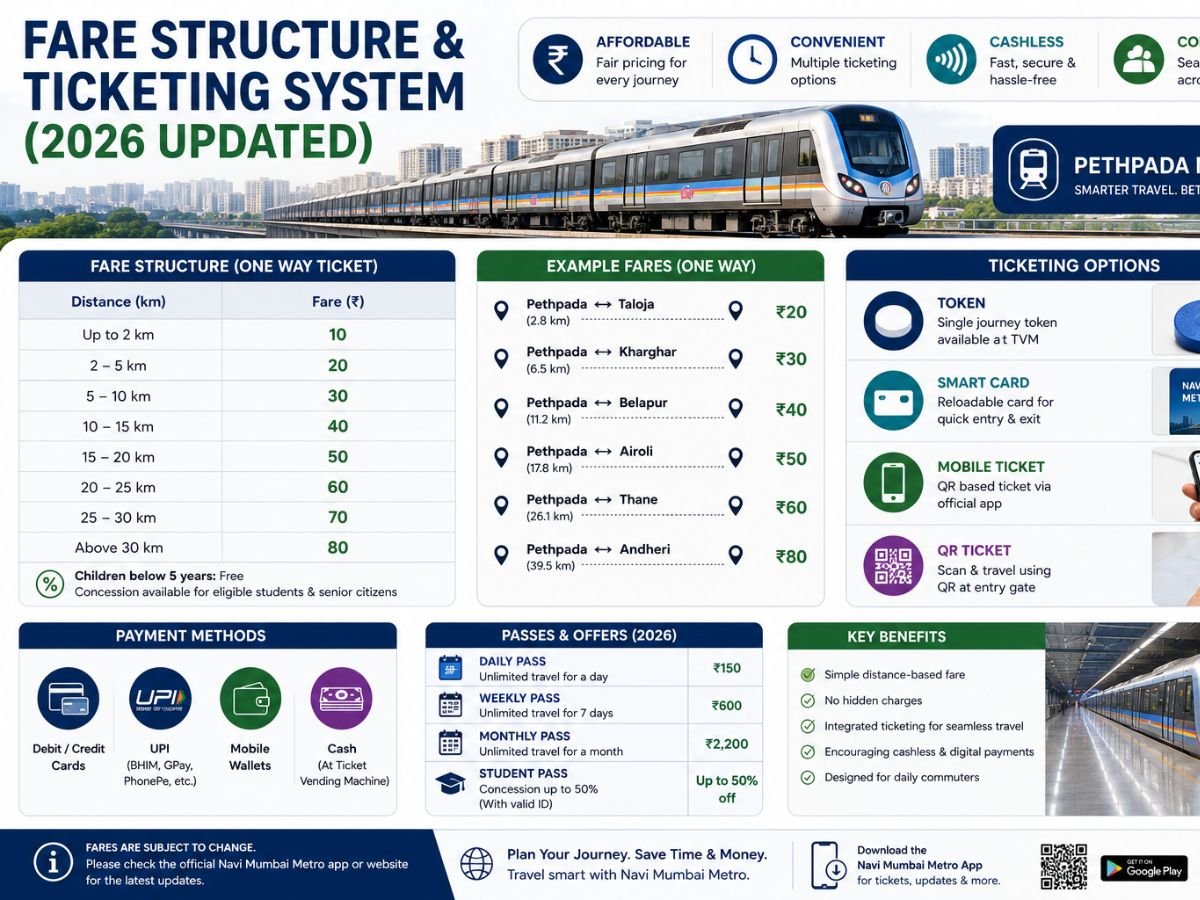
CBD Belapur Metro follows a distance-based fare model. For short-distance commuters, pricing remains affordable, making daily travel economical for residents of Kharghar and nearby sectors.
From CBD Belapur, the fare to Sector 7 (1.2 km) is ₹10. Traveling to Kharghar Village (4.2 km) costs ₹20. Central Park (5.5 km) is also ₹20, while Utsav Chowk (6.5 km) costs ₹30. Taloja MIDC (8.5 km) is ₹30, and the full stretch to Pendhar (11.1 km) costs ₹40.
Passengers can purchase single-journey tokens or use smart cards. QR-based ticket booking and UPI payment options have reduced manual queues. For regular commuters, smart cards offer faster entry and exit, especially during peak hours.
Route Map & Connectivity Structure
Metro Line 1 includes the following stations in sequence: CBD Belapur, Sector 7, Kharghar Village, Central Park, Pethpada, Utsav Chowk, Sector 34, Taloja MIDC, Taloja Phase 1, Taloja Phase 2, and Pendhar.
This corridor directly connects residential zones with employment hubs. Residents of Kharghar and Taloja now have faster access to Belapur’s commercial district.
Although CBD Belapur Metro Station is located near the railway station, there is no enclosed skywalk connection. Passengers must cross the road at ground level, which can be inconvenient during monsoon season or peak traffic hours.
Station Facilities & Nearby Infrastructure
CBD Belapur Metro Station is equipped with modern amenities including escalators, elevators, CCTV surveillance, automated fare collection gates, digital display boards, and clean waiting areas. Accessibility features such as ramps and lifts are also available.
Paid parking facilities are available. Two-wheeler parking costs approximately ₹20–30 per day, while four-wheeler parking ranges between ₹50–80 per day. During peak office hours, parking capacity may become limited.
The surrounding commercial presence ensures steady daily footfall. Nearby establishments include McDonald’s, Domino’s Pizza, Cafe Coffee Day, and Hotel Grande 51, making it convenient for office workers and visitors.
Residential Property Rates Near CBD Belapur Metro (2026 Detailed)
Metro connectivity has steadily increased property demand in Belapur and surrounding micro-markets. Projects within walking distance of the metro station command a premium due to transit convenience.
In 2026, average property prices in CBD Belapur range between ₹18,000 to ₹24,000 per square foot. A 1 BHK apartment typically costs between ₹85 lakh to ₹1.2 crore, while a 2 BHK ranges from ₹1.4 crore to ₹2.2 crore.
In Kharghar, average rates range from ₹13,000 to ₹17,500 per square foot. A 1 BHK costs approximately ₹55 lakh to ₹85 lakh, and a 2 BHK ranges from ₹95 lakh to ₹1.6 crore.
Taloja offers a more affordable entry point, with prices between ₹6,500 to ₹9,000 per square foot. A 1 BHK ranges from ₹28 lakh to ₹45 lakh, and a 2 BHK costs between ₹48 lakh to ₹75 lakh.
Pendhar remains one of the most affordable metro-connected zones, with average rates between ₹6,000 to ₹8,000 per square foot.
Belapur shows price stability due to its developed status, Kharghar offers balanced growth, and Taloja remains popular among investors seeking affordable long-term appreciation.
Commercial Property & Rental Market Impact

Metro connectivity has gradually improved office absorption in Belapur. Due to the presence of government offices, rental stability remains strong.
Commercial sale rates in 2026 range between ₹22,000 to ₹28,000 per square foot. Monthly office rentals range from ₹120 to ₹180 per square foot depending on location and building grade.
In the residential rental market, 1 BHK apartments in Belapur rent between ₹18,000 to ₹28,000 per month. In Taloja, 1 BHK rentals range from ₹8,000 to ₹13,000 per month. Properties within walking distance of the metro station enjoy stronger tenant demand.
Investment Perspective – Stability vs Growth
Belapur is considered a low-risk, stable appreciation zone. Due to its developed infrastructure, sudden price spikes are unlikely, but steady long-term growth is expected.
Kharghar offers a balanced risk-reward ratio, supported by education hubs, Central Park, and metro connectivity.
Taloja represents a high-growth potential zone, particularly due to industrial expansion and future infrastructure projects. Lower entry costs make it attractive for long-term investors.
FAQs
Frequently Asked Questions
Where is CBD Belapur Metro Station located?
Is there a direct skywalk connection to the railway station?
What is the fare from Belapur to Pendhar?
What time is the last metro?
Is parking available?
Conclusion
CBD Belapur Metro is not just a transport project; it is an urban growth accelerator for Navi Mumbai. Commute times have become predictable, traffic dependency has reduced, and the real estate market has gained new direction.
Infrastructure will continue to expand, connectivity will improve further, and transit-oriented development will make metro proximity even more valuable in the future.
By 2026, it is clear that CBD Belapur Metro is gradually becoming the backbone of Navi Mumbai’s urban framework. With a stable administrative base, improving connectivity, and strong real estate growth potential, this region is positioned to perform strongly over the coming decade.