
Ready Reckoner Rate in Navi Mumbai: What Buyers and Sellers Need to Know
Navi Mumbai has changed a lot. What once felt like a planned extension of Mumbai now behaves like a serious real estate region with its own demand cycles, premium nodes, and infrastructure-driven price shifts. Airport discussions, metro corridors, CIDCO layouts, new townships, and older established sectors all now sit inside the same larger property conversation. In that kind of market, one government benchmark quietly matters more than most people think: the Ready Reckoner Rate.
If you are buying, selling, inheriting, registering, or even just evaluating property in Navi Mumbai, this rate affects the legal and financial side of the deal. It shapes stamp duty, registration value, and compliance. It also becomes more relevant in Navi Mumbai because of the city’s land history, especially the long-standing CIDCO leasehold structure and the practical difference between official valuation and real market price. The state’s ASR framework is issued annually and is meant to show official rates for land and buildings across local-body areas.
The practical importance of Ready Reckoner Rate becomes clearest at the sale deed registration stage, where stamp duty and valuation logic often come into play.
Quick Summary
| Topic | What it means in Navi Mumbai |
|---|---|
| Ready Reckoner Rate | Government’s minimum value benchmark for registration |
| Also called | Annual Statement of Rates or ASR |
| Main use | Stamp duty, registration valuation, compliance |
| Same as market price? | No, market price is often higher |
| Stamp duty basis | Usually calculated on the higher of agreement value or government valuation |
| Registration fee | 1% below ₹30 lakh, capped at ₹30,000 above ₹30 lakh |
| Official rate-check system | Maharashtra IGR e-ASR |
| Why it matters here | Node-wise variation, CIDCO land history, leasehold/freehold context |
The reason this matters so much in Navi Mumbai is simple. The city does not behave as one flat market. Vashi, Nerul, Kharghar, Ulwe, Panvel-side growth belts, and older CIDCO sectors all operate with different ground realities. So when people casually ask, “Navi Mumbai ka government rate kya hai?”, the real answer is always more specific than that. Official rates must be checked locality by locality through e-ASR.
What Is Ready Reckoner Rate in Navi Mumbai?

Simple Meaning
Ready Reckoner Rate is the government’s minimum assessed value for a property in a particular location. It acts as the official floor for valuation during registration. Even if buyer and seller agree on a lower deal value, the state can still calculate stamp duty on the higher official benchmark if that benchmark applies.
In normal language, this is the number the government uses to say: for legal valuation purposes, this property cannot be treated as worth less than this amount. In Navi Mumbai, where valuation can change sharply from one node or sector to another, that baseline becomes very important.
Ready Reckoner Rate is useful for official valuation, but it is still only one part of the larger verification process, which is why buyers should also read this property buying checklist documents in Navi Mumbai before making any final decision.
Government Valuation vs Actual Selling Price
Government valuation and actual selling price are not the same thing. The Ready Reckoner Rate is an official benchmark. Market price is what the buyer actually agrees to pay in the open market. That market price reacts to builder reputation, tower quality, station access, road width, project amenities, and future infrastructure expectations.
This is exactly why a premium apartment in a strong micro-market can trade much higher than the official valuation. In Navi Mumbai, that gap can become especially visible in nodes where infrastructure expectations move faster than government benchmarking catches up.
Ready reckoner-based value analysis can become misleading if the buyer does not first understand carpet area vs built-up vs super built-up properly.
Ready Reckoner Rate vs Market Rate in Navi Mumbai
Main Difference
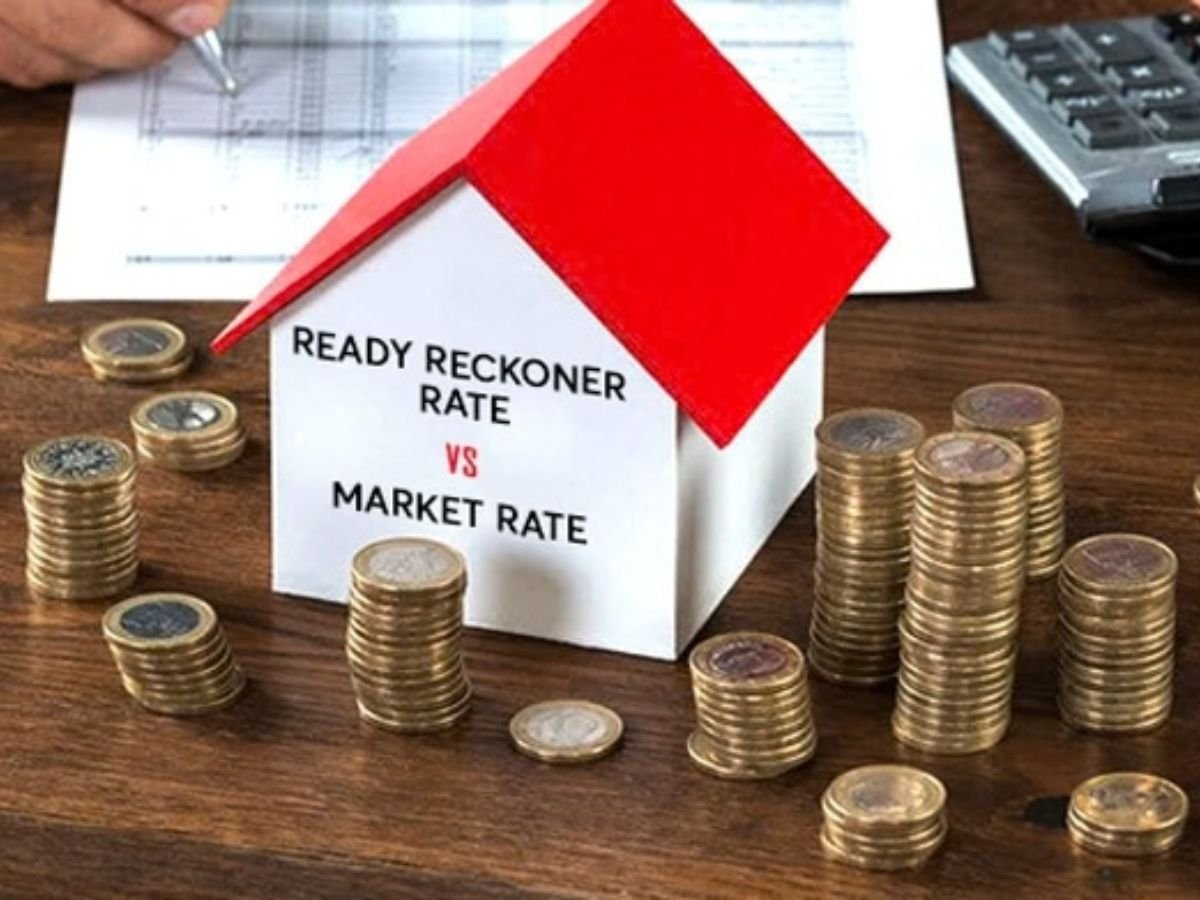
The main difference is straightforward. Ready Reckoner Rate is state-defined. Market rate is demand-defined. One is administrative. The other is emotional, practical, competitive, and often speculative. Both matter, but they answer different questions.
Ready Reckoner helps the government protect revenue and standardize valuation. Market rate reflects what real buyers are willing to pay. In a fast-changing urban region, those two figures often move at different speeds.
Why Both Values Are Different
They differ because the market sees details that a standard rate schedule cannot fully absorb in real time. A project with better maintenance, stronger builder credibility, cleaner views, stronger retail frontage, or better future connectivity can command a premium above the official benchmark.
In Navi Mumbai, this is not theory. It is everyday property reality. Two buildings in the same broad area can feel very different in the market, even if government valuation treats the location in a more standardized way. That is why buyers who rely only on official rate sheets often misread actual deal value.
How Ready Reckoner Rate Is Calculated
Location
Location is one of the most powerful inputs in official valuation. Maharashtra’s ASR framework is prepared area-wise for local bodies, municipal corporations, and other zones, and the official e-ASR process requires users to narrow down district, taluka, village, and in many cases location or survey details.
In Navi Mumbai, this matters because locality selection is not just cosmetic. A property that is casually described as “Navi Mumbai” still needs the correct administrative path to get the right official rate. One wrong locality selection can distort the result.
Property Type
The official system also distinguishes by property category. In practice, users can view rates for land and for different use classes such as residential, office, and shop in the e-ASR workflow.
That means a flat, a commercial office, a ground-floor retail unit, and a land parcel are not treated the same way. In a planned city like Navi Mumbai, where mixed-use development is common, that distinction matters a lot.
Usage and Zone
The official rate structure also depends on the way the area is classified and searched. The e-ASR user manual shows different search logic for urban area, influence area, and rural area. In some cases, users can even search by survey number to get the relevant rate.
That is why local property valuation is more technical than many people think. It is not only about city name. It is about correct zone, correct search path, and correct property category.
How Ready Reckoner Rate Affects Stamp Duty and Registration
Stamp Duty Basis
This is the section most buyers actually care about. In Maharashtra property registration, the practical rule is that charges are assessed on the higher applicable value base, not simply whatever number sounds better in negotiation. That is why Ready Reckoner matters at the time of documentation and registration. The department’s ASR framework exists precisely to support official market-value determination.
For public-facing blog writing, it is safer to say this clearly: in Navi Mumbai, the final payable stamp-duty percentage can vary based on the exact urban jurisdiction, local-body applicability, and buyer category. Women continue to receive concessional treatment in Maharashtra on eligible residential purchases, but you should confirm the final applicable slab at the time of execution through the official registration workflow rather than relying on generic internet summaries.
Registration Value Impact
Registration fee is one of the easiest cost components to state clearly. Maharashtra’s published fee table supports the commonly used consumer rule of thumb: 1% of property value below ₹30 lakh and ₹30,000 for property value above ₹30 lakh.
For buyers in Navi Mumbai, this matters because the real upfront cost is never just the agreement value. There is down payment, documentation, stamp duty, registration, and other transaction costs. A property may feel affordable in conversation, but the official cost picture becomes clear only when the legal valuation layer is added.
Example:
If a property agreement value is ₹80 lakh but the applicable official valuation works out higher, the statutory charges are normally planned around the higher legal benchmark, not the lower conversational number.
How to Check Ready Reckoner Rate Online in Maharashtra

Official Portal Process
The Maharashtra Registration & Stamps Department says that the official ASR is available through the web application e-ASR, and that citizens can find the official rate of any property in the state there. The e-ASR portal also shows current year selections such as 2025–2026 and earlier years.
Use this process:
1. Open the official Maharashtra IGR e-ASR system. 2. Select the relevant year. 3. Choose the correct district. 4. Select the correct taluka. 5. Select the exact village / node / location. 6. View the displayed rates for the relevant property category. 7. If needed, use the survey number search option shown in the official user manual.
Common Checking Mistakes
The most common mistake is selecting the wrong district or locality. This happens often in Navi Mumbai because people think geographic identity and registration identity are always the same. They are not. Some nodes fall under different district or taluka paths in official records.
Other common mistakes include:
- mixing up square feet and square meters
- checking the wrong sector or sub-location
- relying on outdated unofficial calculators
- assuming one node’s rate applies to the full city
That last mistake is especially costly in a place like Navi Mumbai, where node-wise variation is the whole point.
Area-Wise Ready Reckoner Rate Relevance in Navi Mumbai

Vashi, Nerul, Kharghar, Ulwe, Panvel
The smartest way to read Ready Reckoner in Navi Mumbai is node by node. Vashi behaves like a mature urban node. Kharghar combines planning, education, lifestyle appeal, and long-term demand. Ulwe and Panvel-side growth belts are shaped more by future-facing infrastructure narratives and expansion potential.
That means the same question, “Is this property fairly priced?”, has a different answer depending on where the property sits. A practical affordability-led purchase in a growth corridor should not be evaluated with the same lens as a premium property in a mature node.
Why Rates Differ by Locality
Rates differ because local property value in Navi Mumbai is shaped by multiple factors:
- stage of node development
- rail and road connectivity
- commercial density
- social infrastructure
- planning history
- growth expectations
- project quality within the same area
This is why hyperlocal reading beats generic reading. That is also where a local platform like yours can outperform broader real estate portals.
Why Ready Reckoner Rate Matters for Buyers and Sellers
For Buyers
For buyers, Ready Reckoner Rate defines the minimum official valuation base of the transaction. It helps estimate stamp-duty and registration burden, and it keeps the buyer grounded in legal cost rather than only builder or broker conversation.
This matters more in Navi Mumbai because the city is full of future-oriented buying decisions. People buy for airport growth, metro access, family upgrade, investment hope, or a better lifestyle shift. But hope alone does not register a property. Official valuation does.
For Sellers
For sellers, the rate acts as a compliance floor and a perception anchor. It does not automatically decide the final asking price, but it influences how low a deal can sensibly go on paper. A seller also benefits from understanding whether the official benchmark is moving upward in the locality.
In Navi Mumbai, this becomes even more relevant where land tenure history and transaction comfort can affect buyer perception. A property with cleaner ownership comfort can attract better response than another with more friction, even in the same broad area.
For Investors
For investors, the gap between official valuation and live market value is a useful signal. It can hint at whether a locality is maturing, overheated, or moving ahead of official recognition. But that signal should never be read alone.
Infrastructure optimism can push sentiment quickly. End-user absorption may move more slowly. The smart investor reads benchmark, demand, liquidity, and project quality together.
Common Mistakes People Make While Using Ready Reckoner Rate

Confusing It with Market Value
This is the biggest mistake. Ready Reckoner Rate is not the same as market value. It is a government benchmark for legal and revenue purposes. A buyer who treats it as the exact price guide for all transactions is usually seeing only half the picture.
In strong Navi Mumbai localities, actual transaction values often move above the official benchmark because real-life demand responds to factors that official schedules standardize more slowly.
Ignoring Actual Demand and Project Quality
Government valuation is standardized. Real estate is not. Two properties in the same area can differ hugely in maintenance, layout quality, society culture, construction grade, view, parking comfort, or resale appeal.
That is why Ready Reckoner should be treated as a framework, not a final verdict. It is useful. It is necessary. But on its own, it is not enough.
Conclusion
Use Ready Reckoner Rate for tax planning, registration budgeting, basic legal valuation, and compliance checks. In Navi Mumbai, it is especially useful before buying, before selling, and before making assumptions about what a property will cost on paper.
It gives structure. It helps you understand the government side of the transaction. In a city where real estate discussion is often driven by hype, that structure matters.
Do not use it as the final answer for true market pricing, resale value, or investment quality. It does not fully capture builder brand, society quality, view premium, product positioning, or emotional buyer demand.
That is the real lesson for Navi Mumbai. Ready Reckoner gives you the legal framework. The market gives you the living reality. If you understand both together, you make better property decisions.
FAQs
Frequently Asked Questions