TTC Navi Mumbai MIDC Guide: Full Form, Areas, Map, Property Types & Rules
TTC Navi Mumbai MIDC refers to the Trans Thane Creek industrial belt along the Thane-Belapur corridor in Navi Mumbai. In actual market use, TTC Navi Mumbai is not one single locality or one clean municipal label on a map. It is a wider MIDC-led industrial and commercial belt that usually overlaps with pockets such as Mahape, Rabale, Pawane, Turbhe, Ghansoli, Kopar Khairane and Airoli, depending on the exact property, access road and business use.
This guide explains what TTC Navi Mumbai MIDC means, how the belt is understood locally, which areas users usually include, what property types exist, which authorities matter, and what buyers or tenants should verify before taking any unit, gala, shed, office, warehouse or leasehold plot in the corridor.
The quick answers below combine official MIDC functions, public-service portals and consistent local corridor usage.
| Question | Answer |
|---|---|
| TTC full form | Trans Thane Creek |
| What is TTC Navi Mumbai? | A broad industrial-commercial belt in Navi Mumbai |
| Is TTC one locality? | No, it covers multiple industrial pockets |
| Main authority | MIDC for notified industrial land and permissions |
| Other relevant authorities | NMMC, fire department, MPCB, IGR Maharashtra |
| Main areas | Airoli, Rabale, Ghansoli, Mahape, Kopar Khairane, Pawane, Turbhe |
| Best for | Manufacturing, IT/ITES, warehousing, MSMEs, offices, service units |
What is TTC Navi Mumbai MIDC?
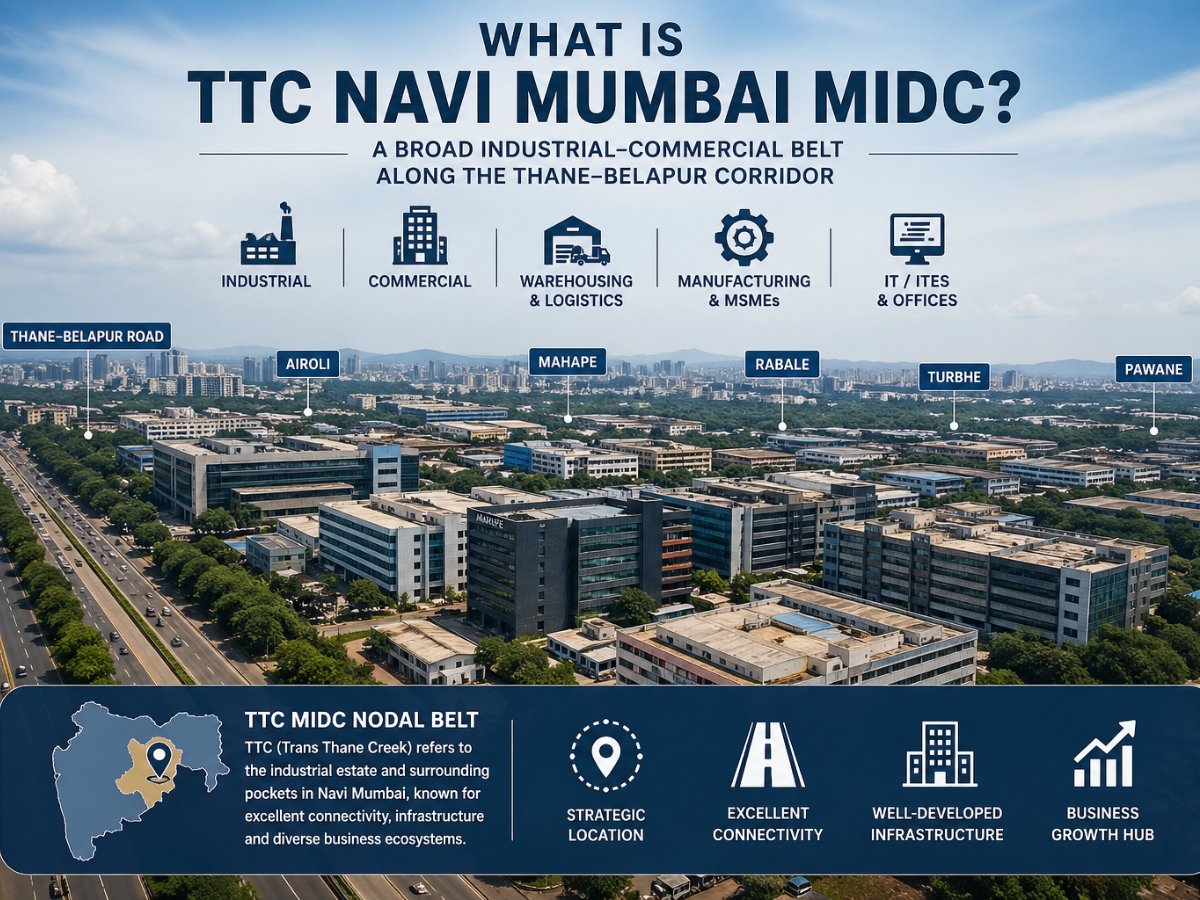
TTC Navi Mumbai MIDC is the working industrial-commercial belt built around the Trans Thane Creek estate on and around Thane-Belapur Road. Official material and court-filed environmental records describe the TTC MIDC estate as an industrial estate at Thane-Belapur Road in Navi Mumbai, while everyday local usage stretches the term across multiple adjoining pockets rather than one fixed pin code. That is why brokers, occupiers, consultants and factory users often say “TTC” slightly differently depending on whether they are looking for a warehouse, an office-led building, a workshop, a factory shed or a leasehold plot.
In other words, TTC MIDC Navi Mumbai is both a formal industrial-area reference and a practical market term. If you are evaluating a unit, do not stop at the label. Check the exact address, block, road approach and permission trail, then cross-check it against the relevant.
TTC Full Form in Navi Mumbai: What Does TTC Mean?
TTC full form Navi Mumbai is Trans Thane Creek. In industrial and property usage, Trans Thane Creek Navi Mumbai generally refers to the broader industrial-commercial belt associated with the Thane-Belapur side of Navi Mumbai, not only one micro-location. MIDC’s GIS listings, state economic documents and environmental records all use the Trans Thane Creek industrial-area naming in this context.
Some market listings and local speech may compress the name into just “TTC,” “TTC belt,” or “TTC MIDC,” but this article uses Trans Thane Creek as the main meaning of TTC full form.
Which Areas Come Under TTC Navi Mumbai MIDC?
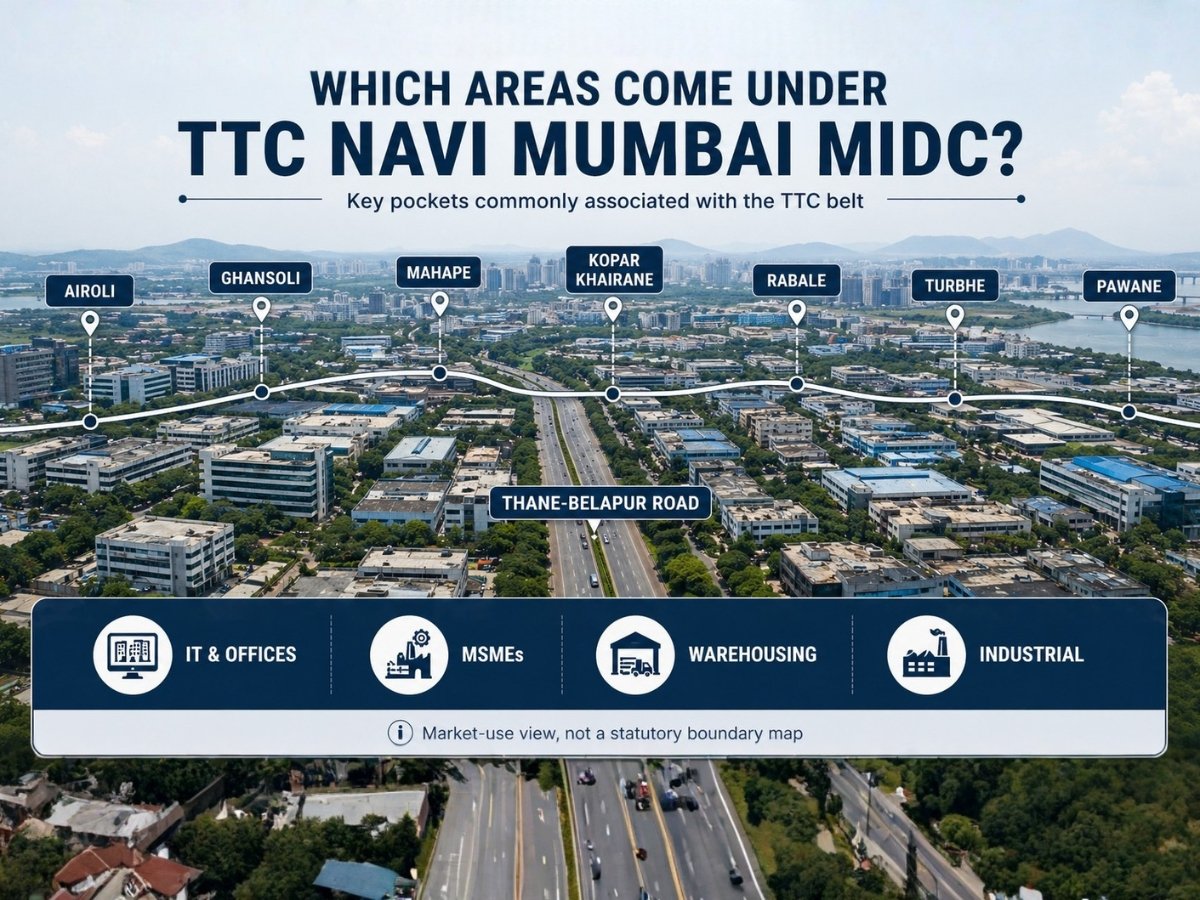
Use the table below as a practical occupier-fit guide, not a statutory boundary certificate. In local and market use, TTC Navi Mumbai usually includes or overlaps with pockets along the Thane-Belapur industrial stretch, and official address records, industrial associations and corridor references show TTC-linked activity across Digha-Airoli, Rabale, Mahape, Pawane and the wider belt.
| TTC pocket | Best known for | Best-fit users |
|---|---|---|
| Mahape | IT, ITES, electronics, light industrial activity,MSME Units | IT offices, back offices, electronics, technical services |
| Rabale | MSME, engineering, mixed industrial activity | Workshops, engineering units, office + operations users |
| Pawane | Manufacturing, fabrication, logistics | Warehousing, fabrication, dispatch-heavy businesses |
| Turbhe | Warehousing, storage, commercial-industrial movement | Logistics, distribution, storage, dispatch |
| Digha | MSME Units | Small Scale MSMEs |
| Kopar Khairane | Mixed commercial-industrial stock | Office + storage, service businesses |
| Airoli | Corporate, office, commuter-friendly belt | IT, corporate, client-facing setups |
If you are comparing occupier fit rather than just map labels. The most important point is that areas under TTC MIDC are better understood as operating pockets inside one industrial belt, not as one universal boundary line.
TTC Navi Mumbai MIDC Map and Location Logic
A TTC Navi Mumbai MIDC map is useful, but it can also mislead. The same “TTC MIDC” label can include very different building stock, road widths, station access patterns and operating conditions from Airoli to Turbhe and from office-led frontage to interior industrial blocks. Official records place the Trans Thane Creek estate along Thane-Belapur Road, and corridor references routinely touch Airoli, Rabale, Ghansoli, Mahape, Pawane, Turbhe and the Digha-Shirwane side of the belt.
When judging any TTC Industrial Area Navi Mumbai location, look beyond the pin on the map. Check the exact pocket, road access, permitted use, power load, truck movement, drainage, fire access, staff commute and building condition. A front-road office building near a station and an interior industrial gala on a narrower road may both be sold as “TTC,” but they are not the same product. For a more block-level view.
Main TTC MIDC Pockets: Mahape, Rabale, Pawane, Turbhe, Ghansoli and Airoli
Mahape TTC MIDC
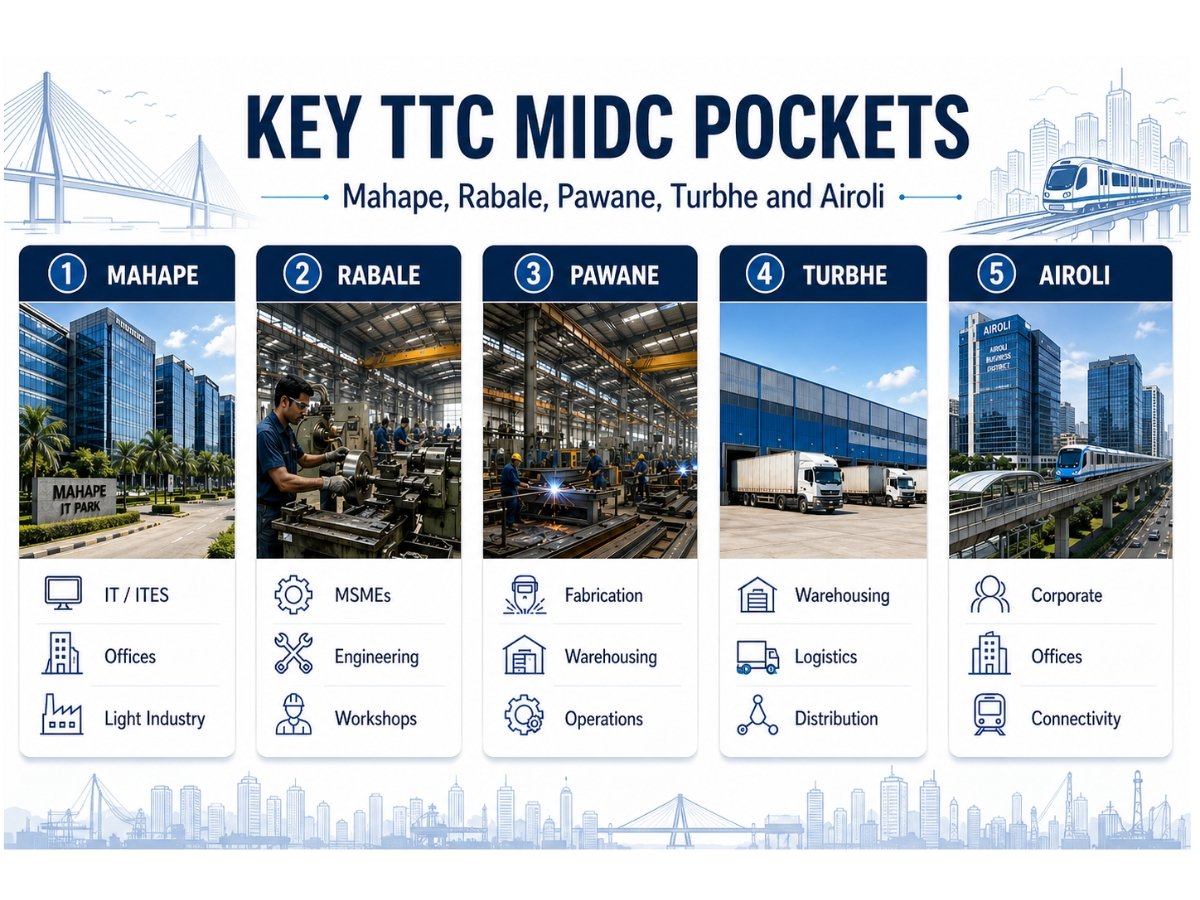
Mahape TTC MIDC is usually the stronger choice for IT/ITES, technical offices, electronics, light industrial activity, back-office operations and hybrid office-plus-operations users. Official IT-park records show TTC Industrial Area, Mahape in government IT-park listings, and the wider policy framework also recognizes IT/ITES activity in MIDC-linked MMR locations.
Even in Mahape, selection should still be done building by building. Check the exact road, building type, sanctioned use, power load, drainage condition, fire compliance and whether modifications were legally approved. If you are comparing edge locations versus deeper industrial blocks, see.
Rabale TTC MIDC
Rabale TTC MIDC remains one of the most practical pockets for MSMEs, engineering, industrial services, workshops, smaller factories and office-plus-operations setups. That is reflected in the presence of corridor industry associations such as TMIA and TBIA in Rabale’s TTC industrial area.
The main checks in Rabale are internal road width, truck access, ageing structures, power availability, fire safety and whether the permitted activity matches the intended use. A workable Rabale unit is usually about operational fit, not just location branding.
Pawane TTC MIDC
Pawane TTC MIDC is often better for operations-heavy users, fabrication, dispatch-oriented businesses, storage-led occupiers and cost-conscious industrial users. Official address records in TTC Industrial Area include Pawane-based units, which is one reason this pocket is regularly treated as part of the larger Trans Thane Creek belt in market practice.
In Pawane, the practical checks are drainage, monsoon behavior, road condition, loading access, turning movement and compliance history. A property that looks cheap on paper can become expensive if dispatch vehicles cannot operate smoothly.
Turbhe TTC MIDC
Turbhe TTC MIDC is one of the stronger warehouse and logistics-facing pockets inside the corridor because of its movement pattern, storage-oriented stock and proximity to larger commercial traffic flows. In practice, this is where TTC warehouse users, distribution users and dispatch-heavy occupiers often focus first, especially when loading and turnaround speed matter.
In Turbhe, prioritize traffic, loading-unloading room, frontage, building height, fire access and parking discipline. On paper, a unit may seem suitable. On the ground, the question is whether goods can move in and out without daily friction.
Kopar Khairane and Airoli Side
These side pockets are usually better for staff-heavy, office-led, client-facing and corporate users than deeper industrial interiors. Airoli, in particular, has a strong office identity because large business-park stock along the Thane-Belapur micro-market is close to station access and major residential catchments. Kopar Khairane can also work well where office frontage, mixed use stock and commuter convenience matter more than heavy truck operations.
Property Types Available in TTC Navi Mumbai MIDC
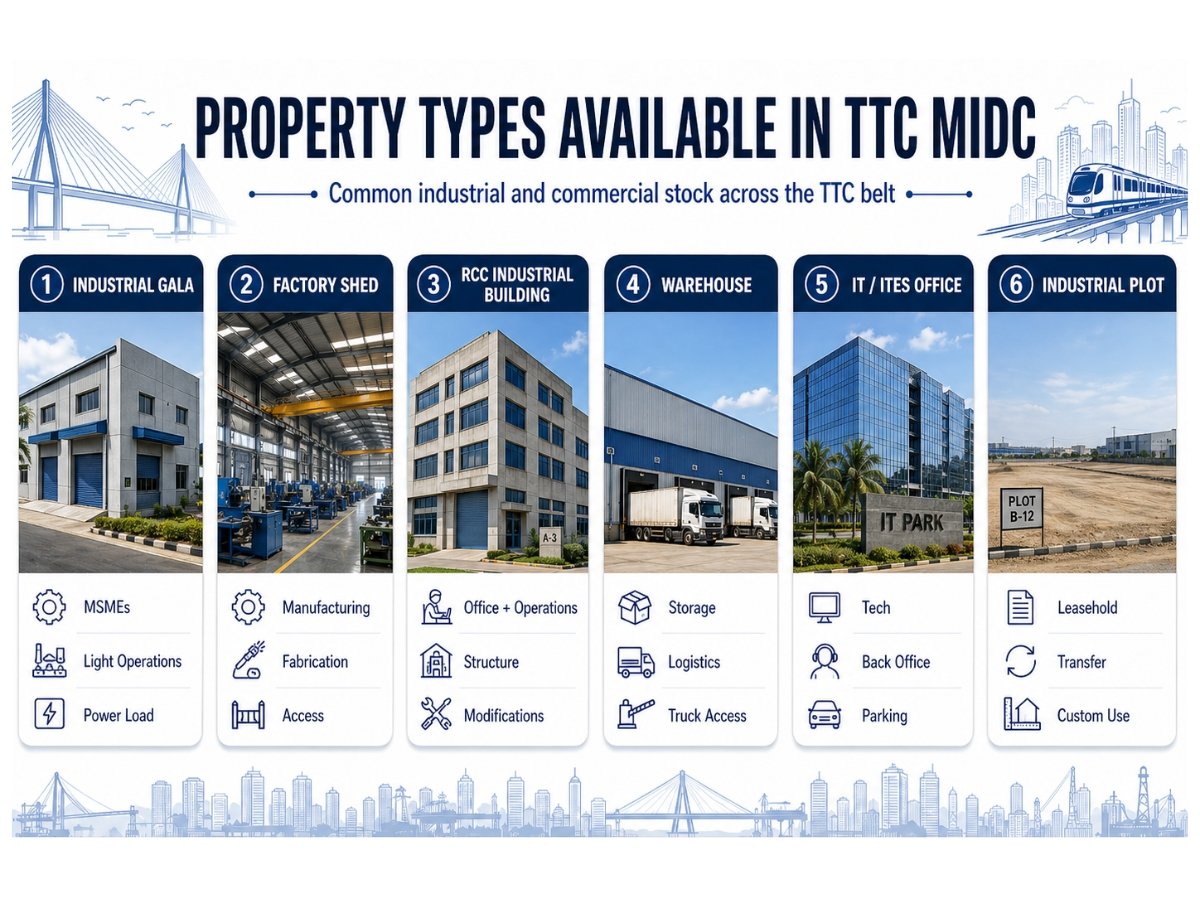
The stock in TTC MIDC Navi Mumbai is mixed. MIDC’s own investor resources refer to built-up sheds and galas, and corridor practice clearly includes industrial buildings, office premises and leasehold industrial plots. The exact mix changes by block, road position and approval trail.
| Property type | Best for | Main checks |
|---|---|---|
| Industrial gala | MSMEs, workshops, light operations | permitted use, power load, fire safety |
| Factory shed | manufacturing, fabrication, engineering | floor loading, access, sanctioned use |
| RCC industrial building | office + operations, small manufacturing | occupancy, structure, modifications |
| Warehouse | storage, logistics, distribution | truck access, height, loading, road width |
| IT/ITES office | tech, back office, corporate use | commute, building quality, parking |
| Industrial plot | larger operators, redevelopment, custom use | MIDC lease terms, transfer, dues |
Do not assume every TTC MIDC property is interchangeable. A TTC industrial gala is very different from a TTC factory shed, a TTC warehouse or a TTC MIDC office space. If you are deciding between industrial and office-led use, compare the fit through.
Best TTC MIDC Area by Business Type
The table below is a practical fit chart, not a legal zoning promise. It reflects station-side office concentration, industrial association geography, and the operational logic of the Thane-Belapur belt.
| Business type | Best TTC pocket | Second option |
|---|---|---|
| IT/ITES office | Mahape | Airoli / Kopar Khairne/ Nerul |
| Back office | Mahape | Airoli |
| Light engineering | Rabale | Mahape |
| Heavy fabrication | Pawane | Rabale |
| Warehousing | Turbhe | Pawane |
| Logistics / dispatch | Turbhe | Pawane |
| MSME office + operations | Rabale | Kopar Khairane |
| Client-facing B2B office | Airoli | Mahape |
| Cost-sensitive workshop | Pawane | Rabale |
| Hybrid office + storage | Rabale | Mahape |
If you want the pocket-by-pocket decision tree, use. Also note that this guide does not quote current rates, because TTC MIDC property values and rents change by pocket, building type, access, power load, compliance and market conditions.
Who Controls TTC Navi Mumbai MIDC? MIDC, NMMC, Fire, MPCB and IGR Explained
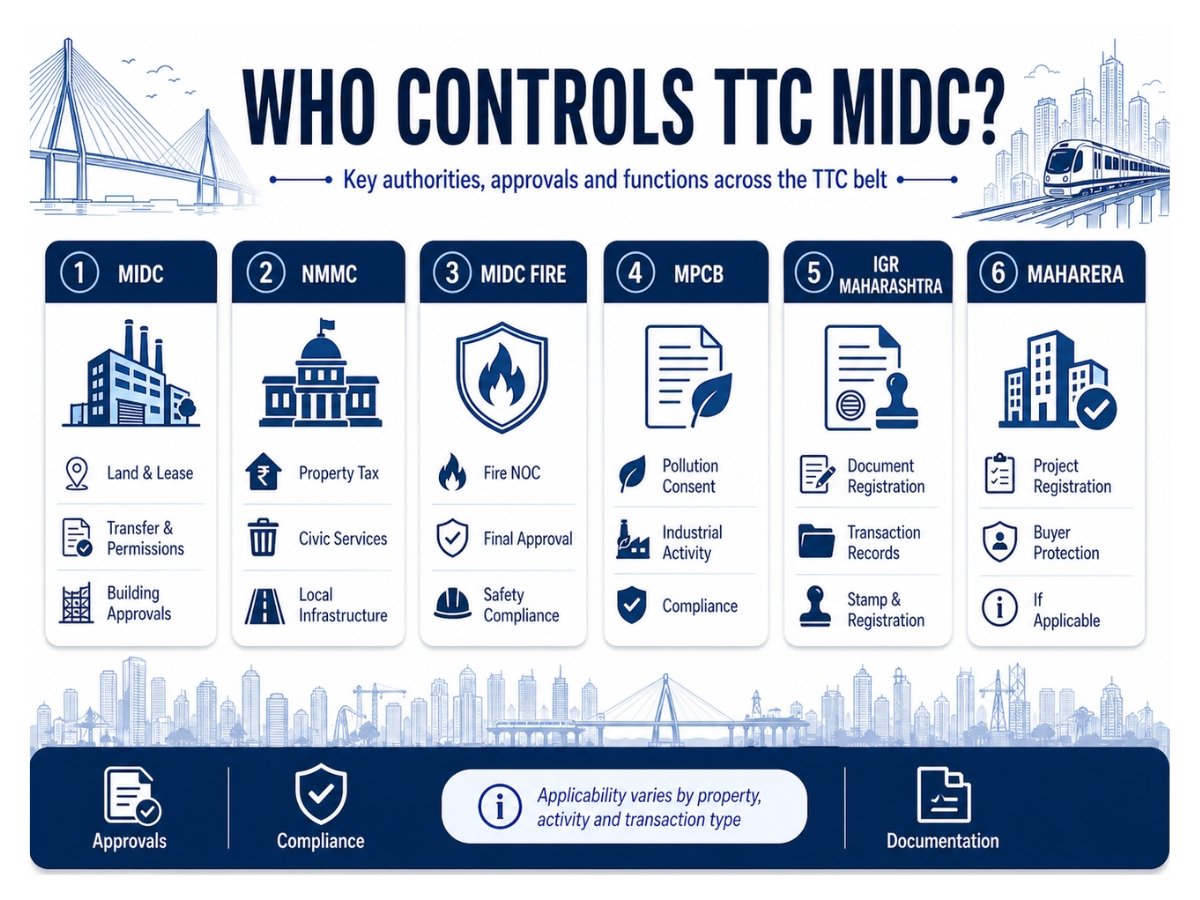
MIDC matters because industrial land in the belt is not only about location. Official MIDC pages separate land management, building approvals, occupancy, fire approvals, water, drainage, transfer, sub-letting, sub-leasing and change in use or activity into specific service and department functions. NMMC separately handles municipal-side services such as property tax and local civic interfaces. MPCB handles applicable pollution consents. IGR Maharashtra handles registration of documents.
| Authority | What it affects |
|---|---|
| MIDC | industrial land, leasehold rights, transfer, sub-letting, sub-leasing, change in land use, building approvals |
| NMMC | property tax, civic services, local infrastructure issues |
| MIDC Fire Department | fire NOC, final fire approval, renewal, fire-safety compliance |
| MPCB | pollution consent for applicable industrial activity |
| IGR Maharashtra | registration of documents |
| MahaRERA | applicable qualifying real estate projects, where relevant |
MIDC’s portals show why TTC MIDC rules are operational, not cosmetic: transfer, sub-leasing, sub-letting, change in activity, change in land use, no-dues certificates, water services, building plan approval, occupancy certificate and fire approvals sit on different tracks. MIDC’s fire-station records also specifically list TTC “D” Block at Juinagar East and TTC “R” Block at Rabale Industrial Area, which is a practical reminder that fire compliance in the corridor is real infrastructure, not a broker checklist line.
> “Do not treat a TTC property as usable only because the broker says it is in MIDC. The permitted use, lease status, transfer position, dues, building approval, fire status and activity permission must be checked separately.”
Buyer and Tenant Checklist Before Taking TTC MIDC Property
The table below is the practical TTC MIDC buyer checklist. It is built from MIDC’s land, town-planning, fire and transfer processes; public service forms; and the compliance trail usually needed to actually occupy and operate a unit.
| Check | Why it matters |
|---|---|
| MIDC lease deed / agreement to lease | confirms the legal right being transferred |
| Transfer permission | prevents ownership and transfer disputes |
| Sub-letting/sub-leasing permission | important for lease or rental arrangements |
| Permitted use | not every unit can run every business activity |
| Change in activity approval | needed if business activity changes |
| Building plan approval | confirms sanctioned construction |
| Occupancy certificate | confirms legal occupation status |
| Fire NOC / fire approval | critical for safety and operation |
| Pollution consent | required for applicable industrial activities |
| Power load | important for machines, data, and industrial operations |
| Water and drainage | important for operations and monsoon risk |
| Road width and truck access | critical for logistics and dispatch |
| NMMC/MIDC dues | avoids hidden liability |
| Illegal mezzanine/modifications | can create compliance and safety risk |
The safest habit is to verify documents first, then inspect the site twice, then negotiate commercials.
TTC Navi Mumbai MIDC Connectivity: Road, Rail, Staff and Truck Movement
TTC Navi Mumbai connectivity is one of the corridor’s strengths, but it varies sharply by sub-pocket. The Thane-Belapur road spine matters, yet so do station access, internal roads, truck turning room and actual dispatch timing. TTC Industrial Area Navi Mumbai should be judged in motion, not only on a static map.
Staff commute
For staff commute, the trans-harbour rail side matters most in Airoli, Rabale, Ghansoli, Kopar Khairane and Turbhe-side catchments. Official Central Railway timetable material reflects the corridor station sequence, while office-led stock in Airoli is explicitly marketed around rail and public-transport access.
Truck and goods movement
For truck and goods movement, the more important questions are road width, loading access, internal-road condition, turning radius and peak-hour congestion. This is why a property that works for staff-heavy office use may fail for dispatch-heavy industrial use, even inside the same TTC MIDC connectivity zone.
Last-mile reality
Inspect any shortlisted property during morning staff arrival, afternoon working hours and evening dispatch traffic. If possible, inspect it in monsoon conditions too. In the TTC belt, the last mile often decides whether a site is merely available or actually usable. For a corridor-first view.
Is TTC Navi Mumbai MIDC Good for Investment, Lease or Business Use?
TTC Navi Mumbai investment works best when the buyer understands that this is a functional industrial-commercial belt, not a generic location tag. If you are comparing TTC MIDC property for rent or TTC MIDC property for sale, the real question is not “Is TTC good?” but “Is this exact unit compliant, usable and fit for my activity?”
| User type | Verdict |
|---|---|
| Manufacturer | Good if permitted use, power, floor loading, access and compliance fit |
| Warehouse operator | Good in Turbhe/Pawane if dispatch access works |
| IT/office user | Better in Mahape/Airoli/Ghansoli side |
| Small MSME | Good in Rabale/Pawane depending on budget and activity |
| Passive investor | Needs caution because leasehold, transfer, dues and compliance matter |
| Residential buyer | TTC is not primarily residential; nearby nodes may benefit from employment demand |
For manufacturers, warehouse users and MSMEs, TTC MIDC Navi Mumbai can be strong because it combines established industrial stock with corridor access. For passive investors, caution is higher because MIDC leasehold property issues, transfer permissions, dues, approvals and usable layout quality matter far more here than on a plain vanilla office floor. If you are comparing this belt with other industrial options.
2026 Update: What is Changing in the TTC Corridor?
n 2026, the corridor came under fresh redevelopment attention. A Times of India report said MIDC had issued an RFP for a major 338-acre slum rehabilitation and redevelopment proposal in the Thane-Belapur industrial belt, targeting roughly 35,800 structures along the TTC corridor from Digha to Shirwane.
But that is not the safe headline to use on its own. A later Hindustan Times report said all three tenders were cancelled through an April 16 corrigendum, less than three weeks after they were floated. The correct conclusion today is not “redevelopment is happening now.” It is this: the TTC corridor is under redevelopment pressure, and long-term land-use or infrastructure changes should be watched carefully, but no buyer or tenant should assume the project is active without checking the latest official status first.
At the same time, the wider Thane-Belapur Road corridor is gradually becoming more commercial and IT-office led in selected pockets, especially around Airoli, Ghansoli, Mahape and nearby TTC nodes. Mindspace describes its Airoli East campus as a major SEZ and IT park on Thane-Belapur Road that has transformed the commercial office micro-market, while Tata Realty’s Intellion Park in Navi Mumbai is positioned as a large IT park with connectivity to Thane-Belapur Road. Recent large office leases also support this commercialisation trend: Smartworks leased over 5.57 lakh sq ft at Intellion Park on Thane-Belapur Road, while Wipro and Dow Chemical signed large long-term office leases at Mindspace Airoli.
So, for buyers, tenants and investors, the practical takeaway is simple: TTC is no longer only an old industrial belt. Parts of the corridor are moving toward a mixed industrial, commercial and IT-office character. However, redevelopment expectations should never replace due diligence. Before making any decision, verify the latest MIDC status, permitted use, leasehold terms, transfer permissions, building approvals, fire compliance, road access and current market demand for that exact pocket.