
Mahape MIDC Industrial Land Rates : Investment, Zoning and Buying Guide
Mahape MIDC industrial land is still worth considering in 2026, but not at any price. Buyers should invest only when the rate, MIDC transfer status, zoning, road access, power load, building permission, and actual business use match clearly. Mahape is a premium industrial-tech location in Navi Mumbai, but “premium location” alone is not enough. The real value lies in usable industrial utility, clean documents, and realistic rental or operational returns.
Mahape MIDC remains one of Navi Mumbai’s strongest industrial and tech-industrial locations in 2026 because it sits inside the important TTC industrial belt and connects well with Ghansoli, Kopar Khairane, Airoli, Rabale, Turbhe, and the Thane-Belapur Road business corridor.
But the market has changed.
Mahape is no longer a simple low-cost industrial land market. It has become a mature, premium and limited-supply location where sellers often quote rates based on future expectations, IT park demand, data centre interest, airport influence, and general Navi Mumbai growth.
That does not mean every deal is good.
A buyer should look at Mahape MIDC as a practical industrial asset, not only as a land appreciation story. If the property can support actual business operations, has clean MIDC transfer status, valid building approvals, proper road access, and manageable authority dues, it can still be a strong buy. If the seller is only pricing the property based on hype, the buyer should slow down.
What Actually Decides Industrial Land Rates in Mahape MIDC?
Mahape MIDC land rates cannot be judged by one fixed number. Two plots in the same belt can have very different values because industrial property depends on legal status, built-up condition, access, power, approvals, and end-use potential.
Current public listings show that Mahape MIDC industrial property asking rates vary significantly by plot size, built-up area, structure, road access and utility readiness. Recent 2026 listings include industrial properties quoted at roughly ₹10,476 per sq ft, ₹14,054 per sq ft, ₹16,000 per sq ft and ₹16,700 per sq ft, while other larger or differently structured properties are listed at lower or higher effective rates. These are asking prices for specific resale properties, not official transaction values or a single standard Mahape land rate. Buyers should compare the exact plot, construction, lease status, approvals and total acquisition cost before treating any quoted rate as market value.
Quick Summary: What Affects Mahape MIDC Property Value?
| Rate Factor | Why It Matters | Practical Mahape Reality |
|---|---|---|
| Plot size | Larger plots are useful for campus-style industrial or tech-industrial operations. | Scarce large plots can command premium pricing |
| Road width | Needed for truck movement, loading, and certain IT/commercial-style permissions | Wider approach roads usually improve value |
| Corner or dual access | Improves entry, exit, loading, and visibility | Corner plots can get stronger buyer interest |
| Existing structure | Ready sheds or RCC buildings reduce setup time | Usable structures can justify higher rates |
| MIDC transfer status | Decides legal transfer cost and risk | Open or underused plots may attract higher premiums |
| FSI consumption | Impacts transfer premium and non-utilisation risk | BCC and approved construction matter strongly |
| Power load | Essential for manufacturing, IT, data, and clean assembly | Existing sanctioned power load improves value |
| Zoning and permitted use | Decides what business can legally operate | Wrong use can block operations or transfer |
| NMMC and MIDC dues | Unpaid dues can become buyer’s problem | No-dues certificates are critical |
Plot Size, Road Width and Corner Access
In Mahape, land value increases when the plot is practically usable. A plot with wider road access, proper frontage, and easy truck movement is more valuable than a plot hidden inside a narrow internal lane.
For industrial users, road width is not a cosmetic factor. It affects container entry, loading, unloading, emergency vehicle access, and daily business movement. A property may look attractive on paper, but if a 40-foot vehicle cannot enter smoothly, its real industrial value drops.
Corner plots and dual-access plots can also command better pricing because they reduce movement friction. This matters for logistics, warehousing, assembly, and businesses with regular vehicle movement.
Existing Structure, Shed Condition and Built-Up Usability
A ready industrial shed, gala, RCC building, or high-clearance structure can be more useful than raw land if the buyer wants to start operations quickly.
In Mahape, usable structures with good ceiling height, goods lift, strong flooring, fire access, power load, and approved construction can justify a higher per sq ft rate. On the other hand, an old or damaged shed may need demolition, repair, fresh approvals, and additional capital.
So the buyer should not compare only land rate. The right question is: how much money and time will be needed before this property becomes operational?
MIDC Transfer Status and Legal Cleanliness
MIDC land is usually leasehold in nature. This means the transaction is not like buying a freehold private plot. The buyer is generally acquiring leasehold rights, subject to MIDC rules, transfer permission, premiums, and compliance conditions.
This is where many buyers make mistakes.
A property with clear MIDC transfer eligibility, proper lease documents, approved construction, BCC, and no pending dues has stronger market value. A property with unresolved transfer issues, unapproved extensions, mortgage complications, or unclear ownership history should be discounted heavily or avoided.
Power Load, Water, Drainage and Fire Access
Mahape forms part of the TTC industrial area, where MIDC provides industrial infrastructure and utility services, but individual plots still need separate verification. MPCB documentation also notes that parts of Mahape are not connected to the MIDC drainage system, so buyers should not assume identical drainage or effluent infrastructure across the entire area.
But every plot must still be checked separately.
The buyer should verify sanctioned power load, water connection, drainage, fire tender movement, internal open space, and any pollution-control requirement. A plot without adequate utility support may not deserve a premium rate even if it is located in Mahape.
Why Asking Price Is Not the Same as Real Market Value in Mahape
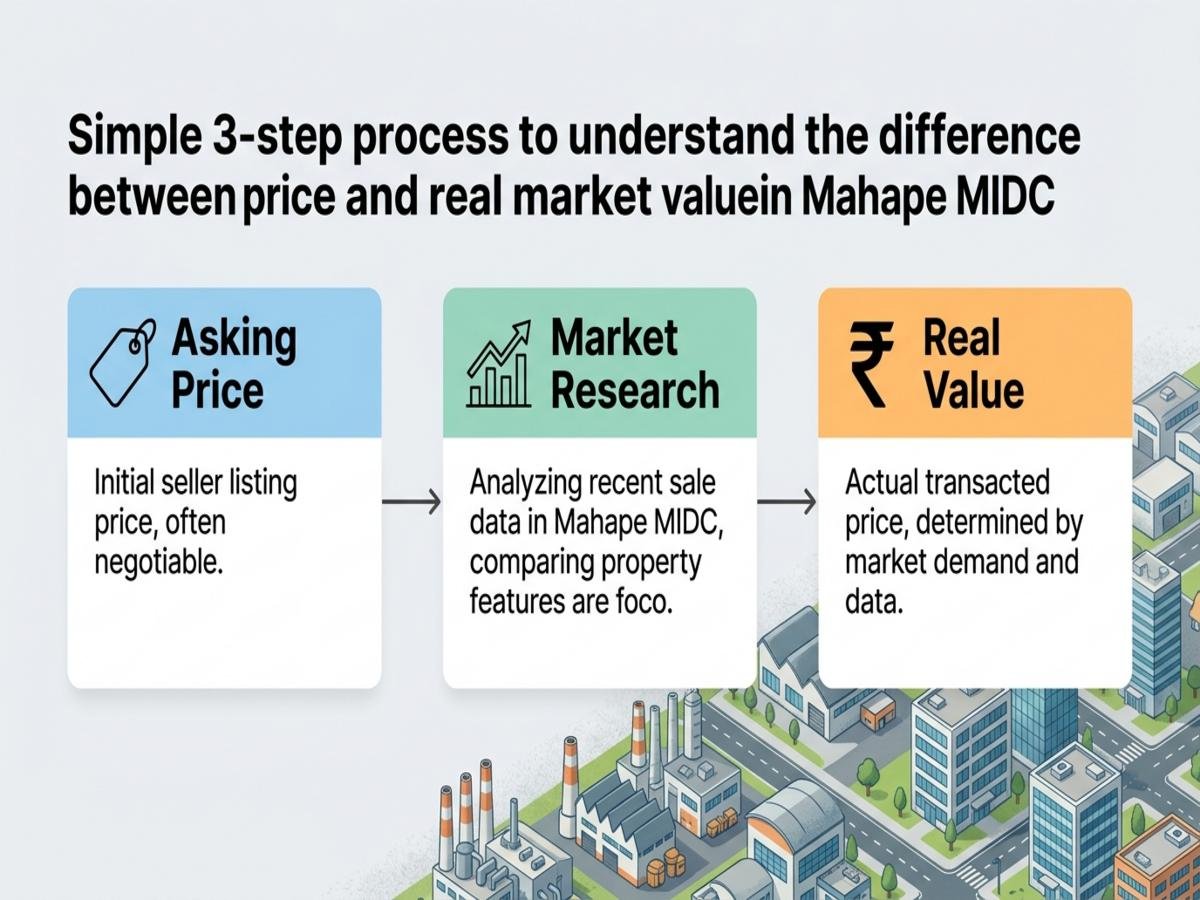
In Mahape MIDC, asking price and real value can be very different.
Many sellers quote rates based on the general image of Mahape, nearby IT parks, data centre demand, airport-linked growth, and the scarcity of industrial land in Navi Mumbai. But a buyer cannot pay only for imagination. The property must justify the price through documents, permissions, access, power, structure, and rental or business utility.
A seller may quote a premium rate, but the buyer may still need to bear MIDC transfer charges, NMMC property tax dues, repair costs, compliance expenses, fire approvals, power upgrades, or legal regularisation.
That is why the real market value should be calculated backwards.
Ask these questions before accepting the quoted rate:
- Can this property be used immediately for the intended activity?
- Is the existing construction approved?
- Is the MIDC transfer premium clear?
- Are NMMC property tax dues cleared?
- Is there a valid BCC or OC where applicable?
- Is the expected rent enough to justify the capital cost?
- Will the property be easy to resell later?
If the answer is unclear, the asking price should not be treated as the final value.
A practical comparison should use at least three numbers: the seller’s asking price, recent comparable asking prices for similar Mahape properties, and the applicable MIDC land-rate information. Then adjust for plot size, built-up area, age and condition of the structure, road frontage, power availability, approvals, transfer requirements and outstanding dues. This gives a more realistic negotiation range than relying on one quoted rate
Which Type of Mahape Industrial Property Are You Actually Buying?
Mahape MIDC has different industrial asset types. Each one has a different buyer profile, rate logic, risk level, and investment purpose.
| Property Type | Best For | Main Advantage | Main Risk |
|---|---|---|---|
| Open industrial plot | Large end-users, built-to-suit facilities | Flexibility to design as per business need | Higher transfer, construction, and approval risk |
| Industrial shed or gala | SMEs, light manufacturing, assembly, service units | Faster operational use | Must verify approval, structure, and utility load |
| Warehouse or storage unit | Last-mile logistics, pharma, e-commerce, specialised storage | Good urban access | Premium land cost can reduce rental yield |
| Office-plus-industrial unit | R&D, IT support, electronics, clean assembly | Strong tenant profile and staff-friendly location | Must check permitted use and commercial limits |
Open Industrial Plot
Open industrial plots are rare in a mature belt like Mahape. They may look attractive because they offer flexibility, but they also bring the highest burden.
The buyer must check the plot-specific MIDC transfer conditions, permitted use, approved development potential, construction requirements and applicable timelines before purchasing. MIDC’s current online services specifically include plot transfer, change in land use/activity, and applications connected with occupancy and development permissions. The applicable conditions should therefore be verified against the individual plot’s MIDC records rather than assuming one FSI or development deadline applies to every Mahape property
Open plots are usually suitable only for buyers with strong capital, clear business plans, technical consultants, and patience for approvals.
Industrial Shed or Gala
Industrial sheds and galas are often more practical for SMEs. A ready shed allows faster business movement compared with raw land.
In Mahape, such units may suit electronics assembly, light engineering, packaging, service operations, storage-linked work, or clean manufacturing. But the buyer must check whether the shed is legally approved, structurally usable, and matched with the intended business activity.
A shed with approved built-up area, power load, good loading space, and clear documents can be more valuable than a cheaper but legally weak property.
Warehouse or Storage Unit
Mahape is not the cheapest warehousing market. If someone only wants large low-cost storage, locations like Taloja, Panvel-side belts, or larger logistics corridors may offer better economics.
Mahape works better for high-turnover urban logistics, specialised storage, pharma-linked movement, electronics distribution, or businesses that need quick access to Navi Mumbai, Thane, and Mumbai-side markets.
For simple dead storage, the land cost may be too high.
Office-Plus-Industrial Unit
This is where Mahape has a strong edge.
Many businesses today need a mix of office, technical team, light assembly, service centre, storage, and client-facing space. Mahape’s cleaner environment, access to Ghansoli, Kopar Khairane, Airoli, and its connection to the Thane-Belapur Road corridor make it better suited for such hybrid use than rougher industrial belts.
But the buyer must be careful. Industrial land cannot automatically be treated as a commercial office property. Permitted use, MIDC approvals, IT/ITeS conditions, and commercial-use limits must be checked properly.
What Zoning and MIDC Rules Should Buyers Check Before Paying Token Money?
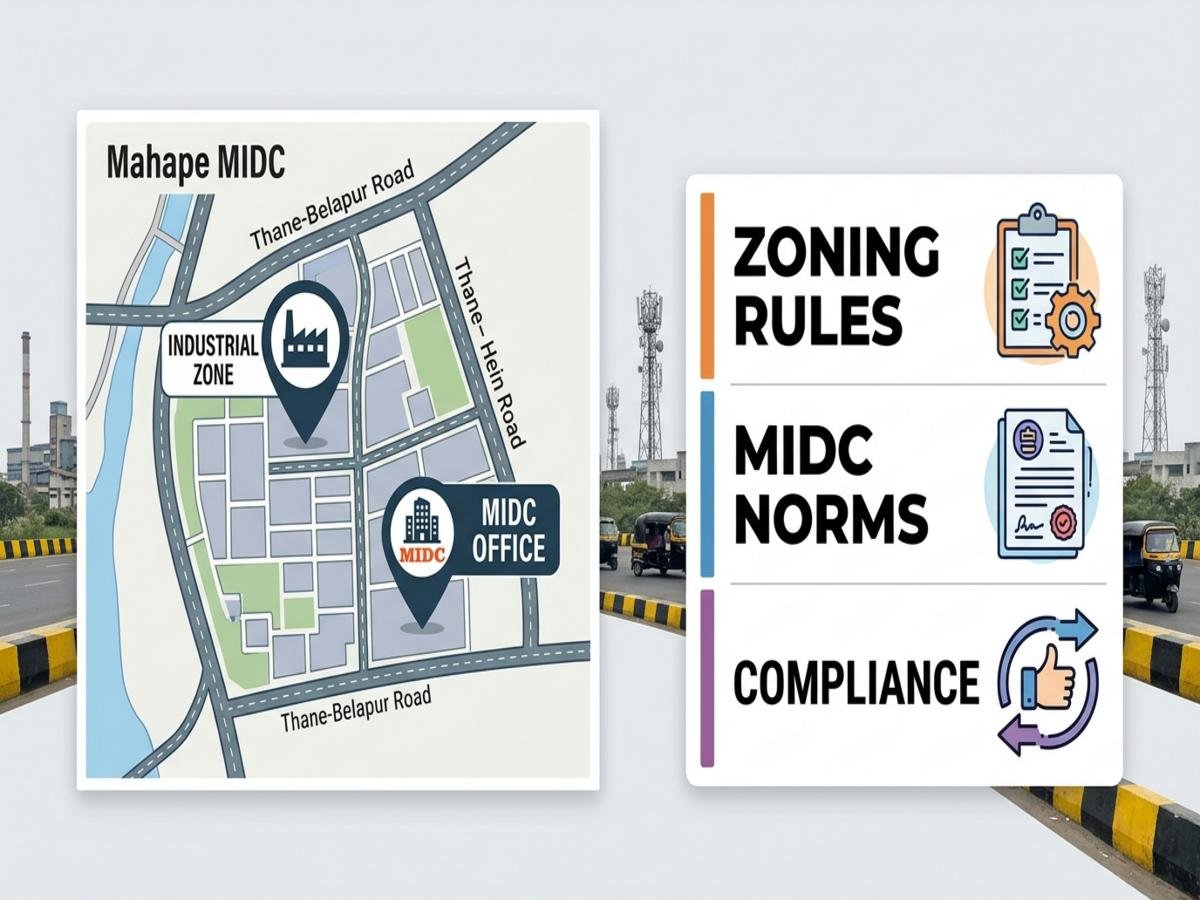
Before paying token money for Mahape MIDC industrial land, zoning and MIDC compliance should be checked first. This is not a formality. It can decide whether the deal is safe or risky.
A normal buyer may think: “The plot is in MIDC, so any business can run there.” That is not correct.
The intended activity must be checked against the plot’s approved use, applicable MIDC permissions, building approvals and environmental requirements. MIDC provides a specific process for permission for change in land use and activity, so buyers should not assume that an existing industrial plot can automatically be used for a different commercial, office or industrial activity. The proposed use should be confirmed with MIDC and, where applicable, the relevant environmental and fire authorities before paying token money
Important checks include:
- Original MIDC allotment letter
- Lease deed and assignment history
- MIDC transfer eligibility
- Differential premium or transfer charges
- Building Completion Certificate
- Occupancy Certificate, if applicable
- Approved building plan
- Actual structure versus approved plan
- NMMC property tax no-dues
- MIDC water and service charge dues
- Power connection and sanctioned load
- MPCB consent, if required
- Fire NOC, if required
- CETP membership, if applicable
- ULC or old authority conditions, if any
The biggest mistake is paying token money first and checking documents later. In MIDC property, the order should be reversed.
When Is the Right Time to Buy Property in Mahape MIDC?
The right time to buy in Mahape MIDC is when the property is legally clean, operationally useful, and priced according to today’s real industrial value, not only future hype.
| Market Signal | Decision | What It Means |
|---|---|---|
| Clean MIDC documents, approved structure, clear dues, usable access | Buy | The property can be used or leased with lower friction |
| Seller is quoting only based on airport, data centre, or “future growth” | Wait | The premium may not be supported by current utility |
| No MIDC transfer clarity or missing BCC/OC | Avoid | Legal and approval delays can trap capital |
| Good location but weak truck access | Negotiate hard | Location alone cannot solve operational problems |
| Strong power load and suitable use permissions | Consider seriously | Utility readiness can justify premium pricing |
| Heavy old dues or unauthorised additions | Avoid or discount deeply | Buyer may inherit expensive problems |
Buy When the Rate Matches Actual Industrial Utility
Buying makes sense when the property can support real business use from day one or with limited improvements.
For example, a clean industrial shed with proper approvals, strong flooring, sanctioned power load, and good road access may justify a premium because it reduces setup time. An investor can also consider such a property if tenant demand is visible and rental yield is realistic.
Wait When the Seller Is Pricing Only Future Hype
Some sellers may price Mahape assets as if every plot will become a data centre, IT park, or airport-linked commercial property. That is not how industrial land works.
A small or poorly accessed plot does not become a high-end tech asset simply because it is located in Mahape. If the property does not have power depth, road width, approvals, fibre readiness, or suitable zoning, the buyer should not pay a tech-infrastructure premium.
Avoid When Legal or Operational Clarity Is Weak
Avoid the deal if the seller cannot provide clean documents, approved plans, tax receipts, transfer clarity, or no-dues certificates.
In industrial property, a cheap deal can become expensive very quickly if there are authority dues, unauthorised construction, wrong usage, old litigation, unpaid property tax, or transfer restrictions.
Is Mahape Better for End-Users or Investors?
Mahape is stronger for serious end-users and stable investors, but it may not suit every small investor looking for quick high returns.
For end-users, Mahape offers a strong business environment. It is suitable for companies that need industrial use with better staff access, organised surroundings, and connectivity to Navi Mumbai’s business corridors. Clean assembly, electronics, R&D support, IT-linked operations, pharma-related storage, and service businesses may find Mahape practical.
For investors, the picture is more complex. Entry cost is high, and rental yield may not always look exciting after considering taxes, transfer costs, repairs, and holding expenses. The advantage is better tenant quality, better resale liquidity, and long-term scarcity value.
A first-time investor with limited capital should compare Mahape with Taloja, Rabale, Turbhe, and Panvel-side industrial belts before finalising.
How Does Mahape Compare with Rabale, Turbhe, Pawane, Taloja and Panvel Industrial Belts?
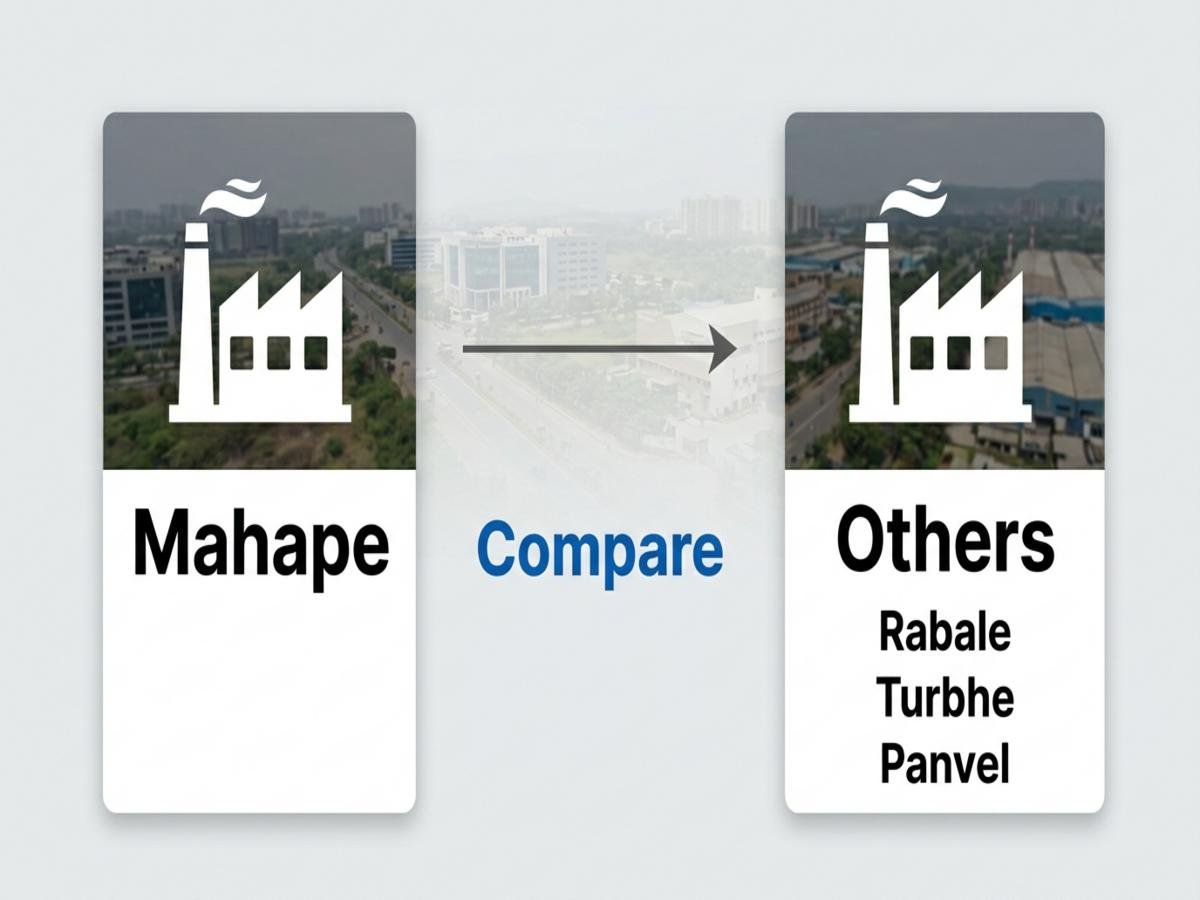
Mahape should not be judged in isolation. Most serious buyers compare it with nearby industrial markets before deciding.
Mahape vs Rabale
Rabale is more rugged and industrial in character. It suits heavier engineering, fabrication, workshop-style businesses, and operations that need a more traditional industrial environment.
Mahape is cleaner, more organised, and better suited for office-plus-industrial users, clean assembly, technical businesses, and companies that need better staff comfort.
If the business is heavy and rough, Rabale may be more practical. If the business is clean, technical, corporate-facing, or staff-heavy, Mahape has an edge.
Mahape vs Turbhe
Turbhe is strong for trade, warehousing, service operations, and APMC-linked commercial-industrial movement. It is busier and often more congested.
Mahape feels more suitable for organised industrial setups that need a better working environment. Turbhe may give stronger daily trade movement, while Mahape gives a more premium operational address.
Mahape vs Taloja
Taloja generally offers better space economics for large manufacturing, chemical, engineering, and land-hungry businesses. It is more industrial in nature and can be more affordable compared with Mahape.
Mahape is better for businesses that need location quality, staff access, tech-industrial use, and proximity to Navi Mumbai’s established commercial-industrial network.
Mahape vs Panvel-Side Industrial Belts
Panvel-side industrial and logistics belts are more future-driven, especially because of airport-linked and logistics-led growth expectations.
Mahape is already mature and operational. Panvel-side markets may suit long-term logistics, warehousing, land banking, and larger-format growth. Mahape suits immediate premium urban-industrial use.
What Local Access Factors Can Increase or Reduce a Mahape Plot’s Value?
In Mahape, map location is not enough. Ground access decides real value.
A plot close to Thane-Belapur Road with smooth access can be far more useful than a plot that looks nearby on Google Maps but suffers from narrow internal roads, bad turning radius, parking issues, or loading problems.
Thane-Belapur Road Access
Thane-Belapur Road is the main industrial and business spine for this belt. Smooth access to this road improves movement toward Airoli, Ghansoli, Kopar Khairane, Turbhe, Vashi, Thane, and Mumbai-side connections.
If a property has quick access without major internal bottlenecks, it can command stronger demand.
Ghansoli, Kopar Khairane and Airoli Workforce Connectivity
Mahape’s value is not only about trucks. It is also about people.
Businesses that need engineers, office staff, technicians, IT teams, and admin teams prefer locations where daily commute is manageable. Access from Ghansoli, Kopar Khairane, and Airoli can improve tenant demand, especially for hybrid office-industrial operations.
Truck Movement, Turning Radius and Loading Space
A plot loses value if trucks cannot enter properly.
Buyers should physically check approach roads, gate width, turning radius, loading bay space, internal circulation, and whether loading spills onto public roads. These small details decide whether a property is truly industrial-ready.
What Are the Biggest Risks in Buying Industrial Land in Mahape MIDC?
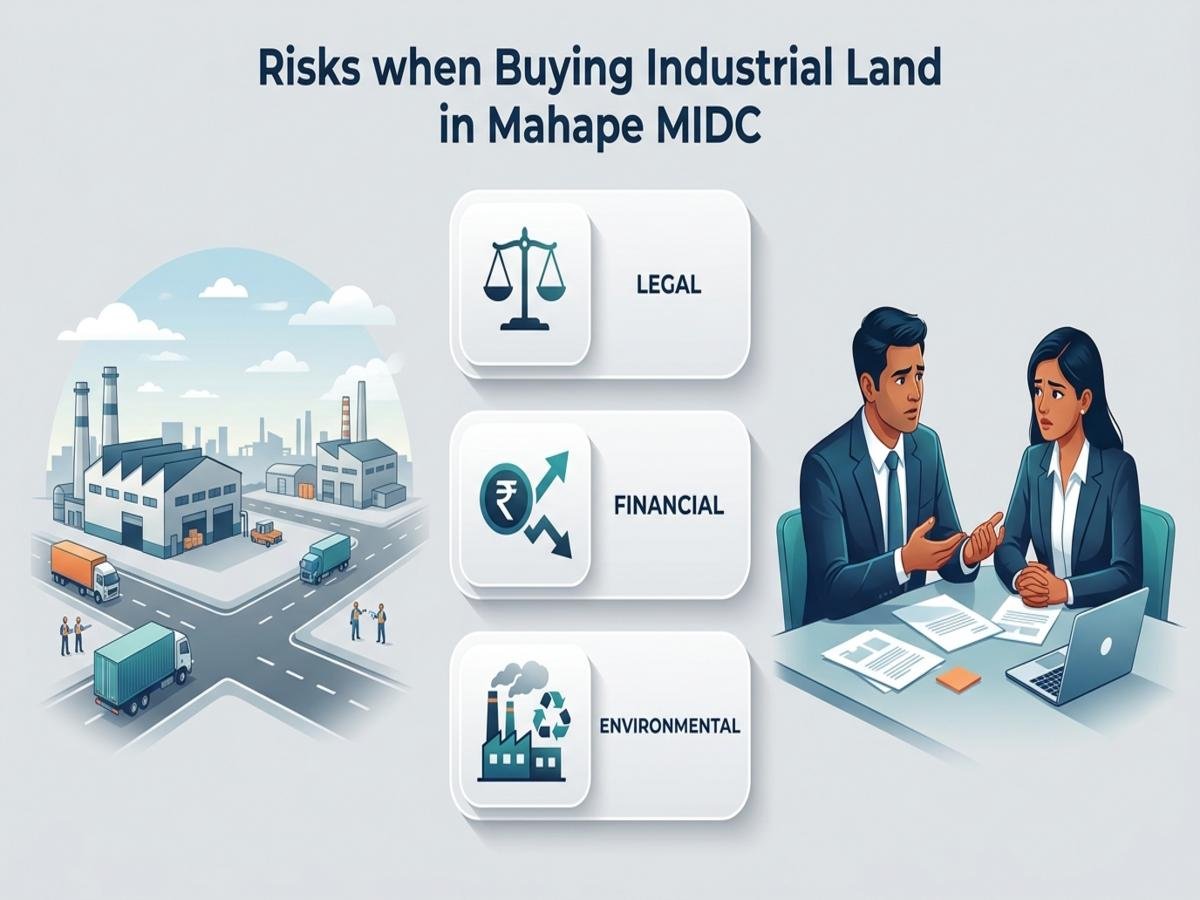
The biggest risks in Mahape MIDC are not always visible during the first site visit. Many problems are hidden in documents, authority dues, construction approvals, and use permissions.
Key risks include:
- Paying premium rate for a property with weak legal status
- Buying an open or underutilised plot without understanding FSI obligations
- Ignoring MIDC transfer premium and authority approval requirements
- Assuming industrial land can easily become commercial property
- Missing old NMMC property tax dues
- Not checking whether the structure matches approved plans
- Ignoring fire access and safety compliance
- Overestimating rental yield
- Buying only because of airport or data centre hype
- Trusting verbal promises from brokers or sellers
A buyer should remember one simple rule: in Mahape MIDC, legal usability is as important as physical location.
Do not assume drainage and environmental infrastructure are identical across every Mahape plot.
MPCB documentation for the TTC industrial area notes that little part of TTC MIDC, including part of Mahape, is not connected to the MIDC drainage system. For activities generating industrial effluent, buyers should therefore verify the actual drainage connection, treatment arrangement and applicable MPCB/CETP requirements for the specific property
What Should a Buyer Verify Before Finalising a Mahape MIDC Deal?
Before finalising a Mahape MIDC industrial property deal, the buyer should complete a full legal, technical, financial, and operational check.
Use this checklist before paying a major token amount:
- Verify MIDC allotment letter and lease deed
- Check assignment deed history if the plot changed hands earlier
- Confirm current owner’s transfer rights
- Ask for MIDC transfer premium calculation
- Check BCC and OC where applicable
- Match actual structure with approved plan
- Check NMMC property tax no-dues
- Check MIDC water and service charge dues
- Verify power load and electricity no-dues
- Confirm permitted industrial use
- Check MPCB consent if the activity needs it
- Check fire NOC and access
- Review road width and loading feasibility
- Calculate total cost after transfer, dues, repairs, and compliance
- Take legal and technical advice before signing
Do not depend only on a broker’s rate statement. Industrial property needs document-backed confidence.
Also check the current MIDC service status before closing the deal.
MIDC currently provides online processes for plot transfer, deed of assignment, change in land use and activity, sub-leasing, sub-letting and other plot-related permissions. Ask the seller to provide the relevant current MIDC records and confirm whether any pending application, permission or condition could affect the proposed transaction.
Conclusion
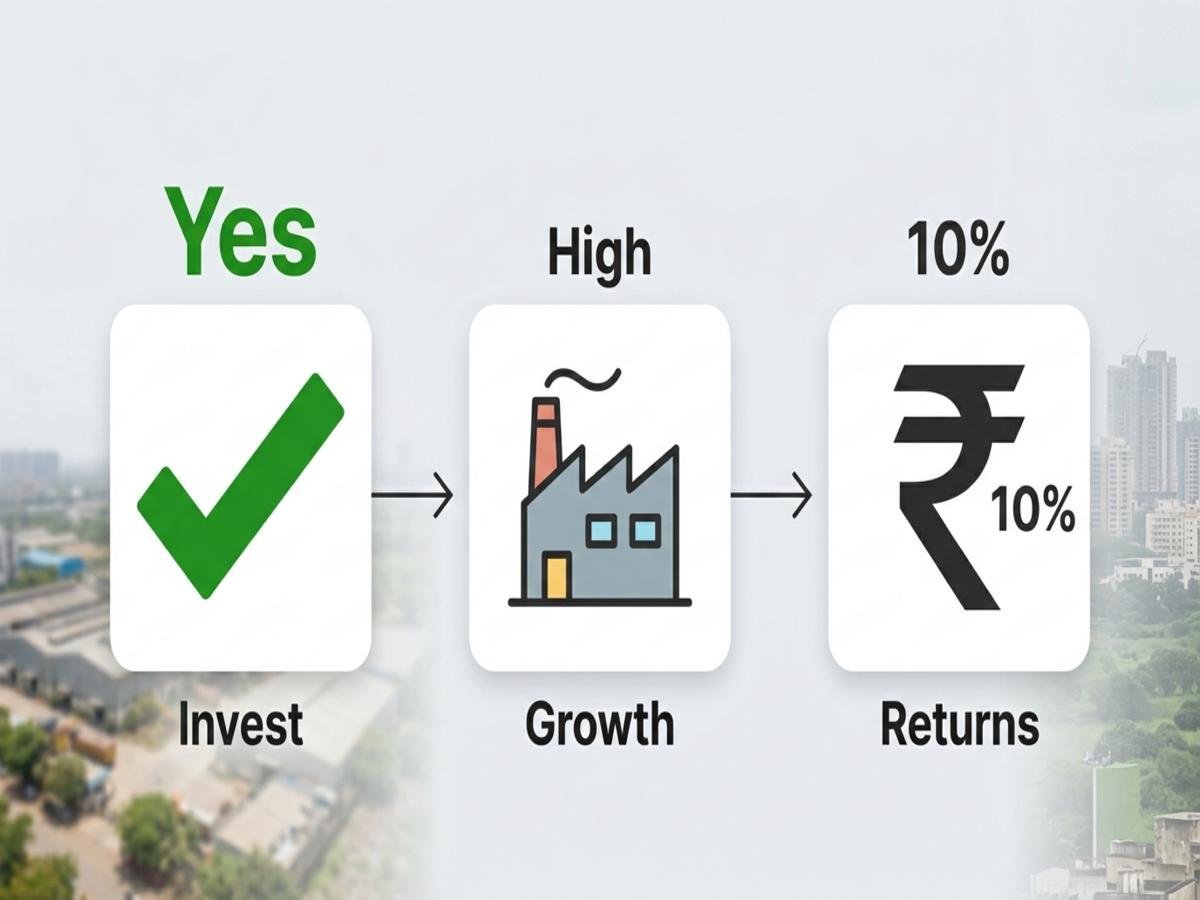
Mahape MIDC is still a strong industrial property market in Navi Mumbai, but it is not a blind-buy location anymore. Prices have moved up, supply is limited, and sellers often quote a premium based on future growth stories.
Buy only when the property gives clear operational value: clean MIDC documents, approved structure, manageable transfer cost, proper road access, power load, zoning clarity, and realistic rental or business use.
Wait if the seller is pricing only on hype.
Avoid if documents, dues, construction approvals, or permitted use are unclear.
For the right buyer, Mahape can still be a premium industrial-tech investment. For the careless buyer, it can become an expensive lesson.
FAQ's
Frequently Asked Questions