
First Time Home Buyers in Navi Mumbai: Where to Start and What to Know
Most first-time buyers in Navi Mumbai do not fail because the flat is too expensive. They fail because they start without a checklist. They begin with site visits, sample flats, and broker calls, but only later realise the real cost is far higher than the quoted price. In Navi Mumbai, where each node has a different price range, authority setup, and ground reality, the right starting point is not a project. It is your budget, your area filter, and your basic document checks.
If you are buying your first home in Navi Mumbai, this guide will help you start in the right order. It explains where to begin, what costs people miss, which areas make sense for different budgets, what to check before paying token money, and how the buying process usually works on the ground.
First Time Home Buyers in Navi Mumbai: Quick Starting Point
Before anything else, remember one simple rule: do not start by asking, “Which flat looks best?” Start by asking, “How much can I safely afford, and which area fits that reality?”
That one change can save you lakhs, months of confusion, and a lot of emotional pressure.
Home Buying in 60 Seconds
| Step | What to do first | Why it matters |
|---|---|---|
| 1 | Fix your total budget | Stops you from wasting time on unaffordable projects |
| 2 | Check loan eligibility and safe EMI | Helps you shortlist realistically |
| 3 | Choose 2 to 3 Navi Mumbai nodes only | Keeps the search focused |
| 4 | Compare ready-to-move vs under-construction | Changes GST, possession time, and risk |
| 5 | Verify RERA, OC, and basic documents | Protects you before token payment |
| 6 | Calculate all-in cost, not base price | This is where most first-time buyers get trapped |
A first home is not only a property decision. It is a cash flow decision, commute decision, and comfort decision together.
In 2026, Navi Mumbai is not just a cheaper backup to Mumbai. It has become a full market of its own, driven by the operational Navi Mumbai Metro Line 1, airport-side development, Atal Setu connectivity, and strong movement in growth corridors like Ulwe, Panvel, Taloja, and Pushpak Nagar. That is good news for buyers, but it also means careless buying has become more expensive.
Before You Search Flats, Be Clear About Budget, Loan, and Monthly EMI
This is the real starting point for a first time home buyers in Navi Mumbai.
A lot of buyers think, “My budget is ₹70 lakh,” when what they actually mean is, “I can buy a flat priced at ₹70 lakh.” These are not the same thing. The flat price is only one part of the deal. The full amount you need to arrange is much higher.
What your real buying budget usually includes
Beyond the agreement value of the flat, a first-time buyer usually has to manage:
- Down payment
- Stamp duty
- Registration fee
- GST if the flat is under construction
- Society deposits
- Corpus fund
- Clubhouse or utility connection charges
- Basic interiors like kitchen, wardrobes, lights, fans, grills, and curtains
- Moving cost and small repair cost
This is where people get confused. They assume the bank loan will cover everything. Usually, it does not. Government charges and many possession-stage charges must come from your own pocket.
A simple first-home budget breakdown
| Cost component | Typical estimate | Why it matters |
|---|---|---|
| Down payment | Around 20% of agreement value | Usually needed for loan approval |
| Stamp duty | 5% for women, 6% for men in 2026 | Mandatory for registration |
| Registration fee | 1% of value, usually capped at ₹30,000 above ₹30 lakh | Makes the sale legally recorded |
| GST | 5% on under-construction, 0% on ready-to-move with OC | Big difference in total cost |
| Society deposits | ₹50,000 to ₹2,00,000 | Often demanded near possession |
| Interiors and kitchen | ₹7 lakh to ₹12 lakh or more | Needed to make the flat properly livable |
So if you are looking at a flat of ₹60 lakh, your actual outflow can be much higher depending on stage, area, and builder charges. This is why first-time buyers should always ask for the all-inclusive cost sheet, not only the base rate.
How much EMI is safe before you start shortlisting
A practical rule for a salaried first-time buyer is this: keep EMI within 30% to 35% of monthly take-home income. Some lenders may allow much higher. That does not mean it is comfortable.
A bank may approve more than what is healthy for your life. Your EMI still has to survive school fees, parents’ medical costs, fuel, food, maintenance, and job uncertainty.
That is why loan eligibility and affordability are not the same thing.
Quick budget checklist before you call brokers
- How much savings do you actually have today?
- How much can you use as down payment without emptying emergency funds?
- What EMI feels safe every month, not just possible on paper?
- Are you also paying rent right now?
- Do you have money left for stamp duty, registration, and interiors?
- Can you handle a possession demand of advance maintenance or deposits?
If these answers are not clear, do not start property visits yet.
[Internal Link: Hidden Costs of Buying Property in Navi Mumbai]
Which Part of Navi Mumbai Should You Start With?
Navi Mumbai is not one uniform market. It is a multi-node city, and each node behaves differently. Price, commute, social infrastructure, water supply, and future appreciation can change a lot from one area to another.
This is why “best place to buy in Navi Mumbai” is the wrong question. The better question is, “Best place for what budget, what lifestyle, and what daily travel pattern?”
Good starting areas for budget-focused buyers
If your goal is to enter the market with a lower ticket size, these areas usually come into the discussion first:
Taloja
Taloja is one of the more affordable entry points for first-time buyers, with many projects in lower price bands compared to mature nodes. Metro connectivity has improved its practical value. But affordability comes with trade-offs. Some pockets still face infrastructure gaps, and buyers should double-check water and maintenance reality carefully, especially in the Taloja Phase 2.
Ulwe
Ulwe sits in the airport influence belt and has become much more relevant after Atal Setu connectivity. It attracts buyers who want future upside and somewhat better access toward Mumbai. But the ground reality in 2026 still includes active construction, dust, and uneven road conditions in some pockets.
Dronagiri
Dronagiri is often pitched as a future growth story because of port and connectivity influence. Prices may still look reasonable compared to premium nodes. But first-time family buyers should stay realistic. Social infrastructure is not equally mature everywhere yet.
Better areas for families who want long-term comfort
If you are planning to live with family and want better daily comfort, schools, parks, and more settled surroundings, the shortlist changes.
Kharghar
Kharghar remains one of the most attractive choices for families because of its broad roads, education ecosystem, open spaces, and overall planned feel. But it is not one simple story. Some sectors are much better than others, and buyers should double-check the water tanker situation in places like Sector 35 before finalising.
Nerul and Seawoods
These are more mature, more established parts of Navi Mumbai. They work well for buyers who value stable surroundings, better transport links, and a more complete urban setup. The downside is simple: entry cost is higher.
Panvel
Panvel has become important for buyers who want larger projects, road connectivity, and long-term growth potential. It can be a practical option for buyers whose daily movement is linked more with the expressway side and the wider MMR belt.
Small area comparison for first-time buyers
| Node | Best for | 2026 ground reality | Main drawback |
|---|---|---|---|
| Taloja | Budget-first buyers | Affordable and metro-linked | Infrastructure varies by pocket |
| Ulwe | Buyers betting on airport-side growth | Fast urban development | Dust and road work in some stretches |
| Kharghar | Families and long-term own use | Green, educational, well-known | Higher prices and some water stress pockets |
| Panvel | Buyers wanting growth plus connectivity | Expanding and practical | Micro-location quality varies a lot |
| Nerul / Seawoods | Buyers wanting comfort and maturity | Strong daily livability | Higher entry budget |
| Pushpak Nagar | Early movers and education-linked investors | Active development near EduCity zone | Still developing |
A first-time buyer does not need to survey all of Navi Mumbai. Start with only 2 or 3 nodes that match your income, commute, and comfort needs.
[Internal Link: Best Affordable Areas to Buy a Home in Navi Mumbai]
Ready-to-Move or Under-Construction: What Makes More Sense for a First Buyer?
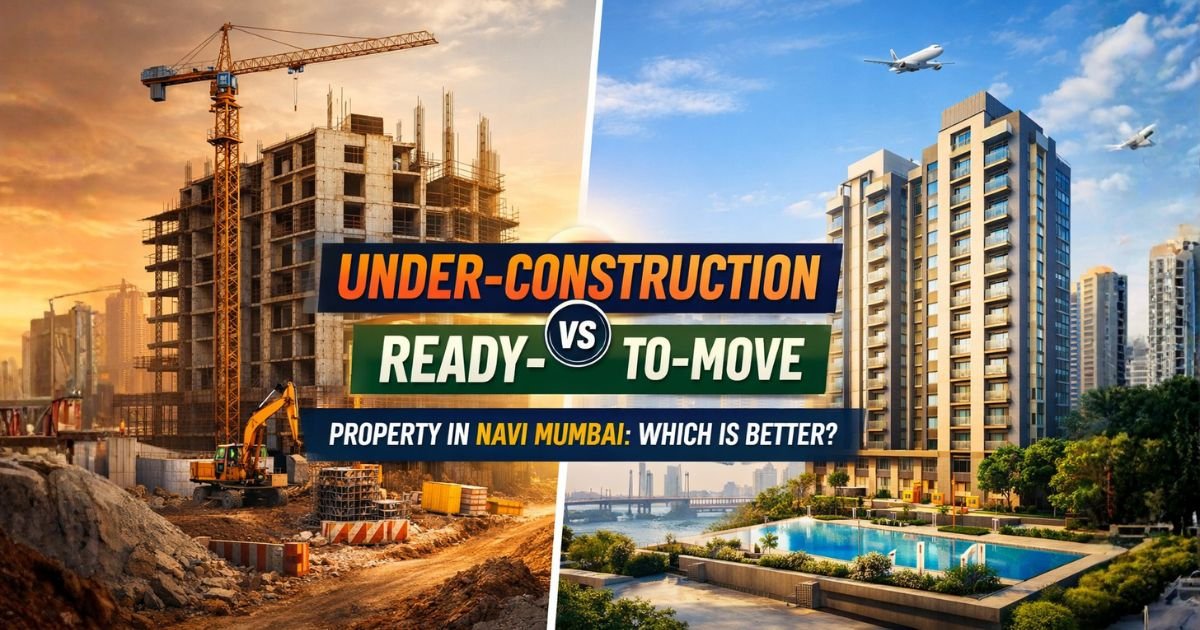
This is one of the biggest decisions in the whole buying process.
Many first-time buyers get attracted to under-construction projects because the starting price looks lower. On paper, that feels smart. But the lower entry price is only one part of the story.
Simple comparison
| Factor | Ready-to-Move with OC | Under-Construction |
|---|---|---|
| GST | 0% | 5% |
| Possession | Immediate | 1 to 4 years or more |
| What you see | Actual flat and building | Promise, layout, and sample flat |
| Risk | Lower | Delay and execution risk |
| Rent burden | Can stop sooner | Rent may continue for years |
| Amenities | Usually visible | Often still promised |
For a salaried first-time buyer who is already paying rent, ready-to-move is often the safer and more practical choice. You save GST, you can inspect the actual building, and you do not stay stuck between rent and EMI for too long.
That does not mean under-construction is always wrong. It may suit buyers who have patience, stronger savings, and comfort with delay risk. But a first buyer usually needs certainty more than a brochure discount.
Also, always check whether the ready flat has an OC, which means Occupation Certificate. In simple words, this is the approval that says the building is fit to be occupied. Without OC, a “ready” flat may still bring legal and service problems later.
What to Check Before You Like a Property Too Much

This is the section that protects your money.
In Navi Mumbai, many first-time buyers fall in love with the sample flat, the grand lobby, or the launch offer. But what matters more is what you cannot see immediately: legal status, service reality, water situation, construction timeline, and total possession cost.
Builder, society, and location checks
Start with the builder and the project itself.
Check whether the project is registered with MahaRERA. Then go one step further. Do not stop at “RERA approved.” Check the completion date and whether it has already been extended multiple times.
Next, check the local ground reality:
- Does the road outside flood in monsoon?
- Is the area properly lit at night?
- What is the actual travel time during office hours?
- Are daily services nearby or still only “coming soon”?
Do not trust “5 minutes from station” claims without checking peak-hour travel on maps and on ground.
In some parts of Navi Mumbai, especially developing belts, the gap between sales pitch and lived reality can be very large.
Flat, building, and document checks
Whether you are buying a new flat or resale, these checks matter:
- Occupation Certificate for ready properties
- Clear title verification by a property lawyer
- Sanctioned plan and approved layout
- Agreement details matching the promised carpet area
- If on CIDCO land, lease status and transfer paperwork position
- Society dues or pending charges in case of resale
Carpet area means the usable wall-to-wall space you actually live in. Do not get carried away by super built-up numbers that make the flat sound bigger than it feels.
Also understand one Navi Mumbai-specific issue: many properties historically sit on CIDCO leasehold land. That does not automatically make them bad. But it does mean you should clearly understand whether the property is leasehold, whether conversion to freehold is available, and what paperwork may be needed during transfer. As of 2026, if a CIDCO property is converted to freehold, you no longer need to wait for a CIDCO Transfer NOC, making the process much faster.
First visit checklist
Before paying token, check these practical things on site:
- Mobile network strength inside the flat
- Water leakage marks in corners or ceiling
- Lift count versus number of flats on one floor
- Daylight and airflow
- Actual carpet feel compared to brochure promise
- Noise from highway, rail line, or commercial activity
- Parking clarity
- Water supply questions asked directly to residents if possible
One small example matters here. A society maintenance charge of ₹4 per sq ft may not look serious at first. But on a 1000 sq ft flat, that becomes ₹4,000 monthly. If the builder or society asks for 24 months in advance, that is ₹96,000 upfront. This is exactly the kind of number that shocks first-time buyers at the last stage.
The Actual Buying Process in Navi Mumbai, Step by Step
The process feels scary only when it is unclear. Once broken into steps, it becomes manageable.
From property shortlist to token amount
First, fix your budget and loan comfort range. Then get a pre-approval or at least a loan eligibility estimate from the bank. This makes your search sharper.
After that, shortlist a few properties and visit them physically. Try not to finalise after just one visit. Compare at least 5 to 10 options across your chosen 2 or 3 nodes.
Once you choose a property, a token amount may be requested. This is often between ₹25,000 and ₹1 lakh depending on project or resale deal. Be careful here. Never assume token is refundable unless it is written clearly on the receipt. If the refund depends on loan rejection, that condition must be written.
From loan approval to registration and possession
After token stage, the next major step is the Agreement for Sale. This is when financial commitment becomes serious. The bank processes the file, legal checks move ahead, and your down payment requirement becomes real.
Then stamp duty and registration are paid. In 2026, stamp duty in Maharashtra is typically 6% for men and 5% for women in this context, with registration fee usually at 1% and capped at ₹30,000 above a threshold. Buyers should be extra careful here because underpayment issues are being treated more strictly, and the proposed penalty environment is much harsher, with fines up to ₹1 Lakh for underpayment. So do not guess figures casually.
After registration, the loan amount is disbursed by the bank to the builder or seller. Then comes possession, but possession should not mean blind excitement. Before taking keys, check taps, switches, windows, door locks, seepage signs, and finishing defects properly.
This stage is called snagging in simple words. It means checking the home for small faults before you accept it fully.
Common First-Time Buyer Mistakes in Navi Mumbai

Most beginner mistakes are not dramatic. They are simple mistakes done too early.
1. Starting with projects instead of budget
People start by browsing beautiful towers and then try to adjust finances later. This is backwards.
2. Looking only at the flat price
The advertised price is rarely the full story. Down payment, stamp duty, registration, deposits, interiors, and moving cost change the real budget.
3. Choosing area based on hype
Airport, metro, and new bridge connectivity are real positives. But not every “future growth” location is equally comfortable for living today.
4. Paying token too quickly
This is one of the biggest traps. If the refund terms are vague, you may lose money just because the loan failed or document issues came up later.
5. Ignoring water and maintenance reality
This is a very Navi Mumbai-specific practical issue. A location may look good on paper but become frustrating if water supply is inconsistent or tanker dependence pushes monthly costs up.
6. Assuming RERA approval solves everything
RERA is important, but buyers still need to check update history, delivery realism, and actual project progress.
7. Forgetting commute cost, not just commute time
For example, if your work travel depends on toll-based routes, that recurring monthly cost matters too. Time saved is useful, but money spent every day also counts.
Final Thoughts
For a first-time home buyer in Navi Mumbai, the smartest start is not a luxury brochure, a launch event, or a broker promise. It is a clear budget, a safe EMI range, a shortlist of suitable nodes, and a basic property-check process.
Navi Mumbai gives real options in 2026. That is its strength. You have mature areas like Nerul, Seawoods, and Kharghar. You have growth belts like Ulwe, Taloja, Pushpak Nagar, and Panvel-side corridors. You have metro-linked and airport-linked advantages that were only future talk a few years ago. But choice is useful only when you know how to filter it.
So start simple. Fix affordability first. Compare only a few areas. Ask for full cost, not just base rate. Check OC, RERA, title, and CIDCO status where relevant. And never let urgency push you into paying money before clarity.
That is how first-home buying becomes manageable.
Conclusion
If you are buying your first home in Navi Mumbai, do not start with dreams. Start with numbers, area logic, and document checks.
The best first-home decision is rarely the most glamorous one. It is the one you can afford comfortably, travel from practically, and own without legal or financial shocks later. In Navi Mumbai, that means looking beyond the brochure and understanding the node, the authority, the total cost, and the ground reality of the building.
That is where smart first-home buying really begins.
FAQs
Frequently Asked Questions