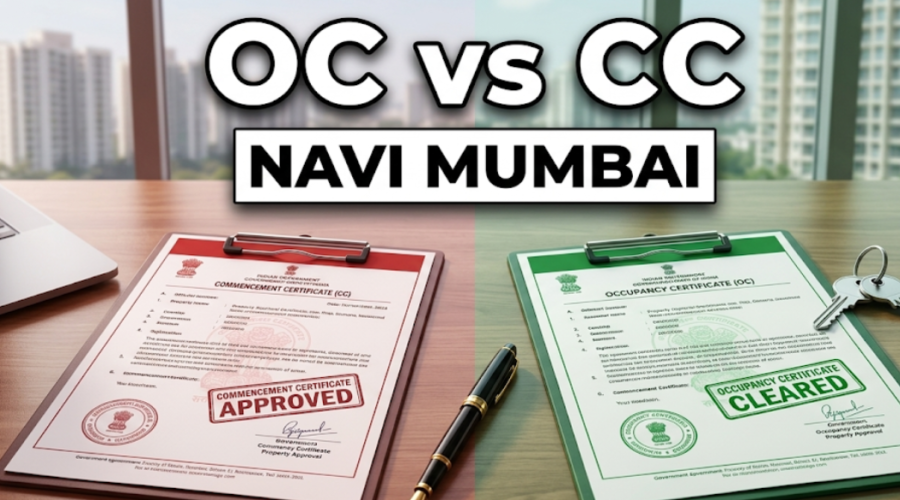
OC vs CC in Navi Mumbai: Difference, Issuing Authority, and How to Verify Before Possession
If your builder says the project is “complete” and asks you to take possession, do not assume that means you can legally move in. In Navi Mumbai, a Completion Certificate and an Occupancy Certificate are not the same thing. A CC shows the building work was completed as per approved plans. An OC is the document that legally clears the building for people to live in.
That difference matters a lot at possession stage.
In Navi Mumbai, buyers often hear phrases like “I finally got my CC ”, “My CC is here”, or “take the fit-out possession .” This is where people get confused. And this is also where costly mistakes happen. A flat can look ready, lifts may work, lights may be on, and some families may even be living there. Still, without the right OC for the right tower or wing, the legal position remains weak.
In short, CC is a construction-stage milestone. OC is the real possession-stage protection.
OC and CC in Navi Mumbai in one quick answer

Both documents matter, but they do not do the same job.
A Completion Certificate says the building has been constructed as per the sanctioned plan and approved building conditions. An Occupancy Certificate says the building is fit and legally cleared for occupation.
For a buyer standing at possession stage, the OC matters more.
Quick summary table
| Point | Completion Certificate (CC) | Occupancy Certificate (OC) |
|---|---|---|
| What it proves | Construction is completed as per sanctioned plans and building rules | Building is fit for occupation and legal for people to move in |
| When it usually comes | After physical construction is completed | After CC and final civic clearances are in place |
| Why buyers care | It shows the builder reached a construction milestone | It protects the buyer at possession stage |
| Can you safely rely on it for possession? | No, not by itself | Yes, this is the key possession-stage document |
| Who issues it? | Local planning authority | Local planning authority |
| Common confusion | Buyers think “building complete” means “ready to live” | Buyers assume any OC is enough, even if it is only partial |
What this means in real life is simple: a builder may finish the structure and get a CC, but the buyer should still ask, “Has the OC been issued for my exact wing, tower, or phase?”
That one question can save years of trouble.
What a Completion Certificate actually proves
A Completion Certificate is mainly about the building being completed according to the approved plan.
It tells you that the authority has accepted, in principle, that the structure was built in line with the sanctioned layout, approved height, setbacks, and other construction-related requirements. It is an important document in the project journey. But it is not the final green signal for you to move in.
What the authority checks before giving a CC
The exact process depends on the authority and project type, but a CC broadly relates to whether the physical building has been completed in line with the sanctioned approvals. That usually connects to items like:
- sanctioned building plan compliance
- structural completion
- permissible built-up area and FSI compliance
- required building layout conditions
- approved construction parameters
For a buyer, this means the builder has crossed a construction compliance stage.
It does not automatically mean the building is fully cleared for normal residential occupation.
Why CC alone does not mean full possession safety
This is where many buyers get trapped.
A building may be complete on paper from a construction point of view, but still not have the final occupation clearance. There may still be pending conditions linked to utility connections, fire clearance, final service readiness, documentation gaps, or authority-side approval steps.
So if a builder says, “CC aa gaya hai, you can take possession,” the safer response is:
“Please show the OC for my building or wing.”
That is the possession-stage question that actually matters.
What an Occupancy Certificate actually proves
An Occupancy Certificate is the final legal clearance that makes a ready building occupiable.
For a buyer, this is the document that matters most before accepting keys for real possession. It means the building is not only built, but also cleared for occupation under the local authority process.
What an OC confirms for a ready flat
An OC broadly confirms that the project or the approved portion of the project is fit for occupation. In practical terms, it tells a buyer that the authority has allowed the building to be used for living.
This is why banks, resale buyers, societies, and careful families pay more attention to OC than CC at possession stage.
Without OC, the building may still sit in a risky zone from a legal and practical point of view, even if the flat looks completely ready.
Why OC matters more at possession stage
At possession stage, the buyer is not asking, “Did the builder finish the structure?”
The buyer is asking, “Can I legally and safely occupy this flat?”
That is an OC question, not a CC question.
This is also where “fit-out possession” creates confusion. Builders sometimes hand over access for interior work before final occupation approval. On the ground, this can look harmless. But from a buyer-protection angle, it is risky. Once keys are accepted and interior work starts, your position can weaken, especially if you later need to challenge delay, incomplete handover, or missing final approvals.
So the practical rule is this:
CC may satisfy the builder. OC protects the buyer.
OC vs CC: the real difference buyers should understand before taking possession
The easiest way to understand it is this:
- CC is about construction completion
- OC is about legal occupation
That is the heart of the whole topic.
Comparison table: CC vs OC before possession
| Point of difference | CC | OC |
|---|---|---|
| Main purpose | Confirms construction completion as per sanctioned plan | Confirms the building is cleared for occupation |
| Buyer use | Helpful for understanding project progress | Essential before final possession |
| Legal comfort for living | Limited | Strong |
| Utility and livability confidence | Not enough on its own | Far more relevant |
| Relevance in resale and loan checks | Secondary | Very important |
| Risk if relied on alone | High | Much lower if it clearly covers your unit |
Where people get confused is that both documents come from authorities, both sound official, and both may be shown by builders during the final stage.
But they answer different questions:
- CC asks: Was the building completed as approved?
- OC asks: Can people now legally live in it?
For possession, the second question matters more.
Who issues OC and CC in Navi Mumbai

This is where Navi Mumbai becomes different from many other cities.
A generic article may tell you to “check with the local municipal authority,” but that is not enough here. Navi Mumbai does not work like one single authority area for all nodes. The issuing authority depends on where the project is located.
CIDCO, NMMC, PMC, and other local authority situations
In practical local terms, buyers usually see these broad buckets:
- Navi Mumbai Municipal Corporation (NMMC) for older and more established nodes such as Vashi, Sanpada, Nerul, Belapur, Kopar Khairane, Ghansoli, and Airoli
- Panvel Municipal Corporation (PMC) for major southern growth nodes such as Kharghar, Kamothe, Kalamboli, and Panvel side areas
- CIDCO for some newer or specific planned areas, especially where CIDCO still acts as the planning authority or where its building permission system remains relevant
This is why a buyer in Kharghar should not waste time checking only NMMC sources. Kharghar generally falls under PMC planning control for OC and CC issuance.
Likewise, a buyer in Vashi or Nerul would typically look toward NMMC-related records or project-level regulatory uploads, not PMC.
Why the issuing authority depends on project location and planning control
Navi Mumbai grew in phases and under different administrative arrangements. CIDCO’s planning role, municipal handovers, and node-wise governance have created a more layered system than outsiders usually expect.
What this means for the buyer is very practical:
- first identify the exact node
- then identify the correct authority
- then verify the certificate from that authority’s side and from the project’s regulatory disclosures
Do not assume all Navi Mumbai projects can be checked through one single portal.
That assumption causes a lot of confusion.
How to verify OC and CC before taking possession

Verification should not be casual. Do not rely only on a PDF forwarded by the sales team or a printed copy shown during a site visit.
Take ten minutes and verify properly.
Step 1: Ask the builder for the exact document
Ask clearly for:
- the Occupancy Certificate
- not just the Completion Certificate
- not just a fire NOC
- not just a possession letter
- not just a sample approval from another wing
Also ask whether it is:
- full OC
- part OC
- wing-wise OC
- phase-wise OC
This matters because a part OC for one wing does not automatically cover another wing.
Step 2: Check the project on MahaRERA
For RERA-registered projects, the promoter is expected to upload key project-stage documents on the MahaRERA project page. This is one of the easiest first checks.
Use the project’s RERA number and look at the uploaded documents. If the builder claims OC has been received, you should expect that status to reflect on the project side.
What this means for the buyer is simple: do not just hear the claim, see the uploaded record.
Step 3: Check the correct local authority
After that, check the local authority angle based on the node:
- Vashi, Nerul, Belapur, Airoli side: NMMC context
- Kharghar, Kamothe, Kalamboli, Panvel side: PMC context
- Ulwe, Dronagiri, some CIDCO-controlled project contexts: CIDCO-related building permission or certificate tracking systems
PMC has publicly accessible town planning sections where OC and CC lists are published. CIDCO also has citizen-facing building permission search tools for certificate status in relevant cases. This makes verification more practical than many buyers think.
Step 4: Match the details like an auditor
Do not stop at “OC available.”
Check whether the certificate matches:
- exact project name
- plot number
- sector number
- tower/wing name
- phase name
- issuing authority name
- date of issue
- whether it is full or partial
This is one of the biggest confusion points in large townships.
A part OC for Wing A is not protection for a buyer in Wing B.
Step 5: Cross-check the ground reality
A certificate check is important, but so is the physical reality.
Ask:
- Is water coming through permanent civic arrangements or only temporary supply?
- Is the power setup final or temporary?
- Are common areas actually ready?
- Are lifts and fire systems fully functional?
- Is the building still looking like a construction zone?
A document may exist, but the possession experience should still make sense on the ground.
What can go wrong if possession is taken without proper OC
This is not a small technical issue. It can affect legality, cost, resale, and peace of mind.
1) You may be living in a legally weak position
Without OC, the occupancy status of the building remains problematic. Even if many people are living there, that does not automatically cure the legal gap.
This is especially relevant in Navi Mumbai because the city has seen a large number of buildings flagged for operating without proper OC compliance. In 2025, NMMC publicly identified 2,111 buildings within its jurisdiction that were occupied without OC and asked residents to move toward compliance. That is not a small or rare issue. It shows the ground reality is very real.
2) Water, taxes, and civic services can become a headache
Buildings without proper OC often face practical service-related pain. In many such cases, residents end up depending on temporary arrangements, tanker dependency, or irregular service conditions. Historically, such properties have also faced punitive tax treatment or additional burden.
Some local tax-relief decisions have reduced the penalty burden in parts of Navi Mumbai, but that should not be misunderstood. Lower penalty does not make a non-compliant building legally safe.
3) Resale becomes harder
The problem often hits buyers later.
At the time of resale, the new buyer’s bank may ask tougher questions. If the flat or building does not have proper OC support, the resale process can slow down, loan approval can become difficult, and the buyer pool can shrink.
That directly affects value.
4) Builder pressure tactics become harder to reverse
Once a buyer accepts keys, starts interior work, or begins living in the flat, practical leverage reduces. Complaining later about lack of final approvals becomes harder than refusing early possession in the first place.
This is why “fit-out possession” should be handled very carefully.
Final buyer checklist before accepting possession in Navi Mumbai
Use this checklist before signing anything.
Possession-stage checklist
| Check | What you should do | Why it matters |
|---|---|---|
| Ask for OC | Demand the Occupancy Certificate specifically | This is the real possession-stage protection |
| Do not settle for CC alone | Ask why OC is not being shown if only CC is shared | CC alone is not enough for safe possession |
| Check MahaRERA | Look for project-level document status | Helps confirm the builder’s claim |
| Check the right authority | Verify through NMMC, PMC, or CIDCO context as applicable | Navi Mumbai is node-specific |
| Read whether it is full or partial | Confirm your exact wing/tower is covered | Part OC confusion is very common |
| Match project details | Check name, plot, sector, wing, and date | Avoid being shown the wrong document |
| Be careful with fit-out possession | Do not treat early access as legal final possession | This can weaken your position |
| Check ground reality | Verify utilities, common areas, lifts, and safety readiness | A flat should be truly ready, not just “shown” as ready |
One simple rule works well here:
No final OC for your exact unit block, no comfort with final possession.
Common mistakes buyers make in Navi Mumbai
Believing the builder’s language instead of the document
Words like “approved,” “ready,” “complete,” and “handover started” sound convincing. But only the actual certificate tells the real story.
Thinking any OC is enough
Many buyers do not read whether the OC is partial, phase-wise, or wing-specific. This is one of the most dangerous mistakes in large projects.
Checking the wrong authority
A Kharghar buyer looking only at NMMC records will go in circles. A Vashi buyer checking only PMC-side sources will do the same.
Assuming old occupied buildings must obviously have OC
This is a common resale-market mistake. Occupied does not always mean fully compliant. Always verify.
Accepting fit-out possession casually
This often feels like a harmless early step. In reality, it can put the buyer in a weaker place.
Conclusion
If you remember only one thing from this article, remember this:
CC tells you the builder finished construction. OC tells you the building is cleared for occupation.
In Navi Mumbai, that difference is not academic. It affects legality, utilities, resale, loan comfort, and buyer safety. It also becomes more important here because different nodes fall under different authorities such as NMMC, PMC, and CIDCO-linked systems.
So before taking possession, do not stop at “project complete.”
Ask the harder and smarter question:
“Show me the valid OC for my exact tower or wing.”
That is the document that protects your money, your possession, and your peace of mind.
FAQs
Frequently Asked Questions