
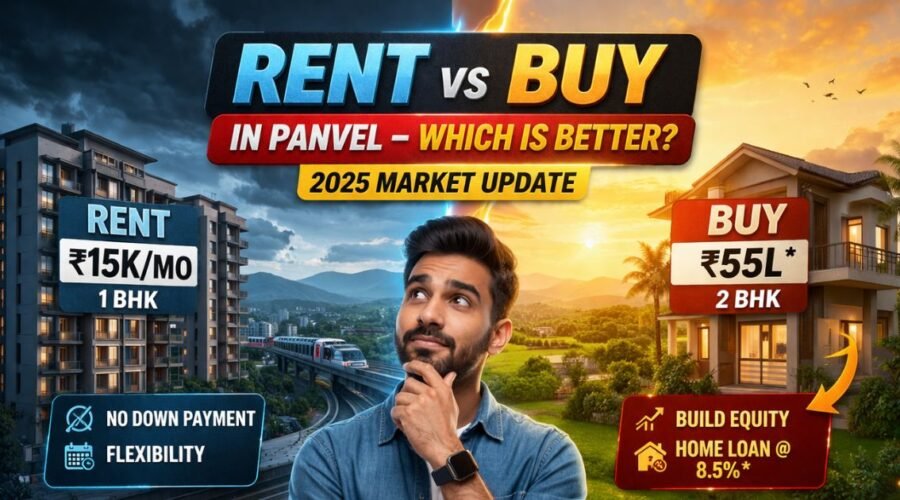
Rent vs Buy in Panvel: Which Option Makes is best?
Renting is usually the better move in Panvel if your timeline is short, your work or family location may change, or the EMI-to-rent gap feels too wide. Buying usually makes more sense if you are planning to stay for years, already have the down payment and cost buffer ready, and are choosing the right Panvel pocket rather than buying only because the market feels like it will run away from you.
Panvel is not one simple market anymore. Old Panvel, New Panvel East, New Panvel West, and outer stretches like Karanjade or Palaspe do not behave the same way on price, commute comfort, civic quality, or daily livability. That is why the answer to rent vs buy in Panvel depends less on a motivational line about “owning your dream home” and more on your holding period, your monthly budget, and what kind of Panvel you are actually entering.
Rent or buy in Panvel right now: what is the practical answer?
The practical answer is this: rent if you need flexibility, buy if you need long-term stability and can absorb the real cost of ownership without stress.
Panvel has changed fast because of infrastructure-led demand, airport-linked positioning, and better regional access. But that does not automatically mean every renter should rush into ownership. Even in a rising market, buying too early, in the wrong micro-market, with the wrong budget structure, can become a financial trap.
Quick summary
| Situation | Rent in Panvel | Buy in Panvel |
|---|---|---|
| Planned stay | Less than 3 to 5 years | 7+ years is usually safer |
| Work/family certainty | Low | High |
| Cash buffer | Thin | Strong enough for down payment, registration, interiors, and reserve |
| Area clarity | Still testing Panvel | Already know the exact pocket |
| EMI vs current rent | Big gap | Manageable gap |
| Best fit | Young professionals, uncertain movers, first-time MMR migrants | Long-term families, stable end users, disciplined long-term buyers |
Panvel’s property pricing is also not uniform. Indicative 2026 market bands place Old Panvel around ₹10,000 to ₹14,000 per sq. ft., New Panvel East around ₹7,000 to ₹9,500, New Panvel West around ₹6,500 to ₹8,500, and outer growth pockets like Karanjade and Palaspe around ₹5,000 to ₹7,500. Broader portal data also shows Panvel averages can look much lower or much higher depending on the listing mix, which is exactly why buyers should not rely on one “average Panvel rate” number.
When renting in Panvel is the smarter move than buying
Renting is not a weak decision. In many Panvel situations, it is the more intelligent one.
If your job, commute, or family location may change soon
If you are working in a role where location can shift, renting protects you. Panvel works differently for a person commuting toward Mumbai, a person working near Taloja, a logistics manager near JNPT-linked belts, and a family trying to balance school, railway access, and daily market convenience.
A lot of people say, “Panvel is connected now, so just buy.” That is too simplistic. Better regional access helps Panvel overall, but your daily experience still depends on last-mile travel, station access, traffic bottlenecks, and how close your building is to what you actually use every week.
If the EMI would be far above your current rent
This is where many first-time buyers go wrong.
Indicative rental bands in Panvel are still far below the cost of ownership in many cases. Current listing-led rent ranges show 1 BHK rents broadly ranging from around ₹7,000 to ₹27,799 per month and 2 BHK rents from roughly ₹10,750 to ₹35,250, depending on block, furnishing, society quality, and micro-location.
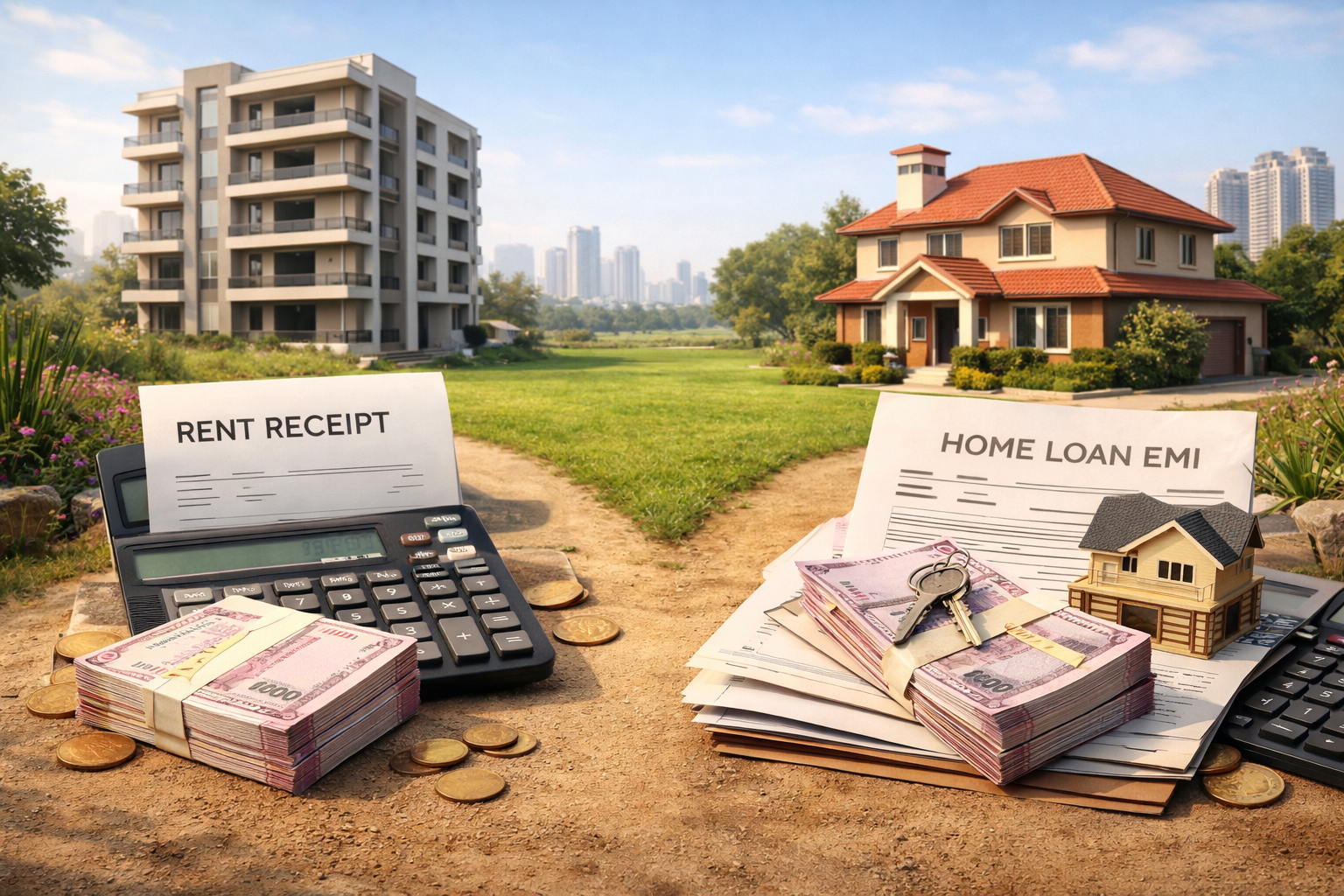
Now compare that with a purchase. On a ₹50 lakh home loan at about 8.5% for 20 years, the EMI is roughly ₹43,391 per month. That is before maintenance, tax, repair reserve, and ownership friction. If your current rent for a workable flat is ₹15,000 to ₹18,000, the jump is not small. It is a major lifestyle shift.
If you still do not know which Panvel pocket actually suits you
This matters a lot more than people admit.
Renting first is often the best way to test whether you really prefer:
- the dense practicality of Old Panvel,
- the more planned feel of New Panvel sectors,
- or the cheaper but more infrastructure-dependent outer stretches.
Panvel also has a real civic split. CIDCO-planned areas and PMC-governed older or organically grown pockets do not always feel the same on roads, drainage, open space, and daily order. PMC’s own online systems also reflect that Panvel property administration today is very much active and digitised, not some simple one-size-fits-all town setup.
Quick checklist: renting is usually better if…
- You may shift within 3 years
- You are new to Panvel and still decoding the area
- Your down payment will wipe out your emergency fund
- You are comparing rent only to EMI and ignoring the rest
- You are choosing Panvel mainly out of FOMO
- You are considering a location that still feels incomplete for everyday life
When buying in Panvel starts making sense
Buying in Panvel starts making sense when the property is solving a real long-term need, not just a fear of future price rise.
If you can hold the property for several years
The strongest case for buying is a long holding period. If your household is reasonably sure that it will stay in the Mumbai Metropolitan Region for many years, ownership starts making more sense because the purchase cost gets spread over a longer life cycle.
This is especially true now that Panvel is no longer just a cheap fringe market. The easy speculative phase has already reduced. Broader MMR inventory data suggests the market is not in a simple runaway cycle; by the end of 2025, unsold homes in MMR were still around 1,79,228 units, down only slightly from the previous year. That supports a more measured, selective approach rather than panic-buying.
If the down payment and registration cost will not exhaust your cash
This is one of the biggest real-world filters.
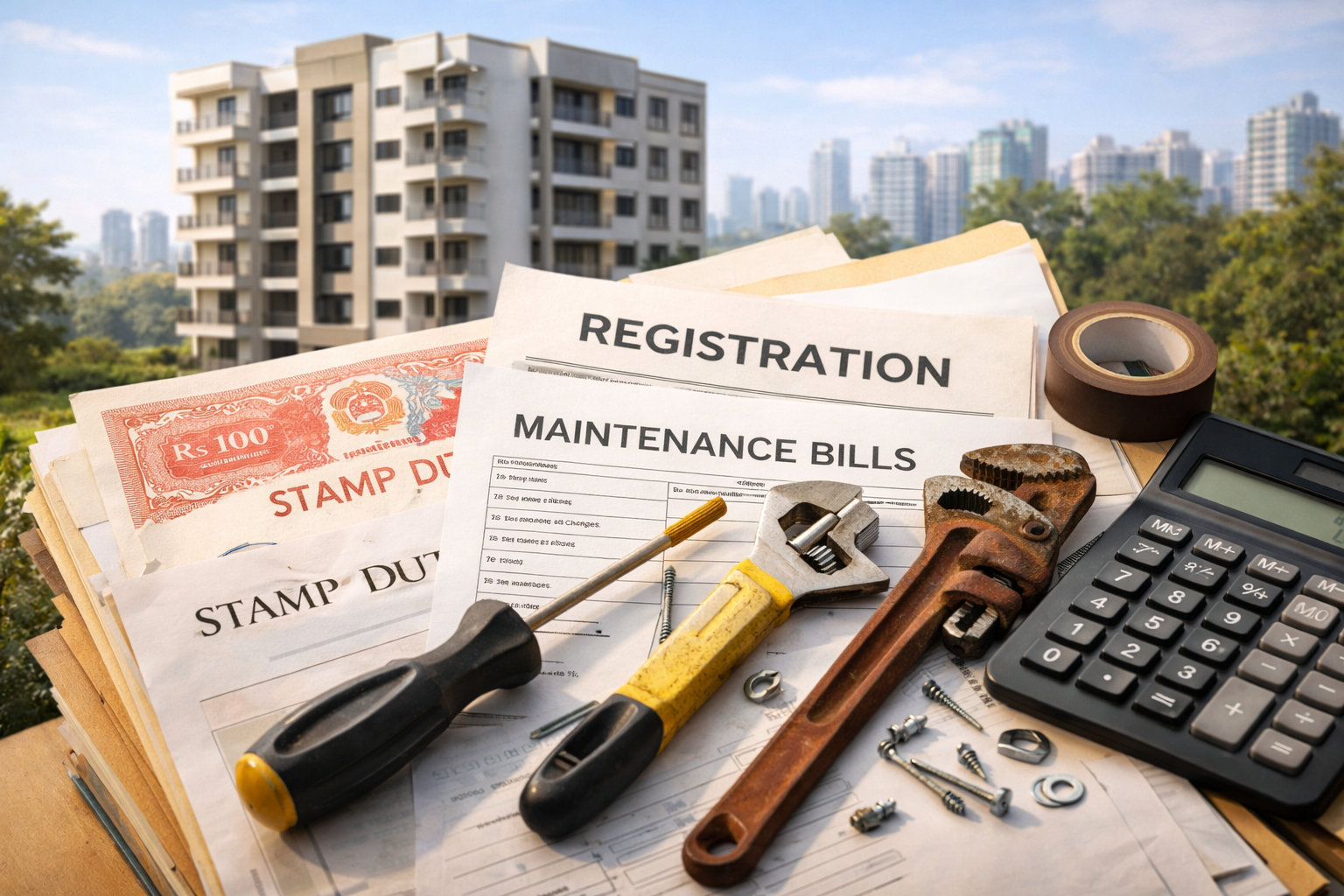
A buyer purchasing a ₹50 lakh flat is not just arranging a down payment. Maharashtra’s property purchase cost structure also includes stamp duty and registration, and the official IGR system remains the reference point for valuation and duty-related calculations. The IGR department’s ASR system is the official route for checking ready reckoner values, and buyers should use it because duty is calculated with reference to official valuation logic, not just brochure pricing.
For practical planning, many buyers in Navi Mumbai work with a composite ownership cost assumption of roughly 7% stamp-duty-related outflow plus registration, with registration commonly capped at ₹30,000 for higher-value homes under Maharashtra’s prevailing structure. Ready reckoner guidance and common 2025–26 Maharashtra explanations also continue to reflect that official valuation matters and that registration is generally 1% up to the cap.
So a ₹50 lakh purchase is not just “20% down payment and EMI.” It is also a serious liquidity event.
If the location solves a daily-life or long-term family need
Buying is easier to justify when the property is giving you one or more of these:
- better railway access,
- more family space,
- better school continuity,
- better road access for work,
- or a long-term stability advantage over living on repeated 11-month agreements.
This is where Panvel can make real sense. Families priced out of mature central nodes can often get more space in Panvel than in Kharghar, Nerul, or Seawoods. That is not a small upgrade. For a family moving from a cramped rented flat to a better-sized 2 BHK with long-term schooling stability, ownership can be practical, not emotional.
A simple comparison box
Buying in Panvel usually makes sense when:
- your stay is long-term,
- you know the exact area,
- the EMI gap is manageable,
- the building solves a daily need,
- and you still have cash left after upfront costs.
Buying usually does not make sense when:
- you are buying only because Panvel feels cheaper than Kharghar,
- you are stretching to the limit,
- you are trusting only future infrastructure talk,
- or you have not yet experienced the area in normal weekday life.
Why the answer changes between Old Panvel, New Panvel, and outer Panvel pockets
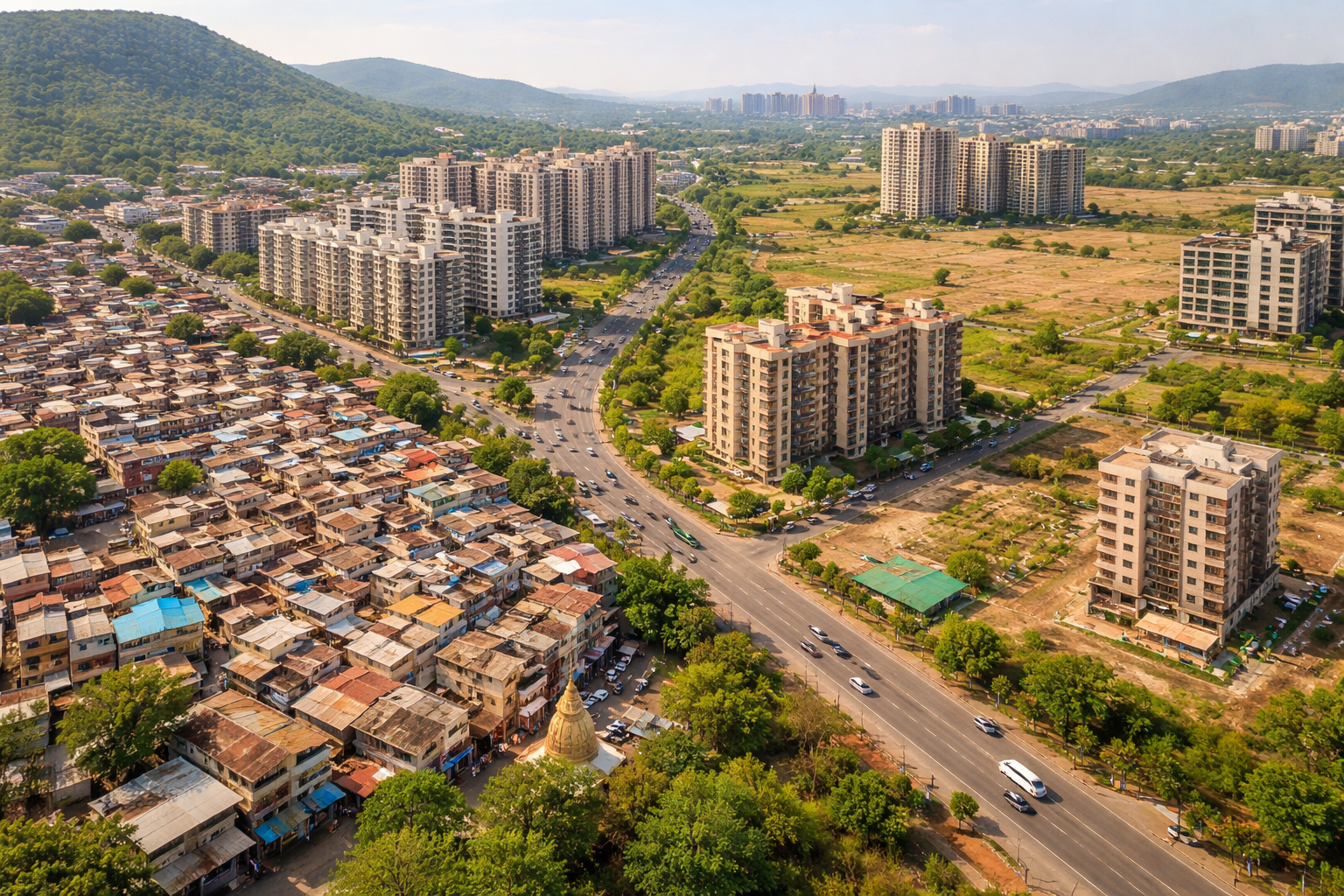
This is the section most generic competitor pages miss.
Old Panvel and established practical areas
Old Panvel has location strength, market familiarity, and a lived-in rhythm. It suits people who value old commercial access, traditional residential logic, and central practicality. But it can also mean more congestion, tighter roads, older building stock, and a less planned feel.
For some buyers, that is absolutely fine. In fact, for legacy residents or local business families, Old Panvel can feel more usable than any brochure-driven township.
New Panvel East and West
New Panvel is usually where the “buy for end use” argument gets stronger. Sector planning, wider roads, better layout discipline, and more organised surroundings make a difference. Khanda Colony and nearby planned stretches appeal to buyers who want a calmer residential feel without losing Panvel access completely.
This is also where many upgraders feel more comfortable buying rather than renting indefinitely, because the environment feels easier to commit to.
Outer growth-led stretches like Karanjade or Palaspe
These pockets are where the entry price looks attractive, but the daily-life question gets harder.
Yes, the price bands can be materially lower than Old or established New Panvel pockets. Indicative 2026 pricing around Karanjade and Palaspe sits in the ₹5,000 to ₹7,500 per sq. ft. range.
But lower entry price does not automatically mean better value. In outer belts, buyers must think harder about:
- last-mile transport,
- bus dependence,
- shared auto dependence,
- social infrastructure depth,
- and how the area behaves in peak summer and monsoon conditions.
That is why many people are better off renting in these zones first rather than buying on brochure logic.
EMI vs rent in Panvel: what buyers often calculate wrongly
The classic mistake is simple: people compare only monthly rent with monthly EMI.
That comparison is too shallow to guide a property decision.
The missing cost of down payment and registration

Let us take a practical example.
Suppose you are buying a ₹50 lakh flat in or around New Panvel.
| Cost component | Indicative amount |
|---|---|
| Down payment at 20% | ₹10 lakh |
| Stamp-duty-related outflow at roughly 7% | ₹3.5 lakh |
| Registration | Up to around ₹30,000 |
| Loan EMI at 8.5% for 20 years on ₹40 lakh | ~₹34,713 |
| Loan EMI at 8.5% for 20 years on ₹50 lakh | ~₹43,391 |
That means the buyer may need to mobilise around ₹13.8 lakh or more upfront even before interiors, moving cost, brokerage where applicable, and society deposits.
That is why “rent is ₹17,000 and EMI is ₹35,000, so buying is better” is not a serious comparison.
The missing cost of maintenance, interiors, and society charges
Ownership carries monthly and non-monthly drag.
Indicative society maintenance in Panvel often falls around ₹2,000 to ₹5,500 per month depending on flat size, building type, and amenities. That is not theoretical. In many societies, it keeps rising as the property ages. The rent-vs-buy decision changes materially once this is included.
Then add:
- basic interiors,
- appliance replacement,
- occasional repairs,
- parking-related charges,
- and the opportunity cost of money locked into the house.
The mistake of comparing today’s rent with tomorrow’s ownership stress
This one is emotional.
People dislike rent because it feels unrecoverable. But in the first years of a loan, a large share of EMI is also not building much ownership value. It is mainly servicing interest. So the question is not “rent is waste, EMI is investment.” The real question is: which option gives me the better outcome for my timeline, cash flow, and local certainty?
That is a much more honest question.
Which type of person should rent in Panvel and which type should buy?
Different reader types need different answers. One article that gives one verdict to everyone is not helping anyone.
First-time salaried buyer
If you are early in your career, still flexible, and unsure whether Panvel is your final MMR base, renting is usually smarter. This is especially true if the down payment is coming from family pressure or if the EMI would noticeably reduce your freedom.
If you still want to buy, buy only when your job and income stability are strong enough that the purchase does not feel like a monthly squeeze.
Family planning to stay long term
This is Panvel’s strongest buyer segment.
A family needing more space, school continuity, and a stable location often gets a better ownership case in Panvel than in costlier Navi Mumbai nodes. In this situation, buying can make real sense if the locality has already been tested and the budget includes the hidden costs.
Investor looking for yield
Investors should be careful.
Panvel can work as a capital-appreciation-led story over time, but it is not automatically a high-yield rental machine in every location. If your main goal is immediate cash yield, the decision should be stricter. Rental demand exists, but not every Panvel project supports strong, reliable rent at the price owners expect.
Buyer choosing Panvel only because it looks cheaper than Kharghar
This is one of the most common bad reasons to buy.
Panvel may offer more space per rupee than Kharghar. That can be a real advantage. But “cheaper than Kharghar” is not enough by itself. If the area adds commute fatigue, weak daily convenience, or civic frustration, the lower price can stop feeling like value very quickly.
What market signals in Panvel should you check before choosing to buy instead of rent
If you are serious about buying, look at signals that tell you whether the micro-market is real, usable, and legally safer.
Price movement versus actual livability improvement
Do not trust price rise alone.
Broader portal data shows Panvel can look attractive on trend charts, and local market reports continue to show a meaningful spread between entry-level and stronger micro-markets. But price movement is not the same thing as daily-life quality.
Ask instead:
- Has the road and access reality improved?
- Is the building actually occupied?
- Are local shops, schools, and regular transport active?
- Does the area feel like a working residential market or only a selling story?
Rent strength versus only brochure-led pricing
A useful market check is this: can the property actually attract a steady tenant at a sensible rent?
If resale price expectations are very high but the rental market is still weak or patchy, that is a sign the market may still be ahead of its lived demand.
Possession reality, unsold stock, and project readiness
For under-construction options, MahaRERA is not optional. The MahaRERA portal allows users to search registered projects, promoters, and related project status information. It also publicly surfaces sections such as registered projects, revoked projects, and other regulatory lists that help buyers avoid blind faith in sales promises.
Check:
- whether the project is registered,
- what completion date is officially shown,
- whether the promoter has a clean record,
- and whether the project appears in stress-related or negative-status lists.
Infrastructure that helps daily life, not just future headlines
Regional infrastructure matters, yes. But daily infrastructure matters more.
A buyer should care about:
- reliable water supply,
- real station access,
- working bus routes,
- and how long it actually takes to reach the railway station or highway access point.
Even transport-side signals matter. NMMT-linked route patterns and bus dependence remain relevant in outer stretches, and official transport sources continue to exist as reference points for route checks. That is far more useful than falling in love with one airport-related sales pitch.
What can go wrong if you buy too early in Panvel
Buying early is not always smart. Sometimes it is just early.
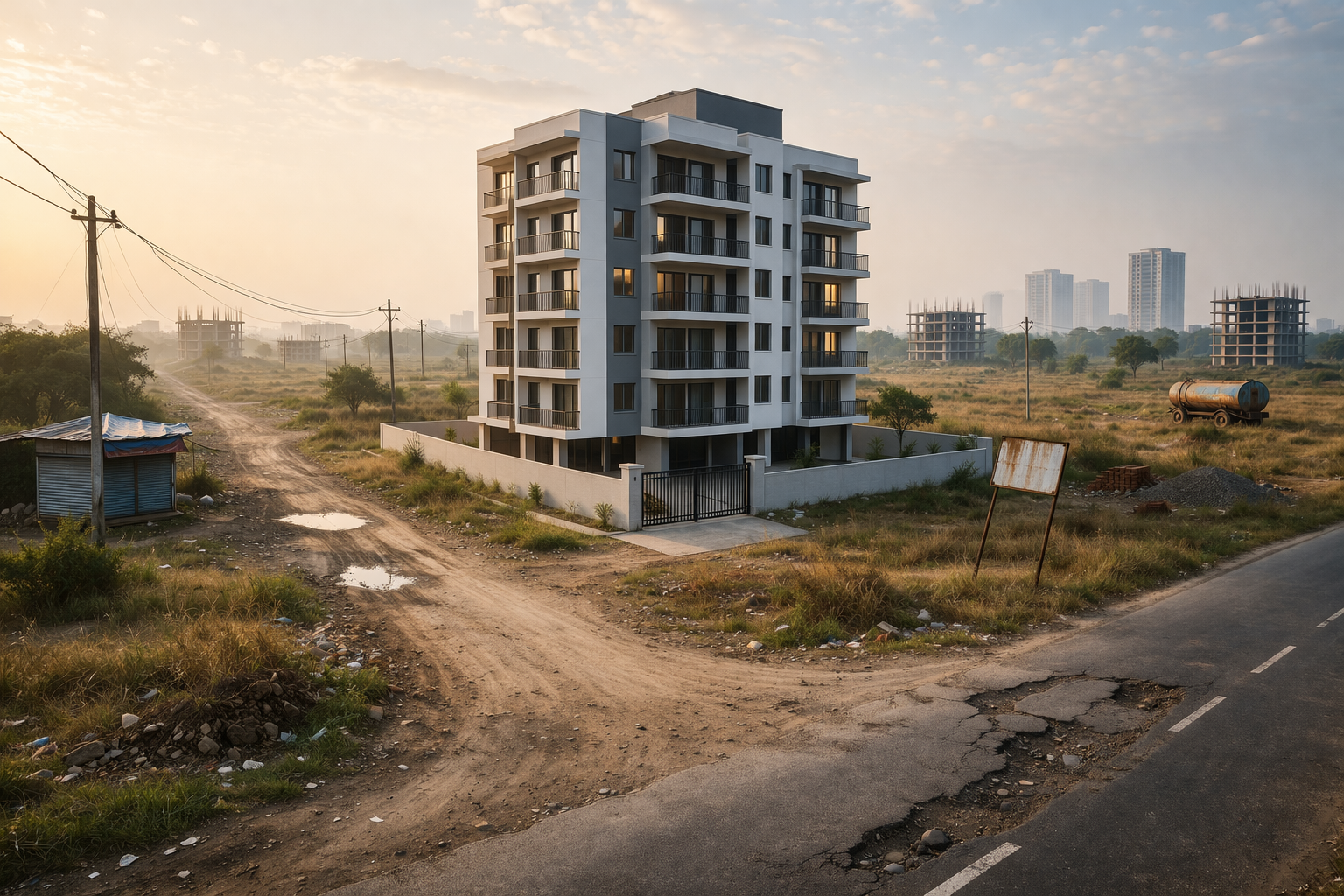
Buying in a pocket that still feels incomplete for daily life
This is the classic outer-corridor risk.
The flat may look affordable and the project may look impressive, but if everyday life still depends on weak last-mile transport, tanker dependence, long internal travel, or missing basic convenience, ownership becomes harder than the brochure promised.
Taking a big EMI for a location you are not fully sure about
This is where regret starts. A renter can adjust. An owner cannot adjust so easily.
If you are not yet sure whether Old Panvel’s density suits you, or whether an outer stretch feels too far from your real life, do not turn that uncertainty into a 20-year commitment.
Treating every Panvel project like a safe long-term bet
It is not.
Some projects may do well. Some may underperform. Some may face long waits, slow neighbourhood maturity, or weaker-than-expected rental response. The broader MMR market still carries significant inventory and is not behaving like a guaranteed straight-line boom.
Caution box
Do not buy in Panvel just because:
- “airport ke baad sab double ho jayega”
- the sales team says launch rates will vanish next month
- the per-sq-ft number looks cheaper than Kharghar
- you have not checked MahaRERA, ready reckoner logic, and actual building progress
- you have never lived in or regularly travelled through that part of Panvel
A simple decision framework: rent, wait, or buy in Panvel
| Decision | Best fit | Why it makes sense |
|---|---|---|
| Rent | Short-term stay, uncertain job base, still testing Panvel | Keeps flexibility, protects liquidity, lets you understand the area first |
| Wait | Income rising but not yet ready, area not final, watching specific project progress | Helps avoid rushed buying and lets you build down payment plus reserve |
| Buy | Long-term settlement, clear micro-market choice, stable income, strong cash buffer | Works best when the home solves a lasting family or commute need |
The cleanest way to decide is to ask three questions:
1. Will I likely stay in this side of MMR for at least 7 years? 2. Can I handle the real upfront cost without weakening my financial safety? 3. Do I know this Panvel pocket well enough to commit to it?
If the answer to all three is yes, buying becomes far more reasonable. If not, renting or waiting is usually the safer move.
Final verdict
For most people asking about rent vs buy in Panvel, the right answer is not emotional. It is practical.
Rent in Panvel if your life is still moving, your area choice is not final, or your budget will feel stretched after down payment, stamp-duty-related costs, registration, maintenance, and EMI.
Buy in Panvel if you are planning to stay long term, have enough liquidity beyond the purchase itself, and are choosing a locality that already fits your daily reality.
Panvel can absolutely be a smart place to buy. But only when you are buying the right part of Panvel, at the right stage of your own life, for the right reason.
FAQs
Frequently Asked Questions