

Who Should Buy Commercial Space in Kharghar? Buyer Fit, Cost Reality and Local Checks
Commercial space in Kharghar is best for selective buyers, not all buyers. It usually makes the most sense for serious end-users, clinics, coaching operators, consultants, and patient office investors who understand location quality, holding cost, and tenant demand. It is usually a poor fit for quick-flip buyers, retail speculators, and anyone buying only because Kharghar looks premium on paper. In this market, the right buyer can do well. The wrong buyer can get stuck for years.
That is the real answer.
A lot of people approach commercial property in Kharghar with residential thinking. They assume that if the node is growing, the asset must work. But commercial property does not behave like that. A unit works only when the exact business type, exact buyer profile, exact sector, and exact cost structure match. A main road label is not enough. A new building is not enough. Even future infrastructure is not enough unless the buyer has the capital and patience to hold through the slow part of the story.
Kharghar has strong long-term promise, yes. It also has dead retail pockets, heavily loaded buildings, recurring maintenance pressure, leasehold complications, and real differences between sectors. So the better question is not “Is Kharghar good?” The better question is “Who is actually suited to buy commercial space here?”
Before taking that call, Kharghar Commercial Property Guide is worth reading for the wider local picture.
Who should actually buy commercial space in Kharghar?
The shortest honest answer is this: buy commercial space in Kharghar only if your use case is strong enough to survive the micro-location, recurring cost, and holding period.
| Buyer type | Suitability | Why |
|---|---|---|
| Self-use clinic, medical practice, diagnostic setup | High | Local service demand can justify buying, especially where patient catchment is already established |
| Coaching, tutorial, education-linked operator | High in selected pockets | Institutional and student-driven demand makes some pockets workable |
| Consultant, CA, lawyer, therapist, professional office user | Medium to High | Small office space can be practical if the building and access suit client visits |
| Office investor with moderate budget and long holding power | Medium to High | Better suited than retail in many cases because office demand is broader |
| Retail buyer in proven catchment only | Selective | Works only where frontage, conversion, parking, and repeat demand are real |
| Long-horizon investor near corporate growth corridors | Selective | More of a future appreciation play than an immediate yield story |
| Short-term speculator expecting easy resale | Low | Commercial resale is slower and friction costs can destroy upside |
| Leveraged buyer without vacancy buffer | Low | CAM, tax, fit-out, and idle months can hurt badly |
So who should buy commercial space in Kharghar? Mostly four types of people.
First, end-users who will actually run their own business from the space. Second, professional operators like clinics, consultants, and education businesses that depend on local demand more than walk-in glamour. Third, small office buyers who understand that a practical office is often safer than a shop. Fourth, patient investors who are not dependent on instant rent or instant resale.
Everyone else should be much more careful.
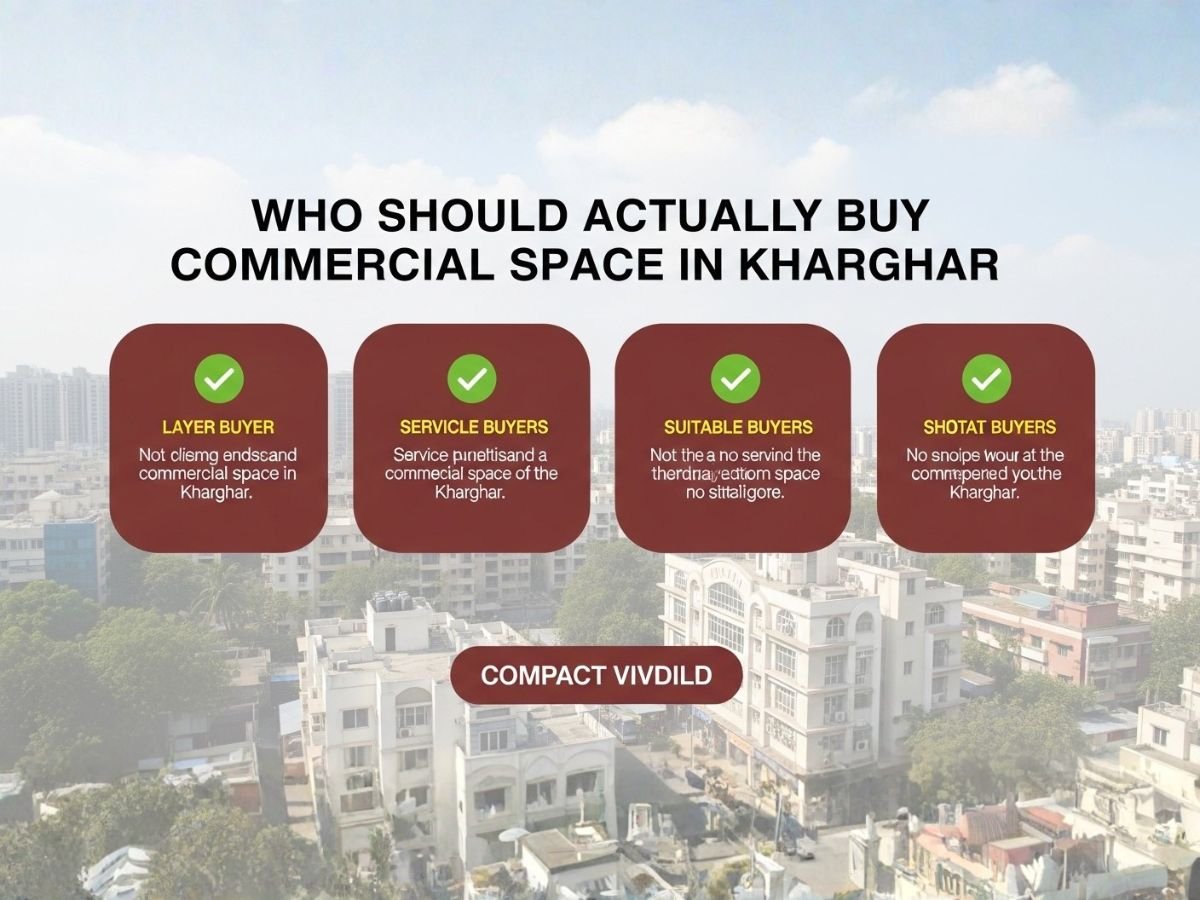
Which types of buyers are usually the best fit in Kharghar?
The best buyers in Kharghar are the ones whose business model already fits the local ecosystem. They are not buying a random commercial unit. They are buying into a demand pattern that already exists.
End-users who need space for their own business
This is the strongest fit in most cases.
If you are already paying rent for a clinic, diagnostic centre, consultancy office, therapy practice, boutique service centre, or local business with repeat customers, buying your own commercial unit in Kharghar can make sense. The logic is simple. Instead of treating rent as a monthly drain, you convert that outflow into an owned operating base.
This matters even more in better sectors where rental pressure can be meaningful. If a business is already stable, a self-use purchase gives control over signage, fit-out, timings, long-term continuity, and future expansion. That is a very different logic from buying for passive rent.
In Kharghar, this profile works especially well where the surrounding residential catchment is strong enough to create dependable local demand. Medical and service-led demand is not built only on glamour. It is built on convenience. People prefer nearby clinics, diagnostic points, therapy centres, dentists, and specialists when the location is practical.
Office buyers with moderate budgets and longer holding power
For many first-time commercial buyers, a small office is a better fit than a shop.
Why? Because office demand is broader, the leasing logic is less dependent on perfect frontage, and the asset is easier to position for multiple tenant types. A compact office can be used by consultants, back-office teams, agencies, legal professionals, immigration firms, training setups, therapists, and small companies. A shop has far less room for error.
This is especially relevant in Kharghar because not every commercial location has real retail conversion. Many buyers pay a retail premium for a unit that looks commercial but does not attract consistent, profitable, formal retail demand. A small office can be far more forgiving.
This buyer type works best when the investor has patience. Office-led commercial property in Kharghar is usually not a quick-yield story. It is a stability plus future-upside story.
Clinics, coaching, consultants and appointment-led businesses
This is one of the most practical buyer categories for Kharghar.
Kharghar has strong education and service demand in selected pockets. Certain sectors are already associated with institutional activity, coaching movement, and healthcare needs. That creates a specific kind of commercial demand: not pure impulse footfall, but planned visits.
That difference matters.
An appointment-led business does not need the same kind of frontage as a daily retail shop. What it needs is accessibility, local trust, surrounding population, parking practicality, and building usability. That is why a clinic or coaching operator may succeed in a location that a fashion or F&B retailer may reject.
Retail buyers only in proven neighbourhood catchment pockets
Yes, retail buyers can still be a good fit in Kharghar. But only selectively.
A shop buyer should not enter this market unless the location already has one or more of the following:
- proven daily-use demand
- visible frontage
- easy stopping and parking
- surrounding residential density that actually converts
- a business category that fits the catchment
- a building and road condition that supports repeat visits
A retail shop is not automatically a good commercial investment just because it is on a wide road or in a new building. That mistake is common. Retail works where the customer has a reason to enter and return. Kharghar has pockets where that happens, but it is not universal across the node.
Who should usually avoid buying commercial space in Kharghar?
This is the section most buyers need, because this is where money gets saved.
Kharghar commercial property is usually a weak fit for buyers who are attracted by the idea of commercial property but are not prepared for how it actually behaves.
Buyers expecting easy flip or fast resale
This is a poor-fit profile.
Commercial property is not as liquid as many first-time buyers imagine. In leasehold markets, transfer friction can significantly affect resale logic. If the buyer’s plan is to buy, wait a short time, and exit with a smooth markup, that plan may fail badly. Transaction friction, slower buyer pools, and mismatched asset types can wipe out the expected upside.
This is especially true when the buyer enters through a highly priced retail unit with a weak end-user base.
Retail buyers depending only on “main road” assumptions
This is one of the biggest traps in Kharghar.
A “main road” tag sounds powerful in marketing. But commercial retail does not run on labels. It runs on conversion. A road may have movement and still not create good business. It may have traffic but poor stopping ability. It may have visibility but weak parking. It may have surrounding residents but no reason for them to buy from that exact shop.
Some internal and semi-visible pockets in Kharghar become long vacancy zones because the business type and the catchment do not match. There are also areas where informal vending or hawker pressure can disturb formal retail economics. So a retail buyer who is buying mostly on brochure language should slow down.
Investors buying without tenant logic
Another weak-fit category.
Before buying any commercial unit in Kharghar, the buyer should be able to answer a simple question: who is the likely tenant here?
Not “someone will come.” Not “commercial always gets rent.” The actual likely tenant.
If the buyer cannot define whether the space suits an office, clinic, tutorial operator, service business, medical store, consultancy, or a daily-needs retailer, then the asset selection is incomplete. Commercial property without tenant logic is speculation disguised as investment.
Buyers stretching budget on under-tested projects
This is dangerous in Kharghar because the true cost of commercial occupancy does not stop at the purchase price.
There can be fit-out costs, CAM charges, property tax under PMC, vacancy periods, shell-to-warm-shell spending, electrical setup, and signage expenses. If the buyer’s budget is already tight at the time of booking, even a short vacancy or a delayed operating start can create pressure.
That is why undercapitalized buyers should usually avoid buying commercial space here, especially in premium new projects.
> Caution box: > If your plan depends on instant rent, zero vacancy, easy resale, or the assumption that every Kharghar sector is commercially active, you are probably not the right buyer for commercial space in Kharghar.
Is Kharghar better for self-use buyers or investment buyers?
For most people, Kharghar is stronger for self-use buyers than for pure passive investors.
That does not mean investors should avoid it. It means the investor case is more selective and more dependent on holding power.
When self-use makes more sense
Self-use makes sense when the business already exists or is operationally clear.
If a doctor, consultant, therapist, coaching operator, diagnostic brand, or local service business is already paying rent in a suitable part of Kharghar, buying can be justified even when the headline yield looks modest. Why? Because the value is not only rent saving. It is also location control, business continuity, asset creation, and insulation from future rent escalation.
In practical terms, self-use allows a buyer to justify locations that a passive investor may reject.
When investment makes sense
Investment makes sense when the buyer:
- understands the exact tenant profile
- chooses a realistic building type
- has vacancy tolerance
- is not overpaying for unusable area
- is willing to hold through longer timelines
In Kharghar, a pure investment purchase often works better in office-led formats than random retail formats. The broader usability of offices usually reduces the dependency on one perfect customer flow pattern.
Also, this is important: for many investors, Kharghar commercial property is more of a future appreciation and strategic positioning play than an instant high-cash-flow play. Gross yields can look attractive on paper, but net outcomes depend heavily on tax, vacancy, maintenance, and fit-out realities.
When a hybrid buyer can benefit
A hybrid buyer is someone who may use the space later, lease it out now, or use part of it operationally and part of it strategically.
This buyer profile can work in Kharghar because it allows flexibility. A family office, expanding local business, or professional practice may buy with a 5 to 10 year view rather than chasing year-one perfection. That approach is more realistic.
Does a shop or a small office make more sense for your buyer profile in Kharghar?
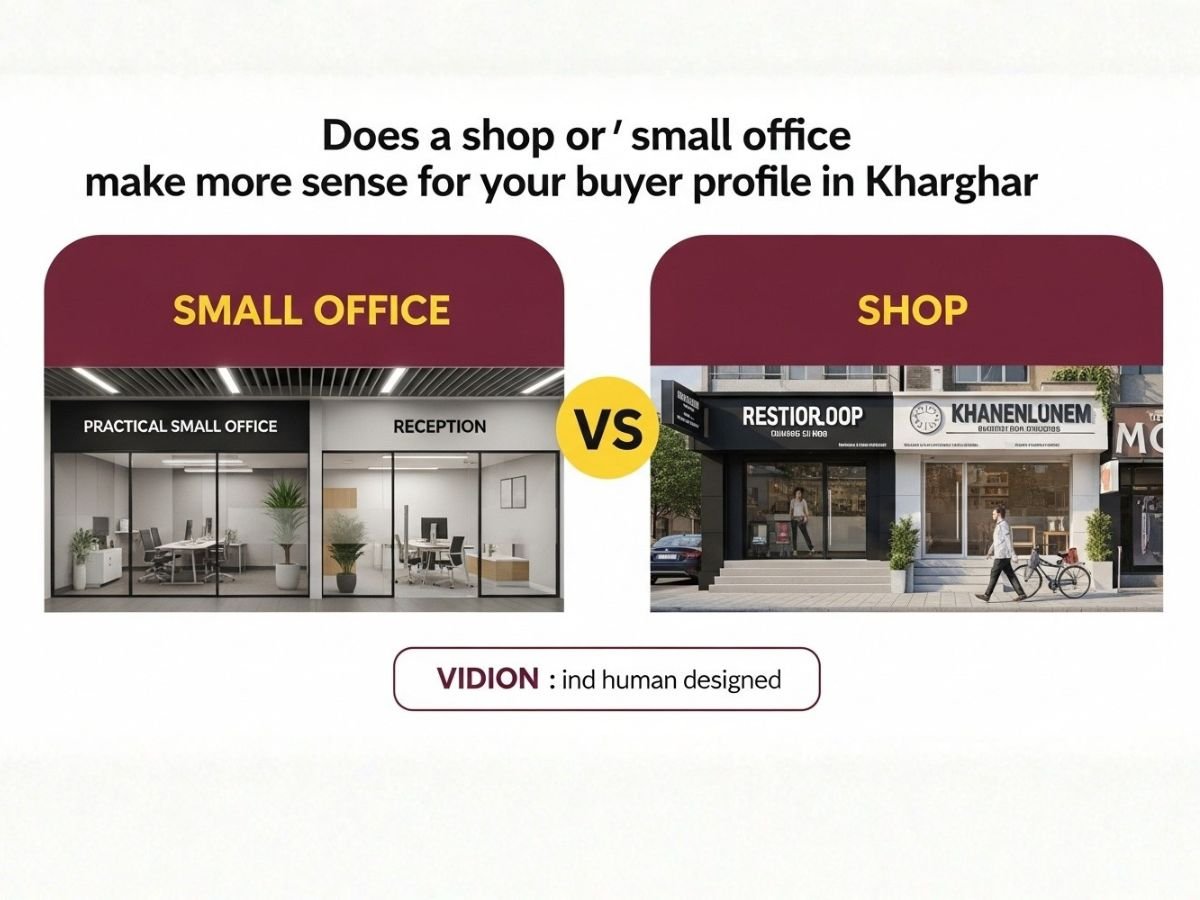
In most cases, a small office makes more sense than a shop for first-time commercial buyers in Kharghar.
That is not because offices are always superior. It is because the error margin is larger with shops.
| Factor | Small Office | Shop |
|---|---|---|
| Tenant pool | Broader | Narrower |
| Dependence on frontage | Lower | Very high |
| Dependence on parking | Moderate | High |
| Dependence on daily walk-in conversion | Lower | Very high |
| Sensitivity to loading factor | Moderate | Very high |
| Suitability for first-time investor | Usually better | Only in strong retail pockets |
When a small office is the safer buy
A small office is safer when the buyer wants broader usability and lower dependence on street-level conversion.
An office can serve multiple user types. Even if one tenant category weakens, another may still fit. That flexibility matters in Kharghar, especially where the long-term story is tied more to organized office use, professional services, and future corridor growth than to spontaneous retail success.
When a shop can outperform
A shop can still outperform an office, but only when the retail fundamentals are strong.
That usually means:
- genuine visibility
- decent frontage, ideally around 10 to 15 feet or more depending on category
- ground practicality
- easy customer entry
- neighbourhood demand that matches the product
- repeat-use or necessity-led category
Without those conditions, the shop can become an expensive problem.
Why frontage alone is not enough
A lot of buyers focus only on super built-up area, road width, and whether the broker says “main road.”
That is incomplete.
Commercial buildings can have heavy loading factors. In some Grade A developments, the difference between saleable area and actual usable RERA carpet area can become very large because of lobbies, atriums, common spaces, and circulation areas. For office users, some of this can be acceptable because premium infrastructure supports corporate perception. For shop buyers, it can be painful because profit comes from actual display and selling space, not from paying for shared glamour.
This is why many first-time retail buyers get shocked later. The purchased number looks big. The usable internal space feels much smaller.
Which Kharghar locations suit which kinds of commercial buyers?
Kharghar should never be treated as one single commercial market. That is one of the biggest mistakes in this space.
Different sectors suit different buyer profiles.
Sector 20 and nearby premium catchments
This is the premium side of the conversation.
Areas around Central Park, the golf course influence, and premium residential catchments can suit high-trust, high-margin, image-sensitive businesses. Premium clinics, specialists, curated service brands, and better-positioned professional uses can justify this location more easily than commodity retail.
But high entry cost means this is not for casual buyers. If the business margin is weak or the rent-saving logic is poor, the purchase becomes hard to justify.
Sectors 30, 32 and 34 as corporate corridor bets
These sectors matter more for office-led investors and patient strategic buyers.
The logic here is not everyday neighbourhood retail. The logic is future office relevance, especially around the wider corporate growth narrative linked to the Kharghar Corporate Park side of the node and larger regional infrastructure such as NMIA. But buyers need maturity here. This is not a guaranteed instant-return story. It is a phased and patient positioning story.
This kind of location is usually stronger for office investors than for casual shop buyers.
Sectors 35 and 36 and the upper Kharghar expansion side
These are more entry-level and expansion-oriented zones in the commercial conversation.
They may suit budget-conscious buyers, transit-linked demand, and selected neighbourhood-serving uses. But these pockets need sharper filtering. Not every unit here works. Internal retail can fail if it lacks active catchment conversion. Some buyers here should lease first rather than buy.
Sectors 12 and 21 as institutional and service-led pockets
These pockets are important for education, training, coaching, and medical or service-linked demand. Where institutional gravity already exists, certain commercial formats become more viable even without luxury positioning.
This is exactly why Kharghar area logic matters. A coaching operator, dentist, therapy centre, or tutorial brand should not choose location using the same framework as a coffee chain or fashion retailer.
What budget range and holding power should a buyer realistically have before buying?
This is where many buying plans collapse. Purchase price is not the full cost. Commercial property needs more stamina.
Entry-level buyer
An entry-level buyer, roughly in the ₹50 lakh to ₹1 crore range depending on unit type, building, and location, should be extremely careful.
This profile is usually vulnerable to three mistakes:
- overpaying for a shop in a weak pocket
- buying based on future hype
- ignoring vacancy and fit-out cost
This buyer should usually prefer practical, smaller, lower-risk formats and avoid over-leverage.
Mid-budget buyer
In the ₹1 crore to ₹3 crore range, the choices improve. The buyer can access better office stock, stronger sectors, and more flexible asset types.
But even here, holding power matters. A serious investor should have enough liquidity to carry recurring charges for months without depending on perfect leasing timing. In premium commercial buildings, CAM can be meaningful. Vacancy is not just lost rent. It is active carrying cost.
Business-owner buyer
This is often the strongest fit because the business itself supports the decision.
A business-owner buyer can justify acquisition through rent replacement, customer stability, operational permanence, and brand consistency. But even this buyer must budget for fit-out. Many commercial units come in shell condition. HVAC, flooring, cabin work, medical setup, wiring, lighting, signage, and compliance all cost money.
Investor with vacancy tolerance
A commercial investor in Kharghar should assume that vacancy can happen. That assumption creates a healthier buying decision.
A good buyer in this category has:
- a 12-month cost buffer
- a realistic rent expectation
- no panic about delayed occupancy
- clear understanding of tenant type
- no dependence on short-term flipping
What local risks change the answer in Kharghar?
Kharghar commercial buying is shaped not only by the market but also by local administrative and operating realities.
Vacancy and tenant mismatch risk
This is the biggest practical risk for many buyers.
A commercial unit can stay empty not because the market is dead, but because the unit is wrong. Wrong floor. Wrong size. Wrong frontage. Wrong building. Wrong catchment. Wrong business category. Wrong expectation.
That is why commercial property in Kharghar has to be bought with tenant logic, not brochure logic.
Parking, access and loading limitations
These issues directly affect usability.
A clinic needs convenient patient access. A retail shop needs stopping ability. A service office needs client comfort. A logistics-linked or operational office may need loading practicality. If the approach road, entry condition, parking pattern, or movement flow is weak, the property’s real business value drops, even if the building looks premium.
Building quality, maintenance and commercial usability
This is another underrated factor.
A project may be visually impressive and still be a weak commercial asset if the layout is too loaded, maintenance is high, shop depth is awkward, or common area planning reduces usable value. Some buildings are better for formal office use than retail. Some are better for service-led occupancy than passive leasing. Buyers need to read the building, not just the rate.
Legal and transfer-related friction
This is where Navi Mumbai-specific understanding becomes important.
A buyer in Kharghar often needs to understand the difference between CIDCO’s planning and land-related framework and PMC’s civic and taxation role. CIDCO-related leasehold structure, NOC issues, transfer charges, and conversion-related questions can change the asset’s resale and holding logic. PMC property tax, arrears, water and civic compliance affect operating reality.
This is not abstract paperwork. It changes real returns.
> Hidden cost reminder: > The true cost of occupying or holding commercial space in Kharghar may include CAM, PMC property tax, vacancy months, GST-linked maintenance burden in some structures, fit-out cost, electrical load setup, and future transfer or documentation friction depending on title structure.
What should you verify before deciding that you are the right buyer?
Before you decide that a commercial unit in Kharghar fits you, verify the following properly.
Title, approvals and project registration checks
For under-construction or newly marketed assets, use MahaRERA properly. Do not stop at the registration number on the ad.
Check:
- whether the project is actually registered
- promoter details
- sanctioned layout
- approved commercial component
- disclosures and updates
- whether what is being sold as commercial is legally approved that way
If the project is not being described consistently in approvals and marketing, slow down.
Also check the title structure. In Kharghar, title and land framework matter because leasehold versus freehold or freehold-convertible status can materially affect future resale ease, financing comfort, and transfer cost logic. If a property falls under a conversion policy or freehold pathway, that should be verified through proper documentation, not verbal assurance.
Carpet, frontage, visibility and actual usability checks
Do not buy on super built-up area alone.
Measure what actually matters:
- RERA carpet area
- actual internal layout
- frontage width
- ceiling usability
- column placement
- visibility from real road movement
- ability to place signage
- parking and drop-off practicality
A 1,000 sq ft saleable unit can behave like a far smaller business space if loading is heavy or layout is poor.
Demand check from existing businesses nearby
This simple step is ignored too often.
Before buying, spend time in the immediate pocket. See what businesses are working, what is vacant, what is surviving, and what kind of customer visits happen at different hours. Talk to current shopkeepers, office users, staff, and local brokers if possible.
The goal is not to gather gossip. The goal is to test whether your assumed tenant or business type already has proof in that pocket.
Total cost check, not just quoted rate
This should be non-negotiable.
Use the IGR Maharashtra ready reckoner only as a baseline reference for valuation and transfer compliance, not as proof of market price. Understand that the statutory benchmark is different from asking rates. What matters to you is the full acquisition and holding stack.
Check:
- base agreement value
- stamp duty and registration impact
- CAM
- property tax
- fit-out cost
- parking or other add-on costs
- vacancy carry cost
- any transfer-related friction on resale
Real buyer profiles: who should buy, who can wait, and who should walk away
These examples make the decision easier.
Profile 1: The expanding medical professional Buy
A dentist or diagnostic operator with a roughly ₹1.5 crore budget, already seeing stable patient demand in Kharghar, is often a strong candidate to buy. A practical commercial unit in a service-led pocket can reduce long-term rental vulnerability and create operational stability.
This buyer is not depending on random walk-ins. That is why the purchase logic is stronger.
Profile 2: The salaried investor chasing a cheap internal shop Walk away
A salaried buyer who wants to buy a retail unit in an internal pocket mainly because it looks affordable should be very careful. If the asset depends on future discovery rather than current business logic, the buyer may face vacancy, CAM, tax, and stress.
This is a classic weak-fit profile.
Profile 3: The long-horizon office investor Buy selectively
A well-capitalized buyer with patience and a 7 to 10 year view may selectively buy office-led commercial stock in the Kharghar corporate-growth belt. This is not an instant yield decision. It is a strategic positioning decision.
This buyer should still be very careful about loading, building quality, title structure, and real tenant profile.
Profile 4: The franchise operator with limited capital Lease first
An entrepreneur opening a café, branded food format, or customer-acquisition-heavy business may be better off leasing than buying. Working capital, marketing, staff, inventory, and operating flexibility may matter more than owning the real estate.
In this case, buying can actually weaken the business.
Profile 5: The coaching operator in the right cluster Buy or lease based on maturity
A mature coaching or training operator in an education-linked Kharghar pocket may be a good candidate for acquisition, especially if the business already has repeat admissions and location dependence. A newer operator should often lease first and buy later.
You should also read Shop vs Office Investment in Kharghar if you are still comparing visibility-led and office-led demand.
Conclusion
Who should buy commercial space in Kharghar? Mostly buyers with a real operating plan, patient capital, and the discipline to match the asset to the exact micro-location.
If you are a serious end-user, a clinic operator, a coaching or service business, or a patient office investor, Kharghar can make good sense. If you are buying because the project looks shiny, because the broker said “future growth,” or because you assume every commercial unit will automatically get rent, you should probably pause.
In Kharghar, commercial buying is not about optimism. It is about fit.
The right buyer should buy here. The average speculative buyer usually should not.
FAQs
Frequently Asked Questions