
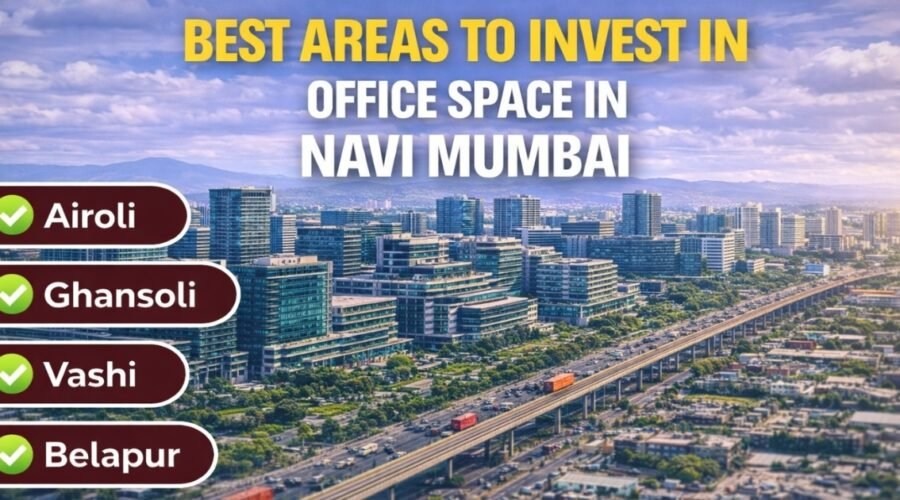
Best Areas to Invest in Office Space in Navi Mumbai
For most office investors in Navi Mumbai, Vashi and CBD Belapur are the safest mature choices, Airoli and Mahape work better for IT and larger occupiers, Nerul and Seawoods suit selective premium service-led offices, and Kharghar remains more of a future play than an automatic office winner. The right area depends less on hype and more on tenant type, station-road access, building quality, vacancy risk, and legal clarity.
Navi Mumbai is now a serious office market, not just a spillover from Mumbai. That shift is real. The city has a strong cost advantage over older business districts, a growing base of Grade A stock, and an office ecosystem that is no longer limited to one or two pockets. But that does not mean every commercial node works for office investment in the same way.
This is where many buyers go wrong. They hear “commercial growth,” “airport impact,” or “next BKC” and assume any office unit in any node will perform well. In reality, office investment works only when the tenant engine matches the location. A legal firm, GCC, coaching office, diagnostic center, back-office BPO, and boutique wealth advisory do not choose space for the same reasons.
So instead of giving you a generic list, this guide will help you answer the real question: Which office market in Navi Mumbai fits your budget, tenant type, and risk appetite?
Best Areas to Invest in Office Space in Navi Mumbai: Quick Answer First
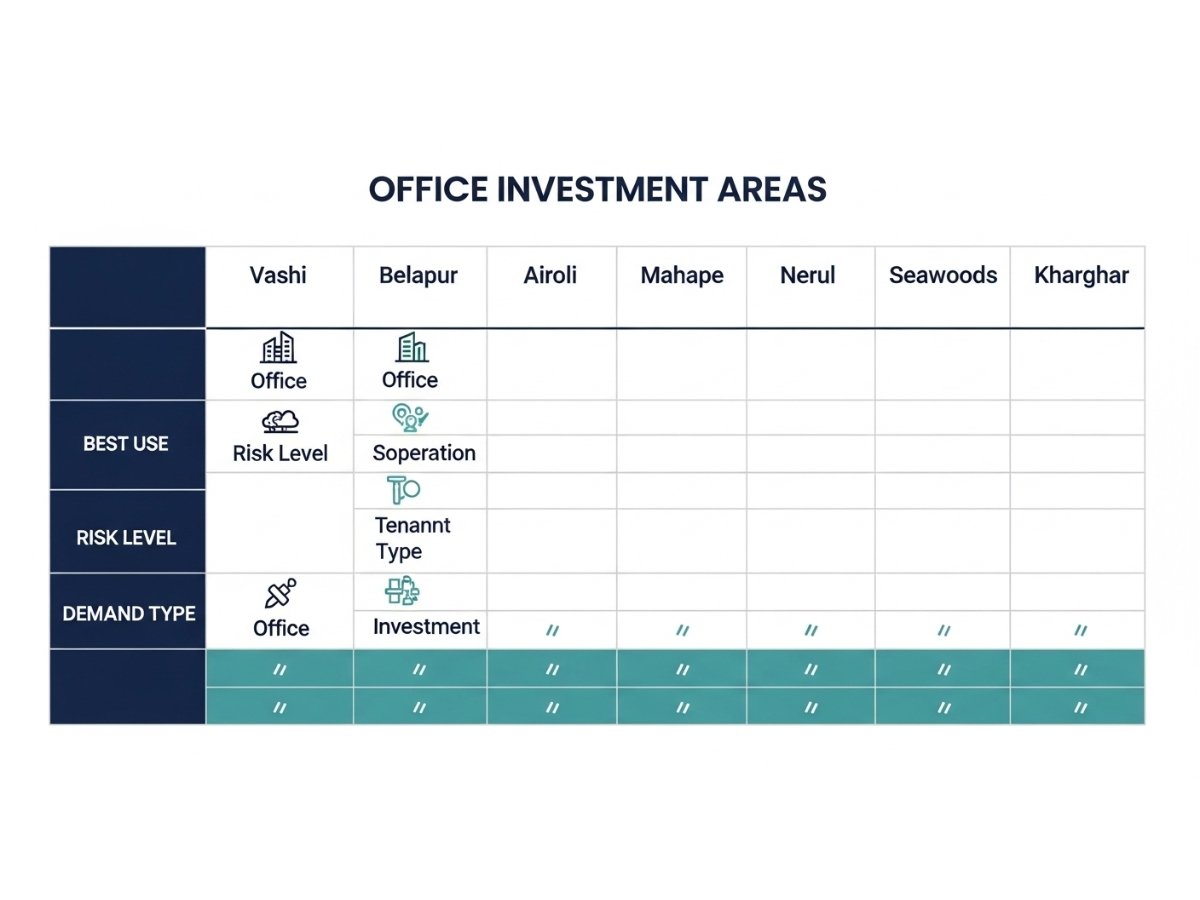
Here is the short answer before we go deeper.
| Area | Best For | Risk Level | Typical Office Demand Type | Who Should Avoid It |
|---|---|---|---|---|
| CBD Belapur | Professional self-use, legal-financial offices, stable holding | Low | Government liaison, law firms, CA offices, branch offices | Buyers seeking large IT floor plates |
| Vashi | Mature rentability, hybrid office demand, wealth preservation | Low | Consultants, clinics, agencies, education, retail-office hybrids | Buyers with tight budgets or yield-only expectations |
| Airoli | Institutional office investment, IT and large occupiers | Low to Medium | IT/ITES, GCCs, corporate campuses, data-heavy firms | Buyers who need high-street visibility |
| Mahape | Yield-driven office investment, mid-sized tech and BPO demand | Medium | SMEs, BPOs, support functions, fragmented office occupancy | Buyers uncomfortable with MIDC-side compliance |
| Nerul | Smaller professional offices with strong local service demand | Medium | Clinics, consultancies, education, boutique service offices | Large back-office or logistics-style users |
| Seawoods | Premium image-led office investment | Medium | Wealth managers, aesthetic clinics, boutique firms, high-end local services | Buyers expecting mass-scale corporate leasing |
| Kharghar | Long-horizon appreciation-led office bets | Medium to High | Startups, education-linked offices, selective future business demand | Buyers needing immediate strong rental certainty |
The practical takeaway is simple. If you want stability, start with Vashi or CBD Belapur. If you want IT-style rental demand, focus on Airoli or Mahape. If you want prestige plus selective local service demand, consider Nerul or Seawoods. If you want future upside and can hold patiently, then Kharghar can enter the conversation, but not blindly.
Which Office Investors Should Choose Vashi, CBD Belapur, Airoli-Mahape, Nerul-Seawoods, or Kharghar?
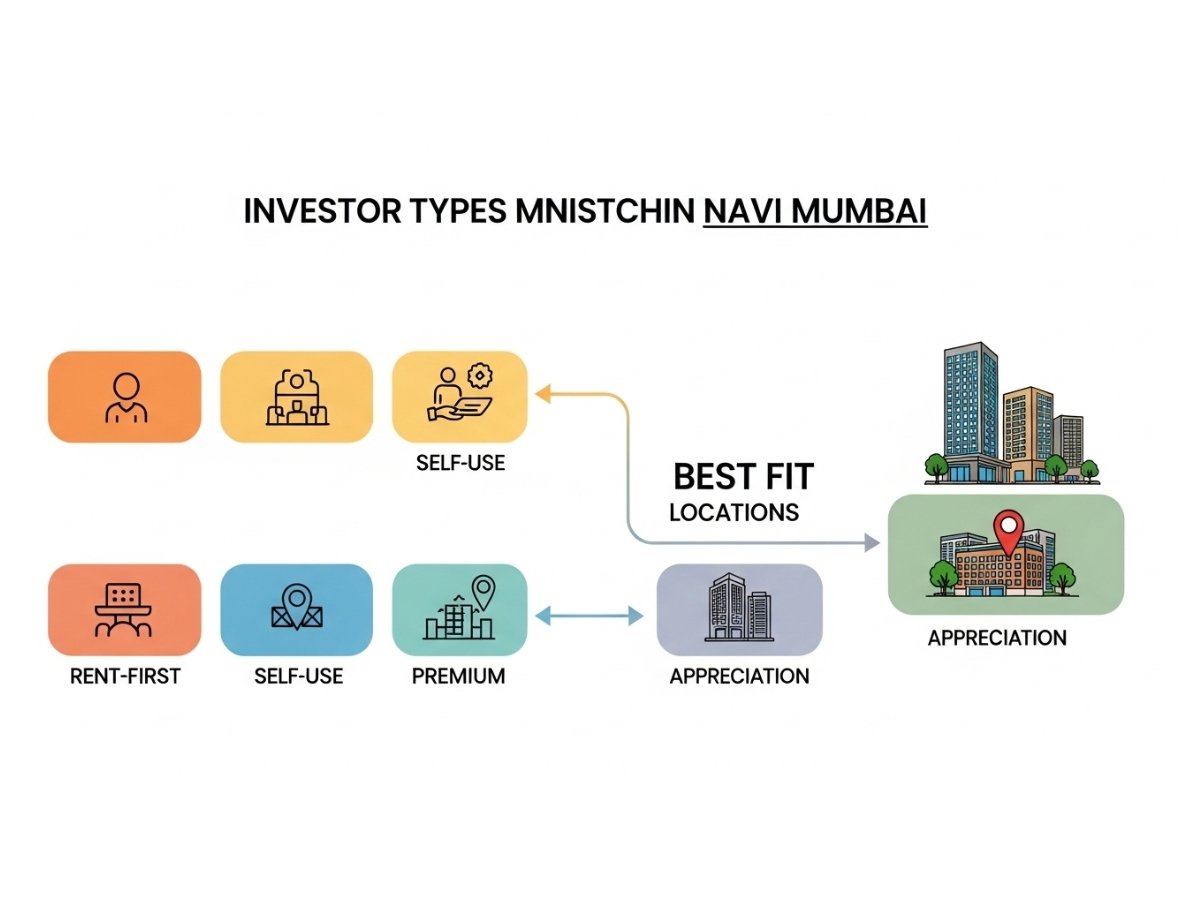
Office investment is not one single game. One buyer wants stable monthly rent. Another wants a self-use office in a respected business address. Someone else is ready to wait seven years for future upside. The right area changes with that objective.
| Investor Type | Best Area | Why It Fits | Main Caution |
|---|---|---|---|
| Rent-first investor | Airoli / Mahape | Strong IT and BPO demand can support steady leasing in the right buildings | MIDC rules, CAM, and tenant-fit matter a lot |
| Owner-occupier / self-use | CBD Belapur | Good business image, practical access, and strong professional ecosystem | Older stock may need interior upgrades |
| Wealth-preservation buyer | Vashi | Mature market, low vacancy risk in strong pockets, easy market recognition | Entry pricing is high, so net yield can compress |
| Premium-image buyer | Seawoods | Strong transit-led image and premium surroundings | Capital entry is high and tenant pool is narrower |
| Smaller professional office buyer | Nerul | Works well for service-led offices linked to affluent local catchment | Not ideal for large corporate scale demand |
| Appreciation-first buyer | Kharghar | Future commercial narrative is strongest here | Present rentability is still selective, not universal |
This framework matters because many losses in commercial property begin with a simple mismatch. A buyer chasing immediate rent in a speculative office zone may face long vacancy. Another buyer who needs a professional address may save money in the wrong node but lose business credibility.
A 500 sq. ft. office for a CA practice, for example, does not need the same location logic as a 5,000 sq. ft. IT support office. Reverse the thinking. First define the likely occupier. Then select the node.
Why Vashi Still Works for Office Investment Even When Entry Pricing Is Higher
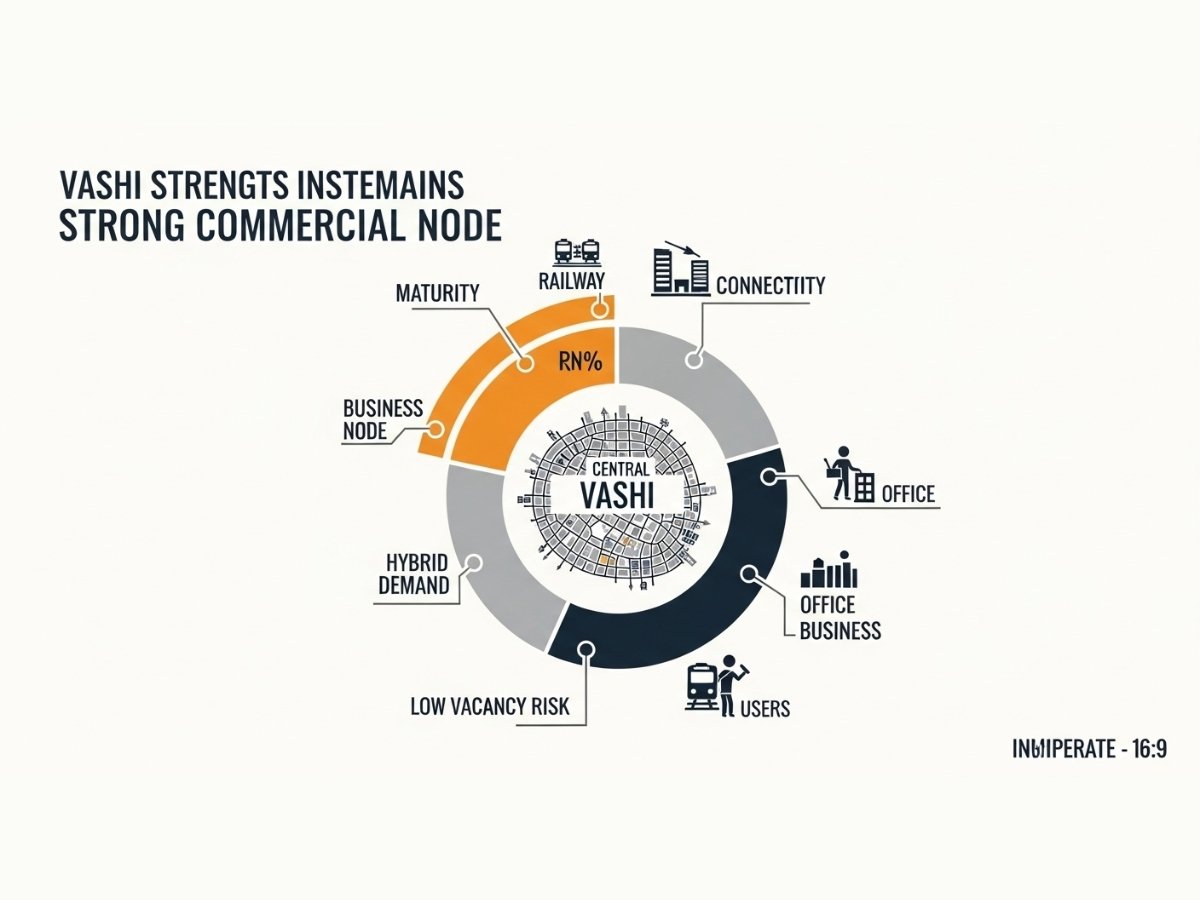
Vashi remains one of the strongest office investment markets in Navi Mumbai because it has something many newer areas still do not fully have: mature business behavior. People already know it, use it, travel to it, and take it seriously as a work address.
That maturity reduces vacancy risk. In office investment, that matters more than flashy brochures.
Where Vashi is strongest for office demand
Vashi works best in pockets near the station and in established commercial belts where daily commuter movement already supports business activity. This is why it suits consultants, agencies, coaching operators, clinics, diagnostic centers, and branch-office users particularly well.
It is also one of the few nodes where hybrid demand exists. Some occupiers want pure office space. Others want an office that also benefits from walk-in visibility or customer convenience. Vashi handles that blend better than most of Navi Mumbai.
A practical example helps here. Suppose an investor buys a compact office for a diagnostic consultancy or a training institute. In Vashi, especially near core commercial sectors, the location itself helps staff access, client access, and recall value. That is not a small thing. It directly affects occupancy and exit ease.
Where Vashi can disappoint investors
Vashi is not the best place for everyone.
First, entry pricing is relatively high. That means buyers chasing aggressive yield may feel disappointed because the capital cost can suppress net return percentages even when the space is occupied.
Second, not all Vashi stock is functionally strong. Some older buildings suffer from weak parking, outdated lift systems, inefficient layouts, or aging common areas. A “great area” does not save a weak office building from functional obsolescence.
So the real Vashi play is not “buy anything in Vashi.” It is this: buy only where the building still works for modern business use.
> Caution: Vashi is usually better as a stability and liquidity market than a fast upside market. It protects capital better than it multiplies it quickly.
Is CBD Belapur the Best Balance of Business Image, Access, and Hold Value?
For many practical office buyers, CBD Belapur is the best all-rounder in Navi Mumbai.
It has a proper corporate identity. It has administrative gravity. It has rail connectivity. It has stronger professional-office logic than nodes that are more residential or more industrial. It also feels more distinctly B2B than Vashi in many pockets.
That combination is rare.
What makes Belapur stronger than many other premium belts
CBD Belapur benefits from being the planned central business district of Navi Mumbai. It hosts a serious business environment rather than only mixed commercial buzz. In office investment, this matters because environment influences tenant type.
Belapur tends to work especially well for:
- law firms
- CA and tax practices
- shipping and logistics documentation offices
- financial service firms
- liaison and branch offices
- businesses that need proximity to government or regulatory touchpoints
This is the kind of office market where a 300 to 800 sq. ft. unit can make complete sense if the use case is right.
Which kinds of buyers fit Belapur best
Belapur is particularly strong for owner-users and conservative investors. If someone wants a respectable office address without moving into a full IT-park environment, Belapur is a very balanced choice.
Take a boutique wealth-management firm serving HNI clients from Navi Mumbai and nearby areas. A Belapur office helps in three ways: the address feels credible, the commute is workable for staff and clients, and the market is office-oriented enough to support long-term perception. That image advantage is real. It is difficult to replicate in a heavy trade zone or a purely residential node.
Belapur is not perfect, though. Older buildings may need interior modernization. Some stock is better for compact professional offices than for modern large-floor corporate setups. So, again, the building matters as much as the node.
When Airoli and Mahape Become Better Than Vashi or Belapur
This is where office investors need to stop thinking like traditional high-street buyers.
If your target occupier is from the IT, ITES, BPO, GCC, or tech-support world, then Airoli and Mahape can make more sense than Vashi or Belapur. Not because they are more prestigious in a classic sense, but because their entire office ecosystem is built around a different tenant engine.
These nodes sit inside the wider TTC-MIDC knowledge and industrial corridor logic. That changes everything: floor plates, power requirements, business hours, tenant behavior, support services, and compliance expectations.
Airoli for institutional and tech-park style demand
Airoli works best when the investor is targeting larger, more formal occupiers. It is one of the stronger nodes for campus-style and institutional office demand. This includes companies that care about access to the Thane side, structured commercial environments, and larger modern space requirements.
That is why Airoli suits buyers who want to ride larger occupier demand rather than local walk-in business demand.
Airoli is not for everyone, though. If your plan depends on high-street visibility or customer-facing retail-office activity, it may not be the right match. Airoli’s strength is structured corporate use, not daily public-facing footfall.
Mahape for larger office ecosystems and TTC-linked business activity
Mahape is different from Airoli, but equally important.
Mahape, especially around long-established office clusters like Millennium Business Park, works well for mid-sized occupiers, BPOs, SMEs, tech support firms, and support-office functions. It often offers more functional entry points for buyers who want office exposure without paying for the highest-end corporate image.
This makes Mahape attractive for yield-focused investors. But the caution here is serious. MIDC-side office environments come with their own compliance reality.
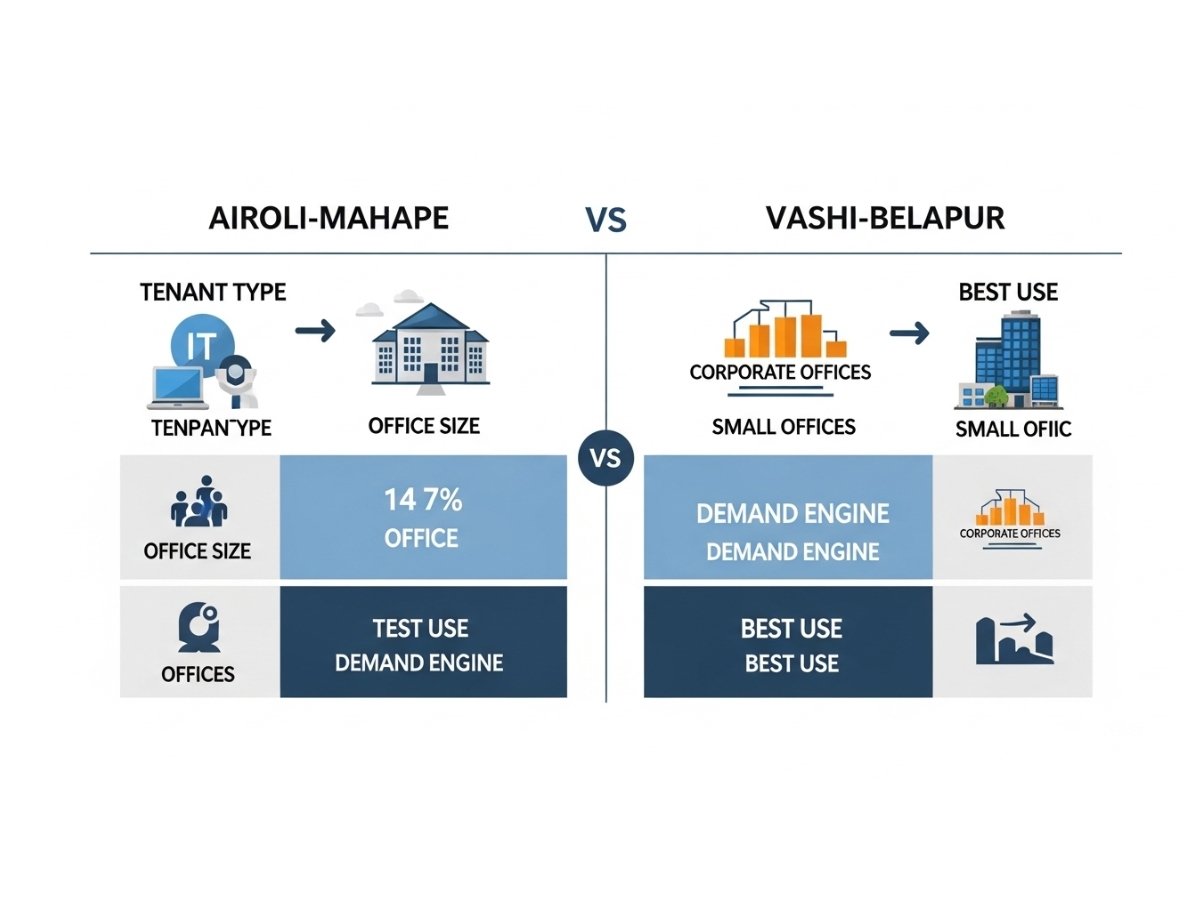
| Feature | Vashi / Belapur Logic | Airoli / Mahape Logic |
|---|---|---|
| Main demand engine | Professional services, branch offices, local business offices | IT, ITES, BPO, GCC, corporate support functions |
| Typical office size pattern | Smaller to medium units | Medium to large floor plates |
| Best for | Self-use, mature rental demand, office identity | Yield-led office investing tied to tech and corporate occupancy |
| Main caution | Older stock and compressed yields | MIDC rules, CAM burden, sanctioned-use discipline |
A buyer in Mahape should not assume that “commercial is commercial.” If the asset falls under MIDC and IT/ITES-linked restrictions, tenant use, sub-leasing, and sanctioned activity must all be checked carefully. This is not the place to behave casually.
> Caution: In Airoli and Mahape, the location can be right but the tenant can still be wrong. A badly matched tenant profile can create compliance and leasing friction even inside a strong office belt.
Are Nerul and Seawoods Better for Smaller Professional Offices Than for Large Corporate Bets?
Yes, usually they are.
Nerul and Seawoods are not weak office locations. But they are often misunderstood. Their strength is not mass-scale corporate desk demand. Their strength is selective, premium, client-facing professional office demand.
That is an important difference.
What kinds of office users actually work here
Nerul and Seawoods tend to suit businesses such as:
- wealth advisors
- architects and design consultants
- specialty clinics
- diagnostic and aesthetic practices
- education consultants
- boutique agencies
- therapy and professional service offices
These businesses benefit from affluent catchment, cleaner surroundings, good road access, and in Seawoods especially, a premium transit-linked image.
Seawoods has the advantage of a stronger premium perception because of the integrated station-mall-commercial ecosystem. Nerul has the advantage of wide acceptance, strong residential depth, and pockets that work very well for local high-value services.
Why not every premium residential belt becomes a strong office investment market
This is exactly where many articles become too generic.
A premium residential area does not automatically become a strong office investment market. High household income and large corporate office demand are not the same thing. A BPO, logistics documentation office, or backend processing unit usually will not pay a premium just because the neighborhood looks better.
So buyers in Nerul and Seawoods should be clear about the target tenant. These nodes usually work better for service-led professional offices than for large-scale corporate occupancy.
If your mental model is “premium area means guaranteed office demand,” that is too simplistic. The better model is: premium local service demand, yes; broad-based corporate demand, more selective.
Is Kharghar a Smart Office Investment Yet, or Still a Selective Future Bet?
Kharghar is the most tempting office story in Navi Mumbai and also one of the easiest places to get carried away.
Yes, the long-term commercial narrative is strong. Yes, the metro, planned corporate infrastructure, and wider growth story matter. Yes, the International Corporate Park narrative gives Kharghar a serious future-facing identity. But no, that does not mean every office unit in Kharghar is already a strong present-day investment.
That distinction is where the real answer lies.
Where office logic works in Kharghar
Kharghar works better where there is already some functional business demand. This usually means pockets near operational metro connectivity, established education-driven activity, and commercially usable sectors where occupiers already have a reason to be there.
In such pockets, small offices for consultancies, coaching-linked businesses, startup teams, and selective service providers can make sense.
A buyer with a long horizon may also find Kharghar attractive because the upside story is still alive. But that should be treated as selective and timing-sensitive, not universal.
Where future commercial stories become risky
The risk starts when the buyer confuses macro story with immediate rentability.
Some Kharghar micro-markets are still too dependent on future completion timelines, surrounding development maturity, and broader commercial ecosystem build-out. In these areas, investors may pay today for tomorrow’s promise and then discover that tenant demand is not yet deep enough.
A common mistake is assuming that “BKC 2” language automatically means near-term office performance. It does not. A true corporate district takes years of layered institutional development, not just announcements.
So Kharghar should usually be treated as a future-upside office market, not as the default answer for someone seeking immediate strong office rent.
> Caution: Kharghar can reward patient buyers, but it is not the place to underwrite a near-guaranteed office yield just because the long-term story sounds exciting.
Which Navi Mumbai Areas Are Better for Shops or Trade Use Than for Pure Office Investment?
This is one of the most important distinctions in the whole article.
Many retail investors do not actually buy “office space.” They buy “commercial property” and then assume one commercial asset behaves like another. That is a mistake.
Some Navi Mumbai nodes are better for trade, logistics, wholesale movement, storage-linked activity, showroom use, or industrial-commercial operations than for standard desk-based office investment.
Turbhe
Turbhe has strong commercial energy, but it is not a default corporate office market. It works better for B2B trade-linked businesses, transport support, automotive activity, wholesale-linked users, and functional commercial operations tied to the wider industrial spine.
That may generate strong income in the right format. But it is not the same as buying an office meant for consultants, corporate teams, or client-facing professional services.
Taloja
Taloja can make commercial sense for industrial and support uses. It is more functional for manufacturing-linked or storage-linked logic than for polished office occupancy.
Someone looking for a normal desk-based office tenant should be very careful here. Affordable entry price alone does not make a strong office investment market.
Panvel-side belts
Panvel is benefiting from the operational airport and broader growth corridor changes. But that does not automatically make it the best office node for traditional corporate desk demand. Much of the stronger opportunity there aligns more naturally with logistics, warehousing, hospitality, transport, and airport-linked service activity.
So if the user is specifically asking about office space investment, Panvel-side zones should usually be handled with more caution unless the exact micro-market and office use case are clear.
Simple rule: Do not buy an office in a trade-heavy building just because the asset is “commercial.” Functional mismatch destroys both rentability and resale logic.
What Matters More Than the Area Name Before You Buy an Office Unit?
A weak office in a strong area can still become a weak investment.
This is why serious buyers must check the asset itself, not just the node. The area creates potential. The building decides whether that potential can actually be converted into rent, occupancy, and resale value.
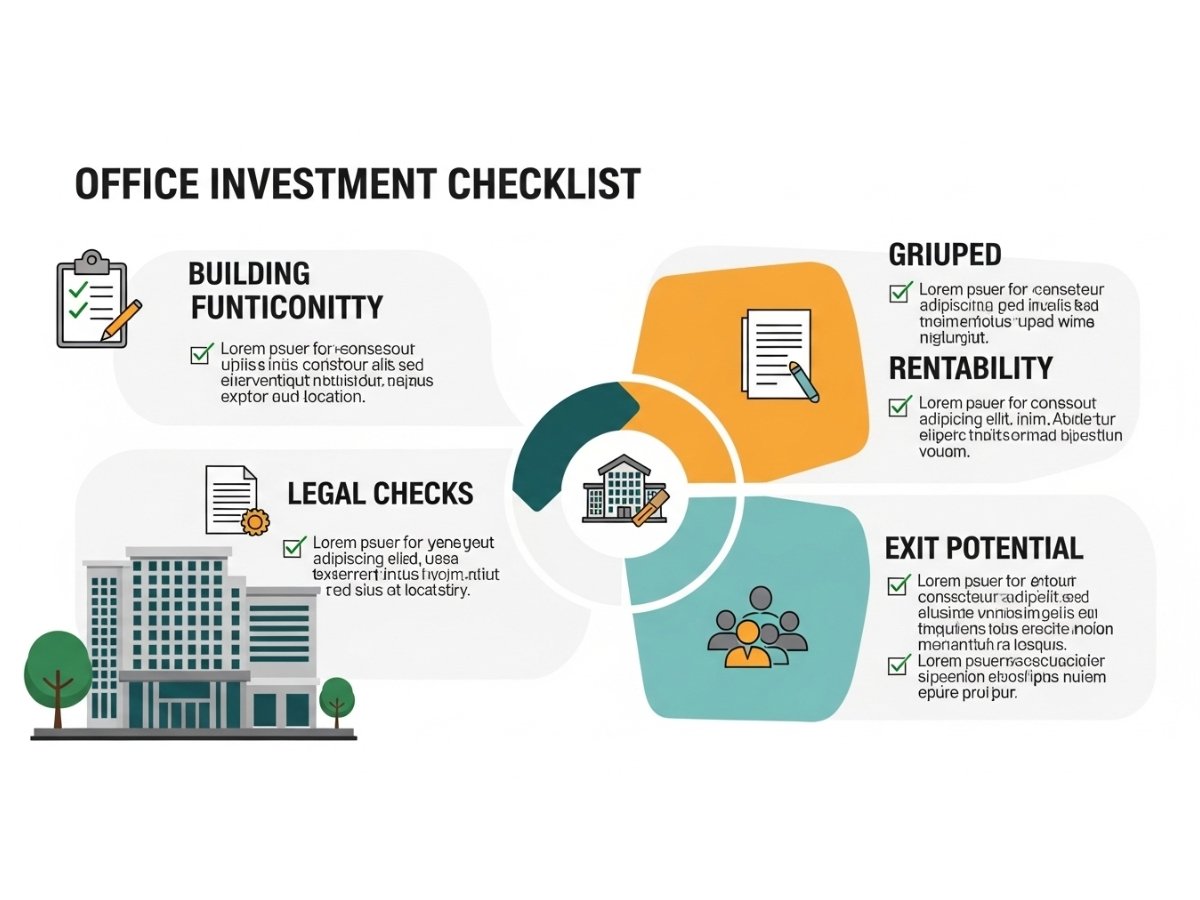
Building functionality checks
These checks directly affect tenant comfort and rentability:
- Is the floor plate efficient or too wasteful?
- Is the usable carpet area good enough for actual office layout?
- How many lifts are there, and do they work reliably?
- Is there enough parking for staff and clients?
- Is power backup adequate?
- Does the building feel like a place where a professional tenant would actually sit?
A 700 sq. ft. office in a respected node can still struggle if access is awkward, parking is poor, or the building feels tired.
Legal and authority-side checks
This part is non-negotiable in Navi Mumbai because authority-side realities matter more here than many first-time buyers expect.
You must check:
- Sanctioned office use
- Title and leasehold clarity
- MahaRERA registration and disclosures, if the project is under construction
- Whether the marketed layout matches uploaded plans
- Transfer premium implications, especially in CIDCO-linked areas
- Sub-lease or use restrictions, especially in MIDC-side environments
- NMMC dues and property tax status
Commercial property tax in Navi Mumbai is significantly harsher than residential. So a buyer taking a resale office without checking municipal dues can inherit a serious problem. This is not a theoretical risk. It is a practical one.
Imagine buying what looks like a discounted resale office in Belapur, only to later discover large unpaid NMMC dues attached to the property. Suddenly the “cheap deal” is not cheap at all.
Rentability and exit checks
Before buying, ask these questions:
- Who is the natural tenant for this exact office?
- Would that tenant accept this building, not just this area?
- Are CAM charges manageable during vacancy?
- Will resale buyers see this as a clean, usable asset?
- Is the building already occupied by the kind of businesses you want to attract?
If you cannot answer these clearly, you are not yet ready to buy.
Office Investment Checklist Before You Finalize Any Unit in Navi Mumbai
Use this checklist before paying token money or signing a deal.
| Checkpoint | Why It Matters |
|---|---|
| Confirm sanctioned office use | Prevents use mismatch and future enforcement problems |
| Verify title and leasehold conditions | Critical in CIDCO and MIDC-linked assets |
| Check MahaRERA details for under-construction projects | Helps identify delays, layout mismatch, and promoter-side risk |
| Review transfer premium or transfer fee impact | Can materially change acquisition cost |
| Ask for NMMC no-dues proof | Prevents inherited tax liabilities |
| Assess floor plate and carpet efficiency | Directly affects tenant usability |
| Review parking, lift, lobby, and power backup | Office tenants care about function, not just address |
| Check CAM and hidden recurring costs | Gross yield can look good while net yield gets squeezed |
| Study current occupancy in the building | Tells you whether real businesses are already choosing the asset |
| Match building to tenant type | Best area plus wrong building still gives weak results |
Final Verdict: Which Area Is Best for Your Budget, Tenant Type, and Risk Appetite?
If you want the final answer in plain language, here it is.
Choose Vashi or CBD Belapur if your goal is a safer, mature office market with stronger recognition, steadier demand, and lower vacancy fear. These are usually the better choices for conservative investors and professional self-use.
Choose Airoli or Mahape if your investment thesis is based on IT, BPO, GCC, or corporate-support occupancy. These areas work better when you understand tenant profile, building type, MIDC-side discipline, and the difference between gross yield and usable net return.
Choose Nerul or Seawoods if your target is a selective premium service-led office. These are not mass corporate belts, but they can work very well for the right tenant category.
Choose Kharghar only if you are consciously taking a longer-horizon bet and can handle present-day uncertainty in exchange for future potential. It is not the safest immediate office rental market, but it may suit investors who are patient and realistic.
If one line has to summarize the entire article, it is this:
The best office investment area in Navi Mumbai is the one where the tenant engine, building functionality, and legal structure all match each other.
Conclusion
Navi Mumbai has become one of the most serious office investment markets in the MMR, but it is not one uniform market. That is the main truth buyers must understand.
Vashi and Belapur offer maturity. Airoli and Mahape offer scale and tech-corridor logic. Nerul and Seawoods offer selective premium service demand. Kharghar offers future upside, but only for buyers who understand the wait and the risk.
So do not ask only, “Which area is best?” Ask the better question: Best for which tenant, which budget, which building, and which holding strategy?
That is how office investment in Navi Mumbai should be evaluated. And that is how costly mistakes are avoided.
FAQs
Frequently Asked Questions