
Best Warehousing Clusters in Kalamboli: Steel Market and Sector 1E
Kalamboli is not one single warehousing market, and that is the first thing most pages miss. If your work depends on fast truck movement, the Truck Terminal belt usually comes first. If you deal in steel, hardware, bulk material, or heavy stock, the Steel Market, KWC, and Disma side usually fit better you can find more Best Warehousing Clusters in Kalamboli. If you need cleaner, smaller, more hybrid storage, Sector 1E and the Roadpali-side edge can make more sense. Cheap outer pockets can work too, but only for the right kind of storage.
That is the real answer.
A lot of people search for a warehouse in Kalamboli as if the whole area behaves the same. It does not. One belt is built around transport rhythm, another around heavy trade, another around smaller cleaner storage, and another mostly around price. If you choose the wrong pocket, the problem usually does not show up on the rent sheet. It shows up when a 40-foot trailer cannot turn, when loading becomes slow, when parked trucks choke the lane, or when a “highway-touch” warehouse still takes 25 extra minutes to reach properly.
Kalamboli also matters for a reason beyond local hype. Panvel Municipal Corporation’s own planning material treats Kalamboli as an iron and steel market and warehousing complex, and the same planning record notes that the PMC area has only one truck terminal, at Kalamboli. That is why this is not just another node. It is one of the most logistics-sensitive belts on the Panvel side.
Kalamboli has a few real warehousing belts, not one single market
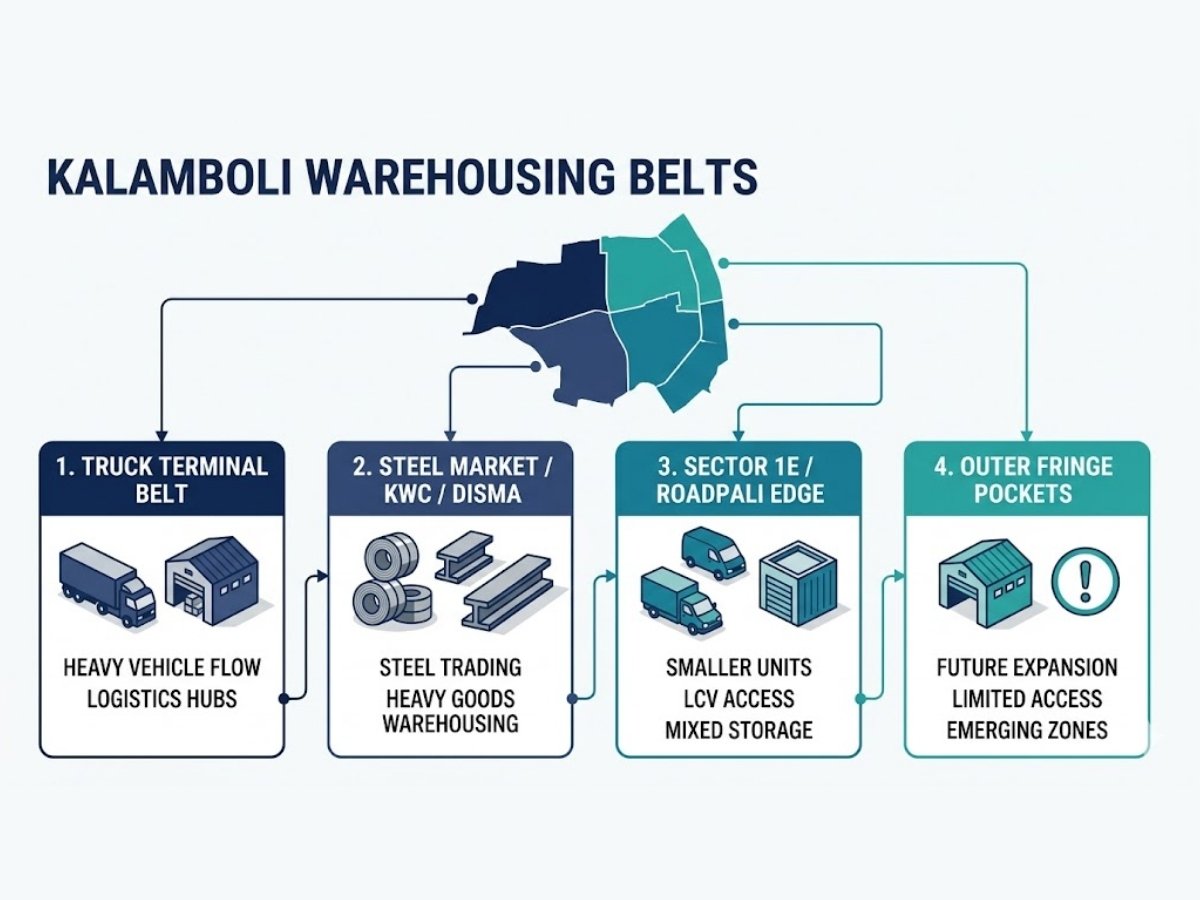
The easiest way to understand Kalamboli is to stop thinking in pin code terms and start thinking in belts.
| Kalamboli belt | Usually best for | What makes it work | Main caution |
|---|---|---|---|
| Truck Terminal and rail-yard belt | Transport-led warehousing, cross-docking, fast dispatch, multimodal movement | Truck ecosystem, staging logic, institutional logistics presence | Congestion, queueing pressure, off-street waiting space becomes critical |
| Steel Market / KWC / Disma side | Steel, hardware, building material, heavier stock, trade-led storage | Old trade ecosystem, floor-load practicality, heavy-goods familiarity | Internal road condition, monsoon movement friction, older stock quality varies |
| Sector 1E / Roadpali-side edge | Smaller warehouses, cleaner storage, hybrid office-plus-warehouse use, LCV-led distribution | Better frontage, cleaner environment, easier for staff and smaller vehicles | Not ideal for unrestricted heavy trailer operations in many stretches |
| Outer fringe pockets such as Jadhav Wadi side | Budget storage, dead stock, low-frequency movement | Lower entry price or rent | False economy if truck access, lighting, drainage, or road width is weak |
This four-belt view is far more useful than simply saying “warehouse in Kalamboli.” It gives you a shortlist before you waste time on site visits.
Which Kalamboli warehousing cluster fits your business type best?
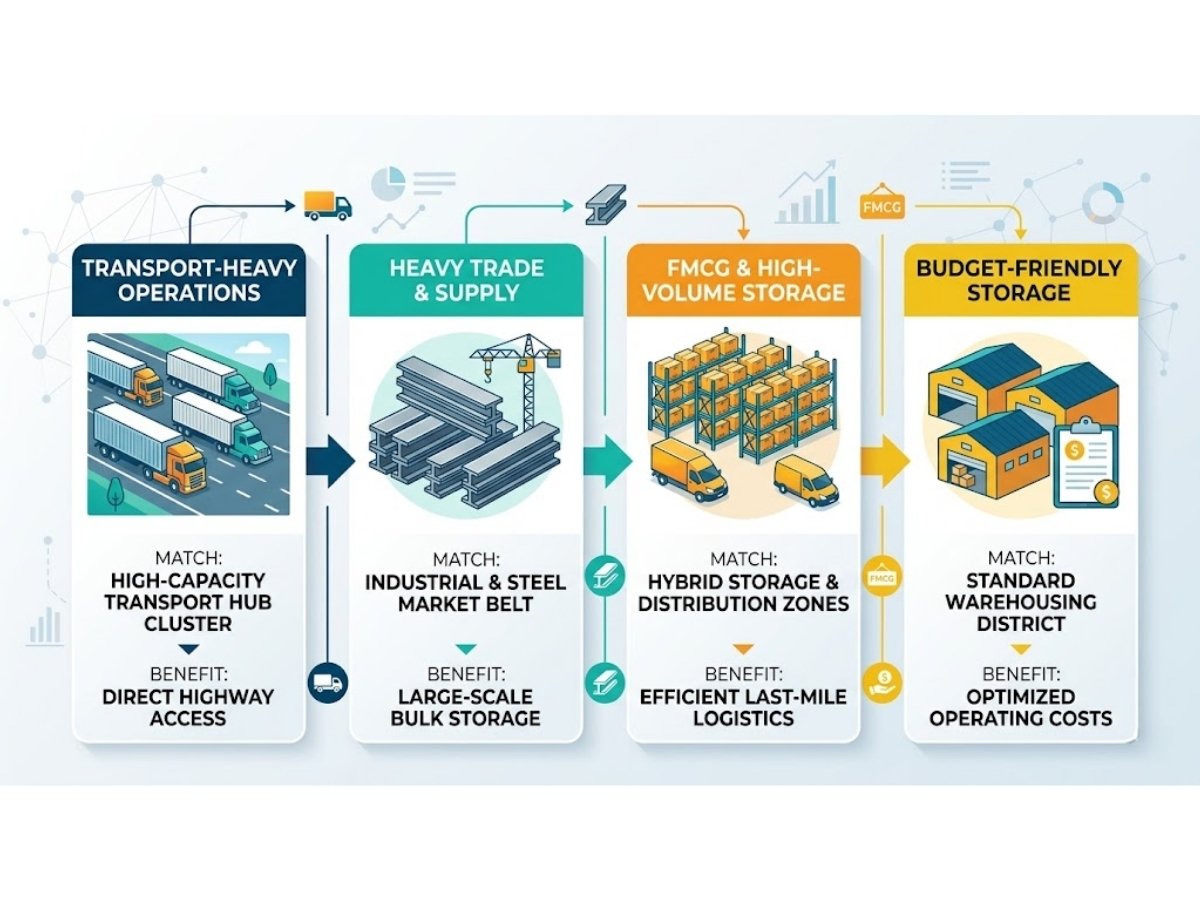
The right answer depends less on square footage and more on what actually moves in and out of your premises.
Best for transport-heavy operators
If your business is dispatch-heavy, trailer-heavy, or depends on constant in-out movement, the Truck Terminal belt usually wins. This is where transport logic matters more than appearance. You need access, waiting space, loading rhythm, and quick exit toward the wider highway network.
Best for steel, hardware, and bulk-trade stockists
If you store coils, pipes, metal sections, machinery, tiles, construction inventory, or heavy hardware, the Steel Market, KWC, and Disma-side belts usually make more sense. These belts are not glamorous, but they are closer to the operating culture of bulk goods.
Best for smaller urban-distribution and hybrid storage users
If your work is less about full-size trailers and more about LCVs, smaller commercial vehicles, local deliveries, cleaner storage, or a mix of warehouse and office activity, Sector 1E and the Roadpali-side edge often fit better. These areas tend to suit businesses that want a Kalamboli base without fully stepping into deep heavy-trade conditions.
Best for budget-first occupiers
If your only priority is headline rent, outer pockets may tempt you. But this is where the biggest mistakes happen. Low rent works only when cargo is slow-moving, access demands are light, and your vehicles do not need heavy maneuverability every day.
Is the Truck Terminal belt the strongest choice for transport-led warehousing?
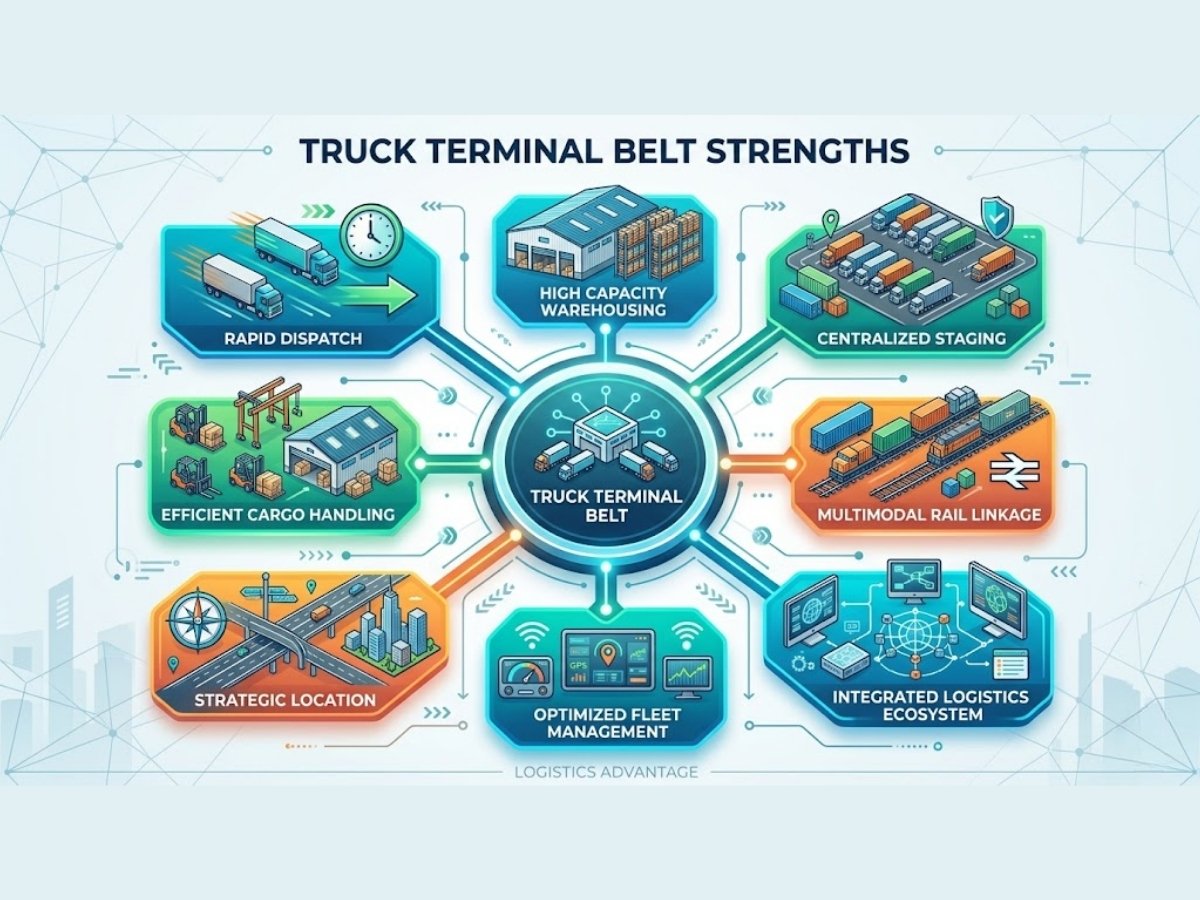
For pure transport logic, yes, it is often the strongest belt in Kalamboli.
The reason is simple. This side is built around movement, not just storage. The wider Kalamboli logistics ecosystem includes rail-linked freight handling through the Kalamboli goods shed side and institutional warehousing presence. That makes this belt especially relevant for cross-docking, route-based consolidation, and fast dispatch setups. :contentReference[oaicite:1]{index=1}
Why this belt works
It works because transport businesses need more than a shed. They need rhythm. They need a belt where truck entry, truck waiting, loading, and onward movement are normal operational events, not daily conflict points.
This is also where the new heavy-vehicle timing rules matter. Since February 1, 2026, Mumbai has been enforcing peak-hour restrictions on heavy vehicles entering the city, broadly from 8 am to 11 am and 5 pm to 9 pm. That makes staging capacity more important than before. A warehouse that has no room for trucks to wait can become painful even if the rent looks reasonable. :contentReference[oaicite:2]{index=2}
Where it becomes messy
The same concentration that makes this belt powerful can also make it messy. If your chosen property has weak off-street queueing space, poor apron depth, or a narrow approach despite being in the “right” belt, then trucks spill outward, delays build up, and operations become stressful.
So the Truck Terminal side is not automatically good. It is good when the individual warehouse also has geometry that supports movement.
> Caution: In Kalamboli, the right belt can still hold the wrong warehouse.
Why do the Steel Market, KWC and Disma-side belts matter so much in Kalamboli?
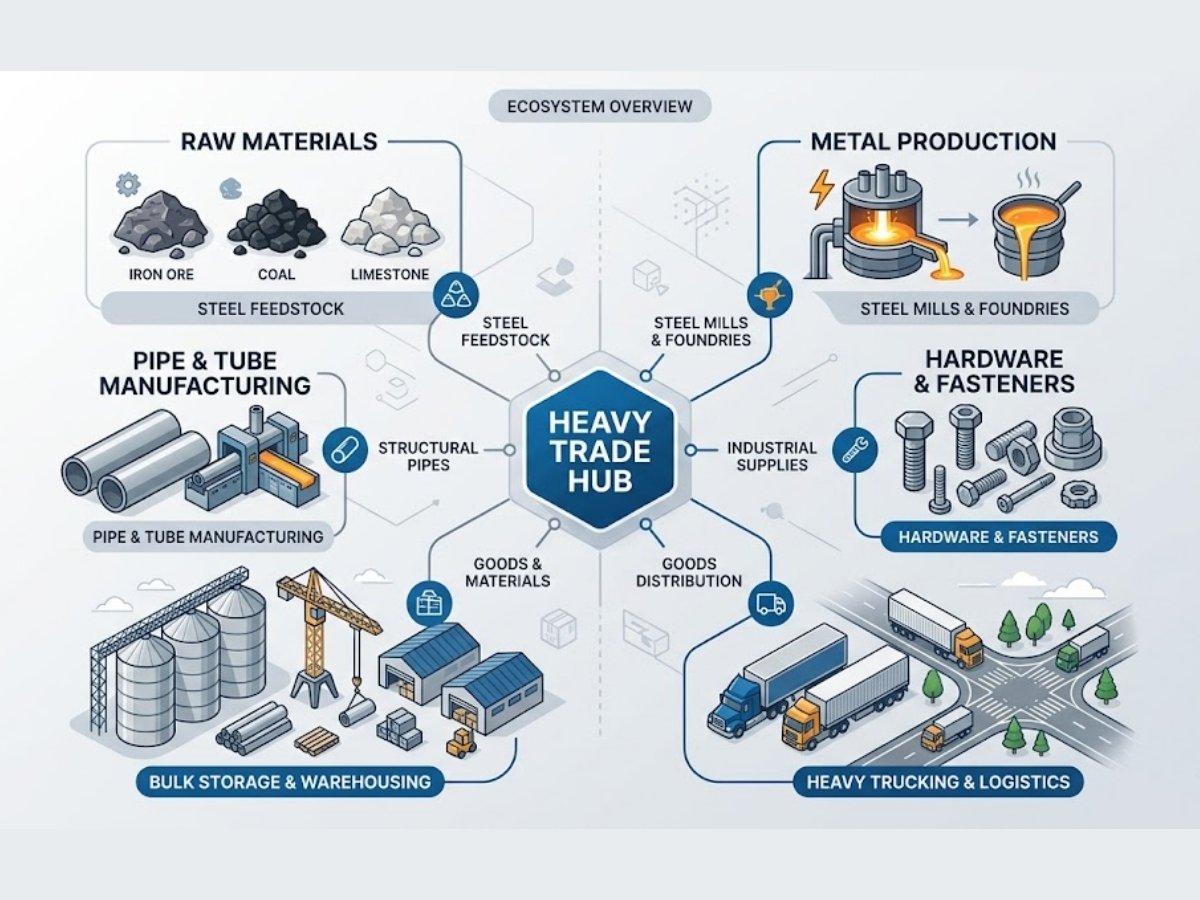
Because this is the belt that gave Kalamboli its warehousing identity in the first place.
PMC planning records continue to treat Kalamboli as an iron and steel market and warehousing complex, which is why this side still matters so much for heavy trade users. This is not just a random cluster of old warehouses. It is part of a long-established heavy-commerce ecosystem. :contentReference[oaicite:3]{index=3}
Best-fit cargo and user profile
This side usually works best for:
- steel stockists
- hardware traders
- pipe and section dealers
- building-material businesses
- heavier trading inventory
- users who need tougher operating culture more than polished frontage
If your work depends on heavy floor loads, rugged handling, and surrounding trade relevance, KWC-side stock often makes more practical sense than prettier but lighter-use stock elsewhere.
What kind of warehouse stock you actually find here
You often find older RCC sheds, trade-linked warehouse structures, office-plus-storage formats around complexes, and properties that make sense because of ecosystem support rather than presentation. Some occupiers actually prefer that. They do not care about a premium entrance. They care whether unloading is practical, whether neighboring activity matches theirs, and whether the area understands heavy goods.
But this belt has a known trade-off. Internal roads and monsoon-time movement can become the real story. A warehouse may look attractively placed on paper, but if the last stretch is rough, potholed, or crowded with parked vehicles, daily operational efficiency falls.
A cleaner warehouse in the wrong belt may still perform worse than an older warehouse in the right belt. That is why KWC and Disma should not be judged like office-space markets.
Does Sector 1E or the Roadpali-side edge work for smaller or hybrid warehousing?
Yes, but only for the right kind of user.
This side of Kalamboli usually makes sense when you want a cleaner environment, smaller format, easier staff access, better frontage, or some mix of warehouse and office activity. It is usually better for LCV-led distribution, city dispatch, smaller godowns, packaging, or cleaner storage use than for heavy all-day trailer operations.
When this side makes sense
This belt usually suits:
- FMCG redistribution
- pharma or cleaner stock storage
- urban last-mile support
- smaller warehouse plus office combinations
- businesses that want Kalamboli access without deep industrial roughness
In market asking terms, this is also where you may see the sharpest premium for modern stock. As a rough 2025-26 market pattern, older peripheral sheds may quote around ₹24 to ₹25 per sq. ft., more standard KWC-type stock may hover around ₹30 to ₹35 per sq. ft., while cleaner high-spec PEB stock can quote much higher, even stretching toward the ₹70-plus level in select cases. These are asking bands, not achieved rents, and actual deals vary by road access, clear height, loading quality, utility setup, and title comfort.
When it becomes the wrong fit
The problem starts when occupiers assume “cleaner” automatically means “better.” It does not.
Roadpali-side and Sector 1E edge locations can become the wrong fit when your business needs unrestricted multi-axle trailer movement, constant large-truck reversals, or heavy loading through roads that also feel the pressure of nearby residential growth. In those cases, a more premium-looking warehouse may actually be the weaker logistics decision.
Are outer-fringe pockets like Jadhav Wadi worth considering, or are they a false economy?
Most of the time, they are a false economy unless your use case is very specific.
These pockets attract attention because the headline number looks better. But warehousing decisions are rarely won on headline rent alone. If the approach road is weak, lighting is poor, drainage is unreliable, or a container truck cannot comfortably turn, the “cheap” warehouse starts becoming expensive through delay, damage, fuel waste, driver time, and operational unpredictability.
That does not mean fringe pockets are useless. They can work for dead storage, low-frequency stock movement, small-vehicle access, or businesses that do not depend on daily heavy-truck efficiency. But for active transport-led warehousing, many outer pockets create avoidable friction.
> Caution: If a warehouse is cheap because the last 500 metres are bad, then that cheapness is not a bargain. It is the risk premium.
What matters more in Kalamboli: highway access, port linkage, or inside-road practicality?
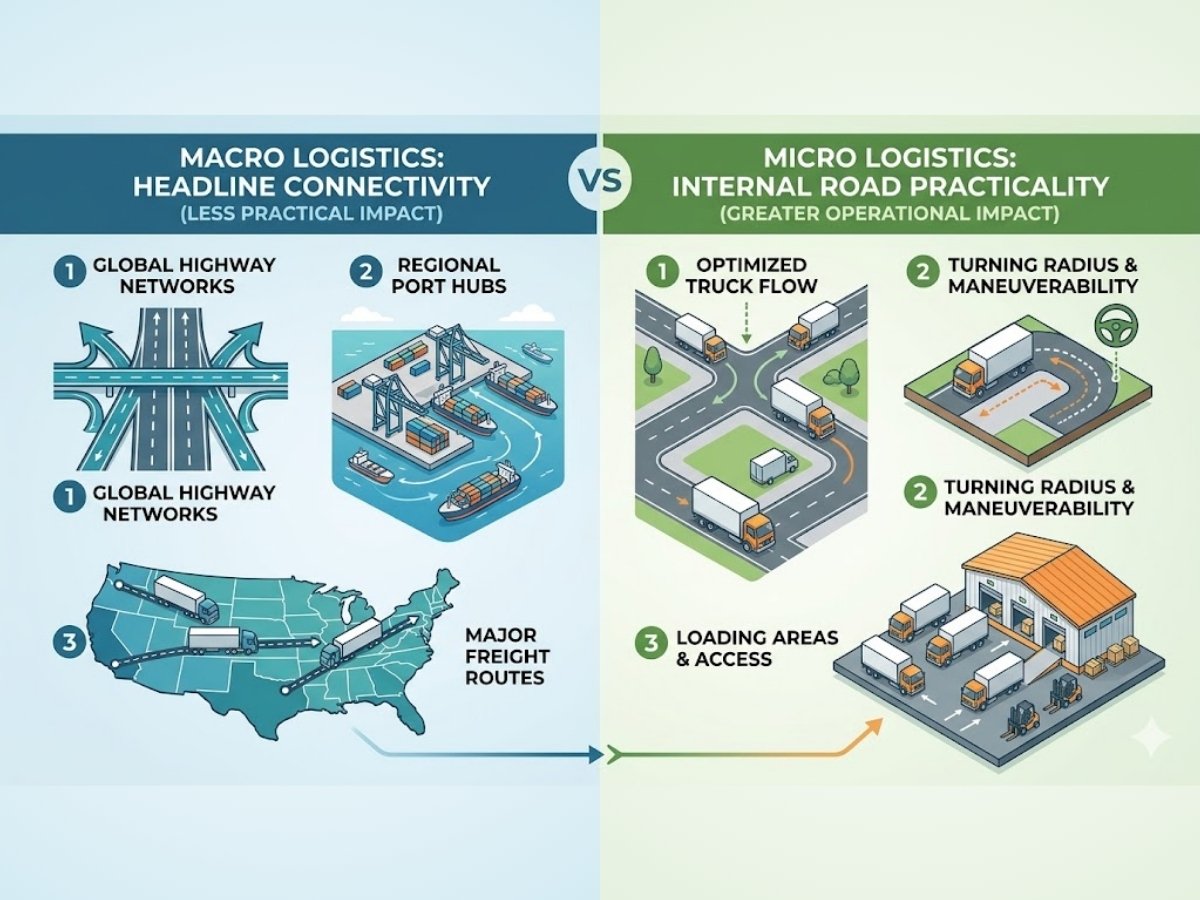
Inside-road practicality matters more in day-to-day life.
Regional connectivity is the reason Kalamboli matters at all. The wider JNPA-side network, NH connectivity, Mumbai–Pune Expressway access, Atal Setu influence, and airport-region growth all strengthen the location story. JNPA’s own material highlights the broader road network around the port-side ecosystem, including NH-4, NH-48, the Mumbai–Pune Expressway, MTHL, and NMIA proximity in the wider corridor. :contentReference[oaicite:4]{index=4}
But once you decide on Kalamboli, macro connectivity stops being the main differentiator. Micro access takes over.
A warehouse that is five minutes farther from the main road but has better turning radius, a deeper loading apron, cleaner truck entry, and less choke-point friction can perform better than a warehouse marketed as “highway-touch.”
The same applies to future infrastructure. The Kalamboli Junction redevelopment is a real positive, but it should be understood carefully. MSIDC describes it as an 18-month project with a tender cost of ₹482.07 crore and administrative cost of ₹770.49 crore, while reported timelines had pointed to mid-2026 if progress stayed on track. Useful, yes. But do not lease a warehouse on the assumption that future infrastructure will solve a current internal-road problem. :contentReference[oaicite:5]{index=5}
How should you shortlist a warehouse cluster in Kalamboli before you inspect any property?
Start with operations, not with listings.
Use this field checklist before you even schedule a visit:
Kalamboli warehouse shortlist checklist
1. Define your largest regular vehicle
- 32-foot truck, 40-foot trailer, or only LCV?
- This one answer can eliminate entire pockets.
2. Match cargo type to belt
- heavy stock and rugged handling: KWC / Steel Market side
- fast transport and staging logic: Truck Terminal belt
- smaller cleaner hybrid use: Sector 1E / Roadpali edge
3. Ask about actual waiting space
- not just loading space
- where do trucks stand if they arrive early or get delayed?
4. Check final-lane geometry
- can your largest vehicle turn, reverse, and align without drama?
5. Ask about monsoon movement
- not just whether the building is dry
- ask whether the road to the building stays workable
6. Verify utilities
- power reliability matters more for some users than rent difference
7. Check use fit, not just area
- a 20,000 sq. ft. warehouse in the wrong cluster is still the wrong warehouse
8. Separate headline rent from full operating cost
- staff time, truck time, road friction, and loading delay all cost money
Which cluster usually works best by warehouse format and size?
Format matters a lot in Kalamboli because different belts support different styles of stock movement.
Small godowns below around 5,000 sq. ft. often work better on the Sector 1E side, Roadpali-edge belts, or fragmented stock in the older market-linked pockets, especially when movement is lighter and operations are cleaner.
Mid-size operational warehouses in the 10,000 to 30,000 sq. ft. band usually need a more careful balance. This is where Truck Terminal-side peripheries and better-access KWC stock can make sense, depending on whether your business is movement-led or trade-led.
For heavy storage, open yards, big stock handling, or heavier trailer dependence, the deeper trade-and-transport belts usually work better than smaller cleaner edge locations. This is one reason many occupiers make a mistake when they shortlist purely by modern appearance.
Should you buy or lease in Kalamboli’s warehousing clusters?
For most users, leasing makes more sense first.
The reason is not just flexibility. It is also capital logic. Maharashtra’s eASR for 2025-26 shows a government benchmark valuation for industrial land in Kalamboli at ₹71,400 per sq. m. That is a tax and registration benchmark, not the live market rate, but it still tells you this is not a casual-buy market. :contentReference[oaicite:6]{index=6}
If you are a 3PL operator, distributor, e-commerce support business, or a company still optimizing route design, leasing usually preserves cash and reduces wrong-bet risk. It also lets you test whether your chosen belt actually matches your movement pattern.
Buying usually starts making more sense for long-horizon users who want a permanent base, customized setup, heavy trade presence, or strategic control over a specific operating location. That is more common for legacy stockists, larger industrial traders, or businesses that know exactly why a given belt matters to them.
What should you verify before calling any Kalamboli warehouse “well located”?
In Kalamboli, “well located” is one of the most overused phrases in listings.
A warehouse is not well located because the broker says “near highway.” It is well located when it passes practical checks:
- the title and transfer chain are clean enough for the transaction structure
- the approach road matches your actual vehicle size
- the loading apron works in real conditions
- the belt suits your cargo type
- the site does not become unusable in rain
- the surrounding activity supports, not fights, your operation
- the building’s structure suits your load and storage pattern
- fire and utility comfort are not weak points
This is also where local authority decoding matters. Kalamboli is under Panvel Municipal Corporation, not NMMC, and that matters when occupiers start checking permissions, taxes, civic reality, and planning context. :contentReference[oaicite:7]{index=7}
Conclusion
The best warehousing cluster in Kalamboli depends on cargo, truck logic, and stock format, not on one-line marketing claims.
Choose the Truck Terminal belt if speed, dispatch, and transport rhythm are central to your business. Choose the Steel Market, KWC, and Disma side if you handle heavy goods and want a trade-ready ecosystem. Choose Sector 1E or the Roadpali-side edge if your operation is smaller, cleaner, more hybrid, or more LCV-led. Choose outer pockets only when your storage style genuinely allows weaker access conditions.
In Kalamboli, the winning warehouse is usually not the cheapest one and not always the newest one. It is the one whose belt, road geometry, and operating environment match how your goods actually move.
FAQs
Frequently Asked Questions