
How Thane-Belapur Road and Airoli Connectivity Affect TTC Demand
Thane-Belapur Road and Airoli connectivity do affect TTC demand, but not evenly. They usually lift demand more for staff-heavy offices, IT parks, data-center-led assets, and hybrid business spaces than for every industrial plot inside TTC. Airoli, Rabale, and Mahape do not behave the same. In practice, frontage, station access, bridge access, internal road quality, turning ease, and last-mile movement matter much more than simply having a TTC MIDC address.
Two units inside the same broader TTC belt can attract completely different demand even when the built-up area looks similar on paper. One can suit an IT back office or a data infrastructure operator. The other may only work for fabrication, storage, or truck-led use. The difference often comes from the connectivity matrix around the plot, not just the building itself.
That is why this topic matters. In TTC, “well connected” is not a generic compliment. It is a filter. It decides which tenant profile comes, which occupier stays, and whether a premium actually makes sense.
The short answer: where connectivity genuinely lifts TTC demand and where it does not
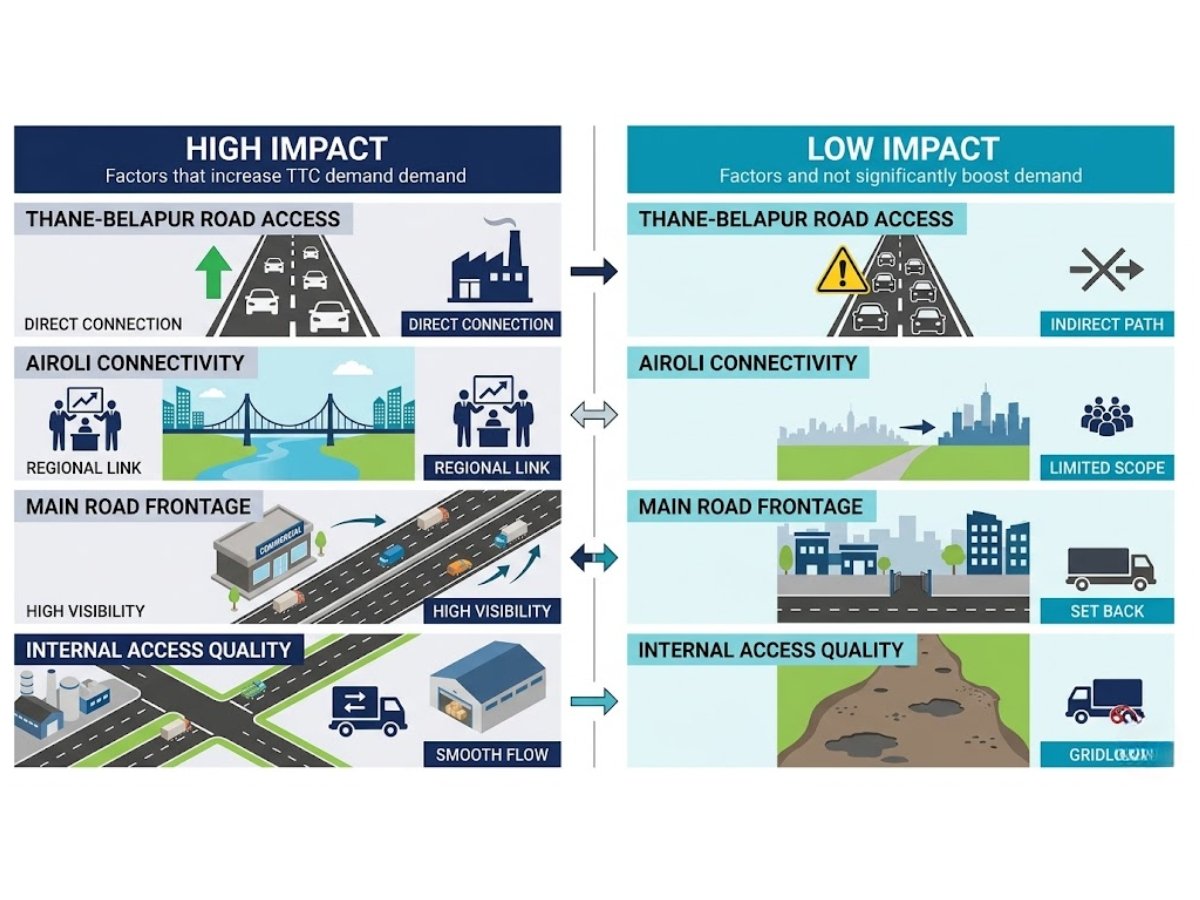
The clean answer is simple. Thane-Belapur Road and Airoli-side access create real demand when the user depends on employee movement, regional access, bridge connectivity, or utility-heavy but road-access-sensitive operations. The same connectivity matters less when the business depends more on wide internal roads, truck holding space, and easy maneuvering than on staff convenience or corporate visibility.
| Factor | Helps demand most for | Helps less for | What to watch |
|---|---|---|---|
| Thane-Belapur Road access | Office-linked, hybrid, service, data-center, and client-facing users | Purely internal or layout-constrained stock | Congestion, turning ease, parking, service-lane quality |
| Airoli-side connectivity | Staff-heavy occupiers, Thane-side commuters, office campuses | Users driven mainly by truck movement rather than employee access | Last-mile quality, station access, bridge-side practicality |
| Main-road frontage | Visibility, faster approach, executive movement, some hybrid uses | Internal operational users who need maneuverability more than visibility | Entry-exit pain, traffic control, loading restrictions |
| Internal access quality | Industrial, warehouse, fabrication, and dispatch-heavy usability | Almost nobody can ignore this for long | Narrow lanes, bottlenecks, damaged stretches, truck handling |
This is where many buyers and even some brokers oversimplify TTC demand. They talk as if one road upgrades the whole belt equally. It does not. Macro connectivity may improve the corridor, but actual demand still gets decided plot by plot, pocket by pocket.
Why Thane-Belapur Road matters more in TTC than in many other Navi Mumbai belts
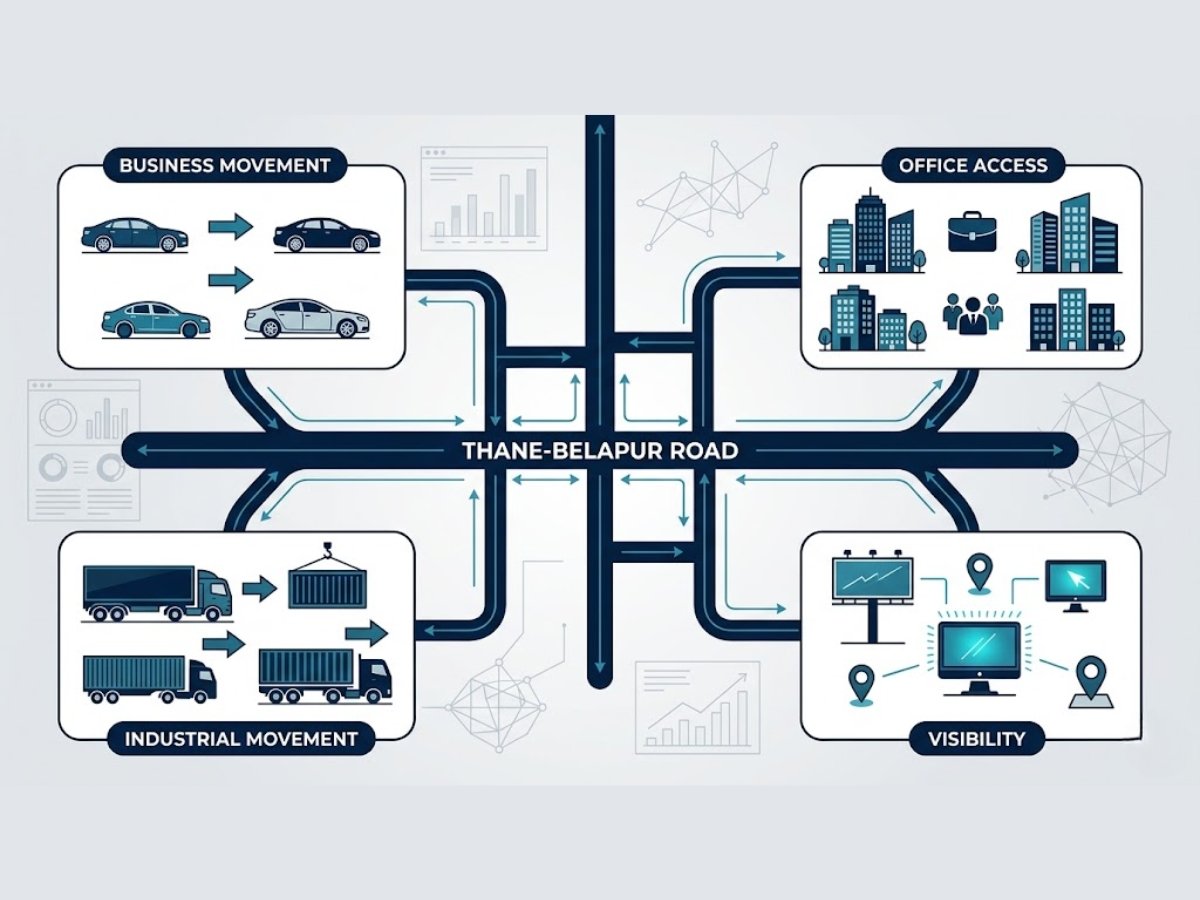
Thane-Belapur Road matters here because TTC is not a compact office district with many parallel access choices. It is a long industrial and commercial corridor that depends heavily on one arterial spine. If that spine moves well, business movement improves. If that spine slows down, the pain spreads across multiple pockets.
It is not just a through-road; it decides reach, visibility, and daily usability
For office and institutional users, Thane-Belapur Road improves reach, brand visibility, and client access. A location that sits well on this corridor often feels easier to explain, easier to visit, and easier to staff. That matters for IT parks, back offices, showrooms, and hybrid business campuses.
For industrial users, the same road works differently. It is the evacuation route for goods, equipment, and supplier movement. So the question is not just, “Is the road near the plot?” The better question is, “Can the business use it efficiently every day?”
That is why connectivity-led TTC demand is real, but selective. A corporate office may benefit from fast regional access and better recall value. A dispatch-heavy occupier may care far more about whether a 40-foot trailer can enter and exit without a daily fight.
The same road can improve access and create friction at the same time
This is the part weak articles usually miss. A main-road address can improve approach and still create operational trouble.
A front-facing building on Thane-Belapur Road may look premium on a listing. But if trucks have to turn directly from a fast-moving lane into a tight gate, or if the entry is too sharp, the location starts working against the occupier. This is where geometry matters. In practical terms, long vehicles need space to swing and align. Without that, a premium frontage becomes a restriction.
A simple local example explains it better. A hybrid office-industrial user may happily pay more for direct road access because the staff, clients, and service movement all benefit. But a warehouse or fabrication user may find the same plot frustrating if heavy vehicle timing becomes difficult, daytime movement gets restricted, or internal truck queuing is impossible. So the value of Thane-Belapur Road is not universal. It depends on what the occupier does between 9 am and 7 pm, not on how nice the address sounds.
Why Airoli changes the TTC demand equation
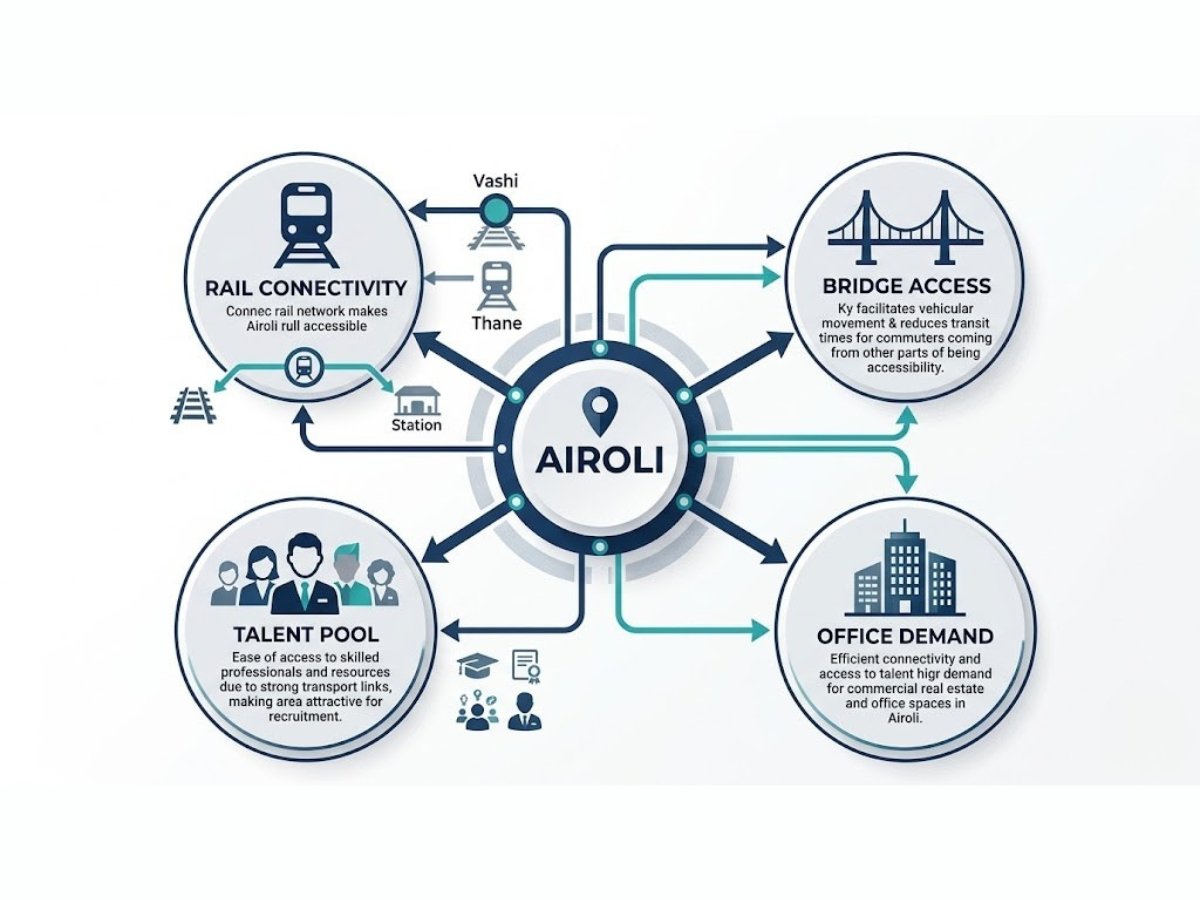
Airoli changes the conversation because it is not just another point inside TTC. It is a gateway. It connects the belt to a much larger commuter and business catchment, especially toward Thane and the eastern side of Mumbai.
Airoli is not just another TTC pocket; it is a commuter and office-access hinge
Airoli has always had a different advantage inside the TTC belt. It combines rail access with bridge-led movement and a better office-user perception than many traditional industrial pockets. That is why Airoli-side logic supports staff-heavy and corporate-facing demand better than heavy manufacturing-led demand.
For an IT company, BPO, back office, digital operations team, or institutional office, Airoli is not just “connected.” It is recruitable. That is a more useful word here. Businesses can hire from Mumbai’s eastern suburbs, Thane-side catchments, and increasingly wider suburbs without pushing the office too deep into a hard industrial belt.
Station-side movement, bridge-side movement, and Thane catchment matter here
Airoli’s strength is not only about one access point. It is about a stack of advantages working together. Rail access helps daily commuters. Bridge access improves cross-city movement. The broader Thane-side catchment widens the labour pool. And because many office occupiers care more about staff convenience than about trailer movement, that demand becomes sticky.
This is why Airoli-side connectivity lifts TTC office demand more strongly than many internal sectors further south. Employee-heavy businesses rarely judge a location only by rent. They judge it by attrition, punctuality, supervisor commute, and how easy it is to explain the office location to clients and candidates.
Why Airoli logic spills into nearby TTC demand but not equally everywhere
Airoli’s pull does spill into Rabale and, to a more selective extent, toward Mahape. But it weakens as you move into pockets where internal movement, last-mile friction, and industrial mechanics begin to dominate.
That distinction matters. Airoli logic is strong for corporate-style or high-tech demand. It is not automatically transferable to every older industrial stretch. A company may like being near the Airoli side of the corridor, but if the last-mile from the station is unreliable, if the approach road is too narrow, or if the building sits too deep in an awkward internal grid, the premium starts leaking away.
So yes, Airoli connectivity affects TTC demand. But the effect is strongest where human movement is the main driver, not where freight maneuverability is the real bottleneck.
Which kind of demand gets the biggest boost from this connectivity?
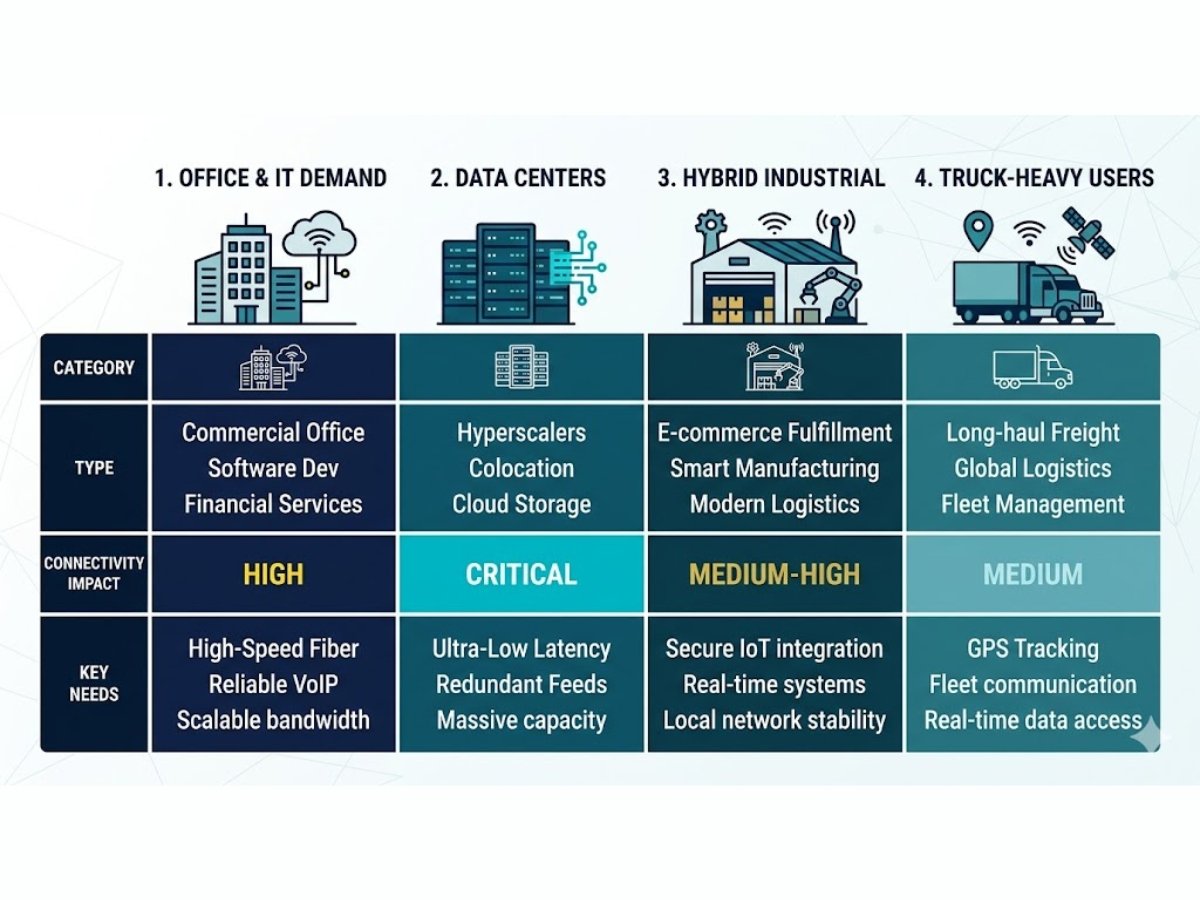
The biggest mistake in TTC analysis is treating all users as one category. They are not. Office, data infrastructure, hybrid industrial, and truck-led occupiers use the same corridor in very different ways.
Office, IT, back-office, and campus-style demand
This is the clearest winner. Office and IT demand benefit heavily from Airoli-side access, rail movement, and the broader reputation of the northern TTC belt as a more viable staff-centric zone. When rents are still competitive compared to larger Tier-1 office markets, connectivity becomes a major deal closer. It helps companies balance cost with commute practicality.
That is why Airoli, parts of Rabale, and the Airoli-Ghansoli-Mahape stretch often appeal to back-office, IT, BPM, and managed office users more than deeper operations-heavy pockets.
Data center and digital infrastructure demand
This is where TTC has changed sharply. Rabale and nearby northern pockets are no longer just industrial in the old sense. They are increasingly tied to digital infrastructure demand.
For data centers, connectivity does not mean footfall. It means fiber route logic, equipment movement, grid access, and corridor-level infrastructure confidence. Rabale and nearby areas benefit because the larger corridor can support power-heavy, infra-heavy assets while still offering strong regional road access. That is very different from office demand, but it is still connectivity-led demand.
Hybrid industrial users who need both staff access and operational practicality
This category often fits Mahape and parts of Rabale best. Think engineering firms with offices plus testing areas, pharma-support operations, light-tech assembly, or industrial users who still need client visits and white-collar staffing.
These users want a middle ground. They do not need pure office polish, but they also do not want deep operational friction. For them, Thane-Belapur Road access matters, but so do internal usability, parking, and employee movement. They are often the reason some TTC locations hold demand better than pure industrial logic would suggest.
Traditional truck-heavy and process-heavy users
This is where connectivity becomes more selective. Yes, highway access matters. But not in the same way.
For warehousing, fabrication, 3PL, cold chain, and process-heavy operations, the real demand driver is often internal usability. Wide turning radius, road condition, queueing space, drainage, and low conflict with traffic controls matter more than visibility. A frontage premium is often wasted here. In some cases, it is worse than wasted. It creates operating pain.
So when people ask whether Thane-Belapur Road and Airoli connectivity affect TTC industrial demand, the honest answer is this: yes, but industrial demand responds far more to usable access than to prestige access.
Which TTC pockets gain the most from Thane-Belapur Road and Airoli connectivity?
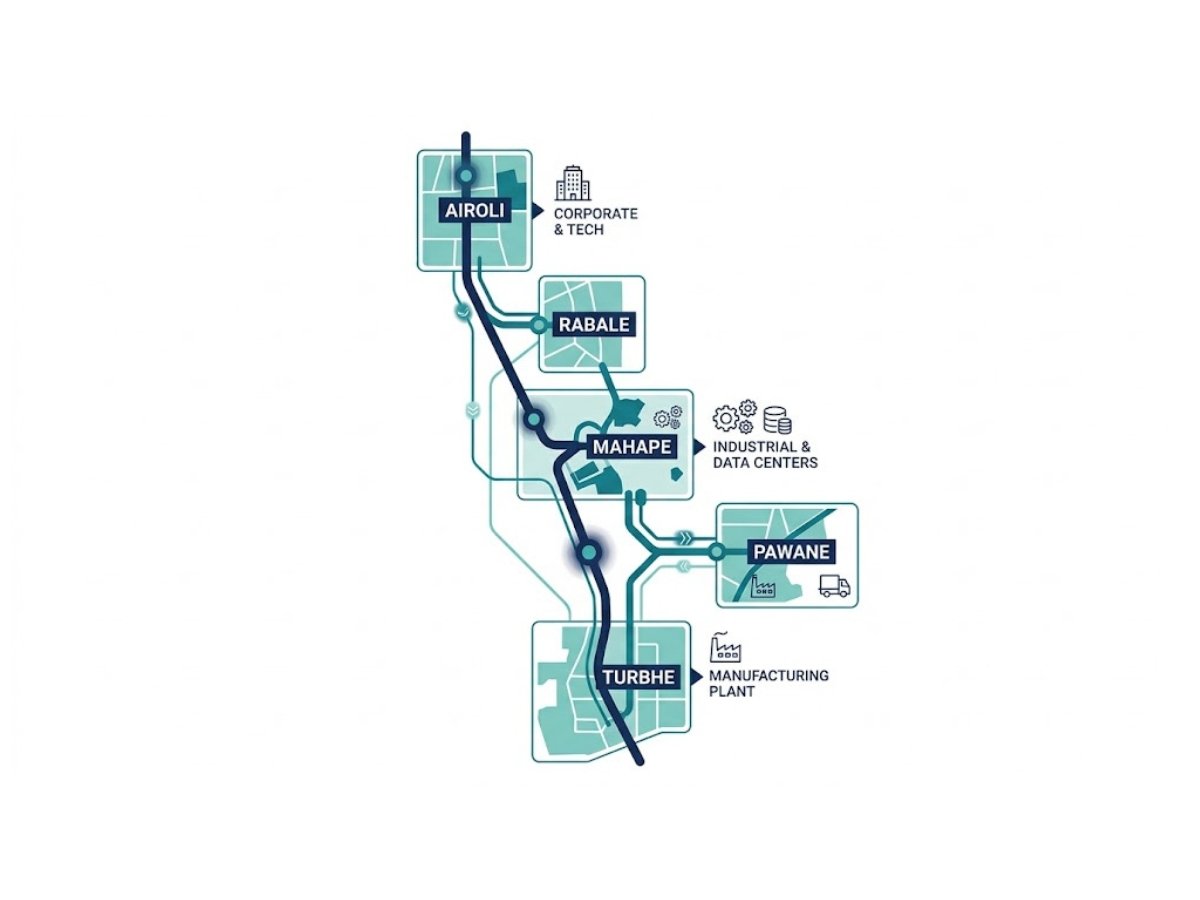
This is where the topic becomes practical. The belt behaves differently from north to south. Even inside the same TTC narrative, the pockets are not interchangeable.
| Connectivity strength | Best-fit demand type | What connectivity really improves | What still limits demand | |
|---|---|---|---|---|
| Airoli | Strongest for bridge-led and commuter-led access | IT, corporate, commercial, office-led users | Talent access, executive commute, city-to-office convenience | Higher entry pricing, limited fit for heavy industrial use |
| Rabale | Strong mix of northern access and utility-heavy viability | Data centers, high-tech engineering, hybrid users | Infra deployment, regional access, selective staff comfort | Not every plot offers the same ease; transition-zone logic varies |
| Mahape | Good central corridor relevance | Hybrid industrial, MSME offices, back-office demand | Client access, regional positioning, mixed-use practicality | Last-mile friction deep inside sectors, employee commute pain in weaker internal stretches |
| Pawane | Useful for operations, less powerful for prestige-led demand | Fabrication, manufacturing, industrial users | Freight movement and industrial relevance | Narrow internal roads, drainage issues, weaker office appeal |
| Turbhe | Strong logistics gateway logic | 3PL, warehousing, heavy dispatch, transport-led users | Supply chain speed, expressway-led movement | Very high traffic pressure, weaker corporate-office attractiveness |
Airoli
Airoli is the strongest human-capital funnel in this story. It benefits the most from bridge-side logic, station-side access, and the broader office-grade image of the northern TTC edge. If the use case is staff-heavy, Airoli deserves genuine premium treatment.
Rabale
Rabale is more interesting than many readers assume. It is not just spillover from Airoli. It increasingly stands on its own because it combines northern TTC access with infra-heavy business logic. That is why data-center-led demand and advanced industrial demand can both make sense here.
Mahape
Mahape is often the middle-ground answer. It is central, commercially relevant, and useful for mixed business formats. But it is also where buyers sometimes overestimate map-based convenience. A plot that looks centrally located can still feel tiring in daily use if the last-mile is messy or the building sits too deep inside an inconsistent internal road grid.
Pawane and nearby operational pockets
Pawane works better when the business is operational first and image second. It can make real sense for manufacturing and fabrication-led occupiers. But it usually does not extract the same value from Airoli-side connectivity that northern office-linked pockets do.
Turbhe-side relevance
Turbhe has its own logic. It is not the cleanest example of Airoli-driven demand, but it is highly relevant to TTC demand because it behaves as a logistics gateway. If the business depends on dispatch rhythm and highway corridor movement, Turbhe’s value can be stronger than a more polished northern location.
When a Thane-Belapur Road address is a real premium and when it is just marketing
A Thane-Belapur Road address is a real premium when the occupier uses it. That sounds obvious, but this is where many deals go wrong.
If the business depends on visibility, client movement, managed office perception, or better staff access, the premium can be justified. If the business depends on trucks, queueing, loading depth, and free movement without conflict, then the same premium can become fake.
A useful way to think about this is simple:
- Real premium: when road access improves business function
- Fake premium: when road visibility looks good but daily operations become harder
Main-road frontage versus deep internal access
Frontage helps some users a lot. Showrooms, hybrid campuses, branded offices, and executive-facing setups can benefit from being easier to locate and easier to approach.
But deep internal access is often better for heavy operational users. The roads may be less glamorous, but the property can function better. In industrial real estate, function usually beats appearance over time.
Fast approach versus difficult entry
A fast approach is not the same as easy entry. A plot can sit on a fast corridor and still be difficult to use if trucks need multiple reverses, gate alignment is poor, or internal holding space is missing.
Visible address versus usable building
This is the real caution point. A visible building that cannot support its intended use is not a premium asset. It is a misfit asset. TTC has enough user diversity that this distinction matters a lot.
What buyers, tenants, and investors should check before paying for “connectivity”
Do not buy the word. Check the mechanics.
For occupiers
Occupiers should visit during real working hours, not empty afternoon slots. A location that feels fine at 2 pm may become frustrating at 9:30 am or 6 pm. Staff-heavy businesses should especially test last-mile movement from the nearest station or bridge-side approach, not just the highway map route.
For tenants
Tenants should think beyond the rent sheet. If the office is difficult to reach from the station, if autos are unreliable, or if internal roads feel unsafe or chaotic after dark, the problem will show up later in staff complaints, hiring friction, and retention.
For investors and landlords
Investors need to ask a sharper question: “Who is the likely tenant for this exact building?” Not “Who might take something in TTC?” The answer changes the valuation logic completely.
Use this ground-level checklist before paying a connectivity premium:
- Visit the site during peak approach hours
- Check station-side or bridge-side last mile, not just map distance
- Judge employee commute comfort, especially for daily office staff
- Test truck entry and exit practicality
- Check parking, loading, and queueing space
- Compare road-facing premium against internal functionality
- Match the building type to the likely user type
- Separate today’s demand from future infra story
- Ask who the real tenant or occupier is likely to be
Should future connectivity upgrades be treated as today’s demand driver or tomorrow’s upside?
Future infrastructure is already influencing TTC sentiment, asking rates, and buyer expectations. But that does not mean every future promise should be priced like present utility.
Some projects are visible enough on ground to affect confidence. That matters. Businesses and investors do react early when a corridor is clearly being upgraded. But in the Mumbai region, timelines can move, construction can cause disruption before relief arrives, and not every macro upgrade fixes a bad internal micro-location.
So the right way to use future connectivity in TTC is this:
- treat it as supportive upside when the current asset already works
- do not treat it as a cure for a weak plot, bad access, poor turning radius, or last-mile pain
This is especially important in Mahape and deeper operational pockets. A future tunnel, flyover, or corridor improvement may improve regional movement. It will not widen your internal road. It will not fix storm-water issues. It will not create truck holding space where none exists. And it will not magically convert a weak industrial layout into a strong office product.
That is why future connectivity should improve conviction, not replace due diligence.
conclusion
The strongest connectivity-led demand inside TTC is in the Airoli-Rabale side, especially for office, IT, corporate, and digital infrastructure users. Here, bridge access, station-side movement, stronger human-capital access, and corridor-level infrastructure create genuine demand that can justify a premium.
The selective connectivity-led demand is in Mahape and mixed-use hybrid pockets. These locations can do very well, but only when the plot has clean arterial access, workable last-mile movement, and the right building format. Connectivity helps here, but it is not automatic.
The overstated connectivity-led demand is in frontage-premium industrial and warehouse pitches where visibility is sold as value even though truck movement, entry, or internal usability are weak. For many traditional industrial users, a wider, cheaper, better-functioning internal location in Pawane or Turbhe may be more valuable than a prestigious Thane-Belapur Road address.
So if the question is whether Thane-Belapur Road and Airoli connectivity affect TTC demand, the answer is yes. Strongly, but selectively. They create the biggest premium where people movement, executive access, digital infrastructure, and hybrid usability matter. They matter less where the real bottleneck is still the internal road, the gate geometry, the turning radius, or the daily truck movement.
In TTC, connectivity is not one story. It is several different demand stories sharing the same corridor. The smart move is to match the road logic to the user logic before you match it to the price.
FAQs
Frequently Asked Questions