
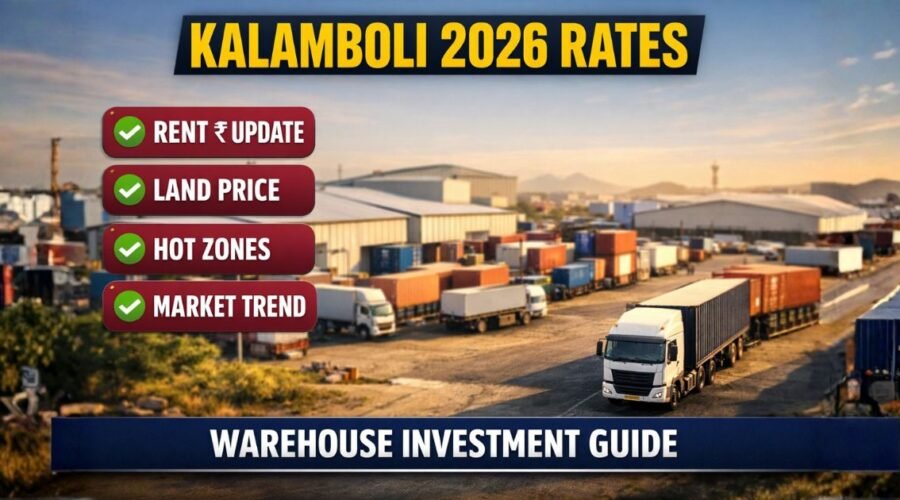
Kalamboli Warehouse Rents, Land Values and Market Trend: Practical 2026 Guide
Kalamboli is still one of the most practical warehousing markets in Navi Mumbai in 2026, but there is no one “Kalamboli rate.” Premium Sector 1E stock, heavy-duty Steel Market sheds, and small mixed-use godowns behave like three different markets. Demand has also stayed firm because Mumbai’s February 2026 heavy-vehicle restrictions pushed more staging and dwell activity outside the city, while the Kalamboli Junction upgrade is creating short-term local friction on the ground.
Kalamboli warehouse rents, land values and market trend in one clear answer
The simplest way to read this market is this: Kalamboli is good when your business values movement, loading practicality, and Panvel-side / highway-side positioning more than polish. It is not good when you treat every “godown” listing like a real warehouse or every land quote like a ready-to-buy legal value. That is exactly where users lose money.
Early-2026 portal samples show just how wide the spread is. A Sector 1E listing with 29-foot double height and two EOT cranes was being quoted at ₹6.5 lakh for 8,771 sq ft, which is roughly ₹74 per sq ft. A Steel Market-side 15,000 sq ft warehouse was being quoted at ₹4.5 lakh, or about ₹30 per sq ft on super area, while small 1,250 sq ft Kalamboli godown listings were appearing around ₹30,000 to ₹40,000 per month. On the land side, portal snippets show asking quotes reaching ₹22,710 per sq ft for a small Kalamboli commercial land listing, which is exactly why raw quote comparison can be dangerous.
Quick summary
| Micro-market / asset type | Typical 2026 asking pattern | Usually fits whom | Main caution |
|---|---|---|---|
| Sector 1E premium warehouse stock | Around ₹70 to ₹84/sq ft asking for top-end functional stock | 3PL, fast distribution, cleaner logistics users | Premium quote only makes sense if loading, height and access are genuinely usable |
| Steel Market / heavy-duty shed stock | Around low-₹40s to ₹50/sq ft for stronger engineering-style stock, but some larger listings are quoted differently by super area | Steel, hardware, heavy stock, machinery, fabrication-linked storage | Flooring, crane, road width and cargo type matter more than headline rate |
| Mixed-use godown stock | Around ₹30 to ₹32/sq ft or similar monthly ticket sizes on smaller units | Small traders, light storage, overflow stock | Often not trailer-friendly and not true warehouse stock |
| Land / plot asking quotes | Wide and highly distorted; premium snippets can touch ₹22,710/sq ft | Only serious buyers with legal clarity | Leasehold, transfer charges, and actual use rights change the real number completely |
Why Kalamboli is not one warehouse market
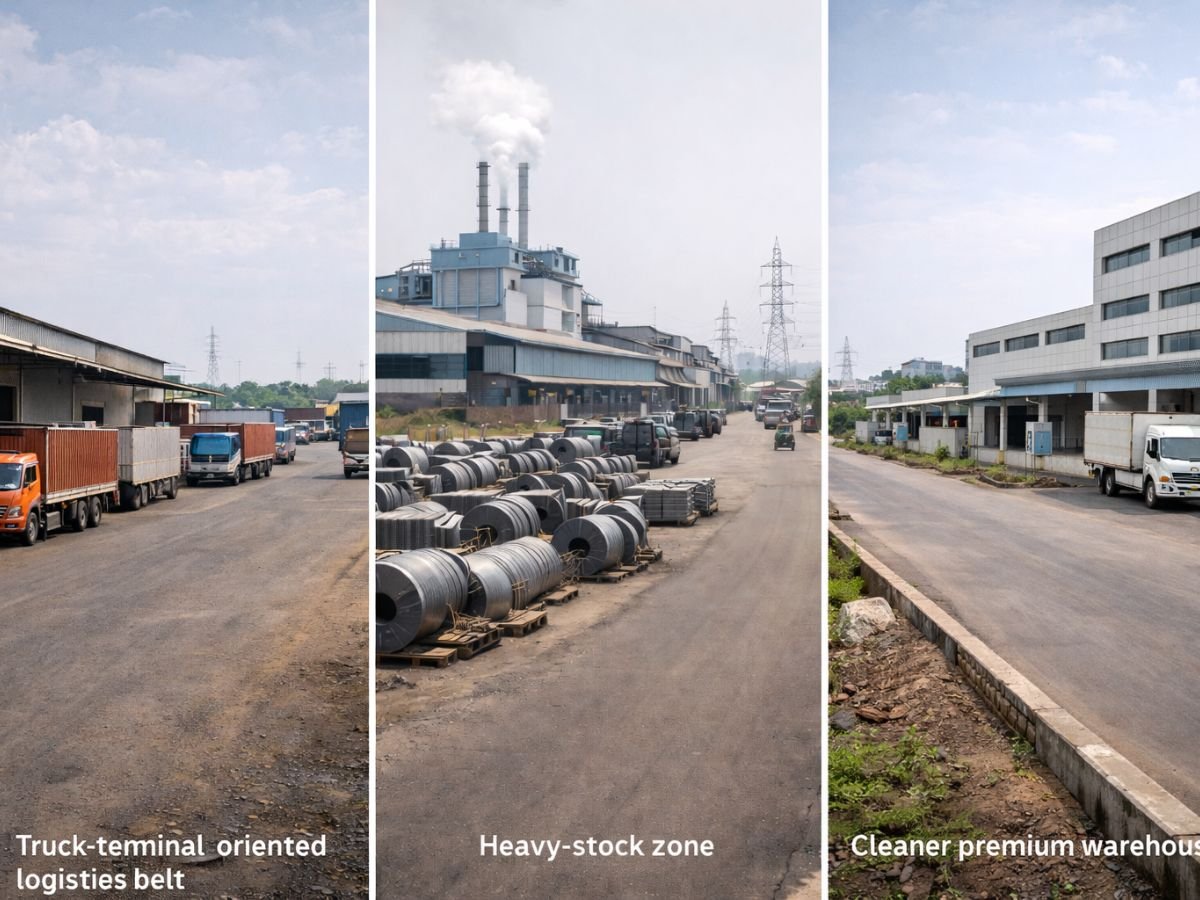
This is the first thing weak pages miss. Kalamboli is not one uniform warehouse belt. It is a cluster of different industrial and transport-led pockets sitting under one place name.
Truck Terminal-side movement and transport-led stock
This side works because of movement, not because it looks premium. Operators use Kalamboli as a staging point between the Mumbai-Pune corridor, Panvel-side flow, and port-linked traffic logic. That value has become even sharper after Mumbai restricted heavy vehicles during 8 am to 11 am and 5 pm to 9 pm from February 1, 2026.
Steel Market and heavy-stock practicality
Steel Market logic is different. Here, the better assets are not “nice” in the corporate sense. They are useful. Occupiers care more about flooring, crane support, loading space, and whether the truck can actually enter and reverse properly. Current listings around Kalamboli Steel Market still reflect this heavy-duty bias, including larger sheds with industrial zoning, loading platforms, open space, and highway proximity.
Sector 1E and cleaner warehouse demand
Sector 1E behaves closer to a premium logistics product. The better listings here are double-height, better planned, more visible, and easier to sell to corporate occupiers. That is why the asking numbers jump sharply compared to generic Kalamboli godowns.
Where mixed commercial stock gets wrongly treated as warehouse stock
This is the trap. A small 1,250 sq ft unit in a mixed zone may be marketed as a warehouse or godown, but that does not make it functional for 40-foot trailer movement, vertical racking, or serious stock rotation. Cheap storage and usable warehouse infrastructure are not the same thing.
What warehouse rents in Kalamboli usually depend on
The rent here is driven more by operational usefulness than by a neat price chart.
Size and usable loading format
A 2,500 sq ft or 5,000 sq ft unit may be easy for a smaller stockist, but large occupiers will usually pay more for proper loading flow than for simple area. A 2,500 sq ft Kalamboli warehouse listing at ₹1.1 lakh per month looks expensive on a per-foot basis, but that does not automatically make it overpriced if it actually works operationally.
Road width, turning radius, and trailer practicality
This is one of the most monetisable features in Kalamboli right now. The node has strong macro connectivity, but local movement is not always smooth. MSIDC’s Kalamboli Junction project is real and large, with a ₹482.07 crore tender cost, but while it improves the long-term picture, ongoing works and local bottlenecks mean approach quality matters a lot today.
Clear height, cranes, and open yard value
A 29-foot double-height warehouse with cranes is not comparable to a basic covered shed. That is why premium Sector 1E quotes and heavy-duty Steel Market quotes sit far above generic godown stock. Height, crane availability, loading apron, and open space are real rent multipliers in this market.
Power, office insert, and compliance fit
Some users need only storage. Others need an office insert, higher sanctioned power, or fabrication-friendly infrastructure. The more specific the utility, the less meaningful a generic market average becomes.
What land values in Kalamboli actually mean before you compare deals
This is where many buyers get fooled. In Kalamboli, “land value” is not just a location issue. It is also a legal-status issue.
A portal snippet may show a Kalamboli commercial land quote at ₹22,710 per sq ft, but that is still only an asking number. Before you compare that with any other plot, you must know whether the parcel is leasehold, whether transfer permission is clean, what the end use is, and what post-transfer cost burden sits on the asset.
CIDCO transfer charges were revised from April 1, 2025, and the revision affects key Navi Mumbai nodes including Kalamboli. Indian Express reported that commercial properties above 200 sq m can attract transfer charges as high as ₹5,84,600 per sq m, while commercial land transfers start at ₹1,93,400 per sq m. That is not a side note. That can completely change a deal.
There is one more important nuance. CIDCO’s 2025 freehold-conversion announcement clearly covered residential leasehold plots and certain scheme categories. The fee is based on a percentage of the ready reckoner rate, and unearned income can also be recovered if the lease deed provides for it. So commercial or industrial buyers should not casually assume that every Kalamboli plot they are shown can be converted on the same terms. That must be checked asset by asset.
> Caution: In Kalamboli, a cheaper-looking leasehold plot can end up being costlier than a more expensive-looking parcel once CIDCO transfer charges, conversion assumptions, and documentation gaps are brought into the deal.
What the current market trend is really saying
The 2026 trend is not just “rates are rising.” The real trend is that functional, movement-friendly stock is staying more resilient than generic inventory.
The heavy-vehicle entry restrictions in Mumbai have made outer staging nodes more useful. That helps Kalamboli. At the same time, premium logistics users are still willing to pay for better-planned stock, which explains the big gap between Sector 1E and mixed-use godowns.
But this is not a blindly bullish market. The same Kalamboli Junction works that support the long-term case also create present-day congestion and access friction. So the market is not rewarding every owner equally. It is rewarding better approach roads, usable loading, and genuine operational fit.
Which Kalamboli occupiers usually fit this market best
Kalamboli is strongest for users who need grit, movement, and access, not for those chasing a glossy industrial image.
It usually fits:
- logistics and 3PL users needing a staging node
- distributors and stockists
- steel, hardware, machinery, and bulk-goods users
- businesses that value highway-side movement more than office-style campus quality
It is less naturally suited to occupiers who need highly controlled, cleaner, specialist industrial environments and are willing to go elsewhere for that. In many such cases, Taloja or a more purpose-built warehousing location may make more sense. Current Taloja listings still show a separate pricing and asset logic altogether.
When renting in Kalamboli makes more sense than buying
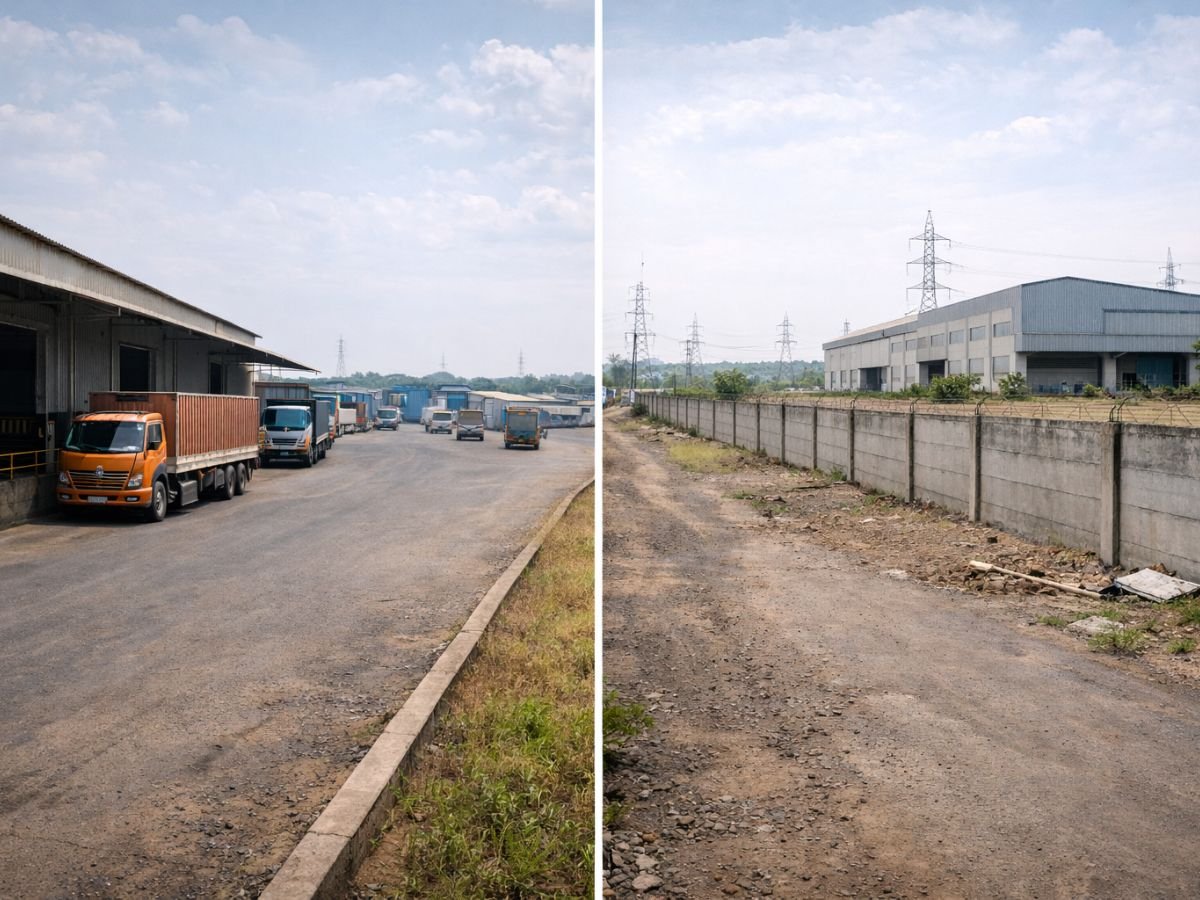
For most operational users in 2026, renting is the cleaner decision.
First, it lets you enter fast without taking CIDCO transfer-charge risk on your balance sheet. Second, it preserves flexibility in a market where the exact pocket and exact format matter a lot. Third, it protects you from overcommitting capital in a node where local movement conditions can materially change site suitability.
There is also a holding-cost issue. PMC’s property-tax system is use-based, and its own assessment documents clearly separate commercial and industrial usage. Industry explainers based on PMC’s unit-area framework note that industrial and commercial categories carry materially higher usage multipliers than residential property, so ownership-side tax should be treated as a real operating line item, not an afterthought.
When buying land or warehouse stock in Kalamboli makes sense
Buying still makes sense, but only for selective buyers.
The strongest case is a long-term owner-occupier who knows exactly why that pocket works, has done proper title and transfer checks, and values long-term location control over short-term flexibility. A second case is a serious investor who understands that Kalamboli is really a transport-led micro-market story, not a generic “industrial appreciation” story.
What usually fails is the lazy version of buying: someone sees a headline per-sq-ft quote, assumes the legal side is manageable, ignores transfer and tax implications, and only later discovers that the real cost was much higher than the brochure number.
How to read quoted rates without getting misled in Kalamboli
This deserves its own section because portal numbers regularly confuse people.
A warehouse can be quoted on carpet area, built-up area, or super built-up area. A smaller godown may look cheaper in monthly ticket size but cost more per usable square foot. A larger industrial shed may look cheaper per foot, but only because the quote is on a broader area base. You have to normalise the number before comparing it. The Kalamboli examples above already show how wildly this can vary.
Also check what is really included. Is the crane part of the rent? Is office space included? Is the open yard private or shared? Is there parking spillover? Is tanker water likely? These details change the real occupancy cost.
One more point: many occupiers still ask about manual loading-unloading and labour-board applicability because the Mathadi framework historically covered such work. But the legal position has also evolved, and PRS notes that a 2023 amendment removed some markets, including iron and steel markets, from the Act’s scope. So do not rely on hearsay. Verify current board/jurisdiction applicability for your exact cargo and premises before signing.
What to check before finalizing a warehouse or land deal in Kalamboli
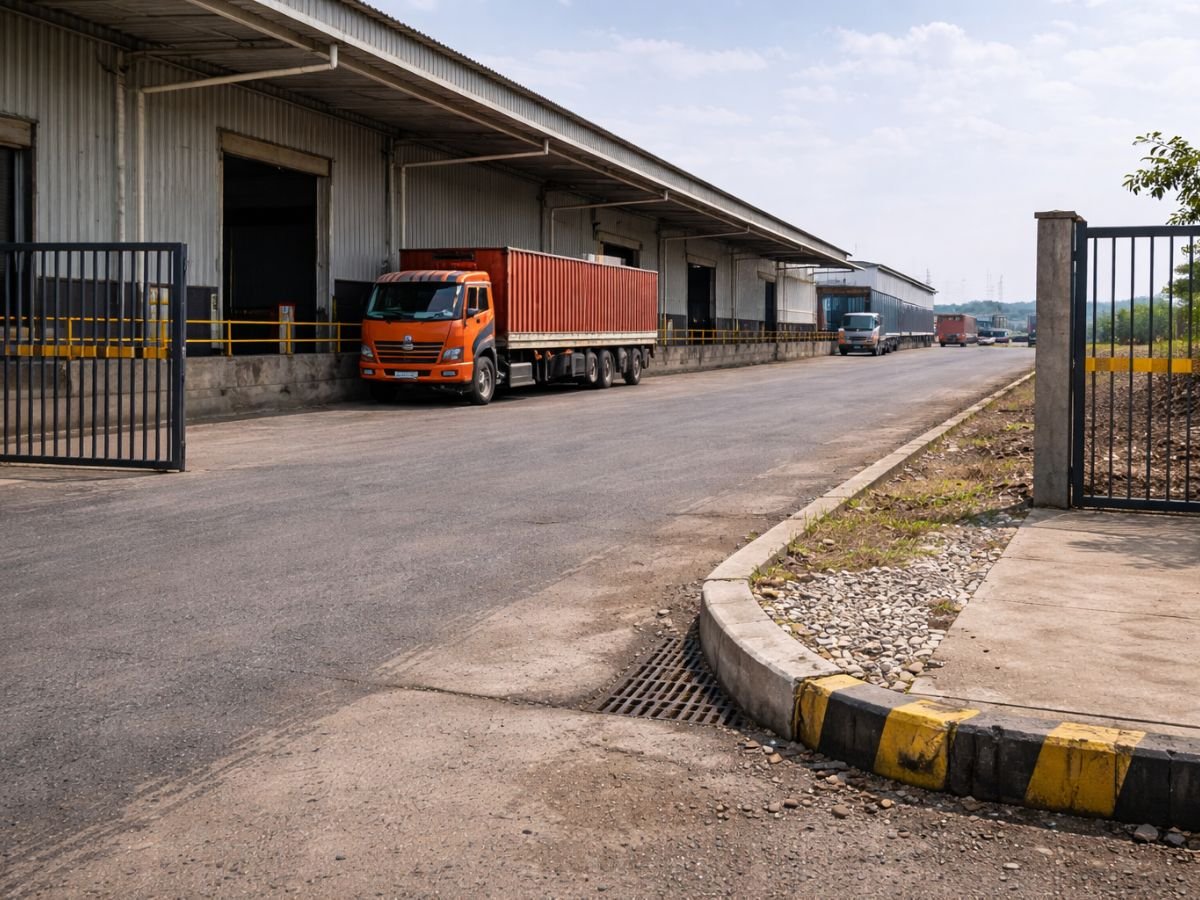
Use this as your ground-level filter before token money, draft LOI, or final negotiation.
Practical due-diligence checklist
- Check whether the property is truly warehouse stock, a heavy-duty shed, or only a small mixed-use godown.
- Confirm the exact area basis of the quote: carpet, built-up, or super built-up.
- Verify whether the approach road can actually handle your vehicle size, especially if you use trailers or multi-axle trucks.
- Check if the current local movement is affected by junction works or roadside parking spillover.
- For land or purchase deals, verify CIDCO transfer liability before commercial negotiation.
- Do not assume “freehold possible” means “freehold already done.” Check actual status and applicability.
- Ask for PMC property-tax receipts and confirm use classification and arrears.
- Confirm whether crane, loading platform, office insert, and power capacity are part of the base deal.
- Ask clearly about water source. In this belt, tanker dependence can affect monthly operating cost.
- If your loading model depends on manual handling, verify current labour-compliance requirements for your exact operation rather than relying on broker assumptions.
Is Kalamboli still a good warehouse market in 2026?
Yes, but only if you read it correctly.
Kalamboli is still a strong warehouse and logistics market in 2026 because its movement logic is real, and the Mumbai heavy-vehicle restrictions have made outer staging nodes more relevant. But this is not a market to judge by one average rent or one random land quote. Premium Sector 1E stock, Steel Market engineering sheds, and small mixed godowns should not be priced, bought, or rented as if they are the same asset.
So the final verdict is simple:
- Good market for: logistics users, stockists, heavy-goods operators, and long-term owner-users who understand the exact pocket.
- Good in which pockets: transport-friendly, loading-friendly, functionally strong pockets, not just any Kalamboli address.
- Risky for: buyers who ignore CIDCO transfer economics, occupiers who mistake small godowns for real warehouse stock, and anyone who compares assets only by headline ₹/sq ft.
FAQs
Frequently Asked Questions