
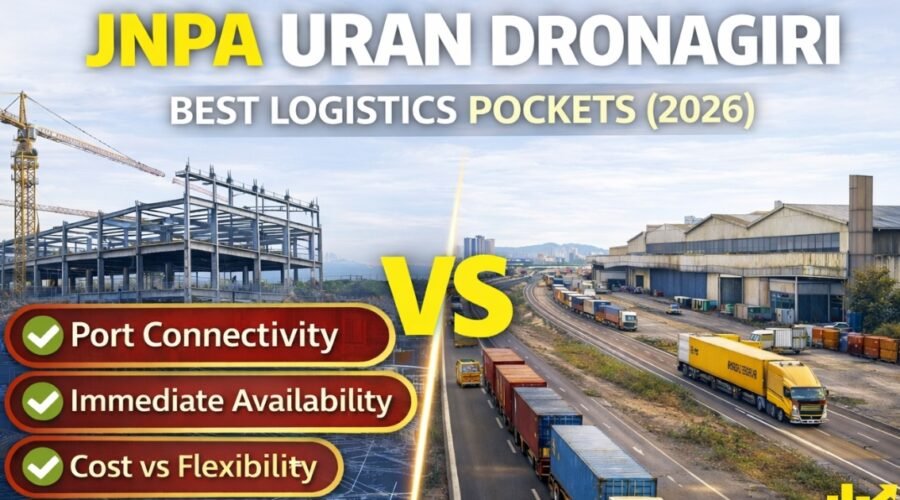
Best Logistics and Industrial Pockets near JNPA, Uran and Dronagiri
If you are choosing between JNPA-side, Uran-side, and Dronagiri-side locations, the Best Logistics and Industrial Pockets near JNPA, Uran and Dronagiri depends entirely on your use case. For real port-linked warehousing, container movement, FTWZ, and logistics throughput, JNPA-corridor and Dronagiri-linked pockets are usually the strongest. For selective industrial use, some Uran-side belts work better where land practicality and cargo linkage are usable. For pure future-bet buying, several pockets may look attractive on map, but not all are equally strong on operations today.
Which pockets near JNPA, Uran and Dronagiri actually make the most sense today?
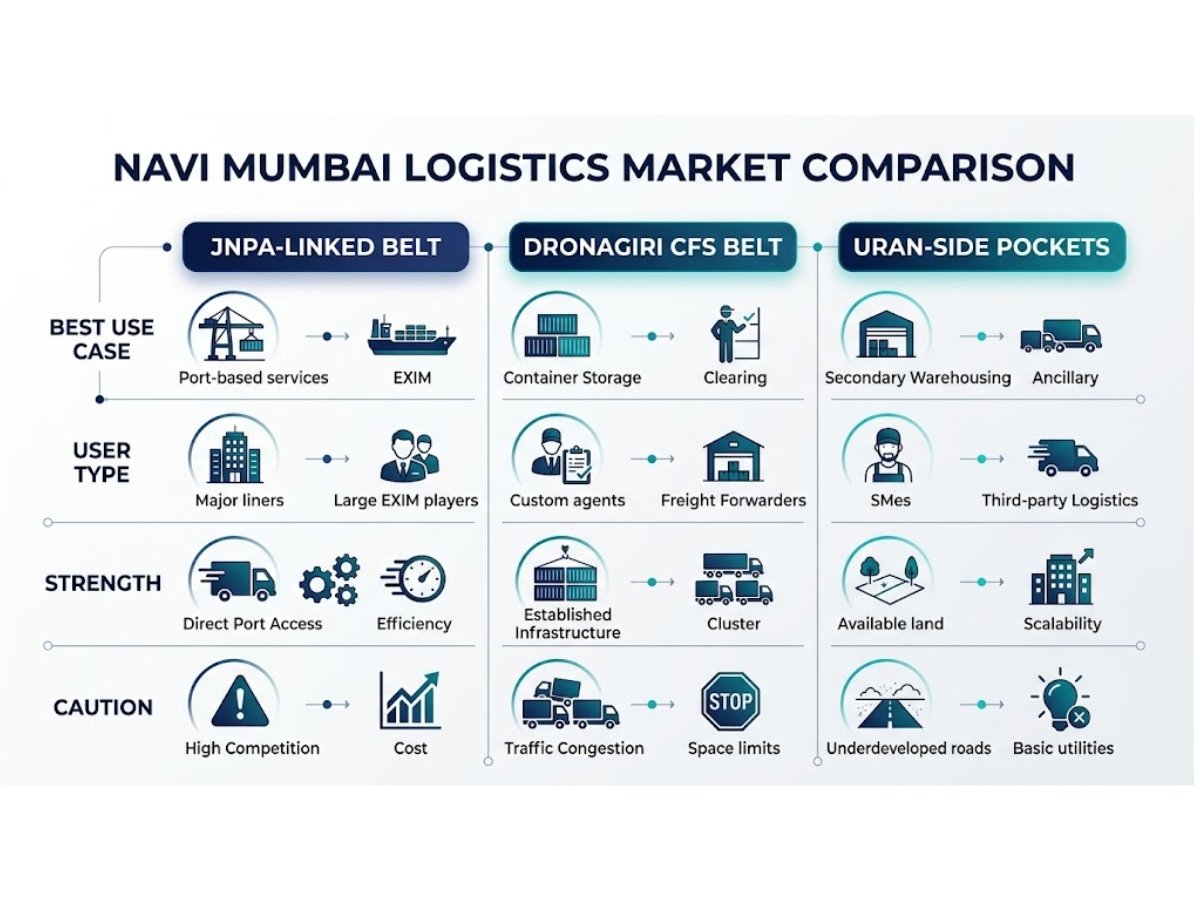
The short answer is simple: this is not one flat market, and there is no single “best area” for everyone. Some pockets work because cargo is already moving. Others work because institutional infrastructure is coming in. And some are mainly running on story-selling.
Here is the practical shortlist.
| Pocket / Belt | Best Use Case | Works Best For | Main Strength | Main Caution |
|---|---|---|---|---|
| JNPA SEZ and immediate JNPA-linked institutional belt | Grade A warehousing, FTWZ, export-import linked operations | Large occupiers, structured logistics players, manufacturing-logistics hybrids | Port relevance, institutional setup, plug-and-play logic, strong future rail upside | Not suitable for everyone on cost or size expectations |
| Dronagiri CFS belt | Container-linked logistics, CFS support, freight-linked storage, select industrial support | EXIM businesses, CFS-linked operators, yard users | Dense logistics ecosystem, direct cargo logic, real port utility | Local congestion, legal and environmental caution in some parts |
| Wider Uran-Khopta-Jasai-Veshvi side | Secondary warehousing, specialized storage, spillover cargo support, selective industrial use | Mid-sized operators, yard users, processing-linked users | More land practicality in select locations, spillover potential from JNPA activity | Must verify road access, truck movement, and real last-mile usability |
| Dronagiri beyond core cargo-linked utility zones | Industrial-first or mixed logistics-industrial plays | Patient self-users, selective investors | Strong industrial policy logic, long-term strategic relevance | Not every micro-pocket has equal occupier depth or easy liquidity |
| Future-led peripheral belts near emerging corridors | Land banking and long-horizon positioning | Patient investors only | Upside tied to big infrastructure and new-town planning | Dangerous if bought as if present-day logistics demand is already mature |
The biggest mistake here is buying or leasing only by map distance to JNPA. In this belt, cargo relevance matters, but truck turning, queue conditions, access roads, yard usability, and documentation reality matter even more.
Why this belt cannot be judged as one market
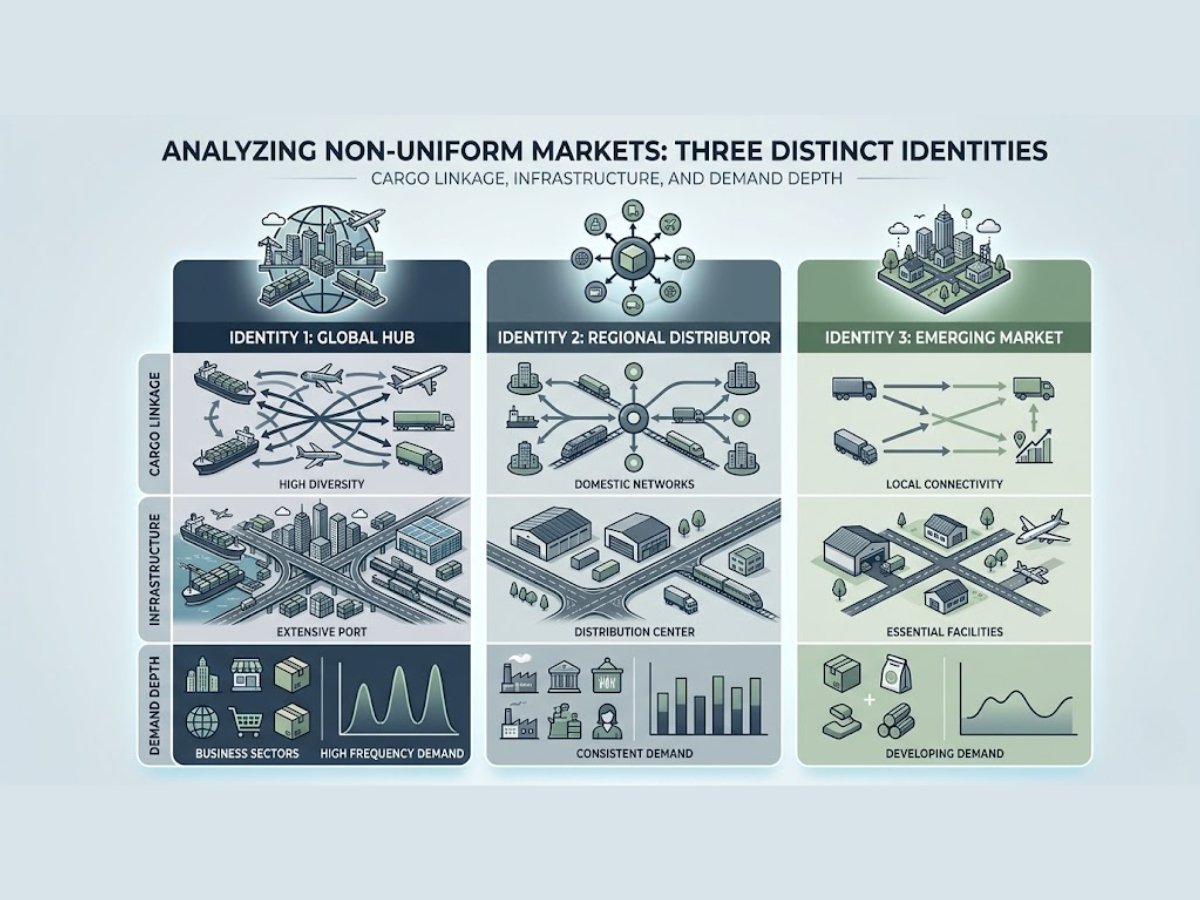
Readers often treat JNPA, Uran, and Dronagiri as if they are one continuous logistics zone. On ground, they are not.
JNPA-side demand is driven by actual port throughput, container evacuation, institutional cargo handling, FTWZ activity, and now the rise of Grade A warehousing. Dronagiri has a much stronger logistics identity than many nearby belts because it is deeply tied to CFS concentration and freight-support functions. Uran-side locations can be useful, but much more selectively. Some work because they support spillover cargo and secondary logistics. Others are still closer to future promise than present usability.
This difference matters because a logistics operator and an investor see the same map very differently. An occupier needs movement efficiency today. An investor may tolerate a slower market if the infrastructure story is credible and entry cost is still reasonable.
That is why this belt should be judged through four filters, not one:
- present cargo linkage
- road and truck practicality
- sanctioned and usable asset type
- future dependency versus current demand depth
A pocket can be physically close to the port and still underperform if trailers queue badly, approach roads are narrow, or the asset is not practically usable for the intended operation.
Which pockets are strongest for pure logistics and warehouse demand?
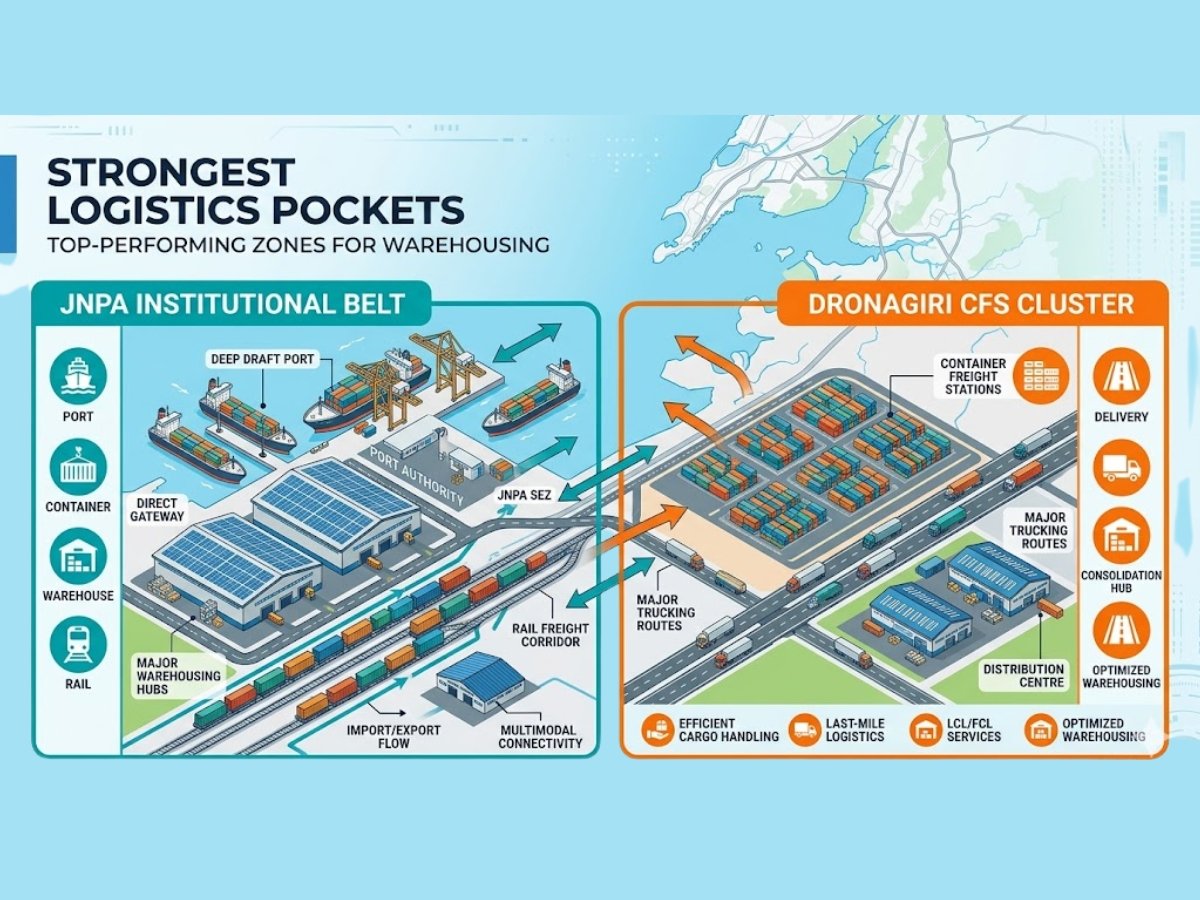
For pure logistics and warehousing, the strongest pockets are the ones already integrated into real cargo movement, not just those marketed as “near port.”
Pockets that benefit from real cargo and port-linked movement
The JNPA-linked institutional zone, especially around the SEZ and FTWZ ecosystem, is the clearest high-quality logistics choice in this belt. This is where the market is moving beyond old-style local godowns toward larger, institutional-grade warehousing and industrial parks. The arrival of major players and large-format warehousing in the SEZ is a serious signal that the market has matured beyond speculation.
This zone suits:
- export-import driven warehousing
- large occupiers needing compliance and scale
- users who want stronger infrastructure planning
- businesses that value future rail evacuation upside from the freight corridor
The Dronagiri CFS cluster is the second major logistics pocket, but for a different reason. It is not just about modern warehousing. It is about container handling support, customs-adjacent movement, CFS-linked functions, and immediate cargo logic. That makes it very strong for container-linked operators and freight-support users.
The wider Uran-Khopta-Jasai-Veshvi side is more of a tactical belt. It can work for secondary warehousing, yard-based operations, specialized storage, or businesses that want cargo relevance without necessarily paying for the most institutional format. But selectivity is everything here.
Pockets that are better only on paper than on operations
Some locations sound attractive because they are spoken about as part of the JNPA-Uran-Dronagiri growth story. But on ground, the answer changes once you ask operational questions.
A pocket may fail despite a good map pitch if:
- truck queues spill into approach roads
- terminal-related congestion increases turnaround time badly
- road width does not support regular large trailer movement
- the site works better as open storage than formal warehouse space
- approvals, CRZ sensitivity, or leasehold complications create execution risk
This is especially important today because the region has seen severe gate and turnaround stress in parts of the port ecosystem. When trailers are taking very long to reach the main gate or export boxes are stuck in out-gate queues, the value of “close to port” becomes more complicated. Nearness helps, but not if access friction destroys efficiency.
Which pockets work better for industrial use than for warehousing?
Not every location near JNPA should be judged as a warehouse market. Some pockets make more sense for industrial or hybrid industrial-logistics use.
Where light industrial or processing-linked users may fit better
Dronagiri has a strong industrial-first character, and this is visible even in official land-value logic, where industrial value has outpaced residential value. That is a major signal. It suggests the belt is not being driven mainly by lifestyle or residential end-use. It is being seen as a production, storage, and freight-support geography.
That makes parts of Dronagiri and the wider belt suitable for:
- processing-linked units
- manufacturing tied to export or port movement
- packaging, food processing, pharmaceutical-linked support
- hybrid industrial users who need both storage and movement
The JNPA SEZ is especially relevant for this category because it is not just a warehousing story. It already has manufacturing, cold storage, food processing, pharmaceutical, and packaging users operating inside a formal institutional ecosystem.
Where warehouse-first users may struggle despite available space
A warehouse user may struggle in a belt that technically has land or structures available, but lacks smooth truck circulation, staging efficiency, or predictable cargo flow. This is where some Uran-side and peripheral pockets need careful screening.
For example, a site may be acceptable for a light industrial user with lower trailer churn, but unsuitable for a high-throughput warehouse operator. That is why the same asset can look workable to one occupier and inefficient to another.
The simple rule is this: if your business depends on fast loading, unloading, frequent trailer movement, and turnaround discipline, then mere space availability is not enough.
Dronagiri, Uran and JNPA-side corridors: what works where?
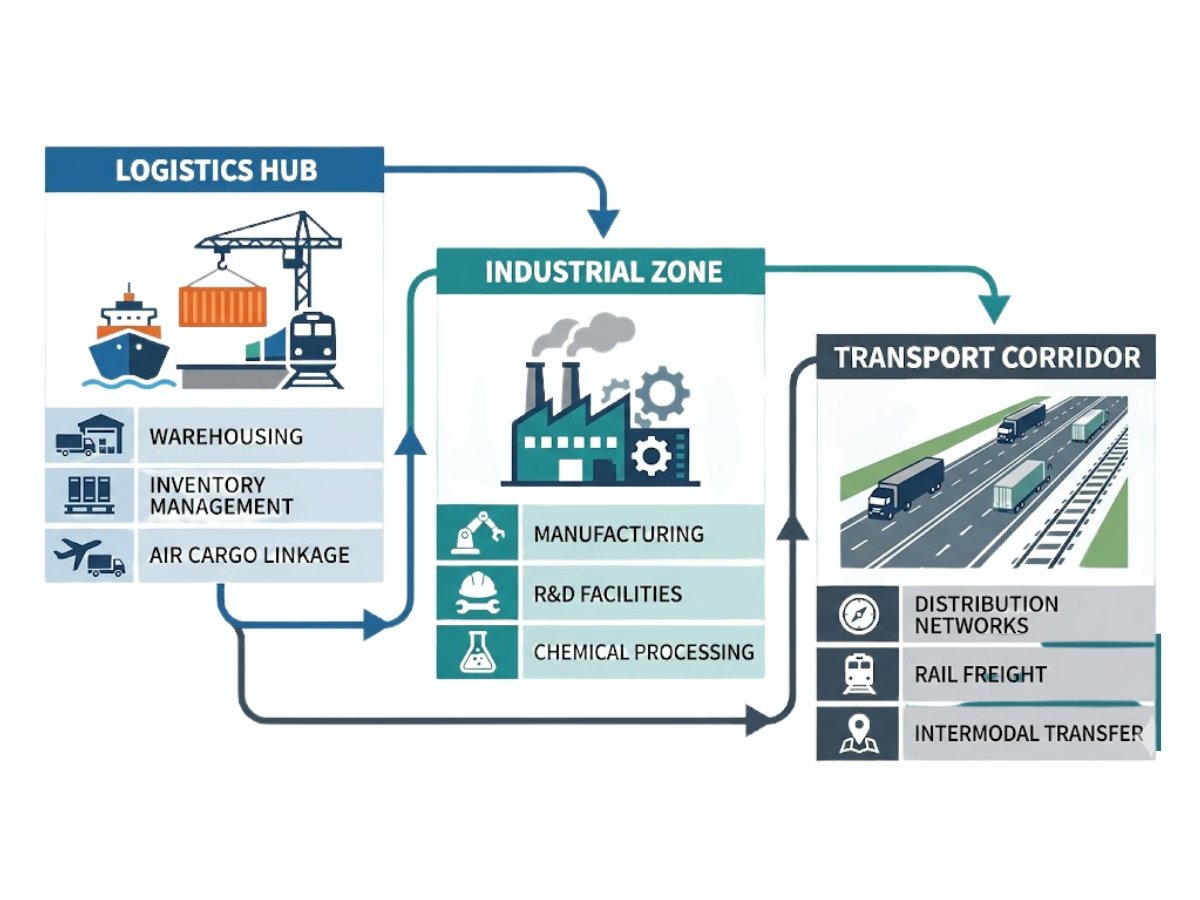
This is the core comparison. The three sides are related, but they do not serve the same purpose equally.
Dronagiri-side logic
Dronagiri is the strongest direct logistics-support node in the broader belt. It has deep CFS concentration, direct container ecosystem relevance, and a market identity tied more to freight and industry than to pure residential growth.
Its strongest use cases are:
- CFS-linked logistics
- container support functions
- freight-support land and warehousing
- industrial users connected to port utility
- patient buyers who understand industrial-first logic
Its weak point is that not all of Dronagiri is friction-free. Some parts face environmental, documentation, or OC-related caution. So buyers cannot blindly assume every project or plot carries the same risk profile.
Uran-side logic
Uran is more selective. It can work well where land practicality, spillover cargo movement, and access logic support the intended use. The wider Uran-Khopta side has relevance because once the core Dronagiri cluster gets stressed or expensive, spillover demand naturally looks outward.
This side may suit:
- secondary warehousing
- open yard users
- specialized cargo handling support
- selective industrial occupiers
- patient investors who are not pretending the market is already fully mature
But Uran-side selection requires hard filtering. A location may seem strategically placed, yet fail on last-mile movement or documentation quality.
JNPA-corridor logic
The JNPA-linked corridor is the most institutionally anchored side of the belt. It is where port-led logistics, FTWZ activity, Grade A warehousing, and large-format industrial planning come together most clearly.
This is where the market looks strongest for:
- serious warehouse occupiers
- institutional logistics players
- high-value storage formats
- companies that want better long-term infrastructure alignment with rail, airport, and port systems
The main constraint here is not demand quality. It is whether the occupier’s size, budget, and specification need actually match the product.
What should occupiers check before choosing any pocket in this belt?
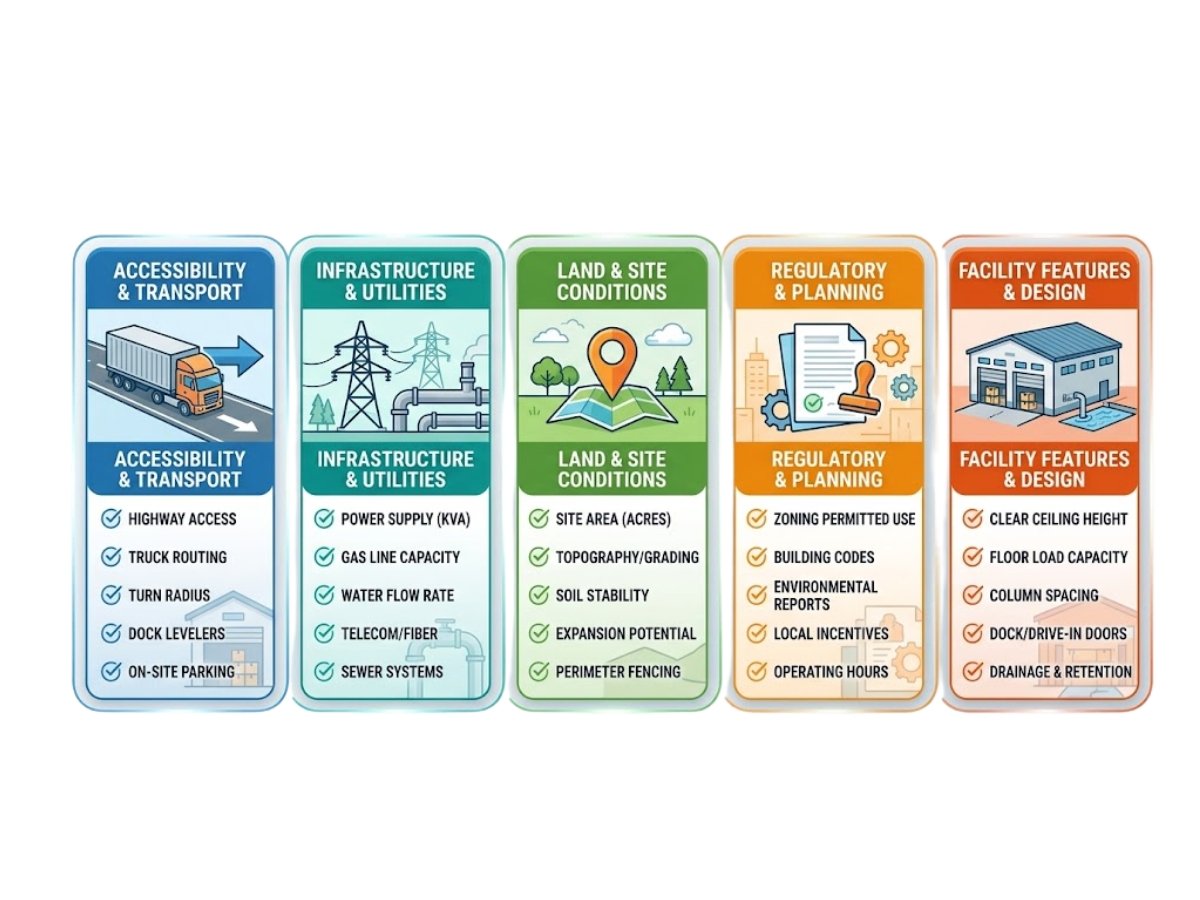
Before taking a warehouse, shed, yard, or industrial plot here, occupiers should think like operators, not like brochure readers.
Road width, truck turning, queuing and last-mile friction
This is the first check. If truck movement is difficult, the location is weaker than the broker pitch.
Look at:
- approach road width
- trailer turning radius
- queue spillover risk
- whether nearby congestion affects gate access
- whether loading and unloading can happen without choking movement
A pocket can lose its advantage if trucks keep losing time before they even reach the terminal or the site gate.
Plot usability, yard depth, loading practicality and expansion scope
Usable land is not just land. The shape, frontage, internal circulation, loading edge, yard depth, and future expansion room all matter.
This is especially important near port-linked markets because operations are movement-heavy. A badly shaped plot or a shallow yard can create constant inefficiency even if the address is strong.
Sanctioned use, approvals and documentation reality
This belt demands extra caution on approvals and documentation. Leasehold structure, CIDCO transfer issues, NOC requirements, CRZ sensitivity, and project-level legal realities can materially affect usability and resale.
Use this practical checklist before committing:
| What to Check | Why It Matters |
|---|---|
| Exact sanctioned use of the asset | Industrial, warehouse, yard, and mixed-use assumptions should not be guessed |
| CIDCO leasehold terms and transfer process | Resale and transfer are not as simple as freehold markets |
| NOC and transfer charge implications | These affect transaction smoothness and future exits |
| MahaRERA registration where applicable | Helps verify legitimacy, plans, and possession claims |
| CRZ or environmental sensitivity | Critical in parts of Dronagiri and nearby geographies |
| Actual truck access, not just Google Maps access | Real operations depend on movement quality |
| Drainage and land condition | Important in low-lying or sensitive belts |
| Whether the asset suits current use or only future potential | Prevents overpaying for story-driven inventory |
Which pockets make more sense for self-use, and which are more investor-driven?
This is where many people get confused. Occupier logic and investor logic are not the same.
Good for real occupiers
For serious occupiers, the best pockets are the ones where cargo logic is already active and asset usability is clear. JNPA-linked institutional warehousing and the stronger Dronagiri logistics-support pockets generally fit this category best.
These locations make more sense when the business needs:
- real throughput
- predictable freight relevance
- stronger leasing or operating ecosystem
- less dependence on distant future appreciation stories
Better for patient investors
Investors with time can look beyond the core cargo-linked zones, especially where corridor expansion, airport influence, or new-town planning may improve the belt over time. But this is for patient capital, not for buyers expecting quick depth or instant leasing ease everywhere.
Investor-friendly logic improves where:
- institutional infrastructure is coming closer
- corridor relevance is strengthening
- entry is still below fully institutionalized zones
- the asset has clear title and usable documentation
Risky if bought only on future-story selling
The risky pockets are those bought on slogans such as “near port,” “near airport,” or “next big growth belt” without checking actual logistics suitability. These purchases often fail because the buyer mixes future regional importance with present occupier demand.
That confusion is expensive.
A location can be important in the long-term planning map and still be weak for immediate leasing, weak for fast exit, or operationally frustrating today.
What mistakes do buyers and tenants make in the JNPA-Uran-Dronagiri belt?
The most common mistake is assuming proximity automatically creates quality demand. It does not.
Other frequent mistakes include:
- treating the whole belt as one identical market
- choosing by headline infrastructure names instead of actual truck movement
- buying warehouse-style assets in pockets better suited for industrial or yard use
- ignoring CRZ, OC, leasehold, or transfer-related complications
- assuming every “near JNPA” site is equally liquid
- paying for future upside as if present cash flow already exists
- confusing cargo relevance with good micro-location quality
Two nearby pockets can behave very differently. One may have smooth access, good logistics fit, and real occupier demand. Another may only look good in a sales presentation.
That is why this market rewards field-level filtering much more than generic location branding.
So which pocket should you choose based on your exact requirement?
The right answer depends on what exactly you are trying to do.
| User Type | Best-Fit Pocket | Why |
|---|---|---|
| Warehouse operators | JNPA-linked institutional belt and stronger Dronagiri logistics pockets | Better cargo relevance, stronger warehousing logic, better long-term infrastructure fit |
| Container-linked businesses | Dronagiri CFS belt and direct cargo-support corridors | Immediate ecosystem relevance and operational alignment |
| Industrial occupiers | Select Dronagiri and selective Uran-side industrial-support pockets | Better fit for processing, hybrid industrial use, and export-linked operations |
| Open yard or spillover cargo users | Wider Uran-Khopta-Jasai-Veshvi side, but only after access checks | Can offer practical spillover space where core clusters are stressed |
| Land investors | Future-linked peripheral belts with clear documentation | Only for patient buyers who understand execution and liquidity risk |
| First-time buyers in this belt | Institutional or clearly usable cargo-linked pockets only | Lower chance of being trapped in weak operational logic |
Conclusion
The best logistics and industrial pockets near JNPA, Uran and Dronagiri are not the cheapest, not the loudest marketed, and not always the ones that look closest on a map. The strongest choices are the ones where port logic, truck practicality, asset usability, and documentation reality come together.
If your requirement is real warehousing, FTWZ, or cargo-linked movement, stay close to the JNPA-linked institutional belt and the stronger Dronagiri logistics ecosystem. If your need is selective industrial or spillover support use, parts of Uran-side belts can work, but only after hard operational checks. If you are buying only for future upside, be honest that you are making an investor bet, not buying into fully mature occupier demand.
In this corridor, the winning decision is rarely “closest to port.” It is usually “most usable for the exact operation.”
FAQs
Frequently Asked Questions