
Leasehold vs Freehold Industrial Property in Navi Mumbai
Freehold usually gives stronger long-term control and cleaner resale comfort. But in Navi Mumbai industrial real estate, leasehold is not automatically a bad option because many prime industrial belts were built through authority-led land planning, especially MIDC. The practical answer is simple: do not judge only by the ownership label. Judge by the file, the remaining lease term, transfer conditions, approved activity, dues, financing path, and how easily the property can be used or resold later.
Leasehold or freehold: which is usually better for industrial buyers in Navi Mumbai?
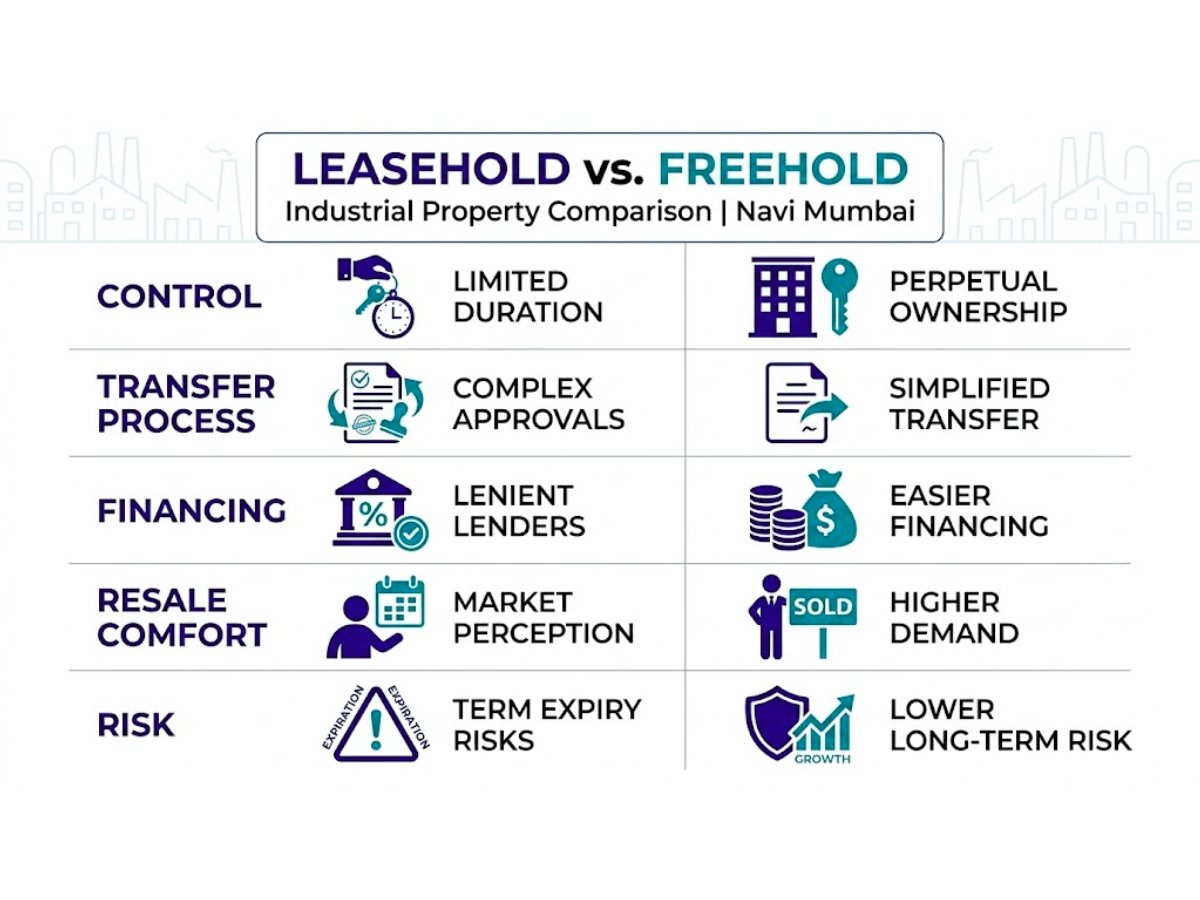
Neither is universally better. The right answer depends on what you do, where you want to buy, and how much future control you need.
If your business needs organised industrial infrastructure, utility support, compliance ecosystem, and a location inside an established belt, a clean leasehold property can make more sense. If your priority is maximum autonomy, easier future transfer, open-ended land control, and lower authority friction, freehold usually has the edge.
The biggest mistake buyers make is assuming that freehold is always safe and leasehold is always risky. In real industrial transactions, a clean MIDC leasehold file can be more practical than a messy freehold parcel with poor zoning clarity, weak road access, or doubtful industrial approvals.
Quick Summary Table
| Factor | Leasehold Industrial Property | Freehold Industrial Property |
|---|---|---|
| Control | Strong use rights, but under authority rules | Maximum control if title and zoning are clean |
| Common in Navi Mumbai | Very common in MIDC and authority-led industrial belts | More common outside core authority-controlled estates |
| Transfer process | Can involve permissions, premiums, and file scrutiny | Usually simpler, though title and zoning still matter |
| Financing | Possible if the file is clean and lender conditions are satisfied | Usually more straightforward structurally |
| Resale comfort | Depends on lease balance, dues, transferability, and compliance history | Usually better for long-term holding and cleaner exit |
| Best suited for | Manufacturing, process industries, users needing industrial ecosystem | Warehousing, logistics, land banking, buyers wanting flexibility |
| Hidden risk | File-level compliance burden | Zoning, title, and infrastructure risk |
What leasehold and freehold actually mean in an industrial property deal
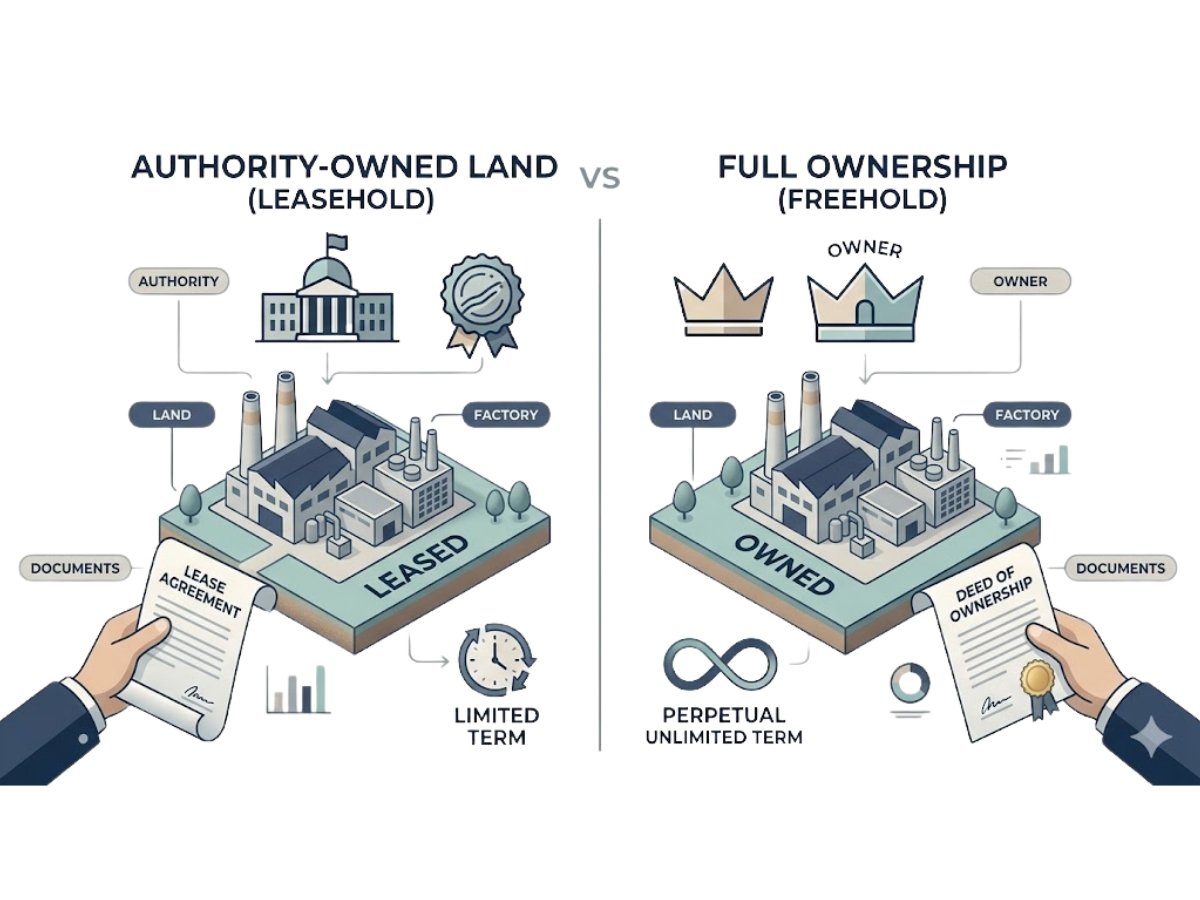
This difference is not just legal language. It directly affects how much control you have, how easily you can borrow against the asset, what permissions you may need later, and how smooth or difficult your future exit may be.
What changes in ownership rights
Freehold means you own the land and structure outright, subject to normal planning, environmental, zoning, and local laws. Leasehold in the industrial context usually means the authority retains ownership of the land while granting you long-duration rights to occupy, build, use, mortgage, and transfer under specific conditions.
That is why industrial leasehold in Navi Mumbai should not be confused with a normal rental arrangement. It is a transacting capital asset, often with a long tenure, but it comes with embedded regulatory conditions.
What changes in land control, transfer freedom, and future approvals
This is the part that matters most in real life.
A freehold owner usually has more flexibility in transfer, redevelopment, mortgage structuring, and long-term decision-making. A leasehold buyer may still have strong rights, but future actions can depend on the authority’s process, approval path, charge structure, and compliance history.
So the real difference is not just ownership on paper. It is the difference between:
- higher autonomy and lower authority dependence
- versus organised industrial access with more procedural friction
That is why the correct comparison is not emotional. It is about freedom, friction, and future exit.
Why leasehold is so common in Navi Mumbai industrial property
Leasehold is common because Navi Mumbai’s industrial growth was planned that way.
The region’s major industrial zones were not shaped mainly by scattered private landowners building factories one by one. They were shaped by statutory authorities creating planned industrial belts with roads, utility systems, and controlled land use. That is why many prime industrial areas in and around Navi Mumbai operate within an authority-driven leasehold ecosystem.
MIDC-side industrial areas
MIDC is the clearest example. Industrial land in belts like TTC and Taloja was developed through a regulated framework where the authority retained land ownership and granted long-duration industrial rights. The idea was not just land disposal. It was controlled industrialisation.
This matters because MIDC-style ownership is designed to enforce actual industrial use, manage transfer, regulate subletting, track activity changes, and maintain planning discipline. That is one reason leasehold is not some odd or inferior exception in these belts. It is the basic operating model.
CIDCO and other authority-linked land situations
CIDCO also shapes much of Navi Mumbai’s land logic, but buyers need to be careful not to mix general CIDCO headlines with industrial reality.
A major market confusion today is the belief that any CIDCO leasehold property can eventually become freehold. That is not a safe assumption for industrial buying. Buyers should verify exact scheme eligibility, asset category, and authority applicability instead of pricing future conversion into the deal.
> Important caution: Never buy an industrial plot at a premium just because someone says “later freehold ho jayega.” Verify first. In industrial property, assumptions like this can become expensive mistakes.
When freehold clearly has the advantage
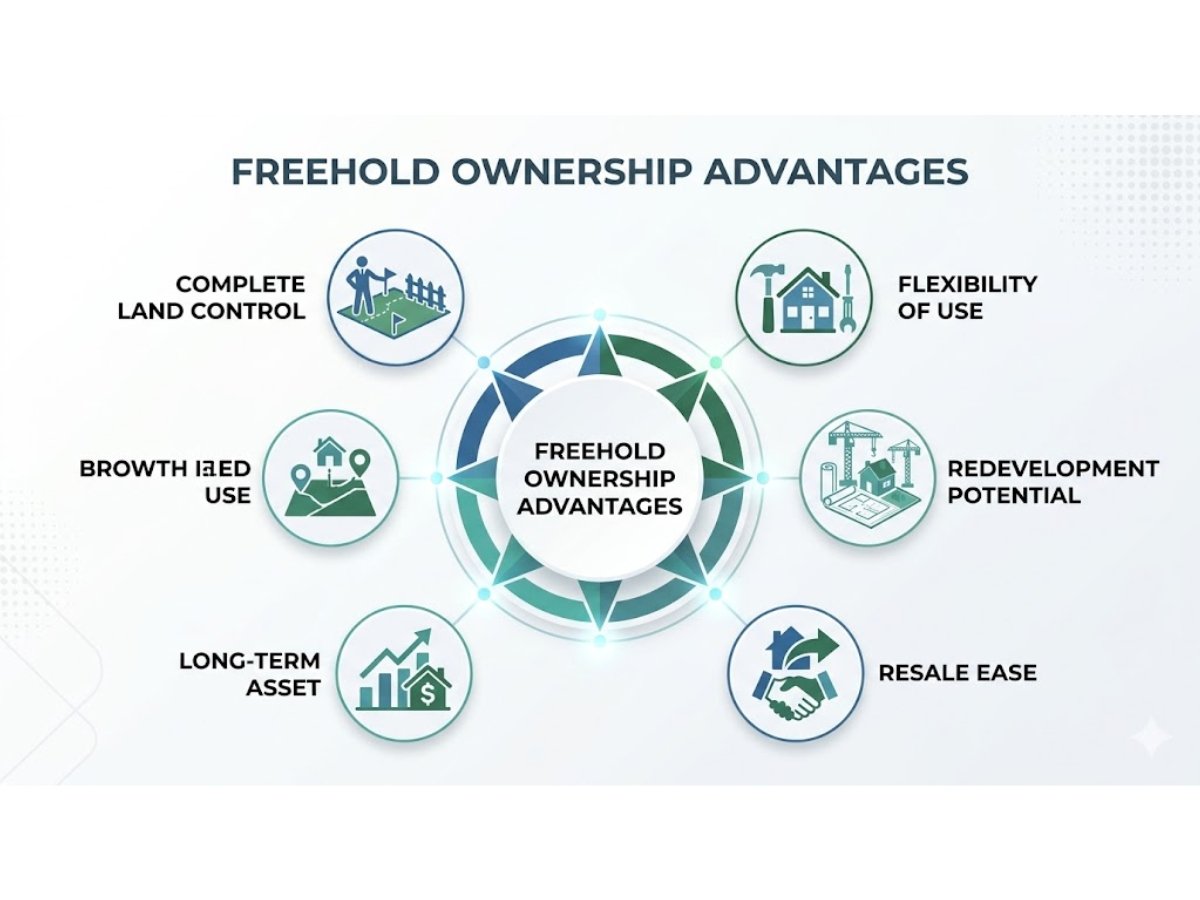
Freehold deserves its premium when the buyer wants long-term control, fewer administrative restrictions, and a cleaner future exit.
Long-term control and redevelopment flexibility
If you want maximum freedom over future planning, subdivision, redevelopment, financing structure, or long-horizon industrial use, freehold is usually stronger. You are less dependent on a lessor authority for key future decisions.
This matters especially for buyers who think beyond immediate occupation and want the asset to remain structurally flexible for decades.
Cleaner perception in resale and legacy holding
Even when a leasehold file is perfectly workable, many future buyers still psychologically prefer freehold because it feels simpler and more permanent. That matters in resale.
For family holding, institutional balance-sheet comfort, or legacy planning, freehold often carries a cleaner market perception.
Fewer authority-linked friction points, if title and land use are clean
This last line matters a lot. Freehold has a clear advantage only when the underlying file is actually clean.
A freehold plot with weak title, poor zoning clarity, missing approvals, or inadequate industrial access can become a bigger problem than a clean leasehold industrial asset. So freehold is powerful, but not magical.
When leasehold is perfectly acceptable and when it becomes dangerous
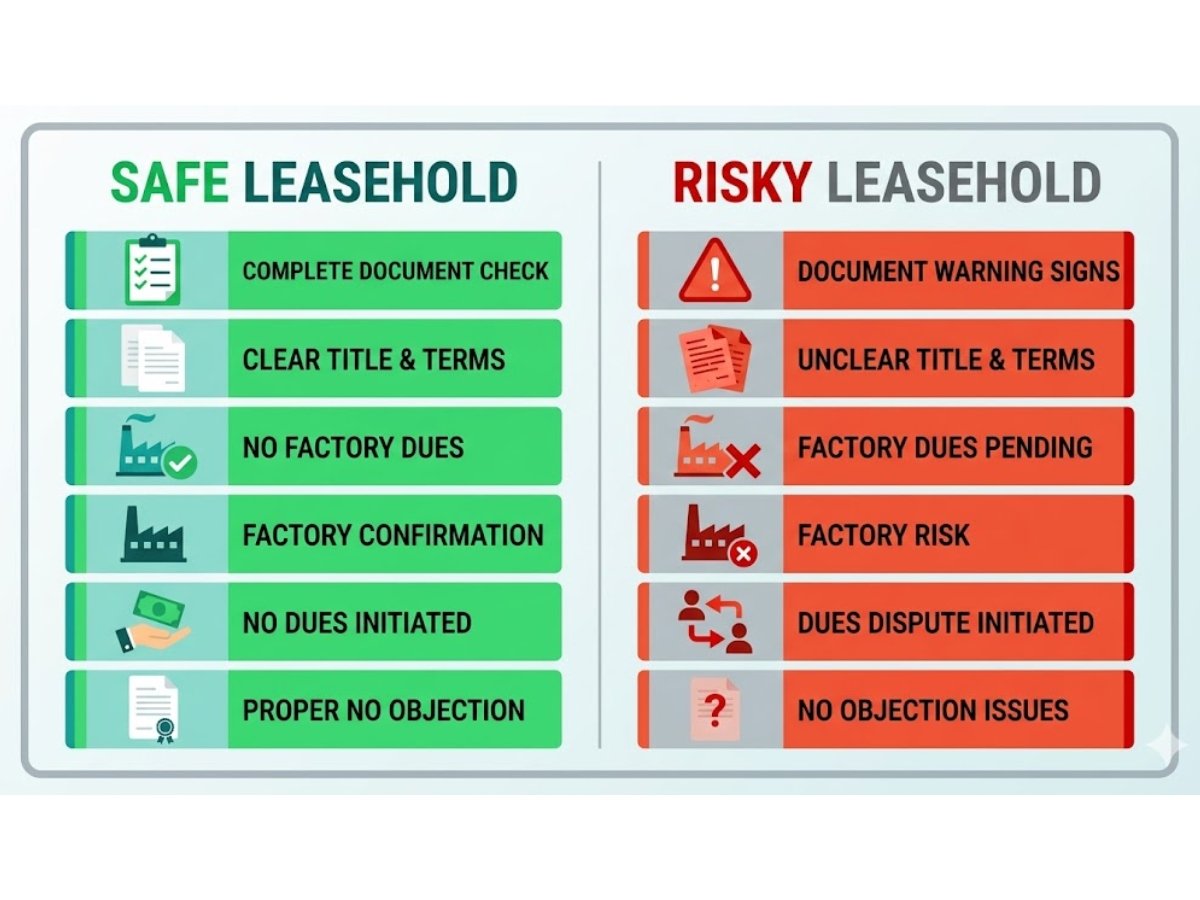
Leasehold becomes acceptable when the file is mature, compliant, transferable, and operationally usable. It becomes dangerous when the previous owner’s mistakes are buried inside the property.
Acceptable leasehold conditions
A leasehold industrial asset is generally much safer when:
- the lease stage is properly documented
- the construction and occupancy status is regular
- the approved activity matches the actual activity
- dues are updated
- subletting, if any, is authorised
- the transfer route is clear
- financing documentation is possible
- there is no serious hidden litigation or compliance trail problem
A clean leasehold file can work very smoothly in practice.
Red-flag leasehold conditions
A leasehold file becomes risky very fast when:
- only early-stage allotment papers are shown but later documentation is weak
- occupancy or completion trail is incomplete
- the actual operator does not match the file
- subletting exists on ground without permission
- there are outstanding civic or authority dues
- the actual activity is different from the approved industrial use
- change in shareholding, possession, or usage has not been regularised where required
Caution Box: Dangerous Leasehold Patterns
Do not treat leasehold risk as a theory. It is usually a file problem.
A toxic leasehold file may look active on ground but still be commercially dangerous if:
- NMMC arrears are pending in TTC-linked properties
- MIDC dues are not clean
- the lease balance is weak
- the property has hidden compliance breaches
- the unit is occupied by an unauthorised tenant
- the current use does not match MPCB or authority records
In industrial buying, structure risk is often lower than file risk.
The real buyer question: how much control do you actually need?
This is the section most buyers should read twice. The best ownership structure depends on business model, not theory.
Owner-occupier manufacturing user
A manufacturer who needs reliable power, industrial water, compliance ecosystem, CETP access, and an established industrial environment may find a clean leasehold property far more practical than a remote freehold parcel.
For this buyer, operational stability often matters more than abstract ownership purity.
Warehouse or logistics user
A logistics or warehousing user may value plot flexibility, large floor plates, height freedom, and fewer authority-linked restrictions. In that case, freehold can be more attractive, especially outside tightly controlled industrial estates.
The more your use case depends on space optimisation and long-term land flexibility, the more freehold becomes commercially interesting.
Investor buying for rent
An investor should think differently. Rental yield is only one part of the story. The real question is: what will happen when I exit?
Leasehold may still work if the tenant profile is strong and the file is clean. But freehold can improve exit simplicity because future buyers often understand it faster and price it with less hesitation.
Buyer planning a later resale
If resale liquidity is central to your strategy, you should be extra careful with leasehold. Transfer premiums, authority permissions, incomplete file history, and dues can materially affect exit timing and realised value.
A buyer planning future resale should ask one uncomfortable question upfront: Will my exit be smooth, or will the authority file consume my profit and time?
How transfer, permissions, and authority approvals change the answer
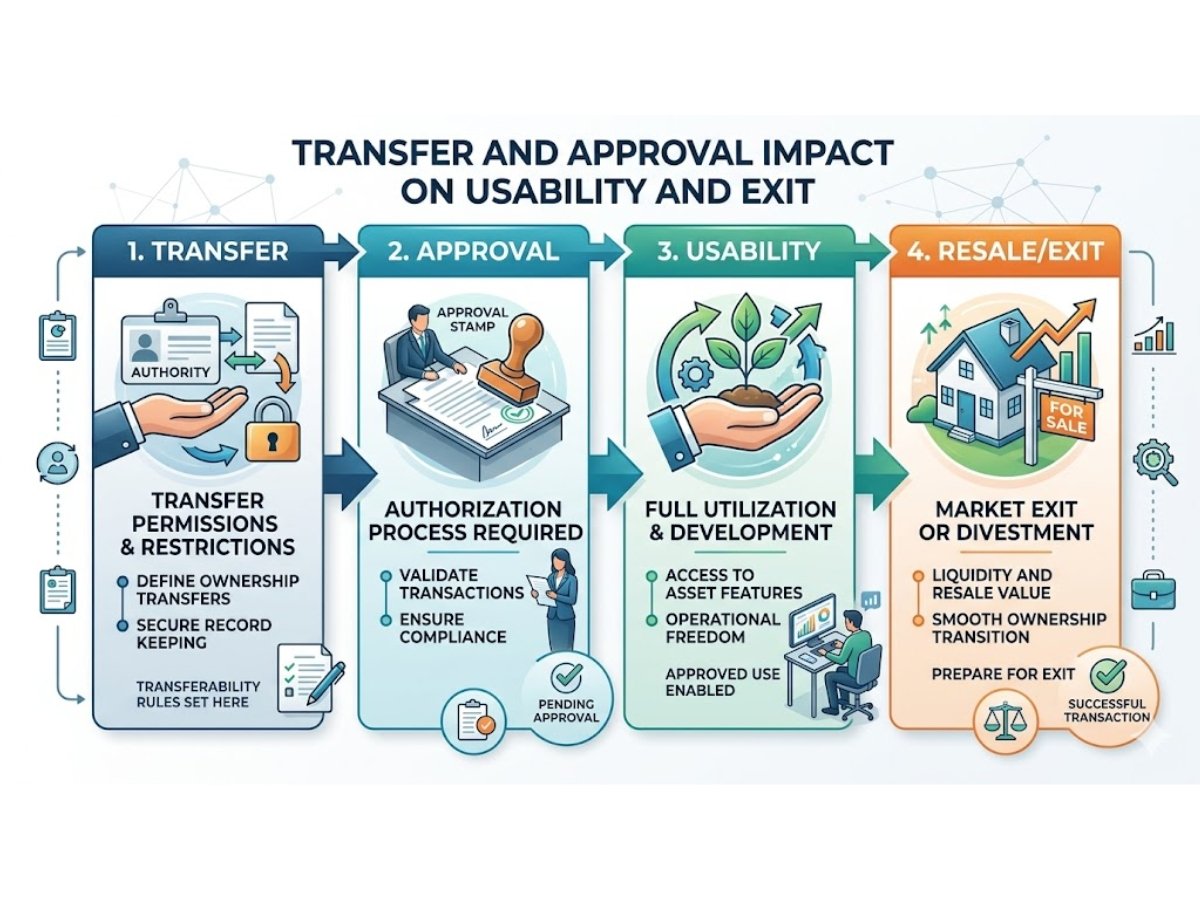
This is where industrial buying becomes real. Ownership type does not matter only at purchase. It matters later when you try to transfer, finance, sublet, mortgage, expand, or sell.
MIDC transfer path and activity approval logic
In MIDC-style transactions, transfer is not merely a private agreement between buyer and seller. The transaction can involve differential premium, eligibility checks, file review, and activity-related conditions.
A very important practical issue is the difference between an open plot and a developed plot. In market practice, open plots can attract much heavier transfer friction and higher premium burden than developed plots. This directly affects exit economics.
The phrase buyers should understand clearly is differential premium. In practical terms, this works like an exit cost. It can materially reduce the seller’s realised gain and affect the buyer’s overall transaction structure.
CIDCO-side transfer and charge implications where relevant
CIDCO-linked assets also need careful file reading. Buyers should never assume that one authority behaves exactly like another. Transfer conditions, charges, conversion possibilities, and category-specific rules can differ.
This is why industrial buyers must verify exact authority jurisdiction first before drawing conclusions from market talk.
Why one old document set is not enough
Many industrial deals go wrong because buyers are shown one impressive file packet and assume the rest is clean.
That is not enough.
A proper industrial due diligence trail should connect:
- planning authority identity
- lease or title status
- sanctioned use
- building permissions
- occupancy/completion status
- current possession status
- dues trail
- environmental status where applicable
- transferability and mortgage suitability
Industrial property is not a flat purchase. It is a layered file.
Core Document Checklist
| Check | Why it matters |
|---|---|
| Original lease deed or title deed | Establishes the base right being sold |
| Planning authority confirmation | Tells you who controls the land and process |
| Sanctioned plans / CC / BCC / OC status | Shows whether the built asset is regular |
| Dues position | Unpaid dues can block or poison the deal |
| Activity approval trail | Confirms whether current use is lawful |
| MPCB consents where relevant | Critical for many industrial activities |
| Mortgage / lender compatibility | Important if financing is needed |
| Possession and tenancy trail | Prevents hidden subletting or occupancy surprises |
Which is easier for loans, valuation, and buyer confidence?
Freehold is usually easier to explain. Leasehold can still be financeable, but banks and buyers usually look deeper into the file.
Why banks may look beyond the ownership label
Many buyers still think banks do not finance leasehold industrial property. That is too simplistic.
In practice, banks look at:
- file quality
- lease balance
- authority permissions
- title chain
- mortgage structure
- borrower eligibility
- future enforceability
So the real question is not “leasehold or no loan?” The real question is whether the leasehold file is structured and documented in a bankable way.
Why lease balance, dues, and transferability matter more than a sales pitch
A broker may say “loan ho jayega” very casually. That sentence means very little unless the file actually supports it.
For valuation and buyer comfort, the following usually matter more than marketing:
- remaining lease term
- clarity on final lease or mature documentation
- no major dues
- clean transferability
- no hidden occupancy or compliance problem
- usable industrial permissions
Example Scenario
Imagine two industrial assets near Navi Mumbai:
- Asset A: leasehold in an established industrial belt, proper documentation, regular dues, valid operational trail, cleaner lender comfort
- Asset B: freehold parcel outside the main belt, but zoning is murky, approach road is weak, and industrial approvals are not clear
On paper, Asset B sounds superior because it is freehold. In real commercial use, Asset A may still be safer, more financeable, and easier to activate.
That is exactly why ownership label alone is not enough.
Plot, shed, gala, or tenanted unit: the answer changes by asset type
Industrial buyers often talk about ownership as if every industrial asset behaves the same. That is not true.
Industrial plot
For a plot, future development freedom matters more. So the buyer must think about land control, FSI realities, construction obligations, planning permissions, and long-term expansion.
A freehold plot can be extremely attractive here if zoning and infrastructure are truly strong. But a leasehold industrial plot inside a proper ecosystem may still outperform it operationally.
Factory shed
A shed is not only land. It is also a constructed operational asset. So construction legality, occupancy trail, utility readiness, and actual industrial usability become central.
For sheds, a bad compliance history can create more trouble than the ownership structure itself.
Industrial gala
In industrial galas, especially in more mature and denser industrial belts, shared infrastructure, building-level management, society NOC issues, and common access can become important.
Here, due diligence must go beyond land and reach building-level practicality.
Tenanted industrial unit
A tenanted unit adds another layer. Now the buyer is not only buying property. The buyer is buying:
- title or lease rights
- tenant quality
- rent continuity
- legal possession structure
- exit timing risk
This is why tenanted industrial buying should never rely only on rental yield percentages.
Taloja, TTC, and Panvel-side industrial areas: where this comparison matters differently
Navi Mumbai industrial value is not one single market. The same ownership structure can behave differently by belt.
Taloja logic
Taloja has a dual nature. One side reflects the authority-led industrial ecosystem. The other side includes surrounding private land pockets where freehold options may appear more often.
That makes Taloja a genuine comparison market. Buyers here often weigh industrial ecosystem versus autonomy more directly than in some other belts.
TTC logic
TTC is mature, strategic, and operationally strong for many industrial users. But it also comes with serious holding-cost sensitivity and file discipline concerns. Buyers here should be especially alert to overlapping cost burdens, compliance history, and civic dues.
In TTC, the location can be very strong, but the file has to be stronger.
Panvel-side logic
Panvel-side industrial buying can look attractive because land options may feel less rigid or more varied. But that flexibility increases the need for zoning verification, approach-road check, sanctioned use confirmation, and practical infrastructure review.
This is where many buyers fall for the “industrial-looking property” trap. A structure may look like a warehouse or factory, but that does not prove the land is lawfully industrial in planning records.
> Area logic: In mature authority-led belts, leasehold may be normal and acceptable if clean. In peripheral or mixed-control areas, freehold may offer more flexibility but demands sharper title and zoning discipline.
If you are paying more for freehold, when is that premium justified?
The freehold premium is justified when your business actually benefits from it, not just because it sounds prestigious.
Paying more for freehold can make sense when:
- you want multi-generational holding
- future subdivision or redevelopment matters
- you want lower transfer friction later
- large-format warehousing or land banking is part of your strategy
- you do not want authority-linked resale leakage eating into appreciation
- your use case values autonomy more than ecosystem dependence
If those things do not matter much, paying a heavy freehold premium may not be commercially smart.
A manufacturer who needs an organised industrial ecosystem may be better off buying a clean leasehold asset instead of stretching for a freehold property that creates operational headaches.
Before paying token: the 12 checks that matter more than the brochure
This is the section that can save buyers from expensive mistakes.
1. Confirm who the planning authority is. 2. Verify whether the asset is leasehold or freehold in actual records, not just in conversation. 3. Check the original lease deed, title deed, or allotment chain. 4. Confirm sanctioned industrial use through proper planning or authority records. 5. Verify building approval and completion/occupancy trail where construction exists. 6. Check outstanding dues, including civic and authority dues. 7. Review whether the current activity matches the approved activity. 8. Check MPCB status where relevant. 9. Confirm whether any subletting or possession arrangement is officially recorded. 10. Test bankability early if loan funding is part of the plan. 11. Check whether transfer is presently eligible and what charges may apply. 12. Verify access, utilities, loading practicality, and actual industrial usability on site.
A polished brochure, active electricity meter, or a busy-looking shed should never replace file-level verification.
Conclusion
If you want the cleanest long-term control, the fewest future permissions, and better psychological comfort in resale, freehold is usually better.
But in Navi Mumbai industrial real estate, that is not the end of the story. Many of the most functional industrial ecosystems are leasehold-based. So the smarter rule is this: choose freehold for autonomy, choose clean leasehold for organised industrial practicality, and reject both if the file is weak.
That is the real decision framework.
A weak freehold parcel can become a slow legal and operational headache. A clean leasehold industrial asset can run smoothly for years. So before paying token, stop asking only “leasehold or freehold?” Start asking the question that actually protects your money:
How clean, usable, transferable, and future-proof is this specific industrial file?
FAQs
Frequently Asked Questions