
Sector 9 Ghansoli: Complete Location, Living, Property & Connectivity Guide
Sector 9 Ghansoli is a mixed residential pocket of Ghansoli known for its blend of older apartments, society clusters, and a few premium towers close to schools, daily-need shops, and workable station access. It suits families, working professionals, and buyers who want practical day-to-day convenience without moving far from the Ghansoli-Rabale-Mahape job belt. The main caution is simple: station distance, parking ease, traffic comfort, and pricing can change sharply from one lane, plot, or building to another.
Overview and location
Sector 9 sits inside Ghansoli, one of the planned nodes of CIDCO, and its present-day civic administration is handled by the Navi Mumbai Municipal Corporation through the Ghansoli/F-ward side of the city system. Official NMMC directories place Ghansoli’s F-ward civic and water-related offices in Ghansoli Gaon/Pragati Nagar, which matters because many Sector 9 addresses connect naturally to the older gaon-side fabric as well as to the newer society belt.
Publicly available sector-level information for Sector 9 Ghansoli is still limited, so the best way to understand it is through verified address patterns. Current school, retail, project, and map listings place Sector 9 around addresses such as Plot 8, Plot 12, Plots 13-17, Plot 21, Talvali/Ghansoli Gaon, Prabhakar Krishanati Patil Marg, Jijamata Nagar, and Bipex Road-facing society pockets. In real life, that means Sector 9 is not one single uniform micro-market. It includes both older neighborhood lanes and more premium tower-style addresses.
A practical way to think about Sector 9 is this: it is more “lived-in” and mixed than a purely new premium cluster, but it is not just old gaon-side housing either. That mixed identity is exactly why the sector can work for a broad set of users, but it is also why buyers and renters should never judge it by one listing photo or one map pin alone.
Quick summary
| Factor | Sector 9 Ghansoli snapshot |
|---|---|
| Location type | Mixed residential pocket with some neighborhood retail |
| Best suited for | Families, office-goers, commuters, and practical end users |
| Connectivity | Strong because of Ghansoli station catchment plus road access to the Ghansoli-Rabale-Mahape belt |
| Railway access | Can range from very close to moderately walkable depending on exact plot/lane |
| Road access | Practical access toward Ghansoli station side and the Thane-Belapur employment corridor |
| Residential character | Mix of older CHS/CIDCO-era stock, mid-rise societies, and newer premium towers |
| Commercial activity | Mostly local-serving shops, eateries, and service businesses, not a major office district |
| Property market | Wide price spread; premium towers and older stock trade very differently |
| Rent demand | Supported by station access and nearby office catchment |
| Daily convenience | Good for schools, groceries, clinics, eateries, and everyday errands |
| Main cautions | Traffic at busy hours, variable parking, inconsistent station walking comfort, and building-by-building quality gaps |
The table above is based on official rail, civic, and planning sources plus current sector-level listings, project inventories, and local map/address data.
What makes Sector 9 different from some other Ghansoli pockets is the amount of variation packed into one sector. One address can feel like a practical daily-use family pocket with school-and-shop convenience, while another can feel like a premium society cluster with ground-floor retail and better amenities. That is useful for buyers because it creates choice, but it also prevents simple one-line pricing and livability judgments.
Connectivity from Sector 9 Ghansoli
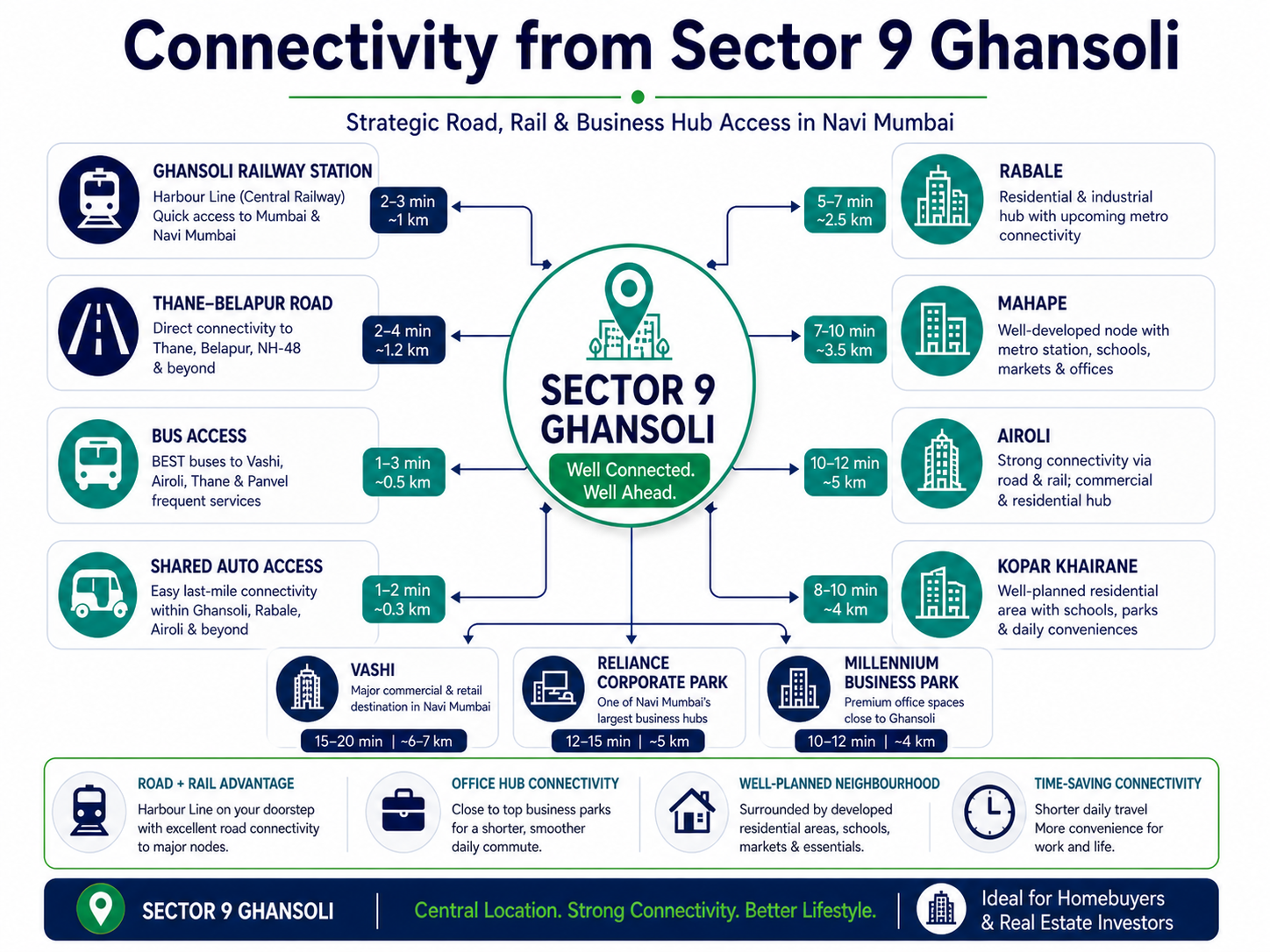
The single biggest connectivity advantage of Sector 9 is its relationship with Ghansoli Railway Station. Central Railway lists Ghansoli as station code GNSL, and the official Trans-Harbour timetable places it between Rabale and Kopar Khairane on the Thane-Vashi/Panvel suburban corridor. In practical terms, that gives residents direct local-train access toward Thane on one side and Vashi, Nerul, Belapur, and Panvel on the other.
The important caution is that “Sector 9 near station” is not one fixed distance. Some station-facing access points are only a short walk away, while deeper internal plots take longer. Route-app and area pages show everything from very close station-side access points to roughly 1 km-scale internal access, and one live project in the sector markets the station as about a 10-minute walk. So, for this sector, walking comfort depends heavily on your exact building gate, not just the sector number.
Bus access is stronger than many generic locality pages suggest. Current transit-route aggregators show Ghansoli Depot and Ghansoli station served by routes such as 10 to Sanpada, 18AC to Kharkopar/Ulwe side, 20AC to Nerul Sector 46/48, 50 to Panvel, 66 to Kalyan, and station-side links such as 4AC, 4EXAC, 7AC, 24AC, 27, and 29 around the Ghansoli corridor. Route patterns can change, but the broad takeaway is clear: Sector 9 is rail-led first, with meaningful NMMT-style bus support around the station/depot network. Autos remain the default last-mile mode for offices, internal sectors, and Thane-Belapur Road stretches.
If you are comparing commute patterns, the most useful internal companion reads would be the Ghansoli railway station guide and the Ghansoli area guide.
| Location | Approximate access from Sector 9 | Practical note |
|---|---|---|
| Ghansoli Railway Station | Short walk to around 1 km, depending on lane/plot | Station-side addresses are much closer than deeper internal pockets |
| Thane-Belapur Road | Short auto or bus hop | Main road advantage matters more for office commuters than for purely local users |
| Rabale | Around 3.29 km | Useful for TTC/MIDC-side work access |
| Kopar Khairane | Around 3.14 km | Good for alternate shopping and office catchment |
| Airoli | Around 5.25 km | Feasible for daily work commute |
| Vashi | Around 6.79 km | Easy by local train via Turbhe/Sanpada/Vashi side |
| Reliance Corporate Park area | Short commute from the Ghansoli station corridor | Strong demand driver for working professionals |
| Millennium Business Park side | Short road commute toward Mahape/Kopar Khairane | Important rental-demand anchor |
These are approximate locality and commute references, not fixed door-to-door timings. Route choice, traffic, the exact society gate, and whether you walk or take an auto can materially change the result.
Living experience and residential profile
Is Sector 9 Ghansoli good for living? For many households, yes. It works especially well for people who care about practical city living more than postcard-style uniformity. The sector has rail access, office catchment, schools, daily-need retail, and neighborhood services already in place. That makes it easier to live in than a purely speculative or still-forming micro-market.
The residential profile is clearly apartment-led. One major sector page shows 100% of current sale inventory as multistorey apartments, and project inventories on another major portal list a mix of ready and under-construction options, with 2 BHK as the most common configuration in active sale stock. Named sector projects repeatedly visible in current inventories include Shree Complex, Gami Satyam Skyscape, Trishul Gold Coast, Shri Omkar Society, Gharonda, Shree Ganesh CHS, and Bhoomi Oscar.
That mix matters. In Sector 9, you are not only comparing “1 BHK vs 2 BHK” or “new vs resale.” You are also comparing older society stock, gaon-adjacent pockets, and premium project addresses. A renter looking at a smaller flat in an older building will have a very different experience from a buyer looking at a larger tower apartment with parking, security, and society amenities.
For families, the main advantage is that the sector already has a neighborhood rhythm. Schools are inside or very close to the sector, daily shopping is not difficult, and public healthcare access is not far. For working professionals, the main attraction is simpler rail and road access to the broader Ghansoli-Rabale-Mahape office-industrial belt.
Safety, crowd, and cleanliness should be judged practically, not romantically. Sector 9 is generally more active than isolated because of school traffic, residential density, station spillover, and neighborhood retail. That usually helps day-to-day comfort, but some locality-review pages also flag frequent traffic jams and occasional power-cut complaints. Buyers and renters should therefore visit in the evening, check lane-level lighting and crowd conditions, and ask directly about inverter or society-backup support.
Parking and traffic are where micro-location becomes decisive. Premium towers and larger gated compounds usually manage parking better than older CHS buildings or tighter internal lanes, while busy school or shop stretches can feel more crowded at specific hours. If off-street parking is non-negotiable for you, do not rely on the sector name. Check the exact building allocation, visitor parking, and internal turning space.
Property market
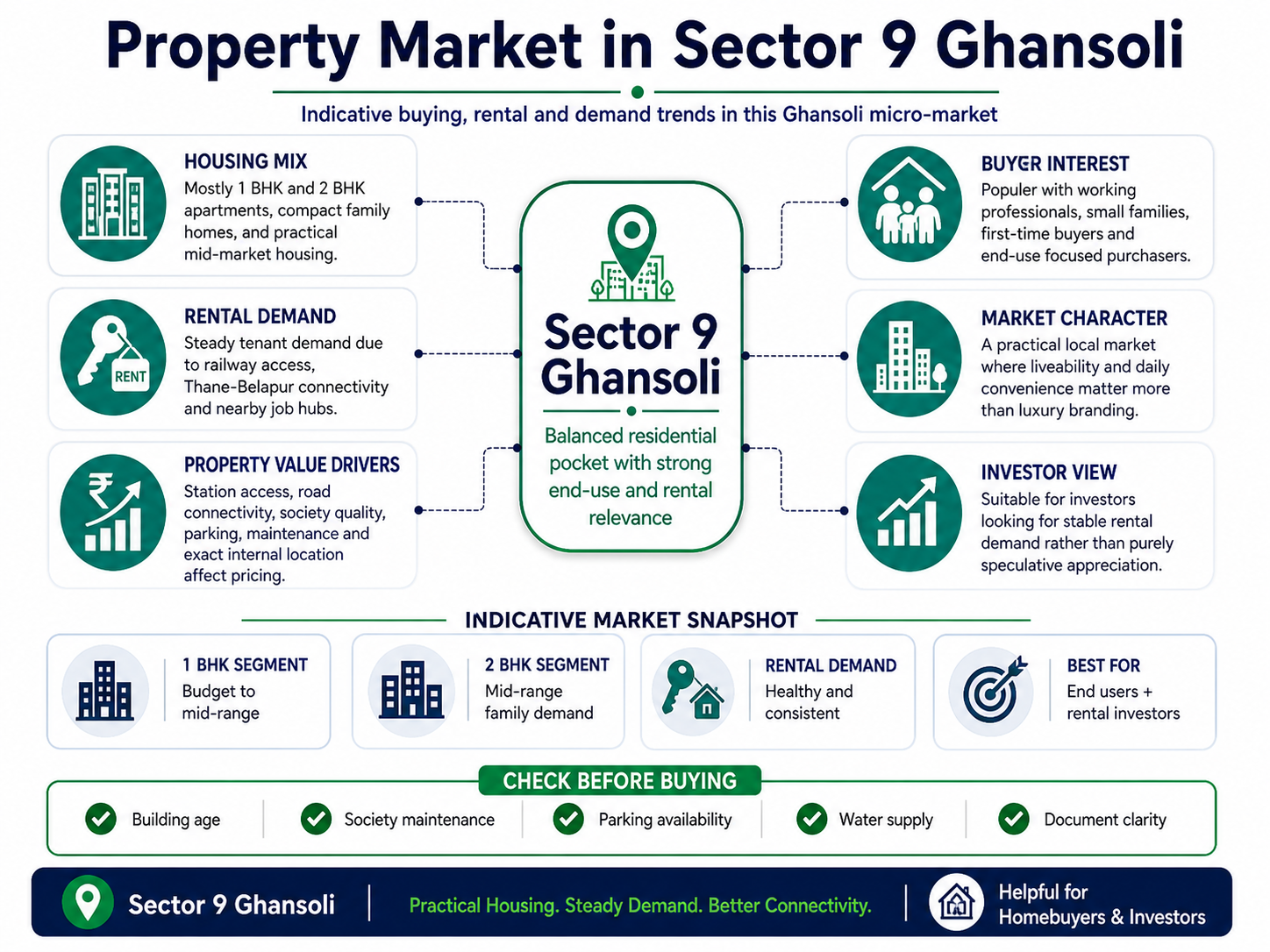
Sector 9 Ghansoli is not a one-rate market, and that remains the single most important property takeaway. Housing.com’s current 2026 Sector 9 price-trend page displays an average price indicator of about ₹16,759 per sq ft, with a listed range of approximately ₹13,589 to ₹24,615 per sq ft. Portal figures are indicative rather than a substitute for an actual negotiated transaction value, and the final price can vary significantly by building age, carpet area, floor, parking, amenities, condition and exact micro-location.
The unit-wise spread also supports that view. 99acres shows an average 1 BHK price around ₹95 lakh for the sector. Current 2 BHK sale listings in Housing broadly cluster around ₹1.8 crore to ₹2.2 crore in many better-known projects, with larger or newer offerings going up to around ₹2.6 crore. Current 3 BHK sale pages place much of the active quoting in roughly the ₹2.75 crore to ₹2.95 crore band. None of these numbers should be treated as final transaction truth; they are listing-led indicators, and actual deal values depend on carpet area, age, floor, parking, furnishing, amenities, maintenance, view, and legal clarity.
Rent follows the same pattern: there is a wide spread depending on configuration, building, furnishing and exact location. Current Housing.com listings show 1 BHK homes in Sector 9 at roughly ₹20,000 to ₹42,000 per month in the available sample, while current 2 BHK listings include examples around ₹55,000 per month. Current 3 BHK listings include examples around ₹75,000 per month. These are live listing indicators rather than fixed market averages, so tenants should compare similar carpet areas, furnishing levels, maintenance charges and building quality before judging whether a quoted rent is reasonable.
So, is Sector 9 better for end users or investors? The safer answer is: stronger for end users and selective long-term landlords than for pure speculation. The sector already has genuine rental demand because of train access and proximity to job anchors like Reliance Corporate Park and the Mahape-Kopar Khairane office belt around Millennium Business Park. At the same time, Housing’s own sector page shows a recent 5.27% year-on-year drop in its asking-rate trend, which is a useful reminder that this market does not move in a straight line. Buy because the building and price make sense, not because you assume automatic appreciation.
Future growth potential is real, but it should be framed carefully. Sector 9 already benefits from established connectivity, the wider Ghansoli employment catchment, and continuing developer interest. Current inventories show active under-construction supply in the sector, official environmental clearance records show residential-commercial development proposed on Plots 23 and 24, and current builder pages also show new tower-style positioning inside Sector 9. That supports continued market relevance. It does not guarantee rapid capital gains.
If you are in buying mode, the natural next internal reads are the Ghansoli property rates guide and the Navi Mumbai property buying guide. If you are renting, the Navi Mumbai rent guide is the more useful companion piece.
Before you commit to any Sector 9 property, check these five things carefully:
- the exact station walking route, not just map distance
- building age, lift condition, society maintenance, and water/power backup
- OC/CC status for completed buildings and registration/documents on the MahaRERA portal for under-construction stock
- stamp-duty valuation context through the official Inspector General of Registration Maharashtra eASR system
- parking allocation, road width, and evening traffic/noise at the exact gate.
Commercial activity and daily life
Sector 9 is mainly residential, not a pure office or high-street commercial district. Even so, it clearly supports neighborhood business demand. Current shop and commercial pages show active shop inventory in the sector, and live addresses confirm consumer-facing businesses operating out of society-linked commercial edges such as Bhagwati Complex and Trishul Gold Coast. That usually means demand is strongest for grocery, apparel, eyewear, clinics, cafés, takeaways, stationery, and daily-needs businesses rather than for formal office space.
That pattern is visible on the ground through current listing data. Examples include Cotton Culture in Bhagwati Complex, Lenskart in Trishul Gold Coast, Fun O Villa in Trishul Gold Coast, and Patil Dhaba in Bhoomi Oscar. For a small business owner, this is a good sign: the sector can generate walk-in, repeat, and resident-driven demand. The trade-off is that parking convenience for customers may not always match the demand potential.
Daily-life convenience is one of Sector 9’s genuine strengths. Local directories show multiple supermarkets and daily-need stores in the Ghansoli Sector 9 catchment, including options such as Shri Jagdamba Mart, Baba Ramdev Super Market, and Ayush Super Mart. For normal households, that means groceries, pharmacy runs, and routine shopping can usually be handled without a major drive. Larger-format shopping still tends to spill into the wider Ghansoli-Kopar Khairane belt.
Education access is stronger than many sector pages in Navi Mumbai. New Bombay City School is officially located at Plot No. 8, Sector 9 and is CBSE-affiliated. Nearby schooling and junior college options in wider Ghansoli include ASP Public School, Mother Teresa Convent School, and Tilak Junior College of Science and Commerce near the station side. This is one reason Sector 9 works credibly for families, not just bachelors or investors.
Healthcare also has both public and private support nearby. Official NMMC health records list an Urban Health Post at the NMMC F Ward Office in Ghansoli Gaon/Pragati Nagar and an Urban Primary Health Centre at Plot 239, Sector 4, Ghansoli. In the wider private-care catchment, directories repeatedly show names such as Ashirwad Hospital on the station side and other Ghansoli hospitals like Laxmi Hospital & ICU and Divine Multispeciality Hospital. That is enough for everyday access, although people with major tertiary-care preferences may still choose larger hospitals outside the immediate sector.
Food options are more practical than glamorous, which is exactly what many residents want. Sector 9 and its immediate edges show current eating options such as Fun O Villa and Patil Dhaba inside the sector, with Aadish Family Restaurant close by in the Jijamata Nagar/Sector 8 side. Around the station corridor, additional snack and quick-service options expand the daily-use food ecosystem.
For open space and walks, the most local green reference is Ghansoli Gharonda Sector 9 Children Park. A larger nearby option is Ghansoli Central Park near the station-side Sector 3 area. Neither turns Sector 9 into a leisure destination, but both improve everyday livability for children, walkers, and residents who want at least some open-space options close by.
Sector 9 also benefits from Ghansoli’s settled community fabric. Religious-place directories and map listings show easy access to neighborhood temples and community spaces in and around the sector, including Sai Baba Mandir in Sector 12, Ghansoli Dargah and Masjid on the Savoli side, the Santoshi Mata Mandir bus-stop area, and smaller temple pockets in Talvali/Jijamata Nagar. For many families, that contributes to the “settled residential area” feel that raw property portals often fail to explain.
Pros, cons and nearby comparisons
| Pros | Cons |
|---|---|
| Strong practical connectivity through Ghansoli station and bus/depot links | Station access is not equally easy from every lane or society |
| Good daily convenience for groceries, schools, clinics, and food | Traffic can build up at peak hours |
| Mixed housing stock gives buyers and renters more choice | Pricing is uneven because luxury towers and older stock sit in the same sector |
| Rental demand supported by office catchment and commuter appeal | Parking pressure can be real in tighter buildings and older lanes |
| Works for both families and professionals | Public sector-level data is still patchy, so building-level checking is essential |
This pros/cons view is based on current rail, civic, market-listing, and locality-review evidence, not on a single promoter pitch or one portal score.
Compared with more purely station-facing or Thane-Belapur-frontage pockets in Ghansoli, Sector 9 usually feels more residential first and commercial second. Compared with some newer premium clusters elsewhere in Ghansoli, it offers a wider budget spread because older CHS-style stock and new towers coexist. Compared with Rabale-side industrial influence, Sector 9 is more convincing for daily family convenience. Compared with Airoli, it may feel less uniform as a micro-market, but it stays highly relevant for people who work in the Ghansoli-Rabale-Mahape corridor.
Who should buy or rent here? Families who want schools and daily convenience. Working professionals employed in Ghansoli, Rabale, Mahape, Thane, Panvel-side, or Kalyan-connected commute chains. Buyers who are comfortable doing building-level due diligence. Landlords who want commuter-backed rental demand. Small shop operators who prefer resident-driven footfall over mall-style format.
Who may want to avoid it? People looking for a completely quiet premium enclave, guaranteed easy parking, or a totally uniform luxury market. Sector 9 is useful and practical, but it is not perfectly polished across every stretch.
If you are comparing nearby nodes, the most useful internal link opportunities here are the Airoli vs Ghansoli guide, the Kopar Khairane vs Ghansoli guide, and the broader Navi Mumbai localities comparison.
Conclusion
Sector 9 Ghansoli is a strong practical-choice sector rather than a hype sector. It is best for families, working professionals, and selective investors who value station access, daily convenience, and office-belt connectivity more than a perfectly uniform premium environment. It is less suitable for buyers who want guaranteed silence, effortless parking, or a one-rate market.
If you are buying, check the exact building, not just the sector. Confirm the real walking route to Ghansoli station, road width, parking, maintenance quality, OC/CC or other completion documents, and the legal/project trail on the MahaRERA and IGR Maharashtra systems where relevant. If you are renting, check building restrictions, furnishing, lift condition, backup power, and evening traffic/noise before finalising.
The cleanest conclusion is this: Sector 9 Ghansoli is better for informed end users and practical renters than for buyers who want to decide from a portal screenshot. The sector can work very well, but only after you verify the exact micro-location and the exact building.
FAQs
Frequently Asked Questions