
Sector 4 Ghansoli: Complete Location, Living, Property & Connectivity Guide
Sector 4 Ghansoli is a practical, mostly residential pocket of Ghansoli that works well for commuters, working professionals and buyers who want everyday convenience near station-side Ghansoli. Its biggest strengths are access to rail, local markets and nearby office belts. The trade-offs are typical for a busier inner pocket: parking can get tight, traffic can vary near approach roads, and pricing changes sharply from one building to another.
Sector 4 Ghansoli Overview
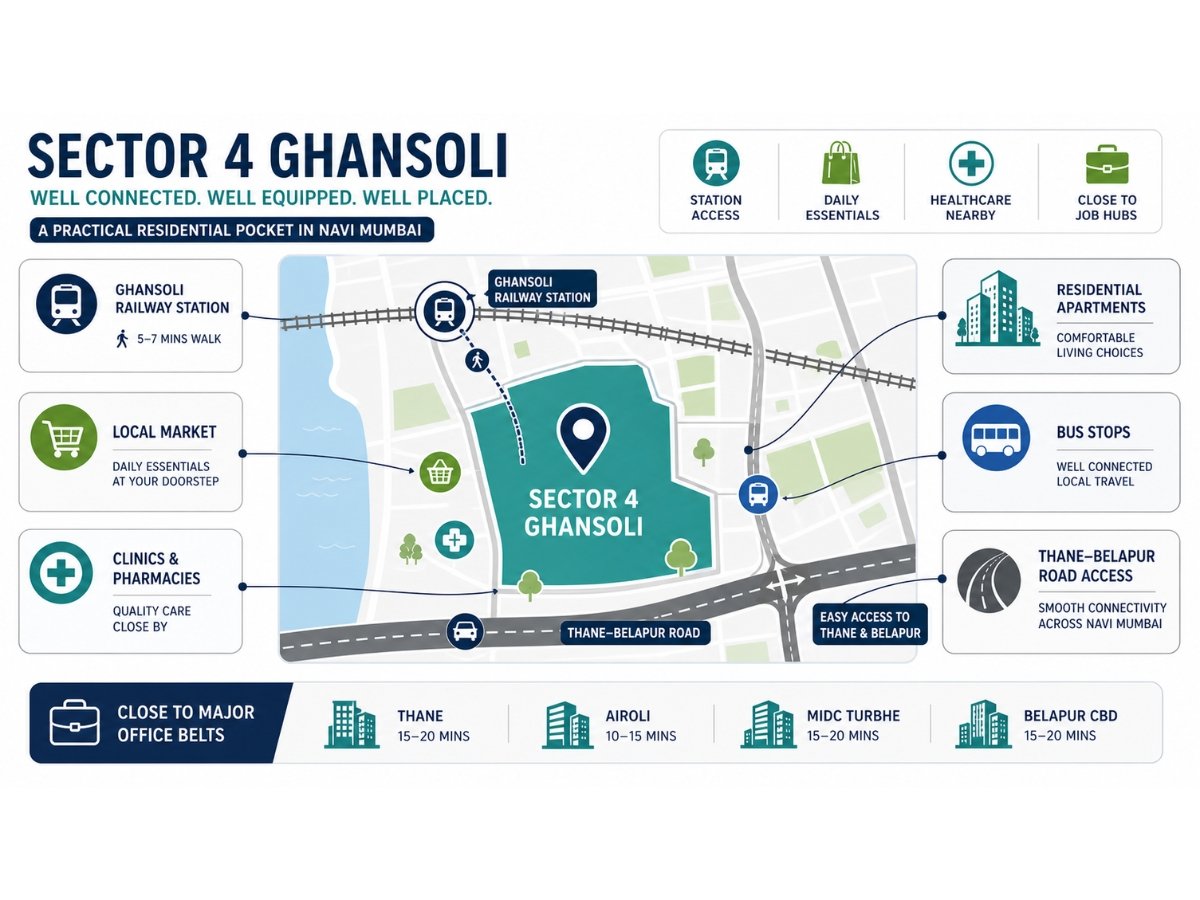
Public locality pages place Sector 4 as a sublocality within Ghansoli, while CIDCO’s Ghansoli nodal plan confirms Ghansoli as a formal Navi Mumbai node. On the civic side, Navi Mumbai Municipal Corporation operates the local ward framework and even lists an Urban Primary Health Centre for Ghansoli 4 at plot no. 239, Sector 4. That combination tells you something important: Sector 4 is not an isolated fringe patch, but a lived-in urban pocket with real civic and daily-use relevance.
A practical way to understand Sector 4 is this: it is more “useful Ghansoli” than “showpiece Ghansoli.” It sits in the part of the node where station access, local shops, clinics, market streets and work commutes matter more than skyline branding. Publicly available sector-level information for Sector 4 Ghansoli is still limited compared with broader Ghansoli locality pages, so buyers and renters should verify the exact building location, station access, parking, maintenance and legal paperwork before deciding.
Sector 4 Ghansoli Quick Summary
| Factor | Practical reading |
|---|---|
| Location type | Inner Ghansoli residential pocket with local market activity |
| Best suited for | Commuters, office-goers, practical end users, some rental investors |
| Connectivity | Strong rail-plus-road advantage for daily travel within Navi Mumbai |
| Railway access | Usually manageable for a walk or short auto ride, depending on the exact building |
| Road access | Good access toward Thane-Belapur Road and Ghansoli station-side routes |
| Residential character | Mixed apartment stock; not every building is part of premium new-tower Ghansoli |
| Commercial activity | Mostly neighborhood-serving shops, food outlets, clinics and services |
| Property market | Mid-market to upper-mid-market, with noticeable building-to-building variation |
| Rent demand | Supported by station access and nearby job hubs |
| Daily convenience | Strong for groceries, clinics, small eateries and routine errands |
| Main cautions | Parking, lane-level crowding, traffic near main approach roads, uneven building quality |
This summary is based on current sector-level property pages, official rail and civic references, and public map data for Sector 4 services and roads.
Where Is Sector 4 Ghansoli Located?
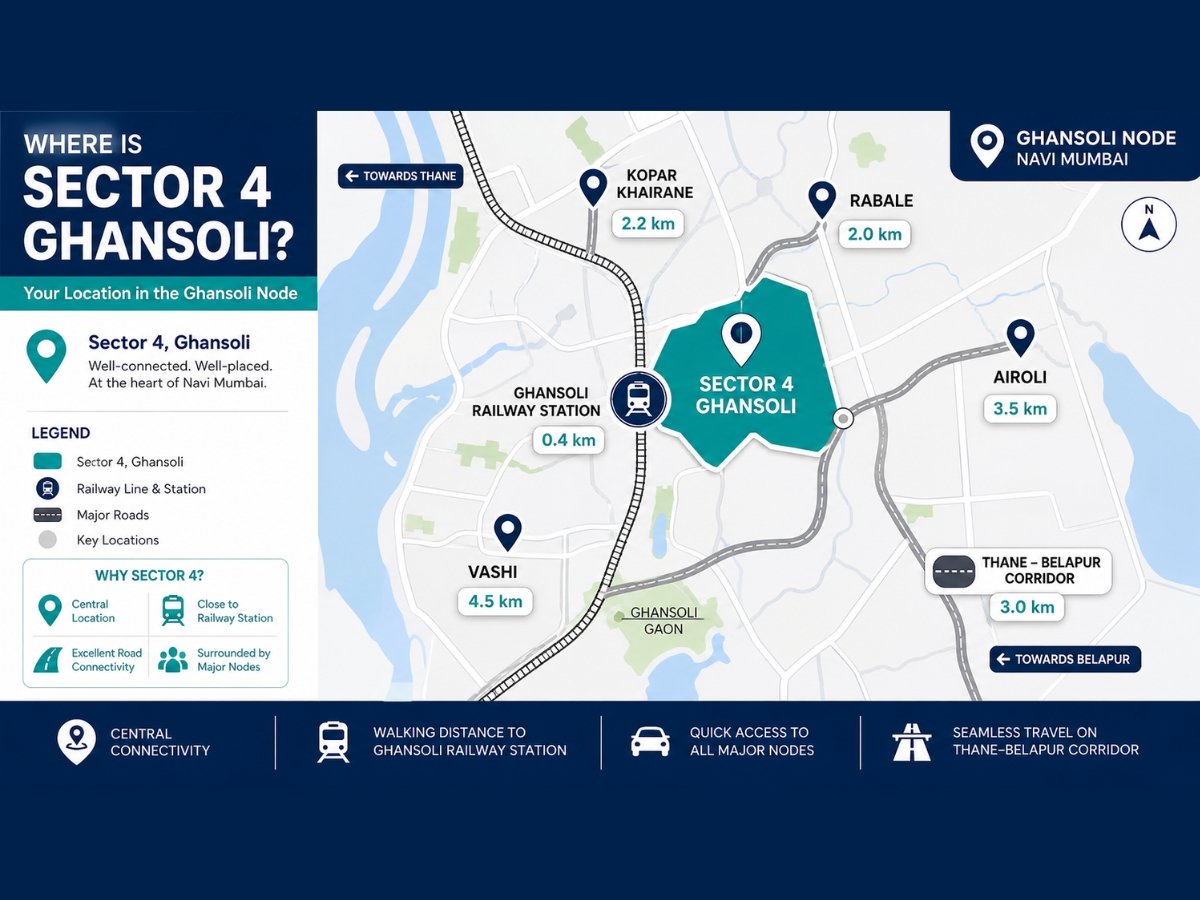
Sector 4 sits within Ghansoli and appears closely tied to Station Road, Sector 3 Road and Savali/Savoli-side addresses in public map listings. Housing’s locality page places Sector 4 within Ghansoli and shows nearby references such as Kopar Khairane at about 3.14 km, Rabale at about 3.29 km, Airoli at about 5.25 km and Vashi at about 6.79 km. In everyday terms, that means Sector 4 is in a useful middle zone for local rail travel and for road movement toward Rabale, Kopar Khairane, Mahape and the wider Thane-Belapur corridor.
For readers trying to place it on the ground, Sector 4 is better understood as a station-influenced Ghansoli pocket rather than a far interior sector. Public map results show Ghansoli Market inside Sector 4, several Sector 4 bus-stop references and multiple health and school addresses within the same sector grid.
What Makes Sector 4 Ghansoli Different from Other Ghansoli Sectors?
The biggest difference is character. Sector 4 is more practical and day-to-day than image-heavy. It is tied to station-side movement, local shopping and routine services, while some newer Ghansoli pockets closer to major corporate campuses or more recent tower clusters can feel more premium and amenity-led. Sector 4 therefore appeals to people who care more about getting around easily than about buying into the most polished version of the Ghansoli brand.
Portal data also hints at this difference. Housing’s current tracker shows Sector 4 listed prices starting around ₹12,087 per sq ft with an average of about ₹16,649 per sq ft, while broader Ghansoli flat transaction averages on 99acres sit much higher. That does not mean Sector 4 is “cheap” or “undervalued” in a simple way; it usually means stock in Sector 4 is more mixed, older in parts, and less uniformly premium than some higher-ticket pockets elsewhere in Ghansoli.
Connectivity from Sector 4 Ghansoli
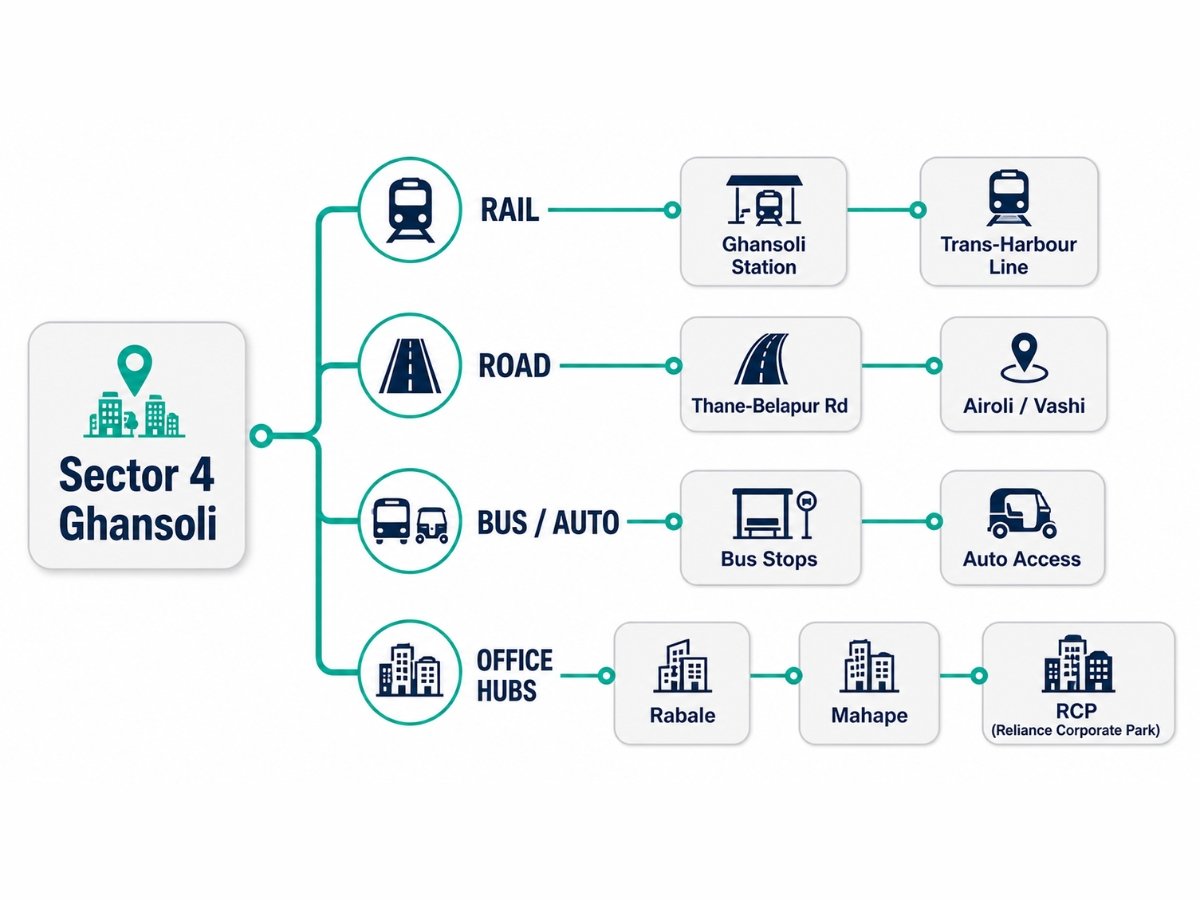
Rail connectivity is the headline advantage. The Central Railway suburban timetable confirms Ghansoli on the Trans-Harbour corridor serving the Thane-Vashi/Panvel side of Navi Mumbai movement. For daily commuters, that is a real advantage because it connects the sector to the broader suburban network without needing to rely entirely on road travel.
Road connectivity is the second strength. Ghansoli’s office influence comes heavily from the Thane-Belapur Road belt, including Reliance Corporate Park in Ghansoli and Millennium Business Park in Mahape. Sector 4 benefits from being close enough to these job hubs for bus, auto and short road commutes, even if your exact travel time still depends on the lane you start from and the main-road traffic that day.
Bus and auto-rickshaw use remain important. NMMC’s official BusTracker app provides live bus schedule and vehicle data, while public route trackers show Ghansoli Depot links to corridors such as Panvel, Sanpada and Thane-side travel. In practice, many Sector 4 residents will combine walking, auto-rickshaw and bus depending on the building location and office destination.
Nearby Railway Station, Bus Stops and Main Roads
The most relevant railhead is Ghansoli Railway Station. Central Railway’s official suburban timetable confirms Ghansoli as a working stop on the Trans-Harbour line, and public map data shows Sector 4 addresses sitting close to station-side roads and bus-access points. In plain language, this is one of the reasons Sector 4 remains practical even when it is not the flashiest Ghansoli submarket.
For buses, public map listings show bus-stop references on Sector 4 itself, Sector 3 Road and Ghansoli Station Road. Route aggregators also show Ghansoli Depot-based services running toward Panvel, Sanpada and Thane-side corridors. Current operations can change, so residents should treat the NMMT BusTracker app as the best live check before depending on any one route.
The main road logic is straightforward: internal roads feed into station-side movement and then out toward Thane-Belapur Road. That helps for office commutes, but it also means traffic conditions near the road approach are a real due-diligence point.
Distance from Sector 4 Ghansoli to Important Navi Mumbai Locations
| Location | Approximate access | Practical note |
|---|---|---|
| Ghansoli Railway Station | Around 0.8 to 1.5 km, depending on the exact building | Often walkable from some pockets; elsewhere a short auto ride is easier |
| Thane-Belapur Road | Roughly 0.5 to 1.5 km, depending on route | Main road access matters more than raw distance |
| Kopar Khairane | Around 3.1 km | Useful for schools, shopping and office movement southward |
| Rabale | Around 3.3 km | Important for industrial and office-side travel |
| Airoli | Around 5.2 km | Reasonable for cross-node commuting |
| Vashi | Around 6.8 km | Train or road, depending on destination and peak-hour traffic |
| Reliance Corporate Park | Roughly 1 to 3 km, depending on gate and route | One of the biggest demand drivers for rentals nearby |
| Millennium Business Park, Mahape | Roughly 4 to 6 km, depending on route | Common short office commute by road or auto |
These are practical approximations compiled from sector/locality pages and public map references, not guaranteed door-to-door measurements. Traffic, one-way patterns and building entrance location can change the real experience.
Is Sector 4 Ghansoli Good for Living?
Yes, for the right type of resident. Sector 4 is good for living if you want practical Ghansoli: rail access, routine shopping, clinics, a working local market and reasonable access to nearby office districts. It is less ideal if your top priority is a quiet, wide-road, low-crowd lifestyle or a fully premium gated-tower environment in every lane.
For working professionals, the key advantage is commute efficiency. For families, the key question is building quality and daily comfort: parking, maintenance, lift condition, school pickup, grocery access and how noisy the lane feels during evening hours.
Living Experience in Sector 4 Ghansoli
The living experience is usually convenience-led. Ghansoli Market is in Sector 4 itself, small-format food and tea options are visible on public maps, and clinics plus municipal health access are nearby. That makes the sector strong for everyday living even if it does not always offer the landscaped, master-planned feel some buyers associate with newer Ghansoli towers.
Walkability is decent in the “daily errand” sense, especially if your building sits close to the station-side grid. But walkability quality is not uniform. Some routes are more functional than pleasant, and the exact building approach can change your experience a lot. That is why one building visit is never enough; the lane matters almost as much as the flat.
Residential Profile of Sector 4 Ghansoli
Current public inventory suggests a mainly apartment-led residential market. Housing’s Sector 4 page shows active sale and rent inventory across 1 BHK, 2 BHK and 3 BHK configurations, and recent rental ads reinforce that mix. There is no strong public signal that Sector 4 is dominated by large bungalows or by a heavy under-construction pipeline inside the sector itself.
That matters because apartment-led sectors usually behave differently in pricing and livability. Maintenance standards, society management, lift quality, security, parking rules and water arrangement can make two nearby properties feel like different micro-markets.
Residential Areas, Societies and Housing Type
Public rent listings currently show examples such as Alliance One and Neel Sidhi Anexo in Sector 4. At the same time, sector-level map data shows hospitals, market streets, schools and other smaller plot-based properties within the same sector. That strongly suggests Sector 4 is not one uniform society cluster, but a mixed sector with both larger residential projects and smaller standalone or co-operative building formats.
If you are considering any under-construction or recently launched property, verify it project-by-project on the official MahaRERA search portal rather than assuming the whole sector has the same legal or construction status.
Property Rates in Sector 4 Ghansoli
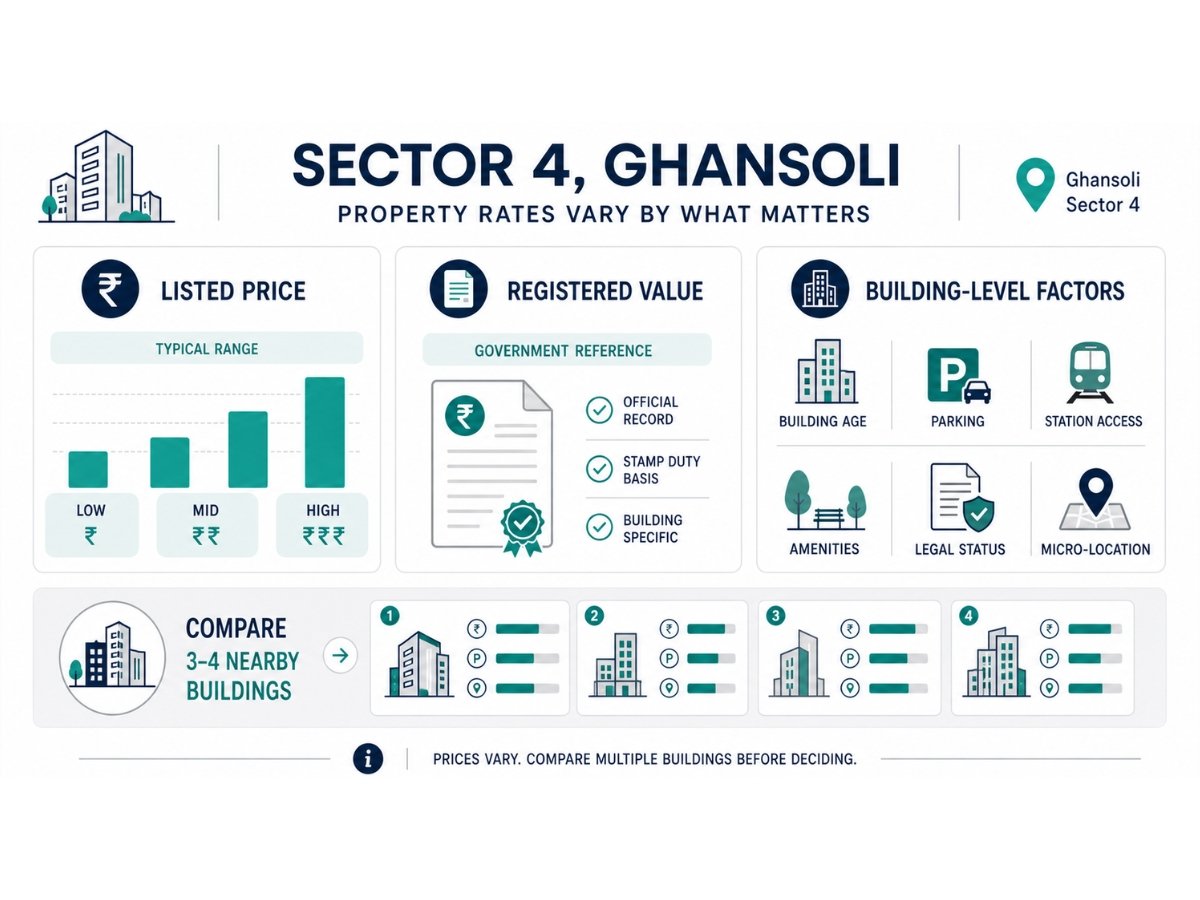
Sector-level price data needs careful reading. Housing’s current price-trend page for Sector 4 shows listed prices starting around ₹12,087 per sq ft, an average around ₹16,649 per sq ft and top asks around ₹20,000 per sq ft. Square Yards’ government-registration dashboard, however, shows 429 sales transactions in Sector 4 from Apr 2025 to Mar 2026 at an average registered rate of about ₹9,050 per sq ft. On top of that, 99acres shows a much higher broader Ghansoli flat transaction average. These figures are not interchangeable. Asking prices, registered values, carpet/built-up treatment and asset mix can all differ.
The safest reading is this: Sector 4 is not a fixed-rate market. It is a mixed market. Actual sale values can move significantly based on exact micro-location, building age, carpet area, floor, parking, furnishings, society upkeep, amenities, road width, station convenience, view, OC/CC position where relevant, and the legal quality of the title documents. Buyers should compare at least three or four nearby buildings rather than applying one sector average blindly.
For government valuation context, Maharashtra’s official eASR/ASR system remains the proper benchmark for ready reckoner valuation, and the state kept ready reckoner rates unchanged for FY 2026-27. That affects stamp-duty valuation logic, but it should not be confused with actual market asking prices in a specific building.
Rent Prices in Sector 4 Ghansoli
Rental data also varies by building type. Housing’s current sector pages indicate average rents of roughly ₹40,666 for 1 BHK, about ₹51,133 for 2 BHK and around ₹55,000 for 3 BHK in Sector 4. Those are portal averages from a relatively small listing pool, so use them as directional indicators, not as fixed rent quotes.
Current public ads show why the spread is wide. In recent listings, 1 BHK homes in Sector 4 are shown around ₹40,000 to ₹45,000, while 2 BHK listings stretch from the high ₹30,000s to ₹75,000 depending on furnishing, amenities and building profile. Many of the higher-end asks cluster around projects like Alliance One, while more basic stock sits lower. That gap is exactly why renters must compare like-for-like homes rather than headline BHK alone.
Rent also changes based on family-only vs bachelor-friendly rules, furnishing level, parking inclusion, lift/security standards, office-hub proximity and how close the building is to the easiest station approach.
Is Sector 4 Ghansoli Better for End Users or Investors?
Sector 4 looks stronger for end users and practical rental investors than for pure speculation. The real demand here comes from utility: station access, Ghansoli office influence, nearby job hubs and easy daily living. That can support occupancy and resale liquidity, but it does not mean every building or every entry price is attractive.
For investors, the better angle is usually tenant demand from working professionals rather than a guaranteed capital-growth story. For end users, the better angle is convenience-led living with realistic expectations about parking, crowding and mixed building quality.
Commercial and Business Activity in Sector 4 Ghansoli
Sector 4 is not the main office district. Its business activity is more neighborhood-serving: market trade, eateries, clinics, small services and convenience retail. The bigger office pull sits outside the sector proper in Reliance Corporate Park and the Mahape business belt.
That is actually useful for many residents. It means you get commercial convenience without living inside a full-scale commercial business park. But it also means anyone planning a large-format retail or office lease inside Sector 4 should study footfall, parking and frontage very carefully.
Shops, Offices and Local Business Demand in Sector 4 Ghansoli
Local shop demand in Sector 4 is easier to justify than large office demand. A sector with its own market, bus stops, station-side access and dense apartment catchment usually supports groceries, pharmacies, clinics, snack counters, tiffin-led businesses and day-to-day services better than pure office inventory.
If you are evaluating a shop, check three things before anything else: customer parking, actual evening footfall and whether the frontage is on a through-route or a dead lane. In a sector like this, those factors can matter more than carpet area on paper.
Daily Life, Markets and Essential Services
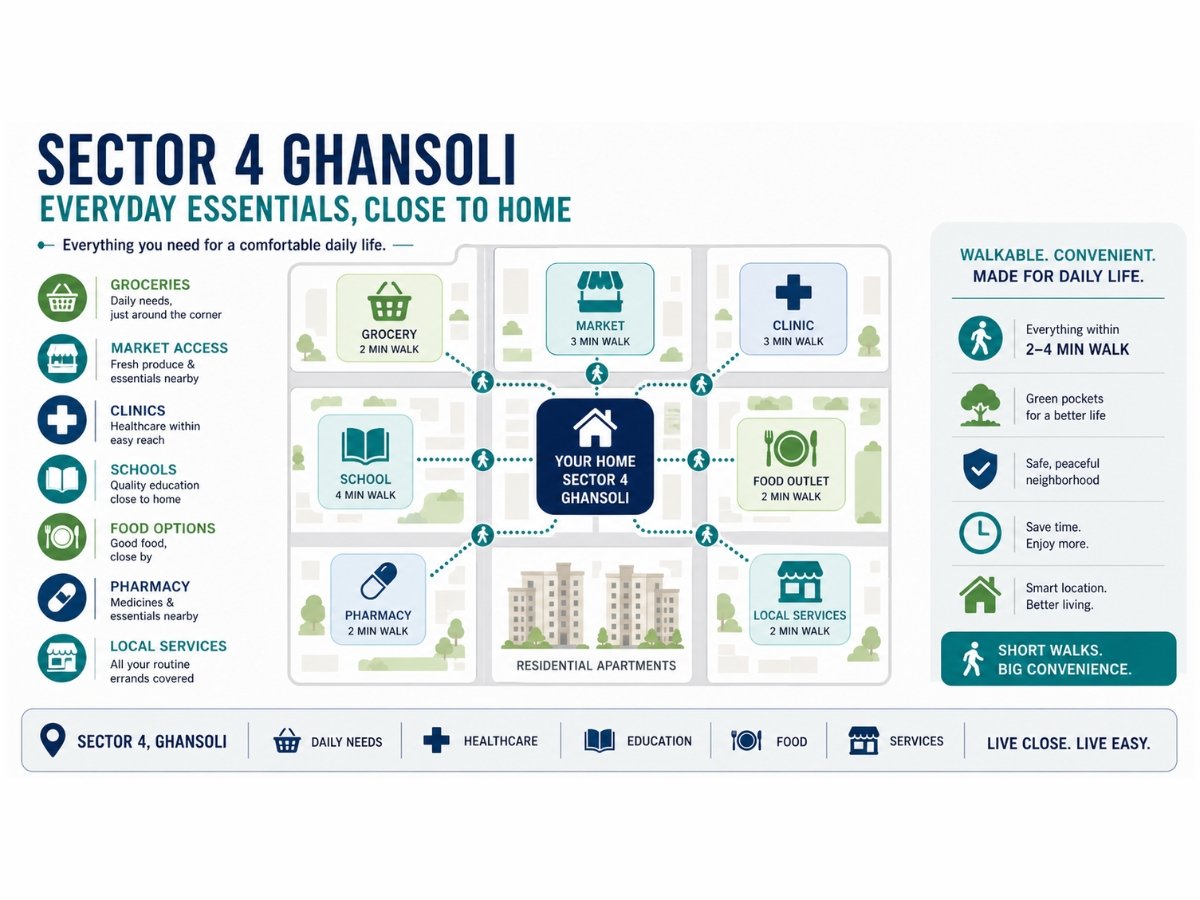
Daily life is one of Sector 4’s strongest points. Between market access, local food options, clinics, diagnostics and the municipal health presence, most regular errands can be handled within the broader station-side Ghansoli grid without long detours.
That makes Sector 4 especially practical for households that value routine convenience over lifestyle branding. If your daily pattern includes train travel, quick groceries, medical access and food pickups, Sector 4 makes more sense than many prettier but more inconvenient pockets.
Grocery Stores, Markets and Daily Need Shops
Map data places Ghansoli Market directly in Sector 4, and public listings also show daily-need retail such as dairy, supermarkets and grocery-oriented outlets in or around the sector. This is a genuine strength because it reduces dependence on long drives for routine household needs.
For bigger format shopping, residents may still head to larger Ghansoli or Kopar Khairane options depending on preference. But for normal weekly living, Sector 4 appears well covered.
Schools, Colleges and Education Options Near Sector 4 Ghansoli
Public map data confirms K. Balaji Aanbo Patil Vidyalaya in Sector 4 itself, while broader Ghansoli locality references and school directories point to schools such as ASP Public School in nearby Ghansoli sectors. This means Sector 4 does offer education access, but the right choice depends more on the exact age group, board, pickup route and traffic pattern than on the sector label alone.
For families, the practical check is not just “Is there a school nearby?” It is “How difficult is the actual daily drop route from this specific building at school timing?” That answer can change from one lane to the next.
Hospitals, Clinics and Healthcare Facilities Near Sector 4 Ghansoli
This section is stronger than many buyers expect. NMMC’s health department directory specifically lists Urban Primary Health Centre Ghansoli 4 at plot no. 239, Sector 4, Ghansoli. Public map data also shows healthcare points inside Sector 4, including Pushpanjali Hospital and Apurva Multispeciality Hospital, along with nearby diagnostics and clinics.
For routine care, that is useful. For specialist or tertiary treatment, many residents will still compare options across the wider Ghansoli, Kopar Khairane, Rabale and Vashi belt depending on the case.
Restaurants, Cafes and Food Options Near Sector 4 Ghansoli
Public map searches show a steady cluster of food options around Sector 4 and the Ghansoli station side, including tea/snack outlets and casual restaurants. Examples visible in public map data include Pandarpuri Chai, Thotay Bakery, Creamy & Spicy, Gokul Restaurant and The Mint Leaf Kitchen & Lounge. That tells you Sector 4 is convenient for everyday eating out, takeaways and quick meetups.
This is not a destination dining district in the same way as some larger Navi Mumbai food clusters. It is a functional, resident-serving food ecosystem, which usually matters more for actual living.
Parks, Walking Areas and Lifestyle Facilities Around Sector 4 Ghansoli
The most relevant nearby open-space reference is Ghansoli Central Park in Sector 3, which public listings and attraction pages place close to the station-side sectors. For many Sector 4 residents, this is the obvious nearby option for walks, light recreation and children’s outdoor time.
Lifestyle quality beyond that depends heavily on the society. In Sector 4, society amenities can vary more than locality marketing suggests. Some buildings offer a basic practical setup; some larger projects offer much more.
Temples, Community Spaces and Spiritual Places Near Sector 4 Ghansoli
Public map data identifies Sai Kuldaubat Mandir in Sector 4, and station-side Ghansoli has the normal spread of neighborhood religious spaces and community points seen in older lived-in sectors. That usually supports community familiarity and daily foot movement, though the exact community feel is still building-specific and lane-specific.
Safety, Crowd and Cleanliness in Sector 4 Ghansoli
Sector 4 is generally better described as active than isolated. Its market, local services and station-side access create natural movement through the area, which many households prefer over quieter but less connected pockets. But crowd level, lighting and cleanliness can still change noticeably between market edges, bus-stop areas and inner residential lanes.
No sector-level article should promise blanket safety. The practical approach is simple: visit once in the evening, once on a weekday morning and, if possible, once during the monsoon. That tells you far more than any brochure summary.
Parking and Traffic Situation in Sector 4 Ghansoli
Parking is one of the biggest building-specific issues here. Public map results show parking references inside Sector 4, but that does not mean every society has easy resident parking or good visitor parking. In station-influenced sectors, the difference between “manageable” and “frustrating” parking often comes down to the exact society arrangement.
Road traffic is the other caution. The closer your routine depends on Thane-Belapur Road, the more you should assume variability. Recent reporting on the corridor points to pothole-related slowdowns and ongoing construction-linked congestion in the wider Thane-Belapur system, especially around Turbhe-side works. Sector 4 residents are not stuck there all the time, but car commuters should budget for inconsistency rather than assume clean exits every day.
Pros and Cons of Living in Sector 4 Ghansoli
| Pros | Cons |
|---|---|
| Good day-to-day convenience for groceries, clinics and local food | Parking pressure can vary sharply by society |
| Useful rail access through Ghansoli station-side movement | Main-road traffic can affect car commutes |
| Strong relevance for office-goers in Ghansoli, Rabale and Mahape | Not every building has premium amenities or uniform maintenance |
| Can be more practical than higher-ticket Ghansoli pockets | Some lanes feel busier and more functional than polished |
| Real rental demand support from nearby employment hubs | Property and rent data varies widely, so quoting one average can mislead |
This pros-and-cons view is based on station access, market presence, civic health access, nearby office influence, current rent listings and road-condition reporting.
Sector 4 Ghansoli vs Nearby Ghansoli Sectors
Sector 4 is better for people who want practical access. Some other Ghansoli sectors are stronger for newer tower inventory, larger society amenities or a more purely residential look-and-feel. Sector 4 sits closer to the “commute plus convenience” end of the Ghansoli spectrum.
If you are comparing sectors, the right benchmark is not only price per sq ft. Compare four things together: station approach, office commute, building age and daily errand convenience. Sector 4 often performs well on the first three practical items even when it is not the most aspirational-looking option on a map.
If you are making a wider decision, also compare the Ghansoli area guide, Ghansoli property rates guide, Ghansoli railway station guide, Navi Mumbai rent guide, Airoli vs Ghansoli guide and Kopar Khairane vs Ghansoli guide before deciding.
Who Should Buy or Rent in Sector 4 Ghansoli?
Sector 4 makes the most sense for commuters using the Trans-Harbour line, employees in the Ghansoli-Rabale-Mahape office belt, smaller families who value routine convenience, and buyers who prefer a practical mid-market pocket over an overhyped address.
It may suit investors looking for working-professional rental demand, but only if the entry price is sensible and the building is actually tenant-friendly. It may suit families if the exact building has decent parking, maintenance and school access. It may not suit buyers whose priority is low-density quiet, very wide internal roads, or a fully premium club-lifestyle tower atmosphere in every part of the sector.
Future Growth Potential of Sector 4 Ghansoli
Sector 4’s future case is grounded more in existing demand than in speculation. The fundamentals are already visible: Trans-Harbour line access, road connection to the Thane-Belapur corridor, proximity to major employment hubs, and rental pull from nearby offices. Those are stronger and more reliable than any flashy “boom” claim.
Broad Ghansoli also has supportive city-level developments in the pipeline or budget focus. Recent NMMC budget reporting pointed to the Palm Beach elevated road extension in the Ghansoli-Airoli corridor, and Ghansoli Sector 13 received budget allocation for a major sports complex. These can help the wider node over time, but the benefit to Sector 4 will still depend on your exact building, lane access and what you pay today.
Conclusion on Sector 4 Ghansoli
Sector 4 Ghansoli is one of those sectors that makes more sense after you strip away the marketing language. It is a practical, station-influenced, convenience-led Ghansoli pocket that suits commuters, working professionals, practical end users and some rental investors better than it suits prestige-focused buyers. Its strengths are real: railway access, daily shopping convenience, nearby healthcare, and fast relevance to the Ghansoli-Rabale-Mahape work belt.
Who should consider it:
- Buyers who want practical Ghansoli rather than only premium-tower Ghansoli
- Renters who care about commute efficiency and daily convenience
- Investors targeting working-professional rental demand
Who may avoid it:
- Buyers who want uniformly quiet streets and easier parking everywhere
- Families who need a clearly premium gated-lifestyle environment
- Anyone tempted to overpay based on broad Ghansoli branding without checking the exact building
What to check before buying:
- Exact walking route to the station
- Access to Thane-Belapur Road
- Parking allocation and visitor parking reality
- Society maintenance, lift quality and security
- Water setup and building age
- OC/CC and title documentation
- MahaRERA status if the property is under construction or very new
What to check before renting:
- Real commute time in peak hours
- Noise near the lane and building entrance
- Rent-agreement terms and deposit
- Bachelor/family restrictions if relevant
- Furnishing vs maintenance trade-off
- Evening crowd and parking behavior around the building
The main caution is simple: do not judge Sector 4 Ghansoli by one listing, one price quote or one afternoon visit. This is a micro-market where the exact building can matter almost as much as the sector itself. The next immediate action is to short-list two or three exact buildings, test the station walk, test evening parking, and then compare the deal against your other Ghansoli options.
FAQs
Frequently Asked Questions