

Navi Mumbai IT Hubs Property Impact: Where Demand Rises and What Buyers Must Verify
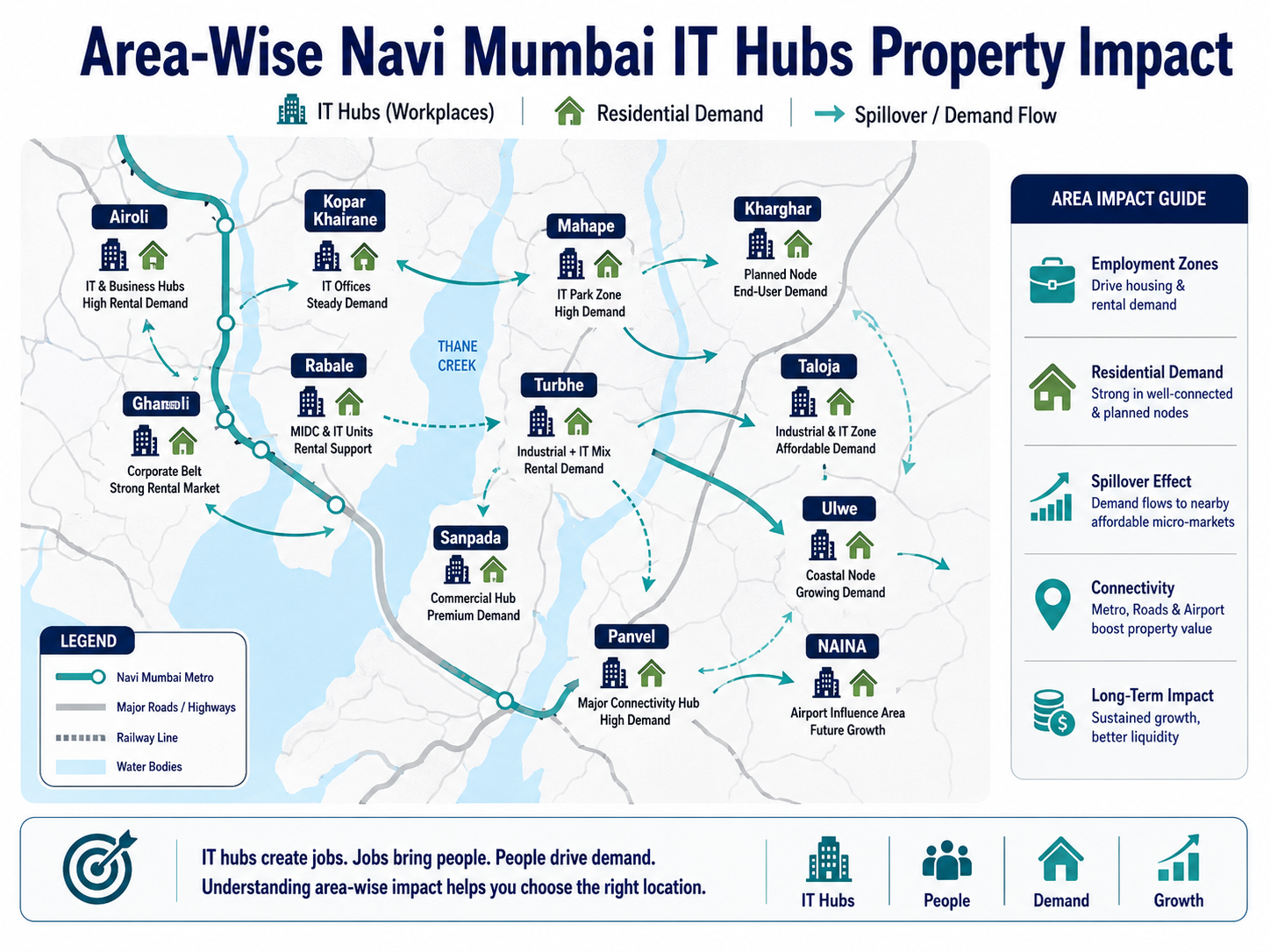
The Navi Mumbai IT hubs property impact is strongest around Airoli, Ghansoli, Kopar Khairane, Rabale, Mahape and Turbhe because these areas are closer to major office and industrial employment zones. Spillover demand can also reach Kharghar, Taloja, Ulwe, Panvel and NAINA. But IT demand alone does not make a property safe. Always verify title, RERA, land records, approvals, NA status, CRZ risk and OC before token money.
Disclaimer: This is an educational guide. Verify the latest position with the relevant authority or a property lawyer before making a transaction.
Why IT Hubs Matter in Navi Mumbai
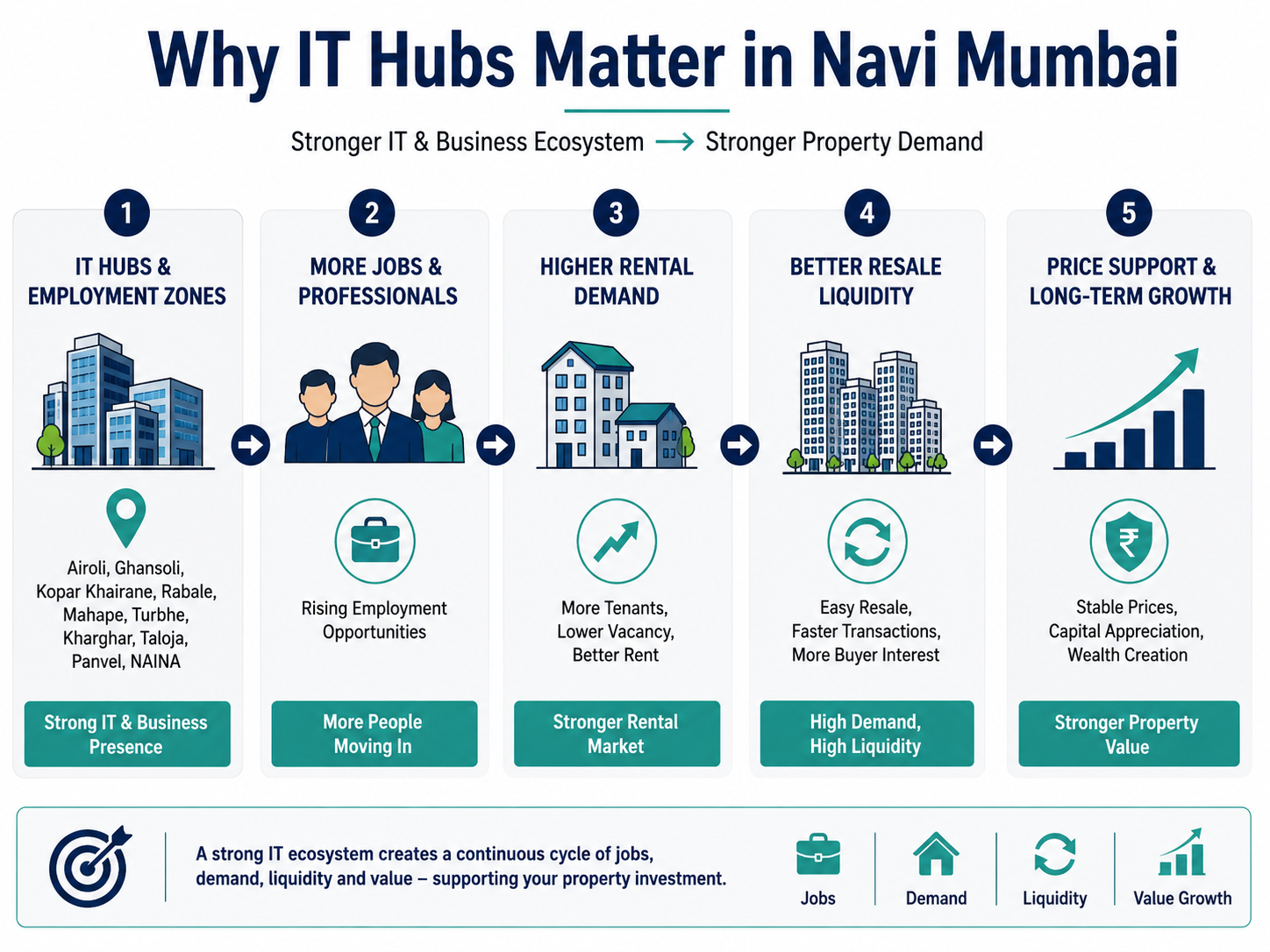
IT hubs affect property in a simple way.
More offices create more jobs. More jobs create rental demand. Rental demand improves resale liquidity. Better liquidity can support price premiums in areas with good commute, railway access, road access, and liveable housing stock.
This is why Airoli, Ghansoli, Kopar Khairane, Rabale, Mahape, Turbhe and Sanpada often come into the discussion when buyers search for residential areas near IT hubs in Navi Mumbai.
For the bigger corridor view, internally link to Navi Mumbai employment hubs real estate impact.
But there is one mistake buyers make.
They assume “near IT hub” automatically means “safe investment.”
That is wrong.
A good property near an IT hub must pass two tests:
| Test | What it means |
|---|---|
| Demand test | Will tenants, end-users or resale buyers want this location? |
| Document test | Is the title, approval, land use and construction status safe enough to proceed? |
If either test fails, the buyer should pause.
Area-Wise Navi Mumbai IT Hubs Property Impact
| IT / employment zone | Better-fit residential areas | Likely property impact | Main caution |
|---|---|---|---|
| Airoli | Airoli, Ghansoli, Kopar Khairane, Thane edge | Strong rental and end-user demand from IT employees | Price premium, older buildings, OC and society documents |
| Ghansoli | Ghansoli, Kopar Khairane, Airoli | Practical residential belt for IT and corporate employees | Check title, OC, society records and redevelopment risk |
| Rabale / Mahape | Rabale, Ghansoli, Kopar Khairane, Mahape-side pockets | Demand from IT, ITeS, data centre, MIDC and corporate activity | Industrial traffic, leasehold/MIDC restrictions, permitted use |
| Turbhe / Sanpada / Vashi | Sanpada, Vashi, Juinagar, Turbhe | Mature connectivity and office/industrial access | Older buildings, structural condition, OC, society conveyance |
| Kharghar / Taloja | Kharghar, Taloja, Roadpali, Kalamboli | Budget spillover from job hubs and future connectivity | Commute, approvals, land use, construction quality |
| Ulwe / Panvel / Pushpak / NAINA | Ulwe, Panvel, Pushpak Node, NAINA villages | Future demand linked to airport, logistics and planning zones | NAINA zoning, TPS, title, access road, NA, CRZ, reservations |
For deeper micro-market articles, internally link to Airoli IT Park real estate impact, Ghansoli IT corridor property impact, and Rabale MIDC property impact.
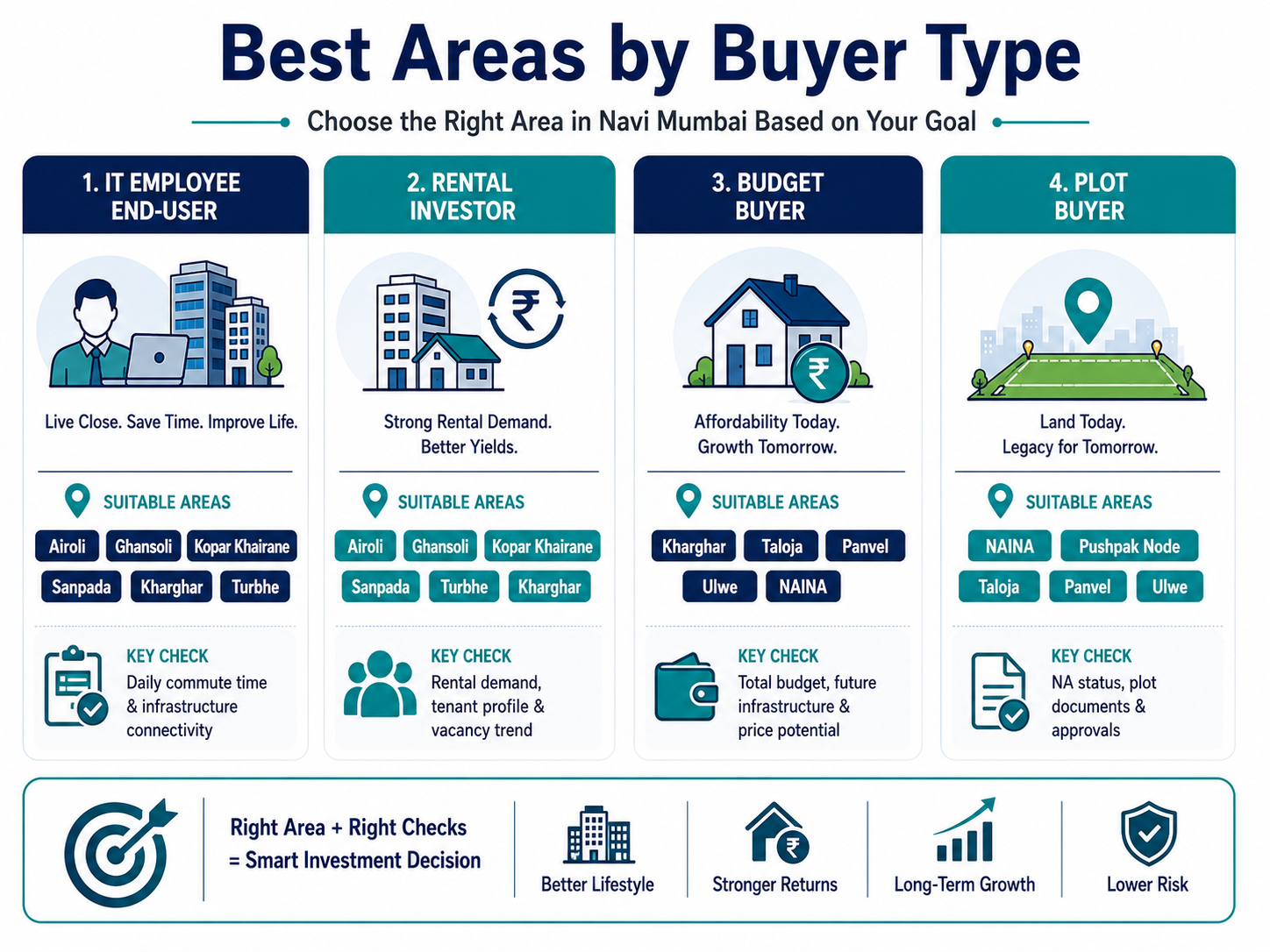
Best Areas by Buyer Type
| Buyer type | Better-fit areas | Why | Main check |
|---|---|---|---|
| IT employee end-user | Airoli, Ghansoli, Kopar Khairane, Sanpada | Shorter commute to office zones | OC, title, society records |
| Rental investor | Airoli, Ghansoli, Kopar Khairane, Mahape-side pockets | Regular tenant demand | Do not overpay only because of “IT hub” branding |
| Budget buyer | Kharghar, Taloja, Kalamboli, Panvel | More affordable than core IT belt | Commute time, RERA, approvals |
| Plot buyer | NAINA, Panvel, Pushpak-side, selected Raigad belts | Long-term planning story | Title, 7/12, ZCS, TPS, NA, access road |
| NRI buyer | RERA projects in established nodes | Easier verification and rental management | Lawyer review, POA, tax and possession documents |
For rental-focused decisions, internally link to employment impact on rental demand Navi Mumbai.
Documents to Check Before Trusting the IT Hub Story
Employment demand can increase interest in a location. It cannot clean a bad title.
Before paying token, check documents based on the property type.
For flats and apartments
Check:
- MahaRERA registration, if applicable
- Project status on MahaRERA
- Agreement for sale
- Title report
- Commencement Certificate
- Occupation Certificate
- Sanctioned plan
- Building completion documents
- Society registration
- Share certificate for resale flats
- Maintenance dues and property tax
- Parking allotment proof
RERA registration supports transparency. It does not remove the need for title, approval and OC verification.
For plots and land
Check:
- 7/12 extract, also called Satbara
- 8A extract
- Property card, where applicable
- Mutation entries, also called Ferfar
- Title chain
- IGR Index II
- Sale deed history
- Encumbrance, mortgage or charge
- Land-use zone
- NA status or applicable land-conversion process
- Access road
- DP, RP or TPS reservation
- Litigation, acquisition or family dispute risk
Plain meaning:
| Term | Simple meaning |
|---|---|
| 7/12 / Satbara | Rural land record showing survey number, holder details and land information |
| 8A | Village account extract connected to land holding |
| Mutation / Ferfar | Revenue-record entry after sale, inheritance, partition or other change |
| Property card | Urban land record for city survey / CTS property |
| Index II | Registered document summary from the registration department |
These records support verification. They should not be treated as complete ownership proof by themselves.
For land-record help, internally link to check 7/12 mutation and property card online.
For CIDCO, NAINA and leasehold property
Check:
- Allotment letter
- Lease deed
- Transfer permission
- CIDCO NOC, where applicable
- Final order or possession letter
- Approved layout
- CC and OC
- NAINA Zone Confirmation Statement
- Town Planning Scheme status
- Development Plan reservation
- DCPR compliance
For NAINA buyers, internally link to verify NAINA plot zoning and TPS status.
For CRZ or creek-side locations
Be extra careful in areas close to creeks, mangroves, coastal influence or low-lying land.
Check:
- CRZ applicability
- CZMP map
- MCZMA recommendation, if required
- MoEFCC clearance, if required
- Mangrove or buffer restrictions
- Development permission conditions
This can matter in parts of Ulwe, Dronagiri, Uran, Panvel creek-side pockets, Belapur, Nerul and other coastal-influence zones.
How to Verify the Property
Do not rely only on broker-forwarded PDFs or WhatsApp screenshots.
Use official portals and professional review.
Step 1: Check MahaRERA
Use MahaRERA for under-construction projects and registered plotted developments.
Check:
- Project registration
- Promoter name
- Project status
- Uploaded approvals
- Complaints and orders
- Lapsed or revoked status
- Quarterly updates
Step 2: Check land records
Use Mahabhumi / Mahabhulekh for 7/12, 8A, property card, mutation and related land-record checks.
Match names, survey numbers, area, village, taluka and mutation entries.
Step 3: Check registration records
Use IGR Maharashtra to check registered document records, Index II and transaction history.
This helps verify whether the claimed sale deed or agreement appears in registration records.
Step 4: Check CIDCO / NAINA records
For NAINA, CIDCO or leasehold property, check development plan, DCPR, ZCS, Town Planning Scheme, CC and OC lists.
Do not buy only because the broker says, “NAINA development is coming.”
Step 5: Check CRZ / CZMP
If the property is near creek, mangroves or coastal influence, check MCZMA and CZMP references.
Step 6: Get title checked
For plots, gaothan, NAINA, CIDCO leasehold, MIDC, inherited property, old buildings or disputed land, verify with a property lawyer and the revenue/planning authority before paying token money.
For title-focused reading, internally link to check title clear property in Navi Mumbai.
NA Permission and Land Conversion Update
Maharashtra has changed parts of the NA and land-conversion process after the Maharashtra Land Revenue Code Second Amendment Act, 2025.
But buyers should not simplify this into: “NA permission is not needed anywhere.”
That is risky.
In some cases, if the land use is allowed under a development plan or regional plan and the planning authority grants development permission or building-plan approval, separate Collector NA permission may not apply. But applicability depends on the land type, planning authority, premium payment, sanctioned use, revenue-record update and local facts.
For NAINA plots, gaothan property, agricultural land, Class-II land, CIDCO leasehold, MIDC property, CRZ areas or disputed title, verify with a property lawyer and the revenue/planning authority before paying token money.
What to Check Before Paying Token Money
Use this checklist before giving even a small token.
| Check | Why it matters |
|---|---|
| Is the IT hub advantage real? | Avoid paying only for hype |
| Is commute practical in peak hours? | Rental demand depends on actual convenience |
| Is the project on MahaRERA? | Needed for applicable projects |
| Is title chain clear? | Avoid ownership disputes |
| Do 7/12, 8A, property card and mutation match? | Land-record mismatch can create future problems |
| Does IGR Index II support the ownership history? | Helps verify registered documents |
| Are CC, OC and sanctioned plan available? | Avoid illegal or incomplete construction risk |
| Does CIDCO / NAINA / MIDC approval apply? | Leasehold and planning rules may restrict transfer/use |
| Is there CRZ, green zone, DP road or reservation risk? | Land may be restricted or affected |
| Has a lawyer checked documents? | Essential before token in risky cases |
Red Flags
Pause if you see any of these:
- Broker says, “IT hub is coming, price will double soon.”
- Seller asks for token before sharing documents.
- Property is marketed as “NA soon” without written proof.
- Plot is in NAINA but ZCS, TPS and title papers are not clear.
- 7/12 does not match seller name or survey details.
- Access road is informal or not recorded.
- CIDCO or MIDC property is being sold without required transfer documents.
- OC is missing.
- RERA project has poor updates, complaints, lapsed status or unclear approvals.
- Land is near creek, mangroves, CRZ, green zone or no-development zone.
- Sale is based only on notarised papers instead of registered documents.
Common Mistakes
1. Buying only because the office is nearby. 2. Confusing rental demand with legal safety. 3. Assuming RERA registration solves every title issue. 4. Paying token without OC, title report, Index II or land records. 5. Ignoring CIDCO leasehold or MIDC transfer conditions. 6. Ignoring CRZ because the building already exists. 7. Buying plots on airport, IT or logistics hype without checking NAINA zoning. 8. Assuming post-2025 NA changes apply automatically to every land parcel.
Example: NAINA Plot Near Pushpak or Taloja
A buyer is shown a plot near Pushpak Node or Taloja.
The pitch is simple:
“Airport is coming. Logistics park is coming. IT jobs will grow. Pay token today.”
The buyer should slow down.
Before token, check:
- Is the land inside NAINA?
- What does the ZCS say?
- Is the plot affected by DP road, reservation or TPS adjustment?
- Does the seller have clear title?
- Does 7/12 match seller name?
- Are mutation entries complete?
- Is the land agricultural, NA or approved for development?
- Is there legal access road?
- Is the project RERA-registered, if applicable?
- Is there CRZ, creek, water-body or green-zone risk?
Employment growth may create demand. Document risk can destroy the investment.
conclusion
Before buying near any Navi Mumbai IT hub, do not stop at the “location is good” argument. Check the documents first.
For flats, verify RERA, title, CC, OC and society records. For plots, verify 7/12, mutation, Index II, land use, NA status, NAINA/CIDCO approval, CRZ risk and access road.
If you are close to paying token money, use property document verification in Navi Mumbai before token money as your next step.
FAQs
Frequently Asked Questions