
MIDC Proximity Pros and Cons in Navi Mumbai: What Buyers Must Check Before Token
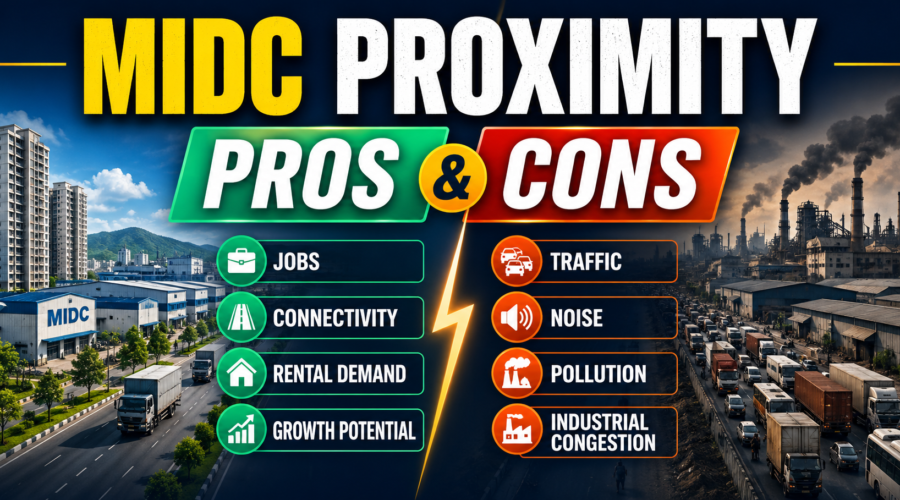
MIDC proximity can be good for rental demand, job access and resale liquidity. But it can also bring pollution, truck traffic, noise, zoning restrictions, leasehold complications, CRZ risk, NAINA planning issues and title-verification problems. In Navi Mumbai, the right decision depends on the exact belt, distance from the industrial area, land use, approvals and documents verified before paying token money.
To see the larger picture, buyers should first understand how Navi Mumbai’s employment hubs are shaping real estate demand before judging any MIDC-side property.
Disclaimer: This is an educational guide. Verify the latest position with the relevant authority or a property lawyer before making a transaction.
What MIDC Proximity Means in Navi Mumbai
MIDC proximity means the property is close to an industrial, IT, logistics or manufacturing belt developed around Maharashtra Industrial Development Corporation areas.
In Navi Mumbai, this usually includes belts such as:
- Rabale MIDC
- Mahape MIDC
- TTC Industrial Area
- Turbhe / Pawane industrial belt
- Taloja MIDC
- Uran / Dronagiri / JNPT logistics belt
- Panvel and NAINA-side industrial-growth pockets
But “near MIDC” is not one single advantage. A flat 3 km away from an employment hub is different from a plot next to a chemical unit, truck road or drainage channel.
Buying near MIDC is not the same as buying an actual MIDC leasehold industrial plot or unit. MIDC leasehold property has separate transfer, use, dues and permission checks.
Pros of Buying Near MIDC
1. Better Rental Demand
Employment hubs create rental demand. Workers, managers, small business owners, logistics staff and service providers often prefer homes near work.
This can help areas around Airoli, Ghansoli, Rabale, Mahape, Kopar Khairane, Taloja, Turbhe, Sanpada and Panvel.
But do not assume guaranteed rent. Rental demand depends on the building quality, commute time, road access, public transport, safety, pollution level and monthly maintenance.
2. Shorter Commute for Working Professionals
For buyers working in Rabale, Mahape, Airoli IT parks, Turbhe, Taloja MIDC or JNPT-side logistics companies, nearby housing can reduce daily travel stress.
This is one reason some buyers prefer Ghansoli, Airoli, Kopar Khairane, Kharghar, Kalamboli, Panvel or Ulwe depending on workplace location.
3. Demand for Small Commercial Spaces
MIDC belts also create demand for:
- Food outlets
- Staff accommodation
- Transport offices
- Repair services
- Warehousing support
- Small offices
- PG-style rental housing
For commercial buyers, this can be useful. But the unit must have proper commercial permission, parking, access, fire safety and society approval where applicable.
4. Price Advantage in Some Micro-Markets
Some properties near industrial belts are cheaper than premium residential pockets.
That can be an opportunity.
But lower price may also reflect pollution, truck movement, title risk, illegal land use, poor access or future resale hesitation.
Cheap should not mean unchecked.
Cons of Buying Near MIDC

1. Pollution and Odour Risk
Industrial areas may have air-quality, odour, dust, smoke, chemical or drainage concerns depending on the belt and activity.
This is especially important near Taloja MIDC, Turbhe, Pawane, Rabale, Mahape and some JNPT-side logistics routes.
Do not decide from a Sunday afternoon visit. Visit in the morning, evening and night.
2. Truck Traffic and Noise
MIDC and logistics belts often have heavy vehicle movement. This can affect family living, senior citizens, children, parking and road safety.
Check truck routes near Turbhe, Taloja, Dronagiri, Uran, JNPT, Pawane and industrial service roads.
3. Resale Hesitation
Some tenants like being near work. But many family buyers avoid properties too close to factories, warehouses, smoke, noise or truck routes.
This can reduce resale demand in some pockets.
4. Zoning and Land-Use Confusion
A common mistake is assuming that all land near MIDC can be used for residential or commercial construction.
It cannot.
For plots and land parcels, check the development plan, zoning, NAINA status, CRZ/CZMP status, green zone, no-development-zone restrictions and access road legality.
5. MIDC Leasehold Complications
If you are buying an actual MIDC industrial plot, shed or unit, check:
- Agreement to Lease
- Lease deed
- MIDC allotment letter
- MIDC transfer approval
- Dues certificate
- Water/service/CETP dues, if applicable
- Permitted industrial use
- MPCB consent, if applicable
- Fire and factory compliance, if applicable
Do not treat MIDC leasehold property like normal freehold land.
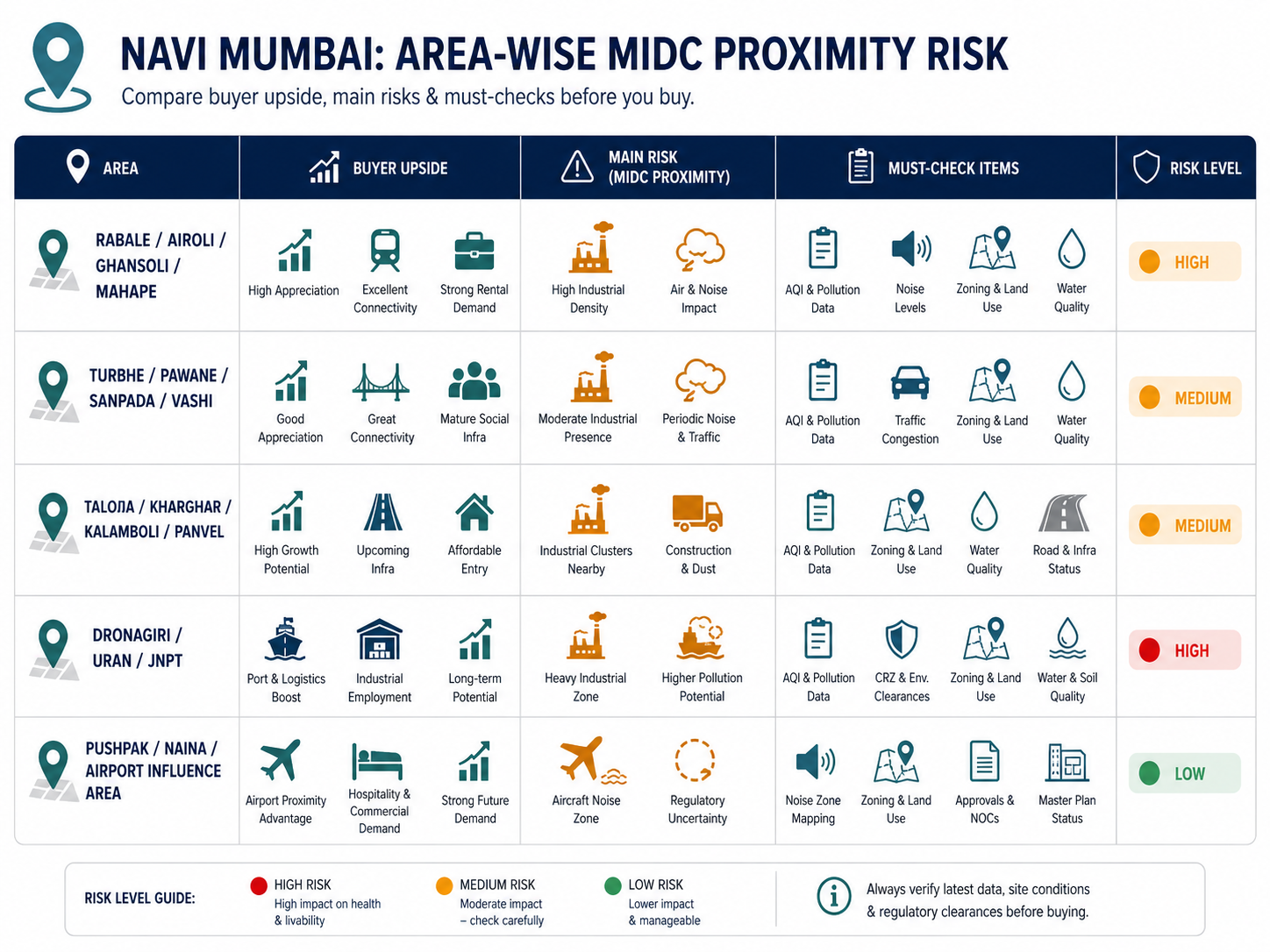
Area-Wise MIDC Proximity Risk Table
| Belt / Area | Buyer Upside | Main Risk | Must Check |
|---|---|---|---|
| Rabale / Airoli / Ghansoli / Mahape | IT, industrial and office rental demand | Traffic, industrial exposure, resale preference | MahaRERA, OC, title, pollution/site visit |
| Turbhe / Pawane / Sanpada / Vashi | Strong commercial and transport access | Truck movement, noise, older industrial pockets | OC, society records, access, land use |
| Taloja / Kharghar / Kalamboli / Panvel | Affordability, MIDC and future growth narrative | Pollution, NAINA/zoning confusion, land conversion risk | 7/12, mutation, NAINA ZCS, DP, approvals |
| Dronagiri / Uran / JNPT | Port, logistics and warehousing demand | CRZ, mangroves, truck routes, infrastructure gaps | CRZ/CZMP, title, access road, approvals |
| Pushpak / NAINA / Airport Influence Area | Airport and planning-area demand | Overhyped land sales, unclear permission, plot risk | CIDCO/NAINA, 7/12, IGR, development permission |
Documents to Check Before Buying Near MIDC
For Flats or Under-Construction Projects
Check:
- MahaRERA registration number
- Project name and promoter name
- Landowner details
- Legal title report
- Encumbrance details
- Layout approval
- Building plan approval
- Commencement Certificate
- Occupancy Certificate or partial OC
- Agreement for Sale draft
- Parking details
- Society registration, if resale
- Conveyance status, if resale
- Pending litigation or complaints
MahaRERA project documents help buyers verify whether the project has basic uploaded legal, financial and technical records. Still, buyers should verify originals with a lawyer before transaction.
For Plots, Land and Gaothan Property
Check:
- 7/12 extract
- 8A extract
- Mutation entries
- Property card, where applicable
- Survey number or CTS number
- Village map or survey map
- IGR registered document search
- 30-year title chain
- Encumbrance or mortgage check
- Access road proof
- Zoning certificate
- NAINA status, where applicable
- CRZ/CZMP status, where applicable
- NA permission or applicable development permission position
- DP road reservation, acquisition or no-development-zone risk
7/12 extract means the village land record showing survey number, landholder details, crop/land-use entries and other revenue details. It supports verification, but it should not be treated as final ownership proof by itself.
Mutation entry means a revenue-record update after sale, inheritance, partition or other change. It supports land-record continuity, but it does not replace title verification.
Property card is commonly used for urban land or city survey areas. It helps verify CTS/property details, but legal title must still be checked through registered documents.
For Actual MIDC Industrial Property
Check:
- MIDC allotment letter
- Agreement to Lease
- Lease deed
- MIDC transfer permission
- MIDC dues
- Water and service charges
- CETP dues, where applicable
- Mortgage/lender NOC
- Building approval
- Factory licence, where applicable
- MPCB consent, where applicable
- Permitted use
- Possession and boundary verification
Use a lawyer familiar with MIDC transfer rules. This is not a casual resale-flat transaction.
How to Verify MIDC Proximity Risk
Step 1: Check Exact Distance
Do not rely on “5 minutes from MIDC” marketing. Check the actual distance, approach road, truck route, railway crossing, service road and daily commute time.
Step 2: Visit at Different Times
Visit:
- Morning
- Evening
- Night
- Weekday
- Sunday
- During or after rain, if possible
Look for smell, smoke, dust, tanker movement, road flooding, open drains, noise and heavy-vehicle parking.
Step 3: Verify Land Records
Use official Maharashtra land-record portals for 7/12, 8A, property card, mutation and survey/CTS checks.
For old land, inherited land, gaothan property or plots, do not stop at online records. Ask for original documents and get a title search.
Step 4: Verify Registered Documents
Use IGR Maharashtra for registered document-related checks wherever applicable.
A seller showing only photocopies, notarized papers or old unregistered agreements is a red flag.
Step 5: Check MahaRERA
For under-construction and registered projects, check the project on MahaRERA. Verify promoter name, project status, uploaded approvals, completion timeline, complaints and lapsed/revoked status.
Step 6: Check CIDCO / NAINA
For Panvel, Taloja, Pushpak, Ulwe-side, airport-influence and NAINA-side areas, verify planning status through CIDCO / NAINA resources.
Check development plan, DCPR, Town Planning Scheme, Zone Confirmation Statement, commencement certificate and occupancy certificate where relevant.
Step 7: Check CRZ / CZMP
For Uran, Dronagiri, JNPT-side, creek-side, mangrove-side and coastal parcels, check CRZ/CZMP status.
Do not accept “future development” claims without official verification.
Step 8: Check Environmental Exposure
For areas around Taloja MIDC, Rabale, Mahape, Turbhe, Pawane and Uran, check pollution-control jurisdiction, local complaints, odour, waterlogging, nearby nallas and industrial activity.
Example: Taloja / NAINA-Side Plot Near MIDC
A buyer is offered a low-priced plot near Taloja MIDC.
The pitch is simple: “MIDC is nearby, airport is coming, workers will rent here and price will increase.”
Before paying token, the buyer checks documents.
The 7/12 still shows agricultural land. Mutation entries are unclear. The access road is not properly recorded. The land falls in a NAINA planning area, but no zoning confirmation is provided. There is no approved layout. Evening site visit shows industrial odour.
In this case, the buyer should not pay token first.
The correct next step is to verify 7/12, mutation, IGR records, NAINA zoning, development permission, legal access, CRZ/green-zone risk if applicable and current NA/development-permission position through a lawyer or revenue/planning authority.
Red Flags Near MIDC
Avoid rushing if you see these signs:
- Broker says “guaranteed rent because MIDC is nearby”
- Seller refuses to share title documents
- Project has no clear MahaRERA match
- Plot is agricultural but marketed as residential
- NAINA-side land has no zoning clarity
- Land is near creek or mangroves without CRZ check
- MIDC leasehold plot is marketed as ownership land
- Access road is only “in use,” not legally recorded
- OC or CC is missing
- Seller pushes token before document review
- Documents are only notarized or photocopied
- Price is much lower than nearby market without a clear reason
- Visible odour, smoke, tanker movement or truck parking is ignored
Common Mistakes Buyers Make
Mistake 1: Comparing Only Price
A cheap property near MIDC may look attractive. But the discount may be due to pollution, access, legal use, title risk or weak resale demand.
Mistake 2: Visiting Only Once
Many industrial problems are not visible during one site visit. Visit at different times.
Mistake 3: Trusting Growth Words
“Near MIDC,” “near airport,” “near JNPT” and “near logistics hub” are not legal checks.
Growth story is useful only when title, approvals and livability are clear.
Mistake 4: Ignoring NA and Zoning
Maharashtra’s NA permission and land-conversion process has seen legal changes. But applicability depends on land status, planning authority, development plan and exact parcel.
Verify before transaction with the revenue office, planning authority or property lawyer.
Mistake 5: Not Checking CRZ
Creek-side and coastal land can have restrictions. This is important in Uran, Dronagiri, JNPT-side and other coastal or mangrove-sensitive areas.
What to Check Before Paying Token Money
Use this checklist before giving token:
| Check | Done? |
|---|---|
| Exact MIDC distance and approach road checked | |
| Day and night site visit completed | |
| Pollution, smell, noise and truck movement checked | |
| 7/12 / property card / mutation verified | |
| IGR registered document check done | |
| MahaRERA project checked, if applicable | |
| CIDCO / NAINA status checked, if applicable | |
| CRZ / CZMP checked, if coastal or creek-side | |
| Zoning and development permission checked | |
| OC / CC / layout approval checked | |
| MIDC transfer/NOC checked for industrial property | |
| Lawyer title search completed | |
| Token agreement reviewed before payment |
Do not pay token only because the property is “near MIDC.” Pay only after document and site-risk checks.
conclusion
Buying near MIDC can be smart when the location advantage is real and the documents are clean.
But do not decide only on the words “near MIDC,” “near airport,” “near JNPT” or “future growth.”
Before paying token money, verify the title, zoning, land records, approvals, site conditions and authority status.
For safer decision-making, start with run a property title search before token or get your property documents checked before token.
FAQs
Frequently Asked Questions