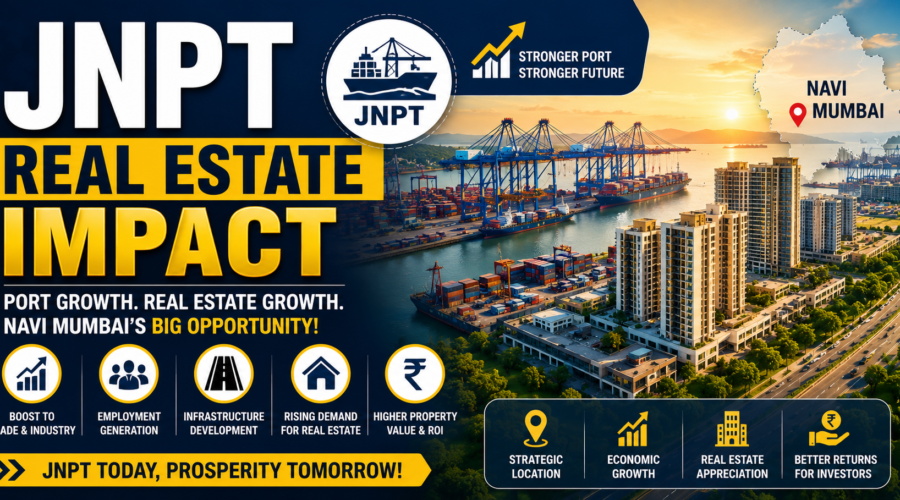
JNPT Real Estate Impact on Navi Mumbai: Areas, Risks & Buyer Checklist
JNPT real estate impact is visible in Dronagiri, Uran, Ulwe, Panvel, Pushpak Node and nearby logistics-linked areas. The port, SEZ, container terminals, warehousing, transport links and employment activity can support property demand. But “near JNPT” is not enough reason to buy. Buyers must verify title, 7/12, IGR records, CIDCO or NAINA approvals, CRZ/CZMP status and MahaRERA details before paying token money.
Disclaimer: This is an educational guide. Verify the latest position with the relevant authority or a property lawyer before making a transaction.
What JNPT Real Estate Impact Really Means
JNPT, now officially known as JNPA, is one of India’s most important container ports. Its impact on real estate comes from jobs, transport activity, logistics, warehousing, port-linked businesses, export-import movement, and long-term infrastructure planning.
But this impact is not equal everywhere.
A flat in Ulwe, a CIDCO plot in Dronagiri, a resale property in Uran, and a NAINA village plot near Panvel do not carry the same risk. The demand story may sound similar, but the documents are completely different.
Simple rule: JNPT can support demand, but documents decide safety.
Why JNPT Matters for Navi Mumbai Property
JNPT matters because it is not only a port. It is an economic engine.
The port supports container movement, port operations, customs-linked services, transport companies, warehousing, cold storage, freight forwarding, export-import businesses and industrial users. This creates direct and indirect employment.
That employment can support housing demand in nearby areas.
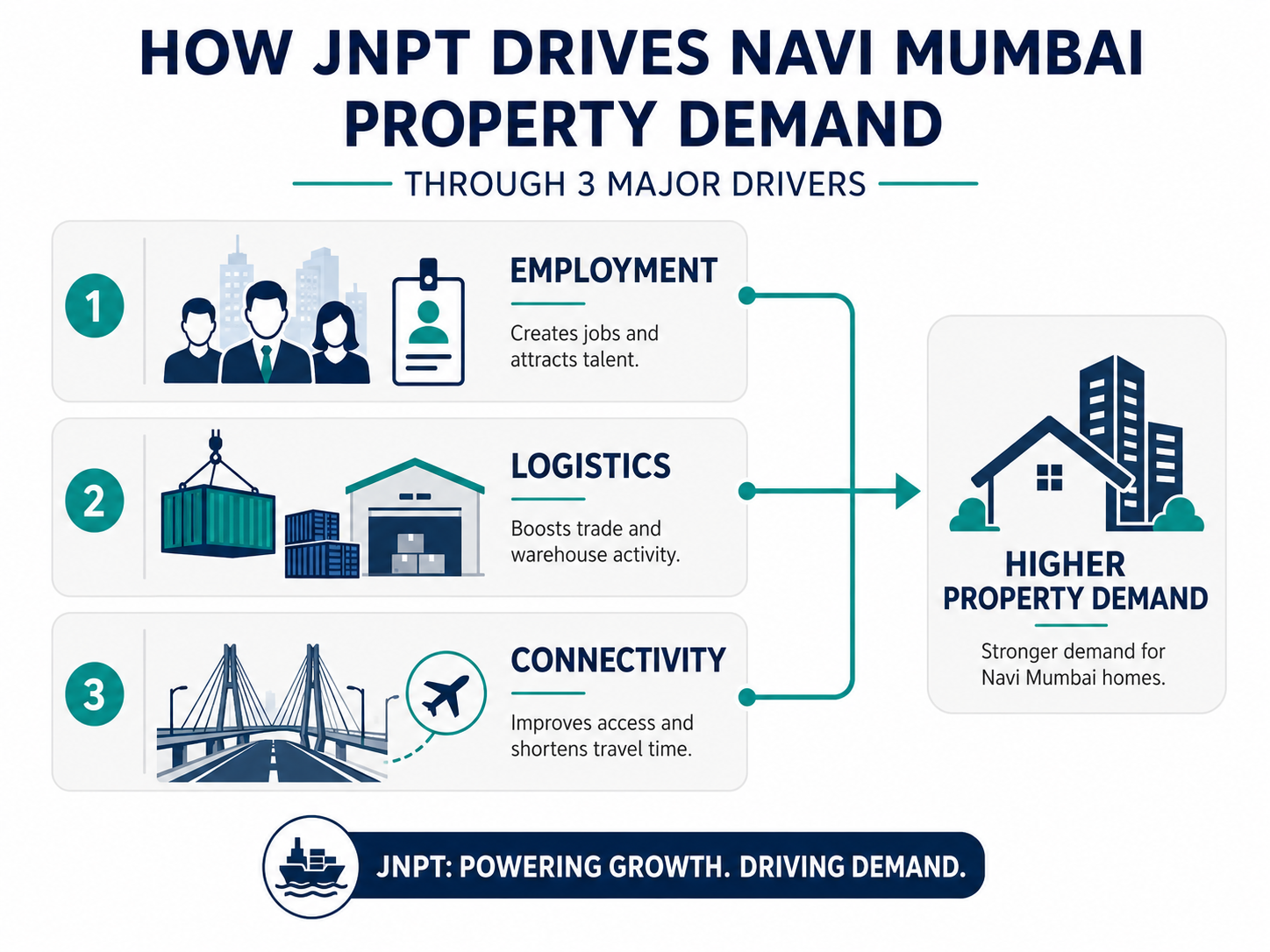
For real estate buyers, JNPT matters in three ways:
| Impact area | What it means for buyers |
|---|---|
| Employment | More workers, managers, transporters and service providers need housing |
| Logistics | Warehousing, CFS, ICD, container movement and SEZ activity create commercial demand |
| Connectivity | Port roads, Atal Setu, airport-side development and freight corridors can improve access |
But this does not mean every property near JNPT will appreciate. Some locations may perform well. Some may remain slow. Some may have legal, CRZ, title, access road or approval problems.
Areas Most Affected by JNPT
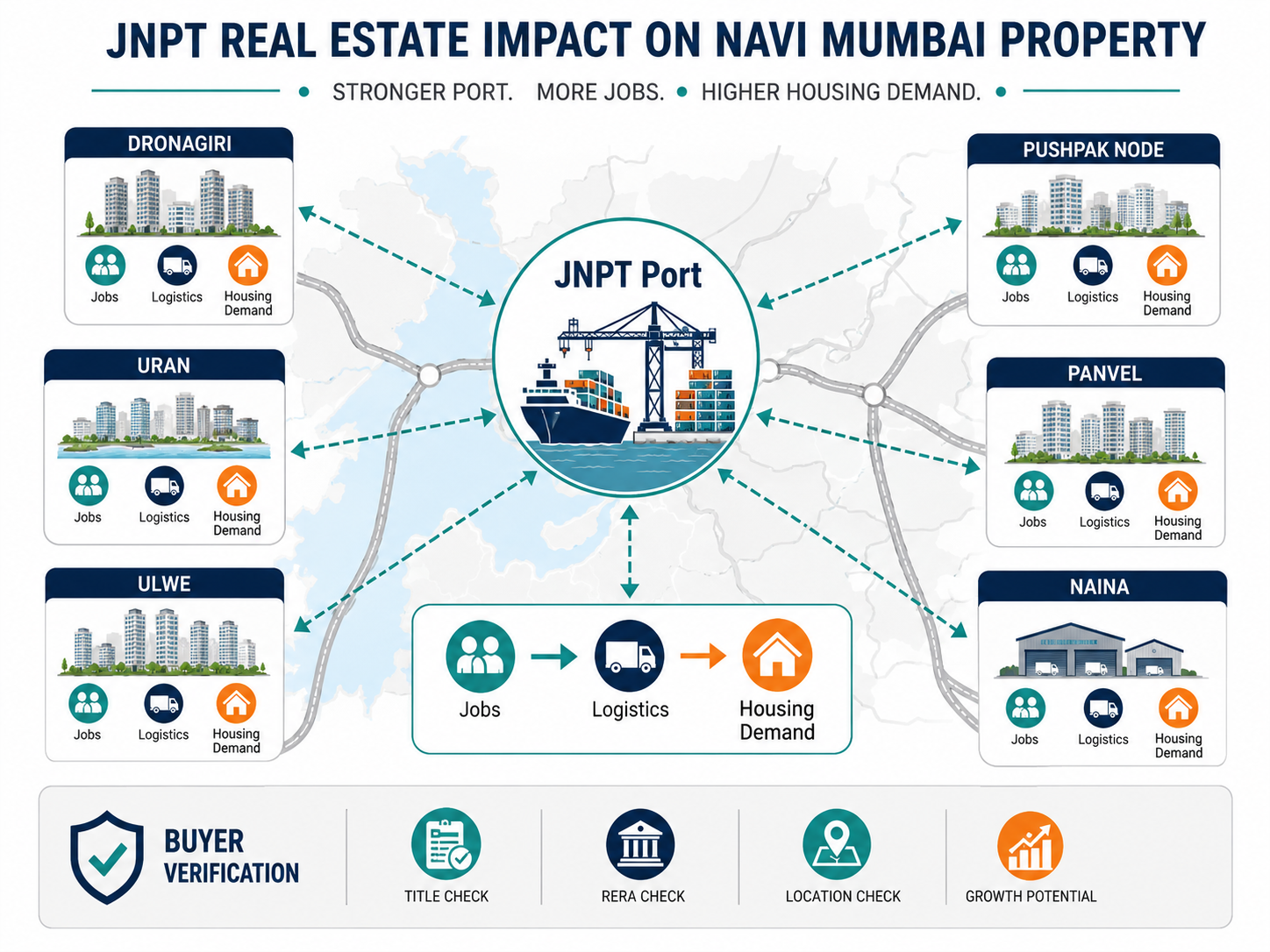
Dronagiri and Uran
Dronagiri and Uran are among the most directly affected locations because they sit closer to the port and port-linked movement.
Dronagiri attracts attention because of CIDCO planning, port proximity, future connectivity and relative affordability compared to established Navi Mumbai nodes. Uran is more mixed. It has old settlements, village land, coastal influence, port-related movement and land parcels with different legal histories.
For buyers, these areas need extra care.
Check:
- CIDCO allotment or lease documents
- MahaRERA project details
- sanctioned plan, CC and OC
- CRZ/CZMP status
- title chain
- access road
- pending dues or transfer permissions
Do not buy only because someone says “JNPT nearby.”
Ulwe and Pushpak Node
Ulwe and Pushpak Node may benefit from a combined story: JNPT, Navi Mumbai International Airport, Atal Setu, logistics activity and airport-side development.
These areas are more suitable for flat buyers and long-term investors than risky document-heavy land buyers. But overpricing is a real risk. If the seller is charging a heavy “future infrastructure premium,” check whether current rental demand and liveability justify the price.
For under-construction projects, verify MahaRERA details. For resale flats, check society records, OC, property tax, share certificate, loan NOC and registered agreement chain.
Panvel and NAINA Villages
Panvel and NAINA areas may see indirect JNPT and logistics impact. But land and plot buying here needs serious verification.
A broker may say:
“This land is near JNPT, airport, DFC and logistics park.”
That statement alone is not enough.
For NAINA and Panvel-side land, check the 7/12 extract, 8A, mutation entries, zoning, NAINA Development Plan, ZCS, layout approval, road access and development permission.
If the land is agricultural, gaothan, inherited, jointly owned or part of a plotted layout, take legal review before token.
Kharghar, Taloja and Kalamboli
These locations may benefit from the wider Navi Mumbai employment and logistics ecosystem, but their JNPT link is indirect.
Kharghar is stronger for residential lifestyle and connectivity. Taloja has MIDC and industrial influence. Kalamboli has transport, warehousing and highway-side advantages.
Do not treat these locations as direct “JNPT premium” areas unless the property has clear demand logic.
JNPT Impact by Location
| Location | JNPT impact level | Best suited for | Main risk | Must-check documents |
|---|---|---|---|---|
| Dronagiri | High | Long-term buyers, port-linked investors | CRZ, CIDCO terms, project delay | CIDCO papers, MahaRERA, CC/OC, CZMP check |
| Uran | High | Land buyers, port-linked users | Title, agricultural land, CRZ, access | 7/12, mutation, IGR search, CZMP, NA/planning status |
| Ulwe | Medium-high | End-users, rental investors | Overpaying for future growth | RERA, OC, society papers, title chain |
| Pushpak Node | Medium-high | Airport/logistics-led buyers | Future-infra pricing | CIDCO/NAINA status, approvals, RERA |
| Panvel / NAINA | Medium-high | Plot buyers, long-term investors | Zoning, layout approval, NA ambiguity | 7/12, ZCS, NAINA permission, IGR, title search |
| Kharghar / Taloja / Kalamboli | Medium | End-users, rental buyers | Weak direct JNPT link | RERA, title, commute, rental demand |
Flats vs Plots Near JNPT
For Flat Buyers
Flat buyers should focus on legal approval, project status and liveability.
Check:
- MahaRERA registration
- project phase
- sanctioned plan
- commencement certificate
- occupancy certificate
- registered agreement
- society formation
- conveyance or lease structure
- actual commute to job hubs
- resale and rental demand
A RERA number alone is not enough. Match the project name, phase, promoter name, building details and possession status.
For Plot and Land Buyers
Plot buyers face more risk than flat buyers.
Why?
Because a plot may be sold on future potential, not current legal buildability.
Check:
- 7/12 extract, also called Satbara
- 8A extract
- mutation entries, also called Ferfar
- title chain
- IGR registered document search
- land-use zone
- NAINA status
- CRZ/CZMP status
- road access
- NA or planning permission position
- sanctioned layout approval
A 7/12 extract supports land-record verification. It should not be treated as full ownership proof by itself.
For Rental Investors
JNPT can support rental demand, but the tenant profile may differ from IT hubs like Airoli or Ghansoli.
Near JNPT, demand can come from:
- port employees
- logistics managers
- transport operators
- CFS and ICD workers
- customs-linked professionals
- airport and logistics workers
- small business owners
Before buying for rent, check actual demand in the building, not only future promises.
Documents to Check Before Paying Token Money
This is the most important part of the buying process.
1. 7/12 Extract
7/12 extract, or Satbara, is a land-record document used mainly for agricultural and village land. It shows land details, holder names, area, crop details and certain remarks.
For Uran, Panvel, NAINA villages and gaothan-side land, it is important.
Check if:
- seller name matches
- survey number matches
- area matches
- loan or charge is recorded
- government remark exists
- mutation is pending
- land use is clear
2. 8A Extract
8A shows landholding details of the person or family in revenue records. It helps cross-check whether the seller’s claimed landholding matches official records.
3. Mutation Entry / Ferfar
Mutation means change in revenue record after sale, inheritance, partition, gift or court order.
If the seller’s name is not properly updated, stop and verify.
4. Property Card
For urban properties, property card helps verify property identity, CTS number, area, holder details and city survey record.
For CIDCO, society or urban property, check property card where applicable along with registered documents.
5. IGR Maharashtra Search
IGR eSearch helps check registered documents, Index II and transaction history.
Before token, check whether the seller’s document chain is consistent. Look for sale deed, agreement, gift deed, release deed, development agreement, mortgage or power of attorney.
6. CIDCO Documents
For CIDCO areas, check:
- allotment letter
- lease deed
- transfer permission
- NOC
- dues
- mortgage status
- society records
- occupation certificate
- building approval
CIDCO property often involves leasehold rights. Leasehold means the land is held under lease conditions, not absolute freehold ownership.
7. NAINA Zoning and Permission
For NAINA areas, check:
- Development Plan
- Interim Development Plan, if applicable
- Town Planning Scheme
- Zoning Confirmation Statement
- building permission
- commencement certificate
- approved layout
- road reservation
- excluded area notification, if relevant
If the seller says “NAINA approval is coming,” ask for official proof.
8. CRZ and CZMP
For Uran, Dronagiri, creek-side and coastal land, CRZ check is critical.
CRZ means Coastal Regulation Zone. It can restrict construction, land use, redevelopment or development potential near coastal areas, creeks and sensitive zones.
Check the approved CZMP map and take expert help where needed.
9. MahaRERA
For projects, check:
- project registration
- promoter details
- approved plans
- phase details
- carpet area
- possession date
- complaints
- lapsed or revoked status
- uploaded certificates
Do not rely only on a brochure screenshot.
2025–2026 NA Permission and Land Conversion Caution
Maharashtra’s land-conversion framework has changed after the 2025 amendment to the Maharashtra Land Revenue Code. In broad terms, where land use is permitted under the relevant Development Plan, Regional Plan or planning regulations, separate Collector permission for agricultural-to-non-agricultural use may not apply in the old way.
But buyers should be careful.
This does not mean every agricultural land automatically becomes safe for construction. Planning authority approval, zoning, development permission, premium/payment position, revenue-record updates, land class, access, title and local conditions still matter.
Verify with lawyer/revenue office before relying on any seller’s statement about NA permission.
How to Verify a JNPT-Linked Property
Follow this sequence before token money.
| Step | What to verify | Why it matters |
|---|---|---|
| 1 | Property identity | Survey number, CTS, plot number, building name and village must match |
| 2 | Land records | 7/12, 8A, property card and mutation show record consistency |
| 3 | Registered documents | IGR search shows registered transaction history |
| 4 | Planning authority | CIDCO or NAINA approval confirms planning status |
| 5 | CRZ/CZMP | Coastal and creek-side land may have restrictions |
| 6 | MahaRERA | Project status, promoter details and compliance must be checked |
| 7 | Legal review | A lawyer should review before high-risk token payment |
Example: NAINA Plot Sold as “Near JNPT”
Suppose a buyer is offered a plot in a Panvel-side NAINA village. The seller says:
“This is near JNPT, airport, DFC and logistics park. Price will double.”
Before paying token, the buyer should check:
- 7/12 extract
- mutation entries
- seller’s title chain
- IGR registered documents
- NAINA zoning
- Zoning Confirmation Statement
- layout approval
- road access
- DP road reservation
- CRZ or creek impact, if applicable
- NA/planning permission status
If even one property identity detail does not match across documents, stop and verify before transaction.
Red Flags Near JNPT
Be careful if you see any of these signs:
- “Near JNPT” is the main selling point, but documents are not shared.
- Agricultural land is sold as future residential land without zoning clarity.
- NAINA approval is described as “in process” without official proof.
- The 7/12 extract has old names, loan entry, dispute or government remark.
- IGR search does not match the seller’s claim.
- The land is near creek, mangroves or coastal belt, but no CRZ check is done.
- The project claims RERA approval, but the number belongs to another phase.
- CIDCO transfer permission or lease documents are missing.
- Token money is demanded before document review.
If the seller refuses basic document sharing, do not pay token.
Common Mistakes Buyers Make
1. Buying only because JNPT is nearby. 2. Assuming Dronagiri, Uran, Ulwe and Panvel have the same risk. 3. Paying token before IGR and title search. 4. Ignoring CRZ in coastal locations. 5. Assuming every NAINA plot is approved for construction. 6. Trusting “NA not required now” without checking planning status. 7. Not checking CIDCO leasehold conditions. 8. Comparing only price per sq ft, not legal safety. 9. Buying based only on future airport, logistics park or DFC claims.
When to Consult a Professional
Consult a property lawyer, revenue expert or document-verification professional when the property involves:
- land or plot purchase
- NAINA village land
- gaothan property
- agricultural land
- Uran or Dronagiri coastal property
- CIDCO leasehold transfer
- inherited property
- power of attorney sale
- unclear road access
- mortgage, charge or litigation
- builder project with unclear RERA status
The cost of checking is usually smaller than the cost of a bad token decision.
Final CTA
Before buying any flat, plot or land near JNPT, do not stop at the growth story. Check the documents first.
If you are comparing property near Dronagiri, Uran, Ulwe, Panvel, Pushpak Node or NAINA, use the Navi Mumbai Property Verification Checklist Before Token Money as your next step.
FAQs
Frequently Asked Questions