

IT ITeS Growth and Navi Mumbai Real Estate: What Buyers Must Check Before Investing
IT/ITeS growth is a real demand driver for Navi Mumbai real estate, especially around Airoli, Ghansoli, Mahape, Rabale, Turbhe and nearby residential areas. But job growth does not make every property safe. Before paying token money, buyers must verify MahaRERA status, title chain, 7/12, 8A, property card, IGR records, CIDCO/NAINA zoning, NA/development permission, CRZ/CZMP and occupancy documents.
This is an educational guide. Verify the latest position with the relevant authority or a property lawyer before making a transaction.
Does IT/ITeS Growth Help Navi Mumbai Real Estate?
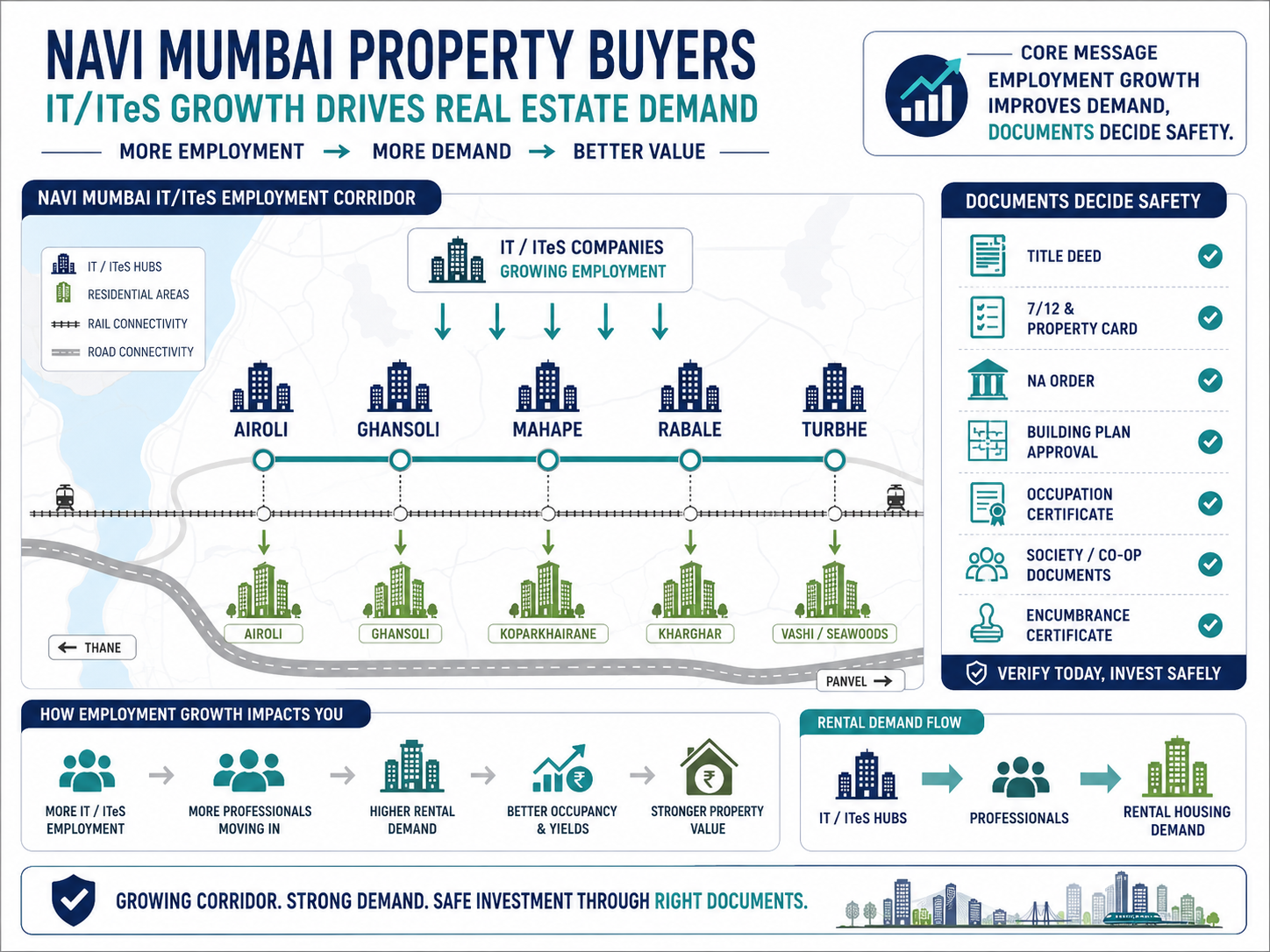
Yes, IT/ITeS growth helps Navi Mumbai real estate when it creates actual job demand, office occupancy, rental demand and better resale liquidity.
But the impact is not equal everywhere.
A flat near Airoli or Ghansoli may benefit from daily office demand. A plot in Panvel, Ulwe, Pushpak, Dronagiri or NAINA may depend more on future infrastructure, zoning and long-term development.
For the wider cluster, read Navi Mumbai employment hubs and property demand.
The simple rule is this:
Employment growth improves demand. Documents decide safety.
Do not buy only because a broker says “IT hub,” “data centre,” “airport growth” or “Third Mumbai future.” These are demand signals, not legal approvals.
Why IT/ITeS Is a Strong Demand Signal
Navi Mumbai has a clear employment base along the Thane-Belapur belt. Airoli, Ghansoli, Mahape, Rabale and Turbhe are important because they connect office parks, IT/ITeS companies, MIDC areas, railway access and residential catchments.
Airoli is especially important because of large office parks and its connection to Thane, Mulund, Vashi, Ghansoli and Mahape. This creates demand from employees who want shorter commute, better rental options and stable social infrastructure.
Ghansoli benefits from proximity to Airoli, Reliance Corporate Park, Millennium Business Park and the wider Thane-Belapur corridor. Mahape and Rabale attract people who work near TTC/MIDC and want practical housing options.
For buyers comparing Airoli, Ghansoli and Mahape, this detailed guide on Ghansoli IT corridor real estate impact explains the local property demand better.
But not every location near an employment belt is automatically good. Buyers must check distance, connectivity, building quality, rent evidence, legal title and approval status.
For a deeper local comparison, use Airoli IT Park property impact and Ghansoli IT corridor real estate impact.
Which Navi Mumbai Areas Benefit Most?
| Area | Main demand driver | Buyer fit | Main risk to check |
|---|---|---|---|
| Airoli | IT parks, office campuses, Thane-Belapur access | IT employees, rental investors, end-users | Premium pricing, OC/CC, society documents, RERA |
| Ghansoli | IT corridor, Reliance Corporate Park, Airoli/Mahape access | Working professionals, rental buyers | Project status, traffic, full vs partial OC |
| Mahape | IT, MIDC, commercial offices | Office employees, practical commuters | Industrial zoning, land-use mismatch |
| Rabale | MIDC, Airoli-Ghansoli proximity | Budget buyers, rental investors | Industrial nuisance, access, approval status |
| Turbhe / Sanpada | MIDC, station access, commercial activity | End-users, redevelopment buyers | Old buildings, conveyance, redevelopment risk |
| Kharghar / Taloja | Residential catchment, metro/road links, affordability | Budget buyers, long-term investors | Commute reality, project completion, RERA |
| Ulwe / Panvel / Pushpak | Airport, NAINA, logistics and future employment | Long-term buyers, plot buyers | NAINA zoning, TPS, NA/development permission |
| Dronagiri / Uran | JNPT, port and logistics economy | Long-term investors | CRZ, mangroves, industrial impact, access |
For area selection, read best Navi Mumbai areas for IT employees.
How IT Jobs Affect Rental Demand
IT/ITeS employees usually look for four things:
- Shorter commute
- Safe building and society
- Parking and lift quality
- Access to station, road, food and daily services
That is why demand is usually stronger in areas with both employment access and liveability.
Airoli and Ghansoli may perform better for daily office access. Sanpada, Vashi and Nerul may work for people who want better social infrastructure. Kharghar and Taloja may appeal to budget buyers who accept longer travel.
For investors, the key question is not “Is there an IT hub nearby?”
The better question is:
Can this exact building attract a tenant at the rent I am assuming?
Ask for rent evidence from the same building or same lane. Do not rely only on broker projections.
Do Not Confuse MIDC Growth With Residential Safety
Mahape, Rabale and Turbhe have strong employment activity. But MIDC proximity also creates checks that many buyers ignore.
Some locations may face industrial traffic, noise, pollution, parking pressure or zoning limitations. If you are buying a flat, check livability. If you are buying land, check land use and development permission carefully.
For this risk, read MIDC proximity pros and cons.
Documents to Check Before Buying
The document checklist depends on the property type.
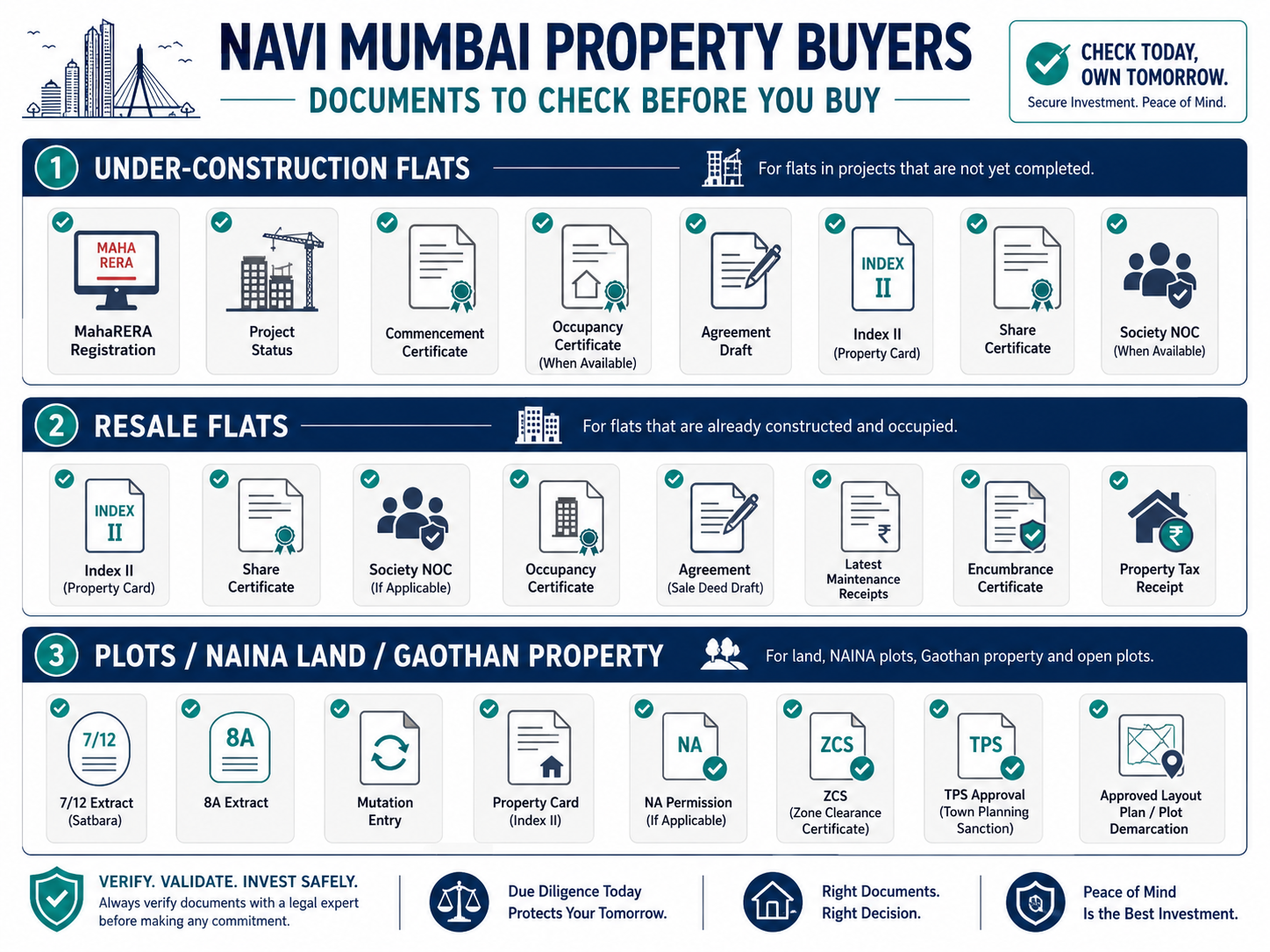
For Under-Construction Flats
Check these before paying token:
| Document / record | What to verify |
|---|---|
| MahaRERA registration | Project name, registration number, promoter name |
| Project status | Active, lapsed, revoked, suspended or abeyance |
| Commencement Certificate | Whether construction approval matches the claimed phase |
| Occupancy Certificate | Full OC or partial OC |
| Approved layout | Building, wing, floor and carpet area |
| Agreement draft | Carpet area, payment schedule, possession date, penalties |
| Promoter updates | Quarterly progress, complaints, changes, approvals |
Do not buy an under-construction flat only from brochure claims. Check MahaRERA first.
For Resale Flats
Check:
- Registered agreement chain
- Index II
- Share certificate
- Society NOC
- Property tax records
- Electricity bill
- Occupancy Certificate / Completion Certificate
- Conveyance or deemed conveyance status
- Loan closure letter, if the flat was mortgaged
- Pending society dues
- Any redevelopment notice or litigation
A resale flat near an IT hub may look attractive because of rent demand. But if society documents are weak, resale and loan approval can become difficult.
For Plots, NAINA Land and Gaothan Property
Check:
| Term | Plain English meaning |
|---|---|
| 7/12 Utara / Satbara | Village land record showing survey number, area, holder names and land details |
| 8A extract | Account/khata extract linked to landholding |
| Ferfar / Mutation | Change entry after sale, inheritance, partition or other event |
| Property card | Urban property record, often used for city survey/CTS properties |
| NA permission | Non-agricultural use permission or land-use conversion status |
| ZCS | Zoning Confirmation Statement, important in NAINA/CIDCO areas |
| TPS | Town Planning Scheme, used in planned development areas |
These documents support verification. They do not replace a full title search.
For land-record basics, read 7/12, 8A and property card verification.
What to Check Before Paying Token Money
Before paying token money for any Navi Mumbai property, ask for documents first.
Use this checklist:
1. Exact project name or survey number
2. Seller name and ownership chain
3. MahaRERA number, if applicable
4. IGR registered document search
5. 7/12, 8A, property card and mutation entries, if land/plot
6. Society NOC and share certificate, if resale flat
7. OC/CC and approved plan
8. CIDCO/NAINA zoning check, if Panvel, Ulwe, Pushpak, NAINA or surrounding village land
9. CRZ/CZMP check, if near creek, coast, mangroves or low-lying area
10. Written token terms with refund condition
Do not pay token first and verify later. After token, your negotiation power reduces.
For a deeper due-diligence route, read 30-year title search before token payment.
NAINA and Panvel Example
Suppose a buyer is offered a plot near Panvel with this pitch:
“Airport, IT/ITeS growth, logistics park, NAINA development price will increase fast.”
This is not enough.
The buyer should verify:
- Village name and survey number
- Seller name on 7/12 and mutation entries
- 30-year title chain
- Registered documents on IGR
- NAINA Development Plan or Town Planning Scheme status
- Zoning Confirmation Statement
- Access road and right of way
- NA/development permission position
- CRZ/CZMP risk, if near creek or mangroves
If zoning, access, title or CRZ status is unclear, verify with lawyer/revenue office before transaction.
For this topic, read NAINA zoning and CIDCO approval checks.
2025–26 NA Permission Update Buyers Should Understand
Maharashtra’s land-conversion framework has changed after the Maharashtra Land Revenue Code amendment. In simple terms, separate Collector-level NA permission may not be required in certain cases where the proposed non-agricultural use is already permitted under the applicable Development Plan or Regional Plan and the planning authority grants development permission or building-plan approval.
But this is not a blanket green signal for every plot.
Class-II land, restricted tenure land, gaothan property, NAINA land, CRZ-affected land, green-zone land, no-development-zone land, access-road issues and title disputes still need careful verification.
For a specific plot, verify with lawyer/revenue office before transaction.
CRZ, Mangroves and Green-Zone Risk
Navi Mumbai has creek-side and coastal-risk areas. This matters in parts of Airoli, Vashi, Nerul, Kharghar, Panvel, Ulwe, Dronagiri, Uran and Raigad-side belts.
If a property is near a creek, mangrove patch, wetland, tidal area or coast, check the CZMP map and local authority records.
A property can have good location demand and still face serious construction or approval restrictions.
For this risk, read CRZ and mangrove risk check.
Red Flags
| Red flag | Why it is risky |
|---|---|
| “Token now, documents later” | Buyer loses control before verification |
| “NA will come soon” | Future permission is not current permission |
| RERA number not found | Project may not be registered as claimed |
| Partial OC shown as full OC | Possession, loan and resale risk |
| Seller name mismatch | Title or authority issue |
| 7/12 area mismatch | Land-record or boundary issue |
| No clear access road | Construction, resale and loan problems |
| CRZ or mangrove nearby | Development restrictions may apply |
| Industrial land sold as residential | Land-use mismatch risk |
| POA sale without full papers | Seller authority may be weak |
Common Mistakes Buyers Make
Mistake 1: Buying only because of “IT hub” marketing
A project can be near an IT corridor and still be overpriced, poorly connected or legally risky.
Mistake 2: Ignoring commute timing
Check actual peak-hour travel, not Google Maps at midnight.
Mistake 3: Treating 7/12 as ownership proof
7/12 supports verification. It must be matched with registered documents, mutation entries, possession and title chain.
Mistake 4: Ignoring MahaRERA status
For under-construction projects, first check whether the project is registered and active.
Mistake 5: Assuming all NAINA land is safe
NAINA planning can increase long-term potential, but zoning, TPS, access road and development permission decide usability.
Mistake 6: Not checking CRZ/CZMP
Creek-side and coastal-risk properties need extra verification.
conclusion
IT/ITeS growth can improve demand in Navi Mumbai, but it should not replace due diligence. Before paying token money, verify the project, seller, land records, RERA status, IGR documents, CIDCO/NAINA zoning and CRZ risk.
Next step: use verify your Navi Mumbai property documents before paying token before committing money.
FAQs
Frequently Asked Questions