
Turbhe Industrial Area Property Impact: Buyer Guide for Navi Mumbai
Quick Summary
Turbhe Industrial Area supports property demand because it creates jobs, rental movement, commercial activity, warehouse demand and MSME business around Sanpada, Vashi, Juinagar, Pawane and Thane-Belapur Road. But buyers should not treat industrial proximity as an automatic “buy” signal. Check the exact building, road, use permission, OC, MahaRERA status, IGR records, MIDC lease or transfer permissions, fire safety and local nuisance before paying token money.
This is an educational guide. Verify the latest position with the relevant authority or a property lawyer before making a transaction.
Why Turbhe Industrial Area Matters in Navi Mumbai Real Estate
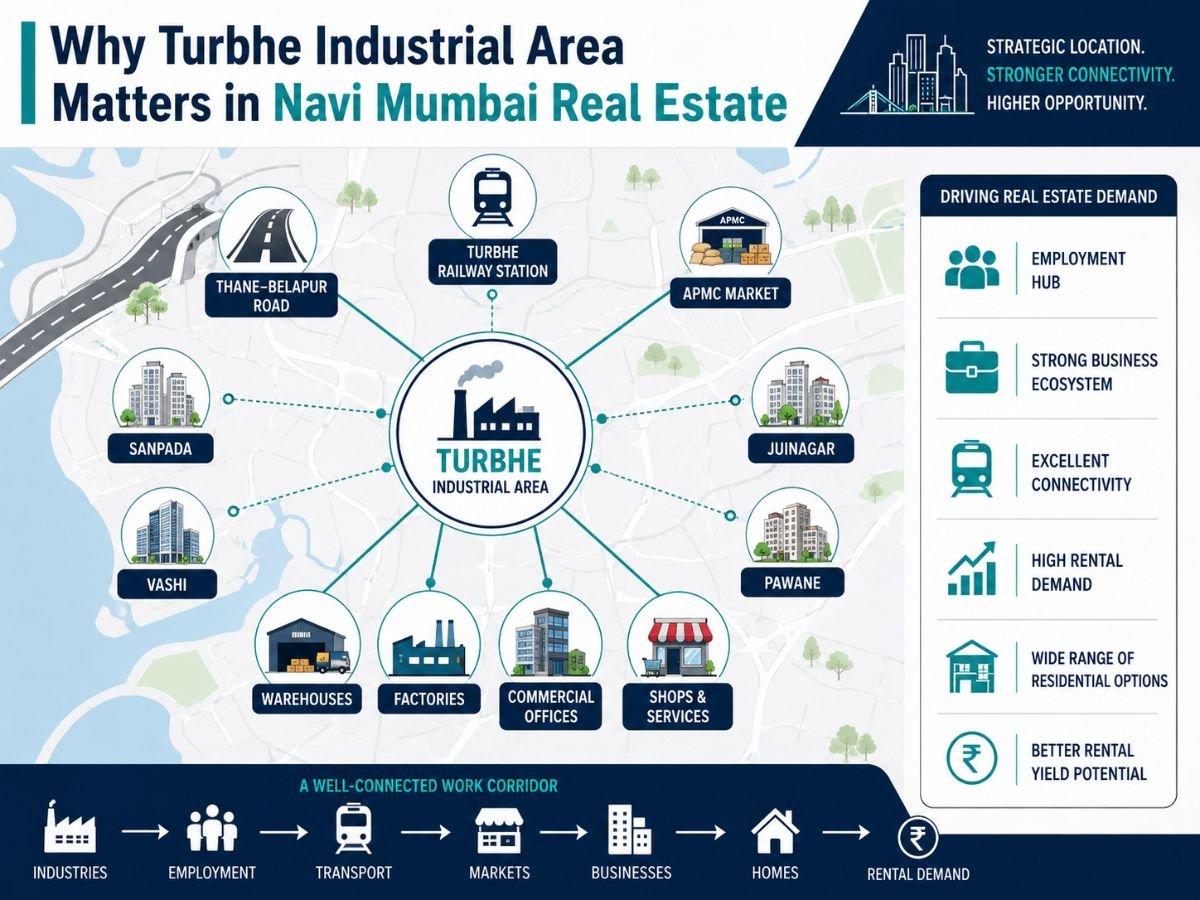
Turbhe is not just a residential location. It is part of Navi Mumbai’s active employment and business belt.
The area connects with Thane-Belapur Road, Turbhe Railway Station, APMC Market, Sanpada, Vashi, Juinagar, Pawane and the larger TTC/MIDC industrial belt.
That means property demand here is driven by practical use.
People look at Turbhe for:
- Work access
- Commercial space
- Small offices
- Warehousing
- Industrial units
- Budget rentals
- Business support services
This is why Turbhe industrial area property impact is different from a normal residential locality guide.
A buyer should not ask only, “Is Turbhe cheap or costly?”
The better question is:
Is this exact property suitable for the kind of demand Turbhe creates?
For wider context, this article connects with Navi Mumbai employment hubs real estate impact, because Turbhe is one of the key industrial and commercial demand pockets in the city.
Property Types Affected by Turbhe Industrial Area
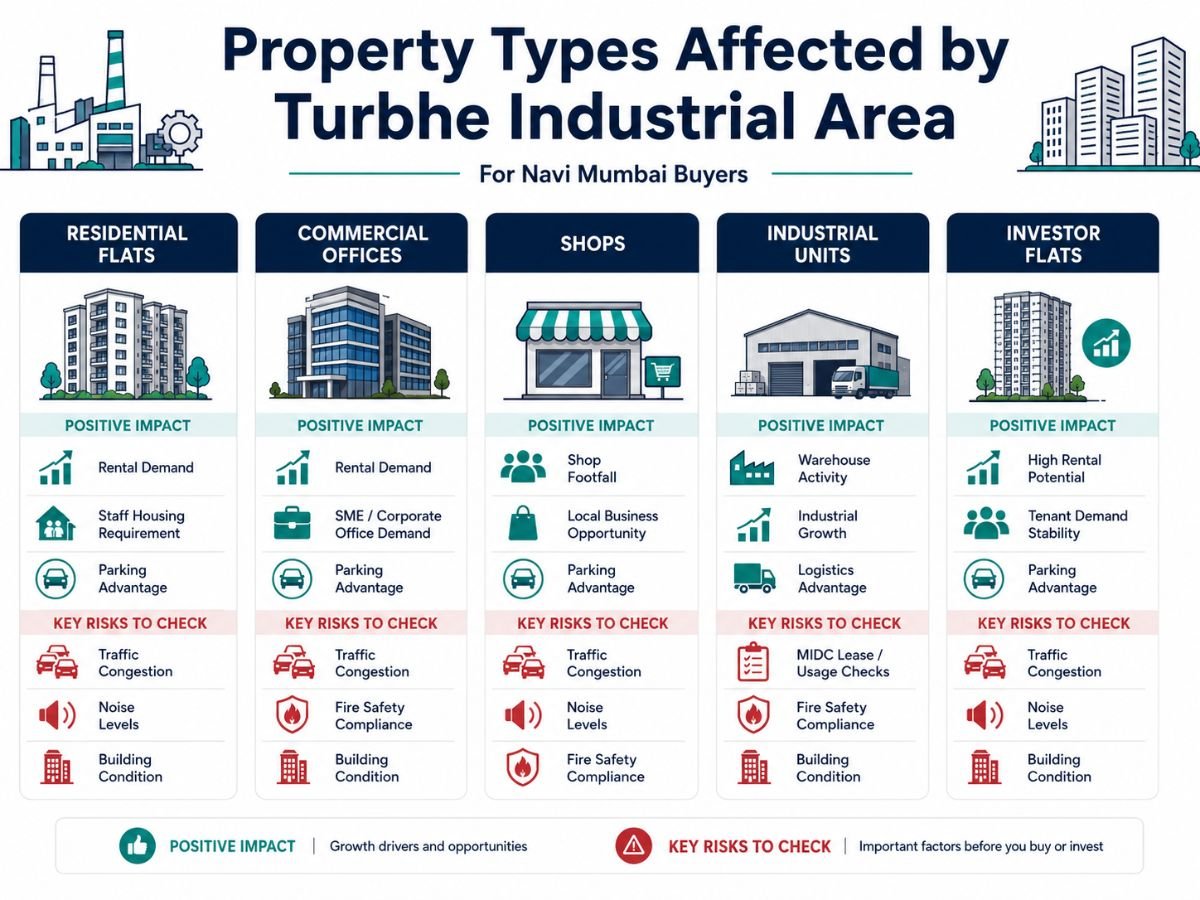
| Property type | Positive impact | Risk to check |
|---|---|---|
| Residential flats | Rental demand from workers, staff and business owners | Traffic, noise, pollution, power reliability, old building condition |
| Commercial offices | Demand from SMEs, traders and service businesses | OC, fire NOC, parking, electricity load |
| Shops | Footfall from workers and transport movement | Frontage, congestion, loading/unloading issues |
| Warehouses | Operational convenience near industrial users | Permitted use, road width, loading access |
| MIDC / industrial units | Business ecosystem and industrial demand | MIDC lease, transfer permission, dues, activity permission |
| Investor flats | Possible rental depth | Overpaying because of “MIDC nearby” hype |
Main point: Turbhe can be useful for practical buyers, investors and business owners. It may not suit every family buyer looking for quiet premium residential living.
Impact on Nearby Residential Areas
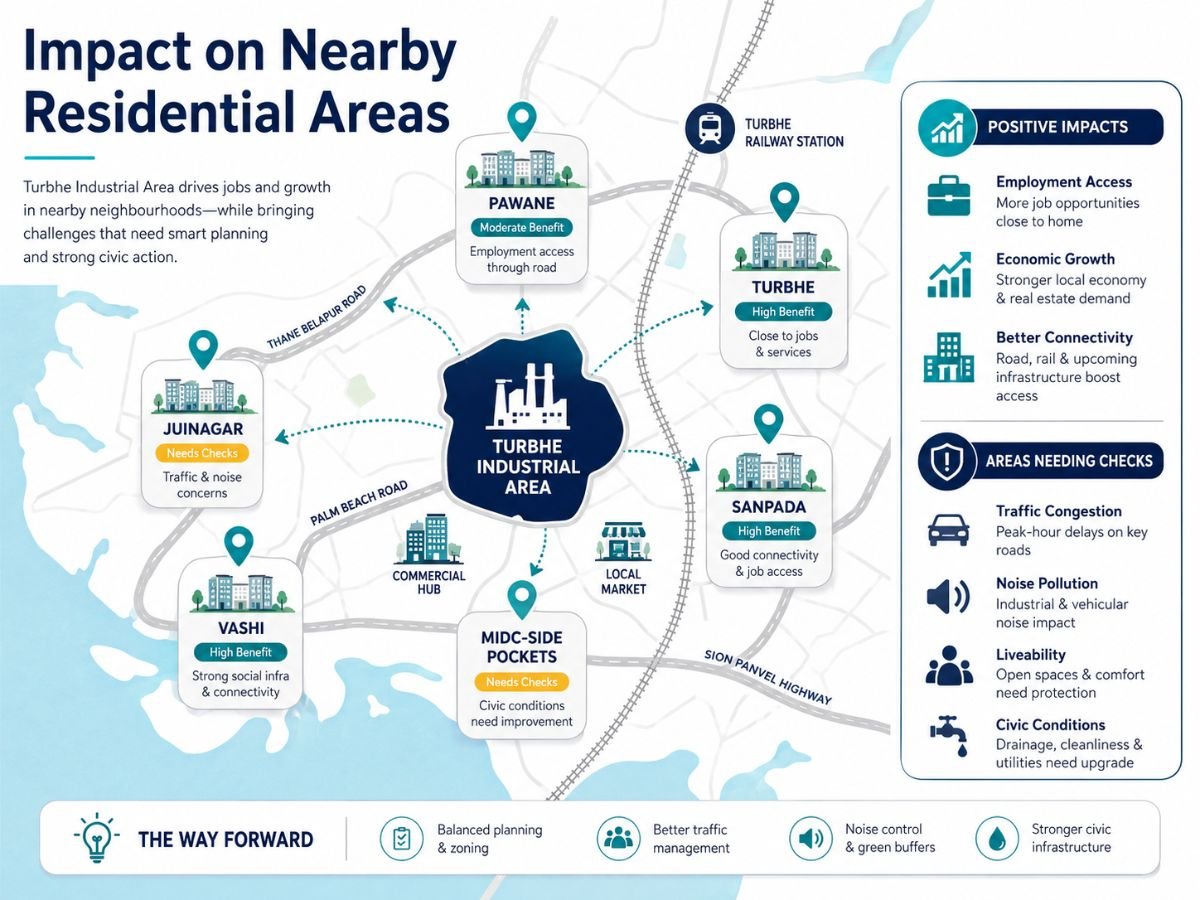
Turbhe
Turbhe works mainly for affordability, work access and rental convenience.
It can suit buyers who work nearby or investors targeting budget rental demand. But the exact lane matters.
A flat close to heavy vehicle movement, workshops, drainage issues or industrial nuisance should not be valued like a flat in a cleaner residential pocket.
Sanpada
Sanpada can benefit from Turbhe’s employment and business movement while offering stronger residential appeal.
For many buyers, Sanpada is a better balance: close to Turbhe, but more established for families.
Add a future internal link here to Turbhe MIDC impact on Sanpada property.
Vashi
Vashi has its own demand drivers: railway access, commercial activity, schools, healthcare, retail and lifestyle.
Turbhe supports the nearby business ecosystem, but Vashi property decisions should not depend only on Turbhe industrial proximity.
Juinagar
Juinagar can work for buyers who want railway access and relative affordability compared with Vashi and Sanpada.
If the property has clear documents, decent access and manageable surroundings, it may benefit from nearby employment demand.
Pawane and MIDC-side Pockets
Pawane and MIDC-side locations are stronger for business, commercial, warehouse and industrial-use logic.
For pure residential buying, the buyer must be more careful about liveability.
Rental Demand Impact
Turbhe Industrial Area can support rental demand because employment hubs create daily movement.
Possible tenant segments include:
- Industrial workers
- Office staff
- Warehouse and logistics employees
- APMC-linked traders and workers
- MSME owners
- Service vendors
- People working between Vashi, Sanpada, Turbhe, Pawane and Mahape
But rental demand is not guaranteed.
Industrial proximity creates tenant demand, but rent stability depends on the building, lane, legal status, water, electricity, parking, safety and road access.
A cheaper flat near Turbhe may rent faster if the location is convenient. But resale value and tenant quality can suffer if the building has poor maintenance, weak society records, traffic nuisance or unclear documents.
For comparison, buyers can also study Airoli IT Park real estate impact, Ghansoli IT corridor real estate impact and Rabale MIDC property impact to understand the difference between IT-led demand and industrial-led demand.
Turbhe vs IT Corridors: Different Demand Logic
| Corridor | Main demand driver | Property impact |
|---|---|---|
| Turbhe / MIDC | Industrial, MSME, logistics, APMC, commercial movement | Practical rental and business demand |
| Airoli | IT parks, corporate offices, Thane access | Stronger white-collar rental demand |
| Ghansoli | IT corridor, business parks, residential growth | Better IT-employee residential appeal |
| Rabale / Mahape | MIDC, IT/business parks, industrial services | Mixed office and industrial demand |
Turbhe is not the same as Airoli or Ghansoli.
Airoli and Ghansoli attract more IT and corporate-office demand. Turbhe attracts more industrial, commercial, logistics and SME-linked demand.
So buyers should choose based on their objective.
For IT employee housing comparison, add an internal link to best areas for IT professionals in Navi Mumbai.
MIDC Proximity: Pros and Cons
| Factor | Benefit | Risk |
|---|---|---|
| Employment | More working population nearby | Tenant profile may be budget-sensitive |
| Business activity | Demand for shops, offices and services | Parking and congestion pressure |
| Industrial ecosystem | Useful for MSMEs and vendors | Use-permission and lease issues |
| Connectivity | Thane-Belapur Road, railway and Vashi access | Peak-hour traffic |
| Rental demand | More tenant base | Lower premium appeal in industrial lanes |
Turbhe’s industrial location is useful for business-driven buyers.
But for families, liveability checks are important.
Visit the property during morning peak, evening peak and late evening. Also check the area during monsoon if possible.
Do not judge Turbhe property only from a clean afternoon site visit arranged by the broker.
Documents to Check Before Buying Near Turbhe Industrial Area
The checklist changes based on property type.
For Under-Construction Flats or Commercial Units
Check:
- MahaRERA registration number
- Project status on MahaRERA
- Quarterly or annual project updates
- Lapsed, revoked or abeyance status
- Approved building plan
- Commencement Certificate
- Occupancy Certificate, if completed
- Agreement for Sale
- Carpet area details
- Promoter history
- Litigation or complaint status, if available
MahaRERA should be checked from the official portal, not only from the brochure.
For Resale Flats
Check:
- Chain of agreements
- Index II
- Registered sale deed
- Society share certificate
- Society NOC
- Property tax bills
- Electricity bills
- Maintenance dues
- Occupancy Certificate
- Loan NOC, if mortgaged
- Lawyer’s title report
Index II is a summary of a registered transaction. It supports verification, but it is not a complete ownership guarantee by itself.
For Commercial Offices and Shops
Check:
- OC
- Fire NOC
- Approved use
- MahaRERA, if applicable
- Parking rights
- Loading and unloading access
- Electricity load sanction
- Water connection
- Common area charges
- Society or association rules
- Signage permission, where relevant
For MIDC / Industrial Units / Industrial Plots
Check:
- MIDC allotment letter
- Lease deed
- Transfer permission
- Permitted industrial activity
- Built-up approval
- Fire NOC
- Pollution-related permissions, where applicable
- Water and power dues
- Encumbrance or lien check
- MIDC transfer charges or pending dues
- Lawyer’s opinion on title and transferability
Do not assume MIDC property is freehold. Verify leasehold rights, transfer rules and permitted use before transaction.
For deeper verification, internally link to MIDC leasehold property transfer checks and title search before buying property in Navi Mumbai.
What to Check Before Paying Token Money
Before paying token money near Turbhe Industrial Area, follow this sequence:
1. Identify the exact building, plot, wing, floor and road. 2. Confirm whether the property is residential, commercial, industrial or mixed-use. 3. Check MahaRERA if it is an under-construction project. 4. Search registered document history through IGR Maharashtra. 5. Check Index II and sale deed details. 6. Check property card, 7/12 or 8A only where relevant to the property type. 7. For MIDC property, verify lease deed, allotment, transfer permission and permitted activity. 8. Check OC, CC, fire NOC and utility load. 9. Visit during peak traffic hours and late evening. 10. Speak with residents, shop owners or neighboring unit owners. 11. Ask a lawyer for title and encumbrance review. 12. Pay token only after document review.
Never pay token only because the broker says, “Turbhe MIDC nearby, rental guaranteed.”
Red Flags Near Turbhe Industrial Area
Be careful if you see any of these:
- Seller refuses to share registered documents
- Broker pushes token before document review
- “MIDC transfer ho jayega” without written proof
- Industrial unit is being sold for office or residential use without approval
- OC is missing or unclear
- Fire NOC is missing for commercial property
- Huge discount without clear reason
- Heavy leakage, old wiring or overloaded electricity
- No parking or loading access
- Property is too close to heavy truck movement
- Frequent local power or water complaints
- Agreement, tax bill and plan show different area details
- Property card, Index II or chain document mismatch
- Pending litigation, mortgage or redevelopment issue
Common Buyer Mistakes
The biggest mistake is assuming industrial proximity always means appreciation.
It does not.
Other mistakes include:
- Comparing Turbhe directly with Vashi or Sanpada without micro-location adjustment
- Ignoring permitted use
- Buying commercial space without checking fire NOC
- Buying MIDC property without understanding leasehold rights
- Treating online land records as a full title report
- Trusting brochure claims instead of official portals
- Ignoring traffic and nuisance during site visits
- Not checking MahaRERA project status
- Paying token before legal review
Example: Sanpada Buyer Considering a Flat Near Turbhe MIDC
A buyer finds a resale flat near the Sanpada-Turbhe side. The price is lower than similar flats inside Sanpada. The broker says it will rent quickly because Turbhe MIDC, APMC, Vashi and Pawane are nearby.
This can be a good opportunity if the building has OC, clean chain documents, proper society records, manageable dues, regular water and electricity, and decent road access.
It becomes risky if the lane has heavy truck movement, poor parking, frequent power issues, no OC, weak society documents or title confusion.
Better action:
Visit during peak hours. Check IGR records. Review OC and society documents. Speak to residents. Then decide after lawyer review.
If the buyer is also comparing NAINA or Panvel-side plots, the checklist changes completely. For NAINA land, verify 7/12, mutation entries, ownership, zoning, CIDCO/NAINA Development Plan, Town Planning Scheme status, building permission path and NA/conversion position.
Use 7/12 extract and property card in Maharashtra as a supporting internal guide.
When to Consult a Professional
Consult a property lawyer or technical professional when:
- Buying MIDC leasehold property
- Buying an industrial unit
- Buying high-value commercial property
- Property use differs from approved plan
- OC or fire NOC is unclear
- Chain documents are incomplete
- Seller offers only “transfer rights”
- Property card, Index II, agreement or tax record does not match
- There is litigation, mortgage, redevelopment, slum, encroachment or government-land angle
- The property involves NA conversion, CIDCO, NAINA, CRZ, gaothan or green-zone issues
Verify with a lawyer, MIDC/CIDCO/revenue office or relevant authority before making a transaction.
Conclusion
Who Should Consider Turbhe Industrial Area Property?
Turbhe Industrial Area can be useful for commercial buyers, MSME owners, warehouse users, light industrial users, practical investors and budget tenants working near Turbhe, Vashi, Sanpada, Pawane or Mahape.
It is more risky for buyers who want quiet premium residential living, low traffic, low noise and strong lifestyle appeal.
The correct approach is simple:
Do not buy because “MIDC is nearby.”
Buy only if the exact property, legal status, approved use, building condition, access, civic services and rental logic are strong.
Near the conclusion, add the next-step internal link: verify property documents before paying token money.
FAQs
Frequently Asked Questions