
Legal Notice to Builder Navi Mumbai: Guide for Delay, Refund and Fraud
A legal notice to builder is a formal written demand sent when a builder delays possession, refuses refund, changes promised terms, demands unexplained charges, hides approvals, or ignores buyer complaints. In Navi Mumbai, Panvel, Ulwe, Kharghar, Taloja, Dronagiri, Uran, CIDCO and NAINA areas, buyers should collect evidence and verify MahaRERA, agreement, payment records, IGR documents, land records, CIDCO/NAINA permissions and OC/CC status before escalating.
Why This Matters for Navi Mumbai Buyers
Many property disputes do not start as “fraud”. They start with small excuses.
The builder says:
“Agreement will happen next week.”
“OC is coming soon.”
“RERA update is pending.”
“Pay this extra amount first.”
“Refund will be processed after approval.”
“Don’t worry, this is CIDCO/NAINA clear.”
A buyer waits. Then months pass.
A legal notice helps you put the issue on record. It forces the builder to respond in writing, gives a clear demand, and helps preserve your case if you later go to MahaRERA, consumer commission, police, civil court, CIDCO, NAINA or another authority.
Important: Do not send a random notice copied from the internet. First collect documents. A weak legal notice can damage your position.
What Is a Legal Notice to Builder?
A legal notice to builder is a formal notice usually drafted and sent through an advocate. It explains:
- Who the buyer is
- Which flat, shop, plot or unit is involved
- What the builder promised
- What the builder failed to do
- What documents or relief the buyer wants
- How much time the builder has to respond
- What action the buyer may take if the issue is ignored
It is not a court order. It does not automatically force the builder to refund or hand over possession. But it creates a written record of your demand.
For a Navi Mumbai buyer, this record can be useful when the problem later becomes a RERA complaint, consumer complaint, refund dispute, token money dispute or fraud complaint.
When Should You Send a Legal Notice to Builder?
You may consider sending a legal notice when the builder is not responding properly or when the issue has become serious.
| Buyer Problem | When Notice May Help | What You Should Ask For |
|---|---|---|
| Possession delay | Builder has missed the agreement/RERA possession date | Possession timeline, interest, compensation or refund, subject to legal advice |
| Refund refusal | Builder is not returning booking/token/cancellation amount | Refund calculation, payment date and written reason for deduction |
| Extra charges | Builder demands unexplained parking, maintenance, legal, infrastructure or development charges | Clause-wise breakup and legal basis |
| Missing OC/CC | Builder offers possession without proper approval clarity | OC, CC, sanctioned plan and completion documents |
| Layout or carpet area change | Flat, tower, plan, amenity or carpet area differs from promise | Approved revised plan and buyer-consent proof |
| False approval claim | Builder says project is RERA/CIDCO/NAINA approved but does not show records | Official approval copies and registration details |
| Suspected forgery | Receipts, agreements, title documents or approvals look doubtful | Document verification and refund/complaint route |
A legal notice is stronger when it is based on documents, not emotion.
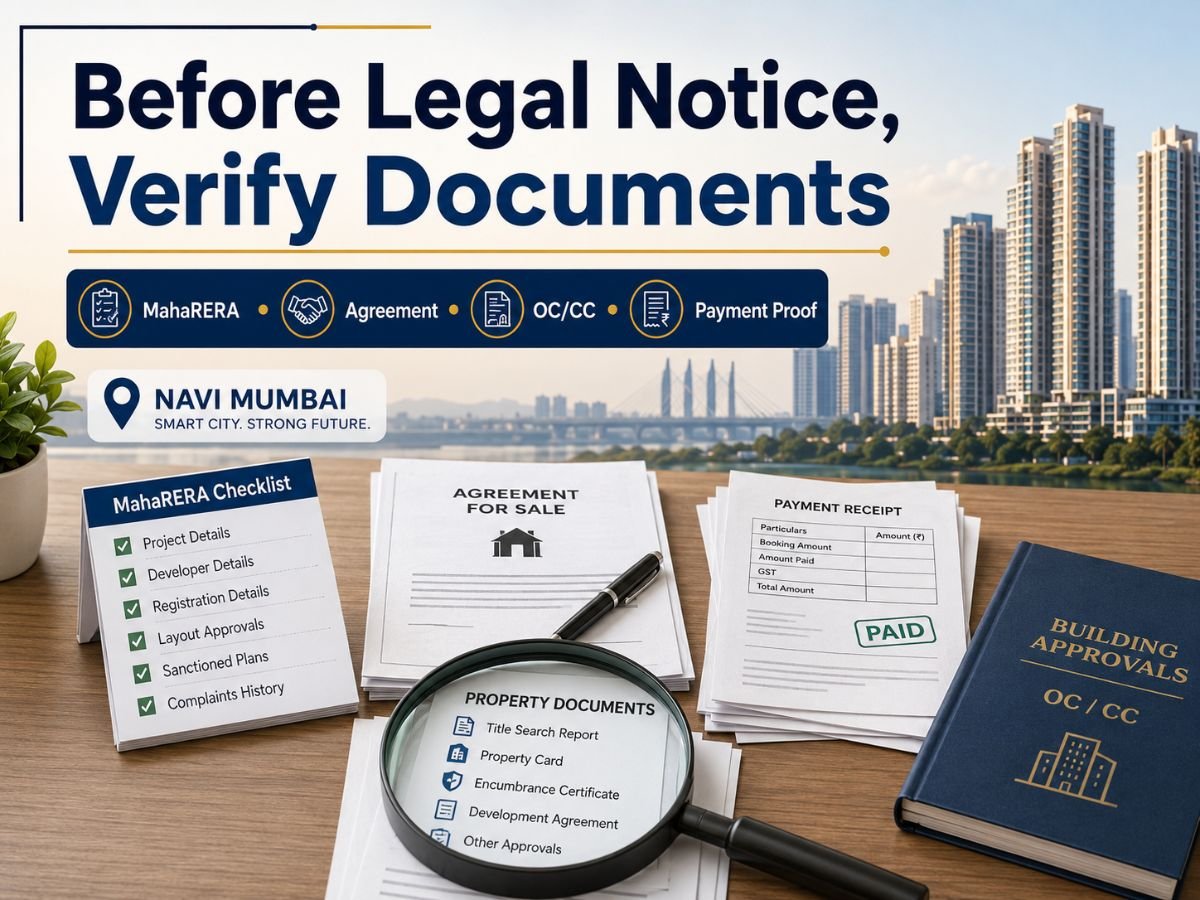
Step 1: Check MahaRERA Before Sending the Notice

If the property is part of a registered real estate project, check the project on the MahaRERA portal.
Verify:
- Project name
- MahaRERA registration number
- Promoter name
- Project address
- Completion date
- Revised completion date, if any
- Project status
- Uploaded approvals
- Agreement-related details
- Complaint/order history, if available
- Registered real estate agent details, if a broker is involved
MahaRERA allows complaints by aggrieved persons for registered projects through its online complaint process. So before making allegations in a legal notice, match your facts with the official project record.
Buyer warning: The brand name used in an advertisement may be different from the promoter’s legal name. Always match the promoter name with the agreement, receipt, bank account and RERA record.
Step 2: Verify the Agreement and Payment Records
Before sending notice, arrange your own documents.
Check:
- Booking form
- Allotment letter
- Agreement for Sale
- Payment receipts
- Bank transfer proof
- Stamp duty proof
- Registration proof
- Index II
- GST payment proof, if applicable
- Builder demand letters
- Email and WhatsApp communication
- Brochure or advertisement used during sale
- Cancellation request, if any
If the agreement is not registered, that itself is a serious risk area. Do not pay large amounts only on the basis of booking form, WhatsApp chat or verbal assurance.
Step 3: Check Land and Title Records
This is especially important for plots, gaothan properties, CIDCO-related properties, NAINA-area projects, redevelopment projects and landowner-builder joint development projects.
Check:
- 7/12 extract
- 8A extract
- Property card
- Mutation entries
- Survey number / gat number / CTS number
- Village and taluka
- Current owner name
- Past sale deeds
- Development agreement
- Power of attorney
- Encumbrance details
- IGR e-search and Index II
- Legal title report
Mahabhumi and Maharashtra land-record portals provide access to land records such as 7/12, 8A, property card and mutation-related services. IGR Maharashtra should be checked for registered documents and Index II records.
Important: A 7/12 extract, property card or Index II helps verification. It should not be treated as complete proof of safe ownership by itself. Title must be checked by a property lawyer.
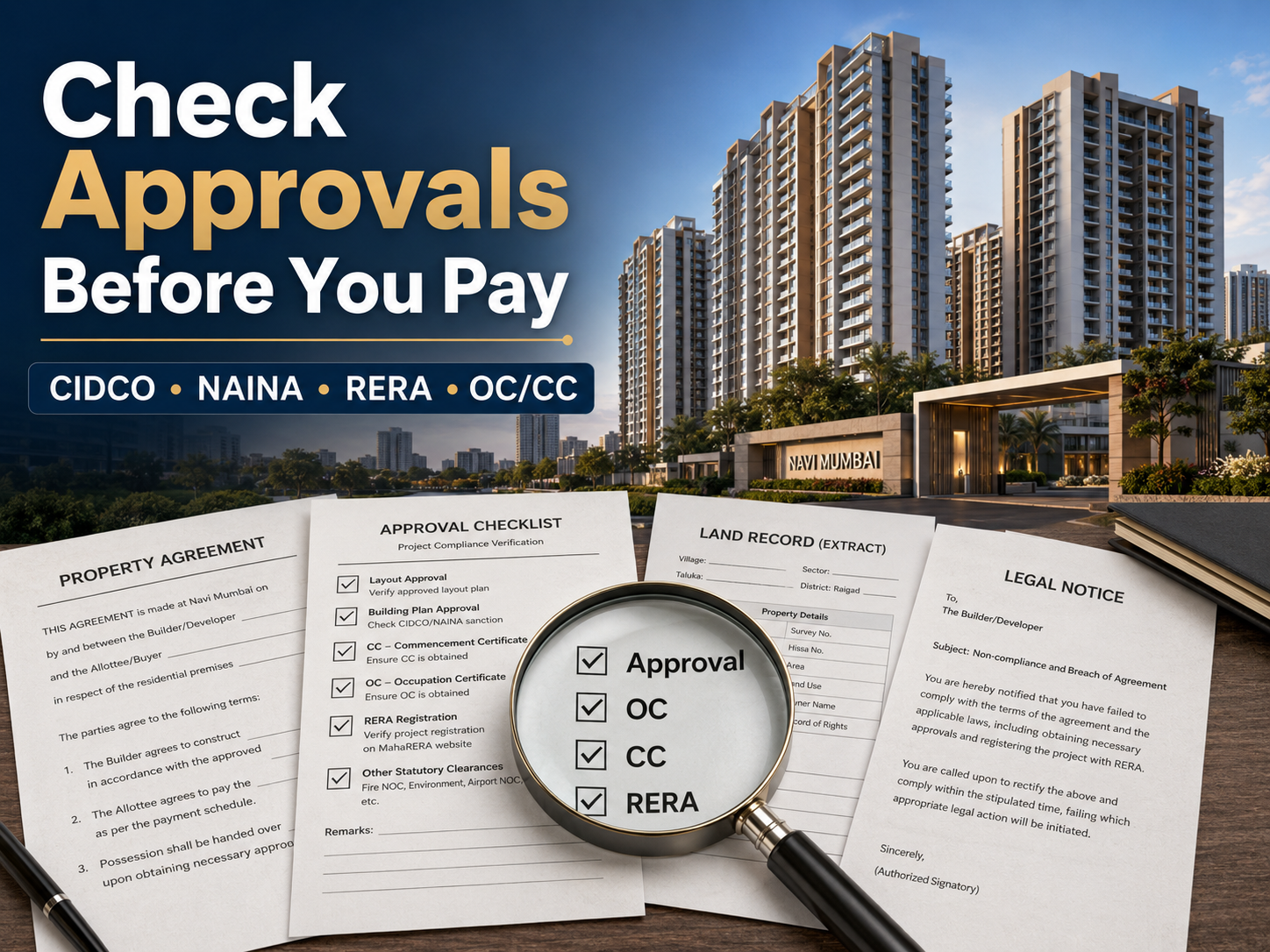
Step 4: Check CIDCO, NAINA and Planning Permissions
In Navi Mumbai, many disputes happen because buyers do not understand who the planning authority is.
For CIDCO, NAINA, Panvel, Ulwe, Dronagiri, Uran, Kharghar and nearby areas, check whether the builder’s claim matches official records.
Verify:
- CIDCO allotment letter, if applicable
- CIDCO transfer permission
- CIDCO lease deed
- CIDCO NOC
- CIDCO 12.5% scheme documents, if relevant
- NAINA development permission
- Building permission
- Commencement Certificate
- Occupancy Certificate
- Final plot / town planning scheme status
- Road access and reservation
- NA or deemed NA position
- CRZ risk, if near creek, mangrove or coastal zone
CIDCO’s official services include development permission, CRZ certificate, 12.5% scheme services, public complaint routes and NAINA-related information.
Do not accept “CIDCO clear” or “NAINA approved” only because the broker says it. Ask for documents and verify them.
What Should the Legal Notice Demand?
The demand should match the problem. Do not overload the notice with every possible complaint if the real issue is narrow.
| Situation | Demand to Include |
|---|---|
| Delay in possession | Confirm possession date, pay applicable interest/compensation, or offer refund as advised |
| Refund refusal | Refund amount, deduction breakup, payment deadline |
| Extra charges | Written legal basis and agreement clause for each charge |
| Missing approval | Copy of OC, CC, sanctioned plan, RERA disclosures and completion records |
| False promise | Explanation of difference between promise and approved record |
| Defective construction | Rectification plan, inspection, timeline and written responsibility |
| Token money dispute | Refund, document disclosure and proof of authority to sell |
| Suspected fraud | Document clarification and preservation of buyer’s rights for further complaint |
A good notice should be factual, calm and specific.
Avoid language like “you are a criminal” unless a lawyer has verified the facts and advised the correct route. Wrong allegations can create unnecessary risk.
Red Flags Before Paying More Money
Stop and verify before paying more if you see these signs:
- Builder refuses to share MahaRERA number.
- Project name differs across brochure, RERA, agreement and receipt.
- Payment is demanded in another company’s account.
- Builder avoids registered agreement.
- Token receipt does not mention flat/plot details clearly.
- Builder says OC is “in process” but asks for possession payment.
- CC, OC or sanctioned plan is not shown.
- Carpet area or layout has changed.
- Extra charges are not mentioned in the agreement.
- Broker claims “CIDCO plot” without CIDCO documents.
- NAINA plot is sold without clear development permission.
- Land records show different owner names.
- Property is near creek, mangrove, CRZ, green zone or reservation area.
- Builder pressures you to sign cancellation or settlement quickly.
Do not pay under pressure. First verify, then decide.
New Flat vs Resale Flat: What Changes?
| Point | New Flat from Builder | Resale Flat |
|---|---|---|
| Main dispute | Delay, refund, OC, extra charges, plan change | Title chain, society dues, transfer, old builder issues |
| Builder notice relevance | High if builder is still responsible | Relevant only if builder obligation still exists |
| Key records | MahaRERA, agreement, OC/CC, receipts | Sale deed chain, Index II, society NOC, share certificate |
| Risk area | Promoter promises and approvals | Seller title and pending dues |
| Buyer action | Check builder and project records | Check seller title and society records |
For resale flats in Navi Mumbai, a legal notice to builder may not always be the right route. Sometimes the issue is with the seller, society, previous agreement, pending dues or title chain. Take legal advice before sending notice to the wrong party.
Navi Mumbai Example
A buyer books a flat in Ulwe after seeing a brochure. The sales team says the project is RERA registered and possession will happen in 12 months. The buyer pays token money and two instalments.
Later, the builder delays the agreement, does not share OC/CC clarity, and demands extra “development charges”. The payment receipt is from a company name different from the brochure brand.
Before paying more, the buyer should:
1. Check the MahaRERA project record. 2. Match the promoter name with the receipt and agreement draft. 3. Ask for sanctioned plan, CC and payment statement. 4. Check IGR records if any document is registered. 5. Preserve chats, receipts and bank proof. 6. Send a legal notice through a lawyer demanding written clarification, document copies, charge breakup and refund/possession remedy.
This is the correct mindset: first evidence, then notice, then escalation.
What Happens If the Builder Ignores the Notice?
If the builder does not respond or gives a vague reply, the next route depends on the facts.
| Route | When It May Apply |
|---|---|
| MahaRERA complaint | Registered project, possession delay, refund issue, disclosure failure, promoter obligation |
| Consumer complaint / e-Jagriti | Deficiency in service, unfair trade practice, refund/compensation dispute |
| National Consumer Helpline | Early consumer grievance route and tracking |
| Police / EOW | Forgery, cheating, fake receipt, fake approval, impersonation |
| Civil court | Injunction, title dispute, specific performance, complex property rights |
| CIDCO / NAINA complaint | False CIDCO/NAINA approval claim, unauthorized development, planning issue |
| Revenue office / land records | Mutation, 7/12, property card, land-class or ownership dispute |
Do not assume one route fits every case. A delay case, refund case, forged-document case and land-title case may need different action.
Common Mistakes Buyers Make
- Sending a copied legal notice without document review.
- Sending notice to the sales executive instead of the legal builder entity.
- Not checking MahaRERA before alleging delay.
- Paying cash token without proper receipt.
- Not checking IGR records.
- Ignoring 7/12, property card and mutation entries for land/plot cases.
- Believing “CIDCO approved” without official documents.
- Believing “NA not required” without lawyer/revenue verification.
- Accepting possession without OC clarity.
- Signing settlement or cancellation without reading waiver clauses.
- Waiting too long after repeated default.
Final Buyer Checklist Before Sending Legal Notice
Use this checklist before taking action:
- Have I checked the MahaRERA project page?
- Does the promoter name match the agreement and receipt?
- Do I have all payment proofs?
- Is the agreement registered?
- Do I have the promised possession date in writing?
- Have I checked OC/CC/sanctioned plan status?
- Have I checked IGR and Index II records?
- For plot/land, have I checked 7/12, 8A, property card and mutation?
- For CIDCO/NAINA property, have I checked authority documents?
- Is the property affected by CRZ, green zone, reservation or road alignment?
- Have I saved emails, WhatsApp chats and demand letters?
- Have I spoken to a property lawyer before sending the notice?
If the answer is “no” to important items, fix the document gap first.
Conclusion
Before sending a legal notice to builder, get your documents organised properly.
Navi Mumbai Property Deals can help buyers understand basic property-document red flags, arrange the right checklist and connect with suitable professionals for deeper legal or verification support in Navi Mumbai, Panvel, Ulwe, Kharghar, Taloja, Dronagiri, Uran, CIDCO and NAINA areas.
If you are stuck with builder delay, refund refusal, token money issue or approval doubt, start with document verification before paying more.
Disclaimer
This article is for educational information only. It is not legal advice. Property disputes depend on facts, documents, agreement clauses, project status and authority records. Before sending a legal notice, filing a complaint or making payment decisions, verify the latest position with a qualified property lawyer and the relevant authority.
FAQs
Frequently Asked Questions