
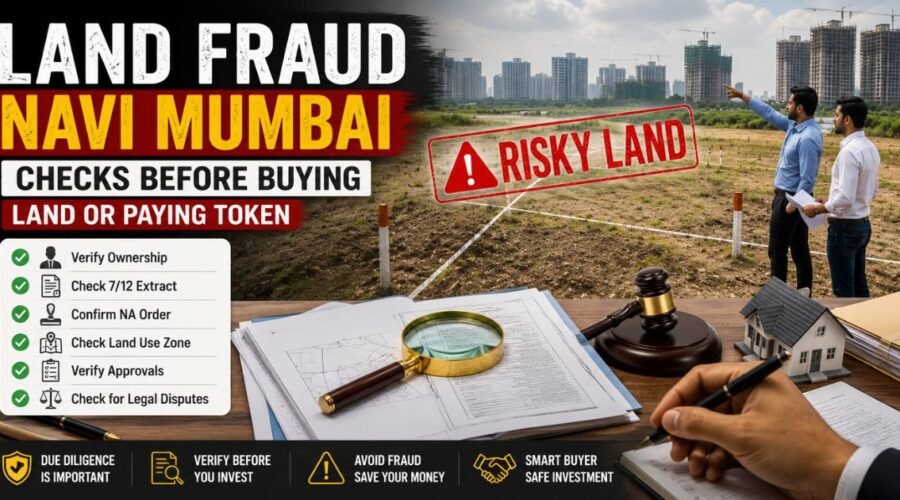
Land Fraud Navi Mumbai: Checks Before Buying Land or Paying Token
Land fraud in Navi Mumbai usually happens when buyers trust verbal claims about ownership, CIDCO approval, NAINA growth, gaothan rights, NA permission or future development without checking official records. Before paying token money for land in Navi Mumbai, Panvel, Ulwe, Uran, Dronagiri, Taloja or nearby NAINA areas, verify the 7/12 extract, property card, mutation entries, IGR registered documents, title chain, zoning, CIDCO/NAINA status, CRZ risk and seller identity.
Do not buy the story. Verify the land.
Why Land Fraud Matters for Navi Mumbai Buyers
Land in and around Navi Mumbai can look attractive because of airport growth, NAINA development, CIDCO influence, road projects, logistics hubs and expanding residential demand.
That is exactly why buyers must be careful.
Many land deals are sold with lines like:
- “This plot is near the airport.”
- “NAINA approval is coming.”
- “CIDCO transfer is easy.”
- “This is gaothan land, no issue.”
- “Pay token today or the deal will go.”
- “The 7/12 is clear, so nothing else is required.”
These lines may be true in some cases. But they are not proof.
A safe land purchase needs document verification, title search, land-use check, authority confirmation and written legal review. A 7/12 extract alone does not guarantee that the land is safe to buy.
For Navi Mumbai buyers, the biggest risk is not only fake documents. The bigger risk is paying token before understanding what the land legally is.
What Land Fraud Means in Navi Mumbai
Land fraud means any transaction where the buyer is misled about ownership, legal rights, approvals, development potential, restrictions, possession or transferability of the land.
In Navi Mumbai and nearby growth areas, this can include:
| Fraud Type | What It Means | Buyer Risk |
|---|---|---|
| Fake ownership claim | Seller is not the real legal owner | Token/payment loss, litigation |
| Forged documents | Fake sale deed, fake allotment letter, fake NOC or edited land record | Criminal dispute and blocked transaction |
| Same land sold twice | Seller or broker collects money from multiple buyers | Long legal fight |
| Fake CIDCO plot claim | Land is presented as CIDCO-allotted or transferable without proof | Transfer may fail |
| NAINA approval confusion | Buyer is told approval is confirmed when only future planning is discussed | Land may not be buildable now |
| Gaothan confusion | Village/gaothan property is sold without clear title or transfer rights | Ownership and permission issues |
| Agricultural land sold as residential plot | Farm land is marketed as ready residential plotting | Construction/use may not be permitted |
| CRZ or green zone issue | Land has coastal, creek, mangrove, green zone or development restrictions | Construction or resale may become difficult |
| Token money fraud | Buyer pays before written verification | Refund dispute |
The practical rule is simple: if the seller cannot prove the claim through official records, treat it as unverified.
Areas Where Buyers Should Be Extra Careful
This guide is especially useful if you are checking land in:
- Panvel
- Ulwe
- Dronagiri
- Uran
- Taloja
- Kharghar fringe areas
- NAINA villages
- Raigad-side growth belt
- Thane-side village/property belt
- CIDCO-influenced land pockets
- Gaothan or village properties
- Plots near creek, mangrove or coastal areas
These areas are not “unsafe” by default. Many genuine transactions happen here.
But the document layer can be more complex because one plot may involve village records, survey numbers, CIDCO/NAINA planning rules, development plan reservations, CRZ checks, title history, mutation entries and land-use permissions.
Key Documents to Check Before Paying Token Money
Use this checklist before even discussing token payment.
| Document / Record | What to Check | Where to Verify |
|---|---|---|
| 7/12 extract | Owner name, survey/gat number, area, land type, loans, restrictions, mutation references | Mahabhumi / Mahabhulekh |
| 8A extract | Revenue account and landholding details | Mahabhumi / Mahabhulekh |
| Property card | CTS number, holder name, area and urban land details | Mahabhumi / Bhumiabhilekh |
| Mutation / Ferfar entries | How ownership changed over time | Mahabhumi / revenue office |
| Sale deed chain | Previous registered transfers | IGR Maharashtra / lawyer |
| Index II / IGR search | Registered documents, past transactions, mortgage clues | IGR Maharashtra eSearch |
| Encumbrance / search report | Mortgage, claim, charge or legal burden | Lawyer / IGR records |
| Seller identity proof | Seller name, PAN, Aadhaar, address, authority to sell | Buyer/lawyer verification |
| Power of attorney, if any | Whether POA is valid, registered and specific | Lawyer verification |
| CIDCO documents | Allotment, lease, transfer permission, NOC, scheme documents | CIDCO office / CIDCO portal |
| NAINA records | ZCS, development plan, CC/OC, TPS status, building permission | CIDCO/NAINA portal |
| NA / land-use approval | Whether land can be used for the promised purpose | Planning authority / revenue office |
| CRZ / CZMP check | Coastal, creek, mangrove or restricted-zone risk | MCZMA / CZMP records |
| MahaRERA record | If land is sold as part of a plotted development/project | MahaRERA portal |
Important: A broker-forwarded PDF or WhatsApp screenshot is not enough. Download or verify records from official portals or through a qualified professional.
Step-by-Step Verification Process
1. First identify the exact land
Before checking documents, identify the land correctly.
Ask for:
- Village name
- Taluka
- Survey number / gat number
- CTS number, if applicable
- Plot area
- Boundary details
- Access road details
- Current possession status
- Seller name
- Previous owner details
If the land shown on site does not match the land record, stop.
2. Check the latest 7/12 extract or property card
The 7/12 extract is a land record used mainly for agricultural/village land in Maharashtra. It can show details such as landholder name, survey number, land area, crop/land-use entries, mutation references, loans or other rights.
A property card is more common for urban/CTS-based property.
For Navi Mumbai, Panvel, Uran, Taloja and NAINA-side land, you may need both land-record and planning-authority checks.
Check:
- Is the seller’s name visible?
- Does the survey/gat/CTS number match?
- Is the land area the same as promised?
- Are there loans, restrictions or other rights?
- Is the land agricultural, residential, government, Class-II, leasehold or restricted?
- Is the latest mutation reflected?
Mahabhumi/Bhumiabhilekh provides official digital land-record services such as 7/12, 8A, Ferfar/mutation and property card services.
3. Check mutation entries
Mutation, also called Ferfar, records changes in land records after sale, inheritance, partition, gift, court order or other transfer.
But mutation is not the same as full title clearance.
It only shows that a change was entered in revenue records. A buyer must still check the legal title chain, registered documents, seller authority and disputes.
Red flags:
- Mutation pending
- Mutation objected
- Missing mutation link
- Family inheritance not properly recorded
- Seller name added recently without clear supporting deed
- Multiple heirs but only one person selling
If mutation history is confusing, verify with the revenue office and a property lawyer.
4. Search registered documents on IGR Maharashtra

IGR Maharashtra eSearch helps users check registered property documents. The department says eSearch can help prevent fraud from multiple transactions and advises checking close to the time of executing/registering the document.
Use IGR search to check:
- Previous sale deeds
- Gift deeds
- Release deeds
- Mortgage documents
- Development agreements
- Lease documents
- Power of attorney references
- Multiple transfers in short time
- Any document that contradicts the seller’s story
For land deals, this is critical. A land record may show one thing, while registered document history may show another issue.
5. Verify title chain with a lawyer
Title chain means the ownership history of the land.
A lawyer checks how the land passed from one owner to another. This may include sale deeds, inheritance papers, release deeds, partition deeds, court orders, lease documents, allotment papers and government permissions.
Ask for a written title search report.
Do not rely on verbal lines like:
- “Title is clear.”
- “Lawyer has checked.”
- “All documents are available.”
- “Registration can happen immediately.”
Ask for written comments.
6. Check CIDCO or NAINA claims
In Navi Mumbai, many sellers use CIDCO or NAINA names to build trust.
But saying “CIDCO plot” or “NAINA approved” is not enough.
CIDCO/NAINA official resources include NAINA Interim Development Plan, building permission, development plan, DCPR, Town Planning Schemes, ZCS, CC and OC approval lists [3][4].
If the land is in a NAINA-influenced area, check:
- Is the plot inside a NAINA planning area?
- What does the Zone Confirmation Statement say?
- Is there a sanctioned layout?
- Is there a Commencement Certificate?
- Is there an Occupation Certificate, if construction exists?
- Is the land part of a Town Planning Scheme?
- Is the land reserved for road, public purpose, green zone or other use?
- Is the seller claiming future benefit without current approval?
For CIDCO-related plots, also check allotment, lease, transfer permission, NOC and scheme-specific documents.
If the seller says “CIDCO transfer will happen later,” verify with CIDCO before paying token.
7. Check land use, NA status and development permission
A common fraud pattern is selling agricultural land as if it is ready residential land.
NA means non-agricultural. It generally refers to permission or legal status allowing land to be used for non-agricultural purposes such as residential, commercial or industrial use.
Maharashtra has seen recent changes around NA permission and land-use conversion. Because these rules are process-sensitive and may vary based on planning authority, development plan and land category, buyers should verify the latest position with the revenue office, planning authority and a property lawyer before relying on any seller claim.
Do not accept:
- “NA will come soon.”
- “NA is not needed now.”
- “Residential zone is confirmed.”
- “Development permission is guaranteed.”
- “Collector permission is not required, so no issue.”
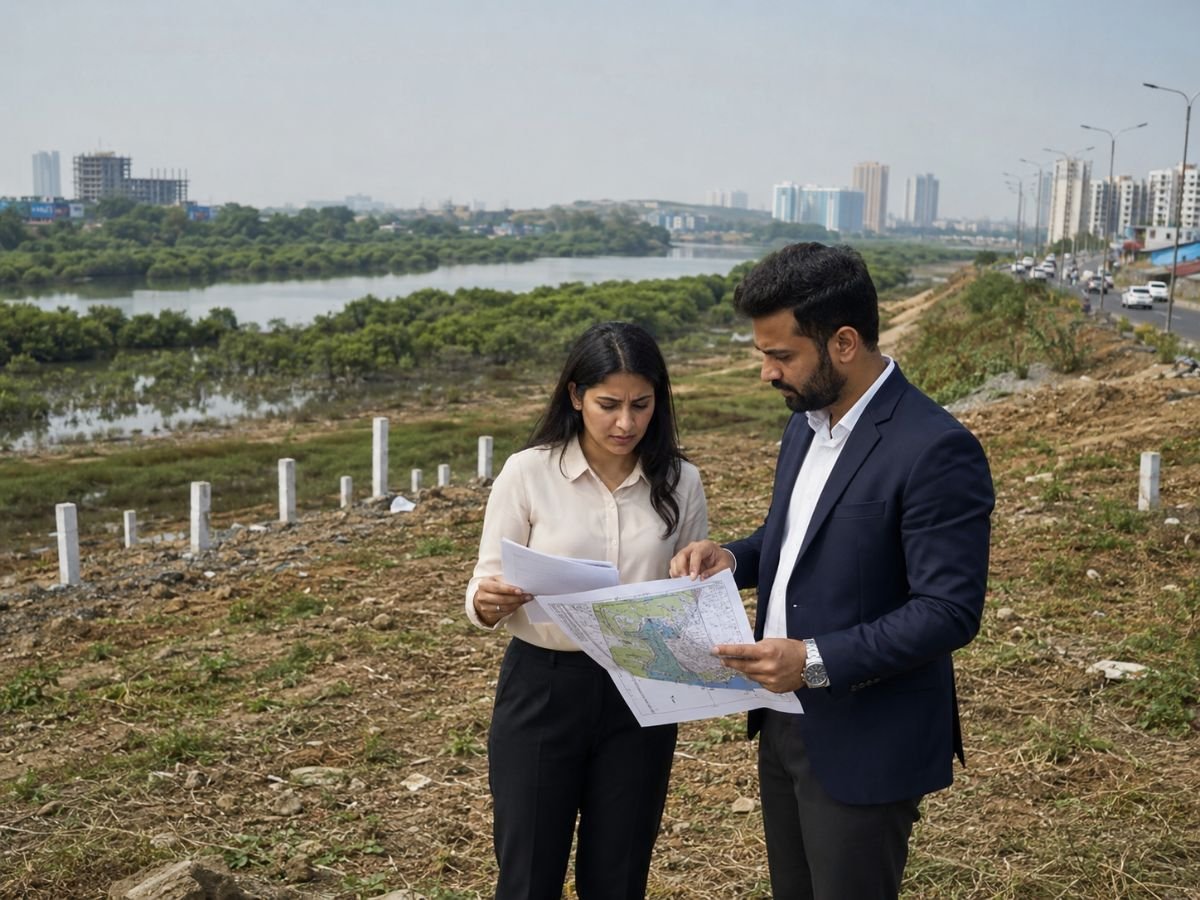
8. Check CRZ, creek, mangrove and green-zone risk
For land near Uran, Dronagiri, Ulwe, Belapur, Nerul, Panvel creek or coastal/creek-side areas, CRZ and CZMP checks become important.
CRZ means Coastal Regulation Zone. It can restrict construction and development near coastal, creek, mangrove and tidal-influenced areas.
MCZMA is the Maharashtra Coastal Zone Management Authority, and its official resources include CRZ/CZMP-related information.
Check this especially if:
- Land is near creek water
- Mangroves are nearby
- The site is close to coastal belts
- There is reclaimed or low-lying land
- Seller avoids giving map-based confirmation
- Broker says “CRZ issue is not there” but gives no proof
If CRZ or mangrove influence is possible, do not proceed without professional verification.
9. Check MahaRERA if it is a plotted project
If land is sold as a plotted development, gated plot scheme, farmhouse plot scheme or investment project, check whether MahaRERA registration is required and whether the project is listed.
MahaRERA provides access to registered projects, revoked/lapsed project lists, complaints, unregistered project complaints and related project information.
Check:
- Project registration number
- Promoter name
- Land title details uploaded
- Layout approval
- Approvals and commencement details
- Project status
- Complaints
- Lapsed/revoked/de-registered status
- Agent registration, if an agent is involved
RERA registration is useful, but it does not replace independent title verification.
Major Red Flags in Navi Mumbai Land Deals
Stop and verify immediately if you see these signs:
| Red Flag | Why It Is Risky |
|---|---|
| Seller refuses latest land records | May indicate title or ownership issue |
| Broker sends only screenshots | Screenshots can be edited |
| Seller name does not match 7/12/property card | Seller may not have legal right to sell |
| Token demanded in cash | Harder to prove and recover |
| No refund clause in token receipt | Buyer may lose money if documents fail |
| “NA soon” claim | Future permission is not current approval |
| “CIDCO approved” without document | Could be a false authority claim |
| “NAINA future growth” used as proof | Growth potential is not legal clearance |
| POA seller avoids lawyer check | Authority to sell may be weak |
| Mutation pending | Ownership record may not be settled |
| Land near creek/mangrove without CRZ check | Development may be restricted |
| Layout shown without approval number | Unauthorized plotting risk |
| Site boundary does not match survey map | Wrong land may be shown |
| Multiple owners, one seller | Consent/title problem possible |
| Very low price with urgency | Often used to push token payment |
Land/Plot vs Flat Verification: What Changes?
This article is about land, but many buyers compare land deals with flat deals.
| Point | Land / Plot | Flat / Apartment |
|---|---|---|
| Main risk | Title, land use, zoning, access, authority approvals | Builder approval, OC, RERA, society, dues |
| Key records | 7/12, property card, mutation, IGR, zoning, CIDCO/NAINA, CRZ | Agreement, OC, CC, RERA, society NOC, share certificate |
| Physical check | Boundary, road access, possession, encroachment | Flat condition, building status, possession |
| Authority check | Revenue office, planning authority, CIDCO/NAINA, MCZMA | MahaRERA, municipal/CIDCO authority, society |
| Token risk | Higher if title is unclear | Higher if builder/resale documents are incomplete |
Land buying is usually more complex than flat buying because the buyer must verify both ownership and land-use permission.
Example: NAINA Plot Near Panvel
Suppose a buyer is shown a plot near Panvel.
The broker says:
“This is a NAINA area plot. Airport development will increase the value. Pay token today. Papers are clear.”
The buyer should not decide based on this pitch.
The buyer should ask:
1. Does the 7/12 show the seller’s name? 2. Are mutation entries complete? 3. Does the survey number match the site? 4. Is the land agricultural, residential, reserved or affected by a planning scheme? 5. Is there official NAINA ZCS or development-plan confirmation? 6. Is there sanctioned layout or building permission? 7. Is there any CIDCO/NAINA CC or OC, if construction is claimed? 8. Is the plot part of a project that needs MahaRERA registration? 9. Does IGR search show any past sale, mortgage or conflicting document? 10. Is token refundable if title or approval fails?
Only after these checks should the buyer consider payment.
Common Mistakes Buyers Make
Many land buyers lose money because they do not make one big mistake. They make many small mistakes together.
Avoid these:
- Paying token before document verification
- Trusting broker confidence instead of official records
- Checking only 7/12 and ignoring IGR
- Treating mutation as final ownership proof
- Not checking old title chain
- Ignoring family inheritance issues
- Buying through unclear power of attorney
- Not checking CIDCO/NAINA approvals
- Ignoring CRZ or green-zone risk
- Believing “NA permission will come later”
- Signing vague MOU
- Paying cash token
- Not taking lawyer’s written report
- Not checking whether plotted development needs MahaRERA registration
What to Do Before Paying Token Money
Use this pre-token checklist.
| Check | Pass Only If |
|---|---|
| Seller identity | Seller matches official record and has legal authority |
| Land record | Latest 7/12/property card is verified from official source |
| Mutation | Entries are complete and explainable |
| Title chain | Lawyer can trace ownership properly |
| IGR search | No hidden sale, mortgage or conflicting document appears |
| Land use | Use is legally suitable for the buyer’s purpose |
| CIDCO/NAINA | Authority claim is verified from official records |
| CRZ/CZMP | Coastal or creek restriction is ruled out where relevant |
| MahaRERA | Project status is checked if it is a plotted development |
| Token receipt | Refund clause is written clearly |
| Payment mode | Paid through traceable banking channel only |
| Legal review | Lawyer gives written comments before payment |
What to Do If You Suspect Land Fraud
If you already paid token or suspect fraud, do not panic. First preserve evidence.
Keep:
- Payment proof
- Token receipt
- MOU
- WhatsApp chats
- Broker messages
- Seller documents
- Site photos
- Brochure or advertisement
- Bank transfer details
- Call details where legally usable
- Copies of all papers received
Then speak to a property lawyer. Depending on the facts, the next step may involve legal notice, police complaint, civil action, MahaRERA complaint, consumer complaint or another remedy.
Do not choose the complaint route only from online advice. The correct route depends on whether the issue is cheating, forgery, title dispute, builder default, broker misconduct, consumer deficiency or RERA-related violation.
Final Buyer Checklist
Before buying land in Navi Mumbai, Panvel, Ulwe, Dronagiri, Uran, Taloja, Kharghar fringe areas or NAINA belt, confirm:
- I know the exact survey/gat/CTS number.
- I have verified the latest 7/12/property card.
- I have checked mutation entries.
- I have checked IGR registered documents.
- I have verified seller identity.
- A lawyer has reviewed the title chain.
- CIDCO/NAINA claims are verified.
- Land-use and development restrictions are checked.
- CRZ/CZMP risk is checked where relevant.
- MahaRERA is checked if it is a plotted project.
- Token receipt has a refund clause.
- Payment is traceable.
- I am not buying only because of future growth claims.
If even one critical answer is missing, pause the deal.
Conclusion
Buying land in Navi Mumbai can be a good decision only when the documents are clear and the risk is understood before payment.
If you are checking a plot, gaothan property, CIDCO-related land, NAINA-area land or resale land parcel, Navi Mumbai Property Deals can help you shortlist the right questions, understand document gaps and connect with verification support before you move ahead.
Do not rush token money. Verify first, decide second.
Disclaimer
This article is for educational information only. It is not legal advice. Land laws, NA permission rules, CIDCO/NAINA procedures, CRZ restrictions, RERA requirements and revenue records can change or vary by case. Before paying token money or signing any document, verify the latest position with the relevant authority, revenue office, planning authority and a qualified property lawyer.
FAQs
Frequently Asked Questions