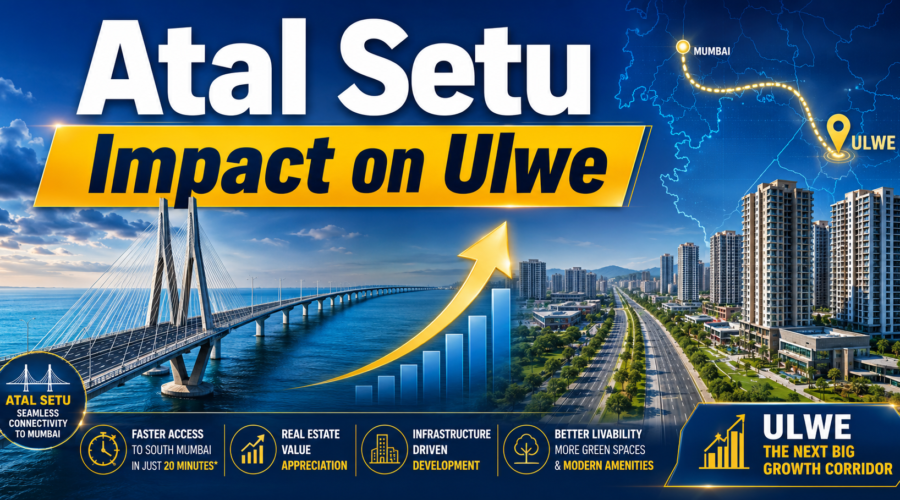
Atal Setu Impact on Ulwe: Connectivity, Airport Proximity & Property Prices
Atal Setu has reduced travel time from Ulwe to South Mumbai to under 20 minutes, making Ulwe one of the best-connected emerging nodes in Navi Mumbai. Combined with its position as the closest residential zone to the upcoming Navi Mumbai International Airport, Ulwe is now sitting at the intersection of two of the biggest infrastructure plays in the Mumbai Metropolitan Region.
If you’re looking at Ulwe — whether as a buyer, investor, or someone weighing it against other Navi Mumbai nodes — this article covers what has actually changed, what it means for property prices, and what risks to factor in before deciding.
Why Ulwe Is Different from Other Navi Mumbai Nodes
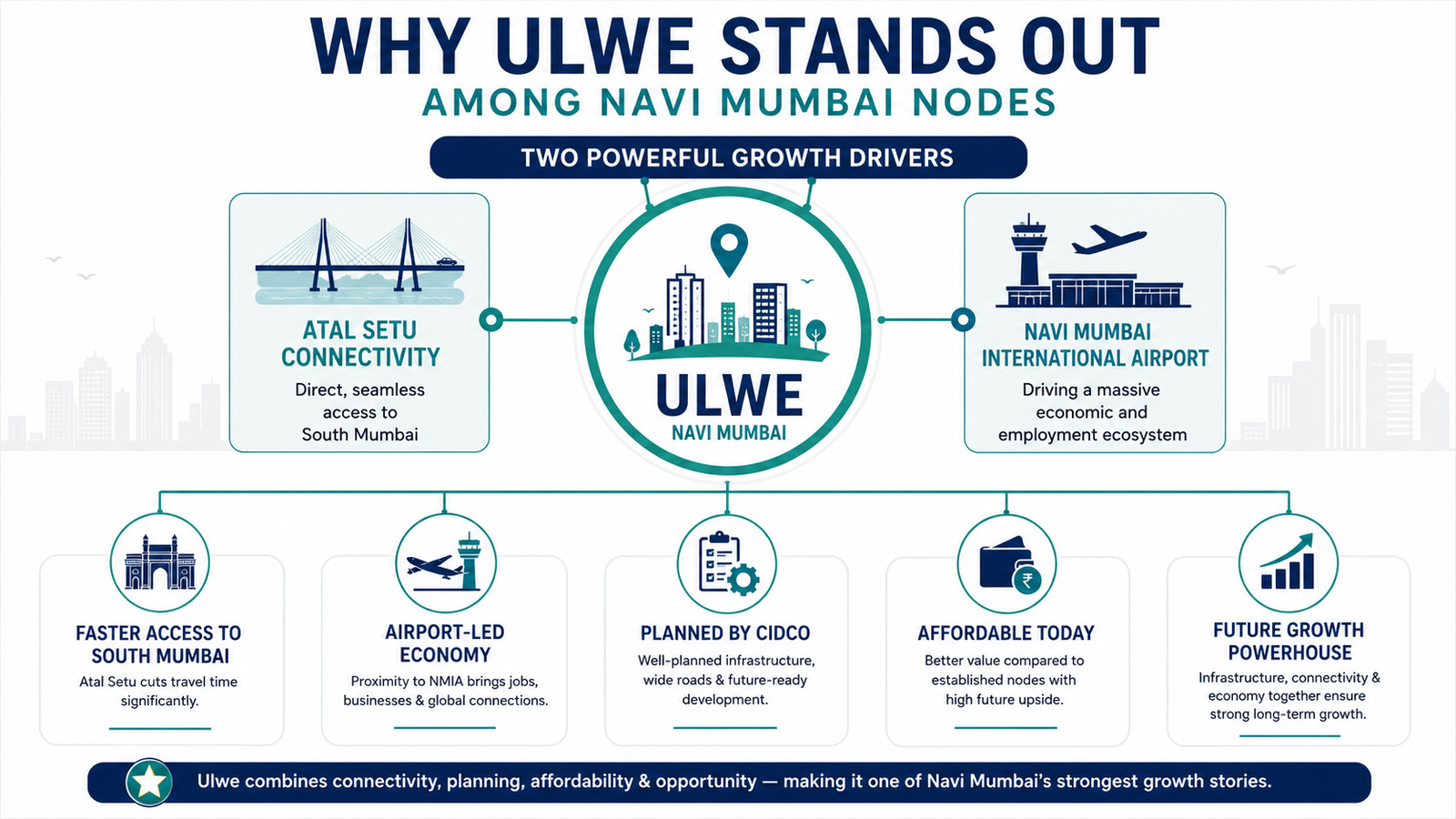
Most Navi Mumbai nodes have one infrastructure story. Kharghar has Metro connectivity and the upcoming BKC-Kharghar Metro corridor. Panvel has rail access and highway coverage.
Ulwe has two simultaneous infrastructure plays at a scale that affects the entire area fundamentally: Atal Setu on the connectivity side, and Navi Mumbai International Airport on the economic activity side. Neither of these was available — or even near completion — five years ago. Both are now either live or in advanced stages.
This is what separates Ulwe from other affordable Navi Mumbai options at a similar price point.
Atal Setu and Ulwe: The Direct Connectivity Shift
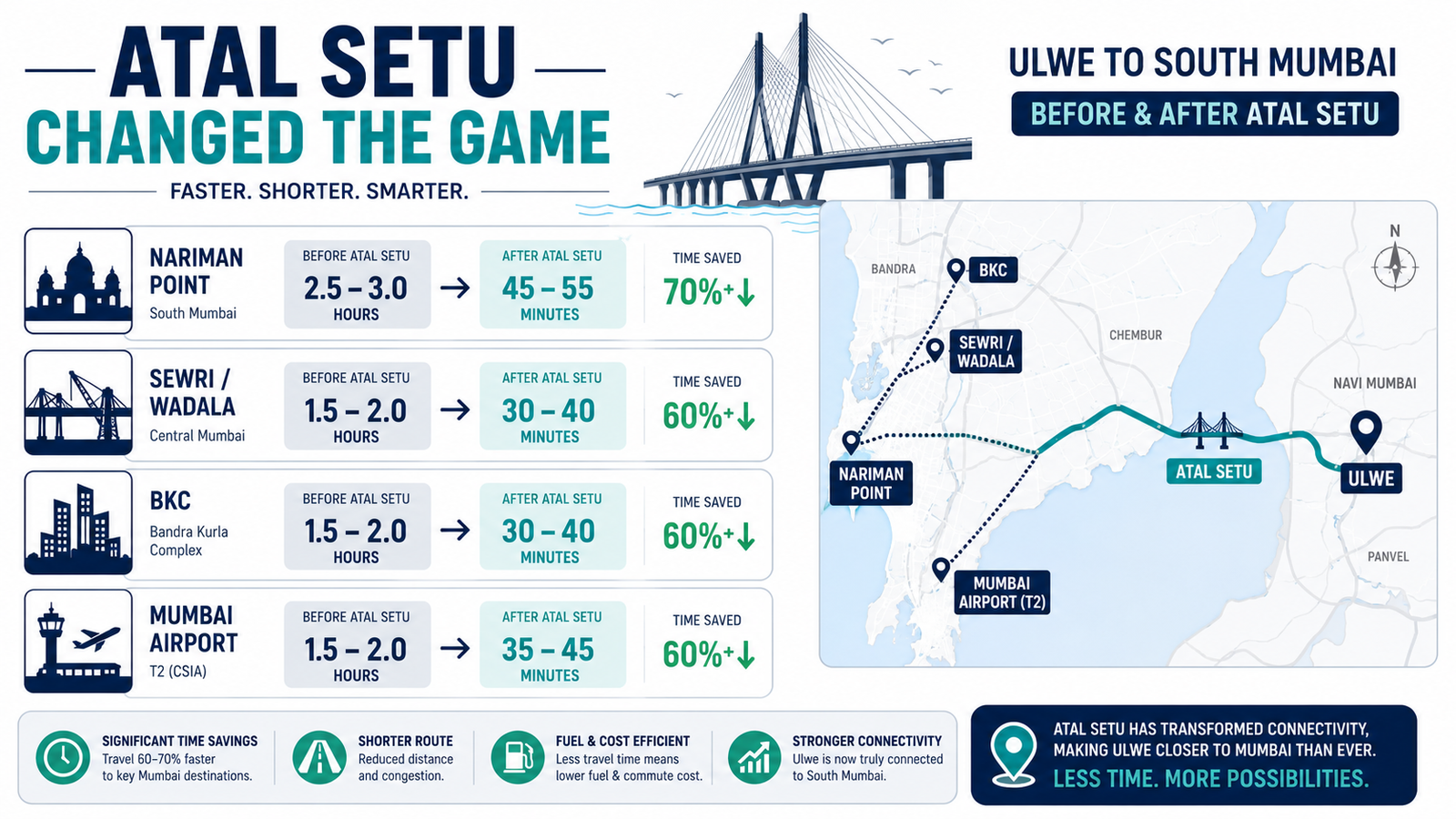
Travel Time Before and After Atal Setu
Ulwe’s location near the Chirle end of Atal Setu gives it among the most direct bridge access in Navi Mumbai.
| Route | Before Atal Setu | After Atal Setu |
|---|---|---|
| Ulwe to Nariman Point | 75-90 minutes | 20-30 minutes |
| Ulwe to Sewri/Wadala | 60-70 minutes | 15-20 minutes |
| Ulwe to BKC | 80-100 minutes | 35-50 minutes |
| Ulwe to Mumbai Airport | 90-110 minutes | 50-65 minutes |
These are approximate figures under normal traffic conditions. Peak-hour travel will be longer, but even with buffer, the improvement is significant enough to change Ulwe’s commute calculus entirely.
How Close Is Ulwe to the Chirle Interchange?
The Chirle interchange — the Navi Mumbai entry and exit point of Atal Setu — is approximately 5-8 km from most residential pockets in Ulwe. According to MSRDC, the Mumbai Trans Harbour Link (MTHL) spans 21.8 km and the Chirle end provides direct road access into the Ulwe-Dronagiri corridor.
This proximity is not accidental. Ulwe was planned by CIDCO as part of a broader south Navi Mumbai expansion, and the Atal Setu alignment has validated that planning intent.
Property Price Impact in Ulwe Post Atal Setu
Current Price Ranges by Property Type
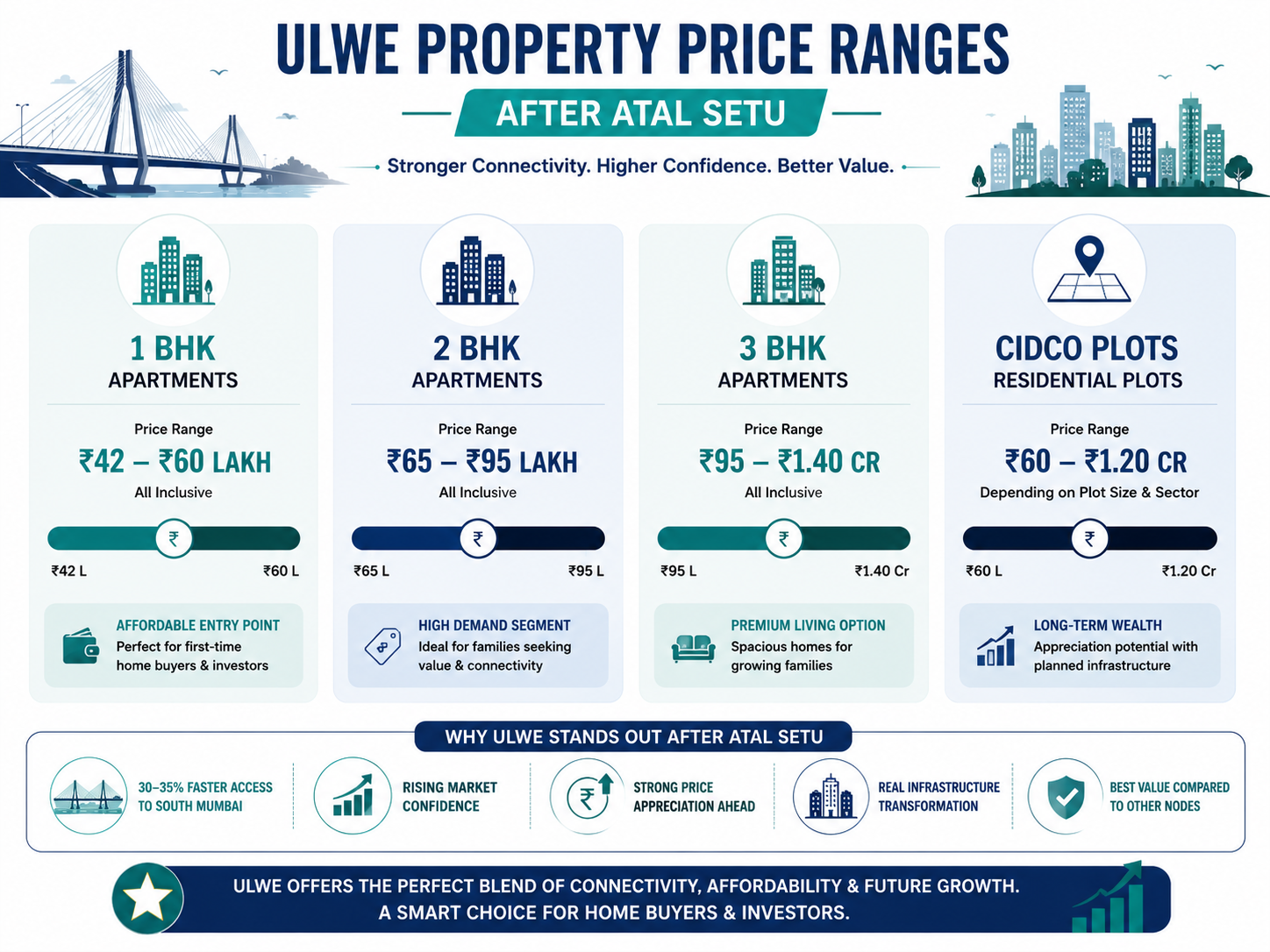
Ulwe remains one of the more affordable nodes in Navi Mumbai despite the infrastructure upgrade. Approximate price ranges as of 2025:
| Property Type | Approximate Price Range |
|---|---|
| 1 BHK | Rs. 45-65 lakh |
| 2 BHK | Rs. 70-1.05 crore |
| 3 BHK | Rs. 1.10-1.60 crore |
| Plots (CIDCO allotted) | Varies significantly by sector and plot size |
These figures are indicative. Prices vary by builder reputation, project stage, exact sector within Ulwe, and current market conditions. [Verify with registered local agents and confirm project registration on MahaRERA at maharera.maharashtra.gov.in before any transaction.]
Ulwe has seen a notable increase in new launches and project registrations since Atal Setu’s inauguration in January 2024. Developers who had acquired land in Ulwe 5-8 years ago at low rates are now launching projects, which is itself a signal of increased market confidence.
Rental Demand and Yield Trends
The rental market in Ulwe has picked up alongside purchase demand. Key rental demand drivers:
Airport-adjacent workforce. As pre-opening activity around Navi Mumbai International Airport increases, Ulwe is attracting construction contractors, airport-sector workers, and early employees of airport-linked businesses. Rental demand from this segment is expected to grow substantially once the airport becomes operational.
South Mumbai and BKC commuters. Professionals who work in South Mumbai but want to avoid Mumbai rental prices are now looking at Ulwe as a live option. A 2 BHK at Rs. 18,000-25,000 per month in Ulwe compares favorably to equivalent options in Chembur or Govandi at Rs. 35,000-50,000.
Rental yields in Ulwe currently hover around 3-4% annually, consistent with other emerging Navi Mumbai nodes. This is expected to improve as social infrastructure catches up with housing supply.
The Airport Factor: Navi Mumbai International Airport
What the Airport Means for Ulwe's Real Estate
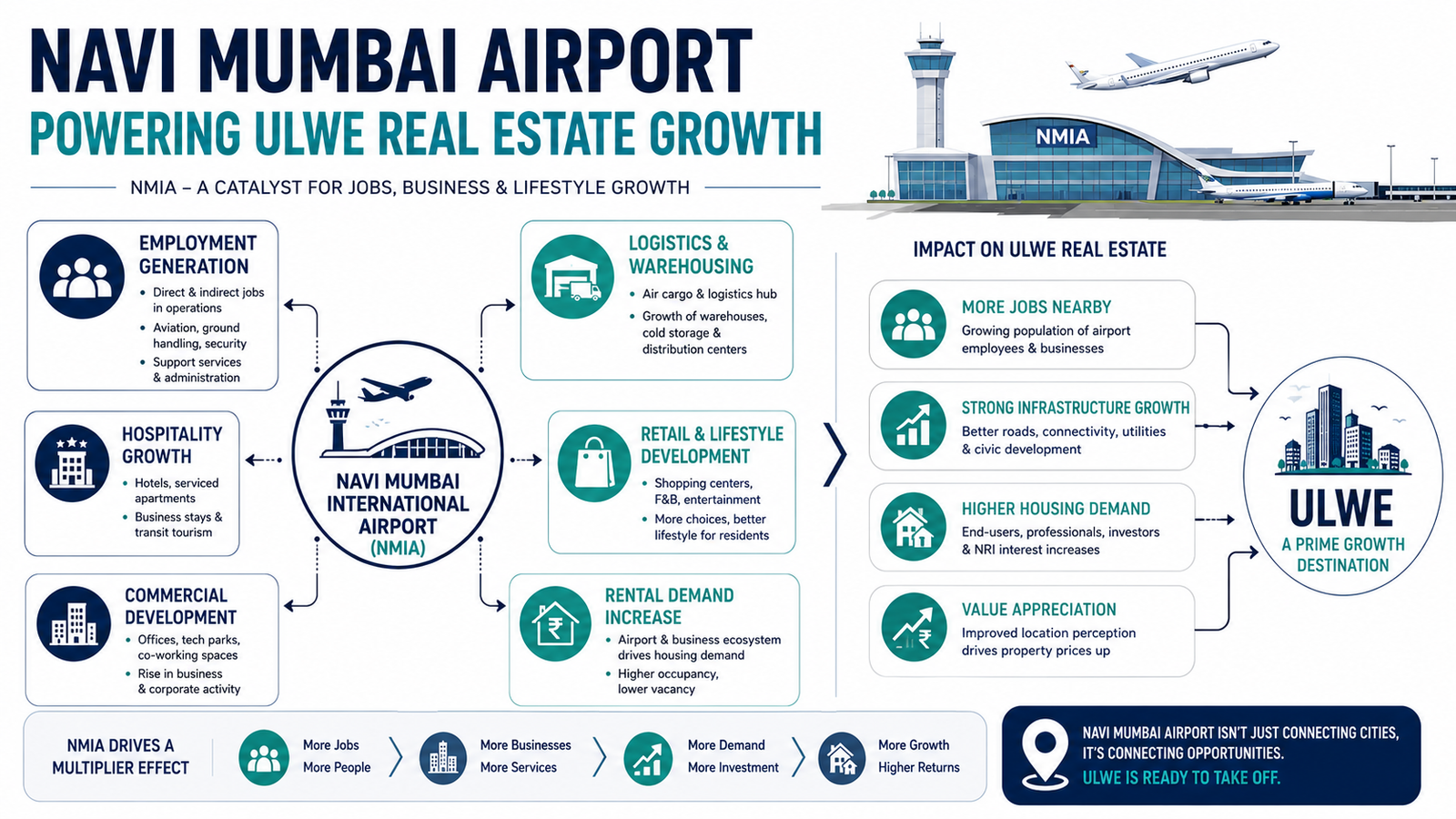
The Navi Mumbai International Airport (NMIA) is located in Ulwe itself, making it one of the few residential zones in India where buyers can live within the vicinity of a new international airport being built from scratch.
According to NMIA’s official project information, the airport is being developed by the City and Industrial Development Corporation (CIDCO) and is designed to handle an initial capacity of approximately 20 million passengers per year, with expansion planned over subsequent phases.
The real estate implications are direct:
Employment generation. Airport operations, logistics, retail, hospitality, and ancillary services will generate significant employment in and around Ulwe. This drives residential demand from workers and professionals who prefer proximity to their workplace.
Commercial development. Airport-adjacent zones tend to see hotels, service apartments, warehousing, and retail develop quickly. Ulwe will benefit from this commercial layer, which in turn supports residential property values.
Perception upgrade. Having an international airport as a neighbor changes the perceived status of an area significantly. Post-airport, Ulwe will likely be described differently in real estate marketing — that shift in perception has a real price impact.
It’s important to note: as of mid-2025, the airport is still in an advanced construction and commissioning phase. Buyers should not assume the airport is fully operational when making purchase decisions. [Verify current airport status at nmairport.com or with CIDCO before transacting.]
Who Is Buying in Ulwe Right Now?
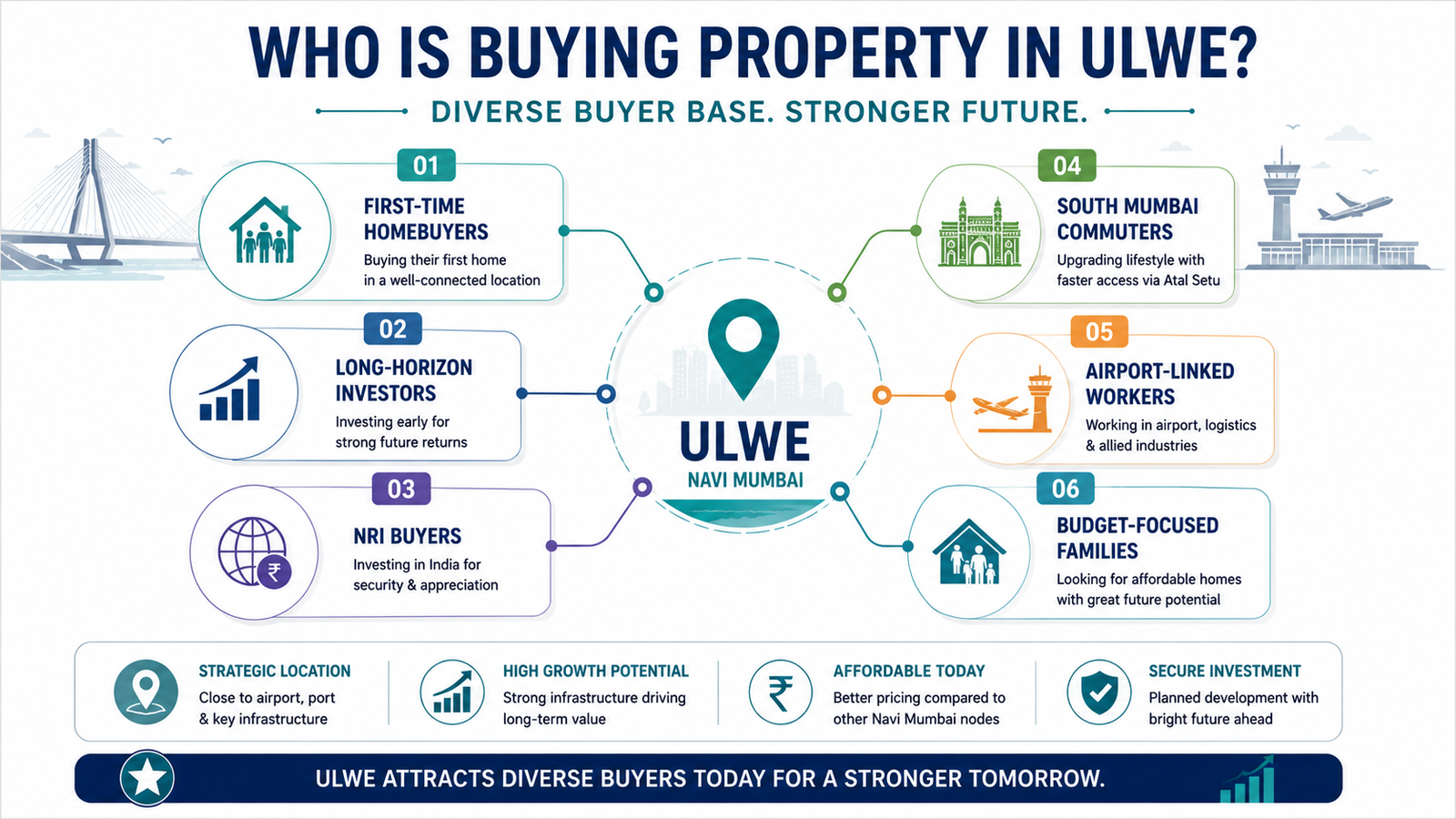
Buyer activity in Ulwe since Atal Setu has come from several distinct profiles:
First-time homebuyers on a budget. The combination of CIDCO-backed land, new-launch pricing, and Atal Setu connectivity makes Ulwe one of the most compelling entry-level options in Navi Mumbai. Buyers who previously defaulted to Taloja or Panvel for affordability are now comparing Ulwe seriously.
Long-horizon investors. Buyers who understand the airport story and are willing to hold for 5-7 years are entering at current prices to capture the anticipated appreciation once the airport becomes fully operational. This is a calculated bet — airport-adjacent real estate has historically appreciated sharply post-inauguration in other Indian cities.
NRI buyers. NRIs looking for a Navi Mumbai anchor investment find Ulwe’s combination of CIDCO pedigree, Atal Setu access, and airport proximity a credible proposition. [Verify project RERA status on MahaRERA and confirm builder track record before any NRI transaction.]
Infrastructure Pipeline Beyond Atal Setu and the Airport
Ulwe’s infrastructure story doesn’t stop at the bridge and the airport:
1. Navi Mumbai Metro (Phase 2 extensions) — Proposed metro lines include coverage for south Navi Mumbai. If metro access reaches Ulwe, it adds a public transit layer to the existing road-based connectivity advantage. 2. Dronagiri Node Development — Ulwe sits adjacent to Dronagiri, another CIDCO-planned node seeing increased industrial and commercial investment. The Dronagiri-Ulwe corridor is being watched closely by commercial real estate developers. 3. Trans-Harbour Road Improvements — Ongoing widening and improvement of arterial roads connecting Ulwe to the Atal Setu interchange will continue to reduce approach time and improve daily usability. 4. Port-Linked Development (JNPA) — The Jawaharlal Nehru Port Authority in the broader region drives logistics and warehousing demand, which indirectly supports residential demand in nearby zones including Ulwe. 5. CIDCO Smart City Infrastructure — Water, power, drainage, and road quality investments under CIDCO’s township mandate continue to improve the basic liveability of Ulwe as a residential destination.
Honest Assessment: Risks and Considerations in Ulwe
Ulwe’s case is genuinely strong, but buyers need the full picture.
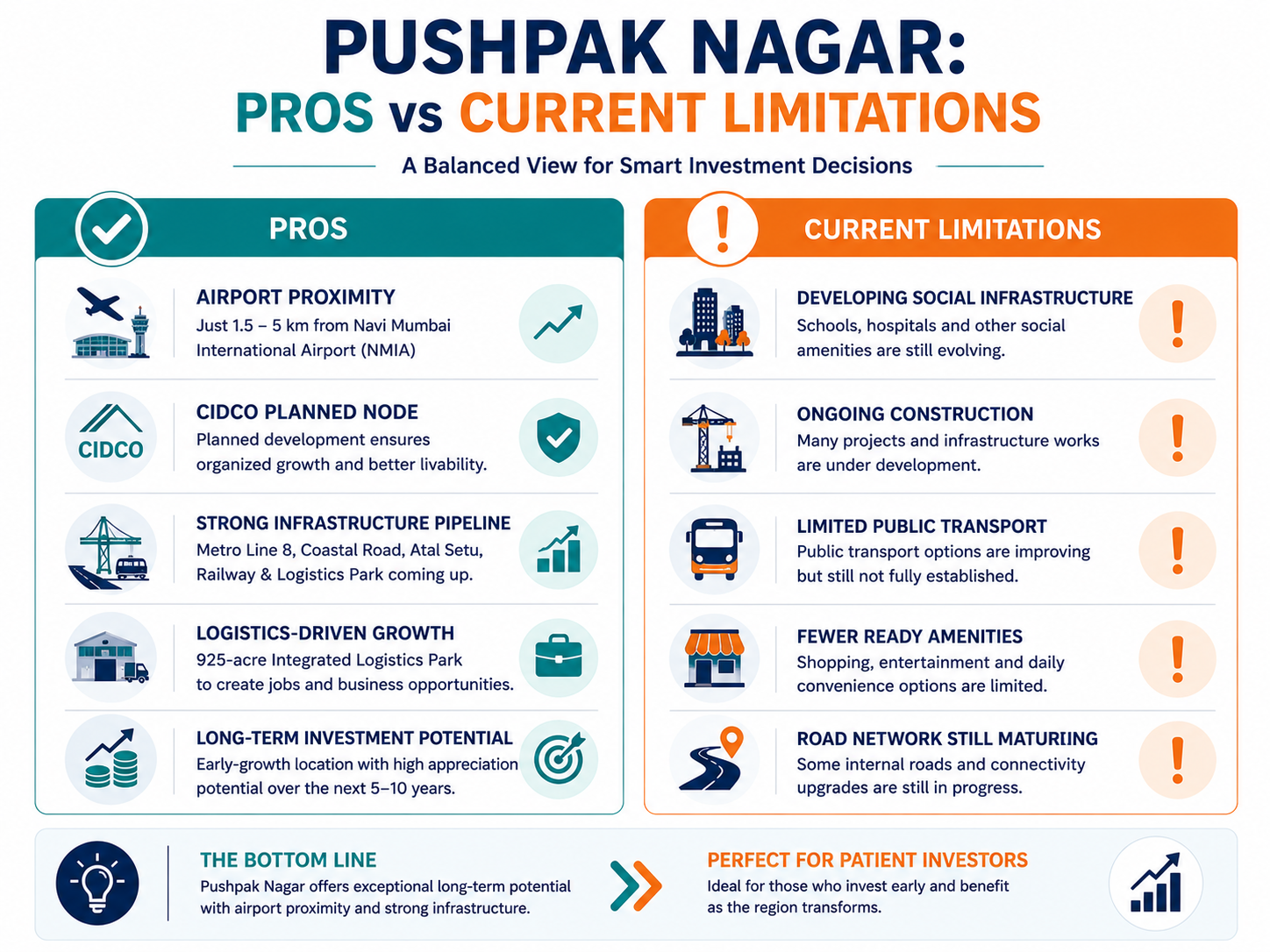
Social infrastructure lag. Schools, hospitals, retail malls, and daily convenience options in Ulwe are noticeably behind more mature nodes like Vashi, Kharghar, or Belapur. If you have school-age children or need frequent access to quality healthcare, do a detailed lifestyle assessment before buying.
Airport timeline uncertainty. The airport has faced multiple deadline revisions. While the project is well-funded and backed by CIDCO and the central government, buyers should not build a buy-decision around a specific airport launch date.
Under-construction project risks. Many Ulwe projects are new launches or under construction. Verify every project on MahaRERA before signing. Check the builder’s track record for delivery. This market has seen delays in other Navi Mumbai nodes, and Ulwe is no exception.
Resale liquidity. In very new nodes, resale liquidity can be lower than established markets. If you might need to exit in 2-3 years, factor in that finding a buyer quickly may be harder than in Vashi or Nerul.
Is Ulwe Worth Buying in 2025?
For long-term buyers: yes, with the right project selection.
The infrastructure fundamentals are genuine and not speculative. Atal Setu is live. The airport is advanced construction. CIDCO-backed development means the township framework is reliable. The price-to-infrastructure ratio remains favorable compared to most other Mumbai Metropolitan Region options.
For end users: viable, with lifestyle trade-offs acknowledged. If your workplace is in South Mumbai or BKC, Ulwe now works on commute time. But you’re buying into a node that’s still maturing — plan around that.
For short-term investors: caution. Ulwe’s upside is a 5-10 year story, not a 12-18 month flip. Price appreciation has started but the big unlock — airport operations, full metro access, commercial development — is still ahead.
Verify all projects on MahaRERA, check builder track records, and consult a certified property advisor before making any purchase decision.
FAQs
Frequently Asked Questions