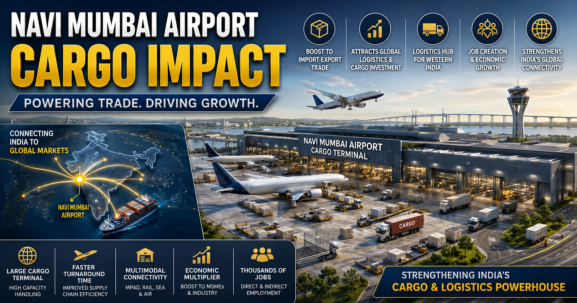
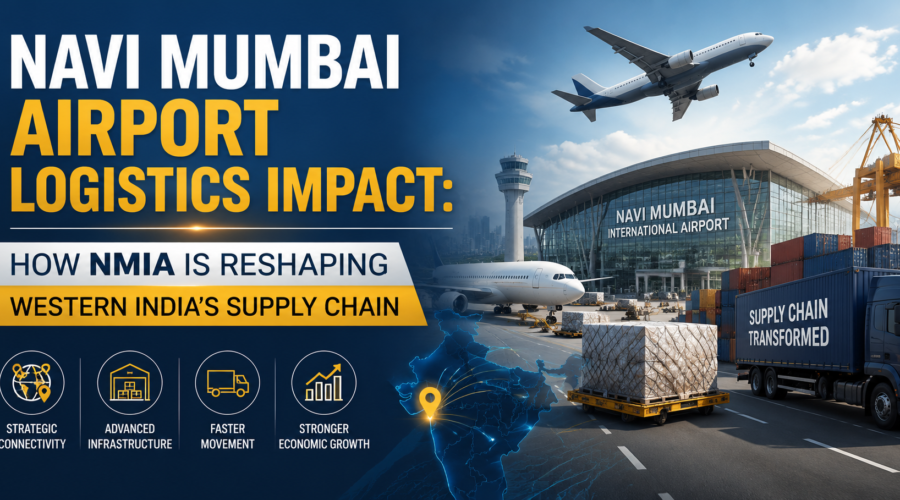
Navi Mumbai Airport Logistics Impact: How NMIA Is Reshaping Western India’s Supply Chain
The Navi Mumbai International Airport (NMIA) is not just another passenger terminal. It is fundamentally restructuring how goods move through western India, positioning the Mumbai Metropolitan Region as one of Asia’s most powerful logistics corridors.
With commercial flight operations underway since December 25, 2025, and 24/7 status confirmed from February 2026, the airport’s cargo infrastructure is now at the center of a supply chain transformation that industry analysts believe will add enormous economic value to Maharashtra over the next decade.
What Makes NMIA a Logistics Game-Changer
Most airports are built for passengers first. NMIA was designed differently.
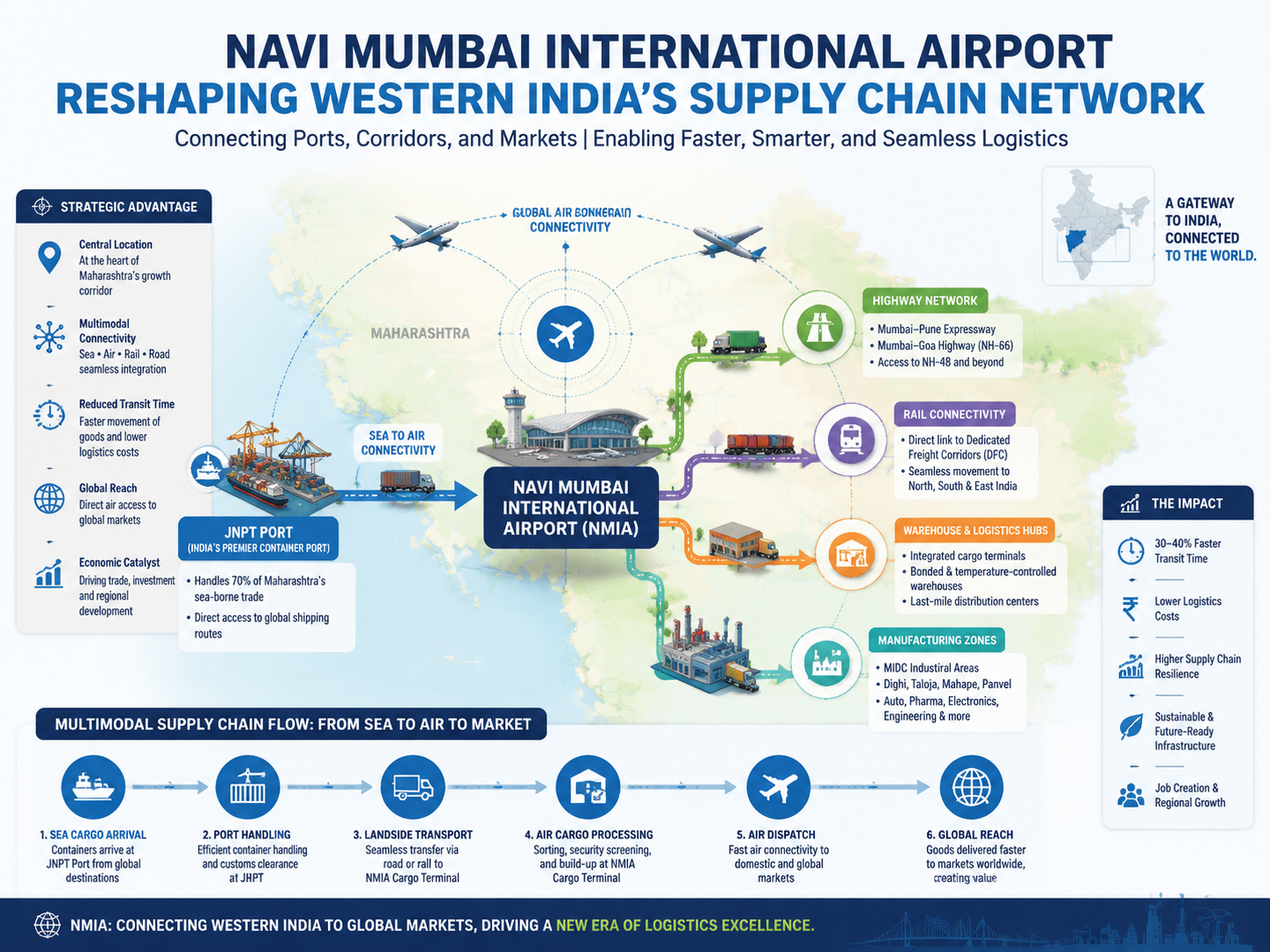
According to [NMIAL (Navi Mumbai International Airport Limited)], the airport was conceived as a multimodal greenfield hub, built to integrate air cargo with road, rail, and planned water transport networks from day one. That blueprint is already translating into real infrastructure.
Phase 1 capacity is set at 0.5 million metric tonnes of cargo annually, with a long-term expansion path to 3.25 million metric tonnes in later phases. That would place NMIA among India’s largest air cargo facilities by throughput.
The cargo terminal features:
- A fully automated handling system with digital tracking
- Temperature control zones for pharmaceuticals and perishables
- Dedicated customs clearance infrastructure
- Bonded warehousing for re-export operations
Pharmaceuticals and perishables are expected to anchor early volumes, two categories where speed, cold chain integrity, and customs efficiency directly affect product value.
FedEx Breaks Ground: A Rs 2,500 Crore Signal
When a global logistics giant makes a nine-figure bet on a new airport, the market takes note.
In February 2026, FedEx broke ground on a fully automated air cargo hub at NMIA, backed by a [Rs 2,500 crore investment] developed in partnership with Adani Airport Holdings. The hub is expected to generate over 6,000 direct and indirect jobs across logistics, warehousing, and transport.
FedEx President Kami Viswanathan described the rationale clearly: India’s competitiveness in global trade will increasingly depend on the reliability and speed of its logistics infrastructure. The NMIA hub integrates FedEx’s global network strength with India’s fastest-growing trade corridor.
What this means practically: Indian exporters in pharmaceuticals, textiles, electronics, and auto components will gain more direct access to trade lanes connecting Southeast Asia, the Middle East, Europe, and the United States, without needing secondary consolidation stops.
That is a meaningful efficiency gain for manufacturers and exporters across Maharashtra and the wider MMR.
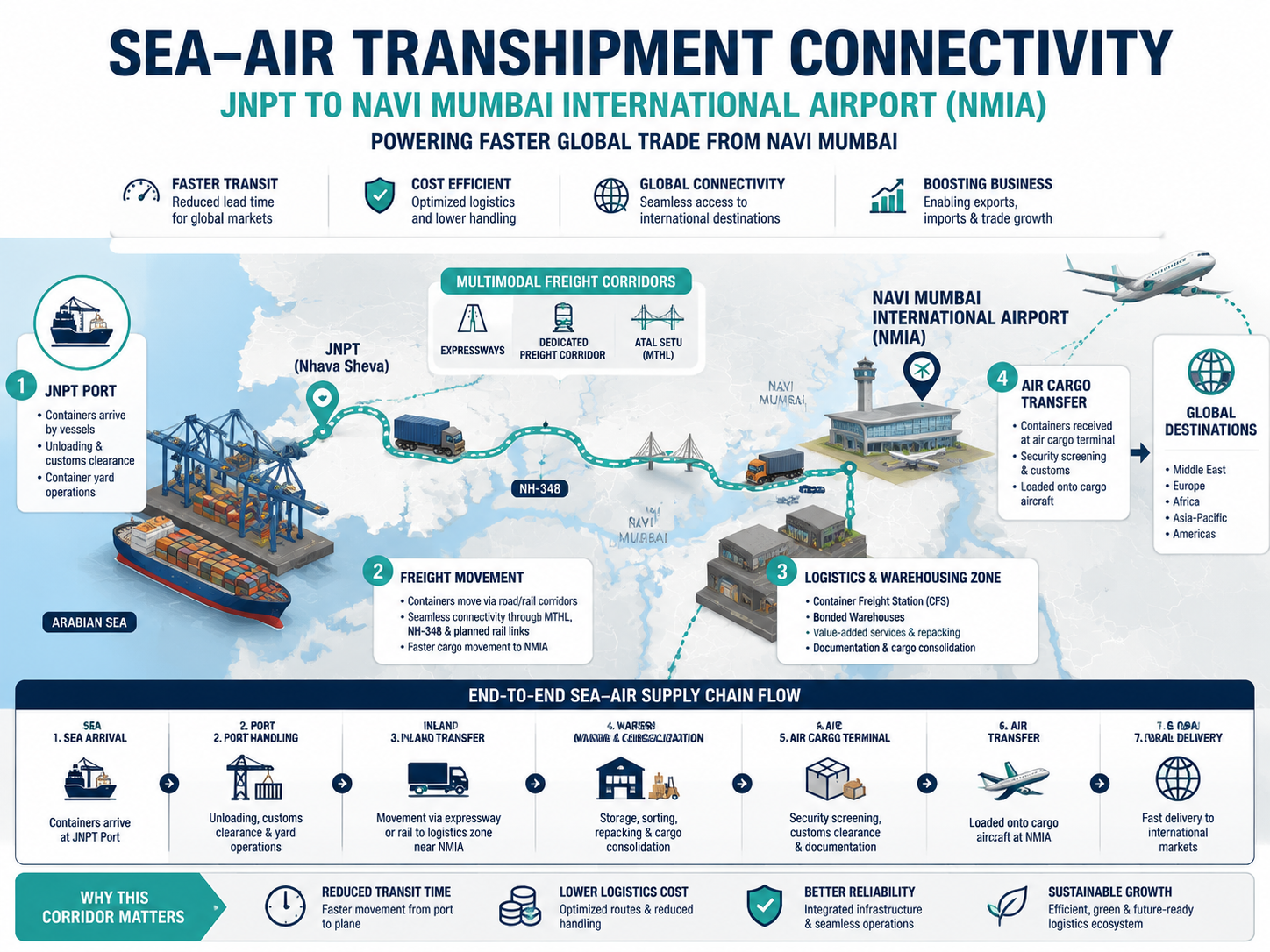
The JNPT Synergy: Sea-Air Transhipment Comes of Age
NMIA’s most underrated logistics advantage is its location.
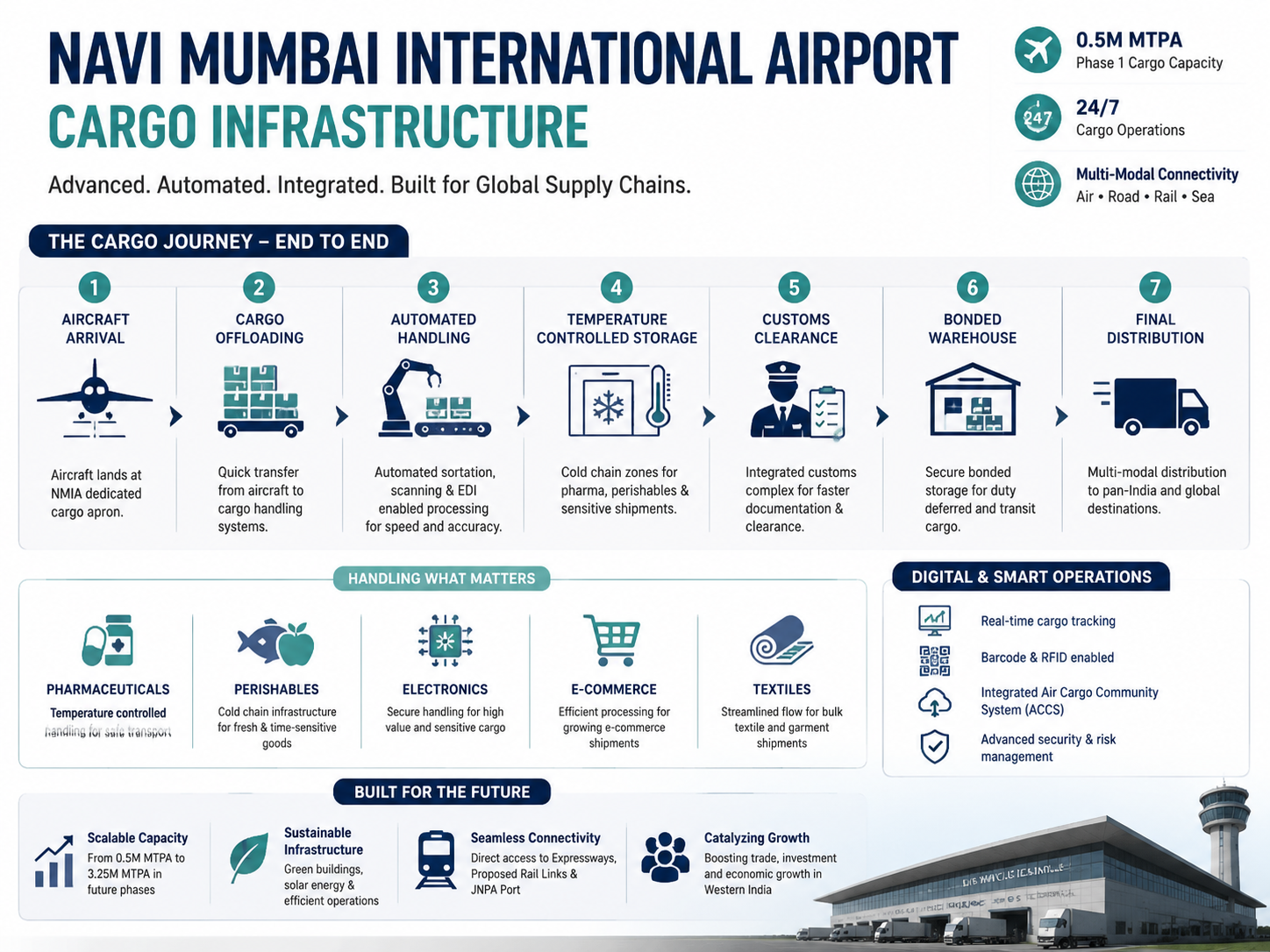
The airport sits approximately 20 kilometers from Jawaharlal Nehru Port Trust (JNPT), India’s largest container port. JNPT is on track to handle 10 million TEUs (twenty-foot equivalent units) annually by 2027, which would make it one of the world’s top ports by throughput.
According to [NMIAL], this geographic pairing creates a rare advantage: goods arriving at JNPT by sea can be quickly processed and airlifted to Europe, North America, or Asia within hours. Together, NMIA and JNPT will cover the entire spectrum of freight movement, from bulk ocean cargo to time-critical air shipments.
This sea-air transhipment model is already proven in cities like Dubai and Singapore. Navi Mumbai now has the physical infrastructure to replicate it.
Integrated free trade and warehousing zones, supported by dedicated freight corridors connecting the two facilities, are being developed to allow importers and exporters to clear cargo efficiently and re-export with minimal friction.
NMIA as the New Primary Cargo Gateway for Mumbai
The transition to NMIA as the dominant cargo hub for the Mumbai region accelerated faster than most expected.
In August 2025, [Chhatrapati Shivaji Maharaj International Airport (BOM)] halted all cargo flight operations to carry out major airside infrastructure upgrades, including new taxiways for Runway 14/32. This affected 24 major cargo carriers, including Lufthansa, Emirates, and Cathay Pacific.
NMIA stepped in as the primary cargo gateway for the Mumbai region during this period, giving the new airport an early operational workout and establishing it as the functional center of Mumbai’s air freight network.
The transition also triggered a re-evaluation of cargo routing strategies among freight forwarders, with many now building NMIA-first operations into their standard workflows.
What Logistics Infrastructure Is Being Built Around NMIA
The airport itself is the anchor, but the logistics ecosystem forming around it is equally significant.
Warehousing and Cold Chain
Demand for Grade A warehousing near NMIA has accelerated sharply since 2024. Cold chain infrastructure in particular is a priority, given the airport’s focus on pharmaceuticals and perishables. Several major developers have acquired land in the Panvel-Taloja-Dronagiri belt specifically for logistics park development.
Bonded warehousing facilities near the airport allow importers to store goods under customs supervision before final clearance, reducing the need for immediate duty payment and enabling more flexible inventory management.
Freight Corridors and Road Connectivity
The airport is being served by a dedicated Airport Road, with upgrades to the Mumbai-Pune Expressway and improved arterial connections to JNPT already underway. The Atal Setu (Mumbai Trans Harbour Link), inaugurated in January 2024, has also significantly shortened the logistics route between South Mumbai distribution centers and the new airport zone.
The NMI Airport Cargo Community System
NMIA has adopted an integrated Cargo Community System designed for error-free, paperless transactions with real-time tracking across the entire supply chain. This digital layer is critical for freight forwarders, customs agents, and airlines to coordinate seamlessly, reducing dwell times and clearance delays.
Economic Impact: The Numbers Behind the Shift
The logistics transformation around NMIA carries significant macro-economic weight.
Independent estimates suggest NMIA could add [Rs 50,000 crore annually to Maharashtra’s trade value by 2035], while creating over 200,000 jobs across logistics, warehousing, and allied services.
The FedEx hub alone is projected to generate over 6,000 jobs directly. Multiply that by the number of freight forwarders, customs brokers, third-party logistics providers, and transport operators expected to cluster around the airport, and the employment multiplier becomes substantial.
For the broader MMR economy, the airport’s logistics impact will be felt in sectors well beyond aviation: manufacturing, retail, pharmaceuticals, agriculture exports, and e-commerce fulfillment all stand to benefit from faster, more reliable access to global markets.
Sectors with the Most to Gain
Pharmaceuticals
Maharashtra is home to a significant cluster of pharmaceutical manufacturers. Air freight access is critical for time-sensitive exports of generic drugs, APIs, and clinical trial materials. NMIA’s cold chain infrastructure makes it a natural hub for this sector.
Perishables and Agri-Exports
India’s agri-export sector has long struggled with inadequate cold chain infrastructure. NMIA’s temperature-controlled cargo zones open new possibilities for Maharashtra’s fruit, vegetable, and processed food exporters to reach premium markets in Europe and the Middle East.
E-Commerce Fulfillment
As cross-border e-commerce volumes grow, fast and reliable air freight becomes a competitive requirement for Indian sellers on global platforms. NMIA’s automated cargo handling and direct international connectivity positions it well to handle high-frequency, time-sensitive e-commerce shipments.
Auto Components
The Mumbai-Pune automotive corridor is one of India’s most dense manufacturing belts. Air freight access for precision components, tooling, and urgent replacement parts is a regular need. NMIA shortens the logistics chain considerably for this sector.
Challenges Still Being Addressed
No infrastructure transformation of this scale comes without friction. Several factors warrant monitoring:
Tariff finalization: According to [ITLN], AERA (Airport Economic Regulatory Authority) is still evaluating the Multi-Year Tariff Proposal submitted by NMIAL. Ad-hoc rates approved in June 2025 remain applicable until the final Tariff Order is issued, expected before the end of FY2025-26. Final tariff clarity will be an important signal for cargo operators planning long-term capacity commitments.
Connectivity bottlenecks: Until road, metro, and rail links are fully operational and scaled to handle peak logistics traffic, some micro-corridors around the airport may face congestion-related delays. [Verify current connectivity status with CIDCO or NMMC before making logistics location decisions.]
Regulatory coordination: Smooth customs operations at a new airport require alignment between multiple agencies: Customs, DGCA, CISF, ground handlers, and airlines. The initial operational phase has gone largely well, but scaling to full capacity will test inter-agency coordination.
Long-Term Vision: India's Most Advanced Air Freight Gateway
NMIA’s long-term positioning is clear and deliberate.
With JNPT scaling to 10 million TEUs, FedEx committing Rs 2,500 crore, a fully automated cargo terminal, cold chain infrastructure, and a multimodal connectivity plan, the airport is being built to become India’s most advanced sea-air logistics gateway.
The Adani-CIDCO partnership behind NMIA has explicitly stated that the vision extends well beyond runways and terminals. The goal is a multi-modal logistics hub aligned with the demands of tomorrow’s global economy.
For logistics operators, freight forwarders, manufacturers, and exporters across western India, NMIA is the most consequential infrastructure development of the decade.
FAQs
Frequently Asked Questions