Best Industrial Area in Navi Mumbai Airoli, Ghansoli or TTC Belt?
When businesses search for the best industrial area in Navi Mumbai, they are usually asking the wrong question in the wrong way. The real decision is not “Which area sounds better?” It is “Which location fits the operating model?” For most tech-led, hybrid, or office-heavy occupiers, Airoli and parts of Ghansoli usually make more sense. For businesses that still depend on deeper industrial infrastructure, more practical floor use, and a stronger operations-first setting, Mahape, Rabale, and the broader TTC-side industrial belt usually make more sense. Airoli and Ghansoli are separate CIDCO nodes, while Mahape and Rabale sit within the wider TTC-MIDC industrial ecosystem, so treating all of them as one market is the first mistake.
That is the practical answer. But it needs to be unpacked properly, because this is not a simple Airoli vs Ghansoli or Airoli vs Mahape debate. A clean-looking office address can still be wrong for a business that needs movement, storage, service access, industrial approvals, or tougher operational tolerance. And an older TTC-side industrial location can still be the smarter decision if the business model is not really office-led, no matter how modern Airoli or Ghansoli may appear on first inspection.
Quick comparison: Airoli-Ghansoli vs Mahape-Rabale-TTC
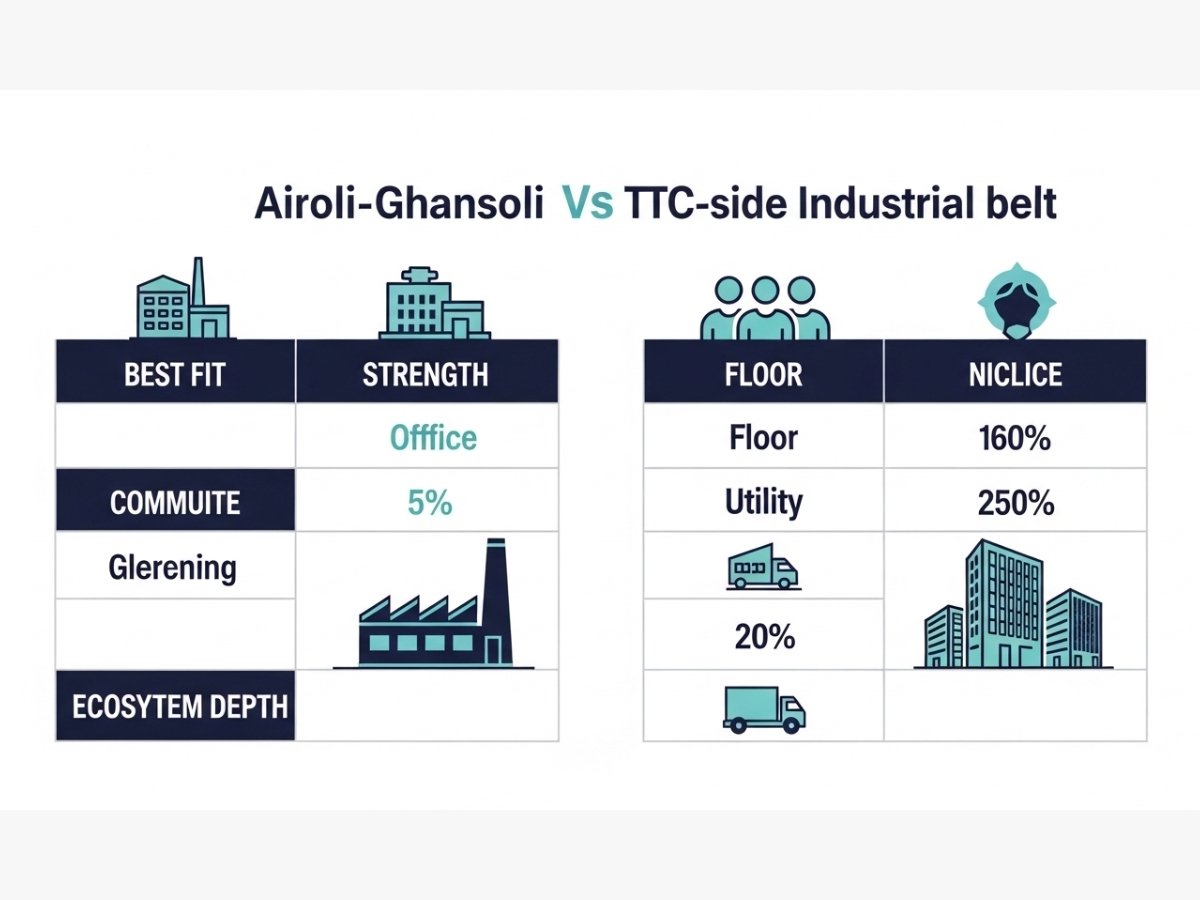
| Factor | Airoli / Ghansoli | Mahape / Rabale / TTC-side belt |
|---|---|---|
| Best fit | Office-heavy, hybrid, tech-led occupiers | Operations-heavy, industrial, service-depth users |
| First strength | Staff access and business environment | Industrial practicality and ecosystem depth |
| Location character | More polished, campus-style, corporate-facing | More functional, legacy industrial, execution-led |
| Commute advantage | Stronger when talent movement matters daily | Acceptable, but not always the main advantage |
| Floor utility | Good in the right assets, but not always industrial-first | Usually better for industrial layouts and tougher use cases |
| Client-facing comfort | Stronger | More mixed |
| Vendor / workshop ecosystem | Moderate to strong depending on asset | Deeper and more organic |
| Wrong-buyer risk | Businesses overpaying for image | Businesses underestimating location friction and stock quality |
This framework is based on the fact that Airoli and Ghansoli are formal CIDCO nodes, Airoli has a large office-park and knowledge-corridor identity, Ghansoli has a major corporate-campus presence on Thane-Belapur Road, and the TTC-side belt has long-standing industrial infrastructure, industrial association activity, industrial fire coverage, and pollution-control/common-treatment systems tied to the industrial estate.
What businesses really mean when they search for the best industrial area in Navi Mumbai
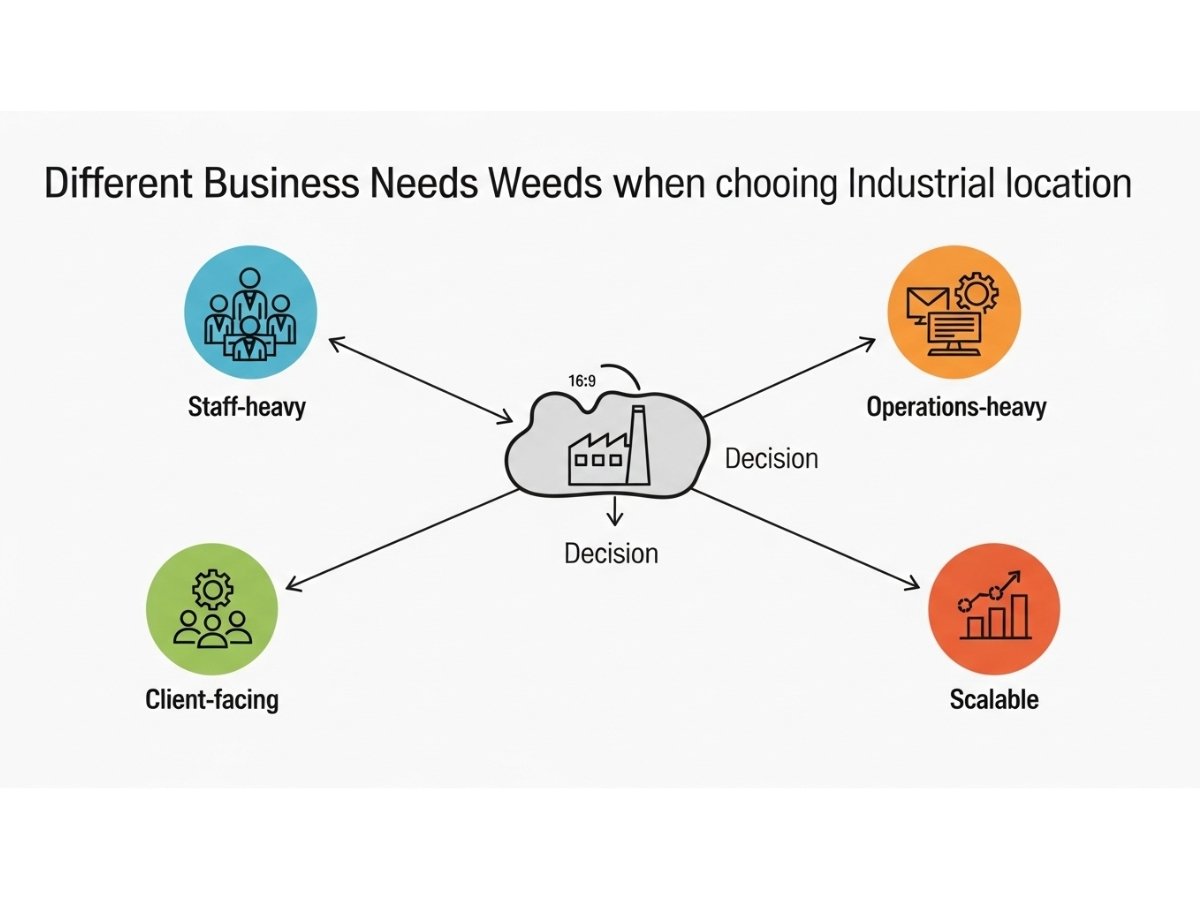
Most occupiers do not actually mean “best” in a generic sense. They mean one of five things: easiest for staff, easiest for operations, easiest for clients, easiest to scale, or safest to run without daily friction.
That is why broad search terms like Navi Mumbai industrial area, industrial property in Navi Mumbai, or best area for office and industrial setup in Navi Mumbai often hide very different needs. A company with a large engineering, design, back-office, or client-management team is solving a different problem from a company that needs loading tolerance, vendor movement, fabrication support, chemical permissions, or harder industrial servicing. The same city cannot answer both in the same way. The structure of CIDCO nodes on one side and the TTC-MIDC industrial belt on the other is exactly why the answer changes by business model.
Why this is not a simple Airoli vs Mahape comparison
Because Ghansoli is not identical to Airoli, and Mahape is not the whole TTC-side story.
CIDCO’s own nodal planning treats Airoli and Ghansoli as separate nodes, which matters because occupier experience changes meaningfully within short distances in Navi Mumbai. Meanwhile, the TTC-side industrial ecosystem is not just one neat box called “TTC core belt.” It includes different industrial pockets and working conditions across places like Mahape and Rabale, and those pockets carry different types of stock, access logic, and on-ground usability. Even official and quasi-official industrial references around Rabale, Mahape, and TTC show multiple blocks, industrial fire stations, and association-led infrastructure rather than one single uniform market.
So no, this is not “newer node versus older node.” It is talent-led business environment versus deeper industrial-operational environment. That is a better way to read the market.
Airoli vs Ghansoli: what is the real difference for businesses?
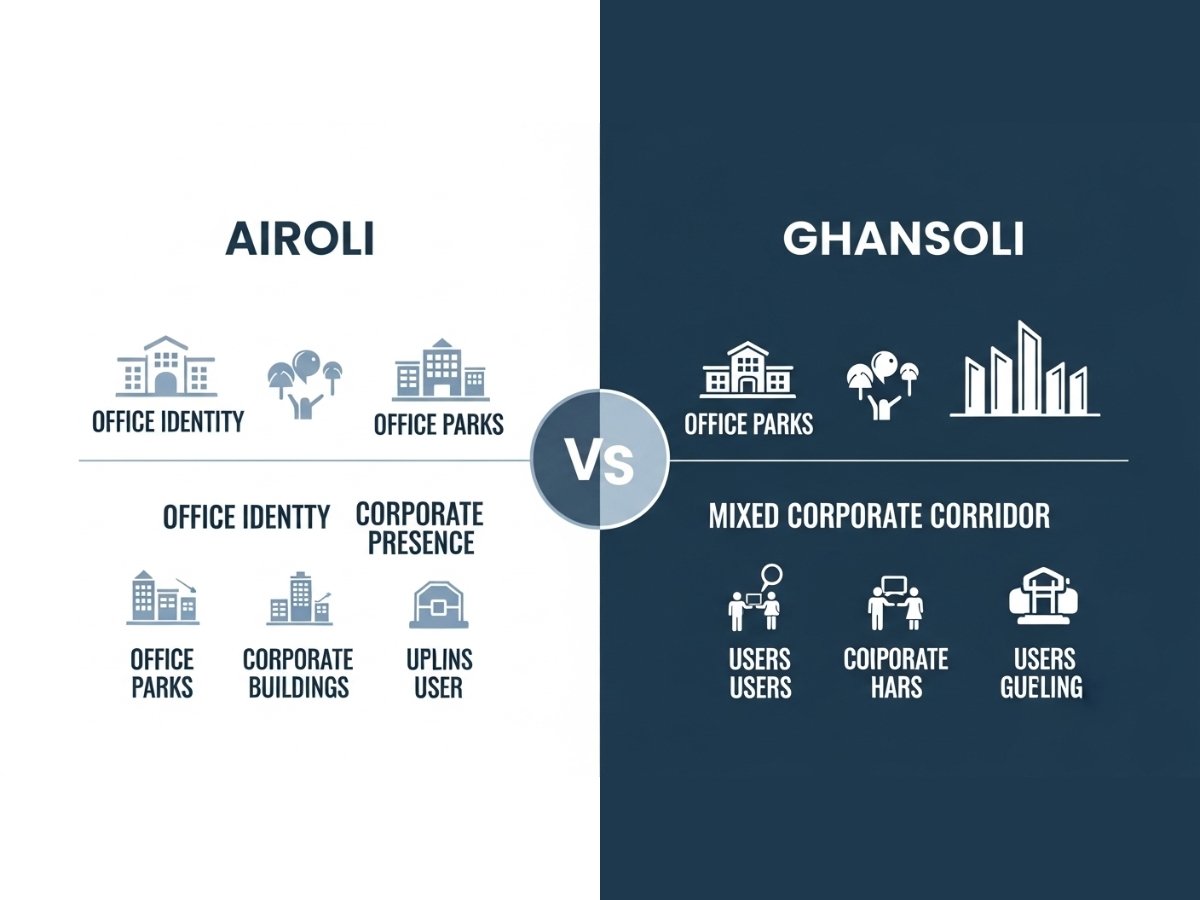
Both can work for hybrid occupiers, but they do not feel the same in practice.
Airoli has the clearer office-market identity. Mindspace Airoli East describes itself as a major IT-corridor node near Airoli Railway Station and emphasizes connectivity to Thane, Mulund, Vashi, and large residential catchments across Thane and Navi Mumbai. Capgemini’s Airoli office page also positions Airoli as part of Navi Mumbai’s knowledge corridor, with access via Airoli and Thane stations. That matters because businesses with large white-collar teams do not just rent space. They rent predictability in commuting, hiring, and retention.
Ghansoli is different. It has strong corporate presence too, but its character is less purely “knowledge park” and more mixed along the Thane-Belapur spine. Reliance’s documentation places Reliance Corporate Park on Thane-Belapur Road in Ghansoli, including references within the TTC industrial area. That gives Ghansoli a serious business address quality, but it still should not be lazily treated as the same product as Airoli. In practice, Ghansoli often sits in the middle ground: more corporate-facing than older industrial pockets, but not always as straightforwardly office-led in perception as Airoli.
So for Airoli vs Ghansoli for business setup, the real split is this: Airoli usually feels stronger for office-first or talent-first occupiers, while Ghansoli can work well for businesses that still want a corporate face but do not need a purely office-market identity.
Is Mahape or the TTC industrial area better for operations?
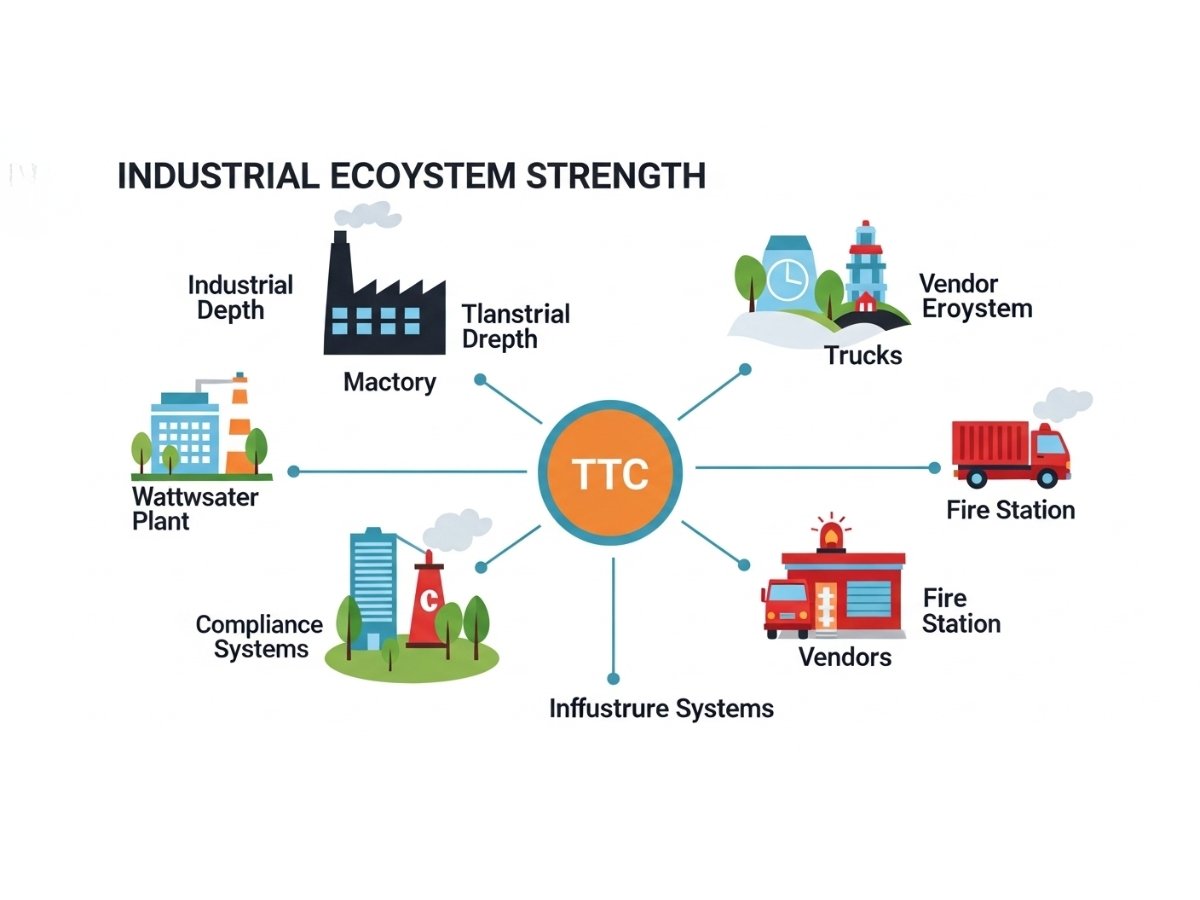
For many industrial and operations-led users, yes.
The TTC-side belt has long-standing industrial depth. Official and regulatory documents repeatedly place industrial units in Mahape, Rabale, and wider TTC industrial locations. MIDC’s Rabale fire-station record, the TTC-MIDC Industries Association in Rabale, and MPCB’s industrial inventory across Mahape and Rabale all point to a real industrial operating ecosystem, not just isolated buildings. MPCB’s Navi Mumbai industrial-cluster documents also show that the TTC industrial area has long been supported by common treatment and hazardous-waste infrastructure, including CETP and TTCWMA-linked systems.
That does not automatically make every TTC-side asset good. Old industrial belts can be messy. Stock quality can vary sharply. Access, loading, drainage, compliance status, and building condition can differ block to block. But when a business genuinely needs industrial practicality, this side of the market usually gives more operational honesty. The area is not trying to pretend it is something else. It is built to work.
Which Navi Mumbai location is better for office plus industrial setup?
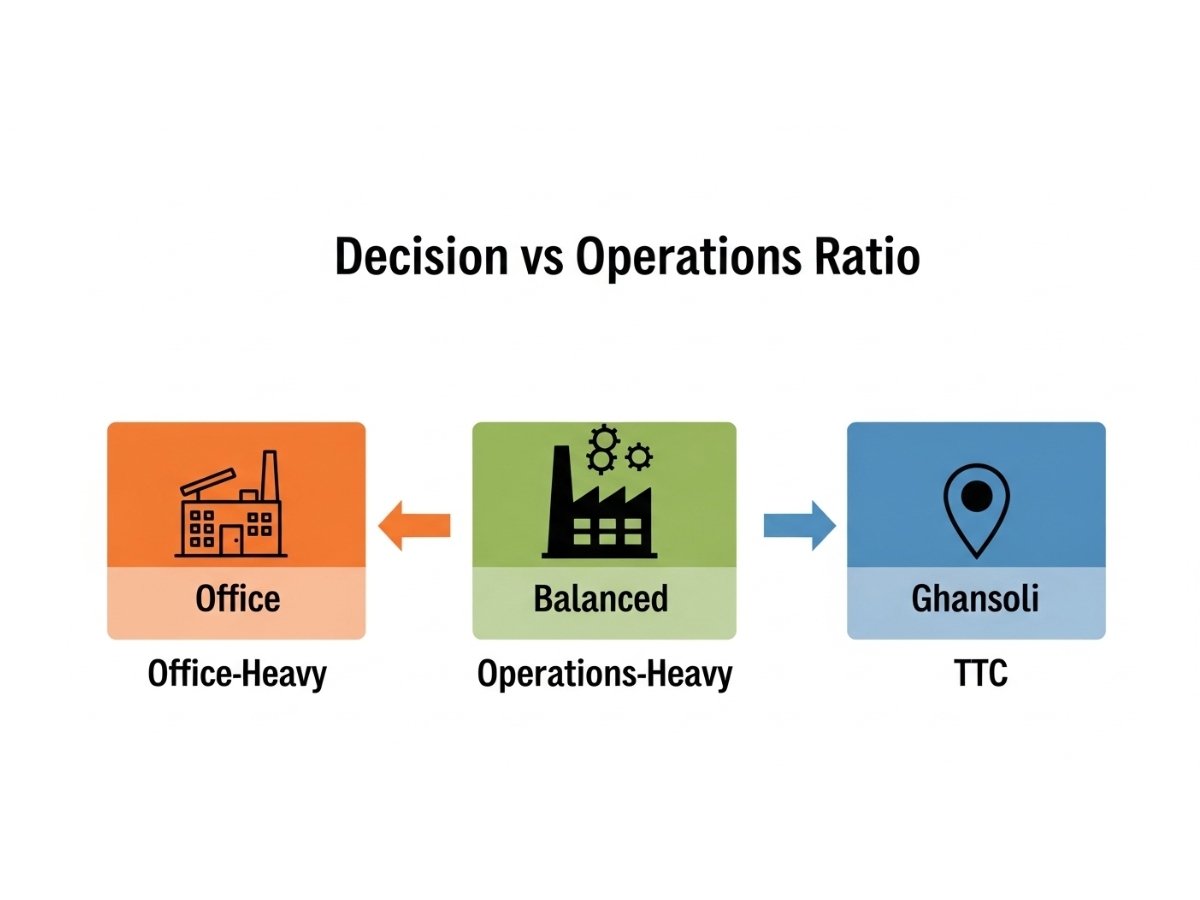
The answer changes with the office share of the business.
If the business is roughly 60 to 80 percent office, coordination, engineering, digital ops, or client-facing work, and only a smaller share is technical or backend support, Airoli usually comes out ahead and Ghansoli often stays in the shortlist. That is where the office environment itself becomes part of the operating model. Hiring gets easier. Daily staff fatigue usually drops. Client visits become smoother. And the brand story aligns better with the workplace. Mindspace Airoli East’s positioning around office tenants, connectivity, and residential catchments is exactly why Airoli keeps attracting this type of
If the business is closer to 50-50 office plus operations, Ghansoli becomes more interesting and some TTC-side options become viable, especially where the business still needs a professional front but cannot afford to ignore industrial practicality. This is where occupiers often make the right decision only after looking at actual floor plates, movement patterns, service access, and what the team does all day, not just the pin code.
If the business is operations-heavy, Mahape, Rabale, or another TTC-side industrial pocket usually becomes the more rational answer.
Why staff movement is one of the biggest location decisions
Because people quietly decide whether the location works long before management does.
Airoli’s documented positioning near residential catchments in Thane and Navi Mumbai, plus its strong office-park identity, is not a cosmetic advantage. It is a daily-operating advantage. For businesses that compete for engineers, analysts, support staff, team leads, and mid-level office talent, easier commute logic often translates into lower friction in attendance, hiring, and retention. That is especially true when the workforce is not purely industrial labour but mixed white-collar and technical
TTC-side locations can still work. But a company should choose them with open eyes. If the business says “people are our biggest operating input,” then a location that is only functionally industrial but weak on daily staff comfort can become expensive in hidden ways. Not on the rent sheet. On the management sheet.
Why asset class matters more than most occupiers admit
This is where many location debates go wrong.
A polished office building in a strong micro-market is not a substitute for a workable industrial floor. And an older industrial structure in Rabale or Mahape is not automatically inferior if the business needs clear movement, rougher utility tolerance, equipment handling, or stronger industrial service support. The market often rewards the wrong conversation. People compare addresses when they should be comparing usable floor, building type, serviceability, and workflow fit.
That is why the same business can make a bad decision in Airoli and a smart one in Rabale, or the opposite, without either market being “better” in absolute terms. The asset has to match the business before the locality can be judged.
Why older TTC-side industrial belts can still be the smarter choice
Because operations do not care about polish nearly as much as decision-makers do.
The TTC-side industrial system is not theoretical. Regulatory and association records show a thick industrial base in Mahape and Rabale, backed by shared industrial infrastructure and long-standing industrial presence. For occupiers that need service vendors, fabrication or processing compatibility, tougher utility tolerance, or a location where industrial activity is already normalized, the older belt often offers more truth per square foot than a newer-looking campus zone.
The weakness, of course, is inconsistency. Older belts demand more due diligence. More physical inspection. More legal checking. More realism. But for the right occupier, that extra effort can still produce the better outcome.
Occupier-fit table: who should choose what?
| Occupier type | Better fit | Why |
|---|---|---|
| IT, analytics, back-office, enterprise support | Airoli | Talent access and office environment matter most |
| Hybrid corporate plus technical operations | Airoli or Ghansoli | Depends on how strong the operations share really is |
| Corporate-facing technical teams needing a business address | Ghansoli | Better middle ground between office image and corridor practicality |
| Engineering support with moderate backend movement | Ghansoli or Mahape | Decision depends on actual floor and service needs |
| Light industrial, servicing, processing, vendor-heavy users | Mahape / Rabale / TTC-side | Industrial ecosystem matters more than polish |
| Heavier operations or compliance-sensitive industrial users | TTC-side belts | Functional industrial context usually matters more |
| Businesses still unclear about their operating model | Pause decision | Location should follow workflow, not brochure appeal |
This table is an inference drawn from the documented office-corridor positioning of Airoli, the corporate-campus presence in Ghansoli, and the long-standing industrial and regulatory footprint of Mahape-Rabale-TTC.
What Airoli-Ghansoli gets wrong for some occupiers
The biggest risk is that businesses confuse a better environment with a better operating fit.
Airoli and Ghansoli can absolutely be the right answer. But they become the wrong answer when a company needs harder industrial handling, deeper workshop support, rougher usage tolerance, or an ecosystem built around operations rather than office presentation. Some occupiers also underestimate how much they are paying for the comfort of a better corporate setting. That premium is justified only when the business really benefits from it.
In simple words: do not buy office convenience if your business actually runs on operational toughness.
What Mahape-Rabale-TTC gets wrong for some occupiers
The biggest risk here is the opposite.
A business chooses Mahape, Rabale, or another TTC-side location because it looks cheaper, more practical, or more industrially “serious,” then later realizes that the team is office-heavy, the culture is client-facing, and the location is wearing people down. Older belts also demand more screening for building condition, compliance, drainage, utility readiness, access width, and maintenance quality. The industrial ecosystem may be real, but the building you pick still has to work.
So yes, the TTC-side market can be smarter. But it punishes lazy due diligence faster than polished office markets do.
A simple decision checklist before choosing an industrial area in Navi Mumbai
Before you choose between Airoli industrial area, Ghansoli industrial area, or the TTC industrial area in Navi Mumbai, answer these six questions honestly:
1. Is the business mainly office-led, hybrid, or operations-led? 2. Will daily staff commute affect hiring and retention? 3. Does the unit need industrial-grade utility and floor practicality? 4. Will clients, partners, or corporate leadership visit regularly? 5. Does the business need vendor, workshop, or service-depth nearby? 6. Is the shortlist based on workflow fit, or just on a cleaner-looking address?
If the answers lean toward talent, meetings, and office-heavy work, Airoli usually moves up. If they lean toward operations, industrial servicing, and execution depth, the TTC-side belt usually moves up. If the answers are mixed, Ghansoli often becomes the testing ground.
Key takeaways
The best industrial area in Navi Mumbai is not one place. It is the place that matches the operating model.
Airoli is usually the strongest answer for office-heavy and talent-led occupiers. Ghansoli is often the bridge option for businesses that want some corporate polish without going fully office-market in mindset. Mahape, Rabale, and the wider TTC-side industrial ecosystem remain stronger for occupiers whose real needs are still industrial, service-led, or floor-utility driven. CIDCO node planning on one side and MIDC-TTC industrial infrastructure on the other are exactly why these markets behave differently.
Final verdict
For most tech companies in Navi Mumbai industrial areas, analytics teams, support centers, and hybrid occupiers, Airoli is the cleaner first shortlist. For businesses that want a corporate corridor but can tolerate a more mixed setting, Ghansoli is often the smarter compromise. For occupiers that still depend on real industrial ecosystem depth, vendor linkages, shared treatment systems, industrial stock logic, and rougher operational practicality, Mahape, Rabale, and the broader TTC-side belt usually make more practical sense. That is the real answer, and it is more useful than any generic “best industrial area in Navi Mumbai” ranking.
FAQs
Frequently Asked Questions