Blogs

Everything about Navi Mumbai

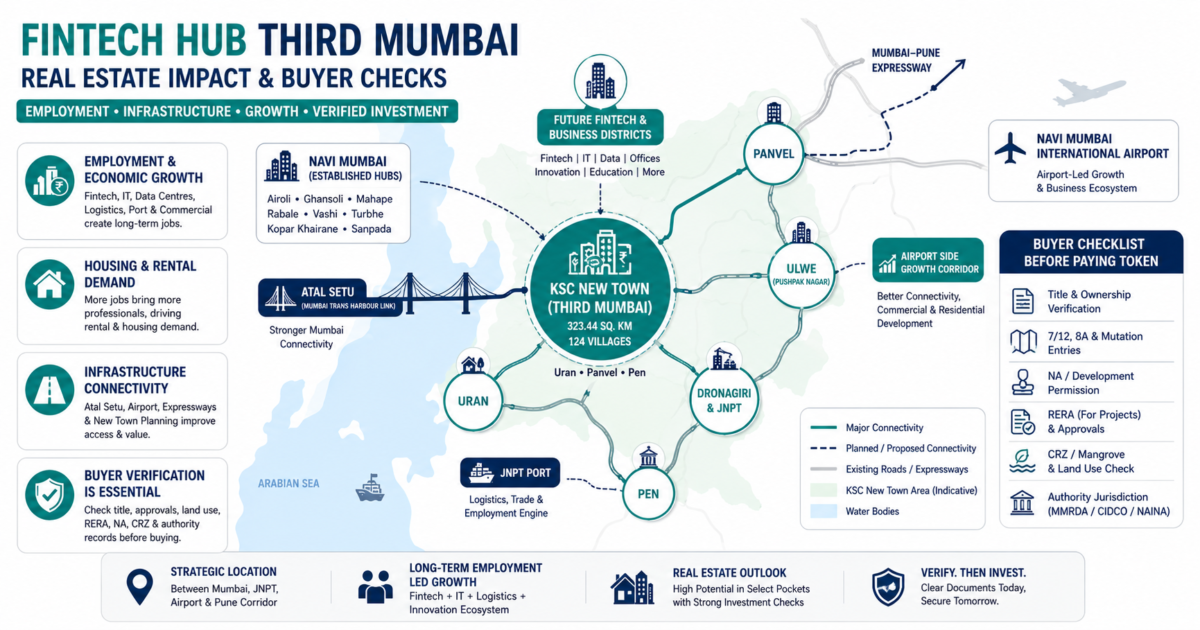
Fintech Hub Third Mumbai: Real Estate Impact and Buyer Checks

Fintech Hub Third Mumbai should be treated as a long-term employment-led real estate theme, not a guaranteed appreciation signal. Official MMRDA material identifies KSC New Town as a 323.44 sq. km notified new-town area across 124 villages in Uran, Panvel and Pen. Before buying, verify title, land records, RERA, authority permission, NA position and CRZ risk. Related pillar: Navi Mumbai employment hubs real estate impact This is an educational guide. Verify the latest position with the relevant authority or a property lawyer before making a transaction. What does Fintech Hub Third Mumbai mean? “Fintech Hub Third Mumbai” is a market phrase buyers are hearing because of three connected ideas: KSC New Town / Third Mumbai Atal Setu and airport-side connectivity Future employment from IT, fintech, data, logistics and commercial offices The official term to track is KSC New Town. MMRDA says the Government of Maharashtra appointed MMRDA as New Town Development Authority for 124 villages in Uran, Panvel and Pen tehsils, and the designated area is named KSC New Town. The same page says the area comprises 323.44 sq. km and that planning proposals are to be prepared under the Maharashtra Regional and Town Planning Act, 1966. That matters because a buyer should not rely only on “Third Mumbai” branding. The real question is simpler: Does the exact property fall under the correct authority, permitted land use, clean title and legally usable development permission? Fintech is one part of the story, not the whole story Fintech means financial technology: companies using software, data and digital systems for banking, lending, payments, insurance, compliance and financial services. For real estate, fintech matters only if it creates real employment, office demand and rental demand. But Third Mumbai is not only about fintech. The wider employment story may include: IT and ITeS Data centres Logistics Port-linked business Education Healthcare Commercial offices Research and innovation uses So the right way to look at this is not “fintech hub = buy anything nearby.” The right way is: Employment theme + infrastructure + legal property verification + holding capacity. Do not confuse Wadala FinTech Hub with Third Mumbai This is important. Recent MMRDA-related investment news has referred to a Fintech-Insurtech hub at Wadala, Mumbai, while Third Mumbai / KSC New Town is a separate Raigad-side new-town theme around Uran, Panvel and Pen. News reports on MMRDA’s WEF 2026 MoUs mention Wadala for fintech-insurtech and other wider MMR investments separately. So, if a broker says, “Fintech hub is coming, buy this land in Third Mumbai,” ask one question: Which official document connects this exact survey number, village, zoning and permission to the claim? If there is no clear answer, pause. Why Third Mumbai matters for real estate Employment hubs affect real estate through a chain: Jobs → offices → workers → rentals → retail demand → resale interest. This is why Airoli, Ghansoli, Mahape, Rabale, Vashi and Turbhe already have real estate demand linked to offices, IT parks and industrial employment. Third Mumbai is different. It is more future-facing. It may support long-term demand in Panvel, Ulwe, Dronagiri, Uran, Pen and nearby KSC/NAINA-side areas, but execution, planning, permissions and market timing matter. A buyer should judge the opportunity on five points: 1. Is the property legally clean? 2. Is the area actually connected to employment or infrastructure? 3. Is the land use permitted? 4. Is the project registered and compliant where RERA applies? 5. Can the buyer hold the asset long enough if development takes time? Areas that may feel the impact Area Possible impact Better suited for Main risk to verify Panvel Spillover from KSC, airport, NAINA and road connectivity End-users, long-term investors Title chain, NAINA/CIDCO/MMRDA status, NA/development permission Ulwe / Pushpak Nagar Airport-side and connectivity-led demand Flat buyers, rental investors CIDCO transfer, RERA, OC, creek-side restrictions Dronagiri / Uran JNPT, port, logistics, Atal Setu and KSC proximity Long-term investors CRZ, mangroves, industrial land use, access Pen / Chirner / Karnala-Sai belt KSC New Town / Third Mumbai planning theme High-risk land investors Acquisition, zoning, 7/12, road access, authority jurisdiction Kharghar / Taloja More established Navi Mumbai-side alternatives Family buyers, budget buyers Green zone, hill slope, project approvals Airoli / Ghansoli / Mahape / Rabale Existing IT and commercial job base Rental investors, working professionals Society documents, OC/CC, industrial-edge issues For current employment demand, also build context with Navi Mumbai IT hubs property impact and Airoli IT Park real estate impact. Third Mumbai vs existing Navi Mumbai job hubs Existing Navi Mumbai job hubs already have demand. Airoli has IT and office parks. Ghansoli benefits from corporate offices and Mahape access. Rabale and Mahape support industrial, IT and back-office demand. Turbhe and Vashi have commercial and industrial activity. Third Mumbai is not yet the same type of mature employment market. It is a future development and planning theme. That does not make it weak. It makes it different. For a conservative buyer, existing nodes may be easier to evaluate. For a long-term investor, KSC / Third Mumbai may be interesting, but only after stronger document checks and realistic holding assumptions. For related employment-led growth topics, use Dedicated Freight Corridor Navi Mumbai impact, Integrated Logistics Park Navi Mumbai impact and JNPT real estate impact. What to check before paying token money Do not pay token money because a brochure says “Third Mumbai,” “fintech hub,” “airport growth” or “Atal Setu benefit.” Check the property type first. If buying a flat in a new project Check: MahaRERA registration number Promoter name Project name and address Completion date and extensions Complaints and orders Lapsed, revoked, deregistered or abeyance status Commencement Certificate Sanctioned plan Occupancy Certificate, if ready possession Agreement draft Carpet area Approved layout Bank loan approval MahaRERA’s official site provides sections for registered projects, revoked projects, lapsed projects, abeyance project lists, complaints, orders and related project information. RERA registration supports verification. It does not automatically guarantee that title, possession, construction quality or every approval is risk-free. If buying resale property Check: Registered sale deed Index II Chain of previous

Read More
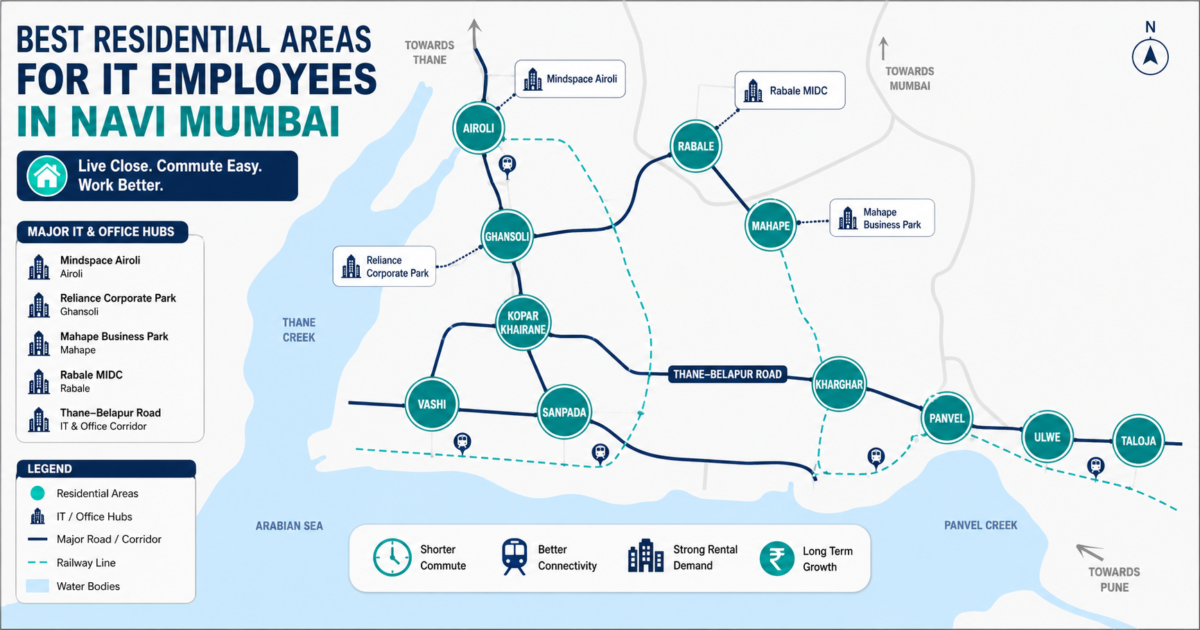
Best Areas for IT Employees in Navi Mumbai

For most IT employees working in Airoli, Ghansoli, Mahape, Rabale or TTC Industrial Area, Airoli and Ghansoli are the strongest daily-commute choices. Kopar Khairane, Sanpada and Vashi suit buyers who want better social infrastructure. Kharghar, Panvel, Ulwe and Taloja can work for budget or long-term buying, but only after stronger land-record, RERA, NAINA, NA and CRZ checks. This guide is part of our Navi Mumbai employment hubs real estate impact series. Best areas for IT employees in Navi Mumbai The best area depends on your office location. If your office is in Mindspace Airoli, Reliable Tech Park, Rabale, Mahape or Ghansoli, staying near Airoli or Ghansoli will usually save the most time. If you want a more balanced residential area with station access, markets and family convenience, Kopar Khairane, Sanpada and Vashi are practical options. If your budget is lower, or you are buying for long-term growth, Kharghar, Panvel, Ulwe and Taloja may be considered. But these areas need stricter verification, especially when the property involves plots, NAINA, CIDCO, village land, gaothan claims, CRZ-sensitive pockets or unclear land-use permission. Quick comparison table Area Best for Nearby job hubs Main advantage Main risk to check Airoli Daily IT commute Mindspace, Rabale, Thane-Belapur Road Strong office access Older society documents, waterlogging pockets, industrial edge Ghansoli IT + family balance Reliance Corporate Park, Mahape, Airoli Good rent demand and residential stock Premium pricing, project approvals Kopar Khairane Mid-point living Ghansoli, Vashi, Mahape Practical commute and markets Society title, OC, maintenance disputes Vashi / Sanpada Lifestyle and resale Vashi, Turbhe, Palm Beach side Mature social infrastructure Older buildings and redevelopment claims Kharghar Family + long-term buying Belapur, Taloja, Panvel side Schools, planned node, budget spread Hillside, green-zone, project status Panvel / Ulwe / Taloja Budget and future growth Airport/logistics/NAINA side Lower entry cost in many pockets 7/12, NA, NAINA, CRZ, title chain Airoli: best for commute-focused IT employees Airoli is one of the strongest residential choices for IT employees working around Mindspace Airoli, Rabale, Thane-Belapur Road and nearby office parks. Choose Airoli if your priority is: Shorter daily commute Access to Airoli railway station Proximity to Thane and Mulund Rental demand from IT and office workers Faster access to Rabale and Ghansoli business areas Airoli is especially useful for people working in IT parks or office campuses near the Airoli-Rabale belt. It also works for investors who want tenant demand from working professionals. But do not buy only because the office is nearby. Check building age, drainage history, society paperwork, parking, occupancy certificate, conveyance status and redevelopment risk. Some pockets close to industrial activity may face noise, traffic or air-quality issues. For deeper understanding, read Airoli IT Park real estate impact. Ghansoli: best balance of IT access and residential demand Ghansoli is a strong choice for employees working near Reliance Corporate Park, Mahape, Airoli, Rabale and Thane-Belapur Road. It gives a better balance between office access and residential living. Many working professionals prefer Ghansoli because it offers good connectivity without feeling as office-heavy as some industrial-edge locations. Ghansoli vs Airoli for IT employees Factor Airoli Ghansoli Best for Mindspace, Rabale, Thane-side commute Reliance, Mahape, Airoli access Rental demand Strong Strong Family living Good, depends on pocket Good, often more balanced Pricing Can be high near prime pockets Can also be high in good projects Buyer check Society documents and drainage RERA, OC, title and project status Airoli is better when your office is exactly in the Airoli-Rabale side. Ghansoli is better when you want a residential base between Airoli, Mahape and Kopar Khairane. For in depth comparison read – Ghansoli vs Airoli for IT employees. Kopar Khairane: practical mid-point for working professionals Kopar Khairane is not always marketed as aggressively as Airoli or Ghansoli, but it can be very practical. It works for people who need access to: Ghansoli Vashi Mahape Airoli Thane-Belapur Road It can suit renters, first-time buyers and families who want shops, schools, local markets and station access without going too far from the IT corridor. Before buying resale property here, check the registered sale deed, Index II, share certificate, society no-dues, OC, property tax, electricity bill name and pending redevelopment discussions. Mahape and Rabale: close to jobs, but not always ideal to live in Mahape and Rabale are important employment zones. But they are not always the best pure residential choices for every IT employee. They can help rental demand in nearby Airoli, Ghansoli and Kopar Khairane. But some pockets around MIDC and industrial areas may have truck movement, noise, pollution, limited family lifestyle and mixed land-use conditions. This does not mean these areas are bad. It means the buyer should separate job proximity from livability. If buying near industrial areas, check: Approved land use Residential permission Building approval OC and CC Environmental or industrial nuisance Road width and access Parking and truck movement Future redevelopment potential To have a Proper understanding read – Rabale MIDC property impact and MIDC proximity pros and cons. Vashi and Sanpada: mature, convenient, but costlier Vashi and Sanpada suit senior IT professionals, families and buyers who want mature infrastructure. They offer stronger access to malls, hospitals, schools, railway connectivity, Palm Beach side movement and established residential societies. The trade-off is cost. You may pay more for the same flat size compared with Ghansoli, Kopar Khairane, Taloja or Panvel. For resale flats, check old agreements carefully. Many older societies may have redevelopment discussions, conveyance issues, parking disputes, structural concerns or pending repairs. Kharghar, Panvel, Ulwe and Taloja: good for budget, not always daily IT commute Kharghar, Panvel, Ulwe and Taloja are better for buyers who are not fully dependent on daily Airoli-Ghansoli office travel. They may work if: You have hybrid work Your office is in Belapur, Taloja, Panvel or logistics-side locations You want a lower entry budget You are buying for long-term growth You are comfortable with longer commute time But these areas require stricter document checks. This is especially true for plots, NAINA-side properties, gaothan property, village land, CIDCO-transfer cases, CRZ-sensitive land and

Read More

Dedicated Freight Corridor Impact on Navi Mumbai Real Estate

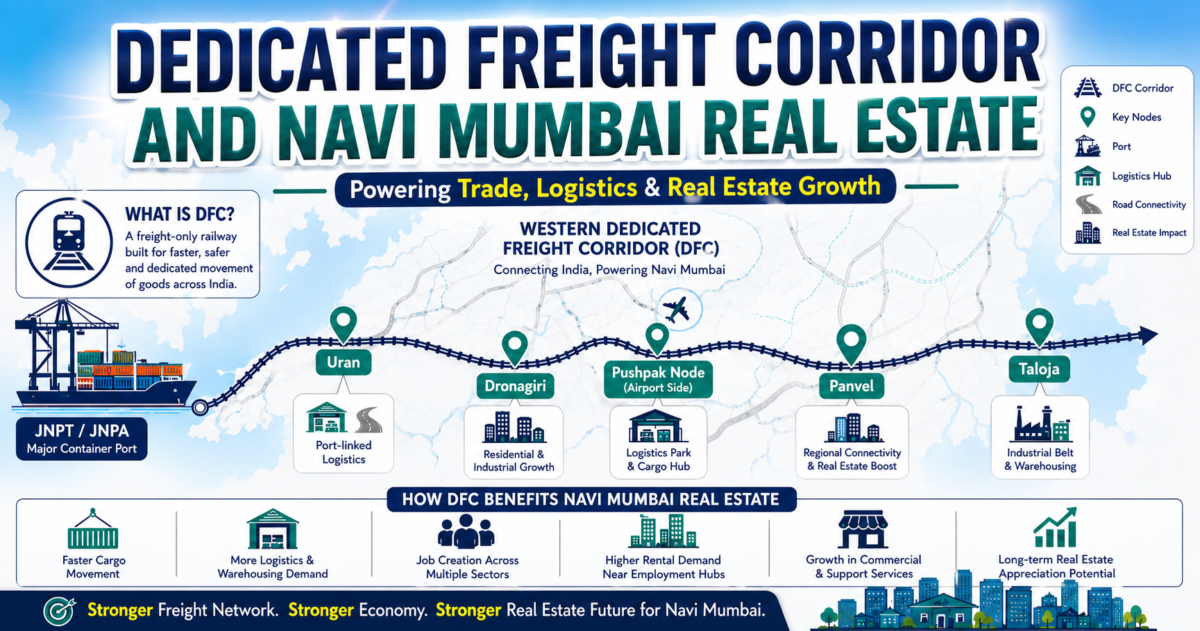
The Dedicated Freight Corridor impact on Navi Mumbai real estate is mainly positive for logistics, warehousing, JNPT-linked trade, industrial movement and job-led rental demand. Areas like Uran, Dronagiri, Pushpak Node, Chirle, Panvel and Taloja may benefit more directly. But DFC proximity does not make every plot safe. Buyers must verify title, zoning, NA/development permission, CRZ, NAINA/CIDCO status and acquisition risk before paying token money. What Is the Dedicated Freight Corridor? The Dedicated Freight Corridor, or DFC, is a railway corridor built mainly for goods movement, not passenger travel. For Navi Mumbai, the important part is the Western Dedicated Freight Corridor because it connects the northern and western freight network with the JNPT/JNPA side near Navi Mumbai. This matters because JNPT is one of India’s most important container ports. In simple words, DFC can improve cargo movement, reduce pressure on mixed passenger-freight railway routes and support logistics activity around port-linked areas. For property buyers, the main question is not only “Will DFC increase prices?” The better question is: Will this specific property benefit from DFC demand, and are the documents clean enough to buy safely? Why DFC Matters for Navi Mumbai Real Estate DFC can affect Navi Mumbai property in four practical ways. First, it can support logistics and warehousing demand near JNPT, Uran, Dronagiri, Pushpak Node, Chirle, Panvel and nearby industrial belts. Second, it can increase employment around logistics, cargo handling, container movement, trucking, warehousing, cold storage, industrial supply chains and support services. Third, it can create indirect rental demand. Workers, supervisors, warehouse staff, port-linked professionals, transport operators and service staff need housing near their workplace. Fourth, it can increase commercial demand for food outlets, offices, repair services, small shops, transport support and worker-focused services. But the impact is not equal everywhere. A flat in Ulwe, a plot in NAINA, a warehouse land parcel near Chirle and a residential unit in Kharghar will not benefit in the same way. Infrastructure creates demand. Documents decide safety. Areas Where DFC Impact May Be Strongest Area Likely DFC Impact Property Types to Watch Buyer Caution Uran Strong port and logistics relevance Land, rentals, commercial, logistics-linked property Check CRZ, access road, title and acquisition risk Dronagiri Port-side and logistics-linked growth Residential, commercial, worker housing Check CIDCO status, RERA, occupancy and location quality Pushpak Node / Chirle Logistics park and airport-side growth story Logistics land, nearby housing, commercial Verify land status, reservations and acquisition impact Panvel Regional growth, NAINA, airport and logistics influence Flats, plots, rental housing Check NAINA zoning and development permission Taloja MIDC and industrial spillover Affordable housing, rentals, industrial-linked assets Check pollution, truck traffic, zoning and commute Ulwe Airport-side and residential demand Flats, rentals, commercial DFC impact is indirect; avoid overpaying only on DFC claims Kharghar / Belapur Indirect employment and premium residential demand End-user housing, rentals DFC impact is weaker than metro, social infra and office access Raigad / NAINA villages Speculative plot demand Plots, agricultural land, layouts Highest document-risk zone: check 7/12, zoning, NA and title DFC vs Airport vs JNPT vs Logistics Park Many sellers mix every infrastructure name into one pitch: DFC, airport, JNPT, MTHL, NAINA, Third Mumbai, Pushpak and logistics park. Buyers should separate each driver. Growth Driver Main Impact Best Fit Risk If Misunderstood Dedicated Freight Corridor Freight and cargo movement Warehousing, logistics, industrial support Assuming every nearby flat or plot will boom JNPT / JNPA Port and container trade Logistics, commercial, worker housing Ignoring truck traffic and industrial surroundings Navi Mumbai International Airport Passenger, cargo and services ecosystem Residential, rentals, commercial Overpaying before local demand matures Integrated Logistics Park Planned logistics cluster Warehousing, services, nearby rentals Ignoring acquisition or reservation status NAINA / Third Mumbai Long-term planned urban expansion Approved layouts and planned development Buying unapproved land on future promises MIDC Belt Industrial employment Rentals, affordable housing, commercial Pollution, nuisance and zoning mismatch Property Types That May Benefit Warehousing and Logistics Land This is the most direct DFC-linked property type. But it is also document-heavy. The buyer must verify land use, access road, zoning, development permission, environmental restrictions, acquisition status and title. A cheap land parcel near a logistics corridor can become a problem if it falls under CRZ, green zone, reservation, acquisition, disputed title or unclear access. Industrial and Light-Industrial Property Industrial units near Taloja, Panvel-side logistics routes, JNPT-linked transport routes and MIDC-influenced belts may see better long-term relevance. Still, buyers must check whether the property use is legally permitted. Residential Flats Residential demand is usually indirect. DFC can support employment. Employment can support rentals. Rentals can support investor demand. But DFC alone is not enough. For residential flats, buyers should also check railway access, road access, school/hospital availability, water supply, building quality, society condition, MahaRERA status and resale liquidity. Approved Plots and Layouts A legally clear NA/development-permitted plot in the right zone may benefit from infrastructure growth. An agricultural plot sold as “future NA” is different. Do not treat future promises as approval. Commercial Units Small commercial units may benefit near housing clusters, logistics worker movement, transport nodes and industrial-support zones. But location quality matters. A shop in the wrong internal road or low-footfall area may not benefit much from DFC. What to Check Before Paying Token Money Before paying token money for any DFC, JNPT, Pushpak, Uran, Dronagiri, Panvel, Taloja or NAINA-linked property, verify the following. Document / Check Why It Matters Where to Verify Survey number and village name Identifies the exact land parcel Seller documents, revenue records 7/12 extract Shows land record details such as owner name, land area, land type and entries Mahabhumi / Mahabhulekh Mutation entries Shows changes in land records after sale, inheritance or transfer Mahabhumi / revenue office Property card Important in urban or city survey areas Property card / land records portal IGR search Helps check registered transactions IGR Maharashtra Chain of title Shows ownership history and transfer trail Lawyer title search NA / development permission Shows whether non-agricultural or development use is permitted Planning authority / revenue office CIDCO / NAINA status Confirms

Read More

Navi Mumbai Employment Hubs Real Estate Impact: Best Areas for IT and Industrial Professionals

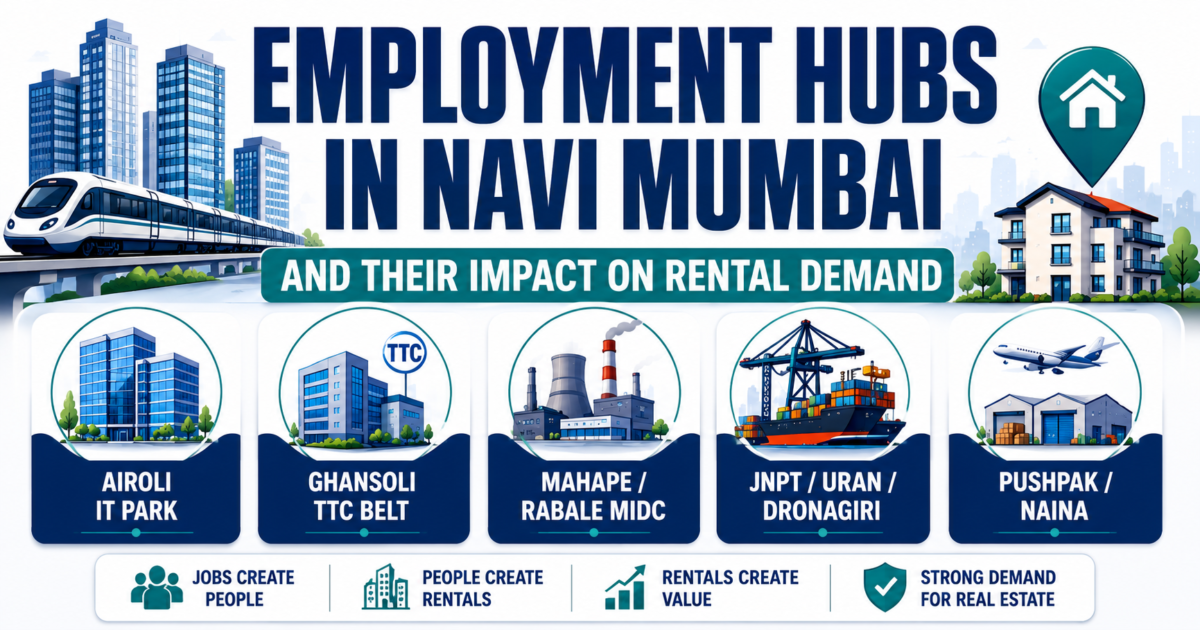
Navi Mumbai employment hubs can improve rental demand around Airoli, Ghansoli, Rabale, Mahape, Turbhe, Taloja, JNPT, Uran, Dronagiri, Pushpak and NAINA. But job proximity does not make every property safe. Buyers should verify title, RERA status, IGR records, 7/12, property card, CIDCO/NAINA permissions, CRZ impact and legal documents before paying token money. Quick Summary Buyer Question Practical Answer Do employment hubs increase demand? Yes, they can improve rental demand and resale interest. Does job proximity guarantee appreciation? No. It is only one demand factor. Best IT areas Airoli, Ghansoli, Kopar Khairane, Mahape, Vashi, Sanpada. Best logistics / industrial impact areas Rabale, Turbhe, Taloja, JNPT, Uran, Dronagiri, Pushpak, NAINA. Main buyer risk Paying extra because of future-growth stories without document verification. Must check before token Title, Index II, MahaRERA, 7/12, property card, CIDCO/NAINA status, CRZ/CZMP where relevant. For a wider buyer journey, connect this article with Navi Mumbai Property Buying Guide. Which Employment Hub Affects Which Area? Employment hubs create demand because people prefer shorter commutes. IT employees, port workers, logistics staff, industrial employees, office teams and service professionals often look for homes close to work. But the impact changes by location. Employment Hub Nearby Residential Areas Demand Type Buyer Caution Airoli IT Park / Mindspace Airoli, Ghansoli, Kopar Khairane, Rabale IT rentals, office commute demand Check building age, OC, society records and resale title. Ghansoli IT / TTC belt Ghansoli, Kopar Khairane, Mahape IT, corporate and industrial demand Do not buy only because someone says “IT corridor”. Rabale MIDC Rabale, Airoli, Ghansoli, Mahape Industrial and office demand Check pollution, truck movement and permitted land use. Mahape IT / MIDC Mahape, Ghansoli, Kopar Khairane, Turbhe Office and industrial employment Check last-mile travel, roads and family livability. Turbhe MIDC Sanpada, Vashi, Juinagar, Turbhe Industrial and commercial demand Check industrial proximity and traffic impact. Taloja MIDC Taloja, Kharghar, Panvel Affordable housing and industrial workforce Check connectivity, pollution and real rental demand. JNPT / Uran / Dronagiri Uran, Dronagiri, Ulwe, Panvel Port and logistics demand Check CIDCO title, CRZ, mangroves and access road. Pushpak / NAINA Pushpak, Panvel, NAINA villages Airport-side and logistics-led future demand Check DP, TPS, zoning, 7/12, NA/development permission. Employment demand can support a location. It cannot replace legal due diligence. Best Areas for IT Professionals in Navi Mumbai Airoli Airoli is one of the strongest choices for IT employees working around Mindspace Airoli, Thane-Belapur Road, Ghansoli and Rabale. It works well for people who want office access, railway connectivity and reasonable access towards Thane and Mumbai. The main caution is pricing. Airoli can carry a commute premium, so buyers should compare carpet area, building age, parking, OC, society condition and resale title before finalising. Read next: Airoli IT Park Real Estate Impact Ghansoli Ghansoli benefits from its position between Airoli, Kopar Khairane, Mahape and TTC industrial-commercial belts. It is suitable for IT employees and families who want better housing options near office zones. The buyer should check whether the quoted price is justified by actual building quality, society records, parking, location inside Ghansoli and distance from railway station or office routes. Read next: Ghansoli IT Corridor Real Estate Impact Kopar Khairane Kopar Khairane can work for buyers who want access to Airoli, Ghansoli and Mahape without always paying the top premium of Airoli. It is also a mature residential node with shops, schools, daily needs and railway access. For resale flats, verify sale deed chain, Index II, share certificate, society NOC, maintenance dues and any pending dispute. Useful internal link: Navi Mumbai Title Search Checklist Mahape Mahape is close to employment, but it is not automatically the best residential choice for every family. Some pockets are more office or industrial in nature. It can work for people who prioritise short commute. Families should check roads, drainage, traffic, noise, public transport, social infrastructure and night-time safety before choosing. Vashi and Sanpada Vashi and Sanpada are more mature lifestyle locations. They may suit senior professionals and families who want better social infrastructure, railway access and established neighbourhoods. The caution is price. Older buildings may need deeper checks on OC, structural condition, society records, conveyance, redevelopment discussions and maintenance history. Related internal link: Navi Mumbai Housing Society Guide Kharghar, Taloja and Panvel These locations attract buyers looking for more space, lower entry cost or long-term growth around airport-side and NAINA-side development. They may not be ideal for daily Airoli commute unless the buyer accepts travel time. For Taloja and Panvel-side properties, check actual rental demand, road access, public transport, water supply, pollution impact and project approvals. Airoli IT Park Real Estate Impact Airoli’s biggest strength is office concentration. A major business park near Airoli Railway Station and Thane-Belapur Road creates a serious tenant base for nearby residential locations. This can help: rental enquiries from IT employees demand for 1BHK and 2BHK flats weekday commute advantage resale interest from working professionals paying-guest and shared rental demand in some pockets But buyers should not treat “near Airoli IT Park” as a guarantee. A flat can still have weak title, missing OC, poor society management, parking issues, high maintenance, litigation or loan/lien problems. Before buying near Airoli, check MahaRERA Project Verification Guide for under-construction projects and registered title documents for resale flats. Ghansoli IT Corridor Real Estate Impact Ghansoli benefits because it sits between IT offices, industrial workplaces and residential supply. It is useful for employees working in Airoli, Mahape, Rabale and TTC-side offices. For investors, Ghansoli may offer rental demand from working professionals. For end-users, it can offer a better balance of commute and family life than some industrial-heavy pockets. Still, the buyer should check: distance from station or office route carpet area versus quoted price actual rental demand in that building society dues and maintenance OC and building permissions parking record past resale transactions through IGR search Portal price trends can support market understanding, but they should not be treated as legal or valuation proof. Rabale MIDC Property Impact Rabale MIDC has a different impact from Airoli IT Park. The demand here is

Read More

Employment Impact on Rental Demand in Navi Mumbai Real Estate

Employment hubs can increase rental demand in Navi Mumbai, especially around Airoli, Ghansoli, Mahape, Rabale, Turbhe, Taloja, Panvel, Ulwe, JNPT, Dronagiri and NAINA. But employment demand does not guarantee rent, resale value or legal safety. Buyers should verify building quality, tenant profile, title, Index II, MahaRERA status, society records, 7/12, property card, CIDCO/NAINA status and CRZ/CZMP where relevant before paying token money. Quick Summary Rental Demand Factor Buyer Meaning IT offices Better demand for 1BHK and 2BHK flats near Airoli, Ghansoli, Kopar Khairane and Mahape. MIDC jobs Demand from industrial workers, managers, small businesses and service staff. Port and logistics jobs Rental interest around Uran, Dronagiri, Ulwe, Panvel and JNPT-side locations. Lower office cost Companies may prefer Navi Mumbai for larger office spaces compared with some Mumbai pockets. Main risk Buying only on “guaranteed rent” promises. Must verify Title, Index II, OC, society records, RERA, 7/12, property card, CIDCO/NAINA and CRZ/CZMP. For the full employment-hub picture, connect this article with Navi Mumbai Employment Hubs Real Estate Impact. How Employment Creates Rental Demand Rental demand usually grows when people want to live closer to work. A tenant compares three things: monthly rent, commute time and daily convenience. If a flat saves travel time and has good access to offices, railway stations, buses, shops and basic services, it can attract better enquiries. In Navi Mumbai, employment-led rental demand comes from: IT parks and corporate offices MIDC and industrial zones port and logistics activity warehousing and transport businesses airport-side and NAINA-side growth areas service jobs created around large employment hubs But the impact is not equal everywhere. A flat near an IT park may rent faster than a remote flat with poor access. A property near MIDC may get tenants, but family demand can be weaker if the area has heavy traffic, pollution or noise. Employment nearby is a demand signal, not a rent guarantee. Rental Demand by Employment Hub Employment Hub Nearby Rental Areas Likely Tenant Profile Buyer Caution Airoli IT Park / Mindspace Airoli, Ghansoli, Kopar Khairane IT employees, corporate staff, shared rentals Check rent-to-price ratio and building condition. Ghansoli / TTC belt Ghansoli, Kopar Khairane, Mahape IT, corporate and industrial-office employees Do not overpay only for the “IT corridor” label. Rabale MIDC Rabale, Airoli, Ghansoli, Mahape Industrial staff, office staff, small businesses Check noise, pollution and family comfort. Mahape IT / MIDC Mahape, Ghansoli, Turbhe, Kopar Khairane Office staff, industrial staff, service employees Check last-mile travel and tenant quality. Turbhe MIDC Turbhe, Sanpada, Vashi, Juinagar Industrial and commercial workers Check truck movement and industrial proximity. Taloja MIDC Taloja, Kharghar, Panvel Industrial workforce, budget tenants Check connectivity, pollution and actual occupancy. JNPT / Uran / Dronagiri Uran, Dronagiri, Ulwe, Panvel Port, logistics, transport and warehouse staff Check CRZ, CIDCO title, access road and occupancy. Pushpak / NAINA Pushpak, Panvel, NAINA villages Future logistics and airport-side demand Check planning status, zoning and land records. Best Areas for IT Rental Demand Airoli Airoli is one of the strongest Navi Mumbai rental locations for IT employees because of Mindspace Airoli, Thane-Belapur Road access and railway connectivity. For investors, Airoli can attract working professionals, bachelors, couples and small families. But buying at a high price can reduce rental yield. Always compare the expected rent with purchase price, maintenance cost, parking, building age and vacancy period. Useful next read: Airoli IT Park Real Estate Impact Ghansoli Ghansoli gets rental demand from Airoli, Mahape, Kopar Khairane and TTC-side employment. It can work well for tenants who want office access and a more residential environment. Buyers should check the exact pocket. A flat near the railway station, main road or strong residential cluster may perform differently from a flat with weak access. Useful next read: Ghansoli IT Corridor Real Estate Impact Kopar Khairane Kopar Khairane can be a balanced rental market for tenants working in Airoli, Ghansoli and Mahape. It has daily convenience, residential maturity and railway access. For resale flats, verify the sale deed, Index II, share certificate, society NOC, maintenance dues, loan or lien status and parking record. Useful next read: Navi Mumbai Title Search Checklist Mahape Mahape has employment strength, but it is not automatically the best family-rental location. Some tenants may prefer nearby Ghansoli, Kopar Khairane or Airoli for better residential comfort. Before buying for rental income in or around Mahape, visit the area during office hours and late evening. Check traffic, road quality, drainage, public transport and nearby daily services. Vashi and Sanpada Vashi and Sanpada may attract tenants who want better social infrastructure, station access and mature city life. These areas can work for senior professionals and families. The caution is older-building risk. Buyers should check OC, structural condition, society records, parking, maintenance, conveyance status and any redevelopment discussion. For broader comparison, use Best Areas for IT Professionals in Navi Mumbai. Rental Demand from MIDC and Industrial Jobs MIDC proximity can create rental demand, but it changes the tenant profile. Rabale, Mahape, Turbhe and Taloja can attract industrial employees, managers, technicians, service staff, transport businesses and small office users. This may support rental enquiries for budget flats, staff accommodation and nearby commercial units. But industrial areas also bring risk. MIDC Factor Rental Impact Buyer Risk Jobs nearby More tenant enquiries Tenant quality may vary. Heavy vehicles Useful for business Can reduce family preference. Lower rents Attracts budget tenants Yield may still be weak if purchase price is high. Industrial activity Supports worker housing Noise, pollution and traffic must be checked. Mixed land use Can support business rentals Legal use must be verified. Industrial employment can create rent demand, but it can also reduce livability if the location is too close to heavy industrial activity. Useful internal links: Rabale MIDC Property Impact, Turbhe Industrial Area Impact, MIDC Proximity Pros and Cons. Rental Demand from JNPT, Logistics and NAINA JNPT/JNPA, Uran, Dronagiri, Ulwe, Panvel, Pushpak and NAINA are connected to the logistics story of Navi Mumbai. Port activity, warehouses, transport businesses, airport-side growth and logistics parks can create demand for rental housing. This

Read More

Land Purchase Checklist Navi Mumbai: What to Verify Before Paying Token

Before buying land in Navi Mumbai, do not rely only on 7/12 or seller claims. Verify the title chain, 7/12, 8A, Ferfar/mutation entry, property card, IGR records, encumbrance, village map, zoning, NA or development permission status, NAINA/CIDCO/CRZ impact, seller authority and physical boundaries before paying token money. This is an educational guide. Verify the latest position with the relevant authority or a property lawyer before making a transaction. Land Purchase Checklist Navi Mumbai: Quick Buyer Checklist Use this table before paying token for land, plot, village land, gaothan property, NAINA land, CIDCO-related land or agricultural land around Navi Mumbai. What to Check Why It Matters Stop If Seller name Confirms basic seller link with records Seller name does not match records 7/12 extract Shows land record details for agricultural/village land Old, mismatched or disputed entry 8A extract Shows khata/account-level land holding Area or holder details conflict Ferfar / mutation Shows change in ownership entry Mutation is pending or disputed Property card / CTS Important for city survey/urban land CTS number mismatch IGR records Checks registered sale, mortgage or transfer documents Undisclosed transaction appears Village map / BhuNaksha Confirms land location and boundaries Physical plot differs from map Zoning / DP reservation Checks land-use restrictions Road, reservation or no-development risk NA / development permission Checks legal development route Seller gives only verbal assurance NAINA / CIDCO / CRZ Local authority risk check Authority record does not support seller claim Documents to Check Before Buying Land in Navi Mumbai Land buying is not like buying a ready flat. A flat usually has a building, society, OC, electricity bills and visible occupation history. Land may look clean on site but still have title, zoning, reservation, access-road or authority issues. Ownership and Title Documents Ask for the complete title chain, not just the latest paper. Check: Sale deed Mother deed or old title document Gift deed, partition deed or release deed, if applicable Legal heirship documents, if inherited land Court order, if title came through litigation or settlement Power of Attorney, if seller is not directly signing Company, trust or partnership authority, if seller is not an individual Important: A 7/12 extract supports land-record verification, but it should not be treated as final title proof by itself. Land Record Documents For village land, agricultural land and many plots around Panvel, Uran, NAINA, Taloja, Dronagiri and Raigad-side belts, check these records: Document Plain Meaning What to Verify 7/12 extract Village land record showing holder, area and crop/land details Name, survey/gut number, area, encumbrance remarks 8A extract Khata/account record of land holder Holder name and total land account Ferfar entry Mutation entry showing change in land record How seller name entered the record Village Form 6 Mutation register reference Pending or disputed entries Property card Urban/city survey land record CTS number, holder name, area Village map / BhuNaksha Map of survey/gut land Boundary, access and location match If online and old handwritten records differ, do not ignore the mismatch. Get it clarified through the revenue office, Talathi, City Survey Office or property lawyer before transaction. How to Verify Land Ownership Step by Step Step 1: Match the Land Identity Match these details across every document: Village name Taluka and district Survey number Gut number Hissa number CTS number, if applicable Plot number Area Boundaries Access road A common land fraud risk is simple: the buyer is shown one land parcel on site, but the document belongs to another survey or gut number. Step 2: Check the Seller’s Right to Sell The person taking token must have legal authority to sell. Confirm whether the seller is: Direct owner Legal heir POA holder Developer Company director Trustee Partner Agent or broker If the person is only an agent, broker or relative, token should not be paid to them without proper written authority and lawyer review. Step 3: Trace the Title Chain A clean title chain should explain how the land moved from older owner to current seller. Check old sale deeds, inheritance papers, release deeds, partition documents, court orders and mutation entries. If even one major link is missing, verify before transaction. Step 4: Search IGR Maharashtra Records Use IGR Maharashtra eSearch for registered document search where available. Check whether the land has: Previous sale deed Mortgage deed Release deed Gift deed Agreement Power of Attorney Any document not disclosed by seller IGR search does not replace a legal title report, but it helps identify registered transaction history. Step 5: Verify Mutation and Ferfar Ferfar means mutation entry. In simple words, it is the land-record entry that records a change such as sale, inheritance, partition or transfer. Check: Mutation number Date of mutation Whether entry is certified Whether any objection exists Whether seller name came through valid document A recent mutation is not automatically bad, but it needs deeper checking. Step 6: Physically Verify the Land Visit the site with documents. Check: Actual boundary Road access Neighbouring land Existing construction Encroachment High-tension line Nala, creek, mangrove or low-lying area Whether the plot shown matches village map or survey sketch For high-value land, use a licensed surveyor or official measurement route. Navi Mumbai-Specific Land Checks NAINA Land Checks For land in NAINA influence areas near Panvel, Ulwe, Taloja, Uran and nearby villages, check more than 7/12. Verify: NAINA ZCS Development Plan status Town Planning Scheme impact Original Plot / Final Plot details, if applicable Road reservation Sanctioned layout CC / OC status, if part of a plotted project Whether the land is affected by future planning changes Do not buy only because someone says “airport ke paas hai.” Airport influence can increase interest, but it does not remove title, zoning, access or approval risk. CIDCO and PAP-Related Land For CIDCO-related plots, leasehold plots, PAP scheme land or allotted plots, check: Allotment letter Lease deed Transfer permission CIDCO dues Scheme conditions Restriction on transfer or development Whether all required permissions are available CIDCO land can have different conditions from ordinary freehold land. Verify with CIDCO record before paying token.

Read More

Leasehold Land Meaning in Navi Mumbai: What Buyers Must Check First

Direct Answer Leasehold land in Navi Mumbai means the land is not fully owned forever by the buyer, society, or plot holder. The right to use, sell, mortgage, transfer, or develop the property depends on a lease deed, allotment terms, and authority permissions. In CIDCO, NAINA, gaothan, Panvel, Ulwe, Kharghar, Taloja, Dronagiri, Uran, Raigad, or Thane areas, verify documents before paying token money. This is an educational guide. Verify the latest position with the relevant authority or a property lawyer before making a transaction. What Is Leasehold Land? Leasehold land means the land is given for use for a fixed period or under fixed lease conditions. The person using the land is usually called the lessee. The person or authority that owns the land is the lessor. In simple words: You may own the flat, structure, or transfer rights, but the land may still belong to CIDCO, government, collector, trust, private owner, or another authority. That is why leasehold property is not automatically bad. But it is also not something you should buy casually. You must read the lease deed. Why Leasehold Land Matters in Navi Mumbai Navi Mumbai has many authority-developed areas. CIDCO has played a major role in planning and allotting land across several nodes. That means many properties in areas like Vashi, Nerul, Belapur, Kharghar, Kamothe, Kalamboli, Ulwe, Dronagiri, Panvel-side areas, and other CIDCO-influenced locations may involve authority-linked land terms. A broker may say: “CIDCO land hai, normal hai.” But for a buyer, that is not enough. You need to know: Who owns the land? What is the lease period? Is transfer allowed? Is CIDCO or authority permission required? Are there unpaid dues? Is there any mortgage, litigation, reservation, CRZ, NAINA, or land-use issue? Do not pay token money only because the building looks ready or the price looks attractive. Leasehold vs Freehold Land in Simple Words Point Leasehold Land Freehold Land Land ownership Land remains with lessor or authority Owner has stronger permanent ownership rights Time period Based on lease term Usually no fixed lease expiry Transfer May need NOC, permission, or charges Usually simpler, subject to title check Mortgage Bank may need lease/NOC clarity Usually easier if title is clean Risk Lease terms, dues, renewal, transfer rules Title risk still exists, but lease-condition risk is lower A freehold property can also have legal issues. A leasehold property can also be safe if documents are clean. The difference is simple: leasehold needs extra document verification. Documents to Check for Leasehold Land in Navi Mumbai 1. CIDCO or Authority Documents Ask for: Allotment letter Agreement to lease Final lease deed Transfer order or transfer permission CIDCO or authority NOC, if required Payment receipts for lease premium, transfer charges, lease rent, service charges, penalty, or dues Mortgage NOC, if loan is involved Commencement Certificate Occupancy Certificate Latest authority record or confirmation If the seller cannot show the lease deed, pause the transaction. 2. Flat or Society Documents For flats and society properties, check: Agreement for sale Registered sale deed chain Share certificate Society registration certificate Society NOC Property tax bills Maintenance dues Conveyance or deemed conveyance status, if applicable Redevelopment agreement, if any Litigation or dispute disclosure A flat agreement alone does not explain the land status. The land documents must also be checked. 3. Land Record Documents Depending on the property type and location, check: 7/12 extract, also called Satbara 8A extract Property card Mutation entry, also called Ferfar Survey number Gut number CTS number Village map Cadastral map Digitally signed land records where required Plain English explanation: 7/12 extract shows agricultural/village land record details. 8A shows landholding and assessment-related details. Mutation entry shows changes in land records after sale, inheritance, partition, or other events. Property card is usually important for urban land and city survey areas. These documents support verification. They should not be treated as automatic proof of clean ownership without title-chain review. 4. Registration and Encumbrance Checks Also check: IGR Maharashtra eSearch Index II Registered deed history Mortgage entries CERSAI search, where relevant Court case search Bank legal report, if available IGR search helps you check registered transactions. It does not replace a full legal title search. How to Verify Leasehold Land Before Buying Use this simple process. Step What to Check Why It Matters 1 Identify landowner CIDCO, government, collector, trust, private owner, society, or other authority 2 Read lease deed Shows lease period, transfer rules, use limits, renewal, and restrictions 3 Match seller name Seller must match title chain and authority records 4 Check transfer permission Leasehold transfer may require NOC, fees, or approval 5 Check dues Unpaid dues can create future problems 6 Check IGR records Confirms registered transaction history 7 Check land records Supports ownership and mutation verification 8 Check MahaRERA For registered projects, compare land and approval details 9 Check NAINA/DP/TPS Important for Panvel, Ulwe-side, NAINA, and airport-influence land 10 Check CRZ/CZMP Important near creek, coast, mangrove, Uran, Dronagiri, and Raigad/Thane coastal belts 11 Take legal opinion Especially before plot, gaothan, old leasehold, or disputed property purchase NAINA Example: Plot Near Panvel or Ulwe Suppose a buyer wants to buy a plot near Panvel because the broker says it is close to the airport. The seller shows an old agreement and 7/12 extract. That is not enough. Before token money, check: Is the land agricultural or NA? Is it inside NAINA? Is the survey number affected by ZCS? Is the plot affected by Development Plan reservation? Is there a proposed DP road? Is the land part of a Town Planning Scheme? Is it original plot or final plot? Has development permission been granted? Is the layout authorised? Does the seller have the legal right to sell? Airport influence does not make a plot legally safe. Red Flags in Leasehold Land Stop and verify deeply if you see any of these: Seller cannot show lease deed Broker shows only WhatsApp PDFs Lease period is unclear Seller says “transfer baad mein ho jayega” CIDCO or authority dues are unpaid Old

Read More

NA Permission Guide Navi Mumbai: Meaning, Documents, Verification and Buyer Risks

Buying land in Navi Mumbai is not like buying a ready flat. With a flat, you usually check the sale deed, OC, CC, MahaRERA details, society documents, loan status and tax records. With land, the risk is different. You have to check survey number, gut number, 7/12 extract, mutation entry, property card, road access, title chain, zoning, Development Plan reservation, CRZ risk, NAINA impact, layout approval, building permission and NA permission. That sounds complicated. But the idea is simple. Before buying any plot, village land, gaothan property or NAINA land, you must know whether the land can legally be used for the purpose being sold to you. That is where NA permission becomes important. Direct Answer NA permission in Navi Mumbai means permission or recognised status for using agricultural land for a non-agricultural purpose such as residential, commercial or industrial use. It is a land-use check, not proof of clear ownership. Buyers should verify the sale deed, title chain, 7/12 extract, property card, mutation entry, zoning, layout approval and building permission before paying token money. Quick Summary Point Simple Meaning Full form Non-Agricultural permission Common use Converting agricultural land for residential, commercial, industrial or other permitted use Important for Plots, village land, gaothan property, NAINA land and farmhouse-type land Does it prove ownership? No Does it approve construction? No, building permission is separate Main buyer risk Seller says “NA plot” but documents do not match Buyer action Verify all records before token money What Is NA Permission? NA permission means permission to use land for a non-agricultural purpose. In simple words, if land was originally agricultural, it cannot automatically be used for residential, commercial or industrial activity. The land-use status has to match the law, planning rules and authority records. In Maharashtra, older land-conversion cases were commonly linked with Collector permission, NA order or sanad. Recent rules have changed the practical process in many planned areas. Where non-agricultural use is already allowed under the Development Plan, Regional Plan, Development Control Regulations or planning rules, the concerned planning authority may grant development permission or building-plan approval. Buyers should verify the latest official position for the exact land parcel before relying on any old advice. For buyers, the key point is this: Do not ask only, “Is this land NA?” Ask, “Can this exact land parcel legally be used for the purpose being sold to me?” What Is Non-Agricultural Land? Non-agricultural land is land permitted or recognised for a use other than farming. Common NA uses include residential, commercial, industrial and other specific permitted uses. NA Use Meaning Residential NA Land allowed for residential use Commercial NA Land allowed for shops, offices or commercial activity Industrial NA Land allowed for factory, warehouse or industrial use Other permitted use Land allowed for a specific non-agricultural purpose This matters because “NA” alone is not enough. A land parcel may be NA for one purpose, but not suitable for another purpose. For example, land permitted for residential use should not automatically be treated as commercial land. Always check the permitted use. Why NA Permission Matters in Navi Mumbai Navi Mumbai is not one simple property market. Some areas are under NMMC. Some are under PCMC. Some are CIDCO-developed. Some are village or gaothan pockets. Some land falls under NAINA influence. Some Panvel and Uran-side parcels may have zoning, town-planning, CRZ, road-widening, airport-influence or green-zone issues. That is why NA permission matters more for land buyers than many people realise. For Navi Mumbai buyers, NA permission or NA status may become important when buying: Independent plots Village land Gaothan property Agricultural land NAINA land Panvel or Uran-side land Farmhouse-type land Commercial or industrial land Old resale plots Private plotted layouts But NA permission is only one part of the full check. A plot can be NA and still have title problems. A plot can be NA and still lack building permission. A plot can be NA and still be affected by road reservation, DP reservation, CRZ, NAINA zoning or layout issues. What NA Permission Can Show NA permission or NA status can help show that the land has been permitted or recognised for a non-agricultural purpose. It Can Show What It Means Land-use conversion The land may be allowed for non-agricultural use Type of use Residential, commercial, industrial or other use Parcel details The permission should match survey number, gut number, CTS number, village and area Conditions Some old NA orders may have conditions Revenue-record update Land records may need to reflect changed use This is useful. But it is not enough to buy safely. What NA Permission Does Not Prove This is the most important section for buyers. NA permission does not prove clear ownership. It does not prove that construction is approved. It does not prove that the layout is authorised. It does not prove that the land is free from dispute. NA Permission Does Not Prove Why It Matters Clear ownership Ownership must be checked through sale deed, title chain and legal title search No family dispute Inherited or jointly owned land may still have claims No loan or lien Encumbrance and lender records must be checked separately Construction approval Building permission and commencement certificate are different Layout approval Private plotting needs separate layout verification No zoning risk DP reservation, road reservation, NAINA zoning and CRZ must be checked Freehold status CIDCO leasehold or authority-controlled land may have separate restrictions Marketable title A lawyer must verify the full title chain Do not think: “NA means safe.” Think: “NA is one important check. Now I must verify the rest.” NA Permission vs 7/12 Extract The 7/12 extract is a land record, mainly used for rural, village or agricultural land. It may show details like survey number, gut number, land area, holder name, cultivation-related details, revenue entries and certain remarks. NA permission is different. NA permission relates to land use. 7/12 extract relates to land-record information. Point NA Permission 7/12 Extract Main purpose Shows non-agricultural land-use permission/status Shows rural land-record details Used for Land

Read More

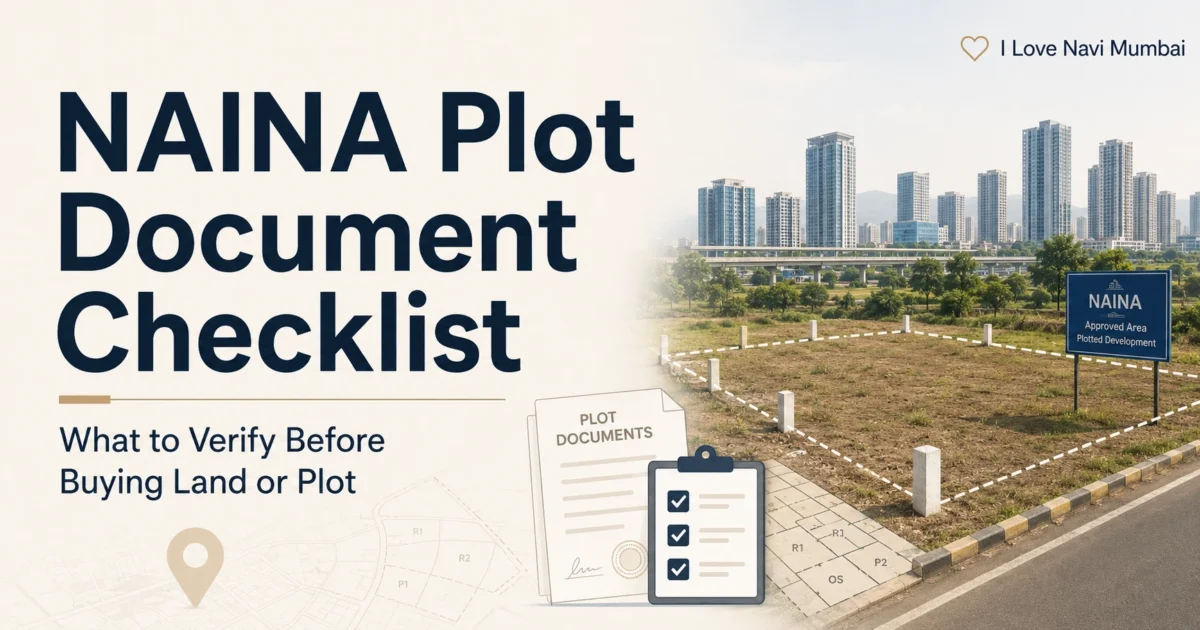
NAINA Plot Document Checklist: Documents to Verify Before Buying Land

Read More

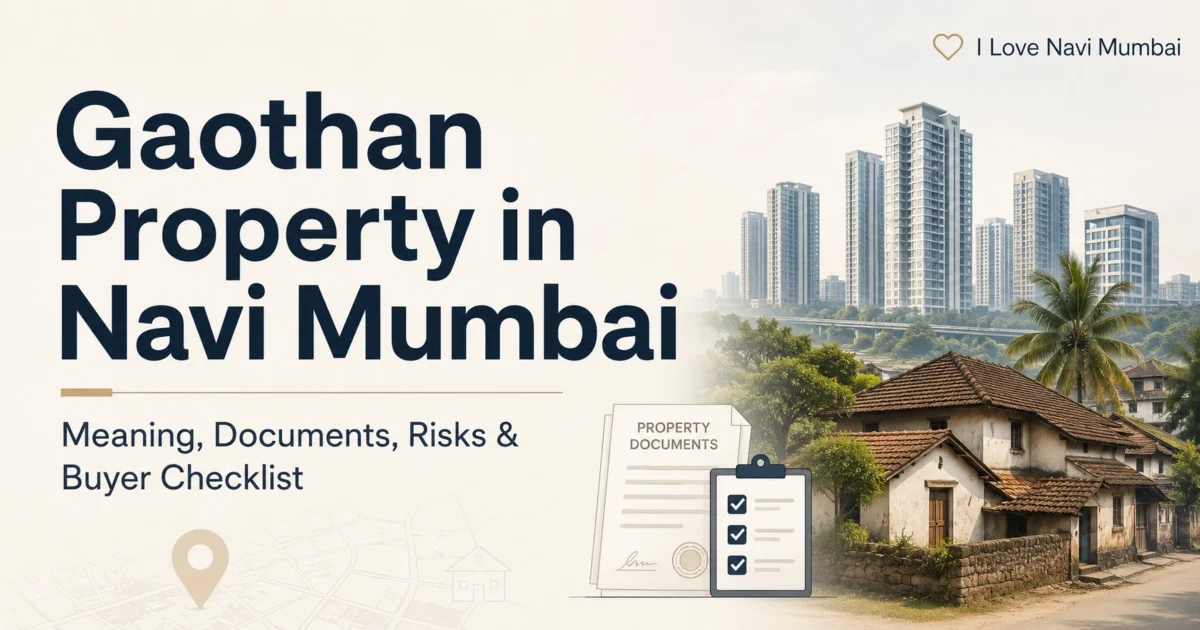
Gaothan Property Navi Mumbai: Meaning, Documents, Risks & Buyer Checklist

Read More