
Fintech Hub Third Mumbai: Real Estate Impact and Buyer Checks
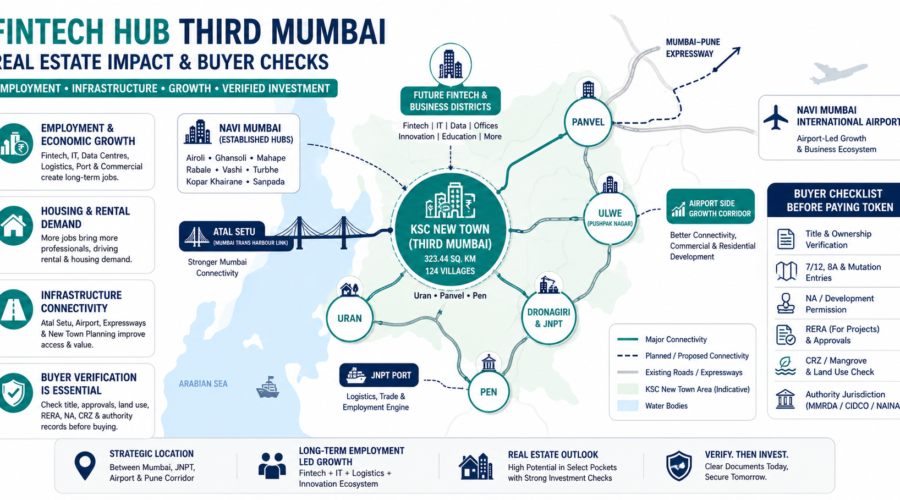
Fintech Hub Third Mumbai should be treated as a long-term employment-led real estate theme, not a guaranteed appreciation signal. Official MMRDA material identifies KSC New Town as a 323.44 sq. km notified new-town area across 124 villages in Uran, Panvel and Pen. Before buying, verify title, land records, RERA, authority permission, NA position and CRZ risk.
Related pillar: Navi Mumbai employment hubs real estate impact
This is an educational guide. Verify the latest position with the relevant authority or a property lawyer before making a transaction.
What does Fintech Hub Third Mumbai mean?
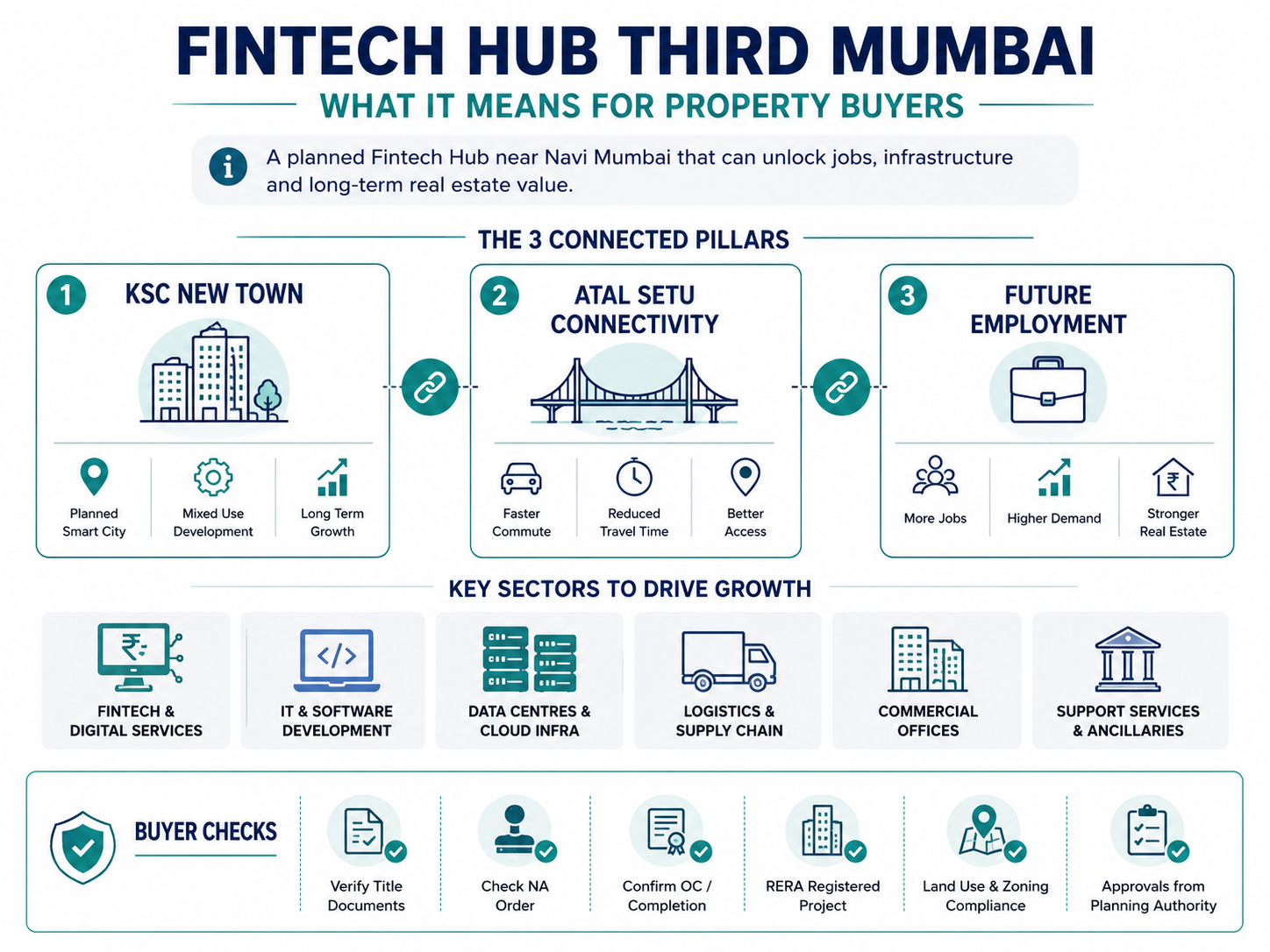
“Fintech Hub Third Mumbai” is a market phrase buyers are hearing because of three connected ideas:
- KSC New Town / Third Mumbai
- Atal Setu and airport-side connectivity
- Future employment from IT, fintech, data, logistics and commercial offices
The official term to track is KSC New Town. MMRDA says the Government of Maharashtra appointed MMRDA as New Town Development Authority for 124 villages in Uran, Panvel and Pen tehsils, and the designated area is named KSC New Town. The same page says the area comprises 323.44 sq. km and that planning proposals are to be prepared under the Maharashtra Regional and Town Planning Act, 1966.
That matters because a buyer should not rely only on “Third Mumbai” branding. The real question is simpler:
Does the exact property fall under the correct authority, permitted land use, clean title and legally usable development permission?
Fintech is one part of the story, not the whole story
Fintech means financial technology: companies using software, data and digital systems for banking, lending, payments, insurance, compliance and financial services.
For real estate, fintech matters only if it creates real employment, office demand and rental demand.
But Third Mumbai is not only about fintech. The wider employment story may include:
- IT and ITeS
- Data centres
- Logistics
- Port-linked business
- Education
- Healthcare
- Commercial offices
- Research and innovation uses
So the right way to look at this is not “fintech hub = buy anything nearby.”
The right way is:
Employment theme + infrastructure + legal property verification + holding capacity.
Do not confuse Wadala FinTech Hub with Third Mumbai
This is important.
Recent MMRDA-related investment news has referred to a Fintech-Insurtech hub at Wadala, Mumbai, while Third Mumbai / KSC New Town is a separate Raigad-side new-town theme around Uran, Panvel and Pen. News reports on MMRDA’s WEF 2026 MoUs mention Wadala for fintech-insurtech and other wider MMR investments separately.
So, if a broker says, “Fintech hub is coming, buy this land in Third Mumbai,” ask one question:
Which official document connects this exact survey number, village, zoning and permission to the claim?
If there is no clear answer, pause.
Why Third Mumbai matters for real estate
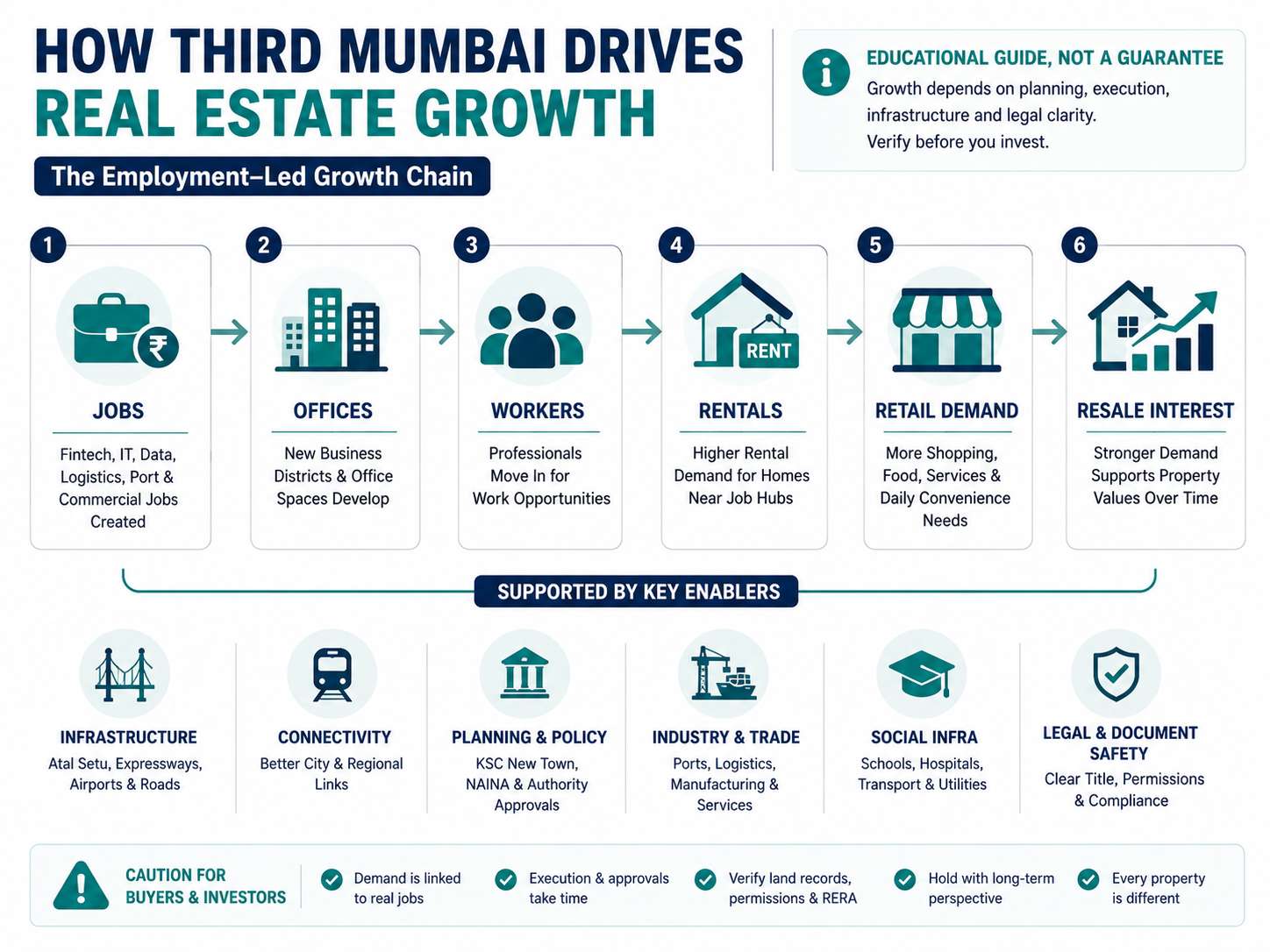
Employment hubs affect real estate through a chain:
Jobs → offices → workers → rentals → retail demand → resale interest.
This is why Airoli, Ghansoli, Mahape, Rabale, Vashi and Turbhe already have real estate demand linked to offices, IT parks and industrial employment.
Third Mumbai is different. It is more future-facing. It may support long-term demand in Panvel, Ulwe, Dronagiri, Uran, Pen and nearby KSC/NAINA-side areas, but execution, planning, permissions and market timing matter.
A buyer should judge the opportunity on five points:
1. Is the property legally clean? 2. Is the area actually connected to employment or infrastructure? 3. Is the land use permitted? 4. Is the project registered and compliant where RERA applies? 5. Can the buyer hold the asset long enough if development takes time?
Areas that may feel the impact
| Area | Possible impact | Better suited for | Main risk to verify |
|---|---|---|---|
| Panvel | Spillover from KSC, airport, NAINA and road connectivity | End-users, long-term investors | Title chain, NAINA/CIDCO/MMRDA status, NA/development permission |
| Ulwe / Pushpak Nagar | Airport-side and connectivity-led demand | Flat buyers, rental investors | CIDCO transfer, RERA, OC, creek-side restrictions |
| Dronagiri / Uran | JNPT, port, logistics, Atal Setu and KSC proximity | Long-term investors | CRZ, mangroves, industrial land use, access |
| Pen / Chirner / Karnala-Sai belt | KSC New Town / Third Mumbai planning theme | High-risk land investors | Acquisition, zoning, 7/12, road access, authority jurisdiction |
| Kharghar / Taloja | More established Navi Mumbai-side alternatives | Family buyers, budget buyers | Green zone, hill slope, project approvals |
| Airoli / Ghansoli / Mahape / Rabale | Existing IT and commercial job base | Rental investors, working professionals | Society documents, OC/CC, industrial-edge issues |
For current employment demand, also build context with Navi Mumbai IT hubs property impact and Airoli IT Park real estate impact.
Third Mumbai vs existing Navi Mumbai job hubs
Existing Navi Mumbai job hubs already have demand.
Airoli has IT and office parks. Ghansoli benefits from corporate offices and Mahape access. Rabale and Mahape support industrial, IT and back-office demand. Turbhe and Vashi have commercial and industrial activity.
Third Mumbai is not yet the same type of mature employment market.
It is a future development and planning theme. That does not make it weak. It makes it different.
For a conservative buyer, existing nodes may be easier to evaluate. For a long-term investor, KSC / Third Mumbai may be interesting, but only after stronger document checks and realistic holding assumptions.
For related employment-led growth topics, use Dedicated Freight Corridor Navi Mumbai impact, Integrated Logistics Park Navi Mumbai impact and JNPT real estate impact.
What to check before paying token money
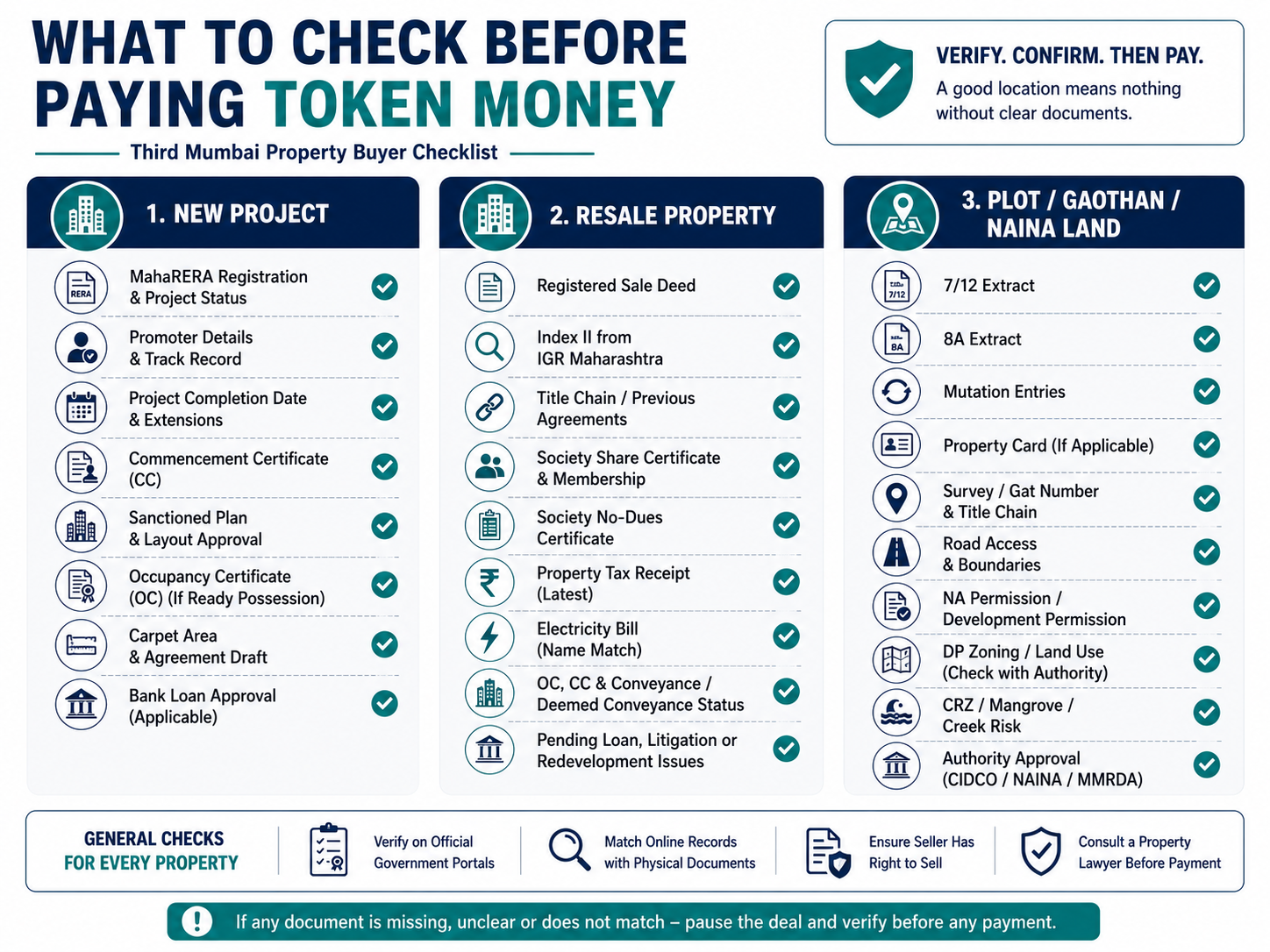
Do not pay token money because a brochure says “Third Mumbai,” “fintech hub,” “airport growth” or “Atal Setu benefit.”
Check the property type first.
If buying a flat in a new project
Check:
- MahaRERA registration number
- Promoter name
- Project name and address
- Completion date and extensions
- Complaints and orders
- Lapsed, revoked, deregistered or abeyance status
- Commencement Certificate
- Sanctioned plan
- Occupancy Certificate, if ready possession
- Agreement draft
- Carpet area
- Approved layout
- Bank loan approval
MahaRERA’s official site provides sections for registered projects, revoked projects, lapsed projects, abeyance project lists, complaints, orders and related project information.
RERA registration supports verification. It does not automatically guarantee that title, possession, construction quality or every approval is risk-free.
If buying resale property
Check:
- Registered sale deed
- Index II
- Chain of previous agreements
- Society share certificate
- Society no-dues certificate
- Property tax receipt
- Electricity bill
- OC and CC
- Existing loan or mortgage
- Pending litigation
- Redevelopment notices
IGR Maharashtra’s eSearch portal allows property or document-number-based searches, and the portal itself says registration data is updated in real time and should be checked before transactions to prevent fraud.
If buying plot, gaothan, village land or NAINA-side land
This is where risk increases.
Check:
- 7/12 extract
- 8A extract
- Mutation entries
- Property card, if applicable
- Survey number or gat number
- Village Form 6 mutation history, where relevant
- Title chain
- Road access
- NA or development permission position
- DP zoning
- NAINA / CIDCO / MMRDA jurisdiction
- CRZ / mangrove / green-zone / no-development-zone risk
- Physical possession
- Boundary measurement
Plain-English meanings:
7/12 extract: land-record extract showing land details, holder names, survey details, land use and certain rights or charges.
8A extract: village account extract used to understand landholder and assessment-related information.
Mutation entry: a land-record update after sale, inheritance, partition, loan or other change. It supports verification but does not replace a title search.
Property card: urban land record used in city survey areas. It supports verification but should not be treated as full ownership proof by itself.
For a dedicated next step, use check 7/12, 8A and property card.
NA permission after 2025: useful change, not a free pass
The Maharashtra Land Revenue Code Second Amendment material states that Collector permission is not required for change of land use from agricultural to non-agricultural if such use is permissible under the draft or final Development Plan, Regional Plan, Development Control Regulations or other applicable planning framework, and the concerned Planning Authority gives development permission or building-plan approval. It also refers to recovery of a one-time premium before development permission or building approval.
This does not mean every agricultural plot is automatically buildable.
Before buying, verify:
- Whether the land use is permitted
- Which planning authority controls the land
- Whether development permission exists
- Whether premium or other dues apply
- Whether revenue records are updated
- Whether the land has Class-II, occupancy, tenancy, acquisition or restriction issues
For any NA, land-conversion or development-permission issue, mark the file: verify with lawyer/revenue office before transaction.
How to verify online
| What to verify | Official source | What to match | Red flag |
|---|---|---|---|
| Land record | Mahabhulekh / Mahabhumi | Survey number, holder name, area, mutation | Name mismatch, loan entry, disputed mutation |
| Registered document | IGR Maharashtra | Index II, document number, buyer/seller names | Missing document or broken title chain |
| Project status | MahaRERA | Project, promoter, completion date, complaints | Lapsed, revoked, abeyance, mismatch |
| NAINA permission | CIDCO / NAINA / NIAMS | Building permission, CC, OC, zoning | No traceable approval |
| KSC status | MMRDA NTDA / KSC pages | Village, planning status, notified area | Broker claim without official match |
| CRZ risk | MCZMA / CZMP | CRZ category, mangrove/creek proximity | Coastal restriction ignored |
| NA/development permission | Planning authority / revenue office | Permitted use and approval trail | “NA plot” claim without proof |
Mahabhumi lists land-record services such as 7/12, mutation record, maps, 8A, property card, e-measurement, court-case status and related citizen services.
CIDCO’s NAINA page includes Development Plan, Building Permission, NAINA DCPR, Town Planning Schemes, NIAMS, Zoning Clearance System, commencement certificate and occupancy certificate references.
For coastal and creek-side risk, MCZMA provides approved CZMP 2019 resources for Mumbai, Raigad, Thane, Palghar, Ratnagiri and Sindhudurg districts.
Red flags
Pause the deal if you see these:
- Broker says, “Fintech hub coming, token now, documents later.”
- Plot is marketed as “Third Mumbai land” without survey-number-level verification.
- Seller cannot show latest 7/12, 8A or mutation entries.
- 7/12 name does not match the seller.
- Mutation is pending, disputed or recently changed without explanation.
- “NA plot” is claimed without approval trail.
- Project is not traceable on MahaRERA.
- MahaRERA status shows lapsed, revoked, deregistered or abeyance.
- Ready flat has no Occupancy Certificate.
- Land is near creek, mangrove, CRZ, hill slope, forest, green zone or no-development zone.
- Power of attorney or inheritance chain is unclear.
- Price is unusually low because of “inside information.”
A property portal listing is not an approval. A brochure is not title verification. A 7/12 extract alone is not complete ownership proof.
Common mistakes buyers make
1. Treating “Third Mumbai” as guaranteed appreciation. 2. Confusing Wadala FinTech Hub with KSC New Town / Third Mumbai. 3. Buying raw land only because of airport or Atal Setu narratives. 4. Assuming a property listing means the land is approved. 5. Assuming 7/12 alone proves ownership. 6. Ignoring CRZ and mangrove restrictions in Uran, Dronagiri and creek-side pockets. 7. Not checking whether CIDCO, NAINA, MMRDA, PCMC, Collector or another authority controls the land. 8. Assuming NA permission is automatic after the 2025 change. 9. Paying token before IGR, RERA, land-record and zoning checks. 10. Buying through power of attorney without lawyer review.
Example: NRI buying a “Fintech Hub Third Mumbai” plot near Panvel
An NRI buyer sees a plot near Panvel marketed as “near Fintech Hub Third Mumbai.” The broker says prices will rise after the airport, Atal Setu and new business district.
Before paying token, the buyer should ask for:
- Survey number / gat number
- Latest 7/12
- 8A
- Mutation entries
- Registered title chain
- Index II
- DP zoning or planning remarks
- KSC New Town / MMRDA status
- NAINA / CIDCO status, if applicable
- NA / development permission position
- CRZ / mangrove check
- Road access proof
- Physical boundary measurement
- Lawyer title-search report
If any document is missing or unclear, the buyer should not pay token.
Next step: property title search before token money.
When to consult a professional
Consult a property lawyer, title-search professional, architect or revenue consultant when:
- You are buying plot, gaothan, village land or agricultural land
- The property is in KSC New Town / Third Mumbai influence area
- The land may be affected by acquisition, reservation, DP road or land pooling
- CRZ, mangrove, green-zone, forest or no-development-zone risk exists
- Seller uses power of attorney
- Ownership came through inheritance or family settlement
- Mutation entries are recent, disputed or incomplete
- RERA, OC, CC or title documents do not match
- Buyer is NRI or cannot physically verify possession
- Token payment is being pushed urgently
Final recommendation
Fintech Hub Third Mumbai is a serious long-term theme, but it is not a shortcut.
For usable housing and current rental demand, existing Navi Mumbai nodes like Airoli, Ghansoli, Kopar Khairane, Vashi, Sanpada, Kharghar, Panvel and Ulwe may be easier to evaluate.
For Third Mumbai / KSC / fintech-led future growth, treat the opportunity as longer-term and higher-risk.
The safest rule is simple:
No token money before title, land records, authority status, zoning, RERA, NA and CRZ checks.
For the next step, use verify your property documents before paying token.
FAQs
Frequently Asked Questions