Property Card Navi Mumbai: Meaning, Uses, CTS and Buyer Checks
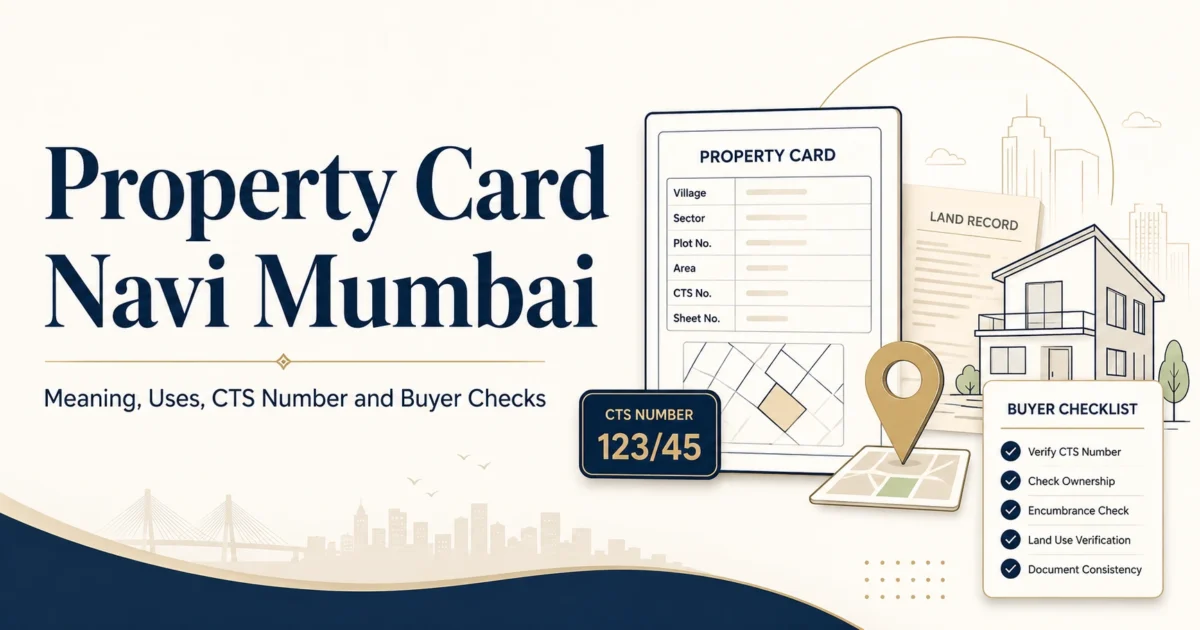
Property Card Navi Mumbai: Meaning, Uses, CTS Number and Buyer Checks A property card is an important land-record document in Maharashtra, especially for urban land, old buildings, plots, gaothan properties, city survey records, and redevelopment cases. In Navi Mumbai, buyers may hear terms like property card, Maalmat Patrak, CTS number, city survey number, mutation entry, 7/12 extract, title search, and property tax record. These documents are connected, but they are not the same. This guide explains what a property card means, what it can show, what it cannot prove, and how Navi Mumbai buyers should use it before paying token money for a flat, plot, gaothan property, CIDCO-related property, redevelopment property, or land parcel. For related checks, buyers should also read Navi Mumbai Land Records Guide, 7/12 Extract Guide, Mutation Entry Guide Navi Mumbai, Land Title Search Guide, and Property Documents Checklist Navi Mumbai. Direct Answer A property card in Navi Mumbai is an urban land-record document that helps identify a property by CTS number or city survey number, area, tenure, holder details, and record changes where available. It is useful for due diligence, but buyers should not treat it as complete proof of clear ownership without checking sale deed, Index II, title chain, tax records, and legal opinion. Quick Summary Point What Navi Mumbai Buyers Should Know Common name Property Card / Maalmat Patrak / Malmatta Patrak Mainly used for Urban land, city survey property, plots, old buildings, redevelopment, gaothan or surveyed areas Key number CTS number / City Survey number What it may show Holder name, property area, tenure, mutation entries, remarks and property identity Does it prove clear ownership? No. It is a supporting land-record document, not a full title-clearance certificate Must be matched with Sale deed, Index II, title chain, mutation entry, tax record, society record and authority records Important for Plot buyers, old-building buyers, gaothan buyers, redevelopment societies, CIDCO-related property buyers Main caution Name, area, CTS number, tenure or remarks mismatch should be checked before token payment Buyer action Verify official records and consult a qualified property lawyer before signing or paying What Is a Property Card in Maharashtra? A property card is a land-record document used mainly for urban or city-survey properties. In Maharashtra, it is also commonly known as Maalmat Patrak or Malmatta Patrak. It helps identify a property through city survey records. Depending on the location and record type, a property card may show details such as: CTS number or city survey number Property area Holder or occupant details Tenure or occupancy type Mutation or record-change entries Remarks or restrictions where applicable Property identification details For Navi Mumbai buyers, the property card becomes important when the property is linked to urban land records, city survey records, old buildings, redevelopment, plots, gaothan property, or certain authority-controlled land cases. However, a property card should not be treated as a complete ownership certificate. It is one document in the due-diligence process. What Is CTS Number in Property Card? CTS means City Survey number. It is used to identify an individual land parcel in city survey records. A property card is generally connected with the city survey number of a land parcel. For buyers, the CTS number is important because it helps match the property shown in the sale deed, title documents, property card, city survey record, municipal record, and physical location. If the CTS number in the property card does not match the sale deed or other documents, buyers should pause the transaction and get written clarification. Do not rely only on a broker’s explanation or seller’s verbal assurance. What Details Are Usually Shown on a Property Card? A property card may show different details depending on the property, location, record status, and official format. Buyers should not assume that every property card will show every detail in the same way. Common details may include: CTS number or city survey number Property description Land area Holder name or recorded person/entity Tenure or occupancy class Mutation entries or record-change references Remarks, restrictions, reservations or government interest where applicable Survey-related details The buyer should carefully compare these details with the registered sale deed, Index II, title chain, tax record, society records, CIDCO records where applicable, and a lawyer’s title search. Is Property Card Proof of Ownership? A property card is important, but it is not complete proof of clear ownership by itself. This is the most important point for Navi Mumbai buyers. A property card may support the ownership-verification process, but it does not replace: Registered sale deed Previous title chain Index II Mutation entry Property tax record Society share certificate CIDCO transfer or NOC records where applicable Encumbrance or lien check Legal title search report Lawyer’s written opinion A safer way to understand it is: A property card helps identify and verify property-record details. It does not automatically prove that the seller has clear, marketable and dispute-free title. If the property card is updated but the title chain is weak, buyers should not proceed without legal review. Property Card vs 7/12 Extract Property card and 7/12 extract are both land-record documents, but they are generally used in different contexts. A property card is more relevant for urban or city-survey property. A 7/12 extract is more relevant for village land, agricultural land, rural land, and land parcels recorded under revenue records. In Navi Mumbai and nearby areas, buyers may need one or both depending on the property type. For example: A city-survey plot may need property card verification. Village land may need 7/12 extract verification. Gaothan property may need property card, village records, or both depending on survey and authority records. NAINA land may need 7/12, mutation, village map, zoning and planning checks. Redevelopment property may need property card, conveyance/deemed conveyance, society records and title report. For deeper understanding, read 7/12 Extract Guide and Village Land Buying Checklist. Property Card vs Sale Deed A sale deed is a registered transfer document. It records the transfer of property between seller and buyer. A property card is a
Read More