Blogs

Everything about Navi Mumbai

Sector 11 Ghansoli, Navi Mumbai: Location, Property, Rent and Living Guide

Sector 11 Ghansoli is one of the more noticed residential pockets in Ghansoli, Navi Mumbai. People usually search for this area when they are planning to rent a flat, buy property, compare Ghansoli with Airoli or Kopar Khairane, or understand how practical the location is for daily living. The area is especially relevant for families, working professionals and corporate tenants because it offers access to Ghansoli Railway Station, Thane-Belapur Road, Airoli, Rabale, Mahape, Kopar Khairane and Vashi. Many residents choose this belt because it keeps them close to major employment hubs while still offering a residential environment. However, Sector 11 Ghansoli should not be judged only by project brochures or property portal prices. The actual living experience depends on the building, lane, parking, water supply, maintenance, station access and legal documentation. For a wider area overview, readers can also explore the [Ghansoli Navi Mumbai guide](#). Quick Summary Point Details Locality Sector 11 Ghansoli City Navi Mumbai PIN Code 400701 Nearest Railway Station Ghansoli Railway Station Nearby Areas Sector 9, Sector 15, Jijamata Nagar, Airoli, Kopar Khairane, Rabale Main Road Access Thane-Belapur Road and internal Ghansoli roads Area Type Residential and mixed-use locality Best For Families, tenants, working professionals and local buyers Property Types 1 BHK, 2 BHK, 3 BHK, resale flats and apartments Civic Authority Navi Mumbai Municipal Corporation Sector 11 Ghansoli is not a completely budget locality anymore. In many pockets, it has shifted towards a mid-premium and premium residential character because of high-rise apartments, corporate rental demand and proximity to important work hubs.   Where Is Sector 11 Ghansoli Located? Sector 11 Ghansoli is located within the Ghansoli node of Navi Mumbai. It falls under the 400701 PIN code and is administered by the Navi Mumbai Municipal Corporation. The area is closely connected with Jijamata Nagar, Sector 8, Sector 9 and Sector 15 Ghansoli. On the wider Navi Mumbai map, Sector 11 sits close to the Thane-Belapur Road belt and has access towards Airoli, Rabale, Mahape, Kopar Khairane and Vashi. This location makes it useful for people who work in nearby business and industrial areas but want to live in a residential pocket. One important local point is the connection between Sector 11 and Jijamata Nagar. Many property listings, project addresses and local references may use both names. So, if a flat is shown as “Jijamata Nagar, Sector 11 Ghansoli,” it generally refers to the same broader residential pocket. Nearby areas around Sector 11 include Sector 9 Ghansoli, Sector 15 Ghansoli, Airoli, Kopar Khairane, Rabale and Mahape. Sector 9 and Sector 15 support local residential movement, while Airoli, Rabale and Mahape are important for employment. Kopar Khairane and Vashi add stronger retail, food, healthcare and lifestyle access.   Connectivity of Sector 11 Ghansoli Sector 11 Ghansoli has good practical connectivity for people who travel within Navi Mumbai, Thane and nearby office hubs. Its biggest advantage is not luxury lifestyle, but location efficiency. For someone working around Reliance Corporate Park, Mahape, Rabale MIDC or Airoli, this area can reduce daily travel stress. Ghansoli Railway Station Access Ghansoli Railway Station is the nearest major railway station to Sector 11. It is on the Trans-Harbour route and connects commuters towards Thane, Vashi and other Navi Mumbai railway points. A practical 2026 update is that responsibility for several Navi Mumbai railway stations has been shifting fully to Central Railway. This does not change the train route or commute pattern from Ghansoli, but it is part of a wider change in station operations and maintenance across the Navi Mumbai suburban network. The station is accessible from Sector 11, but the exact convenience depends on the building location. Some residents may find it manageable by auto or two-wheeler, while others may not prefer walking daily, especially during summer, heavy rain or late evening hours. This is important for tenants. A listing may mention “near Ghansoli Railway Station,” but before renting, it is better to physically check the distance, auto availability and daily route. Road Connectivity Road connectivity is mainly through Thane-Belapur Road and internal Ghansoli roads. From Sector 11, residents can travel towards Airoli, Rabale, Kopar Khairane, Vashi, Mahape and Thane side. The commute towards Mahape, Reliance Corporate Park and Rabale is one of the strongest reasons why many working professionals prefer this belt. For Vashi and Airoli, connectivity is also practical, but peak-hour traffic can affect actual travel time. The Ghansoli–Airoli Palm Beach Road extension is now under construction, but it is not operational yet. During an NMMC Commissioner inspection reported in May 2026, 44 of the project’s 89 piers were reported complete. The project is intended to create an alternative route towards Airoli and reduce pressure on Thane-Belapur Road. Earlier plans targeted completion in 2026, but reporting from February 2026 indicated that completion was then expected during 2027. Buyers should treat the opening date as a current target until NMMC officially commissions the road. Public Transport and Daily Commute Auto-rickshaws are commonly used for short-distance travel. Shared autos are especially useful for office commuters going towards Mahape, Reliance Corporate Park and nearby employment areas. NMMT bus access is available in the broader Ghansoli belt, depending on the exact route and stop. App-based cabs usually work well because the area has a strong residential and corporate user base. Two-wheelers are also practical for local movement, but parking and traffic should be checked building-wise.   Lifestyle and Daily Convenience in Sector 11 Ghansoli Sector 11 Ghansoli is suitable for normal daily living. It has access to grocery stores, medical shops, local food options, small supermarkets, banks, ATMs, salons, clinics and daily-use services in and around the area. The lifestyle here is more residential and practical than entertainment-heavy. It is not like Vashi or Seawoods where malls, multiplexes and premium restaurants are a major part of the local experience. For bigger shopping, movies or premium dining, residents usually travel towards Vashi, Kopar Khairane, Airoli or Thane. For regular household needs, the nearby Ghansoli and Jijamata Nagar pockets are useful. Local shops support daily grocery,

Read More

Builders and Developers in Airoli, Navi Mumbai: 2026 Buyer Guide

The main builders and developers in Airoli worth evaluating in 2026 are Gami Group, Alliance Infra, Superior Navkar Builders, Vidhaata Developers, Safalya Inc, Raikar Group, Millennium Group, and Kumar And Kumar Builders LLP. For buyers, the right shortlist depends less on brand size and more on verified Airoli footprint, project-level checks, and whether you want resale or under-construction stock. Quick Answer If you are searching for builders and developers in Airoli, start with Alliance Infra, Superior Navkar Builders, and Gami Group for the clearest current Airoli-specific relevance. Then compare Raikar Group, Safalya Inc, and Millennium-linked stock for resale and mature-node housing, while treating Vidhaata Developers and Kumar And Kumar Builders LLP as project-wise verification cases rather than automatic recommendations. Why Airoli matters in 2026 is straightforward. Public market data shows a mature stock profile, not an early-launch market: Housing currently surfaces 115+ ready-to-move projects, 23+ under-construction projects, and 111+ resale projects in Airoli. That means buyers here should think like end-users and resale evaluators first, and launch chasers second. Airoli also works because it is residential and commercial-linked. Official and recent sources show the area’s demand is tied to office ecosystems and commute logic: Mindspace’s official page describes Airoli East as a major IT-corridor node near the railway station, Central Railway places Airoli, Rabale, and Ghansoli on the Trans-Harbour Line, and MMRDA says its 12.30 km Airoli-Katai Naka road project is intended to shorten Navi Mumbai access toward Kalyan-Dombivli and nearby corridors. Recent office leasing by Wipro, HERE Technologies, Dow Chemical, and SBI in the Airoli micro-market reinforces that Airoli housing demand is strongly job-linked. For buyers comparing Airoli with nearby nodes, the current public data points to a clear pattern: Airoli is the mature ready-stock market, Ghansoli is the stronger new-supply competitor, and Mahape is more office- and TTC-linked than residentially deep. Housing currently shows average listed rates around ₹13,583/sq ft in Airoli, ₹15,048/sq ft in Ghansoli, and ₹7,247/sq ft in Mahape. For a broader city-level comparison, you can also explore this detailed guide on Builders and Developers in Navi Mumbai. Quick Comparison Table This table helps buyers compare Airoli-relevant builders and developers based on buyer fit, strong areas, project type, and important verification points before shortlisting any property. Developer Best For Strong Areas Segment Project Type Buyer Fit What To Verify Gami Group Buyers who want a known Navi Mumbai brand with actual Airoli relevance Airoli, Ghansoli Mid to upper-mid Ready stock plus regional ongoing pipeline End-users, upgraders, local resale buyers Exact live Airoli project name, current RERA entry, and whether the scheme you are being shown is the same one listed on official material Alliance Infra Buyers who want one of the clearest current Airoli under-construction options Airoli Mid-segment Under-construction apartments First-time buyers, working professionals, investors, end-users RERA P51700048842, sanctioned plans, construction progress, promoter entity, and all sales promises in writing Superior Navkar Builders Buyers looking for a more upgrade-driven Airoli shortlist Airoli Mid-premium Under-construction apartments End-users, upgraders, premium-mid buyers RERA P51700053448, exact site address, and portal-level location inconsistencies before paying token money Vidhaata Developers Buyers exploring smaller-format local projects only after deeper verification Sector 9 Airoli Compact / budget-sensitive Small-format residential First-time buyers only if paperwork is clean RERA P51700031486, current registration status, abeyance/lapse status, and whether agreements can legally be executed Safalya Inc Buyers who prefer older ready possession stock in a mature neighborhood Sector 7 Airoli Compact / older mid-segment Ready residential stock Ready-to-move and resale buyers Exact promoter identity, OC/CC trail, society documentation, and portal mismatches around builder labeling Raikar Group Buyers comparing Airoli with Ghansoli / Rabale-side stock Airoli, Ghansoli, nearby Rabale belt Mid-segment Mostly ready residential stock Resale buyers, working professionals, nearby-area comparers Project-wise legal identity, society papers, and whether the exact project is older legacy stock or newer nearby inventory Millennium Group Buyers willing to compare Airoli with Ghansoli, Kharghar, and Panvel within one regional developer family Airoli, Ghansoli, Kharghar, Panvel Mid to upper-mid Mostly completed / regional stock Cross-node upgraders, resale buyers, comparison shoppers Exact promoter entity because public sources map Millennium Avanish to different promoter labels Kumar And Kumar Builders LLP Buyers who want a local Airoli / TTC-linked project with a clear live reference point TTC Industrial Area, Airoli Mid-segment Under-construction apartments Working professionals, local end-users, niche Airoli buyers RERA P51700054506, progress updates, legal title trail, and whether TTC-linked positioning suits your daily use How to read this table: This is a buyer-fit and verification table, not a final quality ranking. A developer may be relevant to Airoli, but the right choice still depends on budget, paperwork, possession status, micro-location, and project-level due diligence. How We Selected These Developers This list was built to match the actual search intent behind builders in Airoli, developers in Airoli Navi Mumbai, top builders in Airoli, and related queries. The current results for those searches are mostly dominated by portal directories, local business listings, and project-specific pages, not one strong buyer-first editorial guide. Housing’s Airoli builder directory, Justdial’s area listings, and multiple project-level pages for Alliance, Superior, Gami, Vidhaata, Safalya, Kumar, Raikar, and Millennium show that real buyers are currently landing on fragmented pages rather than one reliable local guide. The selection logic was simple and strict: Local project footprint. A developer was included only if there was verifiable Airoli or immediate nearby-node evidence from official sources, major portals, or both. That is why Alliance, Superior, Gami, Vidhaata, Safalya, Raikar, Millennium, and Kumar And Kumar make the cut, while generic citywide names without current Airoli evidence do not. Buyer fit. We scored developers differently for end-users, resale buyers, investors, working professionals, and ready-to-move buyers. That matters in Airoli because this is a mature node with far more ready stock than under-construction supply. Segment and project type. We separated compact legacy stock, resale-heavy buildings, fresh under-construction inventory, and broader regional developers. A buyer looking for a small local under-construction project should not get the same shortlist as a buyer looking for a ready-to-move resale tower. RERA and project verification. Any developer

Read More

Builders and Developers in Vashi, Navi Mumbai: 2026 Buyer Guide

Builders and developers in Vashi that buyers commonly compare in 2026 include Gami Group, Mahaavir Buildcon / Mahaavir Universal, Raj Chamunda Builders & Developers, EV Homes, Swaraj Homes, Akshar Group, Bhumiraj Group, and selected premium brand-led names such as Godrej Properties where exact project relevance is verified. In Vashi, project-wise verification matters more than brand familiarity. If you are searching for builders and developers in Vashi, the smartest approach is not to ask who is “best” in the abstract. The better question is: which developers are genuinely relevant to Vashi, what type of buyer do they suit, and what should be verified before you pay even a token amount? That matters because Vashi is not a blank-slate launch market. It is a mature node in Navi Mumbai with a mix of older stock, redevelopment opportunities, commercial influence, ready-to-move options, and selective premium projects. In practical terms, buyers here are often comparing core Vashi convenience, Palm Beach-side premium options, and nearby alternatives such as Sanpada and Nerul, rather than just chasing the newest brochure. For most serious buyers, the most practical shortlist starts in three lanes: Core Vashi relevance: Gami Group, EV Homes, Mahaavir Buildcon / Mahaavir Universal Smaller local or resale-oriented comparison names: Raj Chamunda Builders & Developers, Swaraj Homes Near-Vashi / Palm Beach / commercial-linked comparison names: Bhumiraj Group, Akshar Group, and Godrej Properties only where exact project relevance is clearly verified This article is built to help buyers shortlist rationally, compare nearby areas, and verify before booking, instead of relying on thin portal pages or broad directory lists. For a wider comparison before shortlisting any local project, you can also explore this detailed guide on Builders and Developers in Navi Mumbai. Quick Comparison Table This table helps buyers compare Vashi-relevant developers based on buyer fit, strong areas, project type, and key verification points before shortlisting any property. Developer Best For Strong Areas Segment Project Type Buyer Fit What To Verify Gami Group End-users and practical upgraders Core Vashi, Vashi-Sanpada comparison belt Mid to upper-mid, project-wise Residential Buyers who want a known local footprint and modern apartment-led options Exact promoter entity, project registration, construction status, address match Mahaavir Buildcon / Mahaavir Universal Local premium and end-use buyers Core Vashi Mid to premium, project-wise Residential and selected commercial Buyers who prefer a Vashi-linked local brand with city familiarity Promoter name consistency, project registration, brochure vs RERA match EV Homes Premium and redevelopment-led buyers Core Vashi and project-specific premium pockets Upper-mid to premium, project-wise Residential, redevelopment, selected commercial Buyers comparing newer Vashi projects and redevelopment-linked supply Phase details, redevelopment approvals, exact project documents, status claims Swaraj Homes Local residential buyers Vashi relevance by office footprint Project-wise; verify current inventory Residential Buyers comparing older local brands and willing to do deeper checks Whether there is active Vashi-relevant inventory, exact promoter records Akshar Group Commercial-linked and selected residential buyers Vashi and Palm Beach-side influence Mixed; commercial-led visibility Residential and commercial Buyers who care about Vashi business connectivity as part of the purchase decision Exact promoter entity, project category, commercial vs residential relevance Godrej Properties Brand-first premium buyers Verified Vashi premium relevance only Premium Residential Buyers who want brand familiarity but still need exact entity verification Affiliate/promoter details, exact project seller entity, RERA record, document match How to read this table: This is a relevance and buyer-fit table, not a blanket quality ranking. A developer can be relevant to Vashi but still be the wrong fit for your budget, risk appetite, or micro-location needs. Use it to shortlist, not to skip due diligence. Builders & Developers in Vashi Others Developers in Vashi How We Selected These Developers Most pages ranking for this topic are either portals, directories, or marketplace templates. They are useful for discovery, but they usually do not answer the hard buyer questions: who is truly relevant to Vashi, who suits which buyer type, and what should be verified before booking? That is why the shortlist in this article is based on a simple, repeatable methodology: Local project footprint: A developer was considered only if there was visible Vashi or near-Vashi relevance through official company pages, official project pages, or public market presence strong enough to justify inclusion. Area relevance: For Vashi, this matters a lot. Some names are strong in core Vashi, while others are more relevant in the Vashi–Sanpada–Palm Beach comparison belt. This page distinguishes between those two instead of mixing them carelessly. Buyer fit: A national or well-known developer is not automatically a better fit than a local developer. Some local developers matter more in Vashi because buyers here often evaluate micro-location, resale logic, redevelopment, and ready-to-move practicality. Segment and project type: Developers were not grouped only by brand. They were also grouped by likely use case: end-use, resale-led, redevelopment-led, premium, or commercial-linked. RERA and project verification logic: Inclusion here does not mean blanket approval. Developers were shortlisted only where their relevance could be checked against official presence and then taken to project-level verification. Delivery visibility and public market presence: If a developer had visible public project presence but unclear project-level certainty, that uncertainty is flagged. Where clarity was thin, the article uses the safer language “verify project-wise before booking” or “Needs manual verification before publishing.” Risk factors: This article gives more weight to ambiguity than a marketplace page usually does. If promoter identity, project phase, or exact Vashi relevance is fuzzy, that is treated as a buyer risk, not as a detail to ignore. Practical source stack used for selection : official developer websites, public project visibility on Housing.com, MagicBricks, and 99acres, plus project-level cross-checking through MahaRERA and office or entity corroboration where relevant. Before paying token money or finalizing a flat, read this practical guide on How to choose the right real estate developers in Navi Mumbai. Buyer Fit and Area Comparison Best Developers by Buyer Type Buyer Type Developers Buyers Commonly Shortlist Why This Fit Makes Sense Premium buyers Godrej Properties, Bhumiraj Group, EV Homes, selected Akshar-led options These names are more relevant where the

Read More

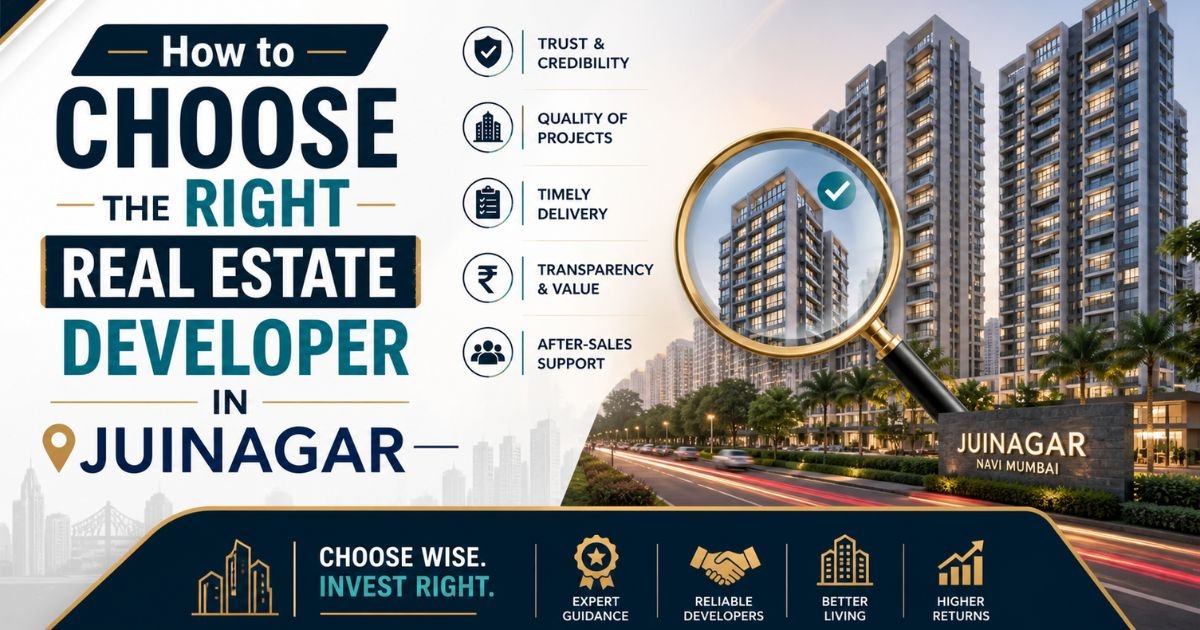
How to Choose the Right Real Estate Developer in Juinagar

To choose the right real estate developer in Juinagar, buyers should verify the developer’s past delivery record, MahaRERA details, legal documents, construction quality, pricing transparency, completed projects, buyer feedback and possession history before paying token money. In Juinagar, this is especially important because many projects involve CIDCO land, NMMC approvals, redevelopment, industrial-to-residential transition, and location-specific legal checks. Juinagar is not a simple property market anymore. It sits between mature Navi Mumbai nodes like Vashi, Sanpada and Nerul, while also seeing new residential and commercial activity around the TTC industrial belt and nearby business zones. This makes the area attractive, but it also increases buyer risk. A glossy sales office, a good-looking sample flat, or a well-known builder name is not enough. The safest way to choose a real estate developer in Juinagar is to check the project legally, physically and financially before making any payment. Quick Summary: How to Choose the Right Real Estate Developer in Juinagar What to Check Why It Matters Good Sign Red Flag MahaRERA registration Confirms project registration, timeline and basic compliance Active project listing with documents uploaded No RERA number or unclear project details Past completed projects Shows real delivery capability Older projects are well maintained Delayed or poorly maintained completed projects CIDCO/NMMC documents Important for Navi Mumbai land and approval clarity CC, OC, title documents shared clearly Builder avoids sharing documents before token Construction quality Protects long-term building life No leakage, good common areas, clean parking Seepage, cracks, poor lift or lobby condition Pricing clarity Avoids budget shock later Written all-inclusive cost sheet Verbal pricing and hidden charges OC and possession clarity Confirms legal occupation status OC received before possession “Fit-out possession” without OC Buyer feedback Reveals real post-sales behaviour Consistent positive resident feedback Repeated complaints on delay, parking or maintenance A reputed developer is not always the right developer if the project has unclear approvals, delayed possession, hidden charges or weak after-sales support. This article is for general buyer awareness. Before booking or signing an agreement, buyers should verify all documents with a qualified legal professional. Why Choosing the Right Real Estate Developer Matters in Juinagar Understand the Developer’s Past Track Record A developer’s past record is one of the strongest indicators of future performance. Brochures show possibilities. Completed projects show reality. Before trusting a new launch in Juinagar, check what the developer has already delivered in Navi Mumbai or nearby markets. Look at the gap between promised possession and actual possession. Check whether completed buildings still look structurally sound. Speak to residents if possible. Check Completed Projects Before Trusting New Launches Under-construction projects often look attractive because of launch pricing, flexible payment plans and modern amenities. But the real test of a developer is visible only after a building has been occupied for a few years. Before booking, ask: How many projects has the developer completed? Were they delivered close to the promised timeline? Did the completed projects receive Occupancy Certificate? Are older buildings maintained properly? Are residents satisfied with after-sales support? In Juinagar and nearby Navi Mumbai nodes, monsoon performance matters. A project that looks good in the first year may start showing seepage, plaster damage, basement dampness or external paint failure after a few rainy seasons if construction quality is weak. Visit Older Buildings Developed by the Same Builder Do not depend only on the sample flat. Visit at least one completed project by the same developer, preferably one that is five years old or more. During the visit, check: External wall condition Basement or stilt parking seepage Lift maintenance Lobby condition Terrace waterproofing signs Common area cleanliness Security and facility management Parking discipline Resident complaints A well-built project usually ages decently even after heavy monsoon exposure. A poorly built project starts showing problems early. Speak to Existing Residents and Buyers Existing residents often give more useful information than sales teams. Ask simple, practical questions: Was possession delayed? Were promised amenities delivered? Was the OC received on time? Were there hidden charges at possession? Did the builder form the society properly? Was the maintenance corpus handed over clearly? Are there water, parking or leakage issues? In Juinagar, also ask whether the developer handled NMMC water connections, parking allocation and society transition smoothly. These details matter more than brochure claims. Check MahaRERA Registration and Project Transparency Why MahaRERA Is Important for Juinagar Buyers MahaRERA helps buyers verify whether the project is officially registered and whether the developer has publicly committed to a possession timeline. It also brings financial discipline because project funds are regulated through escrow-related requirements. For Juinagar buyers, MahaRERA is useful because many buyers are comparing under-construction projects, redevelopment projects and larger residential-commercial developments. The portal can help confirm whether the project is formally registered and whether the promoter has uploaded basic documents. What to Verify on the MahaRERA Website Buyers should verify: Project registration number Developer/promoter name Proposed completion date Uploaded Commencement Certificate Approved plans and project details Litigation details, if any Encumbrance details Past project records of the same promoter Extension history, if visible Draft Agreement for Sale, where available The possession date shown on marketing material may be different from the legal timeline uploaded on MahaRERA. Always check the MahaRERA timeline before trusting the sales pitch. Why MahaRERA Alone Is Not Enough MahaRERA does not replace independent due diligence. It does not guarantee construction quality. It does not automatically clear CIDCO land-title risk. It does not physically inspect whether the building is being constructed well. Use MahaRERA as the starting point, not the final decision. A safe buyer checks MahaRERA, then verifies legal documents, construction quality, pricing, developer reputation and site progress separately. Check Legal Documents Before Booking a Flat Legal document verification is one of the most important steps while choosing a developer in Juinagar. This is because Navi Mumbai properties may involve CIDCO leasehold land, NMMC approvals, society conveyance issues, redevelopment agreements and PAP or 12.5% scheme plot history. Buyers should not pay token money until key documents are reviewed. Document Why It

Read More

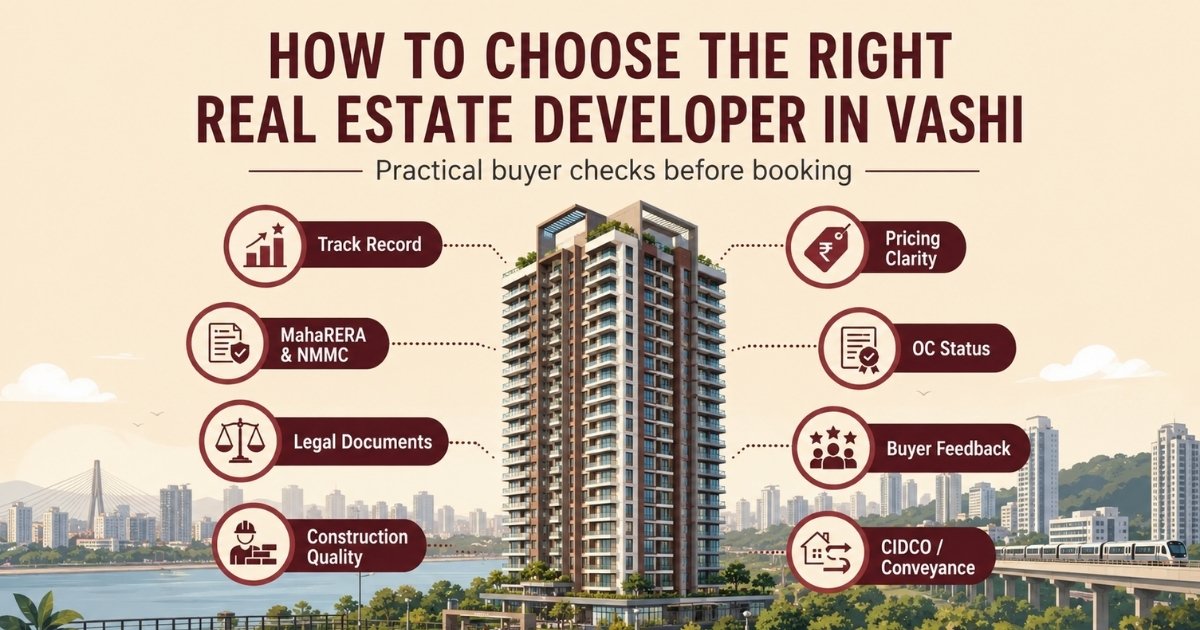
How to Choose the Right Real Estate Developer in Vashi | Buyer Guide

Vashi is one of the most mature and expensive nodes of Navi Mumbai. It has strong commercial activity, established residential sectors, good road connectivity, railway access, retail hubs, educational institutions, hospitals, and proximity to business areas such as APMC Market, Sector 17, Sector 30A, Palm Beach Road and nearby Sanpada. Because of this maturity, buying property in Vashi is not a casual decision. A 2 BHK flat can require a major investment, and in many cases, buyers are comparing ready-to-move homes, redevelopment projects, resale flats, and under-construction towers. Some properties are in old cooperative housing societies, some are on CIDCO-origin leasehold land, and some may involve redevelopment permissions, conveyance, NMMC approvals and Occupancy Certificate checks. The safest way to choose a real estate developer in Vashi is to verify legal documents, completed projects, pricing clarity, and buyer feedback before paying token money. A reputed developer is not always the right developer if the project has unclear approvals, delayed possession, hidden charges, weak construction quality, or poor after-sales support. For broader comparison, readers can also refer to [real estate developers in Navi Mumbai](ADD INTERNAL LINK HERE) and [Vashi real estate guide](ADD INTERNAL LINK HERE). Quick Summary: How to Choose the Right Real Estate Developer in Vashi What to Check Why It Matters in Vashi What Buyer Should Do MahaRERA registration Confirms basic regulatory registration and declared project details Search the exact project and promoter name on the MahaRERA website NMMC Commencement Certificate Shows that construction permission is granted for sanctioned floors Ask for the NMMC CC and check whether your floor is approved Occupancy Certificate Confirms the building is legally fit for possession Do not accept possession without final OC in ready projects CIDCO land and transfer documents Vashi has CIDCO-origin land and leasehold-related concerns Check leasehold, freehold, transfer charges and NOC status Completed projects Shows actual delivery quality, not brochure promises Visit buildings delivered by the same developer 5+ years ago Construction quality Coastal weather and monsoon can expose weak work Check basement, terrace, seepage, facade, lifts and common areas All-inclusive pricing Prevents cost shock after token payment Demand a signed cost sheet before booking Society handover and conveyance Important in older and redevelopment properties Verify society formation, corpus handover and conveyance status Buyer reviews and resident feedback Reveals after-sales issues and repeated complaint patterns Speak to existing residents, not only the sales team Builders and Developers in Vashi Why Choosing the Right Real Estate Developer Matters in Vashi Check Completed Projects Before Trusting New Launches New launches are often sold on future promises. In Vashi, especially around premium pockets such as Palm Beach Road, Sector 17, Sector 30A and central residential sectors, new projects may command high pricing because of location strength. But buyers should not trust a new launch only because the location is strong. Visit at least two completed projects by the same developer. If possible, choose projects that are at least five years old. A newly handed-over building may look good, but a five-year-old building shows how the construction has handled monsoon, regular use, maintenance pressure and resident occupancy. Check: Exterior paint condition Cracks and damp patches Basement or stilt parking watermarks Lift maintenance Lobby quality Terrace waterproofing Society complaints Security and housekeeping standards Whether amenities are functional or only shown in marketing A serious buyer should treat old projects as the developer’s real resume. Visit Older Buildings Developed by the Same Builder Vashi and nearby coastal parts of Navi Mumbai face heavy monsoon, humidity and saline air impact. Poor waterproofing, weak external plaster, bad drainage and basement leakage can become visible after a few rainy seasons. When visiting older buildings, do not only look at the entrance lobby. Lobbies can be maintained well while deeper problems remain hidden. Inspect: Basement and parking areas Terrace and top-floor leakage complaints Common passage walls External facade condition Pump room and water system Drainage slope Fire safety areas Lift breakdown frequency If residents repeatedly mention seepage, poor maintenance, broken promises, or delayed defect repairs, treat it as a warning. Speak to Existing Residents and Buyers Existing residents often tell you what sales teams will not. Speak politely to owners, tenants, society committee members, security staff and local brokers. Ask practical questions: Was possession given on time? Was OC received before people moved in? Did the developer complete promised amenities? Was the society formed smoothly? Was the corpus fund handed over clearly? Are there leakage issues during monsoon? Does the developer respond to complaints after possession? Are there unresolved legal or maintenance issues? A good developer will usually have consistent positive feedback, not only online praise. A weak developer may have repeated complaints across projects. Check MahaRERA Registration and Project Transparency MahaRERA registration is a basic requirement for eligible real estate projects. It improves transparency by requiring the promoter to declare project details, approvals, carpet area, timelines, litigations and other information. For buyers, MahaRERA is a starting point, not the final proof of trust. Always ask for the exact MahaRERA registration number of the project. Do not accept vague statements such as “RERA approved” or “RERA compliant.” Search the project yourself on the MahaRERA website. Why MahaRERA Is Important for Vashi Buyers MahaRERA matters because it gives buyers an official place to check project declarations. It also requires financial discipline, including the use of a dedicated account for project funds as per regulatory requirements. In a high-value market like Vashi, this is important because buyers are often investing large amounts and may be paying through construction-linked plans, loans or staged payments. MahaRERA helps buyers check: Registered project name Promoter name Declared possession date Project status Litigation details Carpet area Approved plans uploaded by promoter Quarterly progress updates Extension history, if any For Vashi buyers, MahaRERA reduces blind dependence on brochures and sales agents. What to Verify on the MahaRERA Website MahaRERA Detail What Buyer Should Check Project name It should match the exact project being sold Promoter name Check whether the developer, landowner or SPV is listed Possession date

Read More

How to Choose the Right Real Estate Agent in Kalamboli: Full Guide

To choose the right real estate agent in Kalamboli, check their local experience, MahaRERA registration, CIDCO documentation knowledge, brokerage clarity, and ability to explain property risks honestly. Kalamboli is not a simple listing-based market. Older CIDCO sectors, Roadpali high-rises, commercial steel market properties, rental demand, and Gaothan-linked risks all need a property agent who understands ground-level legal and local realities. Why Choosing the Right Real Estate Agent Matters in Kalamboli Kalamboli is one of Navi Mumbai’s most practical and complex real estate markets. It has affordable older CIDCO-developed residential sectors, premium Roadpali towers, rental demand from nearby industrial and logistics employment, and commercial activity around the Kalamboli Steel Market Yard and BIMA Complex. That mix makes the role of a real estate agent in Kalamboli more important than in a straightforward residential market. A casual broker may show you properties, but a genuine real estate agent should help you understand price, paperwork, society rules, CIDCO transfer issues, local risks, and transaction timelines. Kalamboli also has a strong leasehold property layer because many properties are linked to CIDCO processes. In resale deals, buyers and sellers may need to deal with transfer charges, title chains, society NOCs, property tax dues, and authority-related papers. In some cases, transfer costs can become a serious negotiation point. If these matters are not clarified before token payment, the deal can get stuck later. Roadpali has a different market character. It attracts buyers looking for relatively modern buildings, 2 BHK flats, better layouts, and newer residential societies. But even there, buyers must verify MahaRERA status, OC, possession timelines, carpet area, amenities, and local environmental concerns such as industrial pollution influence from nearby industrial belts. A good property broker in Kalamboli should not only say, “This is a good flat.” They should be able to explain why it is good, what risks exist, what documents need checking, what costs are pending, and whether the property suits your actual purpose. Understand Your Property Needs First Before choosing a property agent in Kalamboli, first define what you want from the transaction. The right agent for a rental flat may not be the right agent for a commercial godown. The right agent for Roadpali new projects may not be suitable for older CIDCO resale flats in established Kalamboli sectors. Requirement Best Type of Agent What They Must Understand Buying a flat Residential resale or new project specialist MahaRERA, OC, CIDCO transfer, price comparison Selling a property Resale-focused local agent Title chain, society NOC, buyer filtering Renting a home Rental broker with local landlord network Leave and license, police verification, deposit terms Commercial property Industrial/commercial specialist Zoning, loading, power, vehicle access Investment property Market-aware advisor Rental yield, appreciation risk, legal safety Buying a Flat If you are buying a flat in Kalamboli, your agent should understand the difference between old-sector CIDCO resale flats and newer Roadpali apartments. Older areas may offer more affordable rates, while Roadpali generally commands a premium because of newer projects and better residential layouts. The agent should help you compare the property’s asking rate with nearby transactions and current local market expectations. In Kalamboli, pricing can vary widely depending on exact sector, building age, road access, society condition, floor, OC status, and proximity to Roadpali or highway connectivity. For under-construction projects, the agent must check MahaRERA registration and possession details. For resale flats, they must help check title chain, OC, society NOC, property tax dues, and CIDCO transfer-related documents where applicable. Selling a Property If you are selling a flat in Kalamboli, the agent should do more than bring buyers. They should help you prepare the transaction properly. A seller-side agent should check whether your title documents are complete, whether society dues are clear, whether property tax receipts are updated, and whether CIDCO transfer charges or authority-related costs may affect negotiation. If these points are not ready, serious buyers may back out after legal verification. A good selling agent also knows how to position your property. A flat in Roadpali cannot be priced the same way as an older flat in a different sector. Similarly, a well-maintained society with clear documents should be marketed differently from a property where paperwork is incomplete. Renting a Home Kalamboli has rental demand from people working in nearby industrial areas, logistics hubs, commercial pockets, and surrounding Navi Mumbai nodes. A rental property broker in Kalamboli should clearly explain rent, deposit, brokerage, maintenance, agreement period, renewal terms, and police verification. The standard rental brokerage in the Mumbai Metropolitan Region is commonly one month’s rent, but terms should still be confirmed in writing before finalising. Tenants should be careful about renewal brokerage demands, especially when the broker is not doing fresh work. A professional rental agent should help both landlord and tenant avoid disputes by keeping terms clear from the start. Commercial Property Requirement Commercial real estate in Kalamboli is a specialised segment. The Steel Market Yard, BIMA Complex, warehouses, godowns, shops, and industrial-use properties require a different level of understanding. A commercial property agent in Kalamboli should understand: Access for heavy vehicles Loading and unloading needs 3-phase power requirements Godown height and floor strength Fire NOC and safety requirements Zoning and permissible use Industrial and logistics movement patterns A residential broker may not be suitable for a commercial warehouse or steel market property. The wrong agent can miss major operational risks. Investment Property Search Investors are attracted to Kalamboli because of affordability, Roadpali’s growth, improving Navi Mumbai connectivity, and long-term regional infrastructure prospects. However, investment decisions should not be based only on future promises. A good investment-focused real estate agent in Kalamboli should explain both growth and risk. They should compare Roadpali, older Kalamboli sectors, Khidukpada-style affordable pockets, and commercial zones carefully. They should also warn against risky properties with unclear title, unregularised construction, or incomplete authority approvals. For investment, the safest agent is not the one who promises the highest return. It is the one who can protect your capital first. Check the Agent’s Experience in Your Type of Deal Resale

Read More

How to Choose the Right Real Estate Developer in Sanpada

To choose the right real estate developer in Sanpada, buyers should check the developer’s completed projects, MahaRERA details, legal documents, NMMC approvals, CIDCO land clarity, construction quality, pricing transparency, possession history, and buyer feedback before paying token money. In Sanpada, this matters more because many projects involve redevelopment, older CIDCO-origin plots, leasehold land, society approvals, and high-value property transactions where one wrong decision can block resale, possession, or legal ownership. This article is for general buyer awareness. Before booking a flat or signing an agreement, buyers should verify all documents with a qualified legal professional. Before booking any flat or commercial space, read our practical guide on How to Choose the Right Real Estate Developer in Navi Mumbai to verify credibility, project quality, RERA details, and buyer safety. Quick Summary: How to Choose the Right Real Estate Developer in Sanpada Sanpada is one of Navi Mumbai’s mature and high-value residential nodes. It has strong connectivity through Sanpada railway station, Sion-Panvel Highway, Vashi, Juinagar, Nerul, Palm Beach Road access, and nearby commercial belts. But the same market also has older CIDCO housing stock, redevelopment projects, premium high-rise towers, and legal checks involving both CIDCO and NMMC. The safest way to choose a real estate developer in Sanpada is to verify legal documents, completed projects, pricing clarity, and buyer feedback before paying token money. What to Check Why It Matters in Sanpada Buyer Action MahaRERA registration Confirms the project is officially registered and has declared timelines Verify project status, possession date, carpet area, and litigation details NMMC Commencement Certificate Shows the project has construction approval up to a specific level Ask for a copy and verify with authority documents Occupancy Certificate Confirms the building is legally fit for possession Do not accept possession without OC in ready or nearing-completion projects CIDCO land clarity Many Navi Mumbai plots are CIDCO-origin leasehold or transfer-based Check allotment, transfer, leasehold/freehold, and PAP plot status Completed projects Shows actual delivery quality, not brochure promises Visit 3 to 5-year-old completed buildings Pricing sheet Prevents hidden cost shocks Demand written all-inclusive cost sheet Resident feedback Reveals after-sales support and maintenance behaviour Speak to existing residents and society members Monsoon performance Sanpada can face waterlogging and seepage issues in some pockets Visit during or after monsoon if possible Why Choosing the Right Real Estate Developer Matters in Sanpada Choosing the right developer in Sanpada is not only about brand name or tower elevation. It is about whether the builder can legally, financially, and technically complete the project and hand over a usable flat with proper approvals. Sanpada is a premium Navi Mumbai node where property values are high compared to many growth locations. The research dossier indicates estimated average property rates around ₹21,300 per sq. ft. by 2025, though actual prices vary by sector, building age, road access, view, floor, amenities, and project status. In such a market, even a small legal or construction mistake can become a costly problem. A buyer may like the location, floor plan, sample flat, or payment scheme. But if the developer has unclear land title, delayed approvals, weak construction quality, no OC history, or hidden charges, the risk shifts to the buyer. In Sanpada, developer selection matters because: Many older societies are moving towards redevelopment. Some projects may involve CIDCO-origin leasehold land. NMMC approvals like CC and OC are critical. PAP or 12.5% scheme plot issues need careful legal checking where applicable. High-rise projects need strong construction and waterproofing quality. Premium pricing increases financial exposure for buyers. A reputed developer is not always the right developer if the project has unclear approvals, delayed possession, hidden charges, or weak after-sales support. Understand the Developer’s Past Track Record A developer’s completed work is more reliable than a sales brochure. Before trusting a new launch or redevelopment project in Sanpada, buyers should study the builder’s delivery history in Navi Mumbai and nearby nodes such as Vashi, Nerul, Juinagar, Seawoods, and Kharghar. For a broader comparison of trusted real estate companies across the city, read our detailed guide on Builders and Developers in Navi Mumbai before shortlisting a project. Check Completed Projects Before Trusting New Launches Completed projects show how the developer actually performs after collecting money from buyers. A developer may promise premium amenities, branded fittings, fast possession, and high-quality construction. But the real test is visible in already delivered buildings. Check: How many projects the developer has completed. Whether possession was given as per promised timeline. Whether the project received Occupancy Certificate. Whether amenities were delivered as advertised. Whether buyers faced legal, maintenance, or leakage issues after possession. For Sanpada buyers, it is better to check completed projects in similar Navi Mumbai conditions. A builder who has delivered properly in Vashi, Nerul, Sanpada, Juinagar, or Seawoods may understand local land, approvals, and monsoon challenges better than a developer with no proven local record. Visit Older Buildings Developed by the Same Builder A 3 to 5-year-old building tells the truth. Fresh paint and sample flats can hide many things, but older buildings reveal construction quality. During the visit, check: Exterior paint condition. Basement or podium seepage. Terrace leakage. Lift maintenance. Lobby condition. Parking layout. Drainage and waterlogging signs. Society maintenance handover. Cracks, damp patches, or plaster peeling. In Sanpada, monsoon performance is important because some pockets can face waterlogging, and poor waterproofing becomes visible quickly. If a developer’s older building already looks weak within a few years, treat it as a warning sign. Speak to Existing Residents and Buyers Existing residents are usually more useful than online ads. They can tell you whether the developer supported buyers after possession or disappeared after handover. Ask residents: Was possession delayed? Was OC received before people moved in? Were promised amenities delivered? Did the builder hand over maintenance corpus properly? Were leakage or snagging complaints resolved? Was society formation smooth? Were extra charges demanded later? Do not depend only on the sales team. A 10-minute conversation with actual residents can save years of trouble. Check MahaRERA Registration and Project

Read More

Mahape MIDC Transfer for Plots and Industrial Units

In Mahape, an MIDC transfer is not completed by private sale paperwork alone; the transferor and transferee must use MIDC’s Single Window Clearance transfer service, file the prescribed transfer request and supporting documents, clear applicable dues and NOCs, receive MIDC approval and demand processing, and only then finish assignment and record updates with MIDC’s citizen charter showing a 15-day service period only after a perfect application is submitted. That one chain is the whole deal. Miss a link and the file either sits in a query loop or gets rejected at RO Mahape. This guide walks through how the transfer actually moves from the TTC tagging of “Mahape” plots, to what the buyer has to file, to the document triggers, the no-dues clearance, the deed of assignment, the transfer charge logic tied to prevailing rates, and the rejection patterns that catch clean-looking deals. Stage What Actually Happens Where It Sits SWC filing Online submission + physical document receipt MIDC SWC portal → RO Mahape Dues and NOC stage No-dues certificate covering multiple obligation heads RO Mahape Approval + demand MIDC issues transfer approval and transfer charge demand MIDC Regional Office Deed + record update Deed of assignment executed, MIDC records updated MIDC + Sub-Registrar Citizen charter clock 15 working days starts only on defect-free file MIDC service norm Why “Mahape” Transfers Are Administered as TTC Industrial Area Assets “Mahape plot” is how the market talks. MIDC’s file system does not. Mahape sits inside the Trans-Thane Creek (TTC) Industrial Area, and the administrative handler is Regional Office Mahape (RO Mahape). When you open the MIDC Single Window Clearance portal, the location field is TTC Industrial Area not Mahape. Fee schedules, prevailing rate notifications, and the transfer approval route all anchor to TTC, with RO Mahape as the receiving office. This matters for three reasons. First, the submission location for physical documents is RO Mahape, not any other MIDC regional office. Second, the transfer charge math is driven by the TTC prevailing rate band, not a Mahape-specific rate. Third, any internal reference you pull allotment file, lease deed, prior transfer order will read “TTC Industrial Area” with a Mahape plot number, and both identifiers must match across every paper you submit. Note: If your SWC filing, buyer documents, and lease papers mix “Mahape MIDC” and “TTC Industrial Area” inconsistently, expect a naming query before the file even starts moving. For a deeper map of which pockets fall under RO Mahape, see TTC Industrial Area Explained: Which MIDC Areas in Navi Mumbai Fall Under RO Mahape? MIDC Transfer vs. Change in Name vs. Sub-Lease vs. Sub-Letting: Which Application Are You Filing? Four different MIDC services get mixed up in everyday conversations. They are not interchangeable, and filing the wrong one is a standard reason deals get stuck. Scenario Correct MIDC Service What It Actually Does Company A sells the unit to Company B Transfer Moves leasehold rights from one legal entity to another Company A becomes Company A Pvt Ltd (same entity, new name) Change in Name Updates the existing lessee’s title on the same lease Lessee lets another party occupy the premises long-term under a secondary lease Sub-Lease Creates a second-tier leasehold; needs specific permission Lessee allows an occupant to use part of the premises without a lease instrument Sub-Letting Occupant arrangement; commonly treated as unauthorised unless expressly permitted Sub-lease and sub-letting are not the same. A sub-lease is a formal instrument with defined rights; sub-letting is a looser occupancy that, in many lease terms, is treated as a breach. The practical effect depends on the specific lease you hold, so read it before calling anything by either name. For a full walkthrough before you pick a service, see How to Read an MIDC Lease Agreement Before Transferring an Industrial Plot in Navi Mumbai and MIDC Sub-Lease and Sub-Letting in Navi Mumbai: The Difference That Changes Your Approval Risk. What MIDC Asks the Buyer to Submit: Project Details, Investment Figures, and Utility Data Before the Transfer Starts A common mistake is treating the buyer as a passive cosigner. They are not. On any MIDC transfer, the transferee (buyer) has to bring their own operational file, because MIDC approves transfers based on what the incoming user will do with the plot not just on the seller’s clean papers. Standard buyer-side inputs on the transfer application include: ●Constitution of the buyer entity  incorporation papers, partnership deed, LLP agreement, or similar ●Proposed project details  line of manufacturing or service, item list, process summary ●Investment figures  land, building, plant and machinery, working capital ●Employment projections  direct and indirect, skilled and unskilled split ●Utility requirements  power load (HP/kW), water requirement (KLD), effluent generation and category ●Built-up status  existing BCC/FSI position for units with an existing structure, or proposed building plan for vacant plots ●Compliance declarations  pollution category, hazardous material handling where applicable The exact fields can vary with property type, prior approvals, and whether it is a plot or a built unit. A bare plot transfer and a running-unit transfer do not ask for the same paperwork. If you are unsure which track you are on, see MIDC Industrial Plot vs Industrial Gala in Navi Mumbai: Why the Approval File Changes. The underlying point: if the buyer’s project data looks thin or inconsistent with the plot’s permitted use, the file will bounce back even if the seller’s side is spotless. Scenario-Based Triggers for the MIDC Transfer Documents Required There is no single blended document list that fits every Mahape transfer. The core file is standard; the additions are trigger-based. Match your situation, then add the extra paper because missing a trigger document at RO Mahape is a top reason files get parked. Trigger Condition Additional Document Required Operational Note Property is mortgaged to a bank or NBFC NOC from the lender releasing or consenting to the transfer Without lender NOC, RO Mahape will not process the transfer even if the no-dues and buyer file are clean Transferor is deceased transfer to legal heirs Succession certificate / legal heir certificate, family tree, indemnity, NOC from other heirs Missing

Read More

TTC Navi Mumbai MIDC Guide: Full Form, Areas, Map, Property Types & Rules

TTC Navi Mumbai MIDC refers to the Trans Thane Creek industrial belt along the Thane-Belapur corridor in Navi Mumbai. In actual market use, TTC Navi Mumbai is not one single locality or one clean municipal label on a map. It is a wider MIDC-led industrial and commercial belt that usually overlaps with pockets such as Mahape, Rabale, Pawane, Turbhe, Ghansoli, Kopar Khairane and Airoli, depending on the exact property, access road and business use.  This guide explains what TTC Navi Mumbai MIDC means, how the belt is understood locally, which areas users usually include, what property types exist, which authorities matter, and what buyers or tenants should verify before taking any unit, gala, shed, office, warehouse or leasehold plot in the corridor. The quick answers below combine official MIDC functions, public-service portals and consistent local corridor usage. Question Answer TTC full form Trans Thane Creek What is TTC Navi Mumbai? A broad industrial-commercial belt in Navi Mumbai Is TTC one locality? No, it covers multiple industrial pockets Main authority MIDC for notified industrial land and permissions Other relevant authorities NMMC, fire department, MPCB, IGR Maharashtra Main areas Airoli, Rabale, Ghansoli, Mahape, Kopar Khairane, Pawane, Turbhe Best for Manufacturing, IT/ITES, warehousing, MSMEs, offices, service units What is TTC Navi Mumbai MIDC? TTC Navi Mumbai MIDC is the working industrial-commercial belt built around the Trans Thane Creek estate on and around Thane-Belapur Road. Official material and court-filed environmental records describe the TTC MIDC estate as an industrial estate at Thane-Belapur Road in Navi Mumbai, while everyday local usage stretches the term across multiple adjoining pockets rather than one fixed pin code. That is why brokers, occupiers, consultants and factory users often say “TTC” slightly differently depending on whether they are looking for a warehouse, an office-led building, a workshop, a factory shed or a leasehold plot. In other words, TTC MIDC Navi Mumbai is both a formal industrial-area reference and a practical market term. If you are evaluating a unit, do not stop at the label. Check the exact address, block, road approach and permission trail, then cross-check it against the relevant. TTC Full Form in Navi Mumbai: What Does TTC Mean? TTC full form Navi Mumbai is Trans Thane Creek. In industrial and property usage, Trans Thane Creek Navi Mumbai generally refers to the broader industrial-commercial belt associated with the Thane-Belapur side of Navi Mumbai, not only one micro-location. MIDC’s GIS listings, state economic documents and environmental records all use the Trans Thane Creek industrial-area naming in this context. Some market listings and local speech may compress the name into just “TTC,” “TTC belt,” or “TTC MIDC,” but this article uses Trans Thane Creek as the main meaning of TTC full form. Which Areas Come Under TTC Navi Mumbai MIDC? Use the table below as a practical occupier-fit guide, not a statutory boundary certificate. In local and market use, TTC Navi Mumbai usually includes or overlaps with pockets along the Thane-Belapur industrial stretch, and official address records, industrial associations and corridor references show TTC-linked activity across Digha-Airoli, Rabale, Mahape, Pawane and the wider belt. TTC pocket Best known for Best-fit users Mahape IT, ITES, electronics, light industrial activity,MSME Units IT offices, back offices, electronics, technical services Rabale MSME, engineering, mixed industrial activity Workshops, engineering units, office + operations users Pawane Manufacturing, fabrication, logistics Warehousing, fabrication, dispatch-heavy businesses Turbhe Warehousing, storage, commercial-industrial movement Logistics, distribution, storage, dispatch Digha MSME Units Small Scale MSMEs Kopar Khairane Mixed commercial-industrial stock Office + storage, service businesses Airoli Corporate, office, commuter-friendly belt IT, corporate, client-facing setups If you are comparing occupier fit rather than just map labels. The most important point is that areas under TTC MIDC are better understood as operating pockets inside one industrial belt, not as one universal boundary line. TTC Navi Mumbai MIDC Map and Location Logic A TTC Navi Mumbai MIDC map is useful, but it can also mislead. The same “TTC MIDC” label can include very different building stock, road widths, station access patterns and operating conditions from Airoli to Turbhe and from office-led frontage to interior industrial blocks. Official records place the Trans Thane Creek estate along Thane-Belapur Road, and corridor references routinely touch Airoli, Rabale, Ghansoli, Mahape, Pawane, Turbhe and the Digha-Shirwane side of the belt. When judging any TTC Industrial Area Navi Mumbai location, look beyond the pin on the map. Check the exact pocket, road access, permitted use, power load, truck movement, drainage, fire access, staff commute and building condition. A front-road office building near a station and an interior industrial gala on a narrower road may both be sold as “TTC,” but they are not the same product. For a more block-level view. Main TTC MIDC Pockets: Mahape, Rabale, Pawane, Turbhe, Ghansoli and Airoli Mahape TTC MIDC Mahape TTC MIDC is usually the stronger choice for IT/ITES, technical offices, electronics, light industrial activity, back-office operations and hybrid office-plus-operations users. Official IT-park records show TTC Industrial Area, Mahape in government IT-park listings, and the wider policy framework also recognizes IT/ITES activity in MIDC-linked MMR locations. Even in Mahape, selection should still be done building by building. Check the exact road, building type, sanctioned use, power load, drainage condition, fire compliance and whether modifications were legally approved. If you are comparing edge locations versus deeper industrial blocks, see. Rabale TTC MIDC Rabale TTC MIDC remains one of the most practical pockets for MSMEs, engineering, industrial services, workshops, smaller factories and office-plus-operations setups. That is reflected in the presence of corridor industry associations such as TMIA and TBIA in Rabale’s TTC industrial area. The main checks in Rabale are internal road width, truck access, ageing structures, power availability, fire safety and whether the permitted activity matches the intended use. A workable Rabale unit is usually about operational fit, not just location branding. Pawane TTC MIDC Pawane TTC MIDC is often better for operations-heavy users, fabrication, dispatch-oriented businesses, storage-led occupiers and cost-conscious industrial users. Official address records in TTC Industrial Area include Pawane-based units, which is one reason this pocket is regularly

Read More

Property in Mahape Navi Mumbai: Prices, Trends & Best Options in 2026

Property in Mahape Navi Mumbai is best understood as an employment-led, commercial, industrial, and rental-driven market, not a pure residential family market. In 2026, Mahape is strong for offices, industrial units, warehouses, technical businesses, and workforce rental demand. For family living, nearby Ghansoli, Kopar Khairane, Airoli, Rabale, and Vashi often offer better housing depth, social infrastructure, and resale comfort. Quick Summary: Property in Mahape Navi Mumbai in 2026 Factor Practical Answer Best Suited For Caution Main property character Employment-led commercial and industrial market Businesses, office tenants, industrial users, investors Do not judge Mahape like a normal residential node Best property types Offices, industrial units, warehouses, commercial spaces, workforce rentals SMEs, IT/ITES firms, B2B vendors, rental investors Asset type changes the price logic completely Residential suitability Limited inside Mahape; better options in nearby nodes Employees wanting short commute Families should compare Ghansoli, Kopar Khairane, Airoli, and Vashi Commercial demand Strong around MBP, Electronic Zone, and Mahape MIDC Office users, consultants, service firms, back-end teams Check CAM, fit-out cost, parking, power backup, and lease terms Industrial/MIDC demand Strong for light industrial, electronics, assembly, storage, and technical operations Industrial occupiers, vendors, logistics users Check MIDC permitted use, fire NOC, power load, road access, and transfer rules Nearby living options Ghansoli, Kopar Khairane, Rabale, Airoli, Vashi Families, executives, renters Better lifestyle may cost more Key checks before buying MahaRERA, OC, title, MIDC/NMMC status, sanctioned use, taxes, dues Buyers and investors Never rely only on brochure or broker claim Best buyer profile Commercial investor, business owner, industrial occupier, rental-focused investor Practical asset buyers Not ideal for emotional home buying without comparison Is Mahape a Good Property Location in Navi Mumbai in 2026? Mahape is a good property location in Navi Mumbai if the purpose is commercial use, industrial operations, office leasing, workforce rental income, or business proximity. It is not the first location most families should choose if they are looking mainly for peaceful residential living, schools, daily markets, parks, and a complete neighbourhood lifestyle. The main reason is simple. Mahape works because of jobs and business activity. It sits within the larger TTC-MIDC ecosystem and is closely connected to Millennium Business Park, Mahape MIDC, the Electronic Zone, Rabale, Ghansoli, and the Thane-Belapur Road business belt. This gives the area strong practical value for companies, vendors, employees, and investors who understand the asset type properly. But that same business strength also creates a residential limitation. Industrial surroundings, office movement, heavy-use roads, and mixed-use pockets make Mahape different from nodes like Nerul, Vashi, Kharghar, Ghansoli, or Kopar Khairane. Why Mahape Demand Is Different from Normal Residential Nodes In a normal residential node, property demand usually comes from families, schools, retail markets, hospitals, public spaces, and long-term end-use buyers. Mahape is different. Here, demand is largely created by offices, industrial units, technical services, B2B vendors, IT support companies, warehouse users, and employees working nearby. This is why a small office unit, industrial gala, or warehouse in Mahape may have stronger practical demand than a residential flat inside the same area. The property must be judged by utility, not just by pin code. Where Mahape Works Best and Where It Feels Weak Mahape works best for people who want to stay close to work, run a business, lease an office, operate a technical unit, or invest in employment-linked rental demand. It also works for businesses that need access to the TTC belt without paying for a premium corporate address in a more polished commercial district. It feels weak when judged as a complete family-living destination. For daily residential comfort, nearby Ghansoli, Kopar Khairane, Airoli, Rabale, and Vashi usually give better choices in societies, schools, hospitals, markets, food options, and public transport convenience. What Are the Property Prices in Mahape Navi Mumbai in 2026? Property prices in Mahape Navi Mumbai vary sharply because Mahape has many asset types. A single average rate can mislead buyers. Residential flats, commercial offices, industrial plots, MIDC units, shops, warehouses, and rental properties all follow different price logic. The following ranges should be treated as indicative and market-dependent. Final rates can change based on building grade, exact location, legal status, road access, frontage, furnishing, power load, floor height, parking, and current demand. Property Type Indicative 2026 Price / Rent Logic Best Buyer or Tenant What Changes the Rate Verification Needed 1 RK / 1 BHK residential units in Mahape Gaon Lower than premium Ghansoli stock, but varies by building and pocket Employees, bachelors, small rental investors Building condition, station access, safety, daily convenience Live listings, broker inputs, building visit 2 BHK flats near Mahape / Ghansoli side Nearby Ghansoli can command around ₹19,500 to ₹21,500 per sq. ft. in stronger projects Families and executives Society quality, sector, parking, amenities, age of building Recent resale data, IGR reference, society checks Flats in Kopar Khairane side Around ₹17,000 to ₹19,000 per sq. ft. in stronger pockets Family buyers seeking balance Sector, station access, building age, maintenance Local broker check and resale comparison Office units near MBP / Mahape Commercial rents often seen around ₹50 to ₹80 per sq. ft. monthly; premium spaces may go higher IT, consulting, BPO, service firms Grade, furnishing, power backup, parking, building maintenance Lease terms, CAM, GST, lock-in, fit-out cost Premium Grade-A offices Some furnished or higher-grade spaces can move toward ₹100 to ₹150+ per sq. ft. depending on configuration Corporate tenants, larger teams Seating density, furnishing, tower quality, brand value Total occupancy cost calculation Commercial office sale Indicative resale can vary widely, roughly ₹8,500 to ₹18,000 per sq. ft. depending on building and classification Commercial investors, owner-users IT park status, lease potential, maintenance, vacancy Title, sanctioned use, existing lease, CAM Industrial units / sheds Large transactions can run into several crores depending on land, structure, FSI, and MIDC status Manufacturers, technical users, industrial investors Plot size, BCC, FSI consumption, power load, road access MIDC transfer rules, fire NOC, title chain Warehouses / godowns Rate depends heavily on floor height, access, loading, vehicle movement, and permissions Storage, logistics, B2B distribution Loading

Read More