


To choose the right real estate developer in Sanpada, buyers should check the developer’s completed projects, MahaRERA details, legal documents, NMMC approvals, CIDCO land clarity, construction quality, pricing transparency, possession history, and buyer feedback before paying token money. In Sanpada, this matters more because many projects involve redevelopment, older CIDCO-origin plots, leasehold land, society approvals, and high-value property transactions where one wrong decision can block resale, possession, or legal ownership.
This article is for general buyer awareness. Before booking a flat or signing an agreement, buyers should verify all documents with a qualified legal professional.
Before booking any flat or commercial space, read our practical guide on How to Choose the Right Real Estate Developer in Navi Mumbai to verify credibility, project quality, RERA details, and buyer safety.
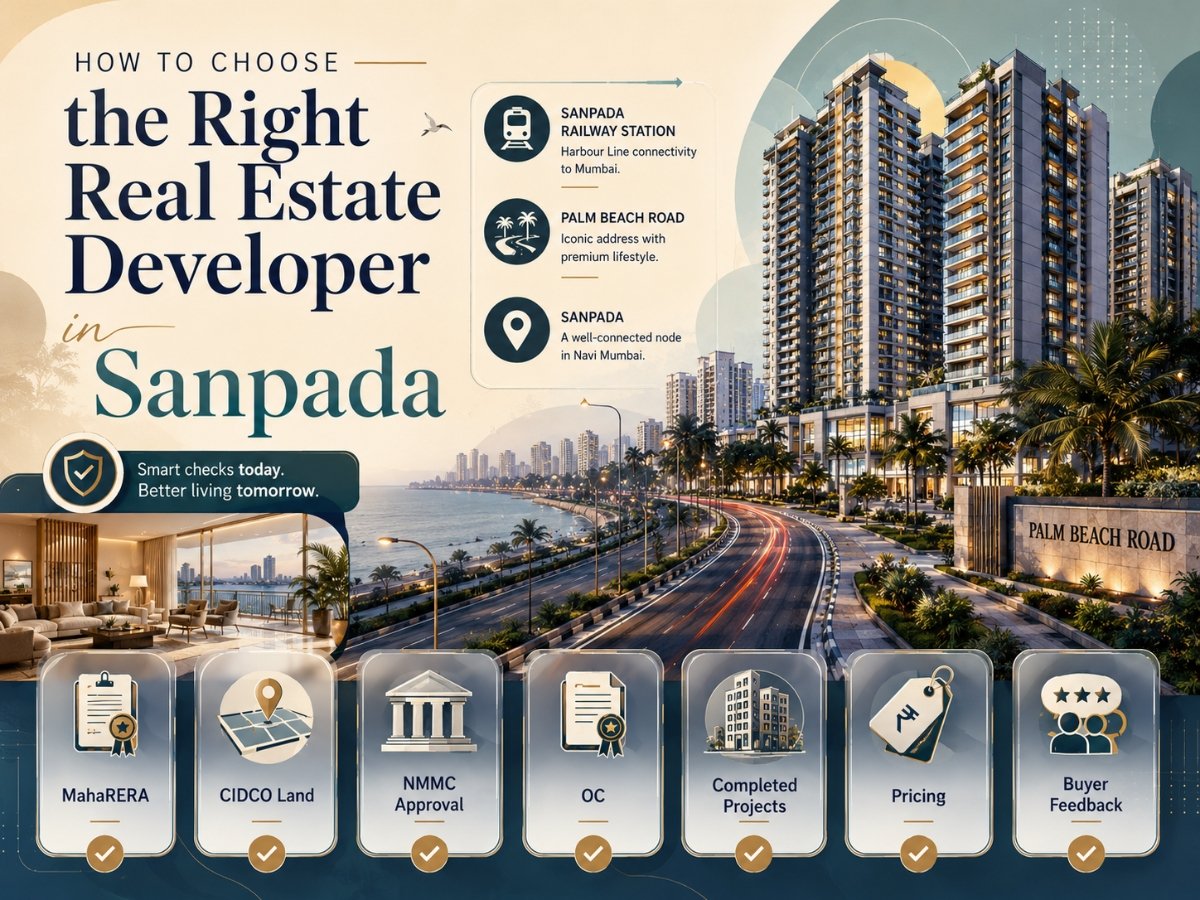
Quick Summary: How to Choose the Right Real Estate Developer in Sanpada
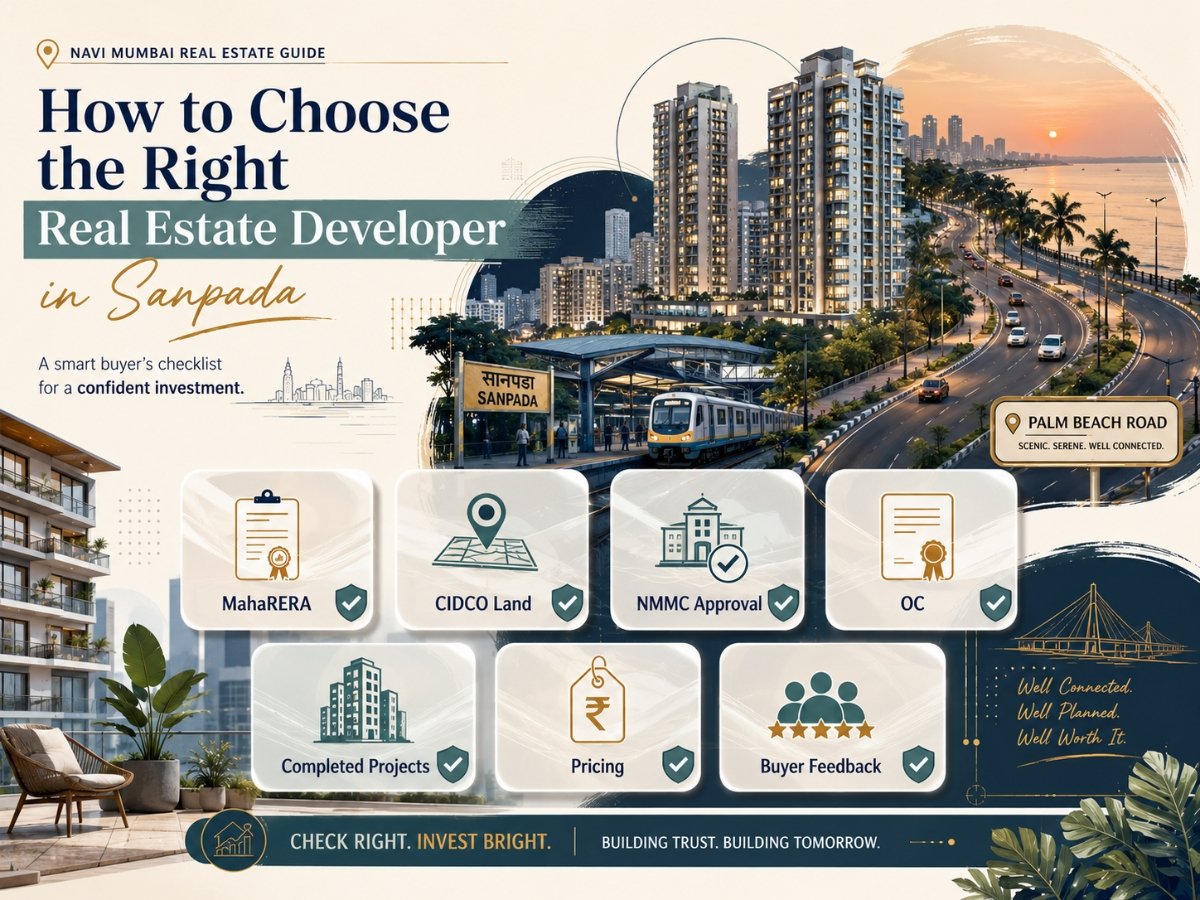
Sanpada is one of Navi Mumbai’s mature and high-value residential nodes. It has strong connectivity through Sanpada railway station, Sion-Panvel Highway, Vashi, Juinagar, Nerul, Palm Beach Road access, and nearby commercial belts. But the same market also has older CIDCO housing stock, redevelopment projects, premium high-rise towers, and legal checks involving both CIDCO and NMMC.
The safest way to choose a real estate developer in Sanpada is to verify legal documents, completed projects, pricing clarity, and buyer feedback before paying token money.
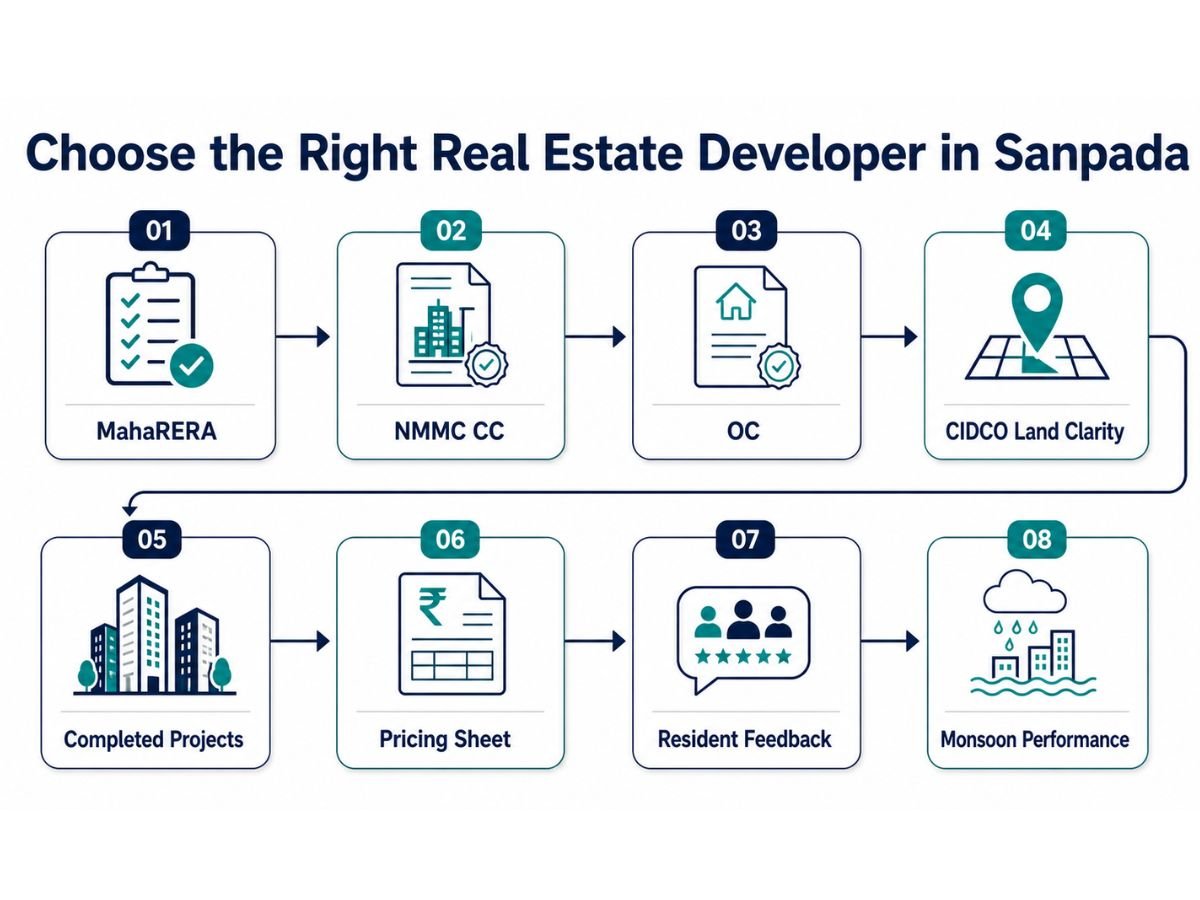
| What to Check | Why It Matters in Sanpada | Buyer Action |
|---|---|---|
| MahaRERA registration | Confirms the project is officially registered and has declared timelines | Verify project status, possession date, carpet area, and litigation details |
| NMMC Commencement Certificate | Shows the project has construction approval up to a specific level | Ask for a copy and verify with authority documents |
| Occupancy Certificate | Confirms the building is legally fit for possession | Do not accept possession without OC in ready or nearing-completion projects |
| CIDCO land clarity | Many Navi Mumbai plots are CIDCO-origin leasehold or transfer-based | Check allotment, transfer, leasehold/freehold, and PAP plot status |
| Completed projects | Shows actual delivery quality, not brochure promises | Visit 3 to 5-year-old completed buildings |
| Pricing sheet | Prevents hidden cost shocks | Demand written all-inclusive cost sheet |
| Resident feedback | Reveals after-sales support and maintenance behaviour | Speak to existing residents and society members |
| Monsoon performance | Sanpada can face waterlogging and seepage issues in some pockets | Visit during or after monsoon if possible |
Why Choosing the Right Real Estate Developer Matters in Sanpada
Choosing the right developer in Sanpada is not only about brand name or tower elevation. It is about whether the builder can legally, financially, and technically complete the project and hand over a usable flat with proper approvals.
Sanpada is a premium Navi Mumbai node where property values are high compared to many growth locations. The research dossier indicates estimated average property rates around ₹21,300 per sq. ft. by 2025, though actual prices vary by sector, building age, road access, view, floor, amenities, and project status. In such a market, even a small legal or construction mistake can become a costly problem.
A buyer may like the location, floor plan, sample flat, or payment scheme. But if the developer has unclear land title, delayed approvals, weak construction quality, no OC history, or hidden charges, the risk shifts to the buyer.
In Sanpada, developer selection matters because:
- Many older societies are moving towards redevelopment.
- Some projects may involve CIDCO-origin leasehold land.
- NMMC approvals like CC and OC are critical.
- PAP or 12.5% scheme plot issues need careful legal checking where applicable.
- High-rise projects need strong construction and waterproofing quality.
- Premium pricing increases financial exposure for buyers.
A reputed developer is not always the right developer if the project has unclear approvals, delayed possession, hidden charges, or weak after-sales support.
Understand the Developer’s Past Track Record
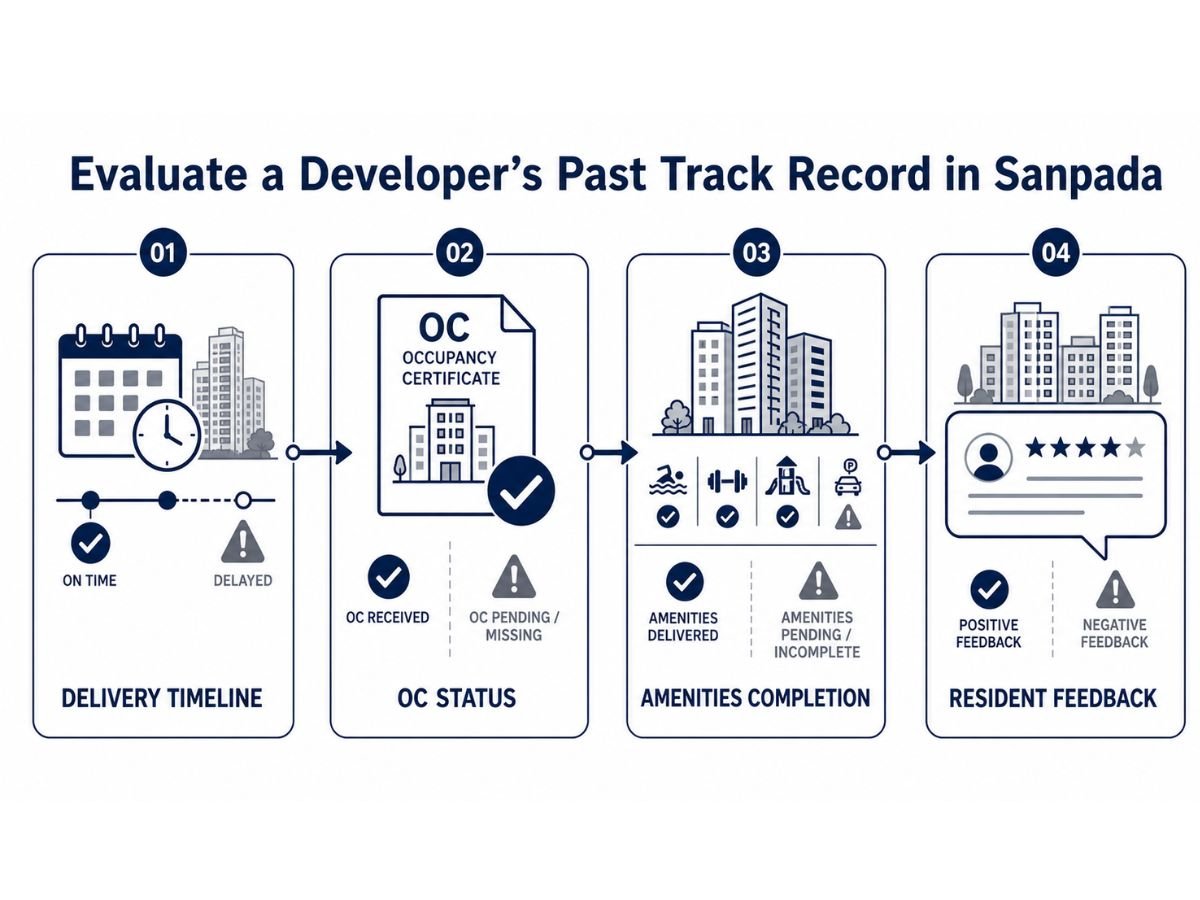
A developer’s completed work is more reliable than a sales brochure. Before trusting a new launch or redevelopment project in Sanpada, buyers should study the builder’s delivery history in Navi Mumbai and nearby nodes such as Vashi, Nerul, Juinagar, Seawoods, and Kharghar.
For a broader comparison of trusted real estate companies across the city, read our detailed guide on Builders and Developers in Navi Mumbai before shortlisting a project.
Check Completed Projects Before Trusting New Launches
Completed projects show how the developer actually performs after collecting money from buyers. A developer may promise premium amenities, branded fittings, fast possession, and high-quality construction. But the real test is visible in already delivered buildings.
Check:
- How many projects the developer has completed.
- Whether possession was given as per promised timeline.
- Whether the project received Occupancy Certificate.
- Whether amenities were delivered as advertised.
- Whether buyers faced legal, maintenance, or leakage issues after possession.
For Sanpada buyers, it is better to check completed projects in similar Navi Mumbai conditions. A builder who has delivered properly in Vashi, Nerul, Sanpada, Juinagar, or Seawoods may understand local land, approvals, and monsoon challenges better than a developer with no proven local record.
Visit Older Buildings Developed by the Same Builder
A 3 to 5-year-old building tells the truth. Fresh paint and sample flats can hide many things, but older buildings reveal construction quality.
During the visit, check:
- Exterior paint condition.
- Basement or podium seepage.
- Terrace leakage.
- Lift maintenance.
- Lobby condition.
- Parking layout.
- Drainage and waterlogging signs.
- Society maintenance handover.
- Cracks, damp patches, or plaster peeling.
In Sanpada, monsoon performance is important because some pockets can face waterlogging, and poor waterproofing becomes visible quickly. If a developer’s older building already looks weak within a few years, treat it as a warning sign.
Speak to Existing Residents and Buyers
Existing residents are usually more useful than online ads. They can tell you whether the developer supported buyers after possession or disappeared after handover.
Ask residents:
- Was possession delayed?
- Was OC received before people moved in?
- Were promised amenities delivered?
- Did the builder hand over maintenance corpus properly?
- Were leakage or snagging complaints resolved?
- Was society formation smooth?
- Were extra charges demanded later?
Do not depend only on the sales team. A 10-minute conversation with actual residents can save years of trouble.
Check MahaRERA Registration and Project Transparency
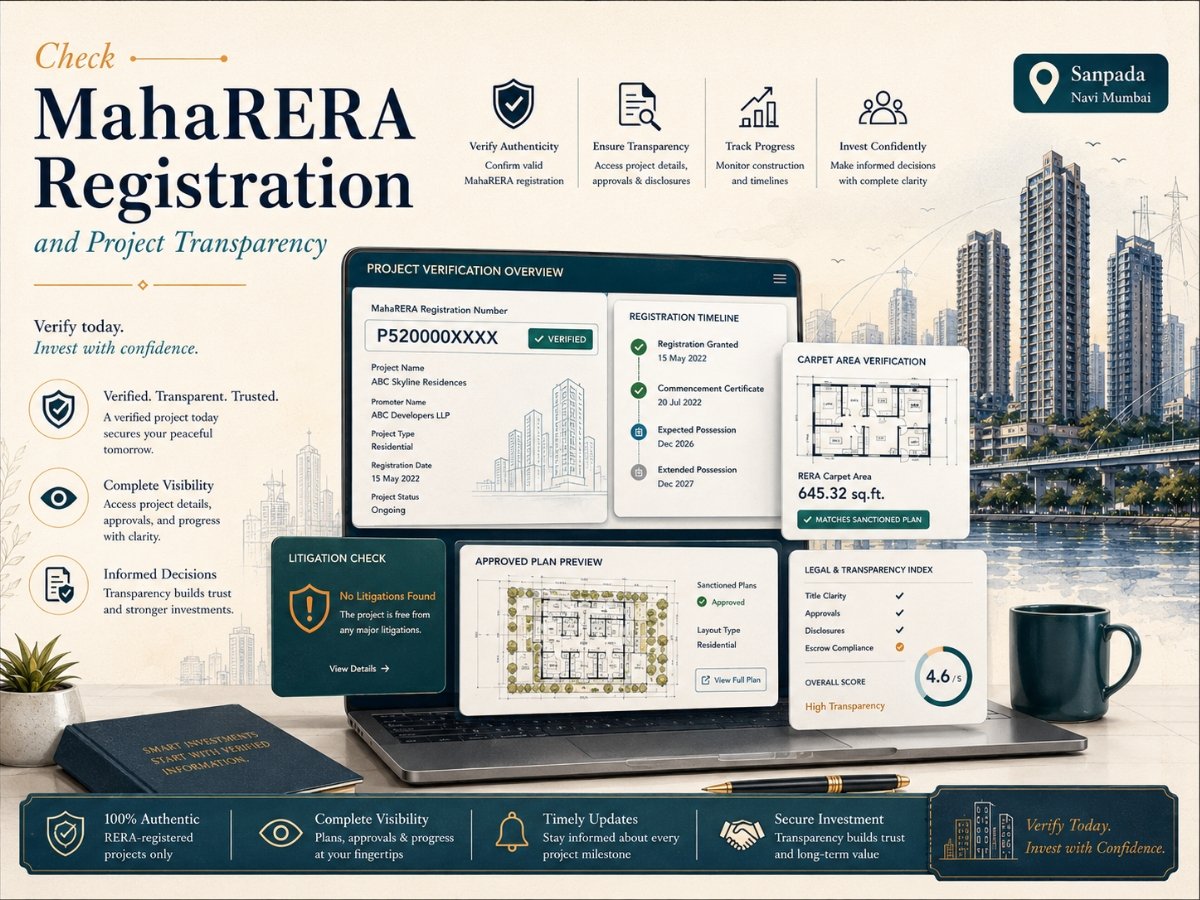
MahaRERA registration is a basic requirement for eligible real estate projects in Maharashtra. It gives buyers access to important project details such as promoter information, declared possession date, carpet area, approvals, updates, and litigation disclosures.
Why MahaRERA Is Important for Sanpada Buyers
MahaRERA is important in Sanpada because many buyers are looking at under-construction projects, redevelopment projects, or premium high-rise inventory. A valid MahaRERA registration gives buyers a formal record of what the developer has declared.
It helps buyers verify:
- Project registration status.
- Promoter name.
- Proposed completion date.
- Uploaded approvals.
- Carpet area.
- Building plans.
- Litigation details, if any.
- Project updates.
MahaRERA also creates accountability because the developer’s promises are not only sales statements; key details are officially declared.
What to Verify on the MahaRERA Website
Before paying token money, buyers should verify the project on the MahaRERA website.
Check:
- Whether the project status is valid.
- Whether the registration number matches the developer’s claim.
- Whether the promoter name is the same as the selling entity.
- Whether the possession date is realistic.
- Whether the carpet area matches the brochure.
- Whether there are litigations.
- Whether approvals and plans are uploaded.
- Whether past project records show delays or lapsed registrations.
Do not accept only a screenshot from the sales team. Search the project yourself or ask your legal advisor to verify it.
Why MahaRERA Alone Is Not Enough
MahaRERA registration is important, but it should not be treated as the only proof of developer quality.
MahaRERA helps with transparency, timelines, and disclosures. But it does not automatically guarantee:
- Excellent construction quality.
- No future leakage.
- Smooth society formation.
- Proper maintenance handover.
- Final Occupancy Certificate.
- Good after-sales support.
- Fair pricing.
A project can be MahaRERA registered and still have weak construction, delayed possession, or civic approval issues. So MahaRERA should be the first check, not the final decision.
Check Legal Documents Before Booking a Flat
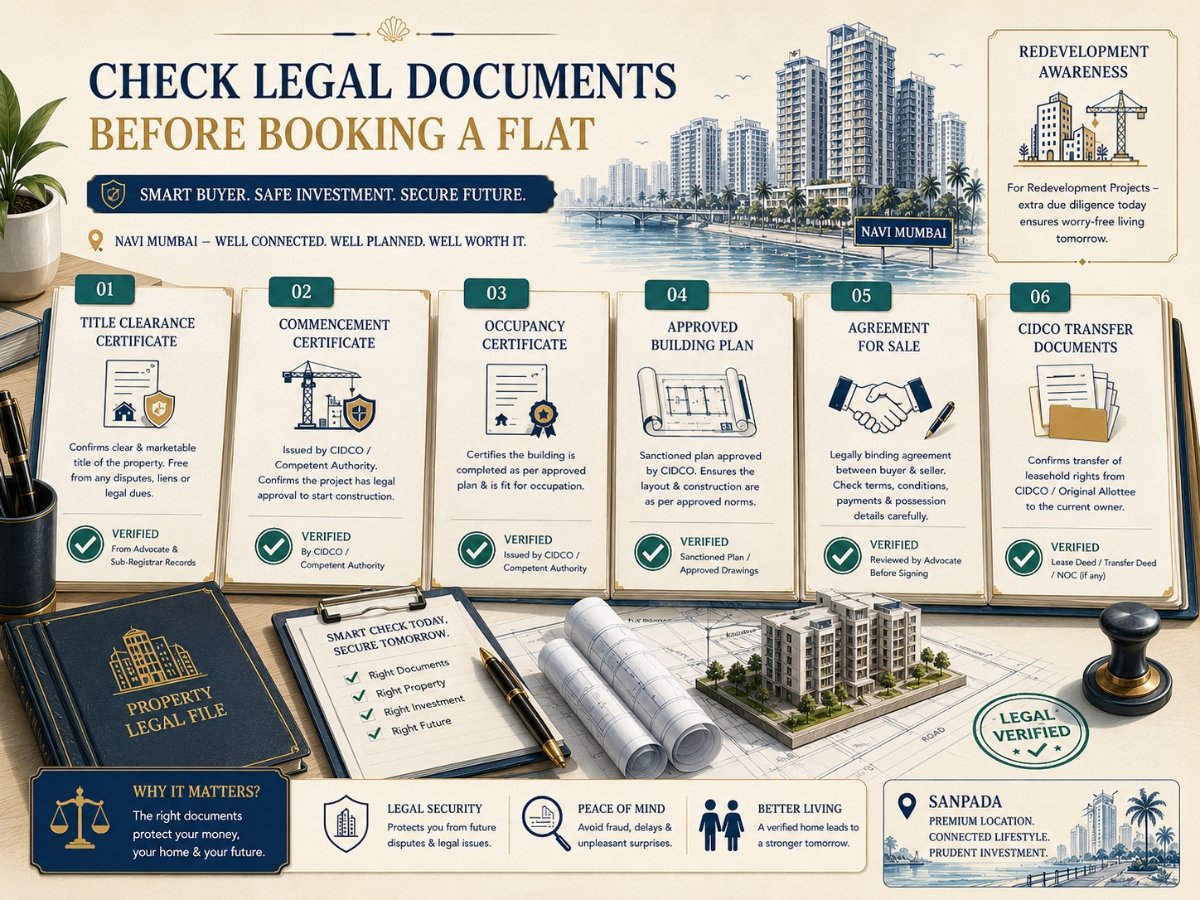
Legal document verification is one of the most important parts of choosing a developer in Sanpada. Buyers should not treat documents as a formality. Documents decide whether the project is legally safe, whether construction is approved, and whether possession will be valid.
| Document | Why It Matters | What Buyer Should Do |
|---|---|---|
| MahaRERA certificate | Confirms project registration and declared details | Verify status, possession date, carpet area, and litigation |
| Title Clearance Certificate | Shows whether the land title is clear | Get it checked by an independent lawyer |
| Commencement Certificate | Confirms construction approval | Check the approved floors and authority details |
| Occupancy Certificate | Confirms legal possession and safety compliance | Avoid taking possession without OC |
| Approved Building Plan | Shows sanctioned layout and building permissions | Compare with brochure and actual construction |
| Agreement for Sale | Defines legal obligations, payment, possession, and penalties | Read carefully before signing |
| CIDCO Transfer Documents | Important for CIDCO-origin land | Verify allotment, transfer, NOC, and lease/freehold status |
| Society and Conveyance Documents | Important in redevelopment and resale | Check society formation and conveyance status |
Title Clearance Certificate
The Title Clearance Certificate helps confirm whether the developer has legal rights over the land. In Sanpada, this is especially important for redevelopment projects, CIDCO-origin plots, and any property where ownership history is complex.
A buyer should not rely only on the developer’s statement. Ask for the title report and get it reviewed by a local property lawyer who understands Navi Mumbai land matters.
Commencement Certificate
The Commencement Certificate, commonly called CC, is the approval that allows the developer to start construction up to a specific level. A project may have CC for only certain floors, not necessarily the full proposed tower.
Buyers should ask:
- Is the CC issued?
- Up to which floor is construction approved?
- Is the approval from the correct authority?
- Does the CC match the building being marketed?
If a developer is selling floors that are not yet approved, buyers must be careful.
Occupancy Certificate
The Occupancy Certificate, or OC, is one of the most important documents for buyers. It confirms that the completed building meets required civic, safety, and structural norms.
Taking possession without OC can create serious problems:
- The building may be treated as incomplete.
- Municipal services may become difficult.
- Resale can become complicated.
- Society formation and conveyance may get delayed.
- Buyers may carry legal risk.
In Navi Mumbai, the dossier mentions a serious concern around buildings occupied without mandatory OC. Sanpada buyers should treat OC verification as non-negotiable, especially for ready or near-ready properties.
Approved Building Plan
The approved building plan shows what the authority has legally sanctioned. Buyers should compare it with the sales brochure, sample flat, amenities plan, parking plan, and actual construction.
Check whether:
- The flat layout matches the approved plan.
- The carpet area matches MahaRERA records.
- The number of floors is approved.
- Common areas and amenities are properly shown.
- Parking is planned clearly.
Agreement for Sale
The Agreement for Sale is not just paperwork. It defines the buyer’s actual legal protection.
Before signing, check:
- Carpet area.
- Total consideration.
- Payment schedule.
- Possession date.
- Delay compensation.
- Parking terms.
- Maintenance charges.
- Amenities commitment.
- Cancellation terms.
- Tax and statutory payment responsibility.
A verbal promise from the sales team has little value if it is not written in the agreement.
CIDCO Transfer and Leasehold Clarity
Sanpada is part of Navi Mumbai’s CIDCO-developed structure. Many plots in Navi Mumbai historically came through CIDCO leasehold allotments. This means buyers must understand whether the land is leasehold, transferred, freehold-converted, or linked to special allotment categories.
Buyers should ask:
- Is the land CIDCO leasehold or freehold?
- Has CIDCO transfer been completed?
- Are there any pending transfer charges?
- Is any NOC required?
- Is the plot linked to PAP or 12.5% scheme allotment?
- Has society conveyance been completed in redevelopment cases?
This is one area where a local lawyer is very useful.
Sanpada-Specific Documents Buyers Should Check Before Booking
Sanpada buyers need to look beyond standard flat documents. Because of CIDCO, NMMC, redevelopment, and older housing structures, certain local documents become very important.
CIDCO Allotment and Transfer Documents
For CIDCO-origin land, buyers should verify the allotment chain and transfer permissions. This is especially relevant in resale, redevelopment, and older society projects.
Ask for:
- CIDCO allotment letter where applicable.
- Transfer NOC.
- Final order, if relevant.
- Lease deed or related land document.
- Any pending dues or transfer charges.
Do not assume that a project is legally clean just because construction has started.
PAP Plot or 12.5% Scheme Plot Clarity
PAP or 12.5% scheme plots in Navi Mumbai can be legally sensitive. These plots were allotted as part of compensation and may involve inheritance claims, multiple heirs, old records, and transfer conditions.
If the project is on such land, buyers should verify:
- Original allotment.
- CIDCO final order.
- Heirship documents.
- Tripartite agreement, if applicable.
- Rights relinquishment by legal heirs.
- Any pending litigation.
If the developer avoids answering questions about PAP plot status, treat it as a red flag.
NMMC, PMC or CIDCO Approval Relevance
For Sanpada, NMMC and CIDCO relevance is more important than PMC. Sanpada falls within the Navi Mumbai civic framework, where NMMC approvals such as CC and OC are crucial, while CIDCO-related land and transfer documents may also matter.
Buyers should understand the difference:
- CIDCO is important for original land, leasehold, allotment, transfer, and certain land records.
- NMMC is important for municipal approvals, building permissions, OC, civic compliance, and property-related civic matters.
This dual-authority confusion is one reason buyers should not handle legal verification casually.
Society Formation and Conveyance Status
For completed buildings and redevelopment projects, society formation and conveyance status matter. If the builder has not properly handed over control to the society, residents may face long-term problems.
Check:
- Is the cooperative housing society formed?
- Has conveyance or deemed conveyance happened?
- Has the maintenance corpus been transferred?
- Are property cards and society records clear?
- Are there pending disputes between society and developer?
This is especially important when buying resale flats in older Sanpada buildings.
Compare Construction Quality and Actual Site Progress
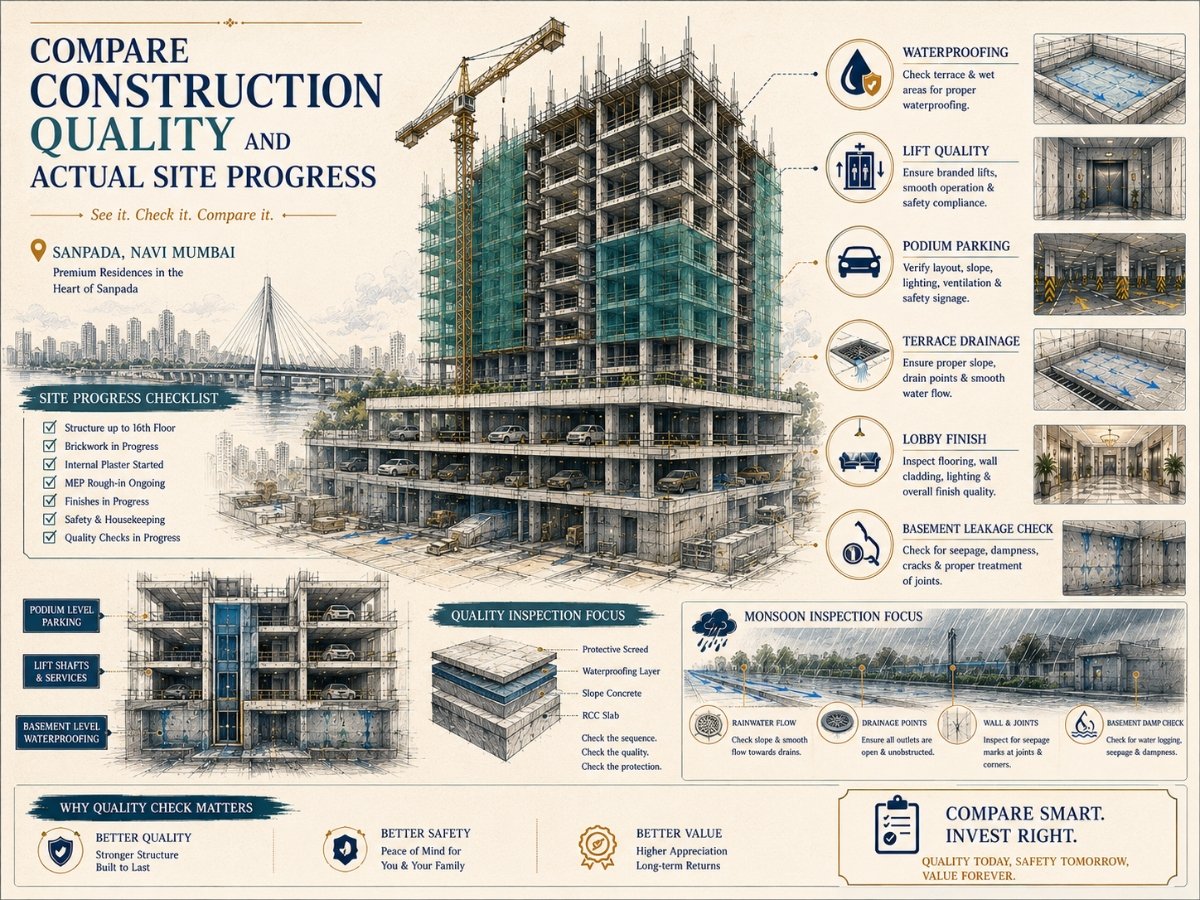
Construction quality should be checked physically. A glossy brochure or 3D render does not show waterproofing, concrete quality, drainage, lift performance, or long-term maintenance.
Visit the Actual Construction Site
When visiting an under-construction project, do not only sit in the sales office. Ask to see the actual site, subject to safety rules.
Observe:
- Site cleanliness.
- Material storage.
- Safety practices.
- Construction pace.
- Labour organization.
- Quality of concrete work.
- Water drainage planning.
- Basement and podium work.
- Whether construction looks active or slow.
A well-managed site usually reflects a more disciplined developer.
Compare Sample Flat and Real Flat Specifications
Sample flats are designed to impress. They may use better lighting, upgraded interiors, movable furniture, and design tricks to make spaces feel larger.
Buyers should compare:
- Actual RERA carpet area.
- Wall thickness.
- Window size.
- Beam position.
- Ceiling height.
- Bathroom and kitchen dimensions.
- Balcony usability.
- Electrical and plumbing points.
Do not buy only because the sample flat looks good. Ask to see the raw flat or actual floor layout where possible.
Check Lift, Lobby, Parking and Common Area Quality
Common areas reveal how seriously the developer treats residents after possession. Poor common area planning can affect daily life more than fancy amenities.
Check:
- Lift brand and number of lifts.
- Lobby ventilation.
- Staircase quality.
- Fire exit access.
- Parking ramp slope.
- Basement ventilation.
- Visitor parking.
- Garbage area.
- Security room.
- Water tank and pump room planning.
In Sanpada, where many projects are high-value, buyers should not compromise on basic building functionality.
Check Monsoon Performance and Leakage Issues
Navi Mumbai’s monsoon can quickly expose weak construction. In Sanpada, buyers should pay special attention to water seepage, basement flooding, terrace waterproofing, and external wall dampness.
During inspection, check:
- Basement damp patches.
- Podium leakage.
- Terrace slope.
- Window seepage.
- Wall fungus.
- Exterior plaster cracks.
- Waterlogging near entry and parking areas.
If the developer’s older projects show serious leakage within a few years, the new project may carry similar risks.
Understand Pricing, Hidden Charges and Payment Terms
Sanpada property is expensive, so pricing clarity is essential. Buyers should not compare only the advertised per sq. ft. rate. The real cost includes taxes, charges, floor rise, parking, corpus, maintenance, registration, and other project-specific costs.
Ask for an All-Inclusive Cost Sheet
Before paying token money, ask the developer for a written all-inclusive cost sheet on letterhead.
It should include:
- Base flat cost.
- Floor-rise charges.
- Preferential Location Charges, if any.
- Parking cost or allotment terms.
- GST, if applicable.
- Stamp duty.
- Registration.
- Legal charges.
- Advance maintenance.
- Corpus fund.
- Clubhouse or amenity charges.
- Electricity, meter, and infrastructure charges.
If the sales team gives only rough numbers verbally, do not proceed.
Check Parking, Floor-Rise, PLC and Maintenance Charges
Many buyers get attracted by a base price and later face a much higher final cost. In Sanpada, premium views, higher floors, Palm Beach Road influence, and tower amenities can increase charges.
Check whether:
- Parking is included or separate.
- Floor-rise is charged from which floor.
- PLC applies for view, corner flat, or preferred facing.
- Maintenance is collected for 12, 18, or 24 months.
- Corpus is refundable, transferable, or society-held.
- Clubhouse charges are compulsory.
A clear developer will explain these in writing.
Understand GST, Stamp Duty and Registration Cost
For under-construction flats, GST may apply as per current rules. Stamp duty and registration also add significantly to the total cost. The research dossier refers to Maharashtra stamp duty around 6% including Metro Cess in MMR, plus registration charges, but buyers should verify current applicable rates before booking.
Use tools like [stamp duty calculator](ADD INTERNAL LINK HERE) and compare final payable amount, not only basic flat cost.
Avoid Verbal Price Commitments
Verbal commitments are one of the biggest traps in real estate transactions.
Do not rely on statements like:
- “Parking will be adjusted later.”
- “Floor rise will be waived.”
- “Maintenance will be less.”
- “OC will come soon.”
- “This is all-inclusive, don’t worry.”
- “Agreement will mention everything later.”
If it is not written, signed, and reflected in the agreement or official cost sheet, treat it as uncertain.
Check Developer Reputation Beyond Online Reviews
Online ratings can be useful, but they are not enough. A developer’s real reputation is found through residents, local brokers, society members, past buyers, and official records.
Read Google Reviews Carefully
Do not only look at star rating. Read the negative reviews first.
Look for repeated complaints about:
- Delayed possession.
- Poor construction quality.
- Leakage.
- Hidden charges.
- No response after payment.
- OC delay.
- Society handover issues.
- Maintenance disputes.
- False sales promises.
One or two negative reviews may not prove anything. But repeated similar complaints indicate a pattern.
Look for Repeated Complaint Patterns
Patterns are more important than isolated reviews. If many buyers complain about the same issue across multiple projects, be cautious.
Common patterns include:
- Delay in possession.
- Poor waterproofing.
- Unclear parking allotment.
- Delay in society formation.
- No maintenance corpus handover.
- Refusal to fix defects.
- Litigation after possession.
A developer’s after-sales behaviour often matters as much as construction quality.
Speak to Local Brokers and Residents
Sanpada has a strong local property network. Experienced brokers, building committee members, and long-term residents often know which builders are reliable and which ones create problems.
Ask local sources:
- Is this developer financially stable?
- Have they delivered projects in Navi Mumbai?
- Do they complete documentation properly?
- Do buyers complain after possession?
- Is resale easy in their completed buildings?
Do not depend on only one broker. Speak to two or three independent sources.
Check Litigation or Delay History Where Possible
Check MahaRERA litigation details, project status, and past completion records. If the developer has multiple delayed or lapsed projects, ask why.
A delay may sometimes happen due to external issues, but repeated delays across projects show weak execution or financial stress.
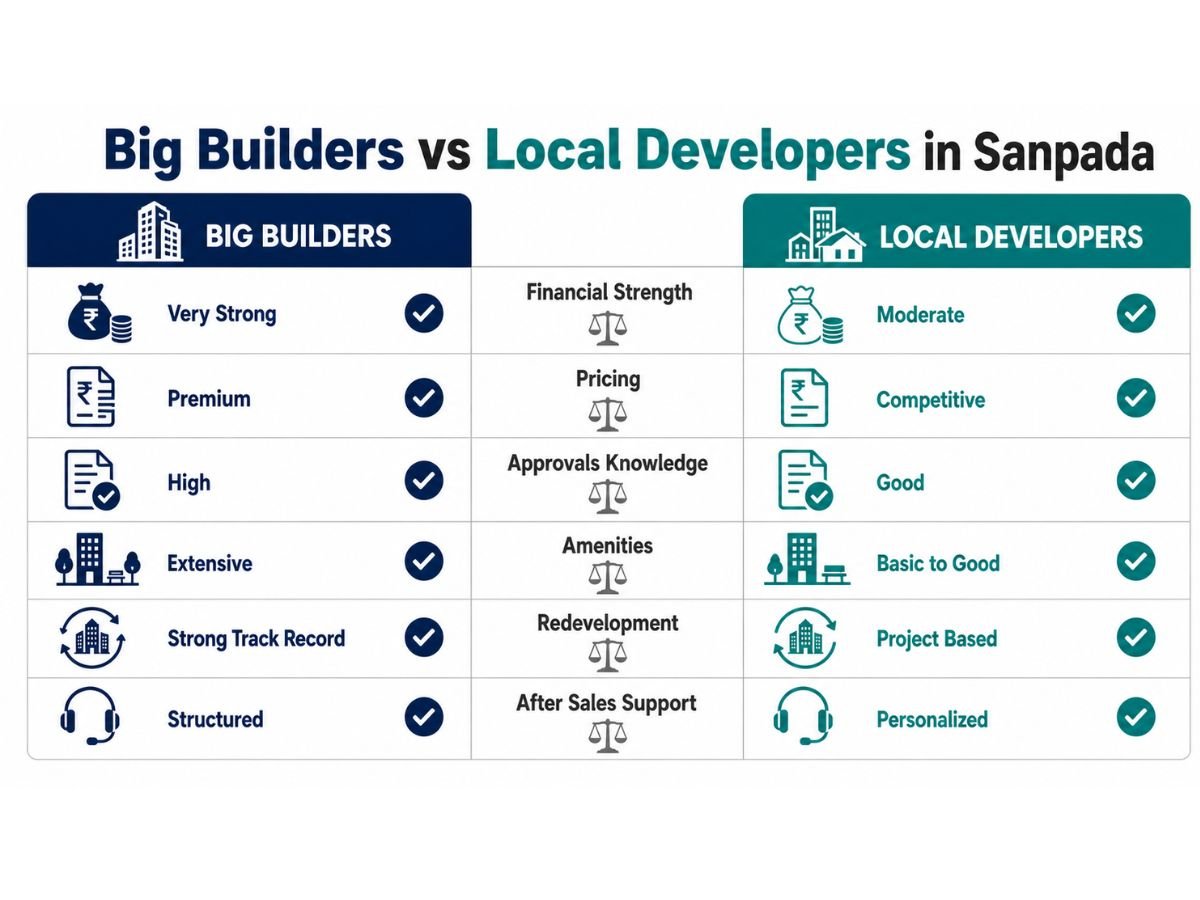
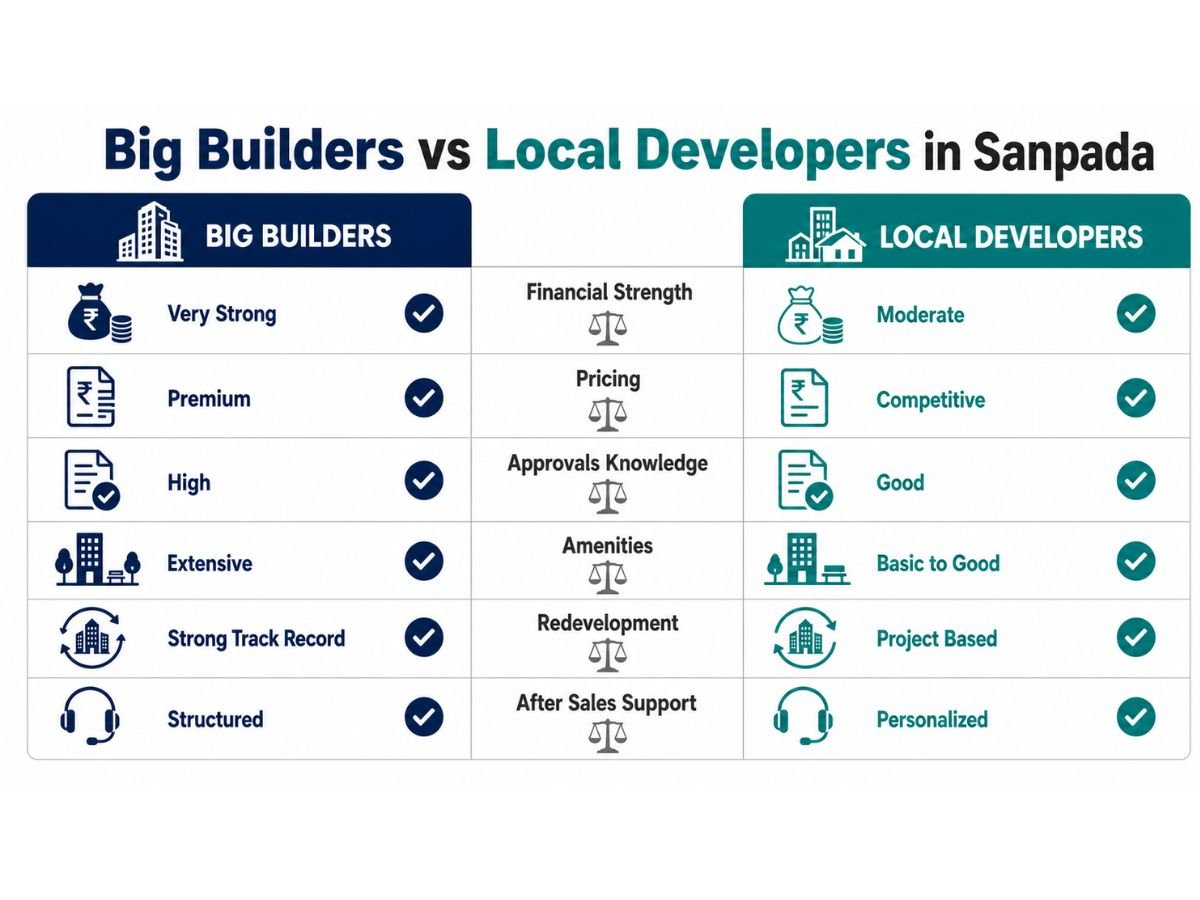
Big Builder vs Local Builder: Which Is Better in Sanpada?
There is no universal answer. A big builder is not always better, and a local developer is not always risky. The right choice depends on project type, legal clarity, delivery record, construction quality, and buyer priorities.
| Factor | Big Builder | Local Sanpada / Navi Mumbai Developer | Buyer Decision |
|---|---|---|---|
| Financial strength | Usually stronger | Varies by developer | Check actual project funding and delivery record |
| Amenities | Often larger and more lifestyle-focused | Usually practical and compact | Choose based on real usage, not brochure glamour |
| Local approval handling | May use consultants and liaison teams | Often understands CIDCO/NMMC process closely | Verify approval history in Navi Mumbai |
| Pricing | Often higher brand premium | May be more negotiable | Compare final all-inclusive cost |
| Redevelopment expertise | May avoid smaller plots | Often active in society redevelopment | Check completed redevelopment projects |
| Flexibility | Usually limited | Sometimes more flexible | Get all changes in writing |
| Risk | Lower in some aspects, but not zero | Depends heavily on track record | Do due diligence equally for both |
Advantages of Big Real Estate Developers
Big developers may offer:
- Better funding capability.
- Professional systems.
- Stronger brand recall.
- Large amenities.
- Better project management structure.
- More standardized documentation.
For buyers seeking large gated communities or premium tower projects, big developers may feel more reassuring. But the specific Sanpada project still needs document and site verification.
Advantages of Local Sanpada Developers
Local developers may have strong understanding of CIDCO, NMMC, redevelopment societies, local land patterns, and micro-market buyer needs. In Sanpada’s inner sectors, many projects are not massive townships but standalone redevelopment towers or compact plots.
A good local developer can be a strong choice if they have:
- Completed projects nearby.
- Clear approvals.
- OC-compliant delivery history.
- Good resident feedback.
- Transparent pricing.
- Strong society redevelopment experience.
When a Smaller Developer Can Be a Better Choice
A smaller developer may be better when the buyer wants:
- A well-located standalone tower.
- Better negotiation.
- Practical layout.
- Faster communication.
- Strong redevelopment execution.
- More local accountability.
But this only applies when the developer has proven delivery and clean documents.
When a Big Brand May Still Be Safer
A big brand may be safer when:
- The project is large and capital-heavy.
- Amenities and long-term maintenance matter.
- The buyer wants institutional systems.
- Financing and banking comfort are priorities.
- The developer has a strong Navi Mumbai-specific record.
Still, buyers should not skip MahaRERA, CC, OC, title, and pricing checks just because the brand is famous.
Check Location Fit Before Choosing the Developer
A good developer in a weak location may not deliver the expected value. Similarly, a good location with a poor developer can create legal and quality problems. Both must work together.
Mature Nodes Like Vashi, Nerul, Seawoods and Juinagar
Sanpada belongs to Navi Mumbai’s mature belt along with Vashi, Nerul, Seawoods, and Juinagar. These nodes have better social infrastructure, railway access, commercial activity, schools, hospitals, and established residential demand.
Because of this maturity, buyers often pay a premium. That premium is justified only when the developer also delivers quality, legal clarity, and timely possession.
For comparison, readers can explore and
Growth Nodes Like Kharghar, Ulwe, Panvel, Pushpak Nagar and Dronagiri
Growth nodes like Kharghar, Ulwe, Panvel, Pushpak Nagar, and Dronagiri may offer lower entry prices compared to mature nodes, but they carry different risks and timelines. Some depend more on future infrastructure, airport influence, road upgrades, metro expansion, and civic development.
Sanpada buyers should understand this difference. In Sanpada, they are paying for existing connectivity and mature location value. So the developer must justify the premium through legal safety, build quality, and execution record.
For broader investment comparison, use [Navi Mumbai property investment guide](ADD INTERNAL LINK HERE).
Why Location Quality and Developer Quality Must Be Checked Together
Location can increase demand, but developer quality protects the buyer’s money. A badly executed project in a good location can still create resale problems, society disputes, leakage expenses, and possession delays.
The best choice is not simply “good location” or “famous builder.” The best choice is the project where location, approvals, construction quality, pricing, and developer track record all support each other.
Questions to Ask a Developer Before Paying Token Money
Token money should never be paid under pressure. Before paying even a small amount, ask direct questions and demand written answers.
Is the Project Registered on MahaRERA?
Ask for the exact MahaRERA number. Verify it yourself on the official MahaRERA website. If the project is eligible for registration but is being marketed without registration, avoid it.
Can You Share the Approved Plan, CC and Legal Documents?
Ask for the approved plan, Commencement Certificate, title report, draft agreement, and relevant CIDCO documents. A transparent developer should not hesitate to share these for legal review.
Is the Quoted Price Fully All-Inclusive?
Ask whether the quoted amount includes GST, stamp duty, registration, parking, floor rise, PLC, corpus, advance maintenance, legal charges, and infrastructure charges.
The answer must be in writing.
What Is the Written Possession Timeline?
Do not rely on verbal possession promises. Check the possession date in the agreement and MahaRERA record.
What Happens If Possession Is Delayed?
Ask what compensation applies if possession is delayed. Check whether the agreement follows the declared timeline and buyer protection framework.
Is the OC Already Received or Expected Later?
For ready-to-move flats, ask for the OC. For under-construction projects, ask the developer’s past OC history and expected OC process.
Do not accept “fit-out possession” as a substitute for legal possession.
Red Flags When Choosing a Real Estate Developer in Sanpada
| Red Flag | What It May Indicate | Buyer Action |
|---|---|---|
| Pressure to pay token immediately | Developer wants to block due diligence | Do not pay before document verification |
| No MahaRERA details | Project may not be legally ready for sale | Verify before engaging further |
| Refusal to share CC or title documents | Legal or approval issue may exist | Stop and consult a lawyer |
| No written cost sheet | Hidden charges may appear later | Demand all-inclusive written cost |
| Past projects without OC | Civic compliance problem | Avoid unless fully clarified |
| Severe leakage in old projects | Weak construction quality | Inspect more completed buildings |
| Too many verbal promises | Poor transparency | Put everything in agreement |
| Unclear CIDCO/PAP plot status | Possible title risk | Get specialized legal verification |
| Lapsed or delayed projects | Weak execution or funding | Study past project record carefully |
Pressure to Pay Token Money Quickly
High-pressure selling is a serious warning sign. A genuine developer should give buyers time to verify documents. If the sales team says “pay today or price will increase,” be cautious.
No Written Clarity on Charges
If parking, floor rise, PLC, corpus, or maintenance charges are not clearly written, the final cost can increase later. This is a common buyer mistake.
Delayed Older Projects
A developer with repeated delays may repeat the same pattern. Check past projects before trusting a new launch.
Poor Maintenance in Completed Buildings
If completed buildings show poor maintenance, unresolved leakages, broken amenities, or unhappy residents, the developer’s after-sales quality may be weak.
Weak Legal Transparency
A developer who avoids sharing legal documents before token money should not be trusted blindly.
Too Many Verbal Promises
Verbal promises are not protection. Only written commitments in official documents matter.
Real Estate Developer Shortlisting Scorecard
Use this scorecard to compare two or three developers before making a final decision.
| Evaluation Factor | What to Check | Good Sign | Red Flag |
|---|---|---|---|
| Past Delivery Record | Completed projects and possession history | On-time delivery with OC | Multiple delays or lapsed records |
| Legal Transparency | CC, title, RERA, approved plans | Shares documents easily | Avoids or delays document sharing |
| Construction Quality | Older project condition | Dry basements, good exterior, maintained lifts | Leakage, cracks, poor common areas |
| Pricing Clarity | Cost sheet and payment terms | Written all-inclusive pricing | Verbal estimates and hidden charges |
| Location Suitability | Project fit with Sanpada market | Good access, civic support, practical layout | Weak access or overpricing |
| After-Sales Support | Resident feedback | Snagging and maintenance handled well | Complaints after possession |
| Buyer Feedback Pattern | Reviews and local sources | Consistent trust signals | Repeated complaints across projects |
A developer scoring well across most factors is safer than a developer who only has a big name or attractive discount.
Common Mistakes Buyers Make While Choosing Builders in Sanpada
Trusting Only Brand Name
Brand name helps, but it does not replace due diligence. Even a known developer should be checked for the specific project, approval status, local execution record, and possession history.
Ignoring Legal Document Verification
Many buyers depend only on bank loan approval. Bank checks are useful, but they may not cover every buyer-specific risk. For Sanpada, independent legal verification is important because CIDCO, NMMC, leasehold, freehold, PAP plot, and redevelopment records can affect ownership clarity.
For related understanding, read
Booking Only Because of Discount or Offer
A discounted project is not always a good deal. If the discount is linked to pre-launch status, unclear approvals, or pressure to pay quickly, the risk may be bigger than the saving.
Not Visiting Completed Projects
Skipping completed project visits is a serious mistake. Older buildings reveal the developer’s true quality, especially during monsoon.
Depending Fully on Broker or Sales Team Promises
Brokers and sales teams can help with information, but final verification should be done independently. For local support, buyers may consult [real estate agents in Sanpada](ADD INTERNAL LINK HERE), but documents should still be checked legally.
How to Verify a Real Estate Developer Before Final Decision
Step 1: Check MahaRERA Details
Search the project on MahaRERA. Verify registration status, possession date, promoter details, carpet area, approvals, and litigation records.
Step 2: Visit the Project Site
Visit the actual construction site. Look at site progress, material quality, organization, and whether work appears active and disciplined.
Step 3: Visit Completed Projects
Inspect older projects by the same developer. Focus on leakage, common areas, lift maintenance, resident feedback, and OC history.
Step 4: Review Legal Documents with an Expert
Hire a local legal professional to check title, CC, approved plan, agreement, CIDCO documents, and any PAP or redevelopment-related papers.
Step 5: Compare Total Cost with Other Projects
Compare final all-inclusive cost, not only per sq. ft. rate. Include taxes, parking, PLC, floor rise, maintenance, corpus, and registration.
Step 6: Take Final Decision Only After Written Clarity
Proceed only when every important promise is written. This includes possession date, price, parking, amenities, carpet area, charges, and possession conditions.
Final Checklist Before Choosing a Real Estate Developer in Sanpada
Use this checklist before booking or signing:
- Verify the project’s valid status on MahaRERA.
- Check the litigation section on MahaRERA.
- Obtain the NMMC Commencement Certificate.
- Verify approved building plans.
- Get the Title Clearance Report reviewed by a lawyer.
- Confirm whether the land is CIDCO leasehold, freehold-converted, or linked to PAP/12.5% scheme.
- Ask for CIDCO transfer documents where applicable.
- Demand a written all-inclusive cost sheet.
- Confirm GST, stamp duty, registration, floor-rise, PLC, parking, corpus, and maintenance charges.
- Visit at least two older projects by the developer.
- Speak to existing residents.
- Check OC history of completed projects.
- Compare sample flat with real carpet area and approved plan.
- Avoid verbal possession or pricing promises.
- Review the Agreement for Sale before signing.
- Pay token money only after document verification.
Conclusion
Choosing the right real estate developer in Sanpada requires patience, document checking, site visits, and local awareness. This is a high-value Navi Mumbai market where location strength is already clear, but the buyer’s real safety depends on the developer’s transparency, approval status, construction quality, pricing clarity, and post-possession behaviour.
The safest developer is not simply the biggest name or the one offering the lowest rate. The safer choice is the developer who has completed projects, valid MahaRERA registration, clear NMMC approvals, proper CIDCO land clarity, written pricing, good resident feedback, and a clean OC record.
Before booking in Sanpada, remember one simple rule: verify first, pay later. A flat is not only a home or investment; it is a legal, financial, and long-term ownership decision.
FAQs
Frequently Asked Questions