Blogs

Everything about Navi Mumbai

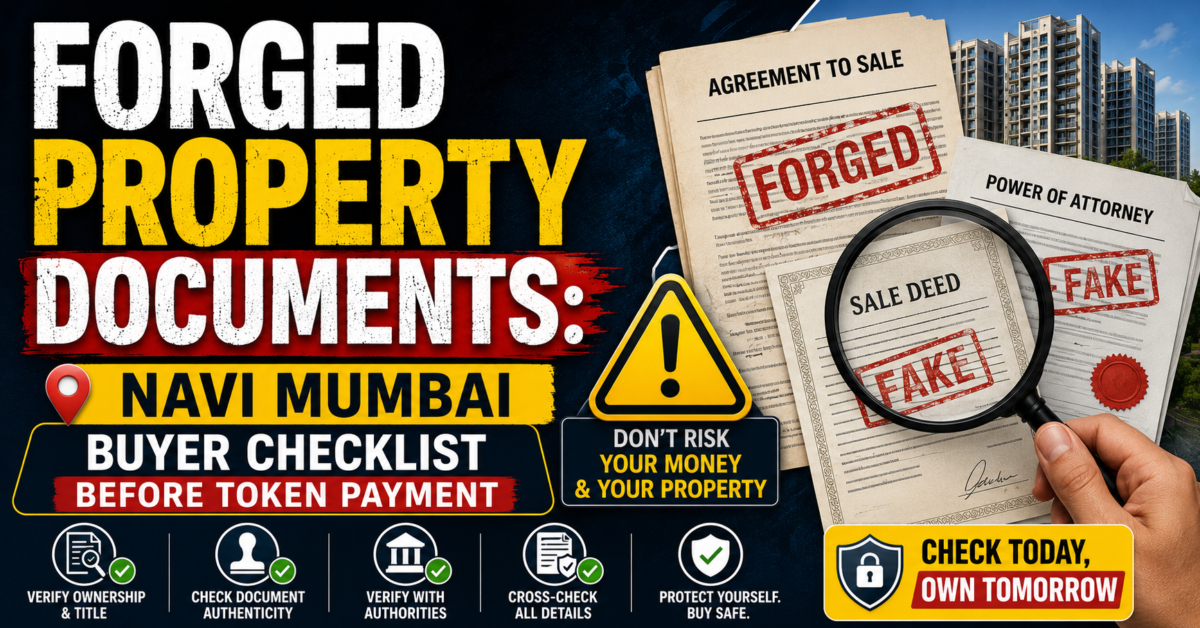
Forged Property Documents in Navi Mumbai: Buyer Checklist Before Token Payment

Forged property documents are fake, altered, backdated or fraudulently used papers shown to mislead a buyer. In Navi Mumbai, common risky documents include sale deeds, 7/12 extracts, property cards, Power of Attorney, CIDCO allotment letters, RERA details, NA permission papers and NAINA approvals. Before paying token money, match every important paper with official records such as IGR Maharashtra, Mahabhumi, MahaRERA, CIDCO/NAINA and the relevant planning or revenue office. Why This Matters for Navi Mumbai Buyers Navi Mumbai property buying is not the same as buying in a fully settled old city area. A buyer may be checking a resale flat in Vashi, Nerul or Kharghar. Another buyer may be looking at a CIDCO plot in Ulwe, Dronagiri or Karanjade. Someone else may be considering land near Panvel, Taloja, Uran, NAINA, gaothan areas or Raigad villages. Each type of property has different documents. The risk is not always that every paper is fake. The bigger risk is that one document may be outdated, altered, incomplete or not matching the official record. For example: The seller name may not match the registered sale deed. The 7/12 extract may be old. The Power of Attorney may not be registered. The CIDCO allotment letter may not be supported by transfer permission. The project may have a RERA number, but its current MahaRERA status may need checking. A plot may be shown as “future NA” without clear planning permission. Coastal or creek-side land may need CRZ/CZMP verification. The goal is simple: do not reject every deal blindly, but do not pay token money only because the broker or seller says “papers are clear.” What Are Forged Property Documents? Forged property documents are documents that are fake, manipulated or used fraudulently. In simple words, a forged document may look real but may not be legally reliable. Forgery can happen in different ways: Type of issue Simple meaning Fake document The paper itself is created fraudulently Altered document A real document is changed later Backdated document A document is made to look older than it is Fake signature Signature is not of the real owner or authority Fake stamp/seal A stamp is copied or misused Misused Power of Attorney Someone claims authority to sell but does not have valid authority Old land record Document may be genuine but not updated Identity fraud Someone pretends to be the owner or legal heir A first-time buyer should understand one thing clearly: a clean-looking document is not enough. It must match official records. Common Documents That Can Be Forged or Misused In Navi Mumbai and nearby property deals, buyers should be extra careful with these documents: Document Where risk can happen What to check Sale deed Fake deed, altered names, wrong property details IGR Maharashtra record and title chain Agreement for sale Fake or unregistered agreement Registration details and seller authority Index II Wrong property details or fake copy IGR eSearch 7/12 extract Old record, wrong mutation, manipulated copy Mahabhumi / Mahabhulekh 8A extract Wrong landholding details Mahabhumi Property card Name mismatch, CTS mismatch Mahabhumi / city survey office Mutation entry / ferfar Incomplete ownership transfer Revenue record and mutation history Power of Attorney Unregistered, expired, misused or owner unavailable IGR and lawyer verification Legal heir papers False heir claim or missing heirs Lawyer and revenue/court documents CIDCO allotment letter Fake allotment or unsupported transfer claim CIDCO office/portal CIDCO transfer permission Seller may not have valid transfer right CIDCO verification RERA registration Wrong or inactive project claim MahaRERA portal CC / OC Fake building permission or occupancy claim Planning authority / CIDCO / NMMC / PMC as applicable NA permission / land conversion papers Outdated or misunderstood claim Revenue office / planning authority NAINA ZCS / approval Wrong zone or no development permission CIDCO / NAINA records CRZ / CZMP claim Land may fall near restricted coastal/mangrove zone MCZMA/CZMP and planning authority First Rule: Do Not Pay Token Only on Photocopies Many buyers make the same mistake. They receive WhatsApp PDFs, photocopies or screenshots. The broker says, “Sir, this is a hot deal. Pay token today. We will verify later.” That is risky. Before paying token, ask for: Original documents for inspection Latest official copies, not old screenshots Seller KYC and ownership proof Registered document details Latest land record, if land/plot is involved RERA details, if it is a registered project CIDCO/NAINA verification, if applicable Written token terms with refund conditions Do not pay token money only because the document looks official. Pay only after basic verification and written conditions. Where to Verify Property Documents in Navi Mumbai Different documents must be verified from different places. What you are checking Where to verify Why it matters Sale deed, agreement, Index II, registered POA IGR Maharashtra eSearch / Sub-Registrar Confirms registered document details 7/12, 8A, property card, mutation, survey records Mahabhumi / Mahabhulekh / Bhumi Abhilekh Confirms revenue and land record details Under-construction project MahaRERA Confirms project, promoter, agent and complaint-related details CIDCO plot or leasehold property CIDCO Confirms allotment, transfer, NOC and lease-related status NAINA plot or project CIDCO / NAINA Confirms zone, development plan, ZCS, CC/OC and TPS status Coastal, creek-side or mangrove-side land MCZMA / CZMP and planning authority Checks possible CRZ or coastal restrictions Gaothan or village property Revenue office, city survey office, local authority and lawyer Checks possession, property card, old records and authority status Inherited property Lawyer, revenue office and court records where applicable Checks legal heirs, release deeds, succession/probate where needed Step-by-Step Verification Process Step 1: Check the Seller’s Identity Start with the person selling the property. Ask: Is the seller the same person named in the registered document? Does the name match Aadhaar, PAN, sale deed, society record and land record? Is the property jointly owned? If one person is signing, do they have authority from all owners? If it is inherited property, are all legal heirs identified? If a Power of Attorney holder is signing, is the POA registered and valid? Do not ignore spelling differences. A small mismatch may be

Read More
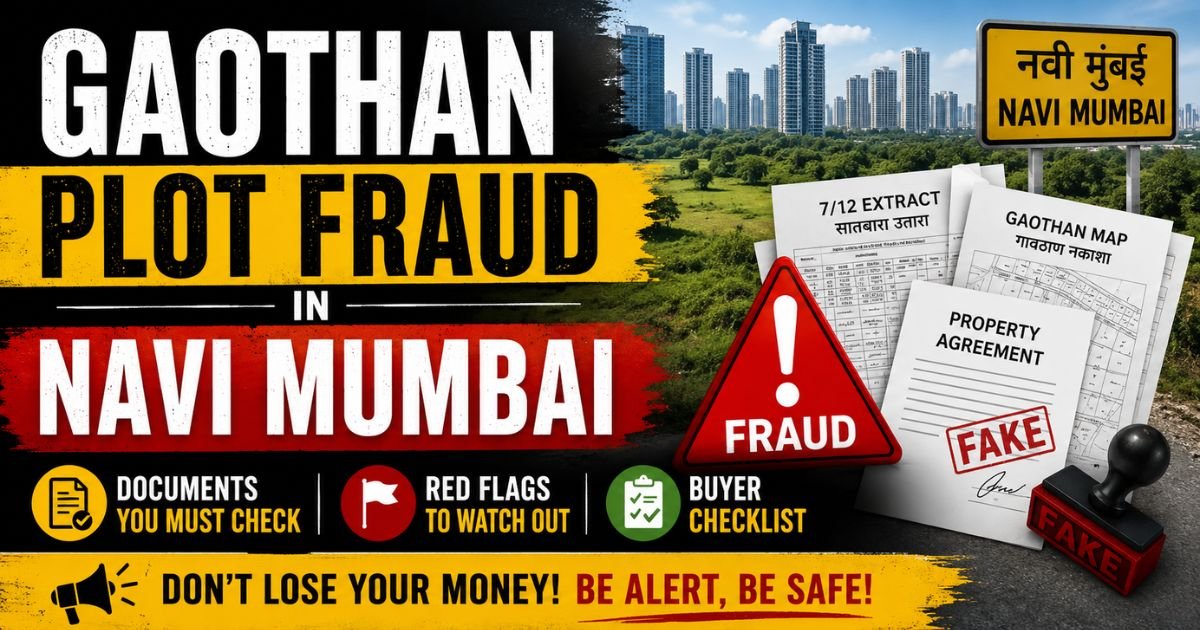
Gaothan Plot Fraud in Navi Mumbai: Documents, Red Flags & Buyer Checklist

Gaothan plot fraud usually happens when a buyer pays token money without checking ownership, 7/12 extract, property card, mutation entries, registered sale history, CIDCO/NAINA approvals, zoning, CRZ restrictions and seller authority. A gaothan plot is not automatically illegal. But in Navi Mumbai, Panvel, Uran, Dronagiri and NAINA areas, buyers should verify every document before making payment. Why This Matters for Navi Mumbai Buyers Gaothan plots are common around old village settlements in Navi Mumbai and nearby growth areas. Buyers often hear terms like “village plot,” “extended gaothan,” “CIDCO 12.5% plot,” “NAINA approved plot,” or “future airport-side land.” The risk is not the word “gaothan.” The risk is buying without proper verification. In areas like Panvel, Ulwe, Kharghar, Taloja, Dronagiri, Uran, Kamothe and villages under NAINA influence, one plot may involve revenue records, old family ownership, CIDCO documents, planning permissions, CRZ restrictions, mutation entries and registered title history. A buyer should not treat a low price or broker confidence as proof of safety. What Is a Gaothan Plot? In simple words, “gaothan” means land within the site of a village, town or city. In Maharashtra land law, village-site limits are determined by the Collector or survey officer. For a buyer, this means one thing: you must confirm whether the plot being shown is actually within the recorded village-site or gaothan boundary. A gaothan plot may be used for residential or village settlement purposes depending on its records, local planning rules and permissions. But this does not mean every gaothan plot is automatically clear for sale, construction or redevelopment. Before buying, check three things separately: Question Why it matters Is the seller the real owner? Prevents title fraud and fake seller issues. Is the plot legally identifiable? Survey number, gut number, CTS number or plot number must match. Is construction or transfer permitted? Ownership and buildability are different checks. Common Types of Gaothan Plot Fraud 1. Fake Ownership Claim A person may claim ownership because the land belonged to the family earlier. But unless the current ownership, mutation and title chain are clear, the buyer may face objections from heirs, co-owners or previous claimants. 2. Missing Heirs or Co-Owners Many old village properties have inherited ownership. If one family member sells without consent from all required owners or legal heirs, the buyer may face dispute later. 3. “NAINA Approved” Without Proof In Panvel and surrounding villages, brokers may say the plot is “NAINA approved.” This phrase is often used loosely. Ask for the exact village name, survey/gut number, zone confirmation, sanctioned layout, commencement certificate or other planning permission where applicable. 4. Fake CIDCO or 12.5% Scheme Claim Some plots are marketed using CIDCO or 12.5% scheme language. Do not accept only photocopies or WhatsApp PDFs. The allotment, transfer chain and authority permissions must match the exact plot. 5. Token Money Pressure A common red flag is: “Sir, pay token today, otherwise the plot will go.” Good property should survive basic verification. If the seller refuses document checking before token, treat it as a serious warning. 6. CRZ, Creek or Mangrove Risk In parts of Uran, Dronagiri, Panvel creek-side areas, Thane creek influence zones and some Raigad belts, coastal regulation and mangrove-related restrictions may affect land use. Clean ownership alone does not mean construction is allowed. Documents to Check Before Buying a Gaothan Plot Use this as your first document checklist. Document What to check Red flag 7/12 extract Owner name, survey/gut number, land area, other rights Seller name does not match 8A extract Landholder account details Different ownership pattern Property card / CTS record Urban or gaothan property record CTS number missing or disputed Mutation entries How ownership changed over time Recent unexplained mutation Registered sale deeds Past transfer history Missing chain of title IGR search Registered documents against property Mortgage, prior sale or mismatch Heirship documents Legal heirs after owner death Not all heirs signing Power of attorney Seller authority Unregistered or unclear POA CIDCO documents If CIDCO/12.5% claim is made Photocopies without authority match NAINA documents Zone, layout, CC/OC where relevant “NAINA approved” only verbal CRZ/zoning check Coastal, green-zone or reservation risk Plot near creek/mangroves but no check How to Verify a Gaothan Plot Step by Step Step 1: Match the Plot Identity Start with basic matching. The plot shown on site must match the documents. Check: Village name Taluka District Survey number / gut number CTS number, if applicable Plot number Area Boundaries Seller name If the location on Google Maps, broker map and land record do not clearly match, stop and verify with a surveyor or revenue expert. Step 2: Check 7/12, 8A and Property Card For village or revenue land, the 7/12 extract is important. It shows land details such as survey/gut number, area, holder name and other rights. But do not rely only on 7/12. For gaothan or urbanised village-site property, a property card or CTS record may also be relevant. Ask a local property lawyer or revenue consultant which record applies to that exact plot. Important point: 7/12 or property card supports verification. It does not by itself guarantee clean ownership or construction permission. Step 3: Study Mutation Entries Mutation means a change recorded in land records. It may happen due to sale, inheritance, partition, gift, court order or correction. Check whether the seller’s name came through a proper mutation. Also check whether the mutation is certified, disputed or pending. A sudden recent mutation before sale is not always fraud, but it needs careful checking. Step 4: Search Registered Documents on IGR Maharashtra Use the property details or document number to search registered documents through the Maharashtra registration system. This helps identify earlier sale deeds, agreements, mortgages, leases or other registered transactions. The main goal is to see whether the seller’s story matches the registered history. Step 5: Check CIDCO Records if CIDCO Is Mentioned If the seller says the plot is CIDCO-allotted, CIDCO-transferable, PAP-related or under the 12.5% scheme, ask for the full authority document chain. This may include: Award copy Letter of

Read More

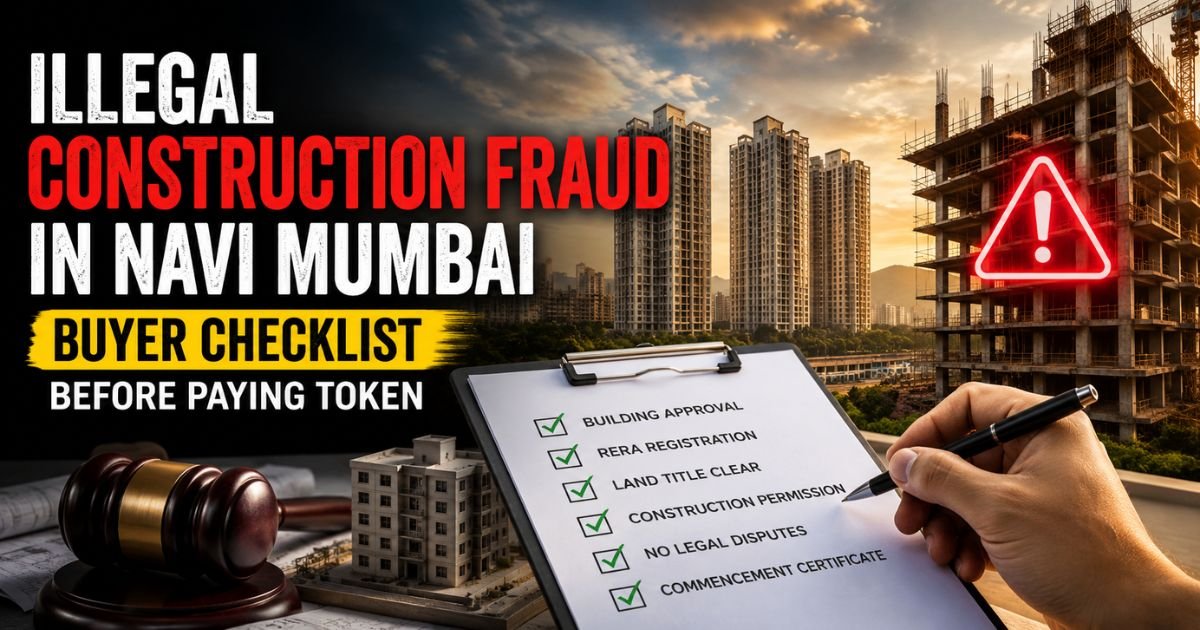
Illegal Construction Fraud in Navi Mumbai: Buyer Checklist Before Paying Token

Illegal construction fraud happens when a buyer is sold a flat, shop, building, plot or layout without proper approvals, valid building permission, commencement certificate, occupancy certificate, RERA registration where required, correct land-use status, or clear authority permission. In Navi Mumbai, Panvel, Ulwe, Kharghar, Taloja, Dronagiri, Uran, CIDCO and NAINA areas, buyers should verify the project before paying token money. A low price is not enough reason to proceed. First check the building approval, RERA status, land record, registered document history, OC/CC status, and any CIDCO, NAINA, municipal, CRZ or revenue-office issue. Why This Matters for Navi Mumbai Buyers Navi Mumbai is growing fast. Areas like Ulwe, Panvel, Kharghar, Taloja, Dronagiri, Uran, Kalamboli and NAINA influence zones have many genuine projects, but they also need careful document checking. The problem is not always obvious. A building may look complete. People may already be staying there. The property may have electricity, water connection, tax receipt or even a registered agreement. Still, that does not automatically mean the construction is fully legal. For a buyer, the practical risk is simple: You may pay token money for a property that later has approval problems, OC issues, land-use restrictions, demolition notice, CRZ concern, CIDCO transfer issue, or missing RERA compliance. That is why the safest habit is this: Do not pay token first and verify later. Verify first, then decide. What Illegal Construction Fraud Means Illegal construction fraud means the seller, builder, broker or landowner hides or misrepresents the legal status of construction. It can happen in many forms: Situation What may be wrong Under-construction building No valid commencement certificate or development permission Ready flat No occupancy certificate or incomplete approval Plot layout No approved layout or development permission Gaothan property Unclear title, unclear construction permission, or disputed regularisation claim CIDCO property Missing transfer permission, leasehold restriction, allotment issue or authority notice NAINA plot No proper NAINA approval, zone confirmation or sanctioned layout Coastal / creek-side land Possible CRZ, mangrove, wetland or buffer-zone issue Cheap resale flat OC missing, society documents incomplete, or title-chain gap The word “fraud” should be used carefully. Every document defect is not fraud. But if the seller knowingly hides a serious approval problem or gives false documents, the buyer must treat it as a major risk. Important Terms Explained Simply Approved Building Plan This is the plan officially approved by the planning authority. A brochure, 3D image, floor plan or WhatsApp PDF is not enough. Ask for the sanctioned plan copy and authority approval reference. Commencement Certificate A commencement certificate, often called CC, allows construction to begin as per approved plans. Without a valid CC, the buyer should not assume the construction is authorised. Occupancy Certificate An occupancy certificate, or OC, indicates that the completed building has permission for occupation after completion checks. For a ready flat, OC is one of the most important documents. MahaRERA Registration MahaRERA is the Maharashtra real estate regulatory authority. For eligible projects, buyers should check the project, promoter, status, uploaded documents, complaints, lapsed status, revoked status and other project details on the MahaRERA portal. Important: MahaRERA registration does not automatically prove clean title or full legal safety. It is one important check, not the only check. 7/12 Extract The 7/12 extract, also called Satbara, is a land record used mainly for agricultural and village land. It shows details like survey number, landholder name, area and crop/land details. For plot or land deals in Panvel, Uran, NAINA, gaothan or village areas, this record can be important. 8A Extract 8A gives account-level landholding details. It helps cross-check ownership and landholding details. Property Card Property card is important in city survey / urban property contexts. It may show details like CTS number, holder name and property area. IGR Maharashtra eSearch IGR eSearch helps buyers check registered property transactions using property details or document number. This can help trace earlier sale deeds, development agreements, power of attorney documents, mortgage-related documents and other registrations. Important: IGR search helps verify registered document history. It does not, by itself, certify that construction is legal. NA / Land Use NA means non-agricultural use. Maharashtra’s 2025 land revenue amendment has changed how certain land-use conversion permissions work where development permission or building-plan approval is granted by the planning authority. But buyers should not assume that every land is automatically safe for construction. For any land or plot purchase, verify the exact current position with the planning authority, revenue office and a property lawyer. Who Issues or Verifies These Approvals? Document / Issue Where to verify MahaRERA project status MahaRERA portal Registered sale deed / document history IGR Maharashtra eSearch 7/12, 8A, property card Mahabhulekh / Mahabhumi CIDCO building permission CIDCO building permission department / COPAS / BPMS NAINA approval NAINA Integrated Approval Management System CC and OC in CIDCO / NAINA areas CIDCO / NAINA approval records CRZ or coastal-zone issue MCZMA / CZMP records Municipal building permission Relevant municipal body such as NMMC or Panvel Municipal Corporation Land-use / NA / mutation issue Revenue office / planning authority Legal title Property lawyer through title search Step-by-Step Verification Process Before Paying Token Step 1: Match the Property Identity Before checking portals, first match basic details. Check whether the same details appear across all documents: Building name Wing Flat or shop number Floor Plot number Survey number Gat number CTS number Village name Sector / node Developer name Landowner name Promoter name RERA project name Agreement name If the broker gives one project name, the builder gives another name, and RERA shows a third name, pause the deal. Small spelling differences may happen, but major mismatches need explanation. Step 2: Check MahaRERA Search the project on MahaRERA. Check: Project registration number Promoter name Project address Project status Completion date Uploaded approvals Litigation details, if available Complaints or orders, if any Whether project is lapsed, revoked, abeyance or deregistered Do not trust only a RERA number printed on a brochure. Search it yourself. Step 3: Ask for Building Approval Documents Ask the builder or

Read More

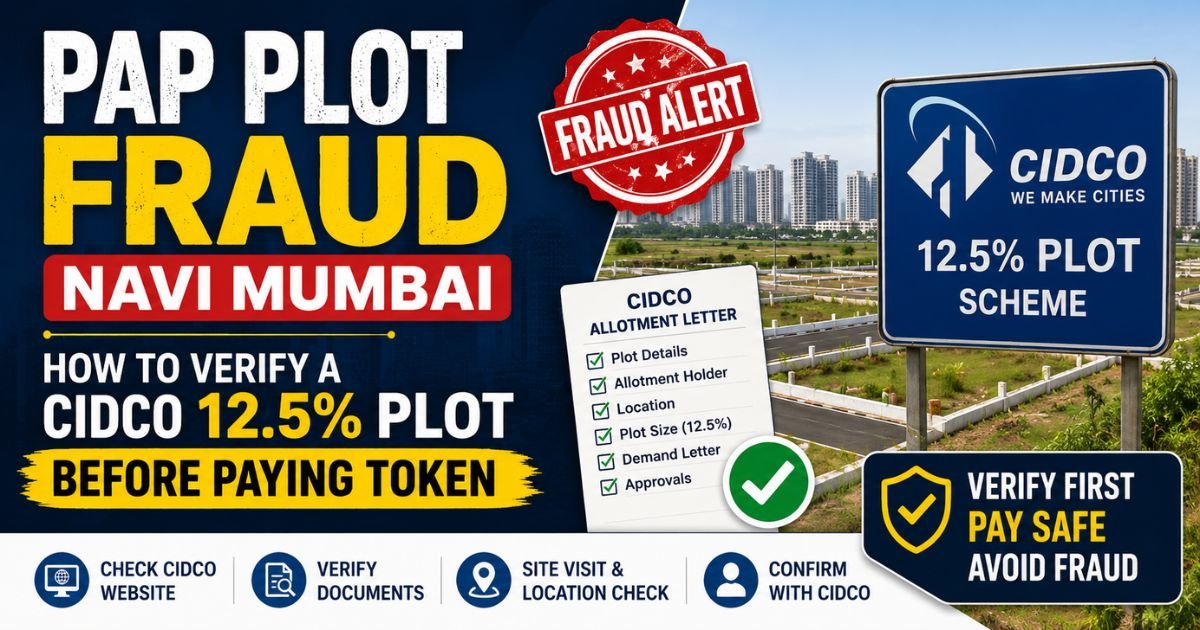
PAP Plot Fraud Navi Mumbai: How to Verify a CIDCO 12.5% Plot Before Paying Token

PAP plot fraud in Navi Mumbai usually happens when a buyer is shown a CIDCO 12.5% / Project Affected Person plot claim without proper verification. Before paying token money, check CIDCO allotment records, transfer permissions, IGR registration history, 7/12 or property card, seller title, NAINA zoning, and legal restrictions. A broker’s verbal promise is not enough. What Is a PAP Plot in Navi Mumbai? PAP means Project Affected Person. In Navi Mumbai real estate, this term is commonly connected with people whose land was acquired for development and who may have received land-related compensation, rehabilitation benefits, or allotment rights under an authority scheme. The most commonly discussed category is the CIDCO 12.5% scheme, where eligible project-affected persons may receive developed land against acquired land, subject to official rules, records, eligibility, and allotment process. For a buyer, the risk is simple: A property may be marketed as a “PAP plot” or “CIDCO 12.5% plot,” but the seller may not have a clean, transferable, verified right to sell it. That is where fraud risk starts. Why PAP Plot Fraud Matters for Navi Mumbai Buyers PAP plot deals are common around Navi Mumbai, Panvel, Ulwe, Dronagiri, Uran, Kharghar, Taloja, and nearby CIDCO / NAINA influence areas. But a buyer should not treat these lines as proof. A PAP plot can involve old acquisition files, allotment records, heirs, power of attorney, transfer permissions, lease conditions, NAINA planning rules, and land-record mismatches. If even one major document is wrong, the buyer can face delay, dispute, loss of token money, or a long legal fight. Do not buy the story. Verify the file. How PAP Plot Fraud Usually Happens PAP plot fraud does not always look dramatic. Often, it starts with small shortcuts. 1. Fake or Misused CIDCO Allotment Letter The buyer is shown a photocopy, scan, WhatsApp PDF, or old allotment letter. The document may look official, but it may not match the actual plot, allottee, village, file number, or transfer status. A CIDCO document should be verified with CIDCO records, not accepted only because it has a stamp or logo. 2. Token Money Before Verification A broker or seller may say: “Many buyers are waiting. Pay token today.” This is one of the biggest traps. Once token money is paid without clear terms, buyers may struggle to recover it if the file has problems. 3. Transfer Permission Is Not Clear In CIDCO-related plots, transferability is important. A person may have an allotment-related document, but that does not automatically mean they can legally sell the plot to you immediately. Check whether CIDCO transfer permission, NOC, lease conditions, and registered documents are in order. 4. Power of Attorney Misuse Some deals are handled by a third party through power of attorney. This needs careful checking. A POA may be old, limited, cancelled, disputed, or not enough for the transaction. If the actual owner or legal heirs are not properly involved, the buyer can get stuck. 5. Legal-Heir Disputes Many PAP / old land files involve family ownership. If the original allottee has passed away, legal-heir documents, succession documents, consent from heirs, and title chain must be checked. One missing heir can create a future dispute. 6. Plot Shown on Site Does Not Match Records A buyer may be taken to one physical plot, but the documents may refer to another survey number, village, node, sector, or plot number. Always match the site location with official records, maps, 7/12 extract, property card, CIDCO documents, and registered papers. 7. NAINA / Gaothan / Agricultural Land Confusion Some land is marketed as a “CIDCO PAP plot” when it may actually be gaothan land, NAINA area land, agricultural land, or a different category of land. Each type needs a different verification route. Do not assume every plot near Navi Mumbai is a clean CIDCO plot. PAP Plot Verification: Quick Risk Table Claim Made by Seller / Broker What Buyer Must Verify Main Risk “This is a CIDCO 12.5% plot” CIDCO allotment and file status Fake or unrelated allotment claim “Transfer will happen after token” CIDCO transfer permission / NOC Transfer may not be allowed or ready “Original allottee is ready” Seller identity, heirs, title chain Ownership dispute “POA holder will sign” Validity and scope of POA Invalid or disputed authority “Plot is clear for construction” NAINA / CIDCO zoning, CC, OC if applicable Buildability issue “Documents are complete” IGR, 7/12, property card, mutation, title search Hidden title defect “Cheap deal, decide fast” Full document verification before payment Token money loss Documents to Check Before Buying a PAP Plot Do not rely on one document. A genuine transaction should have a clear chain. Document Why It Matters CIDCO allotment letter Shows the basic allotment claim CIDCO possession letter / receipt Shows whether possession was handed over Lease deed or agreement Shows legal terms and restrictions Transfer permission / NOC Important for resale or transfer Original allottee documents Confirms identity and eligibility chain Legal-heir documents Needed if allottee has passed away Power of attorney, if any Shows whether third party can act Registered agreement / sale deed Shows transaction history Index II Gives registration summary from IGR records 7/12 extract Shows land ownership and survey details in revenue records Property card Important for urban land/property records Mutation entry / ferfar Shows ownership changes in land records Search report / title report Lawyer’s written title-chain review NAINA Zone Confirmation Statement Helps check planning zone in NAINA areas Commencement Certificate / Occupancy Certificate Required where construction/project approval is relevant MahaRERA details Relevant if the sale is part of a RERA-registered project CRZ / environmental clearance status Relevant near coastal, creek, mangrove, or sensitive zones Step-by-Step PAP Plot Verification Process Step 1: Verify the CIDCO 12.5% / PAP Claim Start with the main claim. Ask: Is this actually a CIDCO 12.5% / PAP plot? What is the CIDCO file number? Who is the original allottee? Is the plot allotted or only proposed / intended? Is possession given? Is transfer allowed? Are there pending dues,

Read More

Best Navi Mumbai Localities for Airport Access: Buyer Guide

Best Navi Mumbai Localities for Airport Access: Honest Buyer Guide Ulwe and Pushpak Nagar are the strongest Navi Mumbai localities for airport access, but they are not best for every buyer. Panvel is better for people who want a broader transport hub and more housing options. CBD Belapur and Kharghar are better for families who want stronger liveability with reasonable airport reach. Dronagiri, Uran-side areas and Taloja need more caution. Disclaimer: This is an educational guide. Verify the latest position with the relevant authority or a property lawyer before making a transaction. Quick Answer: Best Localities for Airport Access If airport access is your main priority, start with Ulwe, Pushpak Nagar and Panvel. If daily family life is equally important, compare Kharghar and CBD Belapur too. Rank Locality Best for Main caution 1 Ulwe Closest practical residential airport-side choice Some pockets still developing 2 Pushpak Nagar Planned airport-influence growth Early-stage social infrastructure 3 Panvel Wider hub with rail, highway and airport access Panvel is broad; micro-location matters 4 CBD Belapur Better liveability with decent airport reach Not closest, but more mature 5 Kharghar Family life plus airport reach More lifestyle-focused than airport-focused 6 Dronagiri / Uran-side Long-term port and airport growth Slower daily liveability 7 Taloja / Kalamboli Budget access to airport-side growth Commute and surroundings need checking For the wider area comparison, start with Navi Mumbai locality comparison guide. How We Ranked Airport Access Airport access is not only about distance on a brochure. A project can say “near airport,” but actual travel depends on road approach, traffic, airport entry route, public transport, cab access, and daily infrastructure. Factor Weight Why it matters Practical airport travel 30% Actual route matters more than marketing distance Daily liveability 25% Schools, hospitals, shops, water, transport Connectivity beyond airport 20% Rail, metro, highway, Atal Setu, Mumbai/Pune links Project/document safety 10% RERA, title, CIDCO/NAINA status Future growth 10% Airport, MTHL, NAINA, JNPT influence Affordability 5% Entry price and budget comfort The best airport-side locality is the one that matches your life. A frequent flyer may prefer Ulwe. A family may prefer Kharghar. A long-term investor may look at Pushpak Nagar or Panvel. A budget buyer may consider Taloja or Kalamboli only after commute checks. Ulwe: Strongest Airport-Side Residential Choice Ulwe is one of the strongest residential choices for airport access. It is close to the Navi Mumbai International Airport influence zone and has become a major focus area after airport and Atal Setu-related infrastructure momentum. Why Ulwe Ranks High Ulwe works well because it offers: Airport-side location advantage Newer residential supply Better future-growth visibility than many older nodes Access to Atal Setu-side connectivity story Stronger buyer interest from airport-focused end users Best For Ulwe is suitable for: Frequent flyers Airport employees Medium to long-term investors Buyers wanting newer buildings People comfortable with developing social infrastructure Caution Do not buy only because the project says “near airport.” Check: Actual route to airport Road condition Public transport Daily markets Water supply Society formation Project delivery MahaRERA registration Ulwe is strong for airport access, but the exact sector and project matter. Pushpak Nagar: Closest Growth Story, But Still Early Pushpak Nagar is often marketed as an airport-influence planned area. It can be attractive for buyers who want early entry into an airport-linked growth location. But it is not the same as a fully mature lifestyle node today. Best For Pushpak Nagar is better for: Long-term investors Airport-side growth buyers Buyers who can wait for infrastructure maturity People looking at planned development around NMIA Caution Check carefully before paying token. You should verify: CIDCO or authority status MahaRERA project registration Project phase Possession timeline Road access Daily convenience Water and basic services Actual distance from airport entry routes Do not buy only on “airport appreciation” promises. Panvel: Broader Hub, Not One Locality Panvel is important because it is a major transport and housing hub. It has railway connectivity, highway access, airport influence and a wide range of housing options. But Panvel is not one single market. Panvel Micro-Markets to Compare Separate these areas before deciding: Old Panvel New Panvel Karanjade Palaspe Pushpak-side areas NAINA-side pockets Outer Panvel villages A project may say “Panvel airport access,” but actual travel time depends on the exact location. Best For Panvel works for: Buyers wanting larger homes Long-term investors Railway/highway users Families who do not need daily Vashi/Mumbai travel Airport-influence buyers with broader budget options Caution Do not judge all Panvel projects equally. Check the exact road, project phase, MahaRERA status, water, local market access, and whether the project is actually convenient for airport travel. CBD Belapur: Better Liveability With Decent Airport Reach CBD Belapur is not the closest airport-side locality. But it is better for buyers who want mature liveability and still want reasonable airport access. Why It Works CBD Belapur offers: Business and government office access Better social infrastructure Mature road connectivity Access to Nerul, Seawoods, Kharghar and Panvel side Better daily convenience than many early-stage airport-side pockets Best For CBD Belapur is suitable for: Professionals Families Business owners Buyers who want airport access without compromising daily life Caution Prices and building quality vary by sector. Check the exact building, road access, parking, OC, society records and maintenance before buying. Kharghar: Family Lifestyle Plus Airport Access Kharghar is not the closest airport locality. But it is one of the better choices if you want family life plus reasonable airport reach. Why It Works Kharghar has: Schools and colleges Open spaces Planned sectors Metro relevance Better social infrastructure than many airport-side growth nodes Good family housing supply Best For Kharghar is suitable for: Families Mid-premium buyers Buyers who value schools and lifestyle People who want a safer liveability balance than early-stage growth areas Caution Outer Kharghar needs commute checks. Project quality varies. Check MahaRERA, possession status, builder track record, approach road and building maintenance. Dronagiri and Uran-Side Areas: Long-Term Airport/Port Play Dronagiri and Uran-side areas may benefit from port, airport and Atal Setu-side growth over time. But they are more

Read More

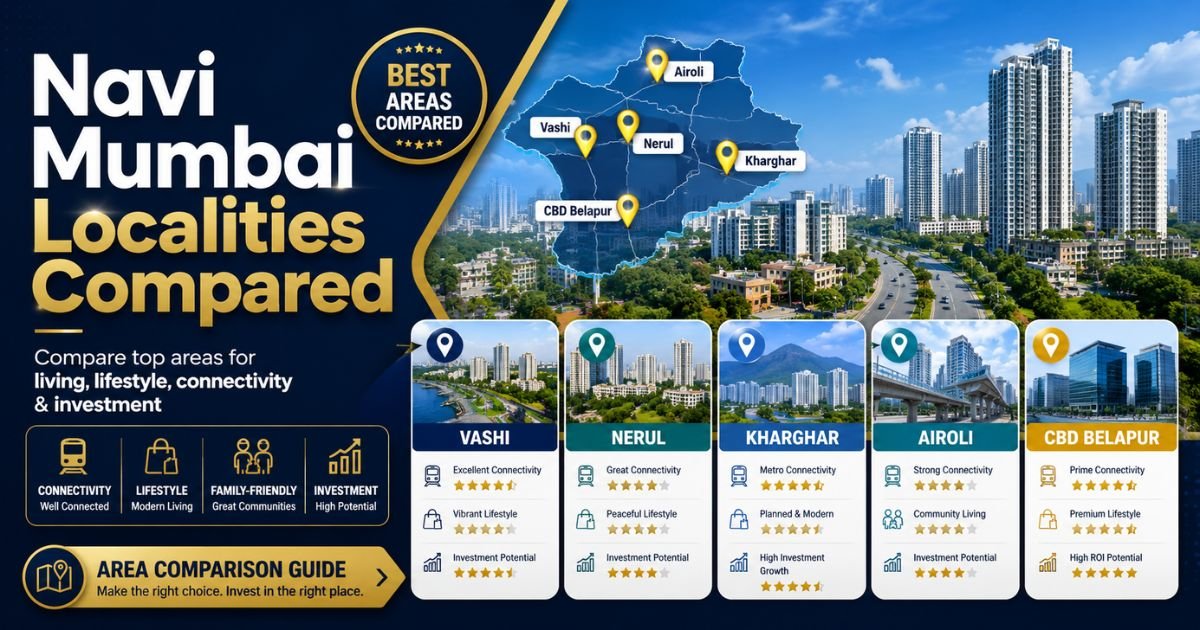
Navi Mumbai localities comparison guide: Best Areas by Lifestyle & Budget

Navi Mumbai localities should be compared by buyer need, not only by price. For family living, Kharghar, Nerul and Seawoods are strong. For mature convenience, Vashi and CBD Belapur work well. For IT professionals, Airoli and Ghansoli are practical. For airport-linked growth, Ulwe, Pushpak Nagar and Panvel matter. For budget buyers, Taloja, Kalamboli and outer Panvel need careful liveability checks. Quick Comparison: Which Navi Mumbai Locality Fits You? Start with your lifestyle. Do not compare Vashi and Taloja only by rate per sq ft. Do not compare Kharghar and Ulwe only by future appreciation. Do not treat Panvel as one single market. Use this table first. Buyer need Better-fit localities Why Family living Kharghar, Nerul, Seawoods Schools, social infrastructure, balanced lifestyle Premium convenience Vashi, Palm Beach Road, CBD Belapur Mature infrastructure and commercial access IT/work commute Airoli, Ghansoli, Kopar Khairane Office-belt access Mumbai connectivity Vashi, Nerul, Seawoods, CBD Belapur Rail and road maturity Airport access Ulwe, Pushpak Nagar, Panvel Navi Mumbai International Airport influence Budget buying Taloja, Kalamboli, Kamothe, outer Panvel Lower entry cost Long-term investment Ulwe, Panvel, Pushpak Nagar, Dronagiri, selective NAINA pockets Growth potential with higher patience For the broader parent guide, use Navi Mumbai locality comparison guide. How We Compared Navi Mumbai Localities A good locality is not just the one with the most hype. It should match your daily life. Factor Why it matters Daily liveability Schools, markets, hospitals, parks, noise, safety Connectivity Railway, metro, road, Mumbai access, office commute Social infrastructure Malls, restaurants, healthcare, education Housing supply Ready flats, resale flats, under-construction projects, premium and budget options Future growth Airport, Atal Setu, metro, NAINA, port-side influence Affordability Entry price, rent, maintenance and value Buyer risk Project delivery, title, RERA, land-use, authority approvals A developed node may cost more but offer better daily comfort. An upcoming node may offer growth potential but needs more patience and document verification. Developed vs Upcoming Navi Mumbai Localities Category Localities Best for Main caution Developed nodes Vashi, Nerul, Seawoods, CBD Belapur, Airoli Living now, resale demand, convenience Higher prices, older buildings Balanced growth nodes Kharghar, Sanpada, Ghansoli, Kamothe Families, professionals, mid-budget buyers Sector and project quality vary Airport-growth nodes Ulwe, Pushpak Nagar, Panvel, Dronagiri Airport access, long-term growth Social infrastructure still developing in pockets Budget-growth nodes Taloja, Kalamboli, outer Panvel Affordability Commute and liveability need checking Land/NAINA-side pockets Select Panvel, Uran, Raigad, NAINA villages Long-term investors and plot buyers Title, zoning, NA, CRZ and authority checks Established nodes are easier for end-users. Upcoming nodes need more research. Vashi vs Nerul vs Seawoods Vashi Vashi is best for mature convenience. It has offices, malls, restaurants, hospitals, schools, railway access and strong commercial activity. For people who want everything nearby, Vashi is still one of the strongest Navi Mumbai localities. Best for: Professionals Business owners Premium convenience buyers Mumbai commuters Rental demand seekers Main caution: some buildings are old. Check OC, society records, redevelopment discussions, parking and maintenance before buying resale flats. Nerul Nerul is practical, central and family-friendly. It gives access to Vashi, Seawoods, CBD Belapur and Palm Beach Road. It works well for buyers who want mature infrastructure without paying the highest premium. Best for: Families Central Navi Mumbai living Mumbai connectivity Buyers who prefer established societies Main caution: building age and society maintenance vary by sector. Seawoods Seawoods is a premium family and lifestyle locality. The station, mall ecosystem, NRI Complex side and access to Nerul, Belapur and Palm Beach Road make it attractive for end-users. Best for: Premium families Lifestyle buyers Station-access buyers Strong resale/rental demand seekers Main caution: pricing is premium. Check building age, OC, society documents and maintenance. Kharghar vs CBD Belapur Kharghar Kharghar is one of the best balanced localities in Navi Mumbai. It has planned sectors, schools, colleges, open spaces, Central Park-side lifestyle, metro relevance and strong housing supply. Best for: Families Mid-premium buyers People who want open spaces Buyers who want lifestyle without Vashi-level pricing Main caution: outer sectors need commute checks. Project quality also varies, so check MahaRERA, possession status and builder track record. CBD Belapur CBD Belapur is more business-district and premium-planned in character. It has greenery, office access, good road connectivity and quieter residential pockets compared to Vashi. Best for: Professionals Premium buyers Buyers who want greenery People needing access to Belapur, Nerul, Seawoods, Kharghar and Panvel Main caution: sector-level variation is high. Compare exact building, road access and surroundings. Airoli vs Ghansoli vs Kopar Khairane Airoli Airoli is strong for IT professionals and Thane/Mulund-side commuters. It works well for people working in Airoli, Rabale, Mahape, Ghansoli, Thane-side and eastern Mumbai-side office locations. Best for: IT professionals Working couples Rental investors Thane/Mulund-side commuters Main caution: peak-hour traffic can be heavy. Ghansoli Ghansoli is practical for working professionals. It has office proximity, rental demand and a useful location in the Airoli–Kopar Khairane belt. Best for: Office-goers Rental buyers Working couples People who value commute over premium lifestyle Main caution: micro-location quality varies. Check station distance, road access and building quality. Kopar Khairane Kopar Khairane is useful for buyers who want access to Vashi, Ghansoli and Airoli without always paying premium-node pricing. Best for: Mid-budget buyers Working professionals Buyers wanting mature daily convenience Main caution: older buildings and pocket variation matter. Ulwe vs Panvel vs Pushpak Nagar Ulwe Ulwe is one of the strongest airport-linked residential stories in Navi Mumbai. It is influenced by Navi Mumbai International Airport, Atal Setu-side connectivity and newer housing supply. Best for: Airport-access buyers Medium to long-term investors Buyers who want newer projects People comfortable with developing infrastructure Main caution: not every pocket is equally mature. Check water, transport, market access, roads and project delivery. Panvel Panvel is a large market, not one single locality. Old Panvel, New Panvel, Karanjade, Palaspe and Pushpak-side areas are different buyer stories. Best for: Buyers wanting larger homes Long-term investors Highway and railway users Airport-influence buyers Main caution: micro-location matters heavily. Do not judge all Panvel by one project. Pushpak Nagar Pushpak Nagar is a planned airport-influence area. It may

Read More

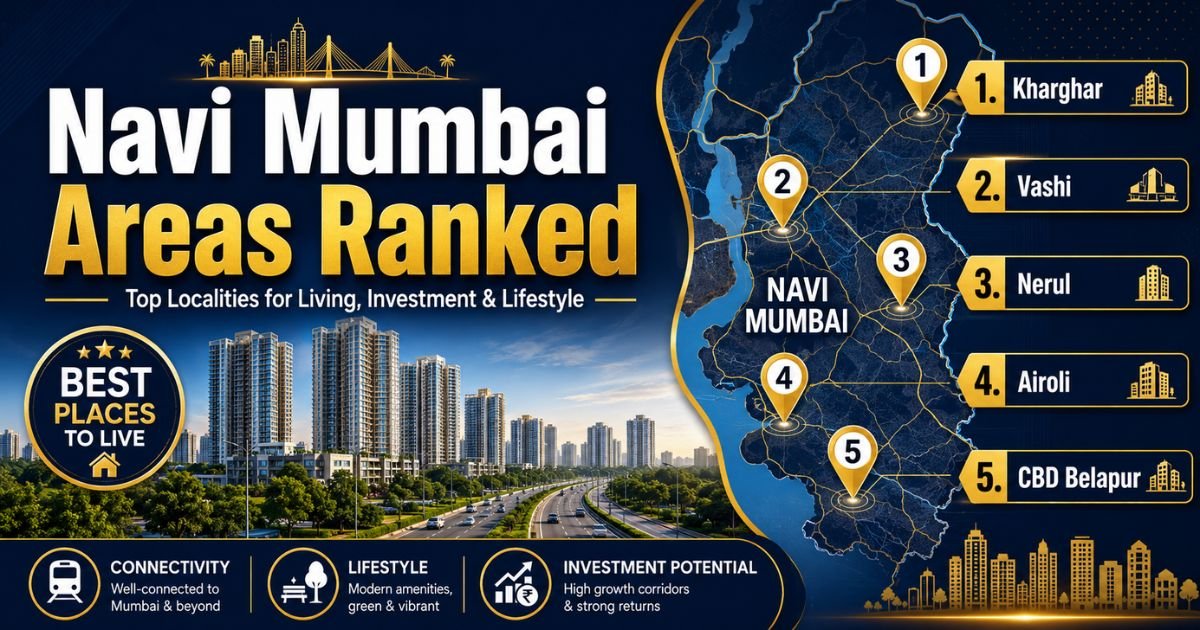
Navi Mumbai Areas Ranked Guide: Best Localities by Lifestyle & Budget

Navi Mumbai areas should be ranked by buyer need, not hype. For overall liveability, Kharghar, Vashi, Nerul, Seawoods and CBD Belapur rank high because they offer better daily convenience, connectivity and social infrastructure. For airport-linked growth, Ulwe, Panvel and Pushpak Nagar matter. For IT professionals, Airoli and Ghansoli rank higher. For budget buyers, Taloja, Kalamboli and outer Panvel need careful checking. Navi Mumbai Areas Ranked Overall This is an editorial ranking based on liveability, connectivity, social infrastructure, market strength, future growth and affordability. It is not a government ranking. Use it as a buyer shortlist, not as a final buying decision. Rank Area Best for Why it ranks here Main caution 1 Kharghar Families, lifestyle, mid-premium buyers Strong balance of schools, open spaces, metro relevance and housing options Outer sectors need commute checks 2 Vashi Convenience, professionals, premium buyers Mature commercial and lifestyle ecosystem Older buildings and higher prices 3 Nerul Families, central living Mature node, rail access, Palm Beach proximity Building age varies 4 Seawoods Premium families, lifestyle buyers Station/mall ecosystem and strong end-user demand Premium pricing 5 CBD Belapur Professionals, premium buyers Business district, greenery and good access Sector-level variation 6 Airoli IT professionals Thane/Mulund/office-belt access Peak-hour traffic 7 Ghansoli Working professionals, rentals Office proximity and rental demand Micro-location quality varies 8 Ulwe Airport access, future growth NMIA and Atal Setu influence Still developing in some pockets 9 Panvel Space, long-term growth Railway, highway and airport influence Very broad market 10 Sanpada Convenience, central access Vashi/Nerul/Palm Beach proximity Limited supply and premium pockets 11 Kamothe Mid-budget families Panvel/Kharghar access Less premium lifestyle 12 Kalamboli Road-linked buyers, budget Highway and logistics connectivity Traffic and industrial surroundings 13 Taloja Budget buyers Affordability and metro relevance Commute and liveability checks needed 14 Pushpak Nagar Airport-linked investors Planned airport-influence story Early-stage social infrastructure 15 Dronagiri Long-term investors Port/airport/Atal Setu-side potential Slower lifestyle maturity For a broader overview, start with Navi Mumbai locality comparison guide. Ranking Method This ranking uses a practical buyer-first model. Factor Weight Daily liveability 30% Connectivity 25% Social infrastructure 20% Property market strength 10% Future growth 10% Affordability 5% Daily Liveability This includes schools, hospitals, markets, parks, walkability, safety, building quality and daily convenience. Connectivity This includes railway, metro, road access, Mumbai commute, office commute and airport access. Social Infrastructure This includes malls, hospitals, schools, restaurants, daily services and lifestyle comfort. Future Growth This includes Navi Mumbai International Airport, Atal Setu, metro, NAINA, port influence, road corridors and planned development. Affordability This includes entry price, rent, maintenance and value for money. A cheaper area does not automatically rank higher. A premium area does not automatically rank better for every buyer. Top 5 Areas for Living Today 1. Kharghar Kharghar ranks first because it gives the best balance for many buyers. It has planned sectors, schools, colleges, open spaces, Central Park-side lifestyle, metro relevance and good housing supply. Kharghar is good for: Families Mid-premium buyers People who want open spaces Buyers who want better lifestyle without Vashi-level pricing Main caution: outer sectors and far pockets need commute checks. Also verify builder quality, MahaRERA status and possession details before paying token money. 2. Vashi Vashi is the mature convenience leader. It has offices, malls, restaurants, hospitals, schools, railway access and strong daily life. For people who want everything nearby, Vashi still ranks very high. Vashi is good for: Professionals Business owners Premium convenience buyers Mumbai commuters Main caution: many buildings are older. Check OC, society records, redevelopment discussions, parking and maintenance before buying resale flats. 3. Nerul Nerul is central, stable and practical. It offers access to Seawoods, CBD Belapur, Vashi and Palm Beach Road. It works well for families who want mature infrastructure without moving into a very expensive premium pocket. Nerul is good for: Families Central Navi Mumbai living Mumbai connectivity Buyers who prefer established societies Main caution: building age and society maintenance vary by sector. 4. Seawoods Seawoods is one of the stronger premium family areas. The station, mall ecosystem, NRI Complex side and access to Nerul, Belapur and Palm Beach Road make it attractive for end-users. Seawoods is good for: Premium families Lifestyle buyers Station-access buyers Strong resale/rental demand seekers Main caution: prices are premium. Check building age, society documents, OC and maintenance. 5. CBD Belapur CBD Belapur offers business-district access, greenery and planned pockets. It suits buyers who want a calmer environment than Vashi but better access than far upcoming nodes. CBD Belapur is good for: Professionals Premium buyers Buyers who want greenery and office access People commuting toward Kharghar, Nerul, Seawoods or Panvel Main caution: the area changes by sector. Compare exact building, road access and surroundings. Best Areas Ranked for Families Rank Area Why it works 1 Kharghar Schools, open spaces, family housing supply 2 Nerul Mature and central 3 Seawoods Premium lifestyle and station/mall access 4 CBD Belapur Green, planned and quieter pockets 5 Vashi High convenience, but costlier Families should not choose only by price. Check school routes, hospital access, playgrounds, traffic, society maintenance and daily market access. For deeper family-focused comparison, use best Navi Mumbai localities for families. Best Areas Ranked for Working Professionals Rank Area Best work profile 1 Airoli IT, Thane/Mulund-side offices 2 Ghansoli IT/office belt, rental demand 3 Vashi Business, retail, Mumbai access 4 CBD Belapur Corporate, government and business district 5 Kharghar Professionals wanting family lifestyle Airoli and Ghansoli rank higher for professionals because they reduce commute for many office-goers in the IT and commercial belt. But for business owners and people who want lifestyle plus work access, Vashi and CBD Belapur can be better. For a work-focused guide, use best areas in Navi Mumbai for working professionals. Best Areas Ranked for Mumbai Connectivity Rank Area Connectivity logic 1 Vashi Mature rail/road access and Mumbai-side movement 2 Nerul Central Harbour Line access 3 Seawoods Station ecosystem and central location 4 CBD Belapur Belapur-side rail/road access 5 Airoli Useful for Thane/Mulund/eastern Mumbai side If your job is in Mumbai, do not choose only by flat size. Test

Read More

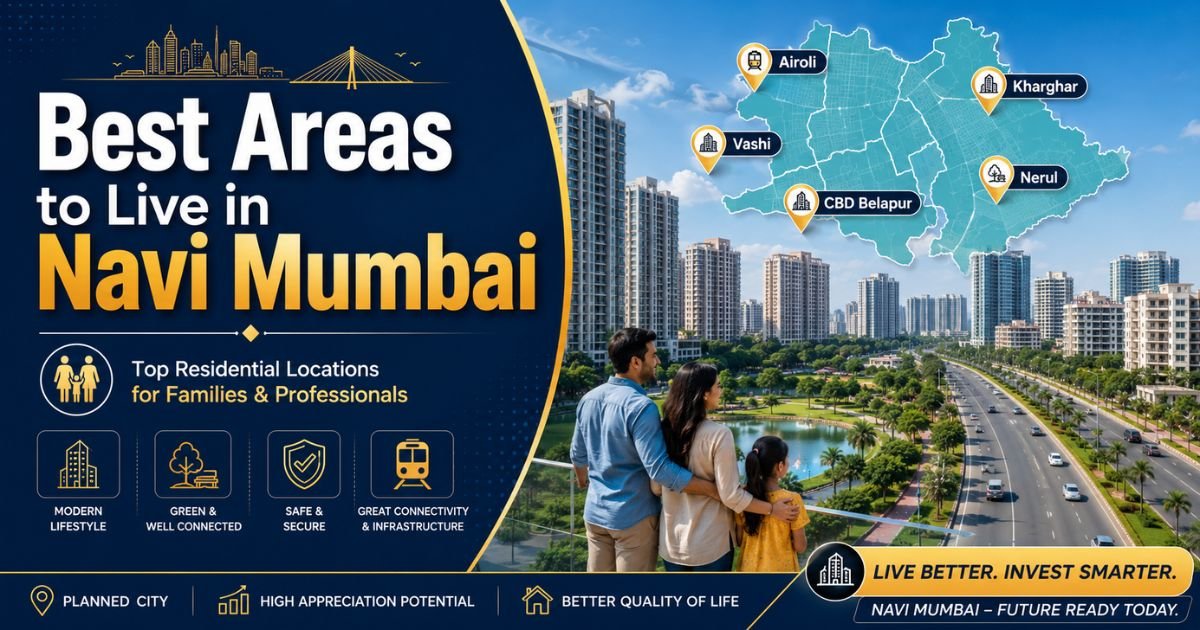
Best Areas to Live in Navi Mumbai: Locality Comparison Guide

Best Areas to Live in Navi Mumbai: Honest Locality Comparison Guide The best areas to live in Navi Mumbai depend on your daily life. Choose Kharghar, Nerul or Seawoods for family living. Choose Vashi, Palm Beach Road or CBD Belapur for mature infrastructure and premium convenience. Choose Airoli or Ghansoli for work commute. Choose Ulwe, Panvel or Pushpak Nagar for airport-linked growth. Choose Taloja only if budget is the main priority. Quick Answer: Best Areas by Buyer Type There is no single “best area” for everyone. A family with school-going children will choose differently from a working professional in Airoli. A Mumbai commuter will choose differently from someone investing near the airport. Use this quick guide first. Buyer type Best-fit areas Families Kharghar, Nerul, Seawoods Premium lifestyle Vashi, Palm Beach Road, CBD Belapur Working professionals Airoli, Ghansoli, Vashi, Belapur Airport access Ulwe, Pushpak Nagar, Panvel Mumbai connectivity Vashi, Nerul, Seawoods, CBD Belapur Budget buyers Taloja, Kalamboli, parts of Panvel Long-term investors Ulwe, Panvel, Pushpak Nagar, Dronagiri, selective Taloja For a deeper node-wise view, start with Navi Mumbai locality comparison guide. How to Choose the Right Navi Mumbai Locality Do not choose only by price. A cheaper flat may mean longer commute, weaker social infrastructure, lower resale demand, or slower area development. A premium locality may cost more, but it may save time, improve lifestyle, and offer stronger rental or resale demand. Before shortlisting any area, check: Daily office commute School access Hospital access Railway, metro and road connectivity Airport access, if important Market, mall and social life Building quality Water and maintenance Parking Future resale demand Project documents and MahaRERA status Old Navi Mumbai vs New Navi Mumbai This is the easiest way to understand Navi Mumbai. Type Areas Best for Main caution Established nodes Vashi, Nerul, Seawoods, CBD Belapur, Airoli convenience, rail, schools, resale demand higher prices, older buildings in some pockets Balanced growth nodes Kharghar, Kamothe, Kalamboli, Ghansoli families, professionals, mid-budget buyers traffic and project quality vary Airport-growth nodes Ulwe, Panvel, Pushpak Nagar, Dronagiri future growth, airport access, investors social infrastructure still developing in pockets Budget-growth nodes Taloja, outer Panvel, parts of Dronagiri affordability commute and liveability need careful checking Established areas are better for living today. Upcoming areas may offer growth potential, but they need more patience and verification. Best Areas for Families Kharghar Kharghar is one of the best family areas in Navi Mumbai. It has planned sectors, schools, colleges, parks, open spaces, and a strong residential feel. Central Park and the Kharghar hills also give the area a better lifestyle identity than many purely budget locations. Kharghar is good for: Families Mid-premium buyers People who want schools and open spaces Buyers who want better lifestyle without Vashi-level pricing Main caution: outer Kharghar and far sectors need commute checks. Also verify project quality, possession status and MahaRERA details before paying token. Nerul Nerul is a mature and balanced locality. It has railway connectivity, access to Seawoods, CBD Belapur, Vashi and Palm Beach Road. It works well for families who want established infrastructure without moving too far into upcoming areas. Nerul is good for: Families Mumbai commuters Buyers who want central Navi Mumbai access People who prefer established societies Main caution: some buildings are older. Check building age, society maintenance, redevelopment discussions and documents. Seawoods Seawoods is a strong family and lifestyle location. The railway station, mall ecosystem, NRI Complex side, and access to Nerul, Belapur and Palm Beach Road make it a premium end-user area. Seawoods is good for: Premium families Buyers who want lifestyle convenience People who value station and mall access Strong resale/rental demand seekers Main caution: pricing is usually premium. Check building age, OC, society records and maintenance before buying resale flats. Best Areas for Working Professionals Airoli Airoli is one of the best areas for working professionals, especially those working in IT parks, Thane-side offices, Ghansoli, Rabale, Mahape and eastern Mumbai-side locations. Airoli is good for: IT professionals Working couples People commuting toward Thane/Mulund Rental-income investors Main caution: peak-hour traffic can be heavy. Check actual commute during office hours before finalising. Ghansoli Ghansoli is practical for professionals who want to stay close to office hubs. It has better rental demand in many pockets because of nearby commercial and IT activity. Ghansoli is good for: Office-goers Rental investors Buyers wanting Airoli-Kopar Khairane belt access People who prefer practical commute over premium lifestyle Main caution: micro-location matters. Compare station access, road access, building quality and neighbourhood feel. Vashi Vashi is the commercial heart of Navi Mumbai. It has offices, malls, restaurants, hospitals, schools, railway access and strong daily convenience. Vashi is good for: Professionals Business owners Premium convenience buyers People who travel often to Mumbai Main caution: rentals and prices are higher. Some buildings are old, so document and structural checks matter. Best Areas for Mumbai Connectivity Vashi Vashi is one of the strongest choices for regular Mumbai connectivity. It has mature rail and road access, plus commercial infrastructure. Buyers who need convenience and Mumbai access often keep Vashi high on the shortlist. Nerul and Seawoods Nerul and Seawoods offer a balanced location advantage. They are useful for people who want Navi Mumbai lifestyle but still need access toward Mumbai, Belapur, Palm Beach Road and Harbour Line connectivity. CBD Belapur CBD Belapur works well for people who want business-district access, government-office proximity, greenery and better movement toward Kharghar, Nerul, Seawoods and Panvel. Best Areas for Airport Access Ulwe Ulwe has one of the strongest airport-linked stories in Navi Mumbai. It is close to the Navi Mumbai International Airport influence zone and benefits from larger infrastructure narratives like Atal Setu, airport connectivity and planned growth. Ulwe is good for: Airport-access buyers Long-term investors Buyers who want newer housing supply People comfortable with developing social infrastructure Main caution: not every pocket is equally mature. Check roads, water, project delivery, society formation, daily markets and transport. Pushpak Nagar Pushpak Nagar is an airport-influenced planned growth area. It may suit buyers who are looking at long-term appreciation

Read More

Due Diligence Before Token Payment in Navi Mumbai

Before paying token money for any property in Navi Mumbai, verify the seller, title chain, land records, registered documents, approvals, dues, and refund terms. For NAINA plots, gaothan properties, CIDCO areas, or land near CRZ/green zone locations, do not rely only on broker claims. Check official records first, then pay only with written conditions. Disclaimer: This is an educational guide. Verify the latest position with the relevant authority or a property lawyer before making a transaction. What Token Payment Actually Means Token money is a small advance paid to show serious interest in a property. But it is not a guarantee that the property is legally clear. It is not proof that the seller has marketable title. It is not proof that the plot is buildable. And it is not proof that the builder, owner, or broker has shown you every important document. In many Navi Mumbai property deals, buyers pay token because they fear losing the deal. This is where risk starts. Once you pay, your bargaining power reduces. The seller may delay documents. The broker may say the token is non-refundable. The builder may push you toward booking without proper review. So the rule is simple: Do basic due diligence before token payment. Do deeper legal due diligence before agreement and registration. What to Check Before Paying Token Money Use this as your minimum checklist before paying even a small token. Check Why it matters Where to verify Seller identity To avoid impersonation or fake authority PAN, Aadhaar, original ID, owner meeting Seller authority Confirms the person can sell Sale deed, POA, board resolution, allotment letter Title chain Shows how the property moved from previous owners Previous sale deeds, Index II, title search Land record Supports ownership and land-status verification 7/12 extract, 8A, property card Registered history Helps detect earlier sale, mortgage, or transaction IGR Maharashtra e-Search RERA status Important for under-construction projects MahaRERA project search Building approvals Confirms sanctioned development NMMC, PMC, CIDCO, NAINA, local authority Zoning / land use Checks whether land can be used as promised Development Plan, planning authority, revenue office CRZ / green zone / NDZ Critical for coastal, creek-side, or restricted areas MCZMA / CZMP maps, planning authority Dues and liabilities Avoids unpaid tax, society, maintenance, or loan issues Society, bank, tax bills, utility bills Refund terms Protects you if documents fail Written token receipt or MOU Do not pay token only on WhatsApp promises. Ask for documents first. If the seller refuses basic documents, that is a red flag. Documents to Verify by Property Type Different properties need different checks. A resale flat in Vashi is not the same as a NAINA plot near Panvel or a gaothan property near Uran. For Resale Flats in Navi Mumbai Check: Current sale deed Previous chain documents Index II Society share certificate Property tax receipt Maintenance dues letter Electricity bill Occupancy Certificate, if applicable Building approval / sanctioned plan, where available Loan NOC if the property is mortgaged Seller KYC Society NOC, if required A property card or land record may not by itself prove ownership of a flat. It supports verification. The registered sale deed, society records, title chain, and possession history must also be reviewed. For Under-Construction Projects Check: MahaRERA registration number Project name and phase Promoter name Approved layout and plans Commencement Certificate Proposed completion date Allotment letter format Agreement for sale draft Deviation report on MahaRERA Complaints or project status issues For RERA-registered projects, Section 13 of the RERA Act says a promoter cannot accept more than 10% of the cost as advance or application fee before entering into a written and registered agreement for sale. This does not mean you should blindly pay 10%. It means you should still verify project details, agreement terms, title, approvals, and refund conditions. For NAINA Plots and Panvel-Side Land Check: 7/12 extract 8A extract Mutation entries Survey number and village name Title chain Access road Development Plan status NAINA / CIDCO planning status Town Planning Scheme impact, if applicable Reservation, zone, or affected land status NA / buildability position CRZ, green zone, or no-development restrictions, if relevant NAINA land is often sold with future-development stories. Do not pay token based only on “CIDCO development coming soon.” Verify the exact survey number. For Gaothan Property Gaothan means village settlement area. These properties can be sensitive because documents may be old, names may not be updated, and structure permissions may not be straightforward. Check: Property card, if applicable Gram Panchayat or local body records Old ownership documents Mutation records Structure permission, if any Access and boundaries Tax records Seller’s right to sell Any family or inheritance dispute For gaothan property, always verify with a local property lawyer or revenue expert before paying a large token. For CIDCO Properties Check: CIDCO allotment letter Lease deed Transfer permission or NOC, if required CIDCO dues Service charges Society documents Occupancy and possession records Whether the property is leasehold or converted/freehold, if applicable Do not assume every CIDCO property follows the same transfer process. Verify the latest rule for that exact node and property type. How to Verify Records in Maharashtra 1. Match Names Across Documents The seller’s name should match across: Sale deed Index II Property card or 7/12 Tax receipt Society records Electricity bill ID proof Small spelling differences can happen. But big mismatches need explanation and supporting documents. 2. Check Mahabhulekh / Mahabhumi Records Mahabhulekh is Maharashtra’s official land-record portal. It provides access to records such as: 7/12 extract 8A extract Property card Plain English meaning: 7/12 extract: Land record showing survey number, area, landholder details, cultivation/land-use details, and remarks. 8A extract: Village-form record showing landholding details of a person. Property card: Urban property record, commonly relevant in city survey areas. Mutation / Ferfar: Entry showing change in record due to sale, inheritance, partition, court order, or other event. These records support due diligence. They do not replace a lawyer’s title search. 3. Check IGR Maharashtra e-Search IGR Maharashtra e-Search allows citizens to search registered

Read More

Risks of Buying Resale Flat in Navi Mumbai: Documents, Red Flags & Checks

The biggest risks of buying resale flat are unclear ownership, missing title-chain documents, unpaid society dues, hidden loans, no OC or CC, illegal alterations, fake NOCs, tenant disputes and local approval issues. In Navi Mumbai, buyers should verify IGR records, society papers, MahaRERA status where relevant, CIDCO/NAINA approvals, property-card or land-record background and lawyer clearance before paying token money. Biggest risks of buying resale flat A resale flat is not automatically safe because someone already lives there. The previous sale may be registered. The building may be occupied. The society may be running. Still, the buyer can face legal, financial, possession or approval problems if the documents are weak. Here are the main risks. Risk What can go wrong Buyer action Unclear ownership Seller is not the full legal owner Check title chain and all co-owner signatures Hidden loan Bank still has charge on the flat Ask for bank NOC and loan closure proof Unpaid dues Society, tax or utility dues remain pending Take written no-dues confirmation Missing OC/CC Building approval or occupation status is unclear Verify with relevant planning authority Fake documents NOC, share certificate or POA may be forged Verify directly with society, bank and authority Possession dispute Tenant, family member or occupier refuses to vacate Take vacant possession terms in writing Do not pay a non-refundable token until the basic documents are checked. 1. Unclear ownership This is the most serious risk. The person selling the flat may not be the only owner. There may be a spouse, sibling, parent, legal heir or co-owner whose signature is also required. Be extra careful if the flat is: inherited after death of the owner owned jointly being sold through power of attorney owned by an NRI under family dispute transferred after divorce or partition A buyer should not rely only on the seller’s statement. Ask a property lawyer to check whether the seller has the right to sell. 2. Broken title chain Title chain means the ownership history of the flat. For example, builder to first buyer, first buyer to second buyer, second buyer to current seller. Every step should be supported by registered documents. Check: registered sale deed or agreement Index II previous agreements allotment letter, if available possession letter share certificate society transfer records Index II is a summary of a registered document. It supports verification, but it should not be treated as complete proof by itself. If one old agreement is missing, do not ignore it. Ask why it is missing and get legal review. 3. Existing loan or hidden mortgage Many resale flats are sold while a home loan is still active. That is not always a problem. But the process must be clean. Ask for: loan outstanding letter bank NOC list of original documents held by bank loan closure letter after payment release of mortgage, where applicable CERSAI search where relevant CERSAI is a central registry used for security interest information. It can help identify loan or mortgage-related entries, but it should be used along with bank and lawyer verification. 4. Unpaid society dues In resale deals, the buyer may later discover pending maintenance, repair fund, sinking fund, non-occupancy charges, parking charges or transfer-related disputes. Before agreement, ask the society for: no-dues certificate latest maintenance bill share certificate status parking record pending legal notice, if any redevelopment discussion or notice, if any A broker’s WhatsApp message is not enough. Get written confirmation from the society office. 5. Missing OC, CC or approved plan issue OC means Occupancy Certificate. It generally shows that the building or relevant part has been allowed for occupation by the competent authority. CC means Commencement Certificate. It relates to permission to start construction. In Navi Mumbai, the relevant authority may differ by area. It may involve NMMC, CIDCO, Panvel Municipal Corporation, NAINA or another planning authority depending on the property location. Check: OC CC approved building plan completion certificate, where available fire or lift NOC, where relevant whether the flat matches the approved plan If the flat has enclosed balcony, merged rooms, loft extension, commercial use or structural changes, verify before transaction. 6. Local approval risk in Navi Mumbai Some resale flats need extra local attention. This is especially relevant in Panvel, Ulwe, Dronagiri, Uran, NAINA-influenced areas, CIDCO leasehold areas, gaothan belts and creek/coastal-sensitive areas. Check where relevant: Local issue What to verify CIDCO leasehold property Lease deed, transfer permission, authority NOC NAINA area Building permission, CC, OC, zoning or ZCS Gaothan / village background Property card, 7/12, mutation history where applicable CRZ or creek-side location CZMP/CRZ sensitivity and authority clearance NA or land conversion issue Current applicability with lawyer and revenue office NA means non-agricultural use. Rules around NA permission and land conversion have changed in Maharashtra in recent years, but the exact impact depends on the location, planning authority and property facts. Verify before transaction. This is an educational guide. Verify the latest position with the relevant authority or a property lawyer before making a transaction. Documents to check before buying resale flat Use this checklist before paying token. Document Why it matters Seller PAN/Aadhaar/passport Confirms seller identity Registered sale deed/agreement Supports title-chain review Index II Helps verify registered transaction summary Previous agreements Shows ownership chain Share certificate Shows society membership record Society NOC Confirms society-level transfer permission No-dues certificate Reduces risk of pending dues OC and CC Helps verify building approval status Approved plan Confirms layout and construction record Property tax receipt Shows tax payment status Utility bills Helps check pending dues Bank NOC Important if loan exists CERSAI search Helps check security-interest risk POA documents Needed if seller uses attorney Heirship/succession papers Needed in inherited property cases For land-record background, 7/12 extract means a land record showing details like survey number, area and holder details. Property card usually relates to city survey or urban land record. These records support verification but should be interpreted by a lawyer or land-record professional. How to verify a resale flat Check IGR Maharashtra records Use IGR Maharashtra eSearch to

Read More