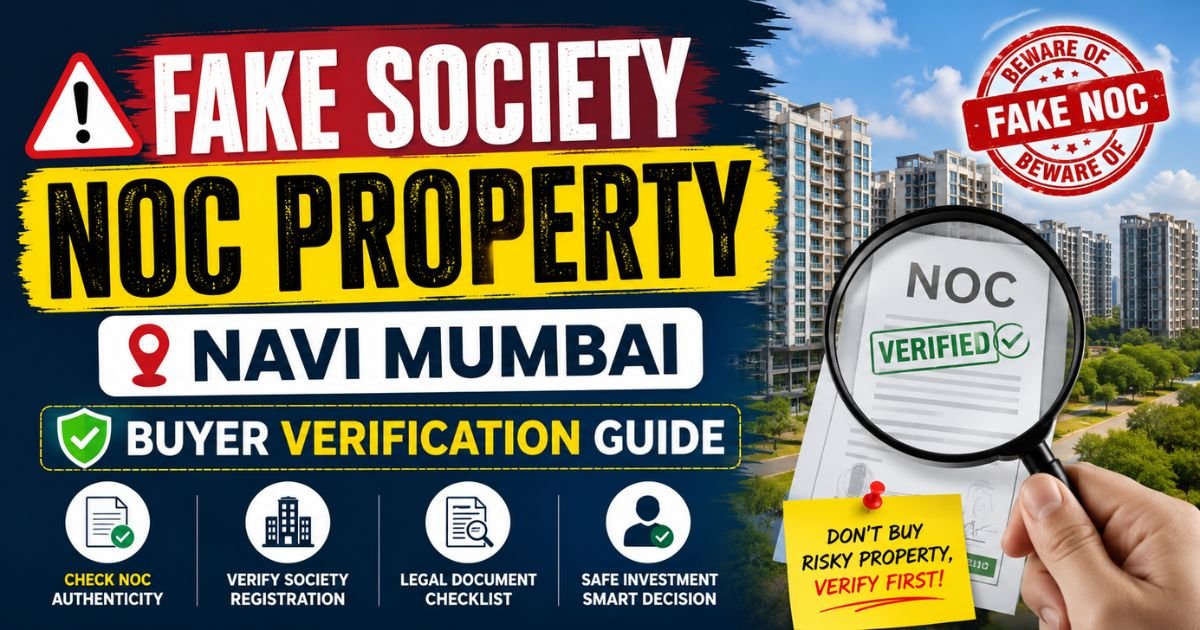
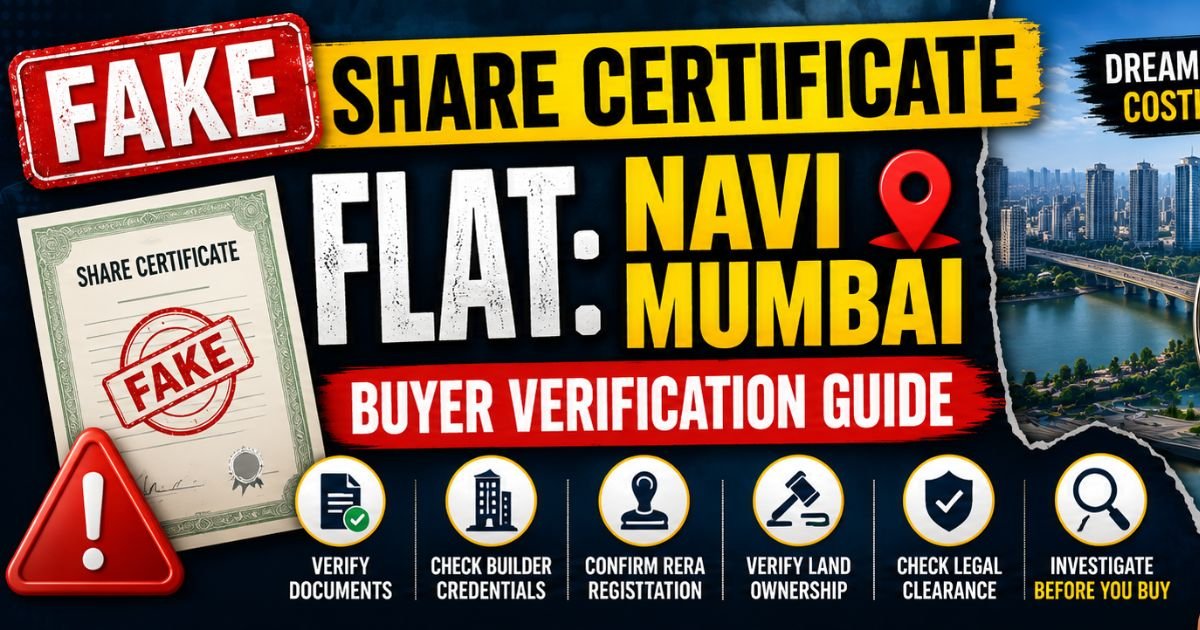
Fake Share Certificate Flat in Navi Mumbai: Buyer Verification Guide
Fake Share Certificate for Flat: Navi Mumbai Buyer Checklist A share certificate alone does not prove safe ownership of a flat. Before trusting it, verify the original certificate with the housing society, seller’s registered sale deed or agreement, Index II, IGR Maharashtra records, society register, share ledger, dues, loan status, and seller identity. In Navi Mumbai resale deals, never pay token money only because a broker shows a share certificate. Disclaimer: This is an educational guide. Verify the latest position with the relevant authority or a property lawyer before making a transaction. What Is a Society Share Certificate? A society share certificate is issued by a co-operative housing society to a member who holds shares in that society. In simple words, it shows that the person is recorded as a member/shareholder in the housing society. It usually includes details like: Member name Share certificate number Distinctive share numbers Number of shares Value of shares Society seal Authorised signatures In Maharashtra, model bye-laws for co-operative housing societies describe the share certificate as a society-issued document for shares held by a member. But here is the important point: A share certificate supports society membership. It should not be treated as complete title proof by itself. For a resale flat in Navi Mumbai, you still need to check registered documents, title chain, society records, dues, loan status, and seller authority. Why Fake Share Certificates Are Risky A fake share certificate can make a buyer believe that the seller is the legal owner. That is where many resale flat risks begin. A fake, altered, old, or wrongly transferred certificate may be used to: Push the buyer to pay token money Hide incomplete title chain Sell a flat where society records are not updated Hide a family or inheritance dispute Hide a mortgage or pending loan Show an old owner’s certificate as the current seller’s proof Create false confidence in a broker-led deal Support fake no-dues or transfer documents This risk is common in resale flats because buyers often ask only one question: “Is the share certificate available?” The better question is: “Does the share certificate match the society records, registered title chain, IGR records, dues, loan status, and seller identity?” Share Certificate vs Sale Deed vs Index II Do not confuse these documents. Each has a different purpose. Document What it supports What it does not confirm Share certificate Society membership and shareholding Complete legal title, no loan, no dispute, no fraud Registered sale deed / agreement Registered transaction between buyer and seller Society records are updated or title is risk-free Index II Summary of registered document Full title chain or legal opinion Society no-dues certificate Pending society dues status Ownership or title by itself IGR search result Registered document history Society membership or physical possession Title search report Lawyer’s review of title chain and risk A government guarantee of title A share certificate can be genuine, but the flat can still have a title issue. A sale deed can be registered, but society records may still be pending. A no-dues certificate can confirm dues, but it does not prove title. So the buyer must verify all key records together. Documents to Check Before Trusting a Share Certificate Before accepting a share certificate as part of your resale flat due diligence, ask for three sets of documents. Seller-Side Documents Ask the seller for: Original share certificate Registered sale deed or agreement Previous chain documents Index II Seller PAN and Aadhaar Name-change proof, if names differ Power of Attorney, if seller is not signing directly Heirship, succession, probate, or family documents if inherited Bank loan closure letter or NOC if mortgaged If the seller says “documents will come after token,” pause the deal. Society-Side Documents Ask the society office or managing committee to confirm: Membership register entry Share ledger entry Transfer form records Committee approval or transfer resolution No-dues certificate Maintenance payment history Parking allotment, if relevant Any pending dispute, redevelopment notice, or lien information Do not rely only on broker confirmation. Speak to the society office directly. Property-Side Documents For a resale flat in Navi Mumbai, also check: Occupancy Certificate, where applicable Completion-related records, where applicable Property tax receipt Electricity bill Water bill, if separately billed Existing loan or mortgage status Possession letter, if relevant Approved plan or building records, where available For CIDCO flats or old leasehold properties, ask for CIDCO-related documents such as allotment letter, lease deed, transfer permission or NOC where applicable, and dues confirmation. How to Verify a Share Certificate Step 1: Ask for the Original Do not rely on a WhatsApp photo, scanned PDF, or photocopy. Ask to see the original certificate. Check whether it has: Society name Registration number Certificate number Member name Share numbers Seal Signatures Date of issue Any overwriting or correction If the certificate is laminated, damaged, overwritten, or unclear, ask for society verification in writing. Step 2: Match the Seller’s Name The seller’s name should match across: Share certificate Registered sale deed or agreement Index II Society register Maintenance bill Seller ID proof Loan NOC, if any If there is a mismatch, do not ignore it. There may be a valid reason, such as marriage, name change, inheritance, or transfer delay. But it must be supported by proper documents. Step 3: Verify with the Society Ask the society secretary or managing committee: Is this certificate number genuine? Is the seller the current member? Are the share numbers correct? Was transfer approved? Are any dues pending? Was any duplicate certificate issued? Is there any objection, dispute, lien, or court notice? The society’s answer matters because a fake certificate may look convincing on paper. Step 4: Check IGR Maharashtra Records Use IGR Maharashtra e-Search to check registered transaction history. Search by: Document number Property details Seller/buyer name, where possible Registration year Village or area details, if applicable Check whether the seller’s registered document exists and whether property details match the flat being sold. This step helps detect gaps in the title chain. Step 5: Verify
Read More