

Builder Not Executing Conveyance in Navi Mumbai: Buyer Checklist
If the builder is not executing conveyance, do not treat it as a small paperwork issue. In Maharashtra, conveyance transfers the builder’s or promoter’s right, title and interest in the land/building to the society or legal body. If the builder delays or refuses, the society may explore deemed conveyance. Before paying token money, verify conveyance papers, IGR records, land records, OC, approvals and society documents.
What does conveyance mean in Maharashtra?
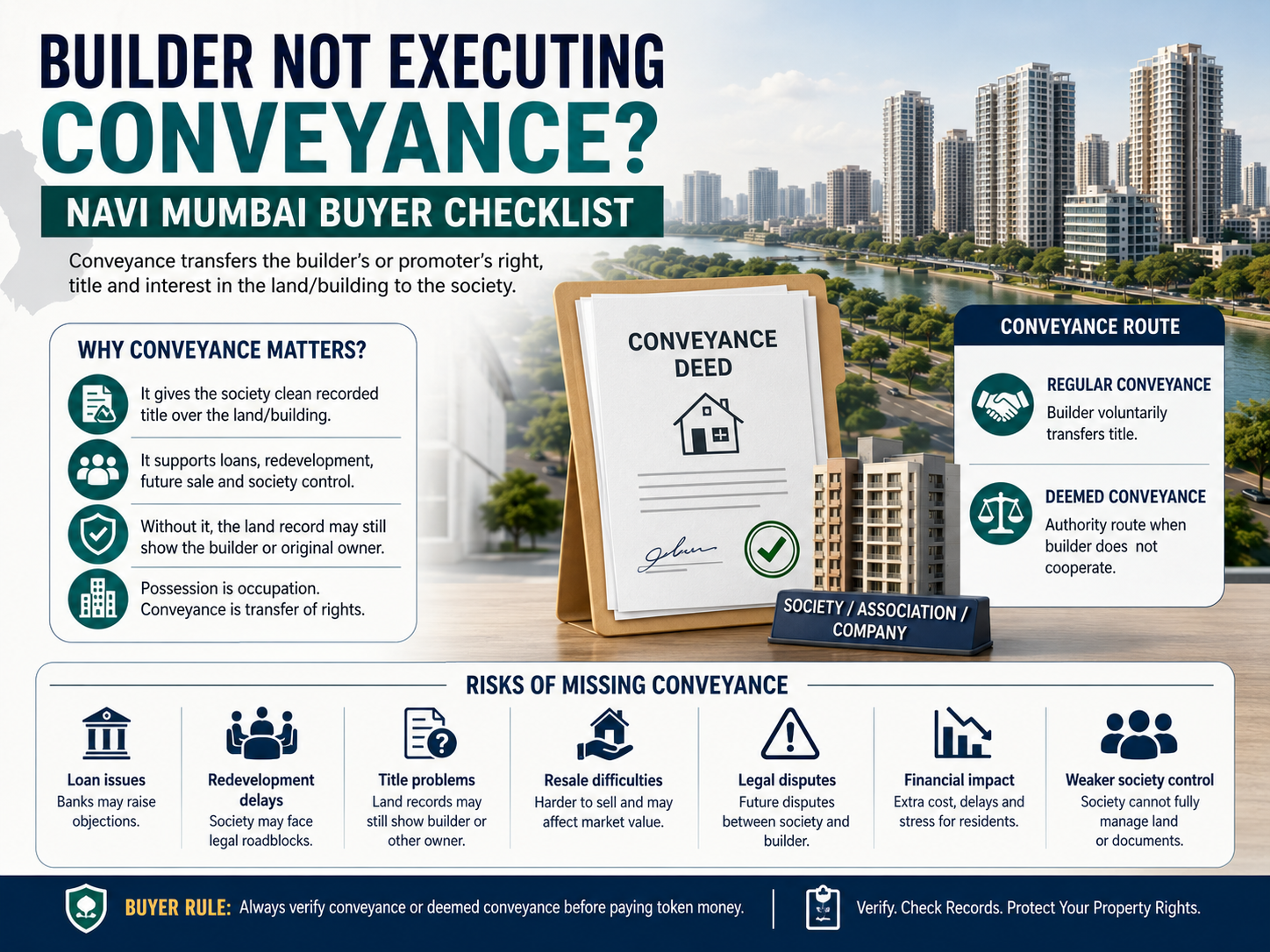
Conveyance means the transfer of the builder’s or promoter’s right, title and interest in the land and building to the housing society, company, association or other legal body.
For a flat buyer, this matters because buying a flat is not only about the flat agreement. The land under the building also matters.
A society may have residents, maintenance bills, share certificates and regular meetings. But if conveyance is not executed, the society may still not have clean recorded title over the land/building.
Do not confuse possession with conveyance.
Possession means you occupy the flat. Conveyance means the property rights in the land/building are transferred to the proper legal body.
Regular conveyance vs deemed conveyance
| Point | Regular conveyance | Deemed conveyance |
|---|---|---|
| Meaning | Builder/promoter voluntarily transfers title | Authority-based route when builder does not cooperate |
| Used when | Builder signs the conveyance deed | Builder delays, avoids or refuses |
| Who usually acts | Builder and society | Society through Competent Authority process |
| Verification | Registered conveyance deed | Deemed conveyance order/certificate plus registration |
| Buyer action | Check registered documents | Check order, registration and title update status |
In Maharashtra, deemed conveyance is a legal route available to societies when the builder does not execute conveyance. But the exact route depends on facts, project age, agreement terms, society formation, OC status and legal records.
Verify with a property lawyer before assuming which remedy applies.
Why builders may delay conveyance
A builder may delay conveyance for several reasons. Not every delay is fraud, but every delay needs checking.
Common reasons include:
- Pending society formation
- Incomplete documents
- Dispute between landowner and builder
- Pending OC or approval issues
- Unsold flats, shops or parking disputes
- Future FSI, TDR or redevelopment control
- Phased layout issues
- CIDCO leasehold or transfer conditions
- Gaothan, NAINA or old land-record mismatch
For Navi Mumbai buyers, this becomes more important in older societies, CIDCO leasehold properties, Panvel and NAINA areas, gaothan properties, redevelopment buildings and resale flats where the seller only shows flat-level papers.
Why missing conveyance is risky for buyers
Missing conveyance can create practical problems later.
It may affect bank loan checks, redevelopment discussions, society control, title verification and future saleability. In some cases, the land record may still show the builder, original landowner or another party.
For resale buyers, the risk is simple: you may buy a flat where the individual agreement looks fine, but the society’s land title is still unresolved.
For redevelopment, the risk is bigger. A society without proper conveyance or deemed conveyance may face delays while negotiating with developers, proving land rights or using future development potential.
For NRIs, the risk is even higher because many depend on brokers, relatives or WhatsApp documents. Do not pay token money only because the flat is occupied and the society looks functional.
Documents to check before trusting the deal
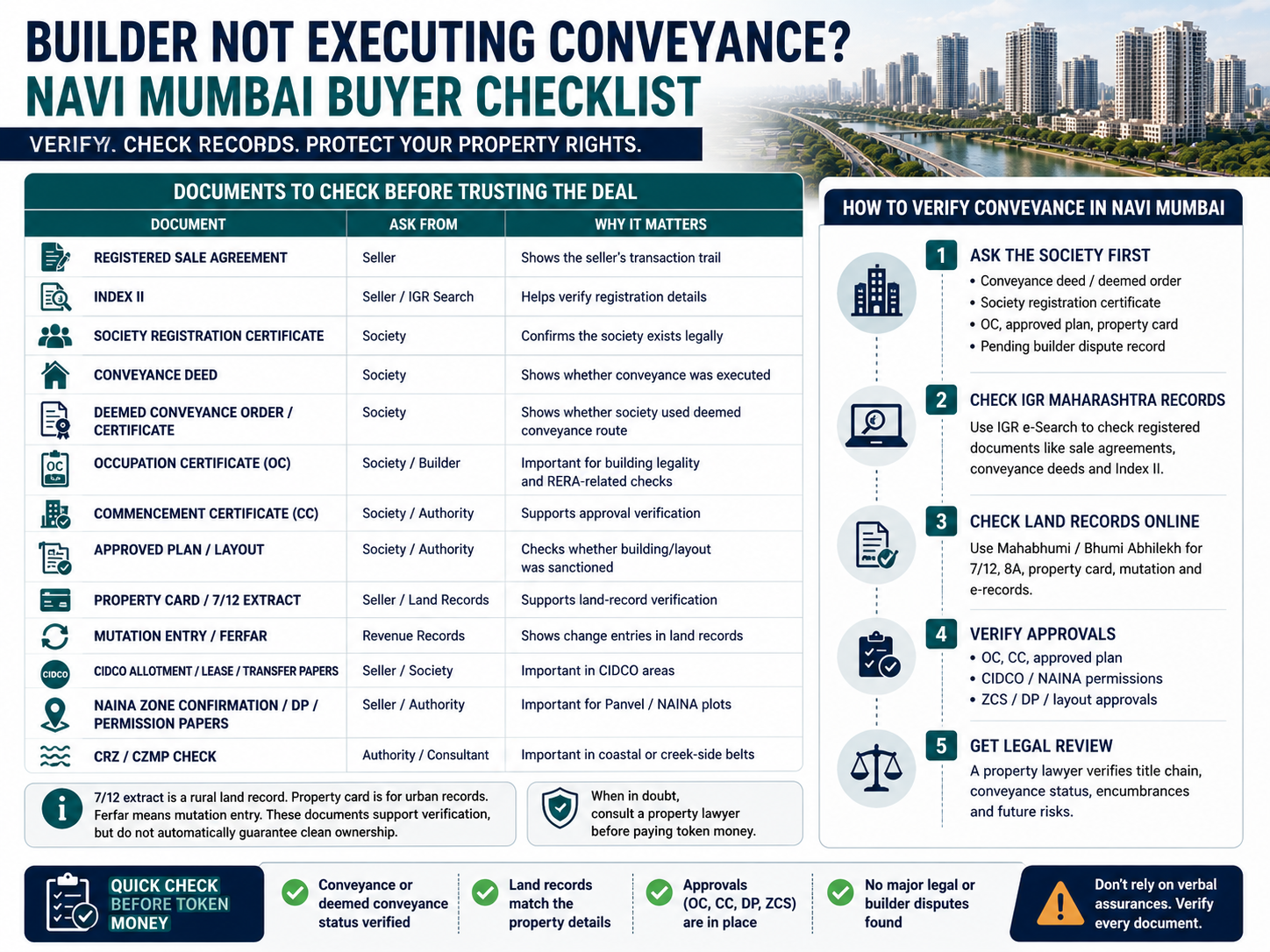
| Document | Ask from | Why it matters |
|---|---|---|
| Registered sale agreement | Seller | Shows the seller’s transaction trail |
| Index II | Seller / IGR search | Helps verify registration details |
| Society registration certificate | Society | Confirms the society exists legally |
| Conveyance deed | Society | Shows whether conveyance was executed |
| Deemed conveyance order/certificate | Society | Shows whether society used deemed conveyance route |
| Occupation Certificate | Society / builder | Important for building legality and RERA-related checks |
| Commencement Certificate | Society / authority | Supports approval verification |
| Approved plan / layout | Society / authority | Checks whether building/layout was sanctioned |
| Property card / 7/12 extract | Seller / land-record portal | Supports land-record verification |
| Mutation entry / Ferfar | Revenue records | Shows change entries in land records |
| CIDCO allotment / lease / transfer papers | Seller / society | Important in CIDCO areas |
| NAINA ZCS / DP / permission papers | Seller / authority | Important for Panvel / NAINA plots |
| CRZ / CZMP check | Authority / consultant | Important in coastal or creek-side belts |
A 7/12 extract is a rural land record. A property card is commonly used for urban land records. Ferfar means mutation entry, which records a change in land records. These documents support verification, but they do not automatically guarantee clean ownership by themselves.
How to verify conveyance in Navi Mumbai
1. Ask the society first
Ask the society office or managing committee for:
- Registered conveyance deed
- Deemed conveyance order, if any
- Society registration certificate
- OC and approved plan
- Latest property card or 7/12 extract
- Any pending builder dispute record
If the society says “conveyance is pending,” ask whether deemed conveyance has been filed.
2. Check IGR Maharashtra records
Use IGR Maharashtra e-Search to check registered documents such as sale agreements, conveyance deeds and Index II records.
Search by property details or document number wherever possible. If the seller gives only photocopies, cross-check them through official registration records.
3. Check land records
Use Mahabhumi / Bhumi Abhilekh services for 7/12, 8A, property card, mutation, e-records and related land-record checks.
For gaothan or village-side properties, check whether the record matches the seller’s claim, society claim and actual property details.
4. Check MahaRERA if the project is RERA-registered
For RERA-registered projects, check the project page, promoter details, approvals, OC status, litigation disclosures and conveyance-related obligations.
Do not assume every old building is covered the same way. RERA applicability depends on the project and facts.
5. Check CIDCO / NAINA where relevant
In Navi Mumbai, Ulwe, Dronagiri, Kharghar, Panvel and nearby areas, CIDCO and NAINA checks may become important.
For NAINA plots, do not rely only on a sale deed. Check zoning, development plan, sanctioned plans, development permission and authority records.
6. Check CRZ where relevant
For Uran, Dronagiri, coastal Raigad, Thane creek belts and creek-facing locations, CRZ/CZMP checks may be needed.
Verify CRZ status with the relevant authority or qualified consultant before transaction.
Red flags
Be careful if you hear any of these lines:
- “Conveyance is not required.”
- “Every society has this issue, pay token first.”
- “Documents will be shown after booking.”
- “The builder is known locally, no need to check.”
- “Society has share certificate, so title is clear.”
- “Property card does not matter.”
- “OC is not available but everyone is living here.”
- “Builder will execute conveyance after redevelopment.”
- “NAINA/CIDCO/CRZ checks are not needed.”
The biggest red flag is pressure to pay token before document verification.
What to check before paying token money
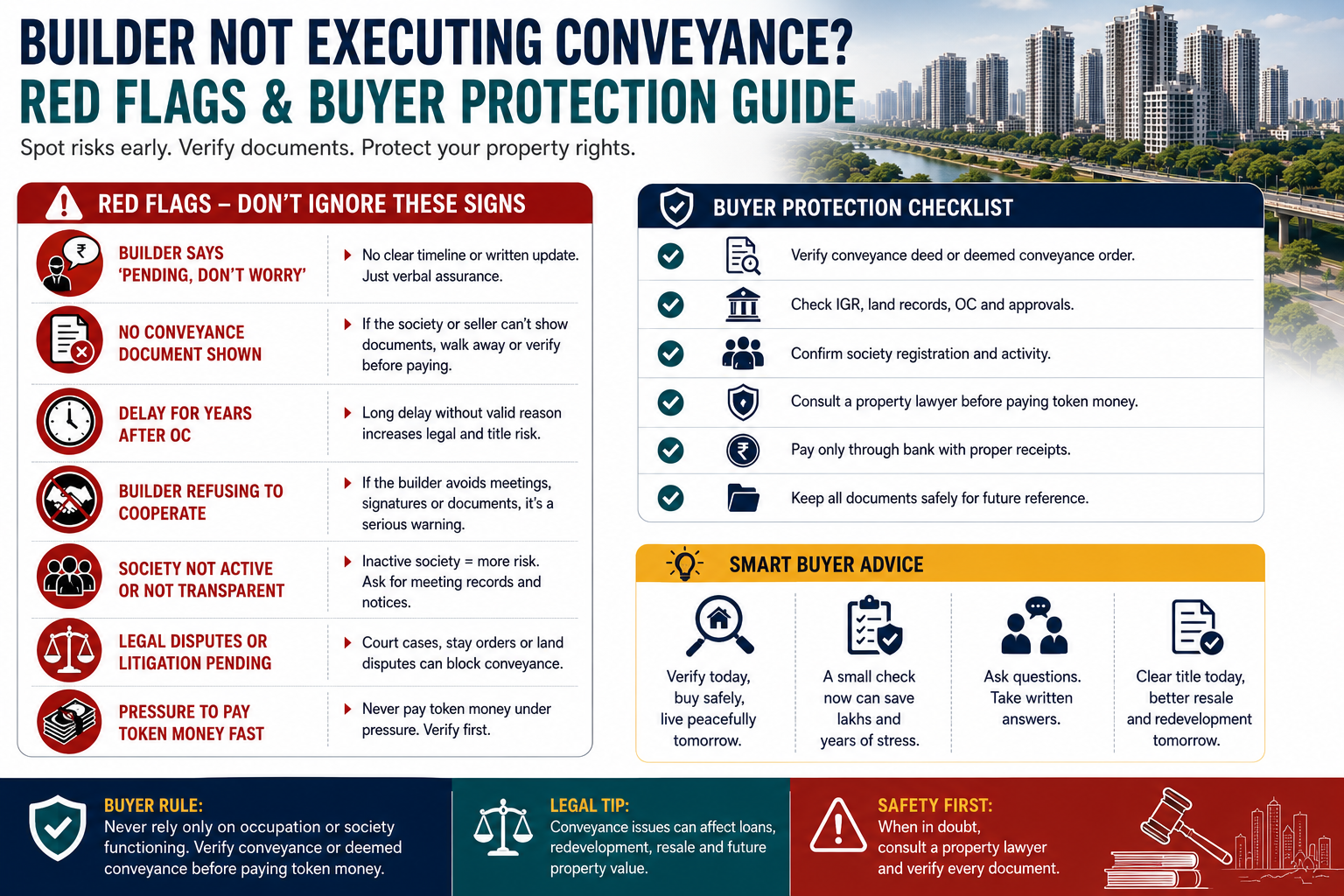
Before paying token for a resale flat, plot or society property, check these points:
| Check | Safe action |
|---|---|
| Is conveyance executed? | Ask for registered conveyance deed |
| If not, has deemed conveyance been granted? | Ask for order/certificate and registration status |
| Does IGR show the relevant document trail? | Check Index II and registered documents |
| Does land record support the claim? | Check property card / 7/12 / mutation |
| Is the society registered? | Ask for registration certificate |
| Is OC available? | Verify with society or planning authority |
| Is CIDCO / NAINA involved? | Check authority-specific records |
| Is the property coastal or creek-side? | Check CRZ/CZMP status |
| Is token refundable if title fails? | Put it in writing |
| Has a lawyer reviewed documents? | Get a written title opinion |
Token money should be conditional. Write clearly that payment is subject to document verification, title check, society record check, authority verification and loan/legal clearance.
Navi Mumbai example
A buyer wants to purchase a resale flat in an older Kharghar society.
The seller has a registered agreement, share certificate and maintenance receipts. The broker says conveyance is “pending but normal.”
The buyer asks the society for the conveyance deed. The society says the builder never executed it. IGR search does not show a registered conveyance deed in favour of the society. The property card still needs legal review.
In this situation, the buyer should pause token payment, ask whether deemed conveyance has been filed, verify OC and society records, and get a property lawyer’s title opinion.
This does not automatically mean the deal is bad. But it means the risk is not yet checked.
Common mistakes buyers make
Mistake 1: Treating possession as ownership
Possession only means the flat is occupied. It does not confirm society-level land title.
Mistake 2: Relying only on share certificate
A share certificate is important in society resale, but it is not a substitute for conveyance or title verification.
Mistake 3: Ignoring IGR search
IGR records help verify registered documents. Do not rely only on photocopies or WhatsApp PDFs.
Mistake 4: Not checking land records
Property card, 7/12 and mutation entries should be reviewed where relevant. They support verification but should be read with the full title chain.
Mistake 5: Assuming old societies are safe
Many old buildings function normally for years without buyers checking whether conveyance was completed.
Mistake 6: Ignoring local authority issues
CIDCO leasehold, NAINA planning, gaothan records, CRZ restrictions and redevelopment plans can change the risk level.
When to consult a professional
Consult a property lawyer if:
- Conveyance is missing
- Society says deemed conveyance is pending
- Builder is refusing to sign
- OC is missing
- Property card / 7/12 does not match the seller’s claim
- CIDCO, NAINA, gaothan, CRZ or leasehold issues are involved
- The property is going for redevelopment
- Token amount is high
- Buyer is an NRI
- There is litigation, mortgage, attachment or title dispute
This is not the area to save small money. A weak title check can become a very expensive mistake.
Conclusion
Before paying token money for a resale flat, society property, CIDCO leasehold property, NAINA plot or gaothan property, get the documents checked properly. Start with conveyance status, IGR records, land records, OC, society papers and authority approvals. If anything is unclear, take a written legal opinion before moving ahead.
FAQs
Frequently Asked Questions