
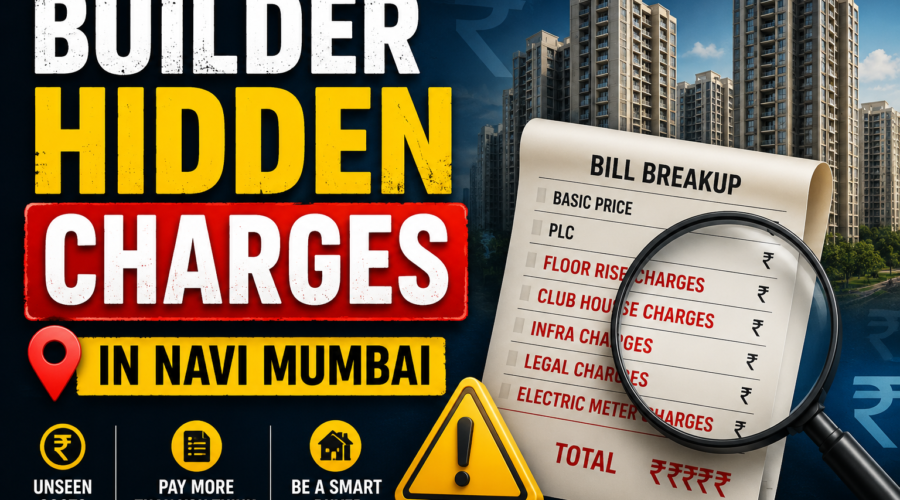
Builder Hidden Charges in Navi Mumbai: Buyer Checklist Before Token Money
Builder hidden charges are extra costs added beyond the first quoted property price. These may include parking, floor rise, clubhouse, legal fees, maintenance deposit, GST, stamp duty, registration, society charges, utility deposits or possession charges. Before paying token money in Navi Mumbai, ask for a written all-inclusive cost sheet and verify the project through MahaRERA, IGR Maharashtra, land records, CIDCO/NAINA and other relevant authorities.
What Are Builder Hidden Charges?
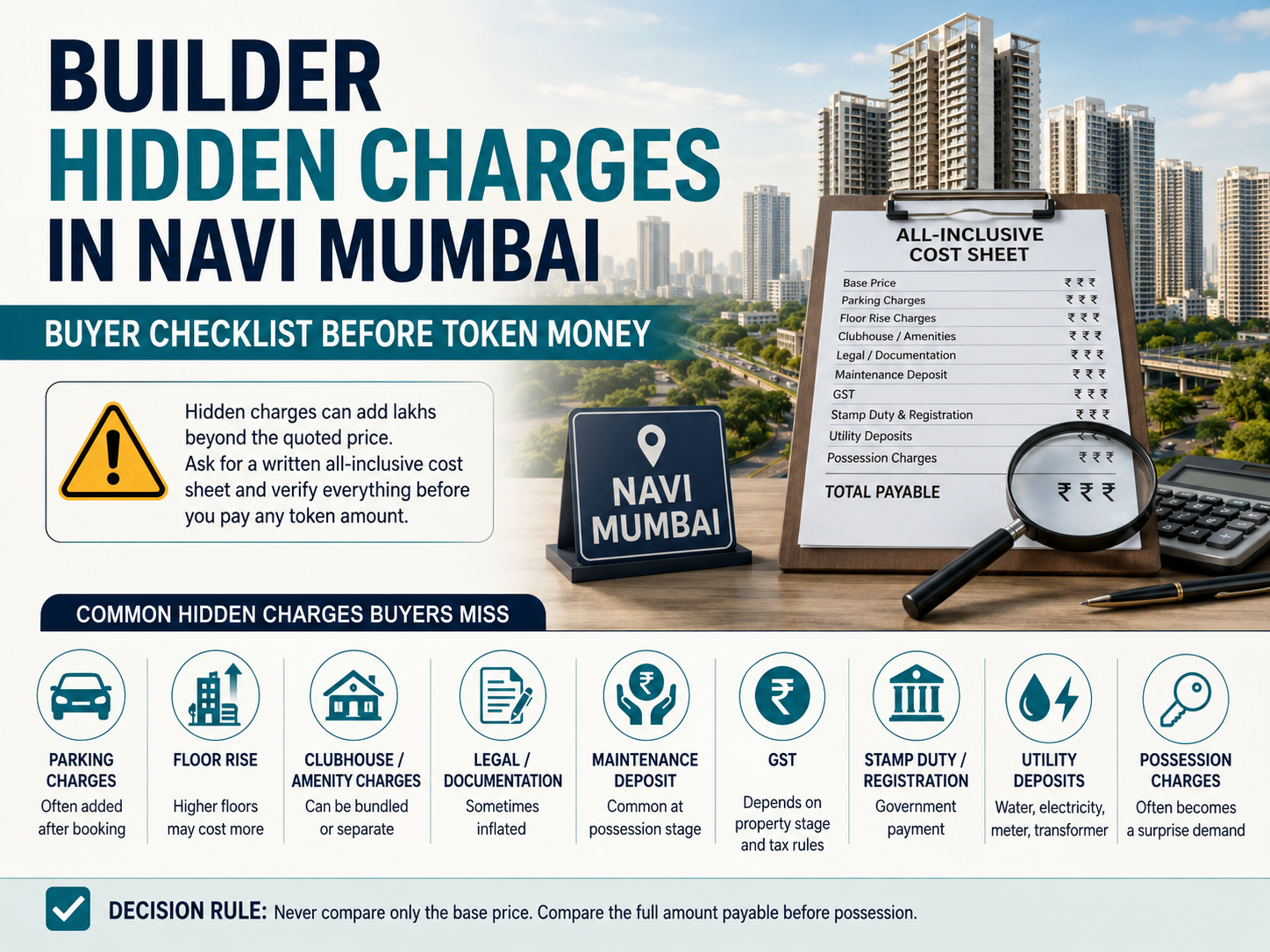
Builder hidden charges are costs that are not clearly explained when the buyer first asks for the property price.
A sales team may say, “The flat is ₹75 lakh,” but later the buyer sees extra charges for parking, floor rise, maintenance deposit, legal fees, GST, society formation, water connection, electricity meter, clubhouse or possession.
Not every extra charge is illegal. Some charges are normal if they are clearly written, supported by documents, and included in the agreement or official demand.
The risk starts when the charge is verbal, vague, added later, demanded in cash, or missing from the allotment letter and agreement for sale.
Common Hidden Charges Buyers Miss
| Charge | Why it matters | What to ask for |
|---|---|---|
| Parking charges | Often added after booking | Parking number, type, size and agreement clause |
| Floor rise | Higher floors may cost more | Written rate and cost sheet breakup |
| Clubhouse/amenity charges | Can be bundled or separate | Amenity list and agreement clause |
| Legal/documentation fees | Sometimes inflated | Written breakup and invoice |
| Maintenance deposit | Common at possession stage | Calculation period and society handover details |
| Corpus/sinking fund | Can be valid but must be clear | Purpose, amount and receipt |
| GST | Depends on property stage and tax rules | GST invoice and CA verification if unclear |
| Stamp duty/registration | Government payment | IGR/stamp duty calculation |
| Utility deposits | Water, electricity, meter, transformer | Authority demand or invoice |
| Possession charges | Often becomes a surprise demand | Final demand letter and agreement reference |
Decision rule: never compare only the base price. Compare the full amount payable before possession.
What to Check Before Paying Token Money
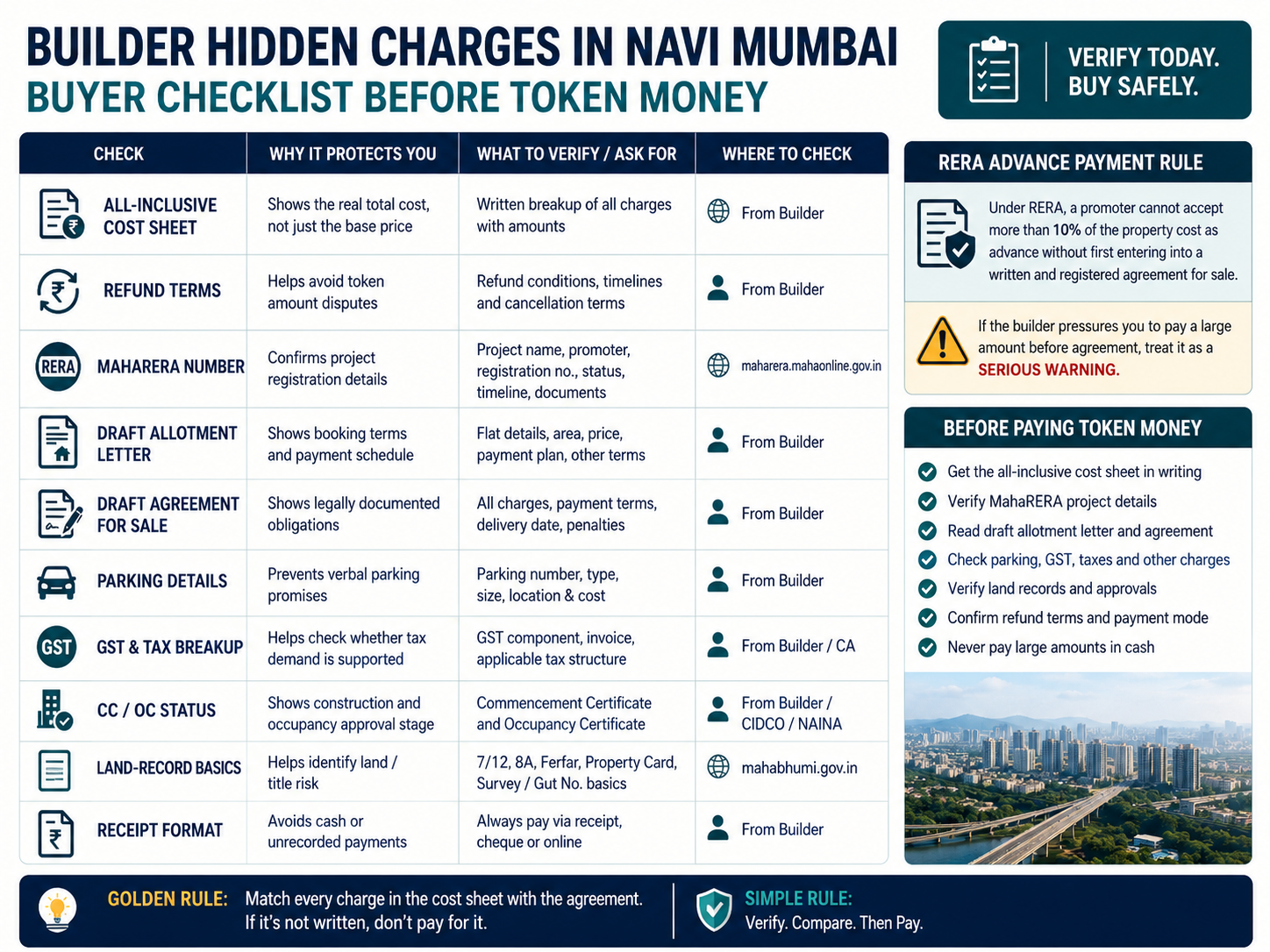
Before paying even a small token amount, ask for these documents in writing.
| Check | Why it protects you |
|---|---|
| All-inclusive cost sheet | Shows the real total cost, not just base price |
| Refund terms | Helps avoid token amount disputes |
| MahaRERA number | Confirms project registration details |
| Draft allotment letter | Shows booking terms and payment schedule |
| Draft agreement for sale | Shows legally documented obligations |
| Parking details | Prevents verbal parking promises |
| GST and tax breakup | Helps check whether tax demand is supported |
| CC/OC status | Shows construction and occupancy approval stage |
| Land-record basics | Helps identify land/title risk |
| Receipt format | Avoids cash or unrecorded payment risk |
Under RERA, a promoter cannot accept more than 10% of the apartment, plot or building cost as advance without first entering into a written and registered agreement for sale. So if the builder pressures you to pay a large amount before agreement, treat it as a serious warning.
Documents to Verify
MahaRERA project page
Search the project on MahaRERA. Check the project name, promoter name, registration number, sanctioned details, possession timeline, complaints, uploaded documents and project status.
MahaRERA registration improves transparency, but it does not mean the buyer can skip document verification.
Allotment letter and agreement for sale
Compare every charge in the cost sheet with the draft allotment letter and agreement for sale.
If a charge is not written anywhere, ask:
“Where is this charge mentioned in the agreement?”
Do not accept “this is standard” as an answer.
IGR Maharashtra records
Use IGR Maharashtra to check registered document history and Index II.
Index II is a summary of a registered property document. It supports verification of registration details, parties, property description and transaction history. It does not replace a lawyer’s title search.
Land records
For plot-linked, gaothan, village or NAINA-side property, check land records.
Plain English meanings:
| Term | Meaning |
|---|---|
| 7/12 extract / Satbara | Village land record showing land details, holder names and cultivation/land-use entries |
| 8A | Account-wise landholding record |
| Ferfar / mutation | Record of change, such as sale, inheritance or transfer entry |
| Property card | Urban property record, often used for city survey/CTS property |
| Survey/Gut number | Land parcel identification number |
These records support verification. They should not be treated as automatic proof of clean ownership.
CIDCO and NAINA checks
For Panvel, Ulwe, Taloja, Dronagiri, Uran and NAINA-side projects, verify CIDCO/NAINA permissions where relevant.
Check building permission, commencement certificate, occupancy certificate, development plan, DCPR, Town Planning Scheme status and Zone Confirmation Statement if applicable.
If the builder adds “CIDCO charges” or “NAINA charges,” ask for the actual authority document behind the demand.
CRZ and coastal-risk checks
For land near creeks, mangroves, coastal areas, Uran, Raigad or Thane coastal belts, check CRZ/CZMP status through MCZMA sources.
If a builder says “CRZ issue is already managed,” verify before transaction.
Parking, GST and Possession Charges
Parking is one of the most common dispute areas.
Ask whether the parking is open, covered, garage, podium, stilt, mechanical or stack parking. Also ask for the parking number, size and location.
If parking is promised but not written in the allotment letter or agreement, do not treat it as confirmed.
For GST, ask for a proper GST invoice. GST treatment can depend on construction stage, project facts and tax rules. If the amount is large or unclear, verify with a CA.
For possession charges, ask for the final demand letter and agreement reference. Do not pay unexplained possession-stage amounts only because the builder says keys will not be given.
Navi Mumbai Example
A buyer sees a 2 BHK near Kharghar-Panvel quoted at ₹78 lakh.
The sales team says, “Pay token today. Price will increase tomorrow.”
After token payment, the buyer receives a new breakup:
- Parking: extra
- Floor rise: extra
- Clubhouse: extra
- Legal charges: extra
- Maintenance deposit: extra
- GST: extra
- Possession charges: “to be decided later”
The actual cost becomes much higher than the first quote.
What should the buyer have done?
Before paying token money, the buyer should have asked for the all-inclusive cost sheet, MahaRERA details, draft allotment letter, draft agreement, parking details, refund terms, CC/OC status and GST breakup.
The right comparison is not “flat price.” The right comparison is “total cost before possession.”
Red Flags
Treat these as warning signs:
- “Pay token now, agreement later.”
- “Parking is confirmed, but not written.”
- “Possession charges will be decided later.”
- “This payment has to be made in cash.”
- “GST invoice will be given later.”
- “RERA is not required for this project.”
- “CIDCO/NAINA approval will come soon.”
- “OC is under process, but you can take possession.”
- “Refund terms are verbal.”
- “Cost sheet and agreement amount do not match.”
Do not pay large money based on verbal promises.
Common Mistakes Buyers Make
Mistake 1: Comparing only base price
A low base price can become expensive after add-ons. Always compare total payable cost.
Mistake 2: Trusting WhatsApp quotes
WhatsApp messages are useful for communication, but not enough for financial commitment. Ask for signed or official documents.
Mistake 3: Ignoring parking details
Parking must be clearly documented. A vague “one parking included” line is not enough.
Mistake 4: Paying token without refund terms
Many disputes start because the buyer does not record when token money is refundable and when it is not.
Mistake 5: Assuming RERA means zero risk
MahaRERA registration helps, but buyers still need to verify title, approvals, payment terms and possession conditions.
Mistake 6: Ignoring local land risk
In Navi Mumbai, Panvel, Ulwe, Taloja, Dronagiri and NAINA areas, land status, planning authority approval, CIDCO permissions, gaothan records, CRZ and mutation entries may matter.
When to Consult a Professional

Consult a property lawyer if:
- The builder refuses to give a full cost sheet.
- The agreement has vague extra charges.
- The property is in NAINA, gaothan, CIDCO leasehold or coastal area.
- OC, CC or sanctioned plan is unclear.
- There is resale, mortgage, litigation, inheritance or title-chain complexity.
- The builder demands high token money quickly.
Consult a CA for GST, TDS, NRI payments or tax invoice doubts.
Consult a planning/technical expert for CRZ, zoning, development plan, FSI, DCPR or sanctioned-plan issues.
This is an educational guide. Verify the latest position with the relevant authority or a property lawyer before making a transaction.
Conclusion
Before paying token money for a flat in Navi Mumbai, Panvel, Ulwe, Kharghar, Taloja, Dronagiri or NAINA, ask for the full cost sheet and verify every major charge in writing.
Next step: read before paying token money and property title fraud checks before you commit.
FAQs
Frequently Asked Questions