

How NMIA, MTHL and Connectivity Affect Ulwe Housing Demand
NMIA, MTHL, rail access, and better connectivity are clearly increasing Ulwe housing demand, but not in one simple way. Demand is rising most in parts of Ulwe where airport visibility, regional access, and daily usability come together. In other words, connectivity helps demand most where it reduces real friction for living, renting, and commuting, not just where it creates big headlines about future growth.
Ulwe has changed a lot from its earlier image as a place people bought into mainly for future hopes. That old “airport ayega, prices badhenge” logic is still part of the story, but it is no longer the full story. In 2026, the more important question is this: which type of connectivity is actually converting interest into occupancy, rent, and real transactions?
That is where the ground reality becomes more interesting. NMIA creates confidence and visibility. MTHL improves Ulwe’s regional position. Rail stations like Bamandongri, Kharkopar, and Targhar improve daily practicality. Local roads, water reliability, and completed surroundings decide whether a buyer or tenant will actually stay.
Does better connectivity really increase housing demand in Ulwe, or just improve sentiment?
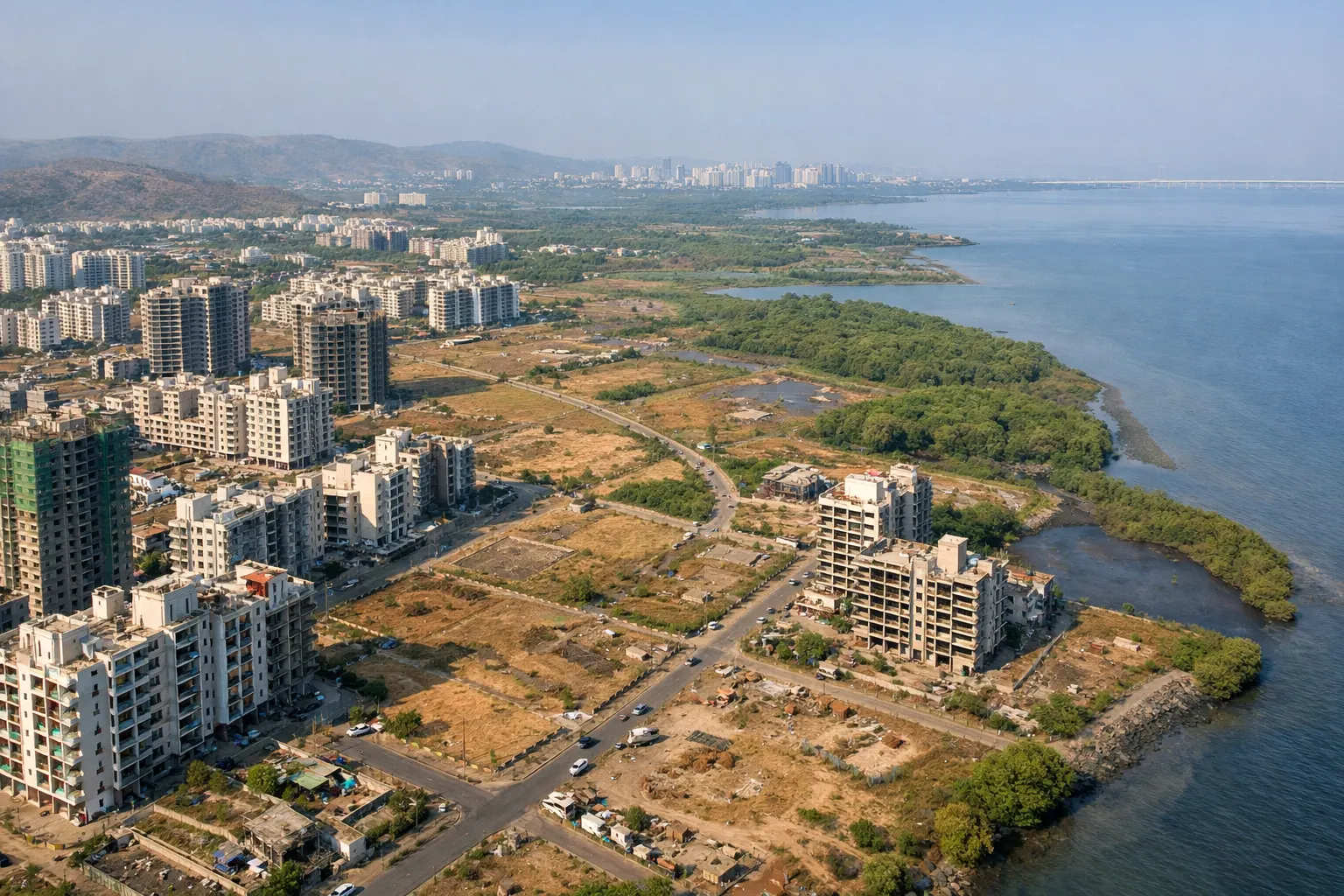
Yes, connectivity is increasing real housing demand in Ulwe now, not just market sentiment. But the benefit is uneven, and the strongest demand is concentrated in sectors and projects where access is actually usable on a daily basis.
For years, Ulwe demand was heavily sentiment-driven. People booked units because of future airport expectations, future road plans, and future city growth. Today, the situation is different because some of the biggest infrastructure links are no longer just promises. NMIA Phase 1 commercial operations began on 25 December 2025. MTHL is operational. The Nerul-Uran rail line is active, and Targhar station opened in December 2025. That shift matters because usable infrastructure changes buyer behaviour more than proposed infrastructure ever can.
Still, rising demand should not be confused with uniform demand. In Ulwe, the difference between enquiry and actual absorption is still important. A project may get a lot of attention online because it is “near airport influence,” but real demand shows up in registered transactions, rental take-up, family occupancy, and resale movement.
Quick Summary: How each connectivity layer affects Ulwe housing demand
| Connectivity layer | What it mainly improves | Strongest demand type | What it still does not solve |
|---|---|---|---|
| NMIA | Strategic importance, employment pull, rental visibility | Investor demand and airport-linked rental demand | Does not automatically create family livability |
| MTHL / Atal Setu | Macro-access to Mumbai side, market confidence, prestige | Buyer confidence and premium positioning | Does not fix internal civic issues inside Ulwe |
| Rail access | Daily commute practicality | End-user demand and stable rental demand | Depends on last-mile access and project location |
| Local roads and sector usability | Internal movement, convenience, retention | Actual long-term occupancy | Still weak in some pockets due to uneven infrastructure |
The simplest way to understand Ulwe in 2026 is this: visibility brings attention, access brings confidence, usability brings actual demand.
What NMIA changes in Ulwe demand that older connectivity stories could not
NMIA changes Ulwe’s demand profile because it gives the node a stronger economic role, not just a better future story. Earlier, Ulwe was mainly sold as an affordable growth node. Now it is increasingly seen as part of an airport-driven residential and rental ecosystem.
The airport matters because it changes who may want to live near Ulwe. Once an airport becomes operational, nearby housing demand is no longer only about speculative investors or long-term land bets. It starts attracting aviation staff, logistics-linked professionals, hospitality workers, consultants, and people who prefer to stay near future commercial activity. That does not make every flat in Ulwe valuable overnight, but it does raise the base level of market interest.
Infrastructure demand does not spread evenly across the node, which is why readers should also study the best sectors in Ulwe to understand which pockets may benefit more from this connectivity story.
Why airport proximity changes buyer psychology
Airport proximity changes buyer psychology because it creates long-term confidence. A functioning airport is a stronger signal than a proposed airport. It tells the market that this zone now has real economic relevance.
That is why Ulwe is no longer viewed only as a far-off affordable suburb. It is now part of a larger airport-led growth belt. The 667-acre Aerocity planning context also supports this long-term confidence, even though that larger commercial story is still in the planning and build-out phase, not fully realised on the ground.
For investors, this creates a belief that tenant demand and future appreciation may both strengthen over time. For buyers, it improves confidence that Ulwe will not remain dependent on one single growth narrative.
Why airport-led demand is not the same as immediate family demand
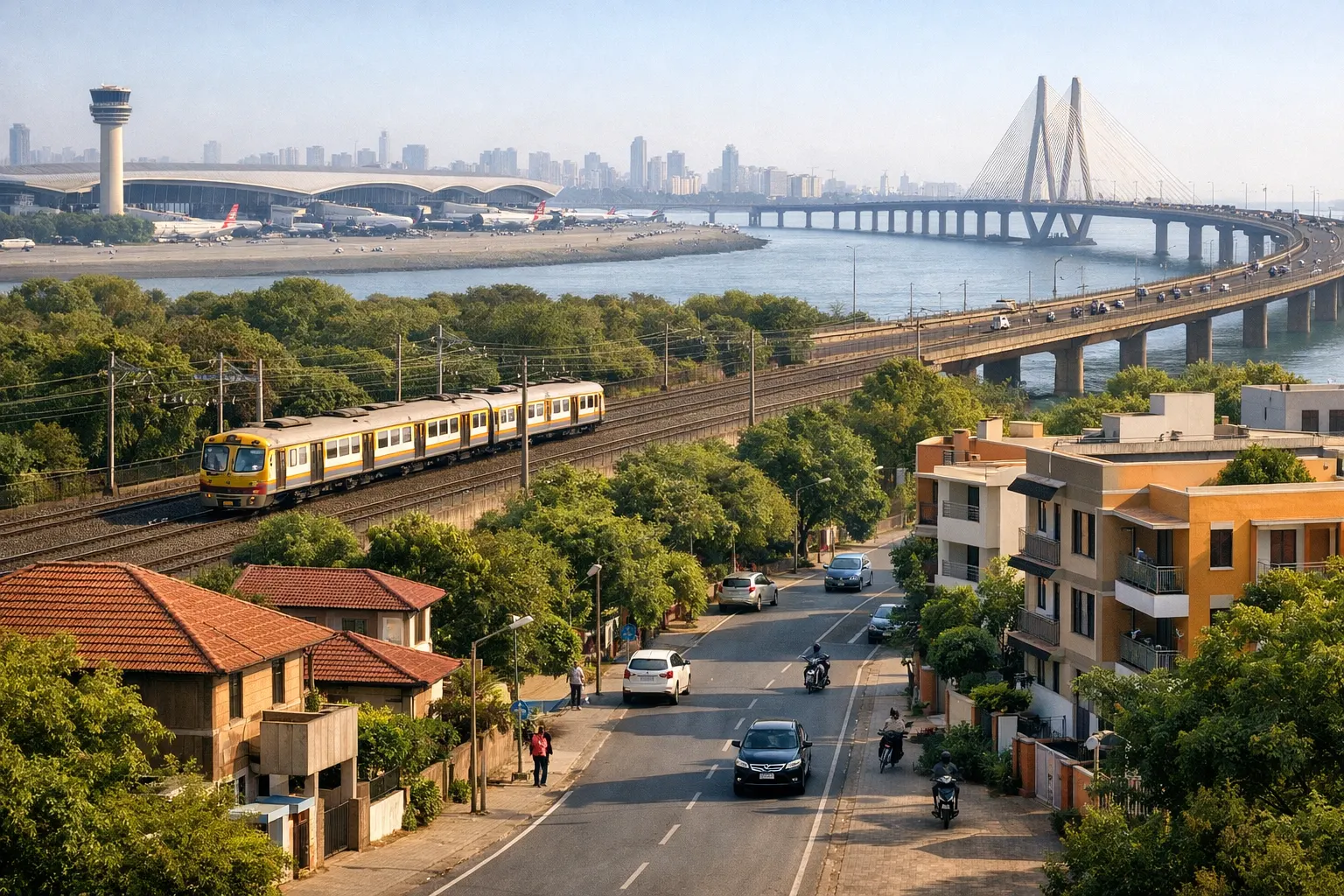
This is where many buyers get confused. Airport-led demand and family end-user demand are not the same thing.
Airport-linked demand is often faster, more transactional, and more rental-oriented. A pilot, cabin crew member, airport services employee, or logistics professional may want a ready flat with decent access, decent furnishings, and quick movement to the terminal side. Family demand works differently. Families care about schools, water reliability, groceries, internal roads, commute comfort, and whether the area feels stable enough for daily life.
So yes, NMIA increases Ulwe housing demand. But the first wave is stronger for rental demand, investor confidence, and short-to-medium-term occupancy logic. Family absorption grows more slowly and depends more on local ecosystem maturity.
How MTHL changes Ulwe’s position in the wider Mumbai movement map
MTHL has changed Ulwe’s market position more than many people realise. Its biggest effect is not only travel time. Its biggest effect is that it pulls Ulwe mentally and economically closer to the Mumbai side of the map.
A 21.8-kilometre sea link that sharply reduces travel time changes how people perceive distance. That matters in real estate. A place that once felt separate now starts feeling connected to a wider urban circuit. Even people who may not use the bridge every day still respond to that shift.
Why macro-access matters even for people who may not use the bridge daily
Macro-access matters because it changes confidence, status, and market depth. A location that can connect faster to South Mumbai and the larger Mumbai economic zone attracts more serious buyers, more institutional attention, and more developer interest.
In practical terms, MTHL helps Ulwe look less isolated. That improved perception can support housing demand because buyers are more comfortable entering a node that now feels connected to bigger job and business zones. It also helps Ulwe compare better against other airport-influence areas that still feel earlier in their development cycle.
What MTHL improves and what it does not solve inside Ulwe
MTHL improves macro-connectivity. It does not automatically improve everyday life inside all parts of Ulwe.
This is a very important distinction. A world-class regional connector can make a location more attractive, but it cannot solve water cuts, uneven internal roads, poor drainage, weak pedestrian movement, or project-level livability gaps. Ulwe’s severe water supply stress in 2025 exposed exactly this problem. A buyer may like the airport and the bridge story, but if the building depends on tankers or the surrounding area still feels unfinished, the final purchase decision becomes harder.
So MTHL absolutely strengthens Ulwe’s demand story. It just does not solve every reason why one project rents faster than another.
Which kind of connectivity actually drives housing demand more in Ulwe: airport, bridge, rail, or local roads?
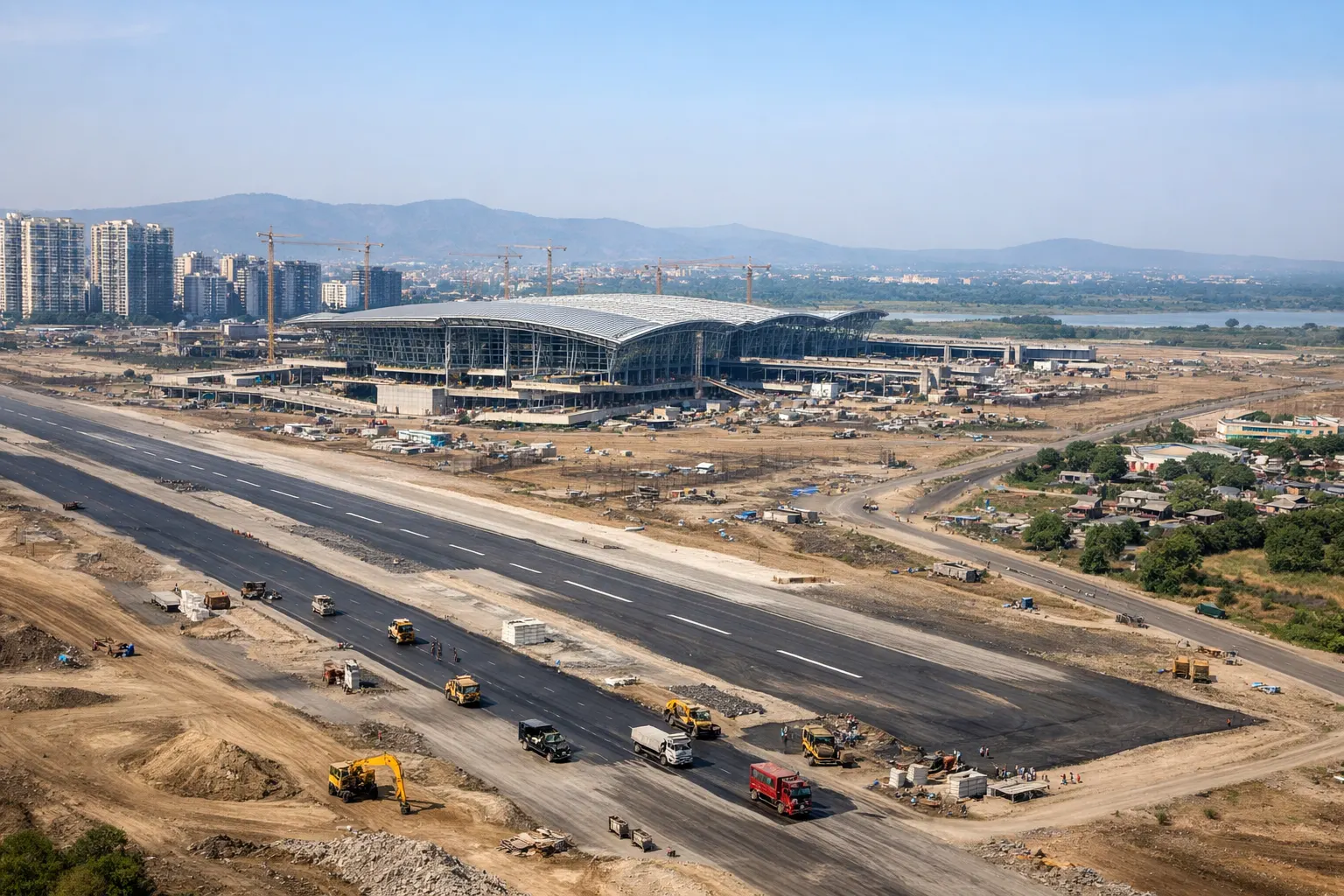
If the question is about real housing demand, rail and daily-use connectivity often matter more than airport headlines for end users. For rental demand near airport-linked work, NMIA matters more. For overall market confidence and positioning, MTHL matters a lot. Local roads decide whether any of this works smoothly in practice.
That is why Ulwe cannot be understood through one infrastructure project alone.
| Connectivity type | Most affected buyer group | Main demand effect in Ulwe | Ground reality |
|---|---|---|---|
| NMIA | Investors, rental buyers, airport-linked professionals | Increases strategic demand and premium expectations | Strongest where ready inventory and access are practical |
| MTHL | Buyers comparing Mumbai-side access and long-term value | Improves market confidence and regional relevance | Strong macro effect, weaker direct daily-use effect inside sectors |
| Bamandongri / Kharkopar / Targhar rail access | Families, office commuters, practical tenants | Drives end-user absorption and daily rental demand | Often the most important for sustained occupancy |
| Internal roads / local movement | All residents | Affects real livability and retention | Weak internal execution can reduce the benefit of bigger projects |
In simple terms, airport access creates future value, MTHL creates regional confidence, rail creates day-to-day usability, and local roads decide whether the experience is smooth or frustrating.
Is Ulwe seeing more end-user demand now, or is investor demand still dominating?
Ulwe is no longer purely investor-driven, but investor demand is still a major part of the market. The more accurate answer is that Ulwe is now in a mixed-demand phase.
That means end-user demand has clearly improved, especially in better-connected and more settled pockets. At the same time, a large layer of buying is still driven by future commercial growth, rental yield expectations, and airport-led positioning.
Signs of genuine end-user demand
The signs of real end-user demand are usually visible on the ground, not just in brochures. When a market begins shifting from speculation to actual living, you start seeing more family occupation, more everyday commerce, more service activity, and more practical use of the transport network.
In Ulwe, station-linked sectors and stronger pockets are showing these signs more clearly. End users are more willing to buy completed or near-completion homes if they feel the area is now usable enough for regular life and not only for future appreciation.
Signs of speculative or future-led demand
Investor demand is still visible where pricing runs ahead of actual usability. One major clue is the gap between portal asking rates and registered transaction reality. In stronger Ulwe pockets, asking rates are often quoted in the range of about ₹13,500 to ₹14,850 per sq. ft., while actual IGR-linked transaction bands are notably lower, closer to around ₹10,500 to ₹11,500 per sq. ft. That tells you the market still carries a lot of expectation.
Another sign is when projects are sold mainly on future Aerocity, airport corridor, or premium-location language, even though daily civic quality is still catching up. That does not mean the area is weak. It simply means part of the market is still pricing tomorrow into today.
How connectivity affects rental demand differently from buying demand in Ulwe
Connectivity affects rental demand faster than buying demand because tenants judge usability immediately. A homebuyer may tolerate some inconvenience if they believe the area will improve over three to five years. A tenant usually will not.
That is why Ulwe’s rental story is becoming stronger, but only in the right pockets. The airport has created a real rental-use case. Rail access supports daily commuting. Together, they improve occupancy logic. But tenants are much less patient than investors.
Market interest matters only when it starts affecting pricing reality, which is why checking the current property rates in Ulwe is important after understanding the demand drivers.
What tenants usually care about more than investors expect
Tenants care more about last-mile convenience than many buyers assume. They notice things like whether autos are easily available, whether the station is genuinely walkable, whether the road outside floods, whether the building has regular water, and whether the surrounding environment feels practical after dark.
This is especially relevant in Ulwe because a flat that looks strategically located on paper may still feel inconvenient in real life. Even airport-linked tenants may not choose a property if the movement from home to station, shuttle point, or road link feels awkward every day.
Where connectivity helps rental demand but not equally across Ulwe
Ulwe’s stronger rental demand is concentrated, not universal. Prime station-proximate pockets such as sectors around Bamandongri and Targhar-side convenience tend to benefit more because they combine commuter value with airport influence. That is one reason rental yields in stronger Ulwe pockets are being seen in roughly the 6.2% to 8.5% range, higher than more mature benchmark markets like Panvel in many cases.
But rental demand weakens when internal access becomes difficult. Deeper interiors or pockets with weaker convenience, weaker roads, or more friction in daily movement do not always get the same tenant response, even if they are technically part of the same Ulwe story.
Why all parts of Ulwe do not benefit equally from the same infrastructure story
Because Ulwe is not one single uniform market. This is one of the biggest mistakes generic articles make.
A sector near a useful rail link, better internal roads, and more active daily surroundings behaves very differently from a sector that still depends heavily on future completion or suffers from civic friction. The airport story may cover the whole node in headlines, but real demand is far more selective.
Station-linked and easier-access pockets
Pockets with stronger station relevance and easier daily movement naturally absorb demand faster. In Ulwe, sectors like 17 and 19 repeatedly appear in stronger demand logic because they align better with commute comfort, tenant practicality, and overall usability. Targhar’s addition to the movement network also improves the demand logic for nearby areas because it strengthens the link between rail access and airport-side movement.
These are the kinds of pockets where connectivity becomes real, not symbolic.
Areas where the story is still stronger on paper than in everyday life
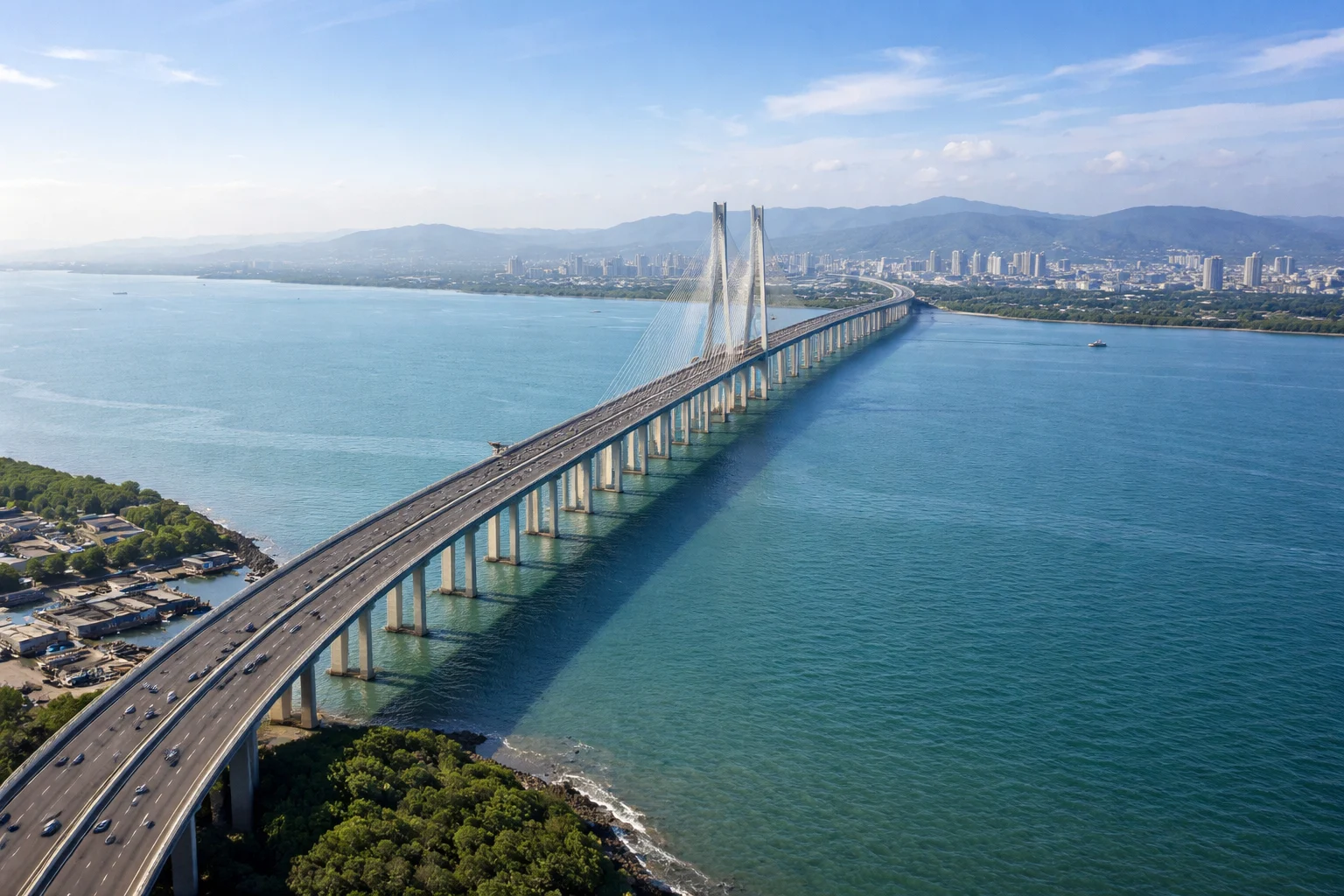
Other parts of Ulwe still depend more on future improvement than present ease. In such areas, the airport and bridge story may help marketing, but it does not fully remove hesitation. If internal roads are weak, if civic services are inconsistent, or if the project sits in a less practical stretch, demand may stay slower and more negotiated.
This is why a buyer should never treat “Ulwe demand is rising” as proof that every sector or every building is equally attractive.
What buyers often misunderstand when they hear “Ulwe demand is rising”
The most common misunderstanding is assuming that rising demand means all properties are becoming safer, more liquid, and more valuable at the same speed. That is not true.
Another misunderstanding is thinking that asking price equals actual market strength. In Ulwe, the gap between portal rates and registered transaction rates shows that seller confidence and buyer reality are not always the same. The market may be improving, but it is still a negotiated market.
There is also a tendency to assume that big infrastructure automatically removes project risk. It does not. MahaRERA risk remains relevant across the wider MMR context, and Ulwe buyers still need to check project status, compliance, and readiness carefully. A location can improve while an individual project remains a poor buy.
If connectivity is improving, why do some Ulwe projects still feel slow or uneven?
Because connectivity improves the market, not every project equally. Project-level performance still depends on pricing, legality, readiness, and micro-location quality.
In a region where large supply has entered the market, buyers are more selective. If a developer priced a project too aggressively by assuming full future airport value in advance, absorption can slow down. Buyers may prefer ready inventory in better sectors instead of paying a premium for under-construction promises.
Launch pricing versus actual absorption
This is a major issue in Ulwe. Some launches are priced as if the full airport-commercial ecosystem is already mature. But educated buyers know that parts of the long-term growth story are still unfolding. So they negotiate harder, shift to completed homes, or compare Ulwe with nearby options where entry cost may be lower.
That means improved connectivity does not guarantee fast sales if the launch price is ahead of the local reality.
Demand concentration versus node-wide demand
Demand in Ulwe is strong, but concentrated. Projects with clearer advantages such as better station access, stronger surroundings, completed status, better water resilience, and cleaner legal comfort are more likely to benefit. Projects without these strengths can still move slowly even inside a rising node.
That is why good analysis in Ulwe has to stay project-specific and sector-specific.
Who benefits most from connectivity-led housing demand in Ulwe right now?
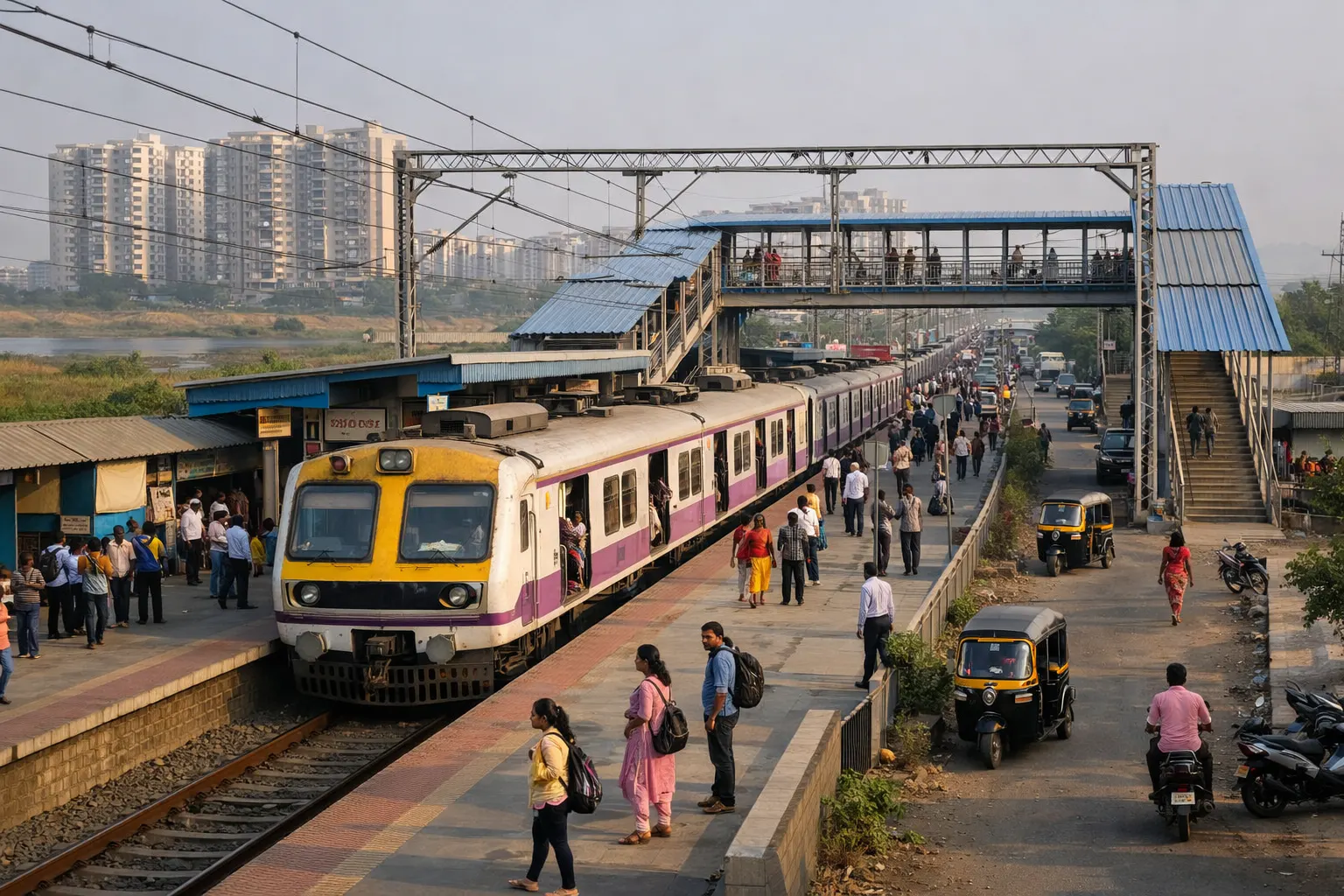
Different buyer types benefit in different ways. There is no single winner profile.
End-use families
Families benefit most in completed or nearly ready projects in sectors with stronger rail access, practical roads, and more reliable everyday life. For them, connectivity is useful only when it supports regular commuting and stable living. The airport story is a bonus, not the main decision factor.
Yield-focused buyers
Yield-focused buyers benefit from Ulwe’s airport-linked rental logic, especially in compact ready units in stronger pockets. This works best where access to station-side movement and airport-side commuting is practical enough to attract working tenants. The high rental yield discussion around stronger Ulwe pockets makes more sense here than in weaker interior locations.
Long-hold investors
Long-hold investors benefit from Ulwe’s broader strategic shift. NMIA, MTHL, Targhar integration, the Aerocity planning context, and future road improvements all support a multi-year appreciation case. But this profile still needs patience and careful selection. The gain is stronger where future growth is backed by present usability.
What should a buyer or investor check before assuming connectivity will guarantee demand?
Before buying in Ulwe, a person should check whether the property is benefiting from real connectivity or only from a marketing narrative.
Use this checklist before making assumptions:
- Check the project’s MahaRERA registration and latest progress updates
- Verify whether the building has CC and, where relevant, OC status
- Ask about actual water supply, storage capacity, and tanker dependence
- Check real walking or commuting distance to Bamandongri, Kharkopar, or Targhar instead of trusting map claims
- See the surrounding roads, drainage, and everyday convenience physically
- Compare portal asking price with realistic transaction logic, not just broker quotes
- Understand whether the demand in that micro-location is family-led, rental-led, or mostly investor-led
- Avoid assuming that all Ulwe sectors benefit equally from NMIA and MTHL
This one step alone can save a buyer from paying airport premium pricing for a building that still behaves like a weak interior project.
Final answer: is connectivity making Ulwe’s housing demand stronger in a durable way?
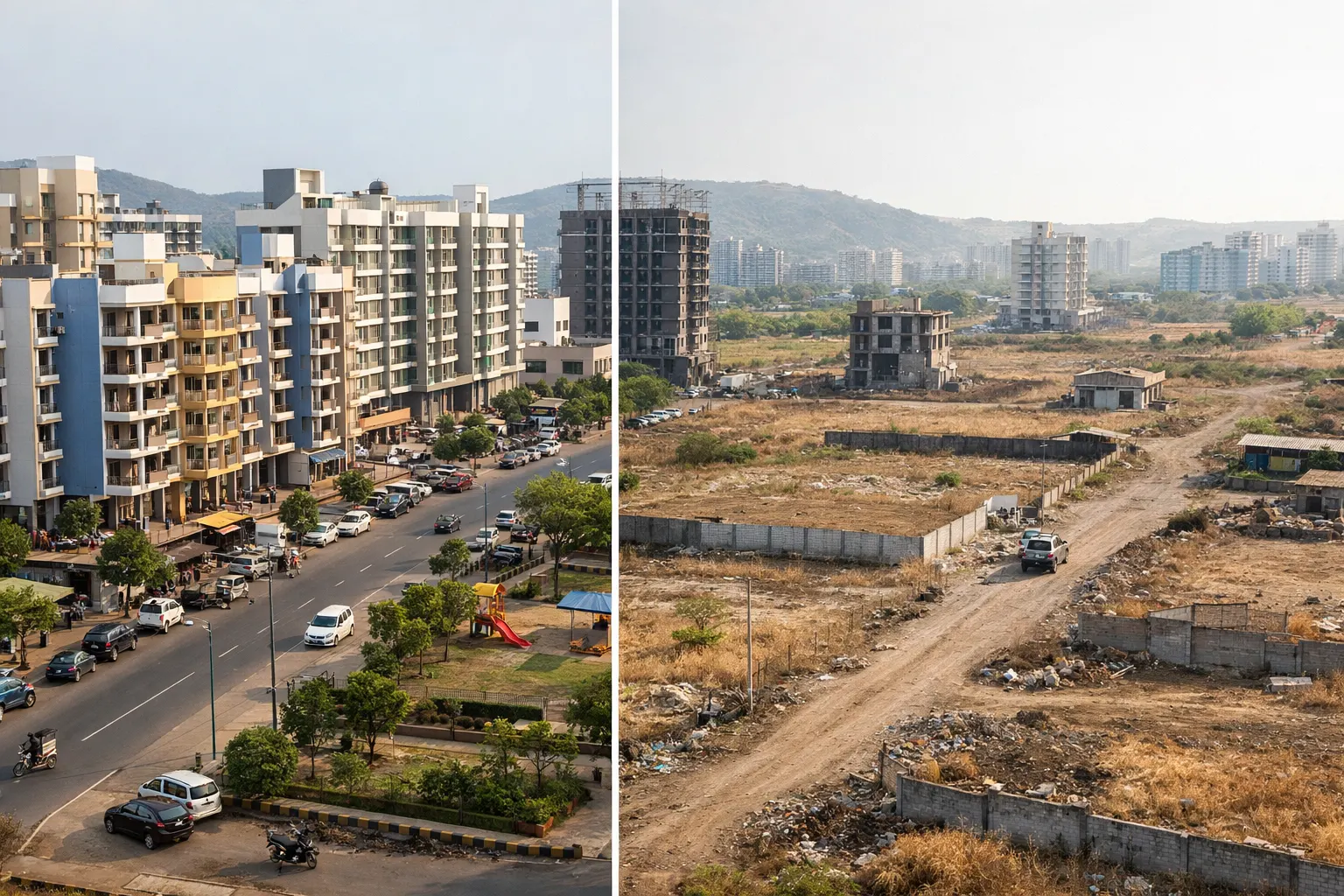
Yes, connectivity is making Ulwe’s housing demand stronger in a durable way, but only where big infrastructure meets daily practicality.
NMIA has made Ulwe more important. MTHL has made it more connected and visible. Rail access has made it more usable. But the most durable demand is appearing where these advantages are supported by real-life factors such as station convenience, internal movement, better civic conditions, and ready livability.
That is the real answer.
Ulwe is no longer just running on future hype. It has entered a more serious housing-demand phase. But it is still not a market where every sector, every building, and every launch benefits equally. For end users, the best demand story is in practical, station-linked, livable pockets. For rental buyers, the best opportunity is where airport-linked occupancy and day-to-day access come together. For investors, the upside remains real, but only if they separate strong micro-markets from weak ones.
Conclusion
The best way to read Ulwe in 2026 is not as an “airport story” alone, but as a layered connectivity story. NMIA has raised the ceiling. MTHL has improved the map. Rail access has improved daily practicality. Local execution decides where demand becomes truly durable.
So yes, Ulwe housing demand is getting stronger. But the strongest demand is not going everywhere. It is going where connectivity is not just visible in infrastructure headlines, but felt in everyday life.
FAQ's
Frequently Asked Questions