
How to Choose the Right Real Estate Developer in Kopar Khairane
To choose the right real estate developer in Kopar Khairane, buyers should check the developer’s past delivery record, MahaRERA details, legal documents, construction quality, pricing transparency, completed projects, buyer feedback and possession history before paying token money. In Kopar Khairane, this becomes especially important because many properties involve CIDCO-origin land, NMMC approvals, older society redevelopment, PAP plot risks and sector-wise differences in water, parking and building condition.

Quick Summary: How to Choose the Right Real Estate Developer in Kopar Khairane
| What to Check | Why It Matters in Kopar Khairane | Good Sign | Red Flag |
|---|---|---|---|
| MahaRERA registration | Confirms basic project registration and uploaded documents | Valid RERA number with clear project details | No RERA number or vague “under process” answer |
| Title and CIDCO documents | Many properties have CIDCO leasehold or transfer history | Clear title report, CIDCO allotment/transfer clarity | Missing title chain or unclear PAP plot status |
| Commencement Certificate | Confirms legal construction permission up to a certain floor | CC covers the floor you are buying | CC approved only up to a lower floor |
| Occupancy Certificate | Confirms legal completion and habitability | OC received or written OC timeline | “Fit-out possession” without OC |
| Completed projects | Shows actual delivery quality | Older buildings are structurally stable | Leakage, cracks, poor lift and lobby condition |
| Pricing clarity | Prevents hidden charges after token payment | Stamped all-inclusive cost sheet | Verbal discounts, unclear parking or PLC charges |
| Buyer feedback | Reveals after-sales reality | Residents speak positively about handover and maintenance | Repeated complaints about water, parking, leakage or corpus |
| Society handover | Important for long-term control and redevelopment | Society formed and conveyance/deemed conveyance done | Builder still controls maintenance after years |
The safest way to choose a real estate developer in Kopar Khairane is to verify legal documents, completed projects, pricing clarity and buyer feedback before paying token money. A reputed developer is not always the right developer if the project has unclear approvals, delayed possession, hidden charges or weak after-sales support.
Why Choosing the Right Real Estate Developer Matters in Kopar Khairane
Kopar Khairane is not a new experimental market. It is a mature Navi Mumbai node located between Vashi, Ghansoli, Airoli, Mahape and the Thane-Belapur business belt. Many homebuyers here are end-users working in nearby employment hubs such as Millennium Business Park, Reliance Corporate Park and DAKC. That makes the area practical for families, working professionals and investors.
But maturity also brings complications. Many buildings are older CIDCO-era cooperative societies. Some are moving towards redevelopment. Some pockets have mixed land histories involving gaothan extensions, PAP or 12.5% scheme plots and leasehold transfer issues. A buyer cannot judge a developer only by brochure design, sample flat lighting or sales office confidence.
A wrong developer can create problems such as delayed possession, no Occupancy Certificate, unclear CIDCO transfer charges, poor waterproofing, weak parking planning, society handover disputes and hidden cost shocks. In Kopar Khairane, the developer must understand both the legal framework and the ground reality of Navi Mumbai living.
This article is for general buyer awareness. Before booking or signing an agreement, buyers should verify documents with a qualified legal professional.
Understand the Developer’s Past Track Record
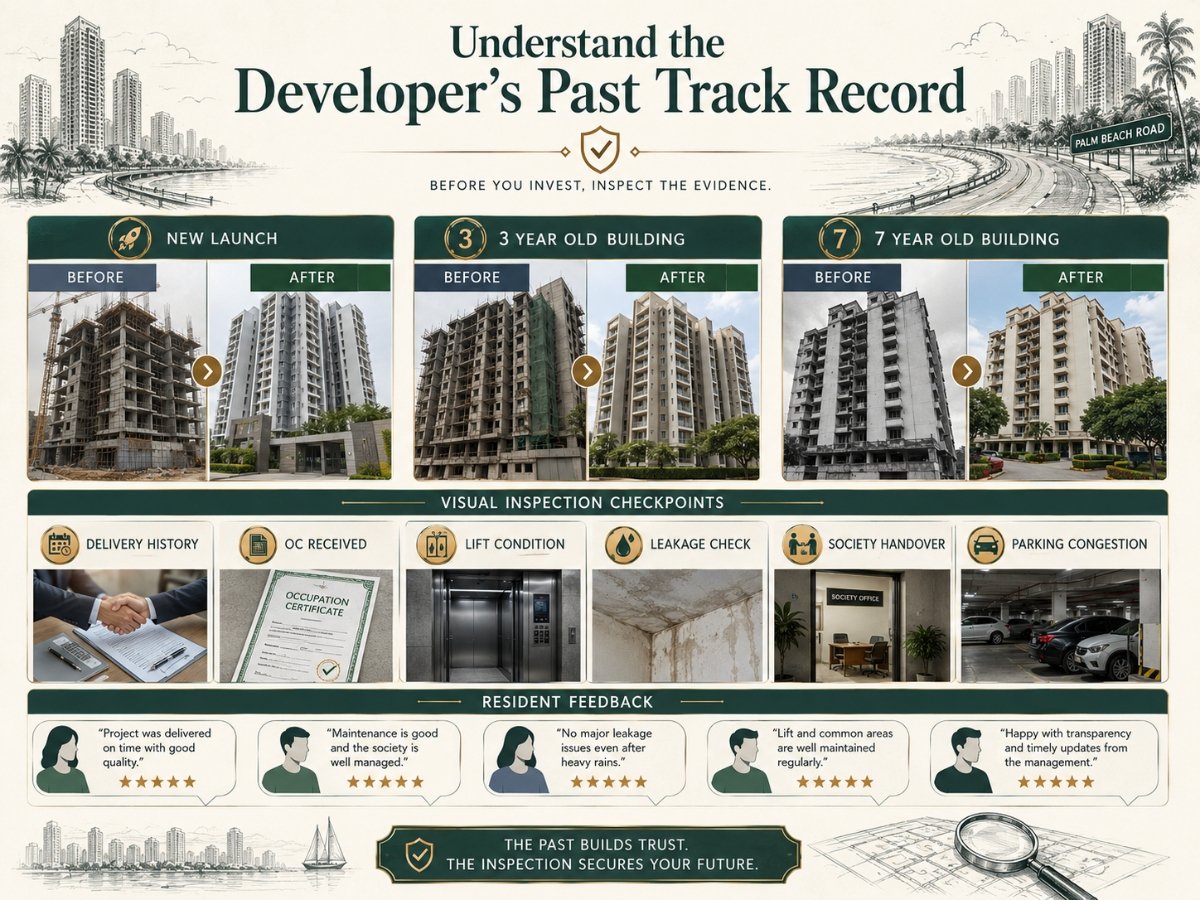
A developer’s past record is the strongest indicator of future performance. Do not judge only by current project advertising. Check what the builder has already delivered in Kopar Khairane, Ghansoli, Vashi, Sanpada, Airoli or other Navi Mumbai nodes.
A reliable developer should have a clean pattern of completed projects, proper handovers, working lifts, usable parking, clear documents and satisfied residents. A weak developer usually leaves clues in older buildings: leakage, poor common areas, broken promises, delayed OC, incomplete amenities and society disputes.
Check Completed Projects Before Trusting New Launches
New launches always look attractive. The brochure is clean, the sample flat is well-lit and the sales team speaks confidently. But a completed project shows the real truth.
Before booking an under-construction flat, visit at least two completed projects by the same developer. Prefer projects that are 5 to 7 years old. This is enough time for poor waterproofing, weak plaster, lift issues and maintenance problems to become visible.
In Kopar Khairane, buyers should also look at older sectors such as Sector 9, 11, 12, 14 and 15 where building ageing, redevelopment and maintenance quality are easier to observe.
Visit Older Buildings Developed by the Same Builder
During a site visit, do not look only at the lobby. Check the building like a buyer, not like a guest.
Look for:
- Damp patches near windows and bathrooms
- Peeling paint on external walls
- Basement water seepage
- Lift breakdown frequency
- Parking congestion
- Cracks in common areas
- Quality of staircase, lobby and terrace waterproofing
- Whether the society has proper records and handover documents
Navi Mumbai’s coastal humidity and monsoon rainfall test every building. If a developer’s older buildings look tired within a few years, be cautious.
Speak to Existing Residents and Buyers
Existing residents are often more useful than online reviews. They can tell you what the developer actually delivered after taking money.
Ask residents:
- Was possession given as promised?
- Was OC received before possession?
- Were there hidden charges after booking?
- Was the society formed on time?
- Did the builder hand over maintenance corpus clearly?
- Are there water supply, lift or parking issues?
- Does the developer respond to defects after possession?
In Kopar Khairane, also ask about NMMC water supply, tanker dependency, parking discipline and monsoon leakage. These are practical issues that affect daily living more than brochure amenities.
Check MahaRERA Registration and Project Transparency

MahaRERA registration is important because it gives buyers access to project information, declared possession timelines, uploaded approvals, legal title reports, financial details and complaints where available. For projects above the applicable size and unit threshold, MahaRERA registration is a basic legal requirement.
However, a buyer should not stop at seeing the RERA logo on the hoarding. The RERA number must be checked on the official MahaRERA website.
Why MahaRERA Is Important for Kopar Khairane Buyers
Kopar Khairane buyers need MahaRERA verification because many projects involve high-value transactions, redevelopment, CIDCO-origin plots or complex approval histories. MahaRERA helps buyers see whether the project is officially registered and whether the promoter has uploaded required project details.
It also gives a formal possession timeline. This matters because sales teams may verbally say “possession in two years,” but the RERA timeline may be longer. The RERA timeline is usually the more important legal reference.
What to Verify on the MahaRERA Website
When checking a project on MahaRERA, open the actual project page and verify:
| MahaRERA Check | What Buyer Should Look For |
|---|---|
| Project registration number | Exact P-number should match brochure and agreement |
| Promoter name | Should match the developer or legal entity selling the project |
| Possession date | Compare sales promise with RERA declared timeline |
| Legal title report | Check whether land title is clear or has remarks |
| Commencement Certificate | Confirm sanctioned floors and approvals |
| Encumbrances | Check if the project land has loans or legal burdens |
| Litigation details | See whether disputes are disclosed |
| Architect certificate | Understand actual construction progress |
| Uploaded plans | Compare with brochure layout and amenities |
MahaRERA registration is important, but it should not be treated as the only proof of developer quality.
Why MahaRERA Alone Is Not Enough
MahaRERA is the baseline of safety, not the finish line.
A project can be registered on MahaRERA and still have poor construction quality, weak waterproofing, bad parking design, delayed civic approvals or a difficult micro-location. MahaRERA does not personally inspect every wall, lift, basement or water tank for practical liveability.
For Kopar Khairane buyers, RERA verification must be combined with:
- Physical site visit
- Completed project visit
- CIDCO and NMMC document checks
- Independent legal review
- Resident feedback
- Pricing and payment term verification
Check Legal Documents Before Booking a Flat
Legal documents are the real foundation of a property purchase. A beautiful building on weak title can become a lifelong problem. Before paying token money, buyers should ask for important documents and get them reviewed by an independent property lawyer.
A bank loan approval alone is not enough. Banks check many things, but their due diligence is not a replacement for buyer-side legal verification.
Title Clearance Certificate
The Title Clearance Certificate confirms whether the land has a clear ownership or leasehold chain, pending disputes, mortgages or multiple claimants.
In Navi Mumbai, the title chain often involves CIDCO acquisition, allotment, lease agreements, transfer orders and developer rights. For Kopar Khairane, this is especially important because some pockets have complex histories involving older societies, gaothan borders and PAP-related plots.
A good sign is when the developer willingly shares a clear title report before asking for token money. A red flag is when the sales team says, “Sir, documents will be shown after booking.”
Commencement Certificate
The Commencement Certificate, or CC, gives legal permission to start construction up to a specific level or floor. Buyers must check whether the CC covers the exact floor they plan to buy.
For example, if you are buying on the 15th floor but the CC is approved only up to the 10th floor, that is a serious red flag. The developer may say further approval will come later, but your money is already at risk if you book without clarity.
Occupancy Certificate
The Occupancy Certificate, or OC, confirms that the building has been completed according to approved plans and is fit for legal occupation.
Important warning: Do not treat “fit-out possession” as final legal possession. Without OC, buyers may face problems with municipal services, resale, taxation, water charges and long-term legal clarity.
In NMMC areas like Kopar Khairane, OC clarity is extremely important. For ready-to-move flats, insist on seeing the OC before making final payment.
Approved Building Plan
The approved building plan should match what the developer is selling. Compare the official plan with the brochure, sample flat and promised amenities.
Check:
- Flat layout
- Carpet area
- Parking layout
- Staircase and lift position
- Open spaces
- Refuge area
- Amenity spaces
- Commercial use, if any
If the brochure shows one thing and the approved plan shows another, trust the approved plan.
Agreement for Sale
The Agreement for Sale is the main legal contract between buyer and developer. It should mention possession timeline, payment schedule, carpet area, flat number, parking details, specifications, delay compensation and all charges.
Before signing, check whether the agreement includes one-sided clauses. Some agreements heavily penalize buyers for small payment delays but offer weak protection against developer delays. This should be reviewed carefully.
For deeper understanding, buyers can refer to [Agreement to Sale vs Sale Deed](ADD INTERNAL LINK HERE).
CIDCO Transfer and Leasehold Clarity
Most Navi Mumbai land has a CIDCO-origin leasehold structure. This means buyers must understand whether the property requires CIDCO transfer, leasehold rights, NOC, transfer charges or other estate-related permissions.
In resale or redevelopment cases, CIDCO transfer clarity becomes even more important. The agreement should clearly mention who will pay CIDCO transfer charges if applicable. Do not accept verbal answers on this point.
Kopar Khairane-Specific Documents Buyers Should Check Before Booking
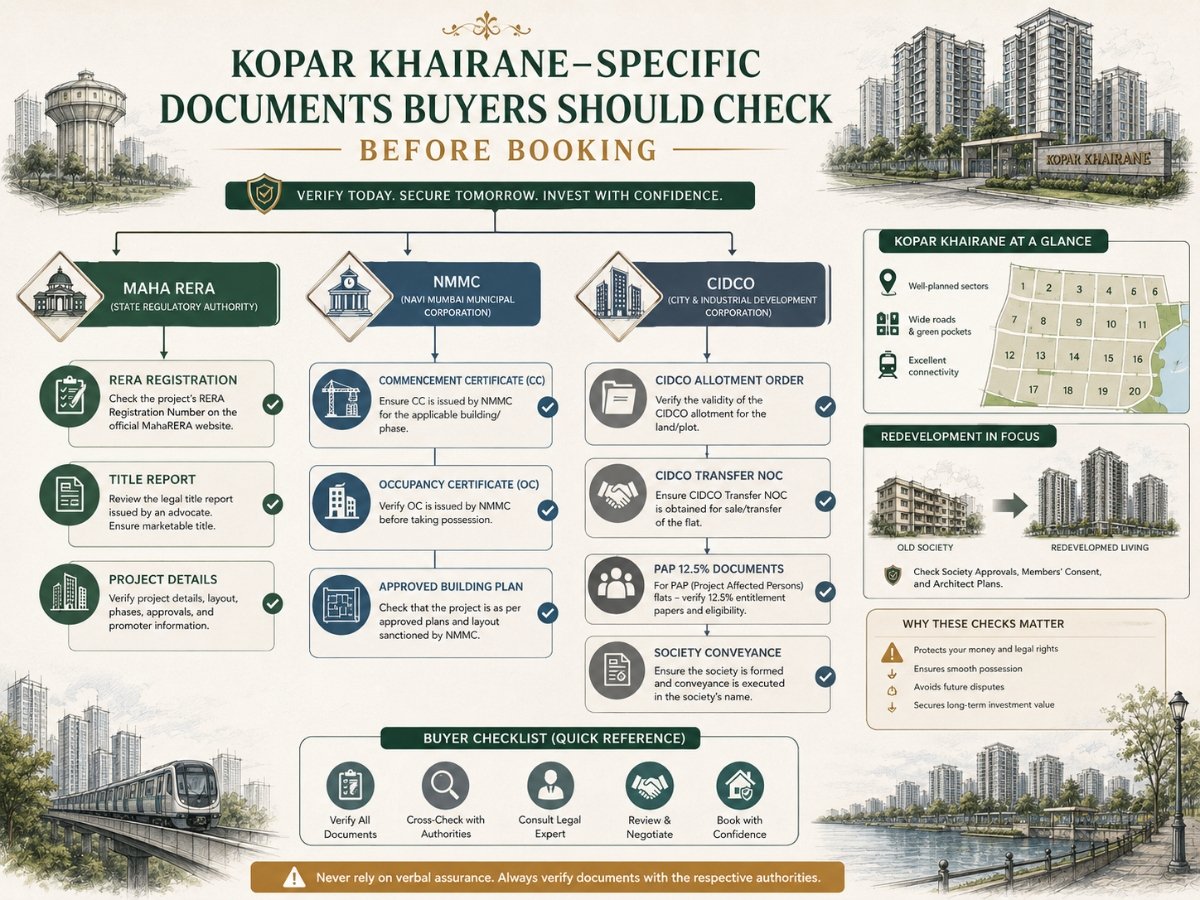
Kopar Khairane is not legally uniform across every pocket. Some plots are clear CIDCO-allotted plots, some are older societies, some are redevelopment properties and some areas near gaothan or PAP belts need deeper scrutiny.
| Document / Check | Why It Matters | How Buyer Can Verify |
|---|---|---|
| MahaRERA registration | Confirms project registration and declared details | Check project P-number on MahaRERA portal |
| Title Clearance Certificate | Confirms land title status | Ask for advocate-issued title report |
| Commencement Certificate | Confirms construction permission | Check whether CC covers your floor |
| Occupancy Certificate | Confirms legal completion | Demand physical/digital OC copy |
| CIDCO allotment documents | Shows original land allotment chain | Review allotment letter and lease documents |
| CIDCO transfer order / NOC | Needed in many leasehold/resale cases | Check with CIDCO estate records where applicable |
| PAP / 12.5% plot papers | High-risk if unclear or incomplete | Verify tripartite agreement and final lease deed |
| Society conveyance/deemed conveyance | Important for future control and redevelopment | Review society records, Form VII, Index II where relevant |
| Approved building plan | Prevents layout and FSI surprises | Compare plan with brochure and actual site |
CIDCO Allotment and Transfer Documents
For CIDCO-origin plots, the original allotment letter, lease agreement, transfer order and NOC matter. These documents show whether the land has legally moved from the original allottee to the current owner or developer.
If these documents are not clear, avoid rushing into payment.
PAP Plot or 12.5% Scheme Plot Clarity
PAP or 12.5% scheme plots require special caution. These plots were allotted as compensation to project-affected persons and can have complex transfer and development histories.
A discount in such a property is not always a bargain. Sometimes it is compensation for legal risk. Buyers should verify the tripartite agreement, final lease deed, CIDCO NOC and approval status before booking.
NMMC, PMC or CIDCO Approval Relevance
Kopar Khairane falls under NMMC for civic services such as water, waste, property tax and local municipal administration. CIDCO remains relevant because of land origin, leasehold rights, transfers and planning history. PMC is not relevant for Kopar Khairane.
This distinction matters because developers sometimes blame “authority delay” vaguely. Buyers should ask: which authority approval is pending, and why?
Society Formation and Conveyance Status
In completed buildings, society formation and conveyance or deemed conveyance are critical. If the builder has not handed over the society properly, residents may struggle with maintenance control, redevelopment decisions and legal ownership clarity.
For older Kopar Khairane societies, this becomes even more important because many buildings are now moving towards redevelopment.
Compare Construction Quality and Actual Site Progress
Construction quality decides long-term comfort. A flat may look beautiful at possession but develop leakage, cracks and maintenance problems within a few monsoons if the civil work is weak.
Kopar Khairane’s humid climate, heavy rains and coastal air make waterproofing and material quality extremely important.
Visit the Actual Construction Site
If the project is under construction, visit the real site, not only the sales office. Look at:
- Actual construction progress
- Steel storage condition
- Concrete curing practices
- Safety and cleanliness
- Basement work
- Lift shaft and staircase quality
- Drainage planning
- Water tank and STP planning
If possible, take a civil engineer with you for one visit.
Compare Sample Flat and Real Flat Specifications
Sample flats can mislead buyers. They may use special lighting, smaller furniture, glass partitions and missing doors to make the flat feel bigger.
Ask for written specifications for:
- Flooring
- Windows
- Bathroom fittings
- Electrical points
- Doors
- Kitchen platform
- CP fittings
- Sanitaryware
- Paint
- Waterproofing
Avoid vague terms like “premium quality” or “equivalent brand.” Ask for exact brand or specification clarity in writing.
Check Lift, Lobby, Parking and Common Area Quality
Common areas reveal the developer’s real attitude. A good builder does not spend only on the flat and ignore the building.
Check:
- Lift brand and number of lifts
- Lobby width
- Staircase quality
- Parking turning radius
- Basement ventilation
- Fire safety access
- Drainage slope
- Security cabin
- Electrical room and pump room condition
Parking is a major practical issue in many Navi Mumbai buildings. Do not assume parking will be manageable later.
Check Monsoon Performance and Leakage Issues
The monsoon is the real test of construction quality in Kopar Khairane. Visit older completed buildings during or after heavy rain if possible.
Look for dampness near windows, terrace leakage, basement waterlogging, seepage in common walls and algae growth outside the building. Repeated leakage complaints across multiple projects indicate a pattern, not an accident.
Understand Pricing, Hidden Charges and Payment Terms
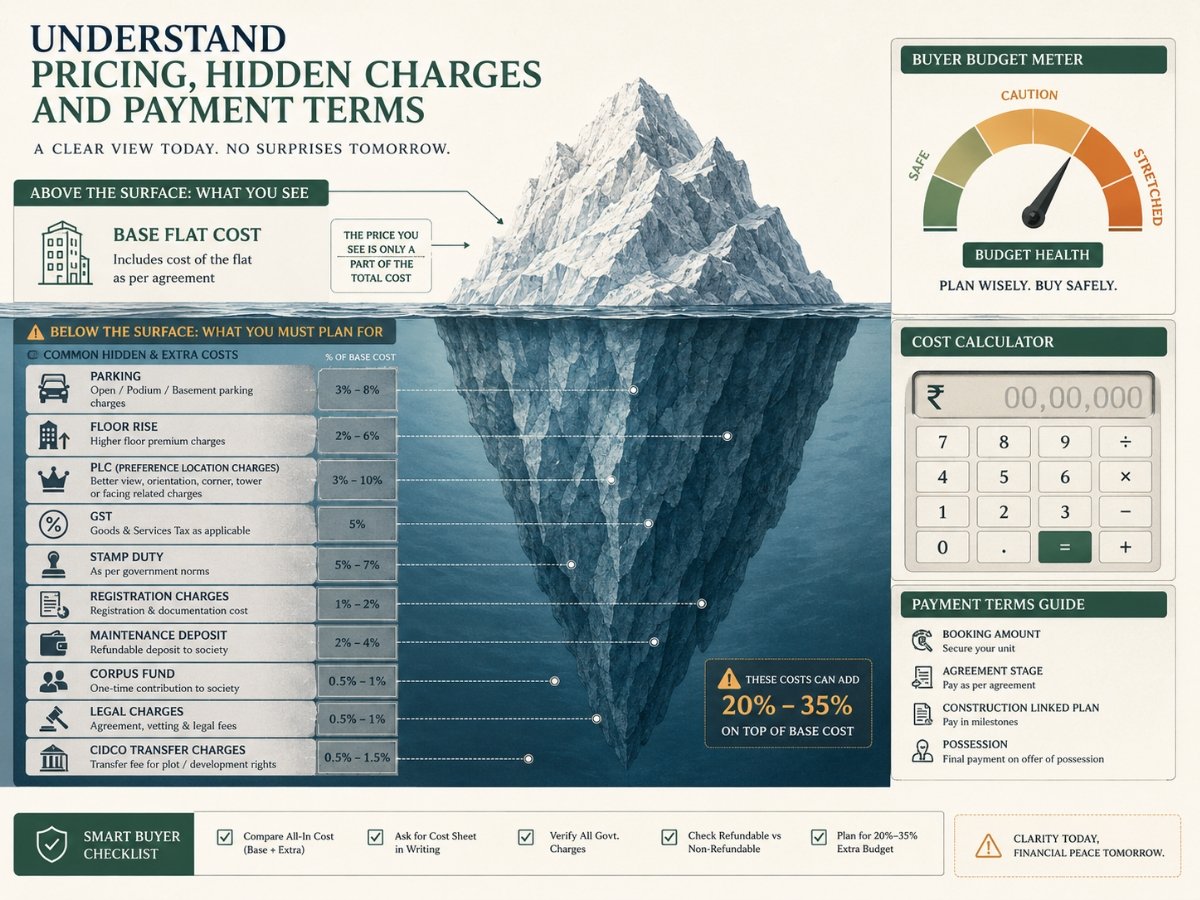
The base price is rarely the full price. Buyers must understand the complete cost before paying token money.
In under-construction projects, GST, parking, floor-rise, PLC, maintenance deposits, legal charges and other charges can increase the final outflow. Ready-to-move flats with OC generally have different GST implications than under-construction flats. Buyers should verify current tax treatment with a professional before payment.
Ask for an All-Inclusive Cost Sheet
Before booking, ask for a signed and stamped all-inclusive cost sheet. It should include:
- Basic flat cost
- Floor-rise charges
- PLC charges
- Parking charges
- GST, if applicable
- Stamp duty
- Registration
- Legal charges
- Society charges
- Maintenance deposit
- Clubhouse or amenity charges
- Corpus fund
- Infrastructure or development charges, if any
For cost planning, buyers can use a [Navi Mumbai stamp duty calculator](ADD INTERNAL LINK HERE).
Check Parking, Floor-Rise, PLC and Maintenance Charges
Parking, floor-rise and PLC can create major cost differences. Also remember that some ancillary charges may attract higher GST rates than the basic flat cost. Buyers should verify the exact tax calculation before booking.
Ask for parking slot clarity in writing. Covered parking, open parking and mechanical parking should not be treated as the same.
Understand GST, Stamp Duty and Registration Cost
Statutory costs should be calculated before booking, not after. Stamp duty, registration and GST can change the final budget significantly.
Ask the developer or your advisor to show a written calculation. Do not rely on a rough verbal estimate.
For budget planning, buyers can also use a [property tax calculator](ADD INTERNAL LINK HERE) where relevant.
Avoid Verbal Price Commitments
If a promise is not written, treat it as non-existent.
If the salesperson promises a modular kitchen, stamp duty offer, free parking, floor-rise waiver or maintenance discount, ask for it on official letterhead or written email from an authorized person. Verbal promises often disappear at agreement stage.
Check Developer Reputation Beyond Online Reviews
Online reviews are useful, but they can be manipulated. A buyer should read them carefully and combine them with offline checks.
Read Google Reviews Carefully
Do not only look at star rating. Read the lowest reviews and the most detailed reviews.
Look for repeated mentions of:
- Leakage
- Water shortage
- Parking problems
- Poor maintenance
- Delayed possession
- Bad CRM support
- Hidden charges
- Incomplete amenities
- OC or society handover issues
One bad review may not prove anything. Repeated patterns matter.
Look for Repeated Complaint Patterns
If several buyers across different projects complain about the same issue, take it seriously. For example, repeated leakage complaints across three completed projects suggest weak waterproofing standards.
Similarly, repeated complaints about maintenance corpus, delay or possession documents show governance problems.
Speak to Local Brokers and Residents
Kopar Khairane has many active local brokers because of its strong rental and resale demand. Speak to more than one broker, especially those who work in Sector 11, 12, 14, 15, 19 and nearby Ghansoli or Vashi pockets.
Ask them which buildings have good resale demand, which builders have delay issues and which societies face water or maintenance problems.
You may also refer to [real estate agents in Kopar Khairane](ADD INTERNAL LINK HERE) for local assistance.
Check Litigation or Delay History Where Possible
Search the developer’s legal entity name, not only the brand name. Check MahaRERA complaints, litigation disclosures, consumer forum references and public legal databases where relevant.
If there are disputes, understand the type of dispute. A minor customer complaint is different from a major title issue or stay order.
Big Builder vs Local Builder: Which Is Better in Kopar Khairane?
There is no single answer. A big builder is not always safer, and a local builder is not always risky. The right choice depends on project scale, legal clarity, construction quality, financial strength and local execution ability.
| Factor | Big Builder | Local Kopar Khairane / Navi Mumbai Developer | Buyer Decision |
|---|---|---|---|
| Financial strength | Usually stronger institutional backing | Varies by developer and project cash flow | Check RERA escrow and funding discipline |
| Project scale | Better for large townships and premium amenities | Better for standalone towers and redevelopment | Match builder size to project size |
| Local authority handling | May take time to understand local approvals | Often stronger local NMMC/CIDCO familiarity | Ask about past OC and approval record |
| Pricing | Often higher brand premium | May offer better usable carpet value | Compare RERA carpet cost, not brochure area |
| Amenities | More standardized lifestyle amenities | Practical, space-efficient amenities | Decide based on actual usage, not brochure |
| Risk | Lower financial risk in many cases | Depends on track record and transparency | Verify documents equally for both |
| After-sales | Process-driven, sometimes slow | More direct, but may vary | Speak to past residents |
Advantages of Big Real Estate Developers
Big developers usually offer stronger financial backing, better brand accountability, standardized processes and larger amenity planning. They may be safer for large-scale projects where land, finance and execution complexity are high.
Advantages of Local Kopar Khairane Developers
Good local developers often understand NMMC, CIDCO, society redevelopment and sector-level issues better. For standalone buildings or redevelopment of older CIDCO societies, a reputed local developer can sometimes execute faster and offer better carpet-area value.
When a Smaller Developer Can Be a Better Choice
A smaller developer may be a better choice when:
- The project is a single tower or limited-scale redevelopment
- The developer has strong completed projects nearby
- Legal documents are transparent
- Pricing is clear
- Existing residents speak positively
- The builder has a good OC and society handover record
When a Big Brand May Still Be Safer
A big brand may be safer when:
- The project is large
- Amenities and township planning matter
- Long-term maintenance systems are important
- Institutional funding is required
- The buyer wants stronger brand accountability
Still, do not skip legal and site checks just because the builder name is famous.
Check Location Fit Before Choosing the Developer
A good developer cannot fully fix a weak micro-location. Before finalizing, check the project’s sector, road access, water situation, parking pressure, railway connectivity and surrounding land use.
Mature Nodes Like Vashi, Sanpada, Ghansoli and Airoli
Vashi and Sanpada offer mature infrastructure and strong resale demand. Ghansoli and Airoli are strong for IT corridor access and commercial employment. Kopar Khairane sits between these practical markets, making it attractive for end-users who want connectivity without paying only for a premium node label.
Buyers should compare project pricing with nearby mature markets before deciding.
Growth Locations Like Mahape, Turbhe, Juinagar, Ghansoli and Airoli
Mahape, Turbhe, Juinagar, Ghansoli and Airoli influence Kopar Khairane’s demand because of office connectivity, industrial access, railway links and redevelopment potential. But each pocket has different traffic, pollution, civic and pricing realities.
Do not buy only because a project is “near an IT hub.” Drive the actual route during office hours.
Why Location Quality and Developer Quality Must Be Checked Together
The ideal formula is simple: good developer plus good micro-location.
Check:
- Distance to Kopar Khairane railway station
- Peak-hour traffic towards Thane-Belapur Road
- Water supply reliability
- Parking pressure
- Nearby industrial impact
- Road width
- Drainage and monsoon conditions
- School, market and hospital access
- Resale and rental demand
For a broader area understanding, refer to [Kopar Khairane real estate guide](ADD INTERNAL LINK HERE).
Questions to Ask a Developer Before Paying Token Money
Before paying token money, ask direct questions and demand written proof.
| Question | Why It Matters | Ideal Proof |
|---|---|---|
| Is the project registered on MahaRERA? | Confirms basic legality | MahaRERA P-number and project page |
| Can I see the title report? | Checks land ownership and disputes | Advocate-issued title report |
| Does the CC cover my floor? | Prevents illegal floor booking | CC copy showing approved floor |
| Is the quoted price all-inclusive? | Avoids hidden cost shock | Stamped cost sheet |
| Is OC received or expected later? | Confirms legal possession status | OC copy or written OC timeline |
| Who pays CIDCO transfer charges? | Avoids late-stage disputes | Written clause in agreement |
| Can I see past project OCs? | Shows delivery history | OC copies of completed projects |
| When will society be formed? | Protects long-term control | Written handover commitment |
Is the Project Registered on MahaRERA?
Ask for the exact MahaRERA number and verify it yourself. Do not accept screenshots or brochures as proof.
Can You Share the Approved Plan, CC and Legal Documents?
A transparent developer should not hesitate to show these documents before booking. If the team says documents are available only after token payment, treat that as a warning.
Is the Quoted Price Fully All-Inclusive?
Ask whether the amount includes GST, parking, floor-rise, PLC, maintenance, legal charges, stamp duty and registration. Get the answer in writing.
What Is the Written Possession Timeline?
Compare the sales promise with MahaRERA possession date and agreement timeline. If there is a mismatch, ask which date is legally binding.
What Happens If Possession Is Delayed?
The agreement should clearly mention delay compensation and buyer rights. Do not depend on verbal reassurance.
Is the OC Already Received or Expected Later?
For ready-to-move property, ask for OC. For under-construction property, ask for the expected OC process and written timeline.
Red Flags When Choosing a Real Estate Developer in Kopar Khairane
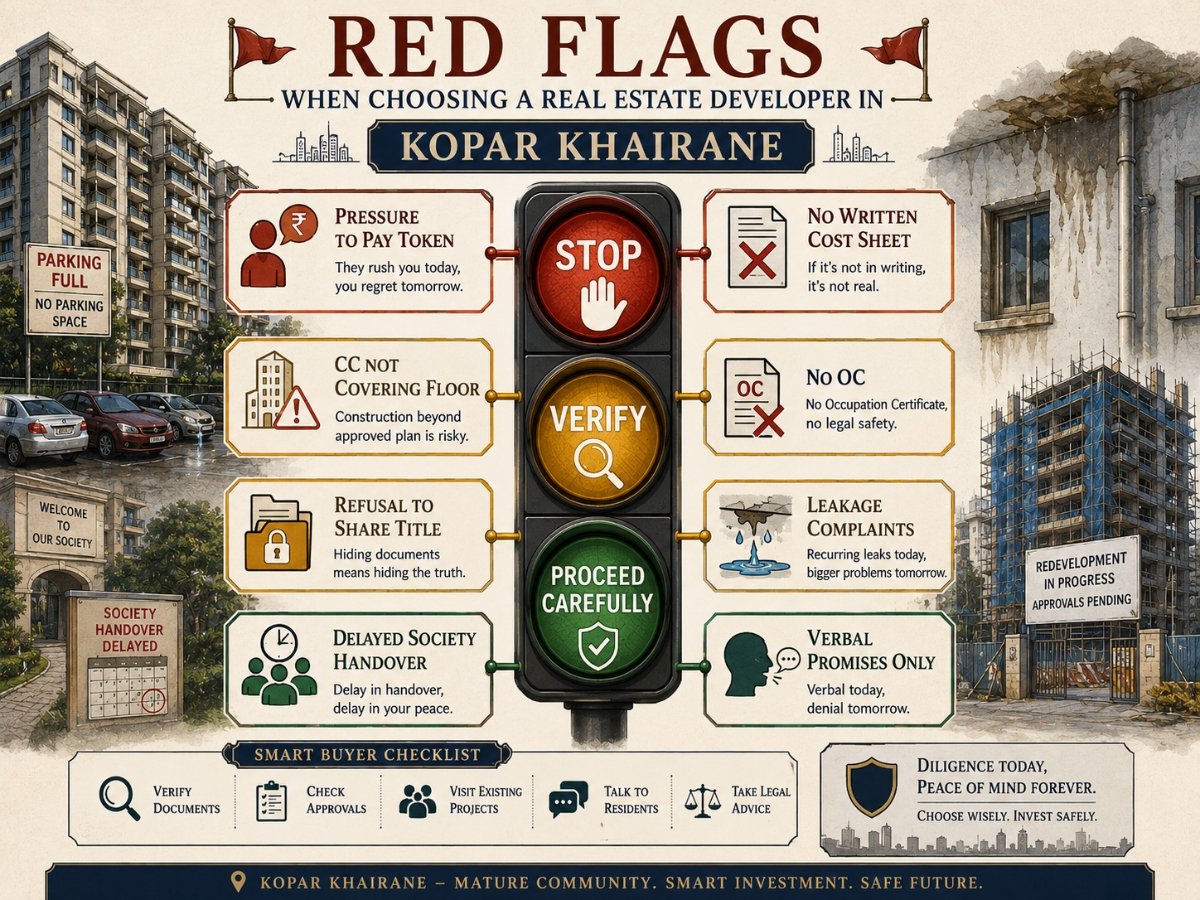
| Red Flag | What It May Mean | Buyer Action |
|---|---|---|
| Pressure to pay token quickly | Sales urgency may be hiding weak demand or document issues | Pause and verify documents first |
| No written cost sheet | Hidden charges may appear later | Demand stamped all-inclusive sheet |
| CC does not cover your floor | Construction may not be fully approved | Do not book that floor without approval |
| No OC in ready building | Fit-out possession risk | Do not make final payment |
| Refusal to share title documents | Possible title or mortgage issue | Consult lawyer or walk away |
| Repeated leakage complaints | Poor construction quality | Visit older projects in monsoon |
| Delayed society handover | Builder may retain control and funds | Speak to completed society members |
| Verbal promises only | Promise may disappear later | Get official written confirmation |
Pressure to Pay Token Money Quickly
A genuine opportunity does not require blind payment. If the sales team says “today only” or “last unit” without giving documents, slow down.
No Written Clarity on Charges
Unclear pricing is a serious red flag. A transparent developer should give a detailed cost sheet before asking for money.
Delayed Older Projects
If older projects show repeated RERA extensions, delayed OC or buyer disputes, do not ignore the pattern.
Poor Maintenance in Completed Buildings
Poor maintenance may show weak builder ethics, delayed handover or poor society formation. Speak to residents before deciding.
Weak Legal Transparency
If the developer avoids sharing title, CC, approved plan or agreement draft, the buyer should not proceed casually.
Too Many Verbal Promises
Verbal promises have almost no practical value during a property dispute. Everything important must be written.
Real Estate Developer Shortlisting Scorecard
Use this scorecard to compare two or three developers before deciding.
| Factor | What to Check | Good Sign | Red Flag |
|---|---|---|---|
| Past Delivery Record | Completed projects and timelines | On-time or near on-time delivery | Repeated extensions |
| Legal Transparency | CC, title, OC, CIDCO documents | Documents shared before token | Documents shown only after booking |
| Construction Quality | Older buildings and site progress | No major leakage or cracks | Dampness, cracks, poor common areas |
| Pricing Clarity | All-inclusive cost sheet | Clear stamped breakup | Verbal offers and hidden charges |
| Location Suitability | Sector, water, access, parking | Practical daily living | Weak access or civic stress |
| After-Sales Support | Defect correction and society handover | Residents confirm support | Builder disappears after possession |
| Buyer Feedback Pattern | Reviews and resident feedback | Consistent positive feedback | Repeated complaints across projects |
Common Mistakes Buyers Make While Choosing Builders in Kopar Khairane
Trusting Only Brand Name
A brand name can reduce some risks, but it does not replace document verification. Even a reputed brand must be checked for project-specific approvals, possession timeline and pricing clarity.
Ignoring Legal Document Verification
Do not depend fully on the bank, broker or sales team. Hire an independent legal professional to check title, CC, OC, agreement and CIDCO-related documents.
Booking Only Because of Discount or Offer
A discount is useful only if the property is legally clear and structurally sound. A cheap price in a legally risky project can become expensive later.
Not Visiting Completed Projects
A sample flat is marketing. A completed building is evidence. Visit older projects before deciding.
Depending Fully on Broker or Sales Team Promises
Brokers and sales teams may help with information, but final verification is the buyer’s responsibility. Ask for written proof.
How to Verify a Real Estate Developer Before Final Decision
Step 1: Check MahaRERA Details
Search the project on MahaRERA and review registration, promoter name, possession date, uploaded documents, litigation and progress certificates.
Step 2: Visit the Project Site
Check actual construction progress, access road, surrounding development, drainage, parking planning and site discipline.
Step 3: Visit Completed Projects
Visit at least two completed projects by the same developer. Prefer older projects that have already faced several monsoons.
Step 4: Review Legal Documents with an Expert
Show the title report, agreement draft, CC, OC, CIDCO documents and approved plan to a qualified property lawyer.
For legal comparison, refer to [questions to ask before buying a flat in Navi Mumbai](ADD INTERNAL LINK HERE).
Step 5: Compare Total Cost with Other Projects
Compare only on RERA carpet area and all-inclusive cost. Do not compare brochure area or base price alone.
Step 6: Take Final Decision Only After Written Clarity
Make payment only after legal, pricing and possession details are clear in writing. If the developer refuses clarity, do not proceed.
Final Checklist Before Choosing a Real Estate Developer in Kopar Khairane
Use this checklist before making payment:
- [ ] MahaRERA registration number checked on the official portal
- [ ] Promoter name and project details verified
- [ ] MahaRERA possession timeline checked
- [ ] Litigation or extension history checked where available
- [ ] Commencement Certificate reviewed
- [ ] CC covers the floor you plan to buy
- [ ] Approved building plan reviewed
- [ ] OC checked for ready-to-move property
- [ ] CIDCO leasehold or freehold status understood
- [ ] CIDCO transfer documents checked where applicable
- [ ] PAP or 12.5% plot documents verified, if relevant
- [ ] Title Clearance Certificate reviewed by a lawyer
- [ ] Agreement for Sale reviewed before signing
- [ ] Written all-inclusive cost sheet received
- [ ] Parking allocation written clearly
- [ ] GST, stamp duty and registration costs calculated
- [ ] Completed project visited
- [ ] Existing residents or buyers spoken to
- [ ] Site progress physically checked
- [ ] Monsoon leakage risk checked in older projects
- [ ] Society formation and conveyance history checked
- [ ] No verbal promises accepted without written proof
- [ ] Final payment linked to legal possession and OC clarity
Conclusion
Choosing the right real estate developer in Kopar Khairane is not about selecting the most famous name or the most attractive sample flat. It is about checking whether the developer can legally, financially and practically deliver what is being sold.
Kopar Khairane is a strong residential market because of its connectivity, mature civic structure and proximity to Vashi, Ghansoli, Airoli, Mahape and the Thane-Belapur employment belt. But buyers must remain careful because the area also has older societies, redevelopment activity, CIDCO leasehold issues, PAP plot risks, water and parking concerns and project-specific approval complications.
The final verdict is simple: choose a developer only after verifying MahaRERA, title, CC, OC, CIDCO documents, completed project quality, resident feedback and all-inclusive pricing. If even one major area is unclear, pause the deal. A good property decision in Kopar Khairane should feel legally clear, financially transparent and practically liveable.
For broader comparison, buyers can explore [real estate developers in Navi Mumbai](ADD INTERNAL LINK HERE) and [Navi Mumbai property investment guide](ADD INTERNAL LINK HERE).
FAQs
Frequently asked questions