

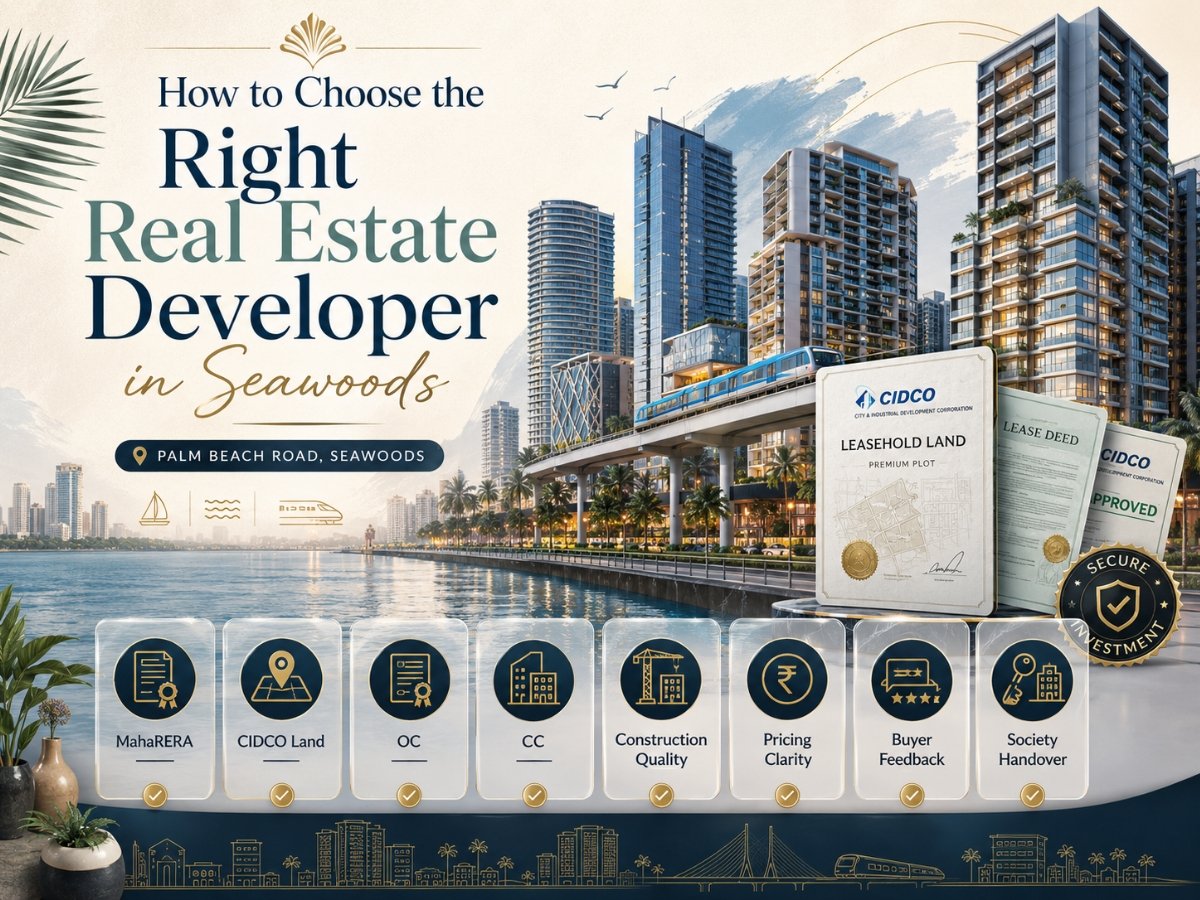
How to Choose the Right Real Estate Developer in Seawoods
To choose the right real estate developer in Seawoods, buyers should check the developer’s past delivery record, MahaRERA details, legal documents, construction quality, pricing transparency, completed projects, buyer reviews, and possession history before paying token money. In Seawoods, this becomes even more important because property values are high, many projects involve CIDCO-origin land, and approval clarity can differ between Seawoods East, Seawoods West, NRI Complex, Palm Beach Road pockets, and older redevelopment sectors.
Seawoods is not a low-risk, low-ticket market anymore. It is one of Navi Mumbai’s most premium residential micro-markets, with many properties commonly discussed in the range of around ₹20,000 to ₹29,000 per sq. ft., depending on project, location, view, age, amenities, and legal status. That means one wrong builder decision can lock a buyer’s capital for years.
The safest way to choose a real estate developer in Seawoods is to verify legal documents, completed projects, pricing clarity, and buyer feedback before paying token money. A reputed developer is not always the right developer if the project has unclear approvals, delayed possession, hidden charges, weak after-sales support, or poor society handover history.
This article is for general buyer awareness. Before booking or signing an agreement, buyers should verify documents with a qualified legal professional.
Quick Summary: How to Choose the Right Real Estate Developer in Seawoods
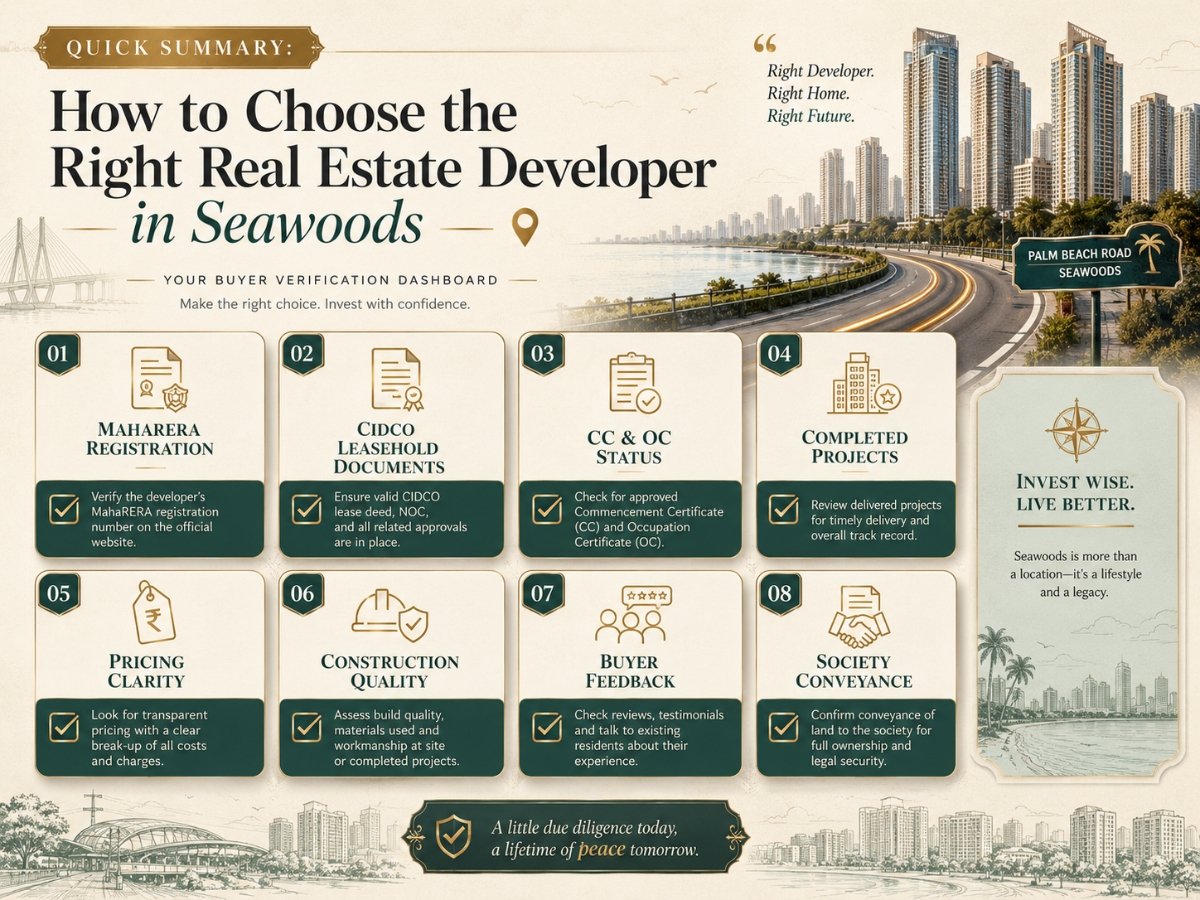
| What to Check | Why It Matters in Seawoods | Good Sign | Red Flag |
|---|---|---|---|
| MahaRERA registration | Confirms basic project registration and disclosed timeline | Project details, progress updates, and documents are available | No RERA number or vague explanation |
| CIDCO leasehold documents | Most Navi Mumbai land originates from CIDCO leasehold structure | Clear allotment, transfer, lease, and NOC papers | Developer avoids sharing CIDCO papers |
| CC and OC status | Shows whether construction and possession are legally valid | CC covers the booked floor; OC before possession | Fit-out possession without OC |
| Completed projects | Reveals real construction quality and after-sales behaviour | Older buildings are maintained well | Leakage, poor lifts, society disputes |
| Pricing clarity | Prevents budget shock after token payment | Written all-inclusive cost sheet | Parking, PLC, GST, maintenance added later |
| Construction quality | Coastal humidity and monsoon can expose weak construction | RMC use, good waterproofing, clean common areas | Seepage, fungus, cracks, hand-mixed concrete |
| Buyer feedback | Shows how the developer behaves after sale | Residents confirm support and corpus handover | Repeated complaints about delay and maintenance |
| Society and conveyance | Important for future control, resale, and redevelopment | Society formed and documents handed over | Builder retains control after possession |
For readers comparing [real estate developers in Seawoods](ADD INTERNAL LINK HERE), this quick rule is useful: shortlist only those developers who pass legal, financial, construction, and reputation checks together. One strong point cannot cover three weak points.
Builders and Developers in Seawoods

Scarlet Builders and Developers Seawoods
S Real Estate Developer • Navi Mumbai • Residential + Commercial Scarlet Builders and Developers Services Areas Projects FAQ Book Enquiry Google...
Read More
Akshar Developers Seawoods
A Premium Residential • Luxury Homes • Navi Mumbai Akshar Developers Services Areas Projects FAQ Send Enquiry MahaRERA: P51700006864 Completed Premium Project...
Read MoreWhy Choosing the Right Real Estate Developer Matters in Seawoods
Choosing the right real estate developer in Seawoods matters because this is a high-value, mature, and legally sensitive market. Buyers are not only paying for a flat. They are paying for location, building quality, legal security, maintenance discipline, future resale value, and peace of mind.
Seawoods has moved from older CIDCO-style residential development to a more premium market shaped by Seawoods-Darave railway station, Nexus Seawoods Grand Central, Palm Beach Road, the NRI Complex belt, and better regional connectivity through Mumbai Trans Harbour Link and the upcoming Navi Mumbai International Airport influence. But a strong location does not automatically make every project safe.
In a place like Seawoods, a poor builder can create five serious problems:
- Delayed possession and locked capital
- Possession without proper OC
- Weak waterproofing and monsoon seepage
- Hidden charges after booking
- Society handover and conveyance problems
This is why the developer must be judged like a long-term partner, not just like a seller. A good builder protects the buyer’s money, delivers what is written, handles legal approvals properly, and leaves behind a building that can survive Navi Mumbai’s monsoon and coastal conditions.
Understand the Developer’s Past Track Record
A developer’s past record is one of the strongest indicators of future behaviour. Brochures, sample flats, sales presentations, and 3D renders can look impressive, but older completed buildings tell the real story.
In Seawoods, buyers may come across national developers, regional Navi Mumbai builders, and smaller local players. Some focus on integrated townships and large premium projects. Others focus on standalone buildings in mature sectors. Neither category should be trusted blindly.
Before shortlisting, check whether the developer has completed projects in Navi Mumbai, especially in Seawoods, Nerul, Vashi, Sanpada, Kharghar, or nearby mature nodes. A developer familiar with NMMC, CIDCO, MahaRERA, leasehold paperwork, and local approval processes usually has a better chance of handling project execution smoothly.
Check Completed Projects Before Trusting New Launches
Do not judge a developer only by a new launch. Visit at least one completed project by the same builder.
Check:
- Was possession given close to the promised timeline?
- Did the builder obtain OC before handover?
- Are lifts, lobby, parking, drainage, and security systems working properly?
- Are amenities actually functional or just shown in marketing material?
- Has the society been formed properly?
A builder who has delivered clean, legally complete, and well-maintained buildings is safer than a builder who only has attractive advertisements.
Visit Older Buildings Developed by the Same Builder
Visit buildings that are at least 3 to 5 years old. New buildings can look good for the first few months. Older buildings show whether construction quality is strong.
In Seawoods, this is very important because coastal humidity, heavy monsoon, and saline air can expose poor waterproofing and weak materials. Check exterior paint, basement condition, wall seepage, lift maintenance, parking area, terrace waterproofing, and drainage.
If an older building has repeated leakage, fungus, cracks, non-working stack parking, or damaged common areas, consider it a warning sign.
Speak to Existing Residents and Buyers
Residents usually know the truth that sales teams will not discuss. Speak to people living in the developer’s completed projects.
Ask them:
- Did the builder respond after possession?
- Were promised amenities delivered?
- Was the maintenance corpus handed over properly?
- Was the society formed without delay?
- Are there legal or maintenance disputes?
- Did the building face leakage during monsoon?
A few complaints are normal in any project. Repeated complaints about the same issue are not normal.
Check MahaRERA Registration and Project Transparency
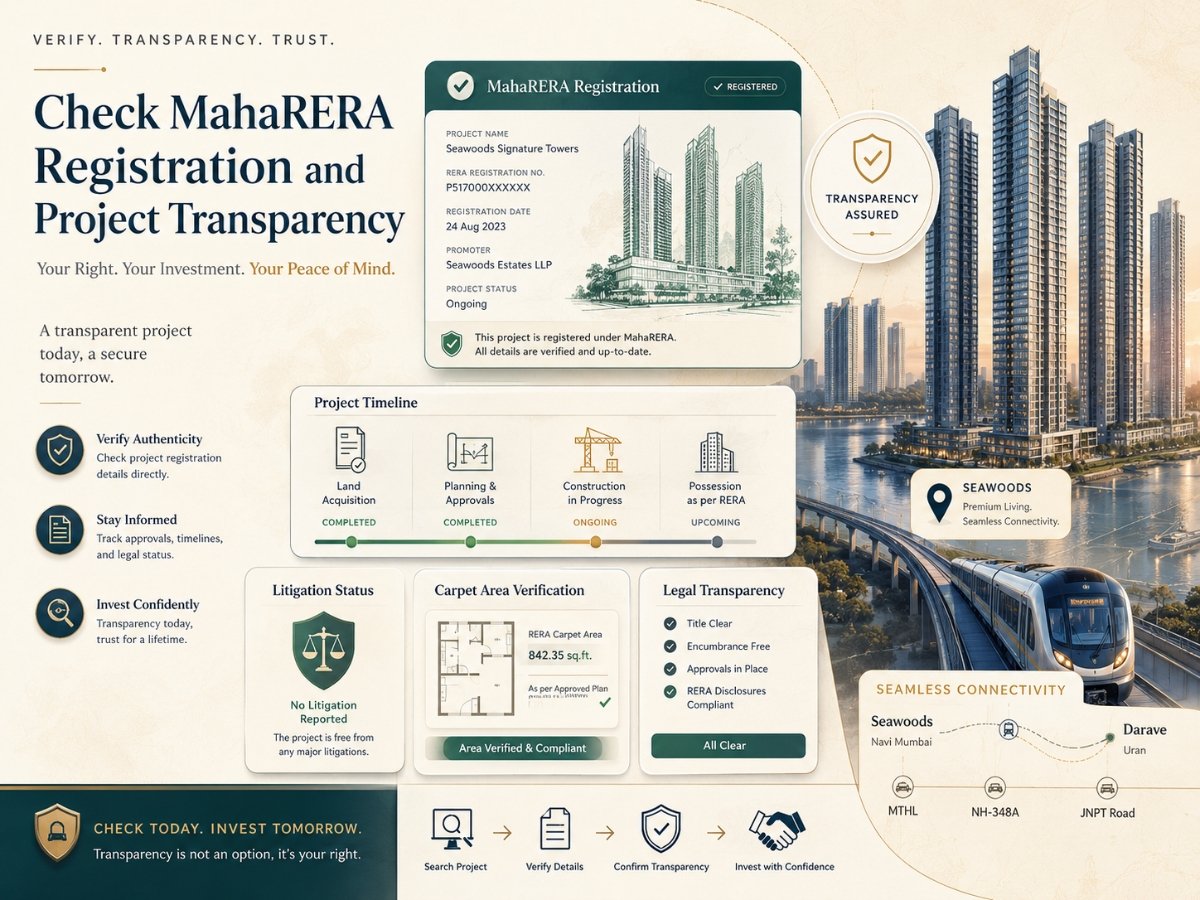
MahaRERA registration is important, but it should not be treated as the only proof of developer quality. It confirms that the project is registered and that key disclosures are available, but it does not guarantee strong construction, good layout, fair pricing, or ethical after-sales support.
Buyers should verify the project details on the MahaRERA website before paying token money. Do not depend only on a screenshot shared by the sales team.
Why MahaRERA Is Important for Seawoods Buyers
MahaRERA helps buyers check the official project name, registration number, promoter details, possession timeline, project progress, uploaded documents, and litigation disclosures where available.
For Seawoods, this matters because many projects are high-ticket purchases. If the project is delayed, the buyer may face both rent and pre-EMI pressure. RERA records help buyers understand whether the developer has a clean timeline or a pattern of extensions.
What to Verify on the MahaRERA Website
Check these details carefully:
| MahaRERA Check | What Buyer Should Look For |
|---|---|
| Project registration number | Should match the project being sold |
| Promoter name | Should match the legal developer or entity |
| Possession date | Should be specific and realistic |
| Uploaded documents | Check approvals, layout, and certificates where available |
| Litigation details | Look for disputes or cases disclosed |
| Project progress | Compare claimed site progress with RERA updates |
| Carpet area | Match RERA carpet area with sales team claims |
If the sales team talks about “usable area,” “saleable area,” or “super built-up,” ask them to clearly show the RERA carpet area.
Why MahaRERA Alone Is Not Enough
A project may be MahaRERA registered and still have practical problems. RERA will not physically check whether the developer used good waterproofing, whether the sample flat matches the delivered flat, whether the building will have good maintenance, or whether residents will get smooth after-sales support.
MahaRERA is the starting point. It is not the final decision.
Check Legal Documents Before Booking a Flat
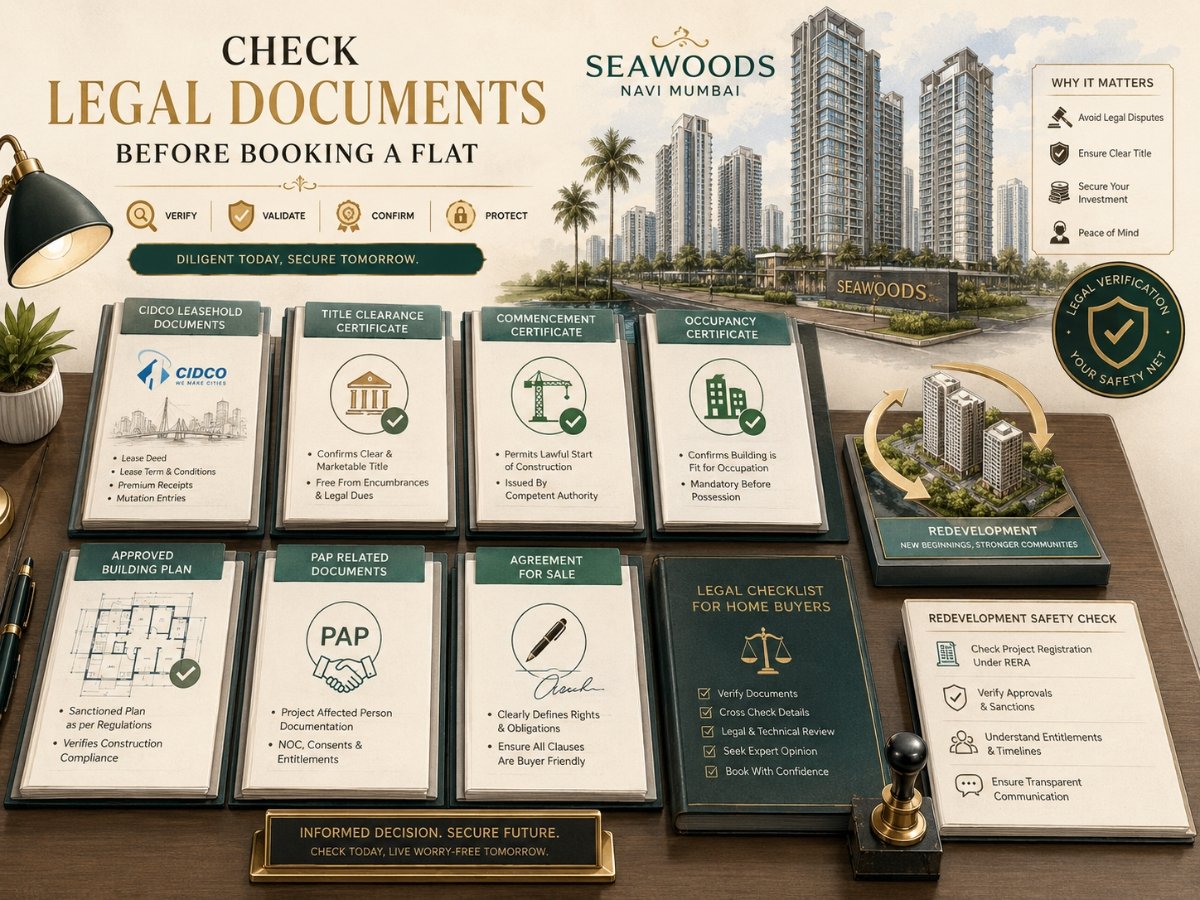
Legal document verification is non-negotiable in Seawoods. Buyers should not pay token money only because the location is good or the builder name sounds familiar.
For approval and occupancy-related clarity, buyers should ask for the relevant CC, OC, approved plan, title documents, draft agreement, CIDCO-related papers, and authority documents.
| Document | Why It Matters | What to Verify |
|---|---|---|
| Title Clearance Certificate | Shows whether the developer has legal right to develop and sell | Ask a lawyer to review title chain |
| Commencement Certificate | Shows legal permission to start construction up to approved level | Check if CC covers your booked floor |
| Occupancy Certificate | Confirms the building is fit for legal occupation | Do not accept possession without OC clarity |
| Approved Building Plan | Confirms the sanctioned layout | Compare with the flat being sold |
| Agreement for Sale | Legally binds price, possession, penalties, and promises | Review clauses before signing |
| CIDCO documents | Important for leasehold land and transfers | Check allotment, lease, transfer, NOC, tripartite papers if applicable |
| PAP / 12.5% documents | Important where land comes from PAP allotment | Verify allotment, 7/12 extract, transfer rights, and title history |
| Society and conveyance status | Important for future control and redevelopment | Check builder’s past society handover record |
Title Clearance Certificate
The Title Clearance Certificate helps confirm whether the developer has the legal right to develop the land and sell flats. In Seawoods, where land may involve CIDCO leasehold origin, redevelopment, or PAP-related history, this certificate must be checked carefully.
A buyer should not accept “title is clear” as a verbal answer. Ask for documents and get them reviewed by an independent property advocate.
Commencement Certificate
The Commencement Certificate, or CC, confirms that the authority has permitted construction. A common buyer mistake is booking on a higher floor without checking whether the CC covers that level.
For example, if a buyer is booking a flat on a higher floor, the buyer should confirm that approvals cover that construction stage. If the developer has only partial approval, the risk increases.
Occupancy Certificate
The Occupancy Certificate, or OC, is one of the most important documents before possession. Without OC, the building may not be legally fit for occupation.
Buyers should be especially careful with “fit-out possession.” It may sound harmless, but it can create serious issues if the OC is delayed or not received. Final possession should ideally happen only after OC-related clarity.
Approved Building Plan
The approved building plan should match what is being sold. Check the flat layout, carpet area, balcony, common areas, parking, floor plan, and amenities.
Do not depend only on sample flat visuals. The sanctioned plan and agreement documents matter more than the sales presentation.
Agreement for Sale
The Agreement for Sale is the most important legal document between the buyer and developer. It should clearly mention possession timeline, payment schedule, carpet area, specifications, delay clauses, cancellation terms, and all charges.
Buyers can also read [agreement to sale vs sale deed](ADD INTERNAL LINK HERE) to understand the difference between key property documents before signing.
CIDCO Transfer and Leasehold Clarity
Most land in Navi Mumbai has CIDCO-origin leasehold relevance. This means the buyer should understand whether the land rights, transfer permissions, and lease documents are proper.
For CIDCO-origin plots, leasehold and transfer-related documents should be checked carefully. In resale, redevelopment, or PAP-related cases, CIDCO NOC, tripartite agreement, final transfer order, or other Estate Department documents may become important depending on the property type.
Seawoods-Specific Documents Buyers Should Check Before Booking
Seawoods requires extra document awareness because it has a mix of old CIDCO housing, redevelopment potential, premium high-rises, transit-oriented development, NRI Complex properties, and projects near Palm Beach Road.
CIDCO Allotment and Transfer Documents
Ask how the land came to the developer. Was it directly allotted? Was it transferred? Is it a redevelopment project? Is there a tripartite agreement? Has the final lease or transfer order been executed?
These questions may feel technical, but they can protect the buyer from future ownership and resale complications.
PAP Plot or 12.5% Scheme Plot Clarity
If the land is connected to a PAP or 12.5% scheme, extra legal checking is required. Such plots can be genuine, but the paperwork must be clean.
Buyers should verify original allotment, transfer rights, 7/12 extracts where applicable, development agreement, power of attorney, and all relevant CIDCO permissions through a legal expert.
NMMC, PMC or CIDCO Approval Relevance
For Seawoods, NMMC and CIDCO relevance is especially important. NMMC generally handles civic and building approval matters within its jurisdiction, while CIDCO’s role remains important because of land origin and leasehold rights.
PMC is more relevant in Panvel-side areas, not typical Seawoods. Buyers should ask which authority has issued the CC, OC, sanctioned plan, and other approvals for the specific project.
Society Formation and Conveyance Status
A developer’s responsibility does not end after handing over keys. Society formation, maintenance account transfer, corpus handover, and conveyance-related progress are important for long-term building control.
If a builder’s older projects still struggle with society handover or conveyance, treat it as a serious warning.
Compare Construction Quality and Actual Site Progress
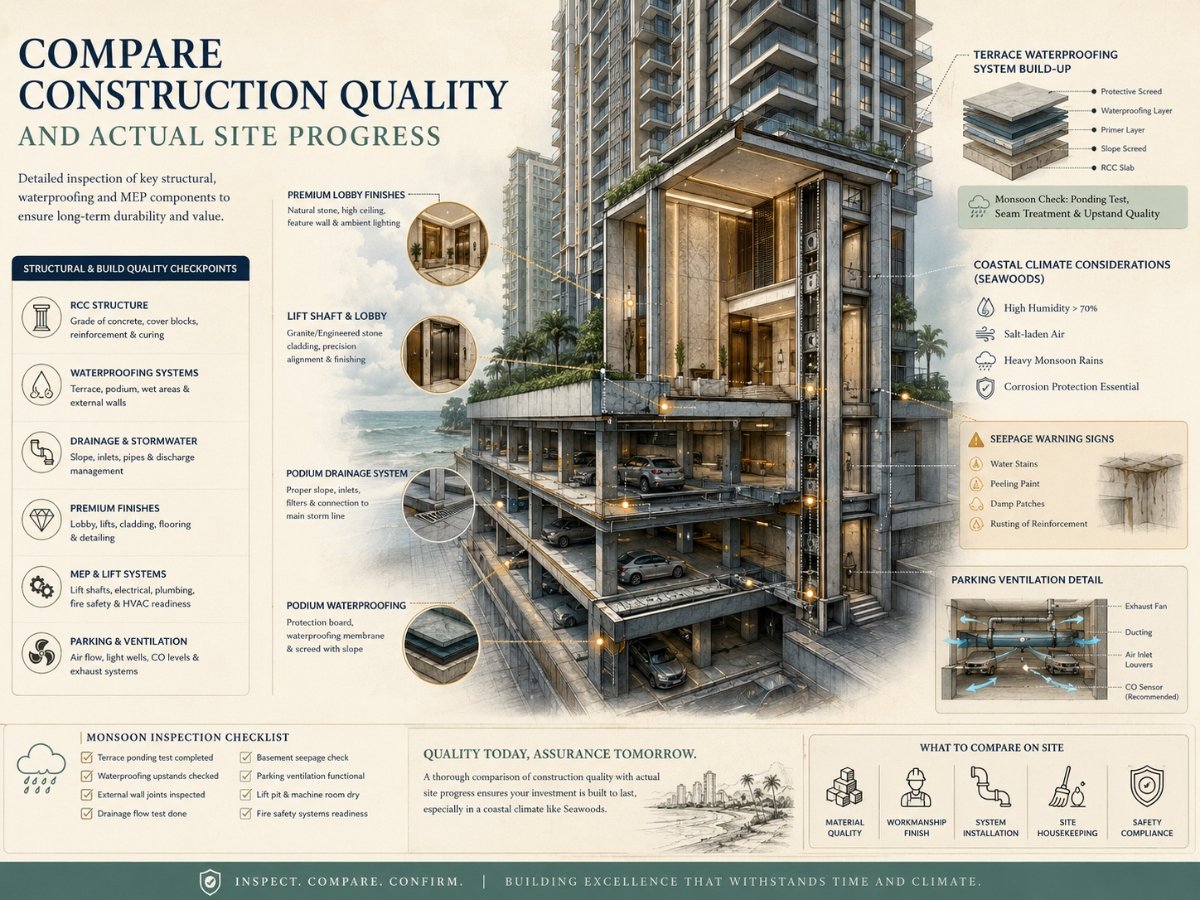
Construction quality is not a luxury point in Seawoods. It is a safety and long-term maintenance issue.
The area faces heavy monsoon, humidity, and coastal conditions. Weak waterproofing, poor concrete practices, and careless finishing can create leakage, fungus, corrosion, and repair costs within a few years.
Visit the Actual Construction Site
When visiting an under-construction project, observe the site carefully. A clean and disciplined site usually indicates better project management.
Check:
- Is there proper safety equipment?
- Are materials stored properly?
- Does the site look organized?
- Is construction moving steadily?
- Is there visible supervision?
- Is Ready-Mix Concrete being used instead of casual hand-mixing?
A buyer cannot do a full civil engineering audit alone, but basic observation can still reveal a lot.
Compare Sample Flat and Real Flat Specifications
Sample flats are designed to impress. They may use better lighting, smaller furniture, fewer internal doors, and premium finishes that may not come with the actual flat.
Ask for the written specification sheet. Compare tiles, fittings, windows, doors, electrical points, bathroom fittings, kitchen platform, and wall finish with what is promised in the agreement.
Check Lift, Lobby, Parking and Common Area Quality
Common areas reveal the developer’s real attitude. Many builders focus on flat interiors but compromise on lobbies, staircases, parking, drainage, mechanical parking, terrace, and service areas.
In Seawoods, where ticket sizes are high, buyers should not ignore these areas. A poorly designed parking system or weak lift maintenance can affect daily life and resale value.
Check Monsoon Performance and Leakage Issues
The best time to inspect older buildings is during or soon after monsoon. Look for damp patches, peeling paint, terrace leakage, basement seepage, fungus smell, and waterlogging around the compound.
If multiple older projects by the same developer show similar leakage patterns, think carefully before booking.
Understand Pricing, Hidden Charges and Payment Terms
The price discussed during the first site visit is rarely the final amount a buyer pays. In Seawoods, where base prices can already be high, hidden or unclear charges can disturb the entire budget.
For a broader cost understanding, readers can use a [stamp duty calculator](ADD INTERNAL LINK HERE) and compare total payable value before committing.
Ask for an All-Inclusive Cost Sheet
Before paying token money, demand a written all-inclusive cost sheet.
It should include:
| Cost Component | What to Check |
|---|---|
| Base flat cost | Based on RERA carpet area |
| GST | Applicable for under-construction property |
| Stamp duty and registration | Approximate total should be shown clearly |
| Parking charges | Written clarity is important |
| Floor-rise charges | Check per-floor calculation |
| PLC | Especially for creek, garden, road, or premium view |
| Clubhouse / amenity charges | Must be clearly stated |
| Legal and documentation charges | Should not be vague |
| Advance maintenance | Check period and amount |
| Corpus fund | Ask how it will be transferred to society |
Check Parking, Floor-Rise, PLC and Maintenance Charges
Parking, floor-rise, Preferential Location Charges, and maintenance can significantly increase the final cost. In premium Seawoods projects, a buyer may choose a higher floor, better view, or better location within the project, but the developer must clearly show how that affects the total price.
Never accept “we will explain later.” Later usually means after the buyer is emotionally committed.
Understand GST, Stamp Duty and Registration Cost
For under-construction flats, GST may apply. Stamp duty and registration are separate from the builder’s base price. The exact amount can vary by property value, buyer category, government rules, and transaction structure.
Buyers should check the official payable amount before booking and not rely only on rough verbal estimates.
Avoid Verbal Price Commitments
A verbal discount is not a financial document. If the sales team promises a discount, free parking, waived floor-rise, modular kitchen, or maintenance adjustment, it should be written in the cost sheet or agreement annexure.
In property transactions, what is not written is difficult to enforce.
Check Developer Reputation Beyond Online Reviews
Google reviews can help, but they are not enough. Real estate reviews are often mixed, emotional, incomplete, or sometimes influenced by marketing activity.
The better method is to combine online reviews, resident feedback, broker intelligence, RERA records, and physical inspection.
Read Google Reviews Carefully
Do not only look at the star rating. Read the 1-star and 2-star reviews. Look for repeated words like “delay,” “OC,” “leakage,” “maintenance,” “refund,” “parking,” “false promise,” or “poor response.”
One angry review may not matter. Ten similar reviews matter.
Look for Repeated Complaint Patterns
Repeated patterns are more useful than isolated complaints. If several buyers mention delayed possession, hidden charges, poor CRM, or society handover issues, take that seriously.
A developer’s response to complaints also matters. A responsible developer usually answers clearly and tries to resolve issues.
Speak to Local Brokers and Residents
Experienced local brokers and residents often know which builders are safe, which ones delay projects, and which ones create post-possession problems.
However, do not depend fully on one broker. Brokers are transaction-driven. Cross-check with multiple sources, including residents and legal documents. For wider local support, readers may also compare [real estate agents in Seawoods](ADD INTERNAL LINK HERE).
Check Litigation or Delay History Where Possible
Search the developer and project on the MahaRERA portal. Check if there are complaints, extension patterns, or declared litigation. For serious cases, buyers may ask a legal professional to check court or tribunal records where relevant.
Big Builder vs Local Builder: Which Is Better in Seawoods?
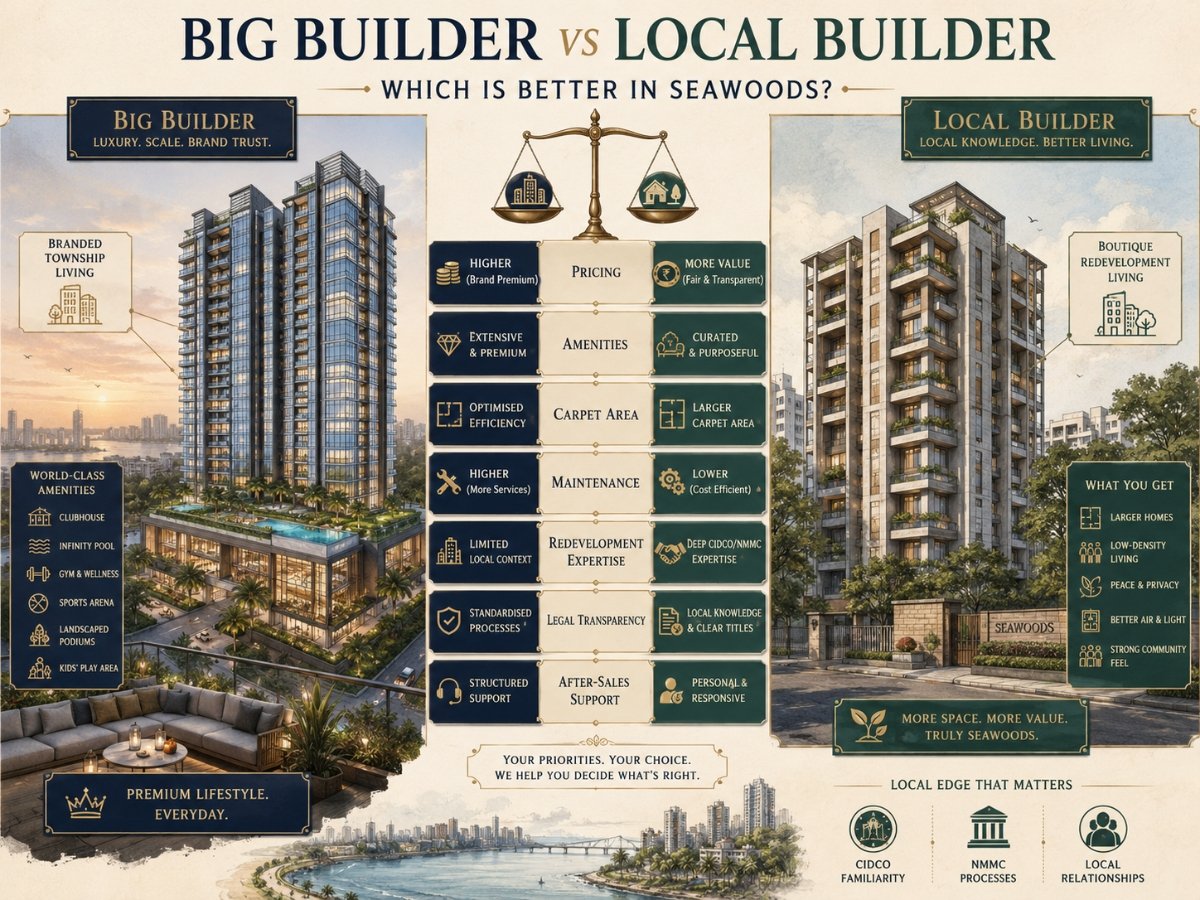
There is no single answer. In Seawoods, big builders and reputed local builders serve different buyer needs.
A big builder may be better for buyers who want brand comfort, structured processes, large amenities, and stronger resale perception. A reputed local builder may be better for buyers who want larger carpet area, quieter sectors, lower density, and practical value.
| Factor | Big Builder | Local Seawoods / Navi Mumbai Developer | Buyer Decision |
|---|---|---|---|
| Project style | Large integrated projects, premium amenities, strong branding | Standalone towers or boutique redevelopment projects | Choose based on lifestyle need |
| Legal structure | Usually more systematic | Can be excellent or weak depending on builder | Verify documents equally in both cases |
| Pricing | Higher brand premium | May offer better value per sq. ft. | Compare total cost, not only base rate |
| Carpet area | Often compact and optimized | May offer larger room sizes | Check RERA carpet and actual layout |
| Amenities | Larger clubhouse and lifestyle facilities | Basic to moderate amenities | Pay only for amenities you will use |
| Maintenance | Often higher monthly cost | Usually lower, but varies | Check long-term affordability |
| Density | Can be high in large projects | Often lower in smaller plots | Check flats per floor and lift ratio |
| After-sales | More formal CRM system | Depends heavily on builder ethics | Speak to past buyers |
Advantages of Big Real Estate Developers
Big developers in Seawoods may offer structured documentation, stronger brand comfort, organized construction processes, and premium amenities. They can be suitable for NRIs, investors, and buyers who want a more formal buying experience.
But brand name alone is not enough. Even in a big project, buyers must verify the exact tower, possession date, legal documents, carpet area, maintenance costs, and final price.
Advantages of Local Seawoods Developers
Reputed local developers may offer larger carpet area, quieter buildings, better negotiation room, and practical layouts. Some local builders understand CIDCO, NMMC, society formation, and Navi Mumbai buyer expectations very well.
However, local builder selection requires deeper verification. Buyers must check title, CC, OC, previous projects, financial strength, and society handover record carefully.
When a Smaller Developer Can Be a Better Choice
A smaller developer can be a better choice if:
- The project has clear title and approvals
- The developer has completed good buildings nearby
- The construction quality is strong
- Pricing is transparent
- The building has lower density
- Residents of older projects give positive feedback
- The society handover record is clean
This is especially relevant for end-users who value usable space and peaceful living over large-scale amenities.
When a Big Brand May Still Be Safer
A big brand may be safer if the buyer is an NRI, has limited time for follow-up, wants stronger resale perception, prefers integrated amenities, or wants a more standardized process.
Still, the project-specific documents must be checked. Do not assume every project from a big brand has the same risk profile.
Check Location Fit Before Choosing the Developer
Developer selection and location selection must happen together. A good developer in a poor-fit location may not solve the buyer’s real need. A good location with a weak developer can also become a bad investment.
Mature Nodes Like Vashi, Sanpada, Nerul and Seawoods
Seawoods belongs to the mature side of Navi Mumbai’s property market, along with Vashi, Sanpada, and Nerul. These areas usually offer stronger social infrastructure, better connectivity, established residential demand, and more stable resale behaviour.
In Seawoods, location micro-pockets matter. Seawoods West, NRI Complex, Palm Beach Road side, Seawoods-Darave station belt, and older CIDCO sectors may have different pricing, redevelopment, parking, and legal considerations.
Growth Nodes Like Ulwe, Panvel, Pushpak Nagar and Dronagiri
Growth nodes such as Ulwe, Panvel, Pushpak Nagar, and Dronagiri may offer future upside linked to infrastructure, airport influence, and regional development. But they also carry different risks related to timeline, civic development, occupancy, social infrastructure, and liquidity.
Seawoods is usually more about lifestyle stability and capital preservation than high-risk speculation.
Why Location Quality and Developer Quality Must Be Checked Together
A premium location cannot compensate for weak legal documents. A reputed developer cannot fully compensate for a location that does not match your commute, family needs, budget, or resale plan.
For deeper area understanding, readers can also refer to the [Seawoods real estate guide](ADD INTERNAL LINK HERE) and [Navi Mumbai property investment guide](ADD INTERNAL LINK HERE).
Questions to Ask a Developer Before Paying Token Money
Token money shifts pressure onto the buyer. Once paid, getting a refund may become difficult if the buyer later discovers legal, pricing, or approval issues.
Ask these questions before paying anything.
| Question | Why It Matters | Proof to Ask For |
|---|---|---|
| Is the project registered on MahaRERA? | Confirms basic legal registration | RERA certificate and project page |
| Who owns the land? | Reveals leasehold, JV, PAP, or transfer issues | Title report and CIDCO papers |
| Is the price all-inclusive? | Prevents cost shock | Written cost sheet |
| What is the RERA carpet area? | Avoids confusion with super built-up area | Sanctioned plan and RERA details |
| Do you have CC? | Confirms construction permission | Copy of CC |
| Is OC received or pending? | Important before possession | OC copy or written timeline |
| What is the possession date? | Protects buyer from vague commitment | Draft agreement clause |
| Are there any litigations? | Reveals legal risk | RERA declaration and legal search |
Is the Project Registered on MahaRERA?
Ask for the RERA number and verify it yourself. Do not rely only on brochure printing or WhatsApp messages.
Can You Share the Approved Plan, CC and Legal Documents?
A serious developer should be willing to share core legal documents for buyer verification. If documents are refused before token money, that is not a good sign.
Is the Quoted Price Fully All-Inclusive?
Ask this directly: “After this amount, what else will I have to pay?” Then ask for the answer in writing.
What Is the Written Possession Timeline?
The possession timeline must be written, not casually spoken. Ask for the month and year mentioned in the draft agreement and MahaRERA record.
What Happens If Possession Is Delayed?
Ask what the agreement says about delay compensation. Do not depend on verbal assurances like “it will not happen.”
Is the OC Already Received or Expected Later?
For ready or near-ready projects, ask whether OC is received. For under-construction projects, ask when OC is expected and whether possession will be offered only after OC.
Red Flags When Choosing a Real Estate Developer in Seawoods
| Red Flag | What It May Mean | What Buyer Should Do |
|---|---|---|
| Pressure to pay token quickly | Sales team may be hiding weak points | Slow down and verify documents first |
| No legal documents before booking | Title or approval may be unclear | Do not pay token |
| Vague possession date | Timeline may be uncertain | Ask for written date in agreement |
| Fit-out possession without OC | Building may not be legally ready | Verify OC before possession |
| Hidden charges | Base price may be used as bait | Demand all-inclusive cost sheet |
| Poor old buildings | Weak construction or after-sales support | Visit more completed projects |
| Repeated leakage complaints | Waterproofing or material issue | Avoid unless technically verified |
| Too many verbal promises | Promises may not enter agreement | Get everything written |
| Weak society handover | Future control and corpus issues | Speak to old project committee |
| Unclear PAP or CIDCO papers | Title risk may exist | Get legal review before booking |
Pressure to Pay Token Money Quickly
Urgency is a common sales tactic. If the sales team says the price will increase tomorrow or only one unit is left, pause and verify.
Good properties can be negotiated. Bad decisions cannot be easily reversed.
No Written Clarity on Charges
If GST, stamp duty, parking, maintenance, corpus, legal charges, and PLC are not written clearly, the buyer should not move forward.
Delayed Older Projects
A developer with multiple delayed projects may have cash flow issues, weak execution, or poor authority coordination. Check RERA history and speak to old buyers.
Poor Maintenance in Completed Buildings
A developer’s older buildings show the truth. Poorly maintained lobbies, faulty lifts, water leakage, and incomplete amenities are signs of weak delivery culture.
Weak Legal Transparency
If the developer refuses to share title, CC, approved plan, draft agreement, or CIDCO documents, the buyer should treat it as a serious warning.
Too Many Verbal Promises
Free parking, modular kitchen, sea view, enclosed balcony, waived charges, and possession timelines must be written. Verbal promises disappear after booking.
Real Estate Developer Shortlisting Scorecard
Use this scorecard before choosing between two or more developers.
| Factor | Score 1 to 10 | What to Check |
|---|---|---|
| Past Delivery Record | Completed projects and delay history | |
| Legal Transparency | Title, CC, OC, CIDCO papers, RERA details | |
| Construction Quality | Older buildings, seepage, common areas | |
| Pricing Clarity | All-inclusive written cost sheet | |
| Location Suitability | Commute, resale, rental, family needs | |
| After-Sales Support | CRM, complaint response, snagging support | |
| Buyer Feedback Pattern | Resident feedback and review patterns |
Past Delivery Record
Give higher scores to developers who have delivered multiple projects with OC, proper handover, and satisfied residents.
Legal Transparency
A builder who shares documents before booking deserves more trust than a builder who hides paperwork behind sales pressure.
Construction Quality
Inspect old buildings. Strong construction should remain visible after several monsoons.
Pricing Clarity
A developer with transparent pricing should provide a detailed cost sheet without confusion.
Location Suitability
The project should suit the buyer’s real life: commute, school, office, family needs, rental demand, and resale expectations.
After-Sales Support
A developer who disappears after final payment creates long-term problems. Speak to residents from previous projects.
Buyer Feedback Pattern
Look for patterns, not isolated opinions. Repeated positive or negative feedback is more meaningful.
Common Mistakes Buyers Make While Choosing Builders in Seawoods
Trusting Only Brand Name
A brand name can reduce some risks, but it does not remove the need for due diligence. Always verify the specific project.
Ignoring Legal Document Verification
Never assume that bank approval or builder reputation means the title is perfect. Banks check many things, but nuanced CIDCO, PAP, conveyance, and society issues still need legal review.
Booking Only Because of Discount or Offer
Discounts, zero stamp duty offers, or festival schemes should not become the main reason for booking. Sometimes these offers are adjusted into the base price or used to push slower-moving inventory.
Not Visiting Completed Projects
A sample flat is marketing. A completed building is evidence. Visit old projects before booking.
Depending Fully on Broker or Sales Team Promises
Brokers and sales teams may be helpful, but they are not legally responsible for every future problem. The buyer must verify documents independently.
How to Verify a Real Estate Developer Before Final Decision
Follow this sequence before making a final decision.
Step 1: Check MahaRERA Details
Search the project on the MahaRERA website. Verify project name, promoter name, possession date, documents, progress, and litigation details where available.
Step 2: Visit the Project Site
Check site progress, cleanliness, material handling, safety, and whether the project appears active. For under-construction buildings, compare physical progress with the sales claim.
Step 3: Visit Completed Projects
Visit at least one older completed project. Ideally, inspect it during monsoon or soon after monsoon. Speak to residents about leakage, maintenance, lift issues, and society handover.
Step 4: Review Legal Documents with an Expert
Hire an independent property lawyer. Ask them to review title chain, CIDCO leasehold papers, PAP-related documents if applicable, CC, approved plan, draft agreement, and possession clauses.
Step 5: Compare Total Cost with Other Projects
Do not compare only base price. Compare total cost including GST, stamp duty, registration, parking, PLC, floor-rise, maintenance, corpus, and legal charges. Readers can also use a [property tax calculator](ADD INTERNAL LINK HERE) and other cost tools before planning long-term ownership.
Step 6: Take Final Decision Only After Written Clarity
Final decision should happen only after legal, cost, possession, specification, and approval clarity is received in writing. If something important is only verbal, treat it as unconfirmed.
Final Checklist Before Choosing a Real Estate Developer in Seawoods
Use this checklist before paying token money:
- [ ] Check MahaRERA registration number and official project details.
- [ ] Verify the promoter name and possession timeline.
- [ ] Ask for Title Clearance Certificate and title search report.
- [ ] Confirm whether the land has CIDCO leasehold relevance.
- [ ] Check CIDCO allotment, transfer, lease, NOC, or tripartite documents where applicable.
- [ ] Verify PAP / 12.5% plot legality if the land has such background.
- [ ] Ask for the Commencement Certificate.
- [ ] Confirm whether CC covers your booked floor.
- [ ] Check the approved building plan.
- [ ] Compare the sanctioned plan with the flat layout.
- [ ] Ask for OC status before possession.
- [ ] Avoid taking possession without OC clarity.
- [ ] Visit the actual construction site.
- [ ] Visit completed projects by the same developer.
- [ ] Check for monsoon leakage, cracks, fungus, and parking issues.
- [ ] Speak to residents of older buildings.
- [ ] Ask whether the society was formed properly.
- [ ] Check whether maintenance corpus was handed over.
- [ ] Demand a written all-inclusive cost sheet.
- [ ] Check GST, stamp duty, registration, parking, PLC, and maintenance charges.
- [ ] Verify the exact RERA carpet area.
- [ ] Read the draft Agreement for Sale with a legal expert.
- [ ] Add all verbal promises in writing.
- [ ] Compare the developer with at least two other options.
- [ ] Pay token money only after written clarity.
Conclusion
Choosing the right real estate developer in Seawoods is not about selecting the most attractive brochure or the most famous name. It is about protecting a high-value property decision through disciplined verification.
Seawoods is a mature and premium Navi Mumbai node, but it also has local complexities: CIDCO leasehold land, older redevelopment sectors, NMMC approvals, PAP plot risks in some cases, high-ticket pricing, coastal monsoon impact, and society handover issues. A buyer who ignores these factors may face legal stress, delayed possession, hidden charges, or long-term maintenance problems.
The right developer should have a clean delivery record, transparent documents, strong construction quality, clear pricing, responsible after-sales support, and a good reputation among actual residents. Before booking, verify MahaRERA, CC, OC, title documents, CIDCO papers, cost sheet, completed projects, and buyer feedback.
A good location like Seawoods deserves an equally careful buying decision.
FAQs
Frequently asked questions
How do I choose the right real estate developer in Seawoods?
What documents should I check before booking a flat in Seawoods?
Is MahaRERA registration enough to trust a builder?
Should I visit completed projects before booking?
Is a big builder always better than a local builder?
What are the red flags in a real estate developer?
Builders and Developers in Seawoods
Scarlet Builders and Developers Seawoods
S Real Estate Developer • Navi Mumbai • Residential + Commercial Scarlet Builders and Developers Services Areas Projects FAQ Book Enquiry Google...
Read More
Akshar Developers Seawoods
A Premium Residential • Luxury Homes • Navi Mumbai Akshar Developers Services Areas Projects FAQ Send Enquiry MahaRERA: P51700006864 Completed Premium Project...
Read More