
How to Choose the Right Real Estate Developer in Turbhe | Buyer Checklist
To choose the right real estate developer in Turbhe, buyers should check the developer’s past delivery record, MahaRERA registration, legal documents, construction quality, pricing transparency, completed projects, buyer feedback, and OC possession history before paying token money. In Turbhe, this is even more important because the area has a mixed industrial, commercial, CIDCO, MIDC and NMMC approval environment where one weak document can create long-term trouble.
Turbhe is not a simple residential market like some planned Navi Mumbai nodes. It sits close to the TTC industrial belt, Mahape, Sanpada, Vashi, Juinagar and Ghansoli. Some pockets are commercial-heavy, some are industrial-influenced, and some are gradually seeing residential and mixed-use development. Because of this, buyers must judge the developer not only by the building design, but also by legal clarity, land background, approvals, environmental conditions, and post-possession responsibility.
This article is for general buyer awareness. Before booking or signing an agreement, buyers should verify documents with a qualified legal professional.
Quick Summary: How to Choose the Right Real Estate Developer in Turbhe
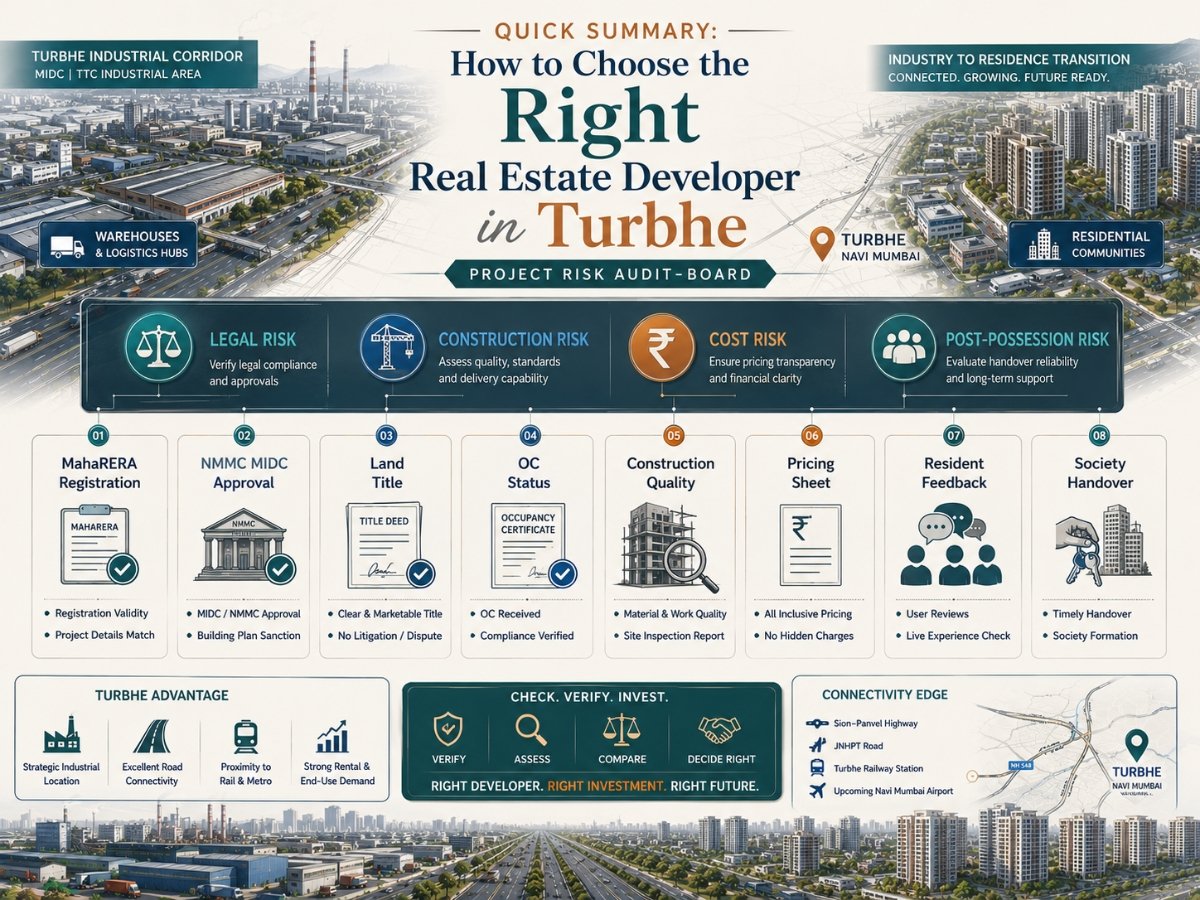
The safest way to choose a real estate developer in Turbhe is to verify legal documents, completed projects, pricing clarity, construction quality, and buyer feedback before paying token money.
| What to Check | Why It Matters in Turbhe | Good Sign | Red Flag |
|---|---|---|---|
| MahaRERA registration | Confirms project registration and disclosed timelines | Active project profile with uploaded documents | Sales team gives only verbal assurance |
| NMMC/MIDC approval | Turbhe has civic, industrial and mixed-use pockets | Clear CC and approved plan | No approval copy before booking |
| Land title | CIDCO, MIDC, PAP and leasehold issues may apply | Clean title report and transfer clarity | Unclear ownership chain |
| Completed projects | Shows real delivery quality | Older buildings are maintained well | Seepage, cracks and poor common areas |
| OC status | Legal possession depends on OC | Final OC or tower-specific OC available | Fit-out possession without OC |
| Pricing sheet | Prevents financial shock | All-inclusive written cost sheet | Hidden parking, PLC or maintenance charges |
| Local reputation | Reveals after-sales conduct | Residents speak positively | Repeated delay or corpus complaints |
A reputed developer is not always the right developer if the project has unclear approvals, delayed possession, hidden charges, poor construction quality or weak after-sales support.
Why Choosing the Right Real Estate Developer Matters in Turbhe
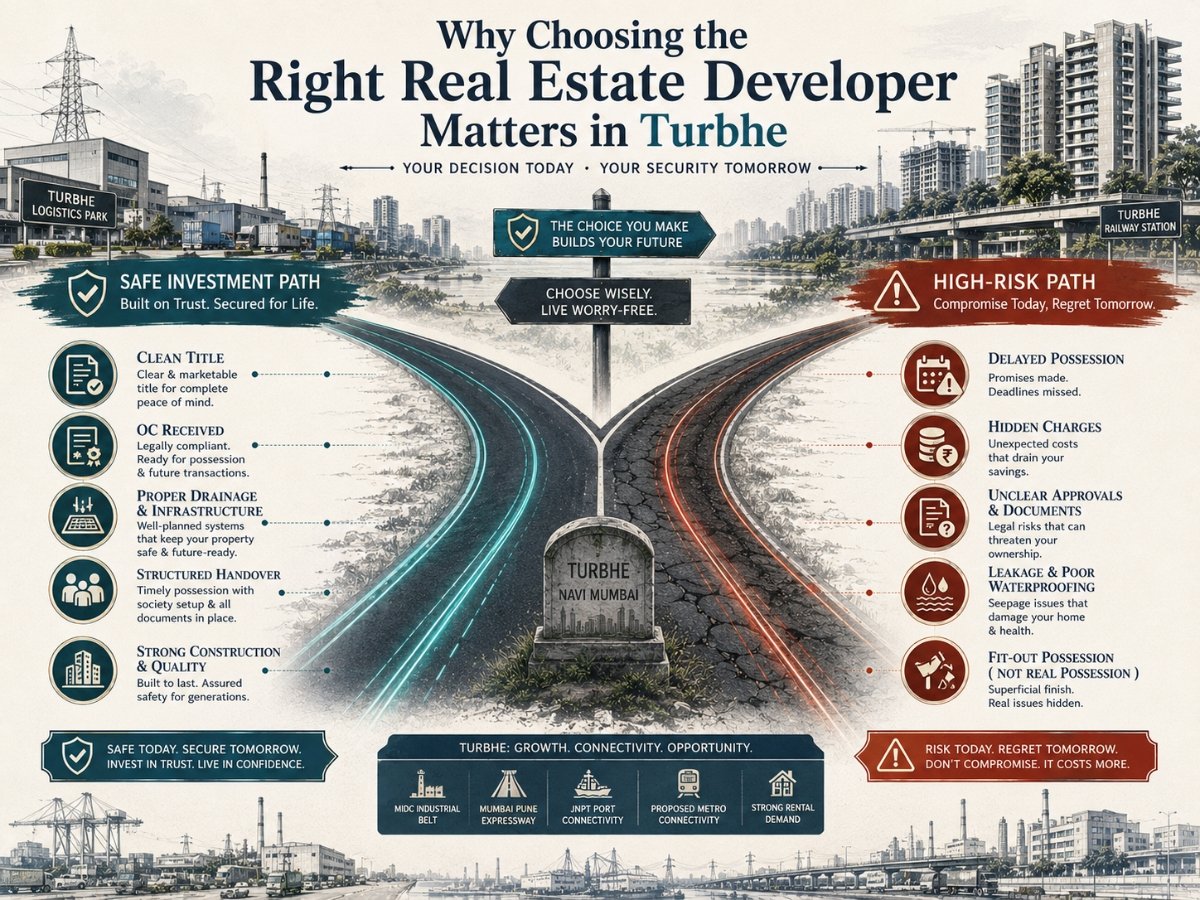
Choosing the right real estate developer in Turbhe is not only about brand name or amenities. It is a risk-management decision.
Turbhe has a different property character compared to purely residential nodes. It is influenced by:
- TTC MIDC industrial activity
- Thane-Belapur Road connectivity
- Sion-Panvel highway access
- Commercial projects and business parks
- Nearby residential demand from Sanpada, Juinagar, Ghansoli, Vashi and Mahape
- CIDCO leasehold and PAP plot history in Navi Mumbai
- NMMC civic approvals and property tax systems
- Possible MIDC-to-commercial or MIDC-to-residential land conversion issues in specific pockets
A developer who understands this local structure can manage approvals, land documentation, construction compliance and possession better. A developer who does not understand Turbhe’s legal and civic environment can leave buyers stuck between RERA timelines, authority approvals, unpaid dues, delayed OC and unclear handover.
For broader comparison, buyers can also refer to [real estate developers in Navi Mumbai](ADD INTERNAL LINK HERE) before shortlisting a Turbhe project.
Understand the Developer’s Past Track Record
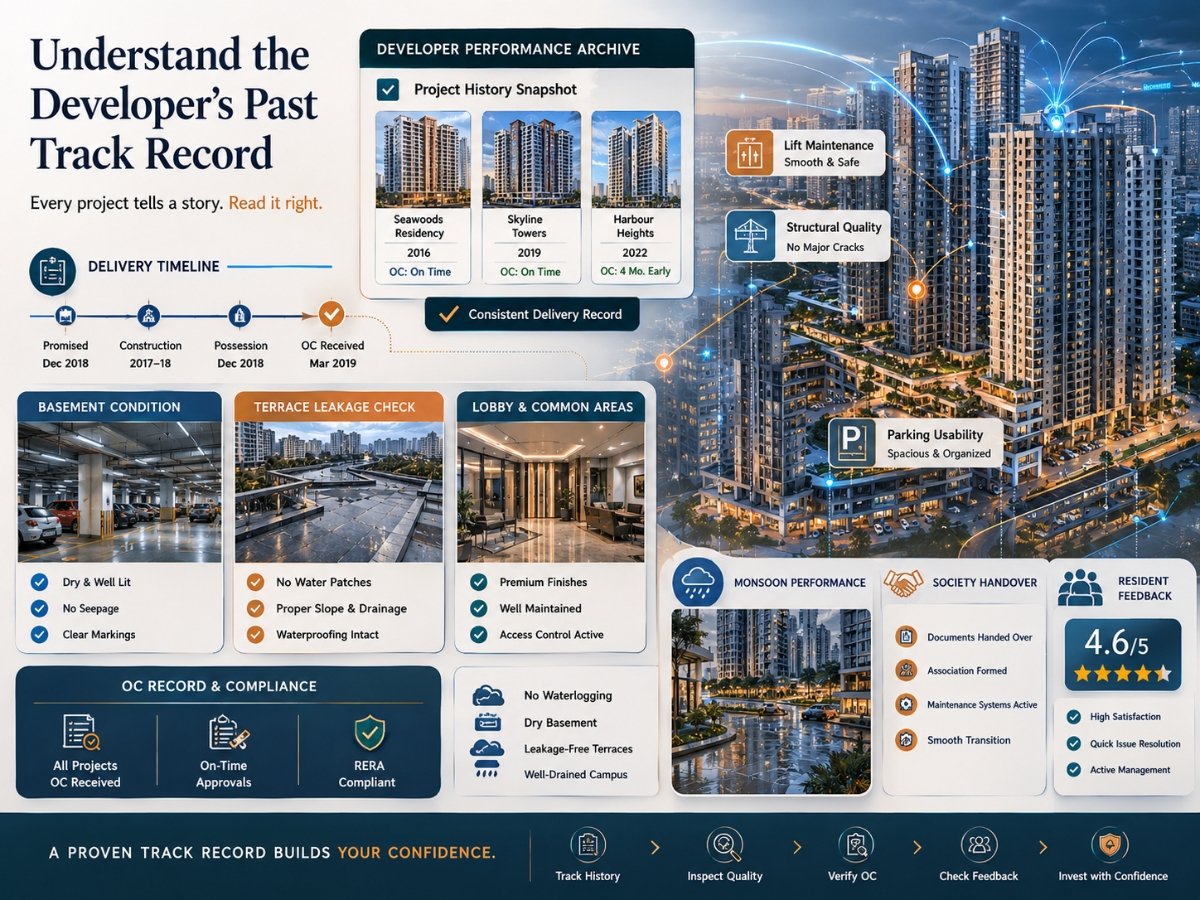
A developer’s past work is more useful than a sales brochure. In Turbhe, buyers should not judge a project only by the sample flat, launch offer or elevation image. They should check what the same developer has actually delivered in Navi Mumbai.
The most important question is simple: Has this developer successfully completed similar projects in Navi Mumbai’s legal, coastal and authority-driven environment?
Check Completed Projects Before Trusting New Launches
Under-construction projects may look attractive because of lower entry price or early-buyer offers. But they also carry higher risk. Before trusting a new launch in Turbhe, check the developer’s completed projects.
Look for:
- Whether the project was delivered close to the promised timeline
- Whether OC was received before possession
- Whether amenities promised in the brochure were actually delivered
- Whether the building looks stable after a few monsoons
- Whether residents are satisfied with maintenance and handover
A completed project is the developer’s real resume. If the older project looks neglected, the new project should be checked with extra caution.
Visit Older Buildings Developed by the Same Builder
Navi Mumbai’s monsoon and coastal humidity test construction quality very quickly. A building may look good in the first year, but seepage, dampness, paint peeling, rust marks and basement waterlogging usually appear after a few rainy seasons if workmanship is poor.
When visiting an older building by the same developer, check:
- Basement parking for water seepage
- Top floors for leakage
- External walls for cracks and damp patches
- Lift condition and maintenance
- Lobby and staircase quality
- Drainage during monsoon
- Overall society cleanliness
Do not visit only the developer’s sales office. Visit at least one 5-to-10-year-old completed building if possible.
Speak to Existing Residents and Buyers
Existing residents can tell you what the sales team will not.
Ask residents:
- Was possession delayed?
- Did the builder give OC before handover?
- Was society formed on time?
- Was maintenance corpus handed over properly?
- Were there hidden charges at possession?
- Are there leakage or structural issues?
- Does the builder respond after possession?
- Was parking allocation clear?
This one step can save lakhs of rupees and years of stress. A short conversation with residents often reveals more than a full day of online research.
Check MahaRERA Registration and Project Transparency
MahaRERA registration is important, but it should not be treated as the only proof of developer quality. It is the starting point of verification.
For any under-construction residential or commercial project in Turbhe, buyers should verify the project details on the MahaRERA website. Do not rely only on the RERA number printed on a brochure. Search the exact project name and promoter name.
Why MahaRERA Is Important for Turbhe Buyers
MahaRERA helps buyers check whether the project is officially registered, what possession timeline has been declared, what legal documents have been uploaded, and whether the developer has disclosed approvals and professionals involved in the project.
In a location like Turbhe, where NMMC, CIDCO and MIDC-related issues may overlap depending on the land, MahaRERA becomes a useful verification tool. It helps buyers ask better questions before booking.
However, MahaRERA does not automatically mean:
- The building quality will be excellent
- The developer has strong after-sales support
- The society will be formed smoothly
- CIDCO or MIDC transfer issues are fully risk-free
- The project will have no delay
It is a regulatory checkpoint, not a complete guarantee.
What to Verify on the MahaRERA Website
Before booking, check these details on the MahaRERA project profile:
| MahaRERA Detail | What Buyer Should Check |
|---|---|
| Project registration number | Match it with the exact project and tower |
| Promoter name | Ensure it matches the developer selling the project |
| Possession date | Compare with the verbal timeline given by sales team |
| Uploaded legal documents | Check title report, approvals and declarations |
| Encumbrance details | See whether any loan, charge or legal restriction is disclosed |
| Building plan approvals | Check whether approval authority is relevant to the project location |
| Litigation details | Look for disclosed legal disputes |
| Architect and engineer details | Useful for professional accountability |
| Construction status updates | Check whether progress matches site reality |
If the sales team says possession will happen in two years but the MahaRERA date is much later, plan your finances using the RERA date, not the verbal promise.
Why MahaRERA Alone Is Not Enough
MahaRERA helps with transparency, but it cannot replace physical inspection and independent legal verification.
MahaRERA may not fully protect you from:
- Poor construction quality
- Fit-out possession without OC
- Weak society handover
- Delay in conveyance
- Hidden pricing practices
- Poor maintenance after possession
- Local title problems on CIDCO or PAP land
- MIDC-related conversion complications in specific pockets
Use MahaRERA as the baseline. Then verify the legal documents, visit the site, inspect completed projects, speak to residents, and take legal advice before signing.
Check Legal Documents Before Booking a Flat
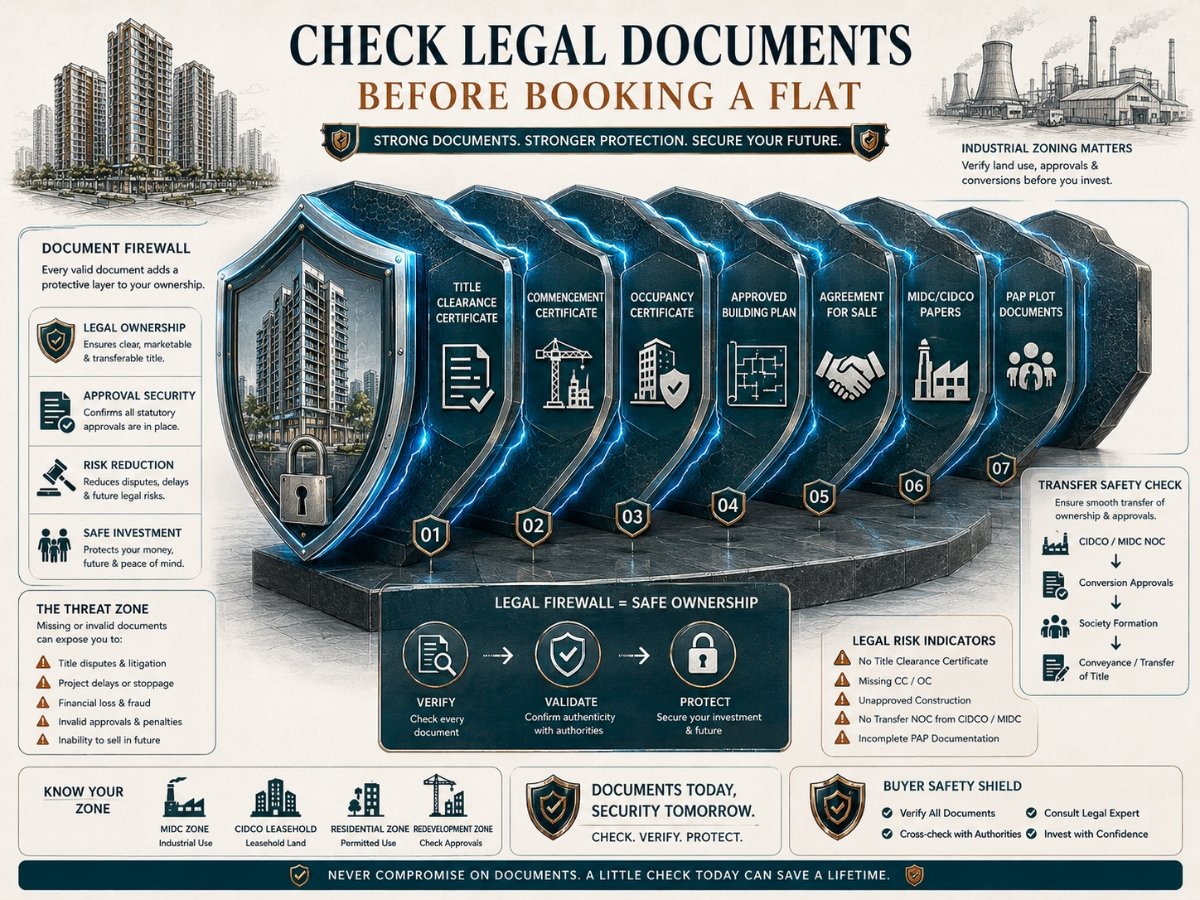
The rule is simple: No documents, no token money.
In Turbhe, legal checks matter because the property may involve NMMC approvals, CIDCO leasehold structure, PAP plot background, or MIDC-related land history depending on the exact plot and project type.
Buyers should not make payment only because the sales team says “all approvals are clear.” Ask for copies.
| Document | Why It Matters | What Buyer Should Verify |
|---|---|---|
| Title Clearance Certificate | Confirms developer’s legal right to develop and sell | Clean title chain and no serious dispute |
| Commencement Certificate | Confirms permission to start construction | Authority, date and approved floor limit |
| Occupancy Certificate | Confirms building is legally fit for occupation | Final OC or tower-specific OC for your building |
| Approved Building Plan | Shows sanctioned layout and amenities | Match brochure claims with approved plan |
| Agreement for Sale | Main buyer-builder contract | Possession date, charges, carpet area and clauses |
| CIDCO/MIDC documents | Important for leasehold or converted land | Allotment, transfer, NOC and dues clarity |
| Society/conveyance records | Shows post-handover responsibility | Developer’s past society handover history |
Title Clearance Certificate
The Title Clearance Certificate shows whether the developer has a clear legal right over the land or development rights. In Navi Mumbai, this is especially important because land may have passed through CIDCO allotment, PAP ownership, leasehold transfer, development agreement or other local arrangements.
A buyer should ask for the title report and get it reviewed by an independent property lawyer. The title chain should be clear, continuous and free from serious disputes.
Red flag: The developer refuses to share the title report before token payment.
Commencement Certificate
The Commencement Certificate, or CC, is permission to start construction. In Turbhe, it may involve NMMC or relevant authority approval depending on the land and project type.
Buyers must check:
- Who issued the CC
- What date it was issued
- How many floors are approved
- Whether the flat being sold is within the approved construction limit
Do not buy a flat on a floor that is not covered by the current CC. Future approval is not guaranteed.
Occupancy Certificate
The Occupancy Certificate, or OC, confirms that the completed building is constructed as per sanctioned plans and is fit for occupation.
In Navi Mumbai, buyers must be very careful about “fit-out possession.” Fit-out possession means the developer gives keys for interior work before final OC. This is risky.
Without OC, buyers may face:
- Unauthorized occupation issues
- Higher utility or property-related complications
- Difficulty in resale or loan transfer
- Weak legal position against the developer
- Delay in proper society formation
Fit-out possession is not the same as legal possession. Buyers should take physical possession only after OC clarity.
Approved Building Plan
The approved building plan is the authority-stamped layout of the project. It shows what has actually been sanctioned.
Compare the approved plan with:
- Brochure layout
- Parking plan
- Amenity area
- Open space
- Floor plan
- Tower configuration
- Commercial or residential use
If the brochure shows an amenity that is not in the approved plan, do not assume it will be delivered.
Agreement for Sale
The Agreement for Sale is the most important contract between the buyer and developer. It should clearly mention:
- Carpet area
- Total consideration
- Payment schedule
- Possession date
- Delay compensation
- Parking details
- Maintenance charges
- Tax and statutory costs
- Amenities and specifications
- Cancellation terms
- Society formation and conveyance responsibilities
Buyers can also read [agreement to sale vs sale deed](ADD INTERNAL LINK HERE) for better understanding before signing.
CIDCO Transfer and Leasehold Clarity
Much of Navi Mumbai has a leasehold property structure linked to CIDCO. Leasehold property is not automatically unsafe, but it must be understood clearly.
For CIDCO-origin property, buyers should check:
- Original allotment document
- Lease agreement
- CIDCO NOC where applicable
- Transfer history
- Pending transfer charges
- Tripartite agreement if applicable
- Maveja or Additional Lease Premium status where relevant
If the developer or seller cannot explain the leasehold status clearly, take legal advice before paying.
Turbhe-Specific Documents Buyers Should Check Before Booking
Turbhe needs extra caution because it is not only a residential node. It has industrial, commercial, mixed-use and developing residential characteristics. Certain plots may need deeper verification than a normal resale flat in a mature housing society.
CIDCO Allotment and Transfer Documents
For CIDCO-origin land, a registered sale deed alone may not be enough for full comfort. The buyer should understand whether CIDCO transfer or mutation has been properly completed or is required.
Ask for:
- CIDCO allotment letter
- CIDCO lease documents
- Transfer order or NOC where applicable
- Tripartite agreement where relevant
- Past transfer history
- Proof of paid authority dues, if applicable
A missing CIDCO transfer link can create resale and ownership complications later.
PAP Plot or 12.5% Scheme Plot Clarity
In Navi Mumbai, many plots are connected to the 12.5% PAP scheme, where land was allotted to original project-affected persons. These plots can be valid and valuable, but they need careful legal verification.
For PAP or 12.5% scheme plots, check:
- Original allottee details
- Heirship clarity
- Development agreement with builder
- CIDCO approvals
- Pending dues or premiums
- Whether any family dispute exists
- Whether the developer has proper development rights
Do not assume that a 12.5% plot is unsafe. The real question is whether the documentation is complete and legally clean.
NMMC, PMC or CIDCO Approval Relevance
Turbhe falls under Navi Mumbai Municipal Corporation for civic administration. However, because of Navi Mumbai’s planning history and industrial land pockets, buyers may also see CIDCO or MIDC-related references depending on the project.
For Turbhe buyers, the practical question is:
Which authority controls this specific approval, land use, tax or transfer issue?
Usually:
- NMMC is relevant for civic approvals, property tax and municipal matters
- CIDCO may be relevant for leasehold, allotment and transfer history
- MIDC may be relevant in industrial or converted land pockets
- PMC is not normally the key authority for Turbhe, but may appear in broader Navi Mumbai-Panvel comparisons
Buyers should ask the developer to clearly explain which authority has approved what.
Society Formation and Conveyance Status
A good developer’s responsibility does not end when keys are given. Society formation, conveyance and maintenance handover are equally important.
Before buying, check the developer’s past record on:
- Timely society formation
- Maintenance corpus handover
- Conveyance or deemed conveyance cooperation
- Parking handover clarity
- Facility management transition
- Resident communication after possession
Weak society handover can create years of conflict between residents and the developer.
Compare Construction Quality and Actual Site Progress
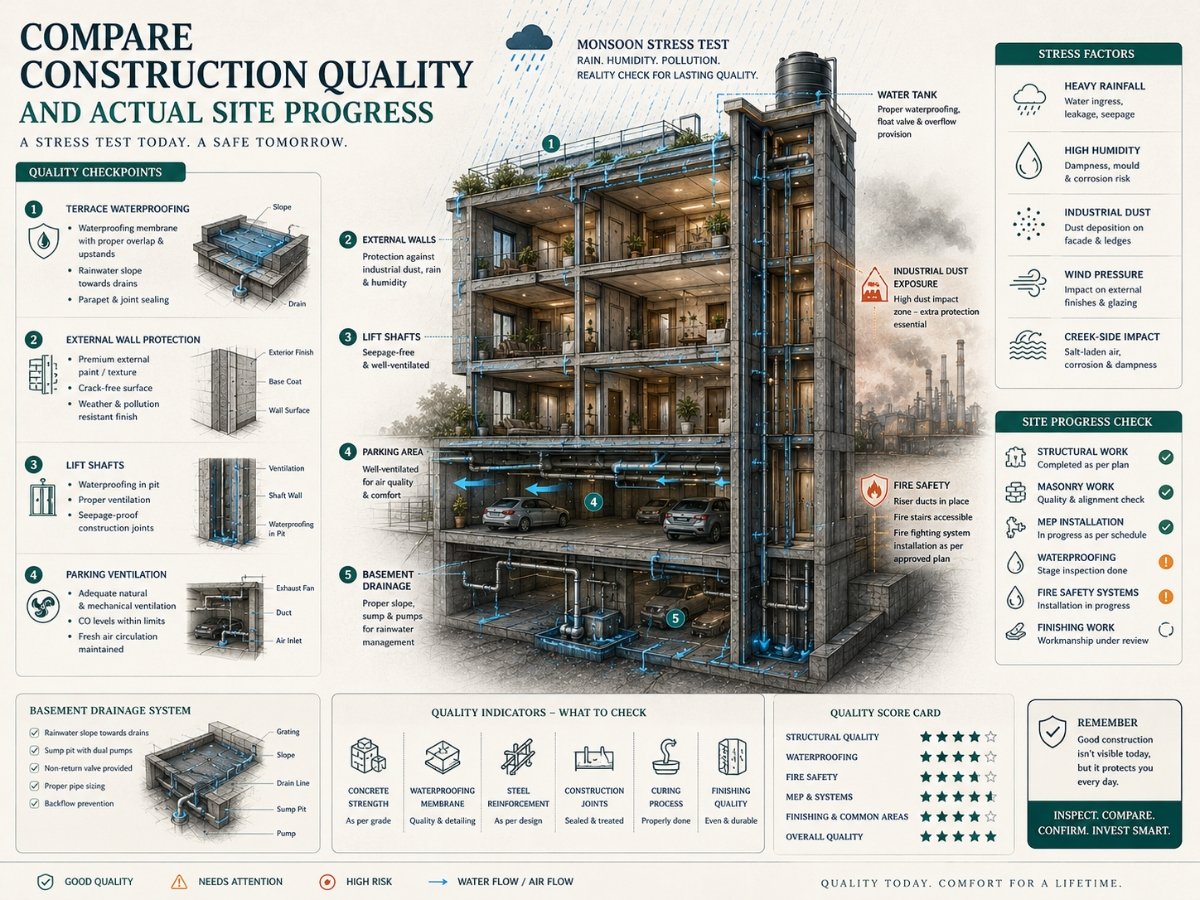
The construction site reveals the truth. A good sales office can hide risk, but the actual site shows pace, discipline and seriousness.
In Turbhe, buyers should also observe the surrounding environment. Some pockets are closer to industrial activity, heavy truck movement, dust and commercial traffic. That may not be a deal-breaker for every buyer, but it must be understood before booking.
Visit the Actual Construction Site
During the site visit, do not look only at the view from the sample flat. Walk around the project.
Check:
- Construction pace compared to promised timeline
- Number of workers and site activity
- Material storage quality
- Safety standards
- Road access
- Drainage around the plot
- Dust-control measures such as green netting, sprinklers or fogging where required
- Proximity to active industrial units
- Traffic and truck movement during working hours
A slow or poorly managed site may indicate future delay.
Compare Sample Flat and Real Flat Specifications
Sample flats are designed to look better than normal delivered flats. They may use better lighting, premium fittings, smaller furniture, missing doors, mirrors and design tricks to make the space look larger.
Before booking, compare the sample flat with the written specification sheet.
Check:
- Flooring brand or type
- Door quality
- Window system
- Bathroom fittings
- Kitchen platform
- Electrical points
- Ceiling height
- Wall finish
- Balcony and utility area
- Actual carpet area
Only written specifications in the agreement matter.
Check Lift, Lobby, Parking and Common Area Quality
Buyers often focus too much on the flat and ignore the building. But daily life depends heavily on lifts, parking, lobby, access, security and common areas.
Check:
- Number of lifts per tower
- Lift brand and capacity
- Basement ramp width
- Parking turning radius
- Fire exit quality
- Lobby finish
- Staircase ventilation
- Refuge area maintenance
- Security cabin placement
- Visitor parking availability
Tight parking and weak common areas reduce daily comfort and resale value.
Check Monsoon Performance and Leakage Issues
Navi Mumbai’s monsoon is a serious construction test. Poor waterproofing usually appears as leakage, dampness, paint bubbling, seepage and basement waterlogging.
When visiting older projects, check:
- Terrace leakage
- External wall dampness
- Basement watermarks
- Rust marks near beams or columns
- Lift shaft dampness
- Parking waterlogging
- Cracks near windows
- Plumbing shaft seepage
If possible, visit during or soon after the rainy season. It gives a more honest picture.
Understand Pricing, Hidden Charges and Payment Terms
In real estate, the advertised price is rarely the final cost. Turbhe buyers must ask for the full cost before deciding.
The total cost may include:
- Base flat cost
- GST for under-construction property, where applicable
- Stamp duty
- Registration fee
- Metro Cess where applicable
- Parking charges
- Floor-rise charges
- Preferential Location Charges
- Advance maintenance
- Corpus fund
- Clubhouse charges
- Infrastructure charges
- Legal and documentation charges
- Utility connection charges
Do not compare developers only on base rate. Compare the final all-inclusive cost.
Ask for an All-Inclusive Cost Sheet
Before paying token money, ask for a written all-inclusive cost sheet.
It should clearly mention:
- Flat number and floor
- Carpet area
- Base price
- Floor-rise charges
- PLC
- Parking cost
- GST
- Stamp duty estimate
- Registration fee
- Maintenance deposit
- Corpus fund
- Club charges
- Possession charges
- Any other charge
If the developer says “we will tell you later,” that is not a good sign.
Check Parking, Floor-Rise, PLC and Maintenance Charges
Parking, floor-rise and PLC can increase the final cost significantly.
Ask these questions:
- Is parking included or charged separately?
- Is the parking open, stilt, podium or basement?
- Is the parking slot written in the agreement or allotment letter?
- From which floor does floor-rise start?
- How is PLC calculated?
- Is advance maintenance for 1 year or 2 years?
- Who holds the maintenance corpus?
- When will corpus be transferred to the society?
In Navi Mumbai projects, covered parking can add a substantial amount depending on project type and location. Buyers should verify the exact amount from the written cost sheet.
Understand GST, Stamp Duty and Registration Cost
Government charges are a major part of the final cost. These charges can change based on rules, property value, buyer category and whether the property is under-construction or OC received.
Buyers should verify the latest applicable charges before registration.
As per the research dossier, buyers should account for:
| Cost Component | What Buyer Should Know |
|---|---|
| Stamp duty | Varies by buyer category and current Maharashtra rules |
| Metro Cess | May apply as an additional cost in the MMR region |
| Registration fee | Usually separate from stamp duty |
| GST | Applies to under-construction property; OC-ready resale property is generally treated differently |
| Legal/documentation cost | Should be confirmed in writing |
| Maintenance/corpus | Must be shown in cost sheet |
Use a [stamp duty calculator](ADD INTERNAL LINK HERE) and verify with the official registration or legal professional before planning the final budget.
Avoid Verbal Price Commitments
In property buying, verbal promises are dangerous.
Common verbal promises include:
- “Parking is free”
- “Floor-rise will be waived”
- “GST is included”
- “Possession will be earlier”
- “OC is almost done”
- “Clubhouse will be ready soon”
- “This charge will not apply to you”
If it is not written, do not rely on it.
Every waiver, discount, parking detail, possession commitment and amenity promise should be written in the booking form, cost sheet and agreement wherever applicable.
Check Developer Reputation Beyond Online Reviews
Online reviews are useful, but they are not enough. Some reviews may be written by early visitors, sales leads or marketing teams. Buyers should read reviews carefully and combine them with offline checks.
Read Google Reviews Carefully
Do not only look at star ratings. Read the content of reviews.
Search for words like:
- Delay
- OC
- Possession
- Leakage
- Parking
- Maintenance
- Hidden charges
- Society
- Corpus
- Builder response
- CRM
- Refund
A five-star review saying “sales staff is polite” is less useful than a three-star review explaining the actual handover experience.
Look for Repeated Complaint Patterns
One complaint may be an isolated case. Repeated complaints across multiple projects are more serious.
Watch for repeated patterns such as:
- Delayed possession
- Poor after-sales service
- Corpus not handed over
- Society formation delay
- Seepage in multiple projects
- Hidden charges appearing late
- OC delay
- Poor parking allocation
If different buyers in different projects mention the same issue, treat it as a serious warning.
Speak to Local Brokers and Residents
Local brokers, residents and society committee members often know the developer’s actual market reputation.
Ask local brokers:
- Does this developer pay vendors and brokers on time?
- Are their projects usually delayed?
- Is the title generally clean?
- Do buyers face refund issues?
- Are they known for OC or society handover problems?
For professional help, buyers can also compare [real estate agents in Turbhe](ADD INTERNAL LINK HERE) and [real estate agents in Navi Mumbai](ADD INTERNAL LINK HERE).
Check Litigation or Delay History Where Possible
If you are buying a high-value flat or under-construction property, check whether the developer has a serious litigation or delay history.
Buyers can search:
- MahaRERA project records
- MahaRERA orders where available
- Public legal databases
- Consumer complaint platforms
- News reports
- Society-level disputes
Do not panic if a large developer has a minor complaint somewhere. The real concern is repeated, serious, unresolved litigation affecting title, possession or construction.
Big Builder vs Local Builder: Which Is Better in Turbhe?
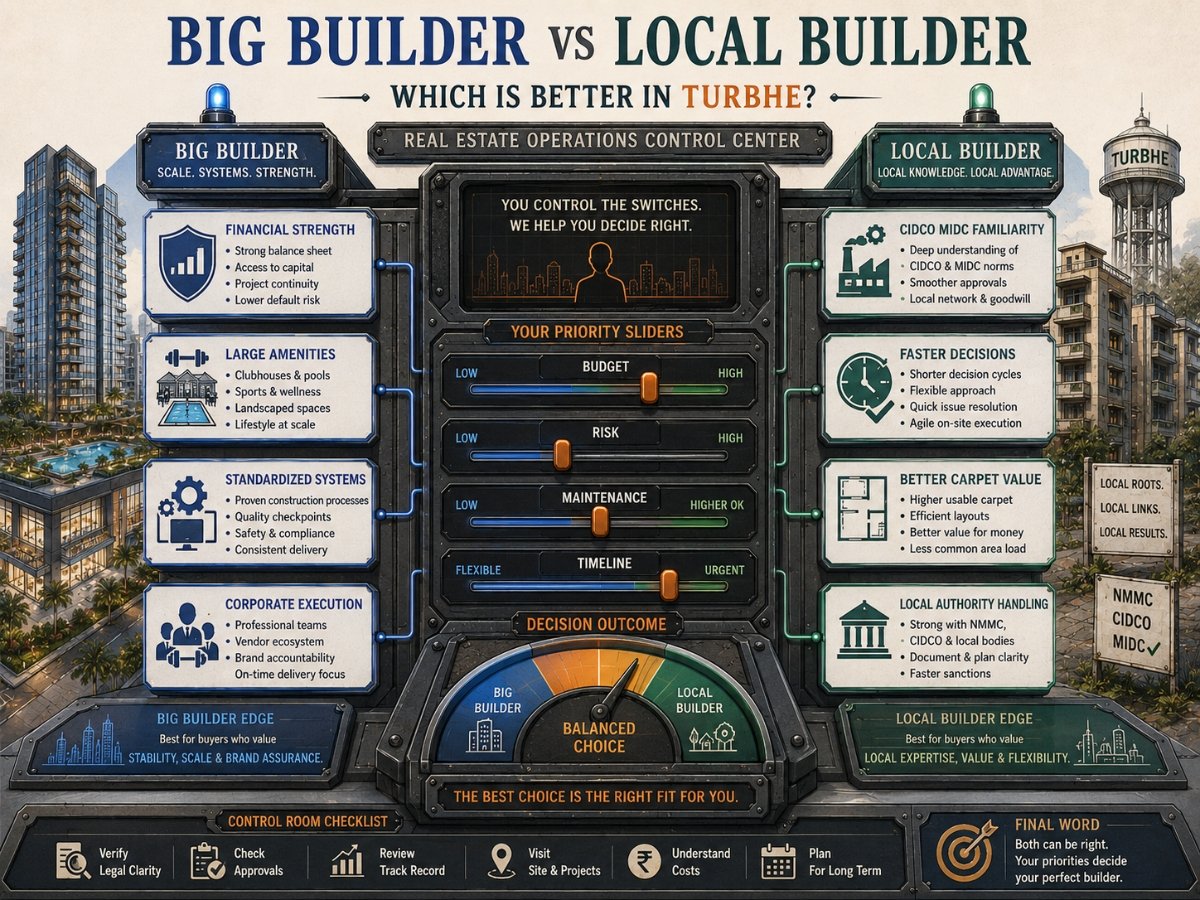
There is no universal answer. A big builder is not always safer, and a local developer is not automatically risky.
The right choice depends on the project size, land type, approval complexity, construction stage, buyer budget and the developer’s actual track record.
| Factor | Big Builder | Local Turbhe/Navi Mumbai Developer | Buyer Decision Point |
|---|---|---|---|
| Financial strength | Usually stronger | Varies by developer | Prefer big builder for very large projects |
| Local approval knowledge | Structured but sometimes rigid | Often stronger in CIDCO/NMMC local processes | Local expertise matters in PAP or leasehold cases |
| Pricing | Usually higher | Often more value-driven | Compare final carpet-area cost |
| Amenities | More standardized | Practical but may vary | Check written amenity commitment |
| Flexibility | Lower | Higher in many cases | Useful for documentation and negotiation |
| Risk | Lower stall risk if financially strong | Depends on cash flow and project scale | Check construction progress and RERA |
| Best fit in Turbhe | Large commercial or mixed-use projects | Standalone buildings, local residential projects, CIDCO/PAP familiarity | Choose based on specific project, not brand image |
Advantages of Big Real Estate Developers
Big developers may offer:
- Stronger financial capacity
- Better project management systems
- More organized documentation
- Standardized amenities
- Better resale perception
- Professional facility management
- Lower risk of complete project abandonment
They are often safer for large projects that need long-term capital and multi-phase execution.
But buyers may pay a brand premium and may get smaller carpet area for the same budget.
Advantages of Local Turbhe Developers
Good local developers can offer:
- Better knowledge of CIDCO and NMMC processes
- Stronger local authority familiarity
- Practical apartment layouts
- Better carpet-area value
- Faster response in smaller projects
- Familiarity with local landowners, PAP plots and leasehold transfer processes
A reputed local developer can be a strong choice if the title is clean, project progress is visible, and past buildings are well maintained.
When a Smaller Developer Can Be a Better Choice
A smaller developer can be a better choice when:
- The project is a standalone tower
- Construction is already at an advanced stage
- Legal documents are transparent
- Past projects are nearby and inspectable
- The cost is more practical
- The developer has a clean local reputation
- OC and society handover track record is good
Do not reject a smaller developer only because the brand is not national. But verify more deeply.
When a Big Brand May Still Be Safer
A big brand may be safer when:
- The project is very large
- Multiple towers or phases are involved
- Large infrastructure investment is required
- The project is in an early-stage growth location
- The buyer wants stronger resale brand comfort
- The buyer is less comfortable with local legal complexity
Even with a big brand, buyers must verify title, CC, OC, pricing and possession timeline.
Check Location Fit Before Choosing the Developer
A good developer cannot fully fix a poor location fit. Turbhe buyers must check whether the project’s micro-location suits their actual lifestyle or investment goal.
Turbhe can be suitable for people who want access to:
- TTC industrial belt
- Mahape and Millennium Business Park side employment
- Vashi and Sanpada connectivity
- Thane-Belapur Road
- Sion-Panvel highway
- Commercial and industrial work zones
But buyers seeking quiet, purely residential surroundings should compare the exact pocket carefully.
Mature Nodes Like Vashi, Sanpada, Kopar Khairane and Nerul
Nearby mature nodes such as Vashi, Sanpada, Kopar Khairane and Nerul usually offer stronger social infrastructure, better residential comfort, established societies, schools, hospitals and daily convenience.
These nodes may be more expensive, but they generally provide more stable end-use comfort.
Buyers comparing Turbhe with these areas should ask:
- Am I buying for end-use or investment?
- Do I need peaceful family living?
- Is my workplace closer to Turbhe or Mahape?
- Is the price difference worth the trade-off?
- Is the developer quality compensating for location limitations?
For wider comparison, read [Navi Mumbai property investment guide](ADD INTERNAL LINK HERE).
Growth Nodes Like Mahape, Ghansoli, Juinagar, Ulwe and Panvel
Growth locations such as Mahape, Ghansoli, Juinagar, Ulwe and Panvel may attract different buyer profiles.
- Mahape is more employment and business-zone influenced
- Ghansoli has stronger residential growth and rail connectivity
- Juinagar has improving connectivity and redevelopment relevance
- Ulwe and Panvel are driven more by airport and infrastructure-led growth
- Turbhe sits between commercial utility and residential transition
Growth locations can give appreciation potential, but they also need patience and careful developer selection.
Why Location Quality and Developer Quality Must Be Checked Together
A strong developer in a weak micro-location may still struggle to give good resale value. A good location with a weak developer can create legal and possession stress.
Check both together:
| Location Factor | Developer Factor |
|---|---|
| Connectivity | Delivery record |
| Pollution and traffic | Construction quality |
| Social infrastructure | OC and CC clarity |
| Zoning and land use | Legal transparency |
| Resale demand | After-sales support |
| Nearby employment | Pricing clarity |
The best decision is not just “best builder” or “best location.” It is the best combination of builder, location, legal clarity and price.
Questions to Ask a Developer Before Paying Token Money
Before paying even a small token amount, ask direct questions and demand written proof.
| Question | Why It Matters | Proof to Ask For |
|---|---|---|
| Is the project registered on MahaRERA? | Confirms regulatory registration | MahaRERA number and project profile |
| Can you share the approved plan, CC and legal documents? | Confirms legal permission | NMMC/MIDC CC, approved plan, title report |
| Is the quoted price fully all-inclusive? | Prevents hidden charges | Signed itemized cost sheet |
| What is the written possession timeline? | Avoids verbal confusion | MahaRERA possession date and agreement clause |
| What happens if possession is delayed? | Defines buyer compensation | Delay interest clause in agreement |
| Is the OC already received or expected later? | Determines legal possession status | OC copy or written OC timeline |
| Is the land freehold, CIDCO leasehold or MIDC-related? | Identifies legal complexity | Title report and allotment/lease documents |
| Are parking and amenities written? | Avoids handover disputes | Parking allotment and amenity annexure |
Is the Project Registered on MahaRERA?
Ask for the exact MahaRERA registration number. Search the project yourself. Match tower name, promoter name, address and possession date.
Can You Share the Approved Plan, CC and Legal Documents?
Do not accept “everything is clear” as an answer. Ask for documents before payment.
Is the Quoted Price Fully All-Inclusive?
The cost sheet should clearly show every charge. If the sales team avoids written clarity, slow down.
What Is the Written Possession Timeline?
Trust the written timeline, not the sales pitch. Your rent, EMI and moving plans should be based on written dates.
What Happens If Possession Is Delayed?
Check the delay compensation clause in the Agreement for Sale. Do not assume compensation will be automatic unless it is legally applicable and properly documented.
Is the OC Already Received or Expected Later?
For ready-to-move property, ask for the OC copy. For under-construction property, ask when OC is expected and whether possession will be offered only after OC.
Red Flags When Choosing a Real Estate Developer in Turbhe
| Red Flag | What It May Mean | What Buyer Should Do |
|---|---|---|
| Pressure to pay token money quickly | Sales urgency may be hiding weak documents | Do not pay without document review |
| No written clarity on charges | Hidden costs may appear later | Ask for signed all-inclusive cost sheet |
| Delayed older projects | Your project may also face delays | Check MahaRERA and resident feedback |
| Poor maintenance in completed buildings | Weak construction or weak handover culture | Visit older projects before booking |
| Weak legal transparency | Title or approval issue may exist | Demand title, CC and approved plan |
| Too many verbal promises | Promises may not be legally enforceable | Put everything in writing |
| Fit-out possession without OC | Legal possession may not be complete | Refuse handover without OC clarity |
| Vague land status | CIDCO/MIDC/PAP complexity may be hidden | Get legal verification |
| Unclear parking | Future parking dispute possible | Get parking details in writing |
| Repeated bad reviews | Systemic developer issue | Compare other projects |
Pressure to Pay Token Money Quickly
If the developer says the offer is valid only today, be careful. A genuine property decision should allow basic legal review.
No Written Clarity on Charges
If the cost sheet is vague, do not proceed. Hidden charges can disturb loan planning and total budget.
Delayed Older Projects
If the developer’s previous projects were delayed by years, assume delay risk in the current project too.
Poor Maintenance in Completed Buildings
Bad lifts, dirty lobbies, seepage and ignored repairs show what your building may look like later.
Weak Legal Transparency
A good developer shares basic documents confidently. A weak developer delays, avoids or pushes for payment first.
Too Many Verbal Promises
Verbal promises are one of the biggest causes of buyer disputes. Written proof is the only safe route.
Real Estate Developer Shortlisting Scorecard
Use this scorecard to compare two or three developers before deciding.
| Factor | What to Check | Good Sign | Red Flag |
|---|---|---|---|
| Past Delivery Record | Completed projects and timelines | On-time or near on-time delivery | Repeated extensions |
| Legal Transparency | CC, title, approved plan, agreement | Documents shared before token | Documents shown only after payment |
| Construction Quality | Older buildings and monsoon performance | Clean structure, no major seepage | Cracks, dampness, rust, poor repairs |
| Pricing Clarity | All-inclusive cost sheet | Every charge shown clearly | Parking, PLC, GST hidden |
| Location Suitability | Exact Turbhe pocket and surroundings | Good access and acceptable environment | Industrial disturbance ignored |
| After-Sales Support | Resident experience after booking | Responsive CRM and handover | No response after payment |
| Buyer Feedback Pattern | Reviews and resident comments | Similar positive feedback | Repeated OC, delay or maintenance complaints |
A developer scoring well on legal transparency but poorly on construction quality is still risky. A developer with strong construction but unclear title is also risky. The final decision should balance all factors.
Common Mistakes Buyers Make While Choosing Builders in Turbhe
Trusting Only Brand Name
Brand name helps, but it is not enough. Even reputed developers can have project-level issues. Always check the exact project, not only the company logo.
Ignoring Legal Document Verification
Many buyers rely only on bank loan approval. Bank checks protect the bank’s loan, not every long-term buyer risk. Independent legal review is still important.
Booking Only Because of Discount or Offer
Festival offers, free gifts and limited-period discounts can distract buyers from real issues like CC, OC, carpet area, parking and possession timeline.
Not Visiting Completed Projects
This is one of the biggest mistakes. A completed project shows how the developer behaves after taking money and handing over flats.
Depending Fully on Broker or Sales Team Promises
Brokers and sales teams may be useful, but their words must be backed by documents. Verify everything independently.
How to Verify a Real Estate Developer Before Final Decision
Step 1: Check MahaRERA Details
Search the exact project on MahaRERA. Verify registration, possession date, uploaded documents, promoter details and litigation disclosures if any.
Step 2: Visit the Project Site
Visit the actual site. Check construction pace, access road, site discipline, dust control, drainage, safety and surrounding land use.
Step 3: Visit Completed Projects
Inspect older completed projects by the same developer in Navi Mumbai. Look for seepage, cracks, maintenance quality, parking comfort and resident satisfaction.
Step 4: Review Legal Documents with an Expert
Hire a property lawyer to check title, CC, approved plan, Agreement for Sale, CIDCO transfer documents, PAP clarity or MIDC-related documents where applicable.
Step 5: Compare Total Cost with Other Projects
Do not compare only base price. Compare final all-inclusive cost, carpet area, taxes, parking, PLC, maintenance and possession-linked payments.
Step 6: Take Final Decision Only After Written Clarity
Pay token money only after written clarity on price, documents, possession, parking, amenities, OC, refund terms and agreement clauses.
Final Checklist Before Choosing a Real Estate Developer in Turbhe
Use this checklist before making payment:
- [ ] MahaRERA registration number checked on the official portal
- [ ] Promoter name and project details verified
- [ ] MahaRERA possession timeline checked
- [ ] Litigation or extension history checked where available
- [ ] Commencement Certificate reviewed
- [ ] Approved building plan reviewed
- [ ] OC checked for ready-to-move property
- [ ] CIDCO leasehold or freehold status understood
- [ ] CIDCO transfer documents checked where applicable
- [ ] PAP or 12.5% plot documents verified, if relevant
- [ ] MIDC-related land or conversion documents checked, if relevant
- [ ] Title Clearance Certificate reviewed by a lawyer
- [ ] Agreement for Sale reviewed before signing
- [ ] Written all-inclusive cost sheet received
- [ ] Parking allocation written clearly
- [ ] GST, stamp duty and registration costs calculated
- [ ] Completed project visited
- [ ] Existing residents or buyers spoken to
- [ ] Site progress physically checked
- [ ] Dust, traffic and environmental conditions checked
- [ ] No verbal promises accepted without written proof
- [ ] Final payment linked to legal possession and OC clarity
Conclusion
Choosing the right real estate developer in Turbhe requires more than comparing brochures, amenities and launch offers. Buyers must verify the developer’s past delivery record, MahaRERA profile, legal documents, CC, OC, land title, pricing sheet, construction quality, resident feedback and society handover history.
Turbhe is a useful but complex micro-market. It offers strong connectivity and commercial relevance, but it also carries industrial, legal, approval and environmental considerations that buyers should not ignore. The safest developer is not always the biggest name. The safest developer is the one with clean documents, visible construction progress, transparent pricing, completed projects, good resident feedback and written commitments.
Before paying token money, remember one practical rule: if the developer cannot give document clarity, price clarity and possession clarity in writing, the buyer should not rush.
FAQs
Frequently asked questions